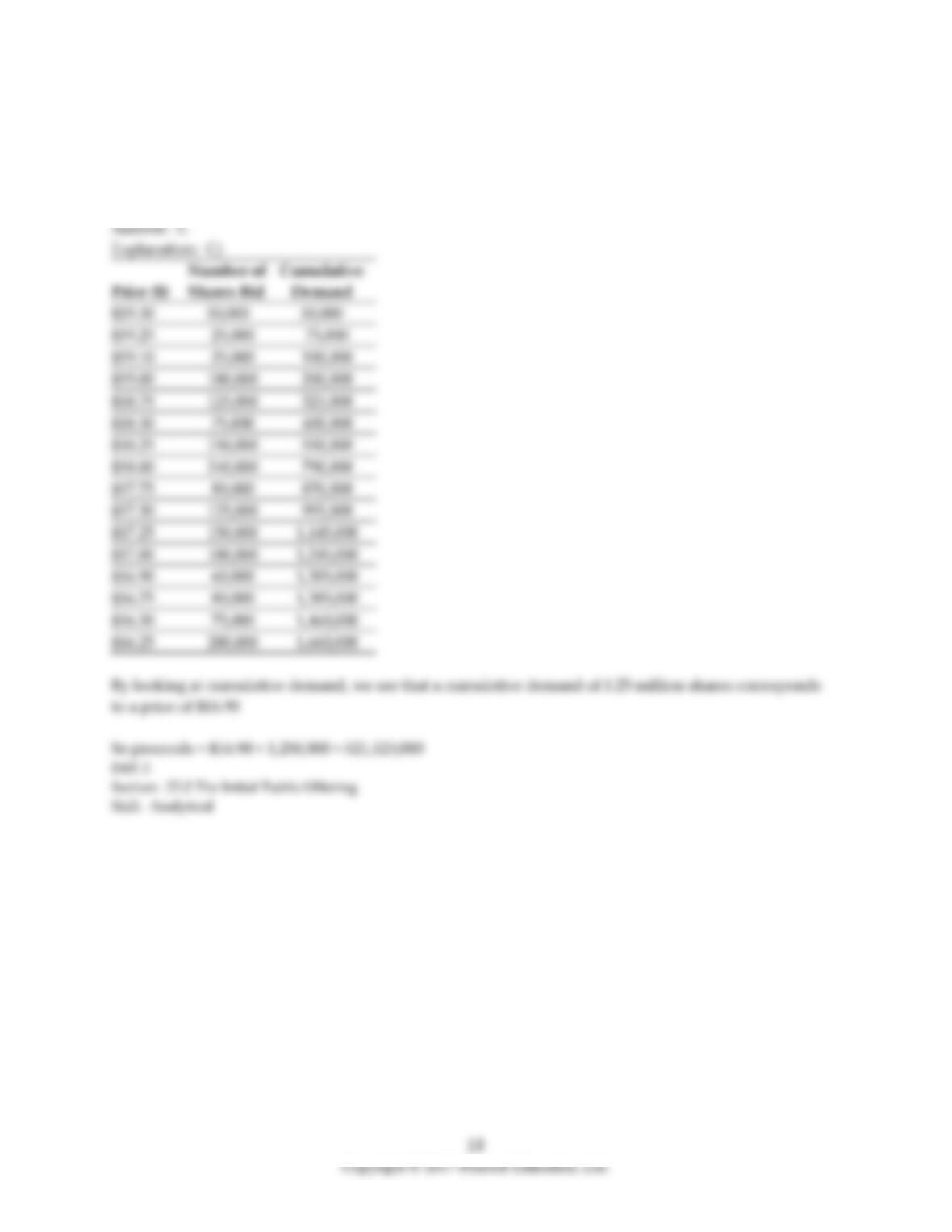
14) The proceeds from the IPO if Luther is selling 1.25 million shares is closest to:
A) $20.6 million
B) $21.6 million
C) $21.1 million
D) $20.9 million
14
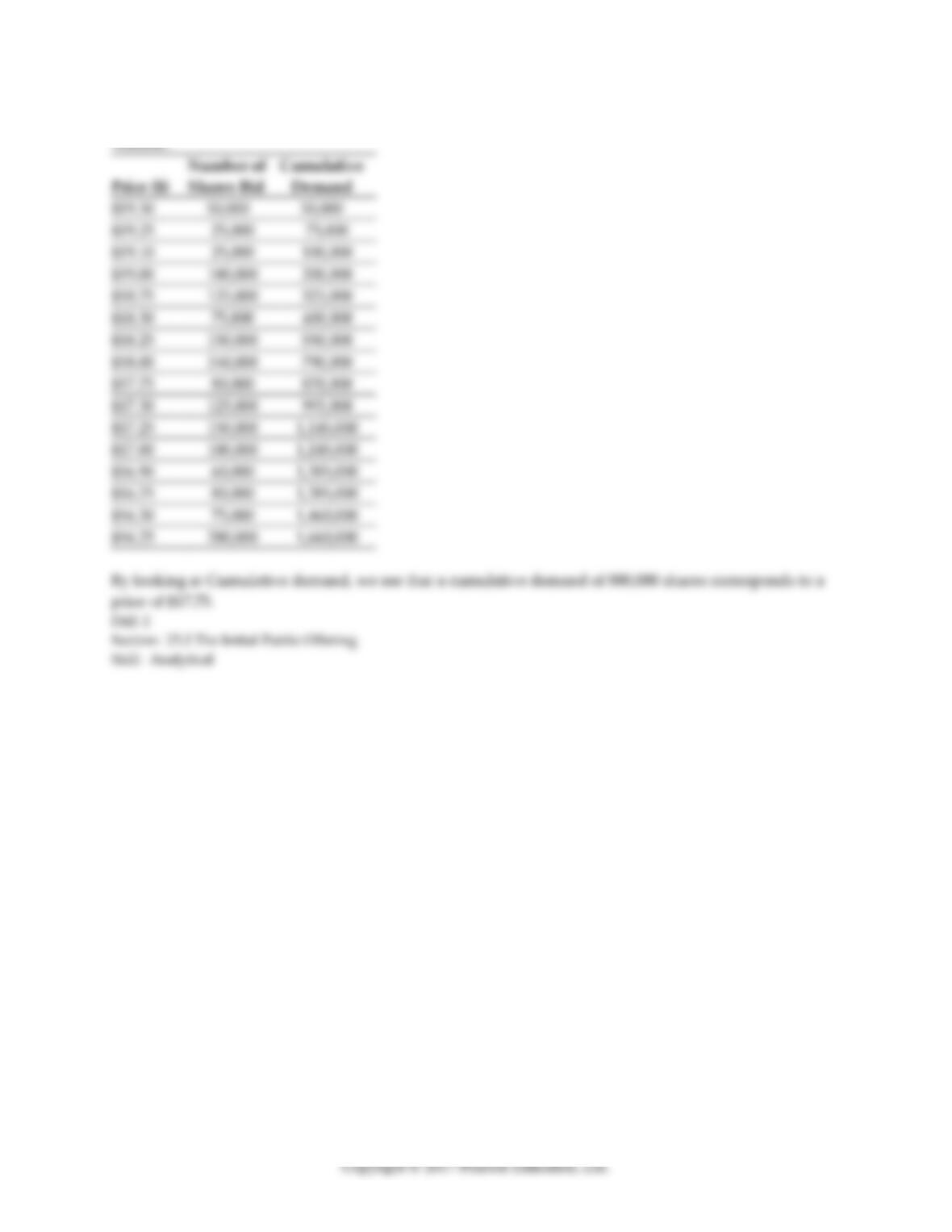
15) What will the offer price of these shares be if Luther is selling 800,000 shares?
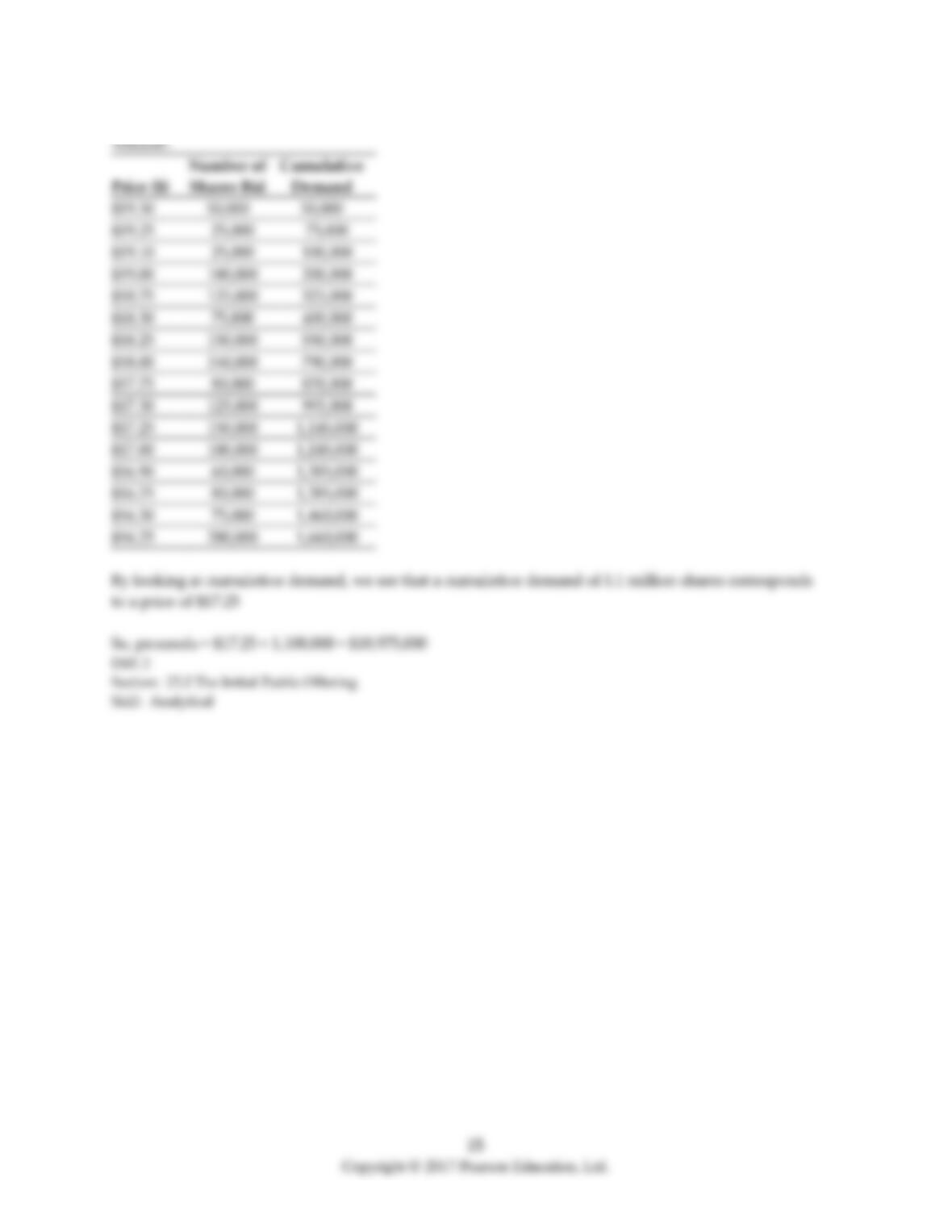
16) What will the proceeds from the IPO be if Luther is selling 1.1 million shares?
Use the information for the question(s) below.
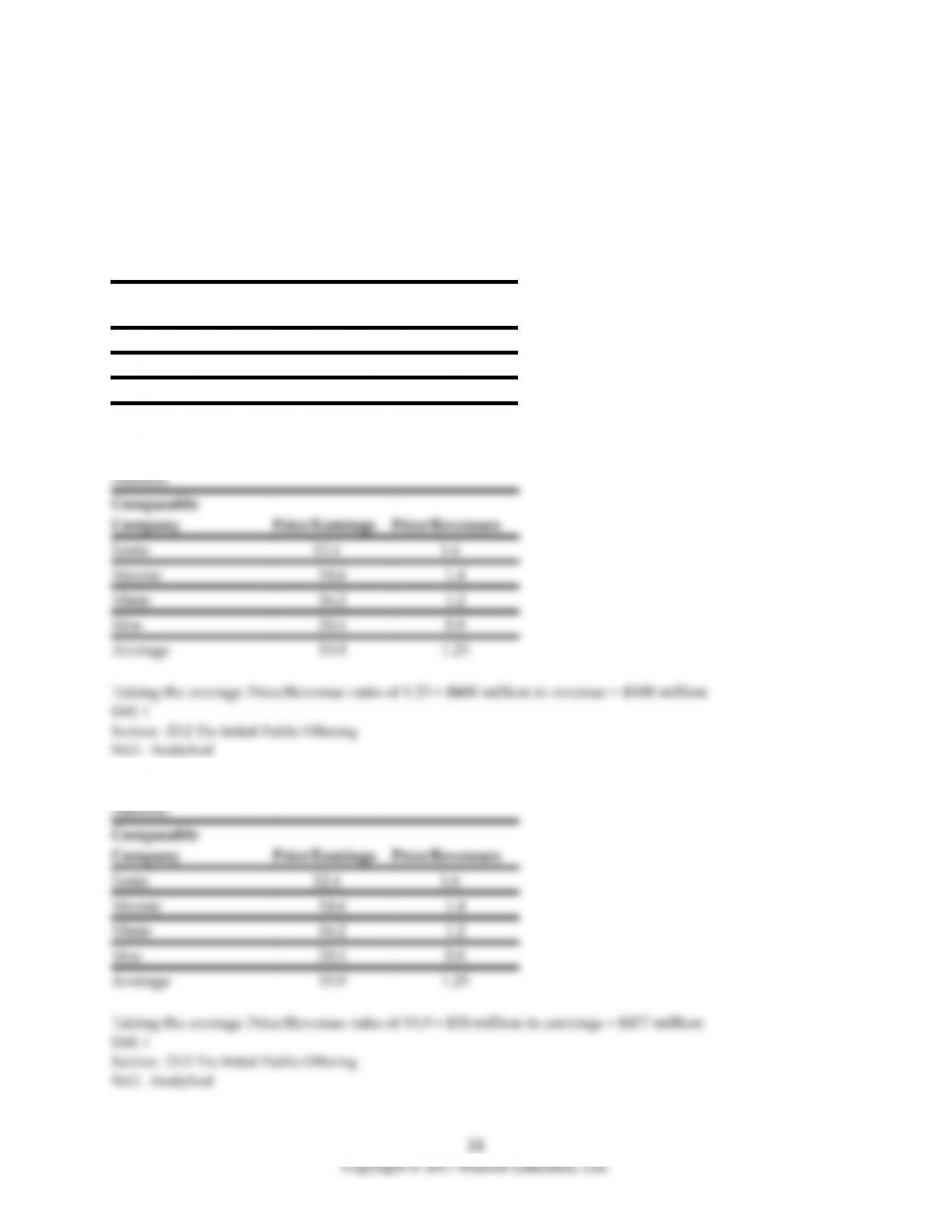
During the most recent fiscal year, KD Industries had revenues of $400 million and earnings of $30
million. KD has filed a registration statement with the SEC for its IPO. Before it is offered, KD’s
investment bankers would like to estimate the value of the company using comparable companies. The
investment bankers have assembled the following information based on data for other companies in the
same industry that have recently gone public. In each case, the ratios are based upon the IPO price.
Comparable
Company
Price/Earnings
Price/Revenues
Eenie
12.4
1.6
Meenie
14.6
1.4
Minie
16.2
1.2
Moe
20.4
0.8
17) Based upon the price/revenue ratio, what would be a reasonable value for KD?
Comparable
Company
Price/Earnings
Price/Revenues
Eenie
12.4
1.6
Meenie
14.6
1.4
Minie
16.2
1.2
Moe
20.4
0.8
Average
15.9
1.25
Taking the average Price/Revenue ratio of 1.25 × $400 million in revenue = $500 million
Diff: 1
Section: 23.2 The Initial Public Offering
Skill: Analytical
18) Based upon the price/earnings ratio, what would be a reasonable value for KD?
Comparable
Company
Price/Earnings
Price/Revenues
Eenie
12.4
1.6
Meenie
14.6
1.4
Minie
16.2
1.2
Moe
20.4
0.8
Average
15.9
1.25
Taking the average Price/Revenue ratio of 15.9 × $30 million in earnings = $477 million
Diff: 1
Section: 23.2 The Initial Public Offering
Skill: Analytical
19) Describe the four characteristics of IPOs that puzzle financial economists.
20) When referring to IPOs, what is book building?
23.3 IPO Puzzles
Use the following information to answer the question(s) below.
Wyatt Oil has 8 million shares outstanding and is about to issue 10 million new shares in an IPO. The
IPO price has been set at $15 per share, and the underwriting spread is 6%. The IPO is a big success with
investors, and the share price rises to $35 the first day of trading.
1) The amount that Wyatt Oil raised during the IPO is closest to:
A) $113 million
B) $141 million
C) $150 million
D) $329 million
E) $350 million
2) The amount that Wyatt Oil pays as an underwriting spread is closest to:
A) $6 million
B) $7 million
C) $9 million
D) $17 million
E) $21 million
3) The market value of Wyatt Oil after the IPO is closest to:
A) $329 million
B) $350 million
C) $592 million
D) $630 million
4) Suppose that the post IPO value of Wyatt is its fair market value. Suppose Wyatt could have issued
shares directly to investors at their fair market value, in a perfect market with no underwriting spread
and no under pricing. If you raise the same amount of funds that you would have with the investment
banker handling the underwriting, the share price in this case is closest to:
A) $35
B) $37
C) $46
D) $61
5) The total cost to the firm‘s original investors due to the market imperfections from the IPO is closest
to:
A) $141 million
B) $210 million
C) $280 million
D) $489 million
23.4 The Seasoned Equity Offering
Use the following information to answer the question(s) below.
Nielson Motors sold 10 million shares of stock in an SEO. The market price of Nielson’s stock at the time
was $37.50. Of the 10 million shares sold, 4 million shares were primary shares sold by the company,
and the remaining 6 million shares were being sold by the venture capital investors. Assume the
underwriter charges 4% of the gross proceeds as an underwriting fee which is shared proportionately
between the primary and secondary shares.
1) The amount of money raised by Nielson Motors is closest to:
A) $144 million
B) $150 million
C) $216 million
D) $219 million
2) The amount of money raised by the venture capitalists is closest to:
A) $144 million
B) $150 million
C) $216 million
D) $219 million
3) The amount of money the underwriter will earn on this transaction is closest to:
A) $4 million
B) $6 million
C) $9 million
D) $15 million
4) Which of the following statements is FALSE?
A) More often than not, firms return to the equity markets and offer new shares for sale, a type of
offering called a seasoned equity offering (SEO).
B) Usually, profitable growth opportunities occur throughout the life of the firm, and in some cases it is
not feasible to finance these opportunities out of retained earnings.
C) When a firm issues stock using an SEO, it follows many of the same steps as for an IPO. The main
difference is that a market price for the stock already exists, so the price-setting process is not necessary.
D) A firm’s need for outside capital usually ends at the IPO.
5) Which of the following statements is FALSE?
A) Primary shares are new shares issued by the company.
B) Today, investors become informed about the impending sale of stock by the news media, via a road
show, or through the book-building process, so tombstones are purely ceremonial.
C) In a cash offer, the firm offers the new shares to existing shareholders.
D) Historically, intermediaries would advertise the sale of stock (both IPOs and SEOs) by taking out
advertisements in newspapers called tombstones.
6) Which of the following statements is FALSE?
A) In a rights offer, the firm offers the new shares only to existing shareholders.
B) Secondary shares are shares sold by existing shareholders, including the company’s founder.
C) If a firm’s management is concerned that its equity may be under priced in the market, by using a
rights offering the firm can continue to issue equity without imposing a loss on its current shareholders.
D) In the United States, most offers are rights offers.
7) Which of the following statements is FALSE?
A) SEO rights offers have lower costs than cash offers.
B) The decision to raise financing externally usually implies that a firm plans to pursue an investment
opportunity.
C) Although not as costly as IPOs, seasoned offerings are still expensive.
D) Researchers have found that, on average, the market greets the news of an SEO with a price increase.
8) Which of the following statements is FALSE?
A) The one advantage of a cash offer is that the underwriter takes on a larger role and, therefore, can
credibly certify the issue‘s quality.
B) SEO underwriting fees average about 5% of the proceeds of the issue and, as with IPOs, the variation
across issues of different sizes is relatively small.
C) As with IPOs, evidence suggests that companies over perform following a seasoned offering.
D) Often the value destroyed by the price decline can be a significant fraction of the new money raised
with a SEO.
9) Luther Industries currently has 100 million shares of stock outstanding at a price of $25 per share. The
company would like to raise money and has announced a rights issue. Every existing shareholder will
be sent one right per share of stock that he or she owns. The company plans to require twenty rights to
purchase one share at a price of $20 per share. The amount of money that Luther will raise through its
rights offering is closest to:
A) $500 million
B) $125 million
C) $100 million
D) $400 million
Use the information for the question(s) below.
Luther Industries sold 10 million shares of stock in an SEO. The market price of Luther at the time was
$25 per share. Of the 10 million shares sold, 6 million shares were primary shares being sold by the
company, and the remaining 4 million shares were being sold by venture capitalists. Luther’s
underwriter charges 5% of the gross proceeds as an underwriting fee.
10) How much money did Luther raise?
11) How much money did the venture capitalists receive?