Chapter 20 – Money Growth, Money Demand, and Modern Monetary Policy
95. If the price of money is determined by supply and demand, what impact should a decrease
in the supply of money (given steady money demand) have on the price of money and the rate
of inflation?
96. Assuming a constant nominal GDP, would the velocity of M1 equal the velocity of M2?
Explain.
97. Irving Fisher derived the quantity theory of money from the equation of exchange. What
two assumptions did he make to derive the theory and what is the basic assertion of the
theory?
Chapter 20 – Money Growth, Money Demand, and Modern Monetary Policy
98. Professor Milton Friedman stated that “inflation is a monetary phenomenon.” What did he
mean by this statement and what is the basis for this assertion?
99. The empirical evidence on the velocity of money, specifically M2, shows it to be
relatively stable over the long run. Does this imply that monetary policymakers really should
focus on the growth rate of money for economic stability?
Chapter 20 – Money Growth, Money Demand, and Modern Monetary Policy
100. Is keeping money growth low when the central bank can accurately forecast real growth
a guarantee that short-run inflation will not occur? Explain
101. If the Fed wanted to keep inflation in check given the growth rate of the economy, how
should they have responded to the financial innovations of the mid to late 1970s and early
1980s in terms of money growth?
Chapter 20 – Money Growth, Money Demand, and Modern Monetary Policy
102. How does money velocity contribute to the observation that in countries with high rates
of inflation, the inflation rate exceeds the rate of money growth?
103. Economists are fond of calculating measures of elasticity. If we calculate the income
elasticity of money as the %M/%PY, where M is the quantity of money held and PY is
nominal income, would you suspect the coefficient to be positive, negative or zero? Will the
absolute value be greater or less than 1? Be sure to explain your choices.
Chapter 20 – Money Growth, Money Demand, and Modern Monetary Policy
104. Why do people hold money? Explain the reasons.
105. In what ways have financial innovations affected the demand for money?
106. Explain why “free” checking accounts are not really free.
Chapter 20 – Money Growth, Money Demand, and Modern Monetary Policy
107. What would the portfolio demand for money look like if it were graphed on a set of
axes? What would each axis represent?
108. If we consider the relationship between the opportunity cost of holding money and
velocity that existed in the 1980s, if the Fed followed the same policymaking in the 1990s,
would they have achieved the desired results? Explain.
Chapter 20 – Money Growth, Money Demand, and Modern Monetary Policy
109. What factors can cause the portfolio demand for money to increase?
110. Is variability in velocity more of a problem in high or low inflation countries? Explain.
111. Why did a decline in mortgage rates in the 1990s cause the velocity of M2 to fluctuate?
Chapter 20 – Money Growth, Money Demand, and Modern Monetary Policy
112. On what aspect of policymaking, according to Robert Lucas, have policymakers been
shortsighted in the past?
113. If monetary policymakers cannot accurately forecast shifts in money demand, what are
they really only left with for a short-term policy instrument and why?
114. Could central banks target money growth to the point of keeping the growth rate
constant? If so, what would be the cost of pursuing this policy objective?
Chapter 20 – Money Growth, Money Demand, and Modern Monetary Policy
20–41
115. Given that the velocity of money can be unstable in the short run, is this reason enough
to dismiss money growth as a policy target? Explain.
116. The European Central Bank (ECB) still announces a money growth target, while the Fed
does not. Why is it the ECB still feels it can announce this target while the Fed gave up on
targeting money aggregates?
Essay Questions
Chapter 20 – Money Growth, Money Demand, and Modern Monetary Policy
117. If the correlation between the rate of inflation and the rate of money growth were closer
to -1 rather than +1 would the Fed care any more or less about the growth rate of money?
Explain your answer.
118. Is it a necessary condition that velocity is constant and that real output growth is assumed
to be zero to have Milton Friedman’s assertion that inflation is a monetary phenomenon be
true?
Chapter 20 – Money Growth, Money Demand, and Modern Monetary Policy
119. If we consider the quantity theory of money and Professor Irving Fisher, who did a lot of
his work in the early 20th century, why might Professor Fisher feel less confident about
predicting constant velocity of money today than when he did his work?
Chapter 20 – Money Growth, Money Demand, and Modern Monetary Policy
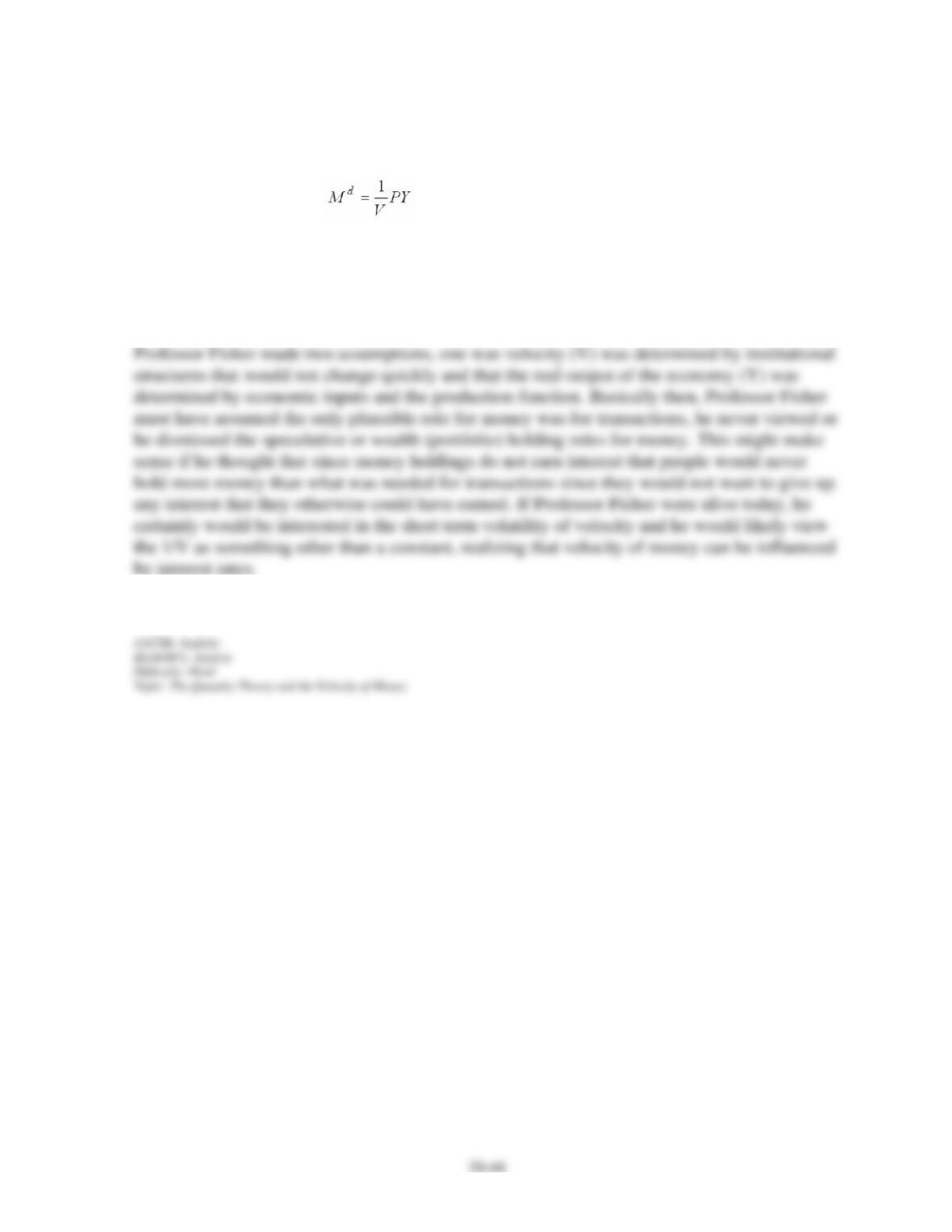
120. The equation for money demand expressed in the chapter that is derived from the
equation of exchange is:
We see that the equation does not explicitly address the interest rate. In fact, Professor Fisher
assumed that velocity is constant which means 1/V is also a constant. Why do you think
Professor Fisher left the interest rate out of the equation? Do you think he would if he were
alive today? Explain.