66. Suppose the quantity demanded for a security is
BD = 150 − 0.1b,
and the quantity supplied of the security is
BS = 50 + 0.1b,
where b is the price of the security in dollars. Suppose that the supply curve shifts to
BS = 75 + 0.1b.
The equilibrium quantity of the security
a. rises by 12.5.
b. rises by 2.5.
c. falls by 2.5.
d. falls by 12.5.
67. In the 1980s, the United States suffered one of its worst financial crises when began to fail in large numbers.
a. commercial banks
b. stock brokers
c. money market mutual funds
d. savings and loan institutions
68. In the Asian crisis, which began in 1997,
a. investors began to pull their financial investments out of Asia with urgency.
b. large banks from Asia began purchasing large American banks, threatening the health of the U.S. financial
system.
c. mutual funds in Asia began to fail in large numbers.
d. savings-and–loan institutions in Asia began to fail in large numbers.
69. One lesson learned from the financial crisis of 2008 was that
a. government regulators need to respond slowly when financial practices threaten the economy.
b. unregulated financial firms need to be prevented from growing so large that their failure would severely
damage the economy.
c. the ease of owning a home has no relationship to the efficiency of the financial system.
d. unregulated financial firms need to be prevented from growing so small that their success would have no or
little effect on the economy.
70. Suppose you are an investor facing a choice between three investments that are identical in every way except in
terms of their rates of return and taxability. Which investment provides the highest after-tax return?
Investment A: interest rate 10 percent, tax rate 40 percent of interest income.
Investment B: interest rate 8 percent, tax rate 25 percent of interest income.
Investment C: interest rate 6.5 percent, tax rate 0 percent.
Investment D: interest rate 5 percent, tax rate 1 percent.
a. Investment A
b. Investment B
c. Investment C
d. Investment D
71. Consider the following four debt securities, which are identical in every characteristic except as noted:
W: A corporate bond rated AAA
X: A corporate bond rated BBB
Y: A corporate bond rated AAA with a shorter time to maturity than bonds W and X
Z: A corporate bond rated AAA with the same time to maturity as bond Y that trades in a
more liquid market than bonds W, X, or Y
Which of the following is the most likely order of the interest rates (yields to maturity) of the bonds from highest to
lowest?
a. X, W, Y, Z
b. W, X, Z, Y
c. X, Y, Z, W
d. X, Z, W, Y
72. An investor calculating the standard deviation of different investments is measuring the
investment portfolios.
a. expected return
b. risk
c. taxation
d. liquidity
of alternative
73. Suppose you are an investor with a choice between three securities that are identical in every way except in terms
of their rates of return and risk. Which investment provides the highest expected return?
Investment A: Total return = 10 percent with probability 50 percent
Total return = 20 percent with probability 50 percent
Investment B: Total return = 12 percent with probability 50 percent
Total return = 20 percent with probability 50 percent
Investment C: Total return = 5 percent with probability 60 percent
Total return = 25 percent with probability 40 percent
Investment D: Total return = 5 percent with probability 60 percent
Total return = 7 percent with probability 40 percent
a. Investment A
b. Investment B
c. Investment C
d. Investment D
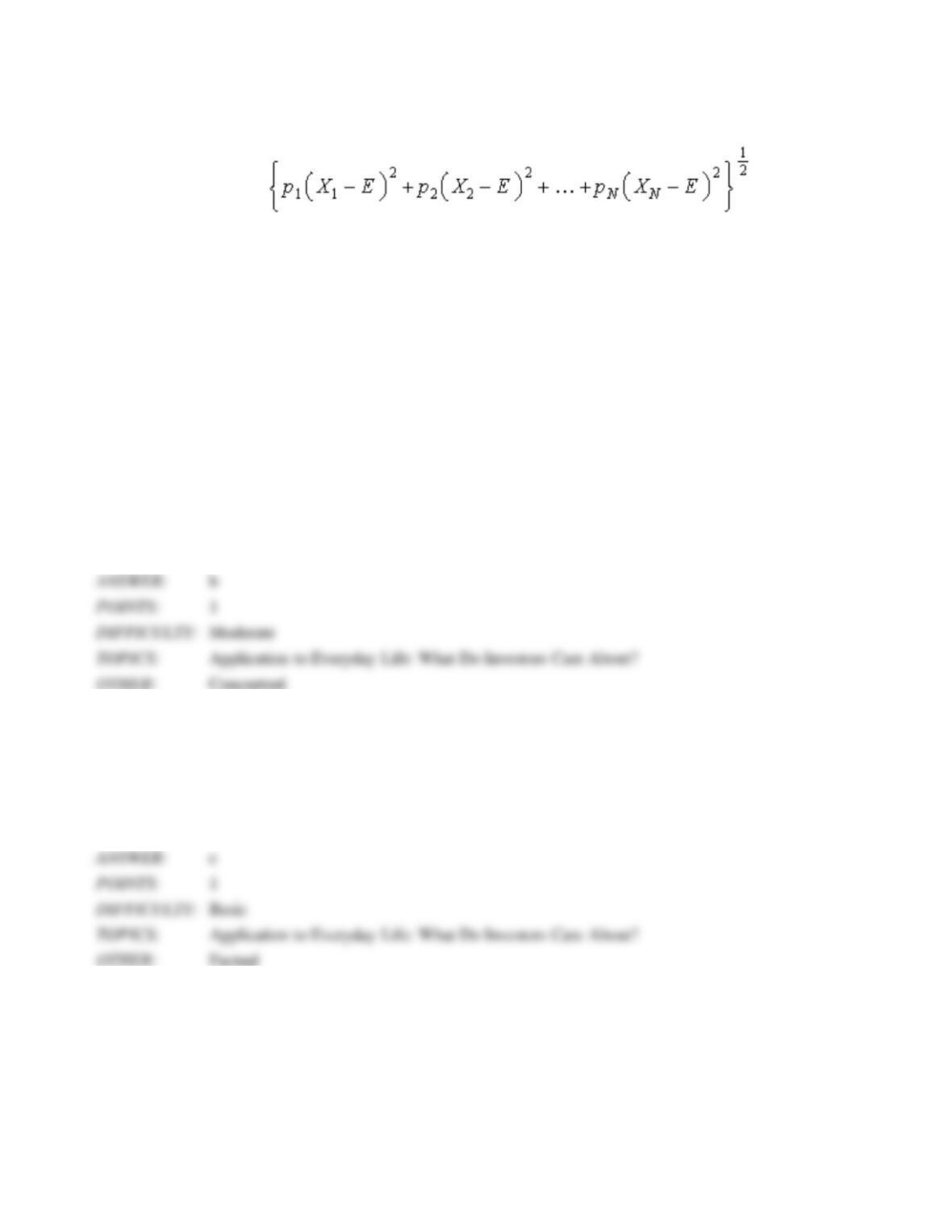
74. Suppose you are an investor with a choice between three securities that are identical in every way except in terms
of their rates of return and risk. Which security has the least risk? Note: You can answer this question intuitively,
without calculating the standard deviation. However, if you want to calculate the standard deviation, the equation is:
Standard deviation = S = .
Investment A: total return = 10 percent with probability 50 percent
total return = 20 percent with probability 50 percent
Investment B: total return = 12 percent with probability 50 percent
total return = 20 percent with probability 50 percent
Investment C: total return = 5 percent with probability 60 percent
total return = 25 percent with probability 40 percent
Investment D: total return = 5 percent with probability 60 percent
total return = 7 percent with probability 40 percent
a. Investment A
b. Investment B
c. Investment C
d. Investment D
75. A nonmarketable security is one that
a. is not widely advertised.
b. has a present value of zero.
c. cannot be resold in a secondary market.
d. has only a current yield and not a capital-gains yield.
76. Consider three investments, where expected return is the expected value of the total return and risk is measured by
the standard deviation. The investments are identical in every way except for their expected return and risk:
Investment A: expected return = 2 percent, risk = 5 percent
Investment B: expected return = 5 percent, risk = 4 percent
Investment C: expected return = 14 percent, risk = 20 percent
Investment D expected return = 6 percent, risk = 12 percent
If a risk-averse investor can buy only one of the three investments and compares each investment with the other
three, which investment option would he never choose?
a. Investment A, because its expected return is lower than Investment B and its risk is higher.
b. Investment B, because its expected return is so much lower than Investment C.
c. Investment C, because its risk exceeds its expected return.
d. Investments D, because the expected return to investment D is so much lower than Investment C.
77. Risk that cannot be eliminated by diversification is referred to as
a. idiosyncratic risk.
b. market risk.
c. default risk.
d. interest-rate risk.
78. Which of the following statements is true?
a. Over the last fifty years, the risk spread between Aaa bonds and Baa bonds always remained positive
except in 1998.
b. The risk spread between Aaa bonds and Baa bonds became negative only in the mid-1960s.
c. For most of the last twenty years, the risk bread between Aaa bonds and Baa bonds remained negative.
d. Over the last fifty years, the risk spread between Aaa bonds and Baa bonds never became negative
79. The income an investor receives in some period divided by the value of the security at the beginning of that period
is known as yield.
a. capital-gains
b. expected
c. current
d. realized
80. The price of a stock at the beginning of a year is $50. There is a 70 percent chance of its price rising to $55 by the
end of the year and a 30 percent chance of its price falling to $45. The stock will pay an amount of $2 at the end of
the year. The current yield of the security is
a. 4 percent
b. 5 percent
c. 70 percent
d. 30 percent
81. If a stock’s price is $20 at the beginning of a year and $17 at the end of the year, and it pays a dividend of $2 during
the year, then the stock’s current yield is percent.
a. −15
b. −5
c. 5
d. 10
82. If the price of a share of Aqua Inc. increased from $40 to $44 over a year, the capital-gains yield per share was
_____.
a. 10 percent
b. 4 percent
c. 11 percent
d. 0.4 percent
83. If a stock’s price is $20 at the beginning of a year and $17 at the end of the year, and it pays a dividend of $2 during
the year, then the stock’s capital-gains yield is percent.
a. −15
b. −5
c. 5
d. 15
84. If a stock’s price is $20 at the beginning of a year and $17 at the end of the year, and it pays a dividend of $2 during
the year, then the stock’s return is percent.
a. −15
b. −5
c. 5
d. 10
85. The dollar value of a company’s stock rose from $20 to $21 during a year. If the stock paid a dividend of $3, the
return on the stock was
a. 20 percent
b. 1 percent
c. 3 percent
d. 14 percent
86. Risk is the amount of uncertainty relating to the a security.
a. maturity of
b. principal of
c. liquidity of
d. return on
87. The situation when the issuer of a security fails to make the payment promised is referred to as
a. default.
b. deviation.
c. failure.
d. defect.
88. A stock’s price is $20 at the beginning of a year. There is a 25 percent chance that the price will be $17 at the end
of the year, and a 75 percent chance that the price will be $25 at the end of the year. The stock will pay a dividend
of $3 during the year. The expected return on the stock is percent.
a. 10
b. 20
c. 30
d. 40
89. The probabilities of different returns on a stock over the year are:
Probability Return
10% −5%
15% 0%
20% 5%
30% 10%
25% 20%
The expected return on the stock is percent.
a. 8.5
b. 9.0
c. 9.5
d. 10.0
90. You buy a bond for $1,000 today that promises interest of $50 in one year plus the return of your principal.
However, the probability that the company will default and not pay you either interest nor repay your principal is 1
percent. The expected return on the bond is percent.
a. 3.95
b. 4.00
c. 4.95
d. 5.00
91. Upside risk is the risk that investors face due to
a. an increase in the market price of a security.
b. an increase in the inflation rate.
c. an decrease in the earnings of the firm they invested in.
d. an increase in the exchange rate.
92. A stock’s price is $20 at the beginning of a year. There is a 25 percent chance that the price will be $17 at the end
of the year, and a 75 percent chance that the price will be $25 at the end of the year. The stock will pay a dividend
of $3 during the year. The standard deviation of the return on the stock is
percentage point).
a. 10
b. 12
c. 15
d. 17
93. A risk averse investor will choose an investment
a. with the lowest standard deviation
b. with the highest standard deviation
c. with the highest return and highest risk
d. with the lowest capital-gains yield
percent (rounded to the nearest