94. The probabilities of different returns on a stock over the year are:
Probability Return
10% −5%
15% 0%
20% 5%
30% 10%
25% 20%
The standard deviation of the return on the stock is about percent.
a. 5
b. 8
c. 11
d. 14
95. The ease with which you can buy or sell a security in the secondary market when you want to without incurring
significant costs is known as
a. liquidity.
b. risk.
c. secondary marketization.
d. secondary market penetration.
96. Which of the following risks is only faced by investors in debt securities?
a. Default risk
b. Upward risk
c. Downward risk
d. Risk due to inflation
97. Which of the following securities is likely to be most liquid?
a. Debt security issued by the government of a small town
b. Stock in a small corporation
c. Government savings bonds
d. 3 month treasury bills
98. A U.S. government savings bond is an example of a
a. marketable security.
b. nonmarketable security.
c. secondary security.
d. primary security.
99. A security can be sold to another investor.
a. marketable
b. idiosyncratic
c. nonmarketable
d. systematic
100. Risk that can be eliminated by diversification is
a. idiosyncratic risk.
b. market risk.
c. default risk.
d. interest-rate risk.
101. Risk that cannot be eliminated by diversification is
a. unsystematic risk.
b. systematic risk.
c. default risk.
d. interest-rate risk.
102. Risk that can be eliminated by diversification is
a. unsystematic risk.
b. systematic risk.
c. default risk.
d. interest-rate risk.
103. A security has a price of $3,000 and an amount to be repaid in a single payment of $3,400. What is the amount of
interest on the security?
104. Suppose the quantity demanded for a security is
BD = 100 − 0.1b,
and the quantity supplied of the security is
BS = 50 + 0.1b,
where b is the price of the security in dollars.
a. Calculate the equilibrium price and quantity of the security.
b. Suppose demand increases by 50, so that BD = 150 − 0.1b. Now, calculate the new
equilibrium price and quantity of the security.
Set quantity demanded equal to quantity supplied to get 100 − 0.1b = 50 + 0.1b, so 50= 0.2b,
a.
so b = 250. Plug into either equation to find the equilibrium quantity. The equilibrium quantity
105. Consider three alternative bonds that you might invest in, each of which matures in one year. The following table
shows the probability that you will receive each possible return. For example, if you buy bond A, the probability is
90 percent that your return will be 20 percent and the probability is 10 percent that your return will be −100 percent
(in other words, you lose the entire amount invested).
Bond
Bond A
Probability
90%
Return
20%
10%
−100%
Bond B
75%
40%
25%
−40%
Bond C
60%
10%
40%
−10%
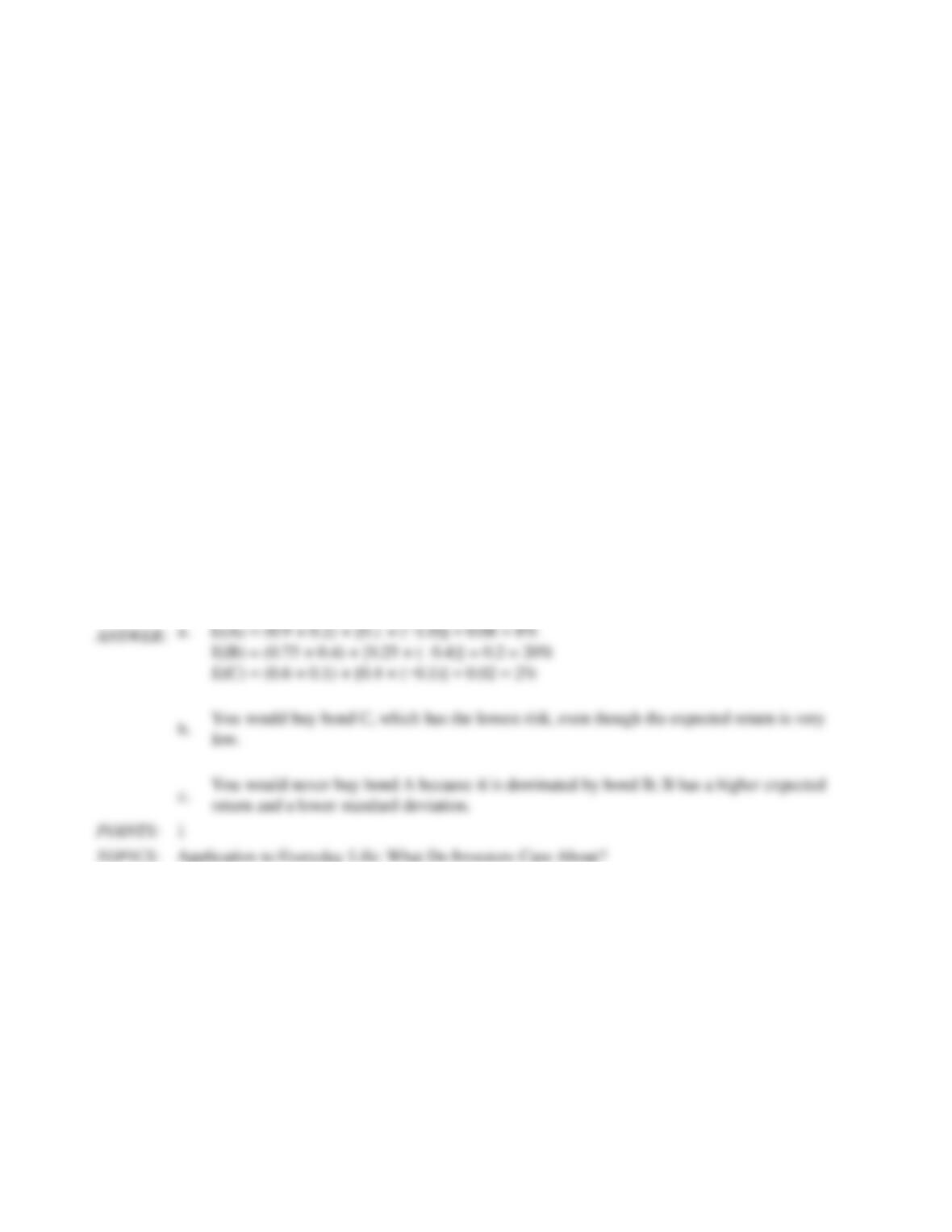
a. Calculate the expected return for all three bonds in percentage terms.
The standard deviations of the returns on these bonds are: Bond A, 36.0 percent; Bond B,
b. 34.6 percent; Bond C, 9.8 percent. If you are extremely risk averse, which of the three bonds
would you buy? Why?
c. Would a risk-averse investor ever buy Bond A instead of one of the other bonds? Why or
why not?
Explain and show all your work. In your calculations, you may round after three significant
digits.
106. Suppose a discount bond costs $5,000 today and pays off some amount b in one year. Suppose that b is uncertain
according to the following table of probabilities:
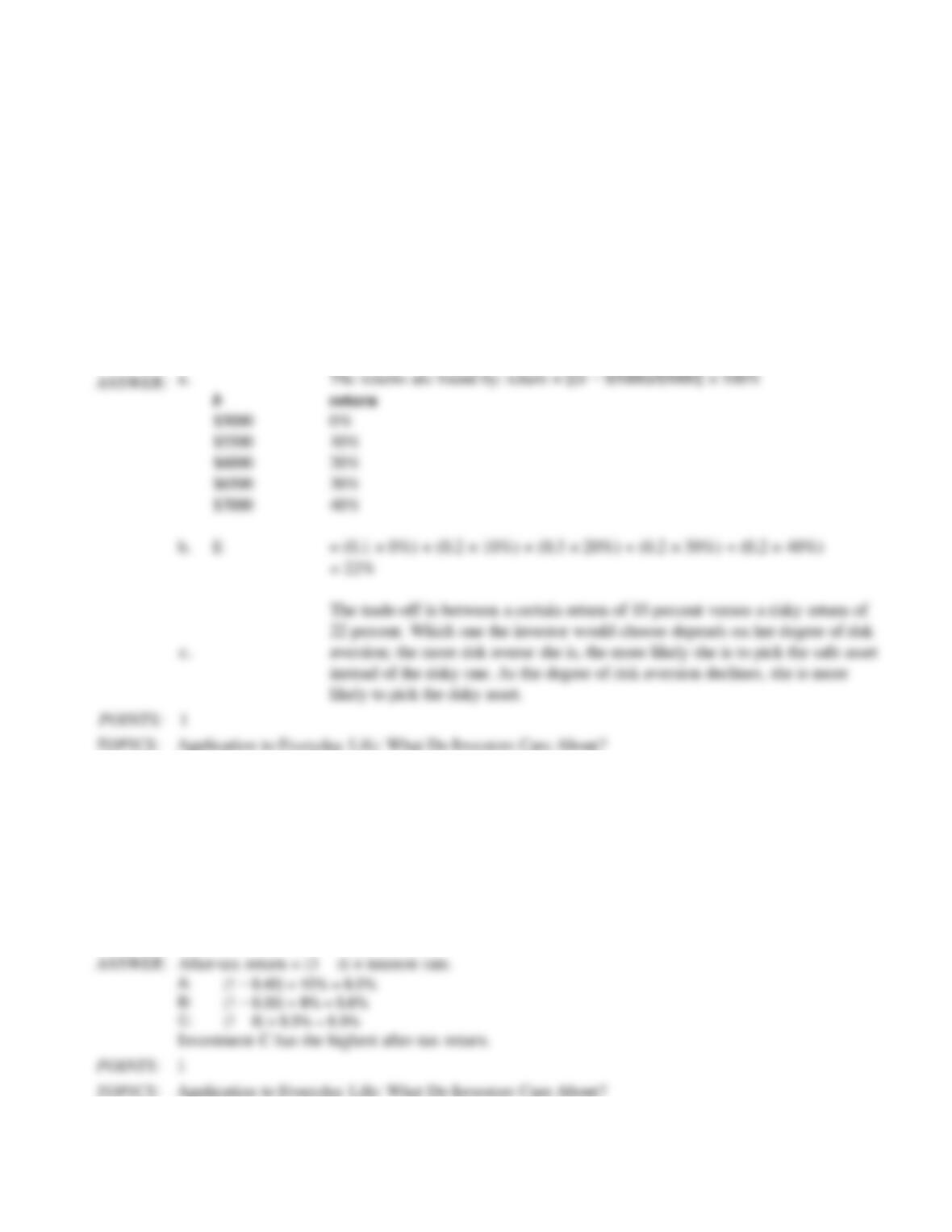
b:
$5,000
$5,500
$6,000
$6,500
$7,000
Probability:
0.1
0.2
0.3
0.2
0.2
a. Calculate the return (in percent) for each value of b. (Note: you may just calculate the total
return and not worry about how this is split up between current yield and capital-gains yield.)
b. Calculate the expected return.
Suppose an investor has a choice between buying this security or purchasing a different
c. security that also costs $5,000 today, but pays off $5,500 with certainty in one year. How is
an investor‘s choice of which security to purchase related to her degree of risk aversion?
107. Suppose you are an investor with a choice between three investments in debt securities that are identical in every
way except in terms of their interest rates and taxability.
Investment A: Interest rate 10 percent, tax rate 40 percent of interest income
Investment B: Interest rate 8 percent, tax rate 30 percent of interest income
Investment C: Interest rate 6.5 percent, tax rate 0 percent
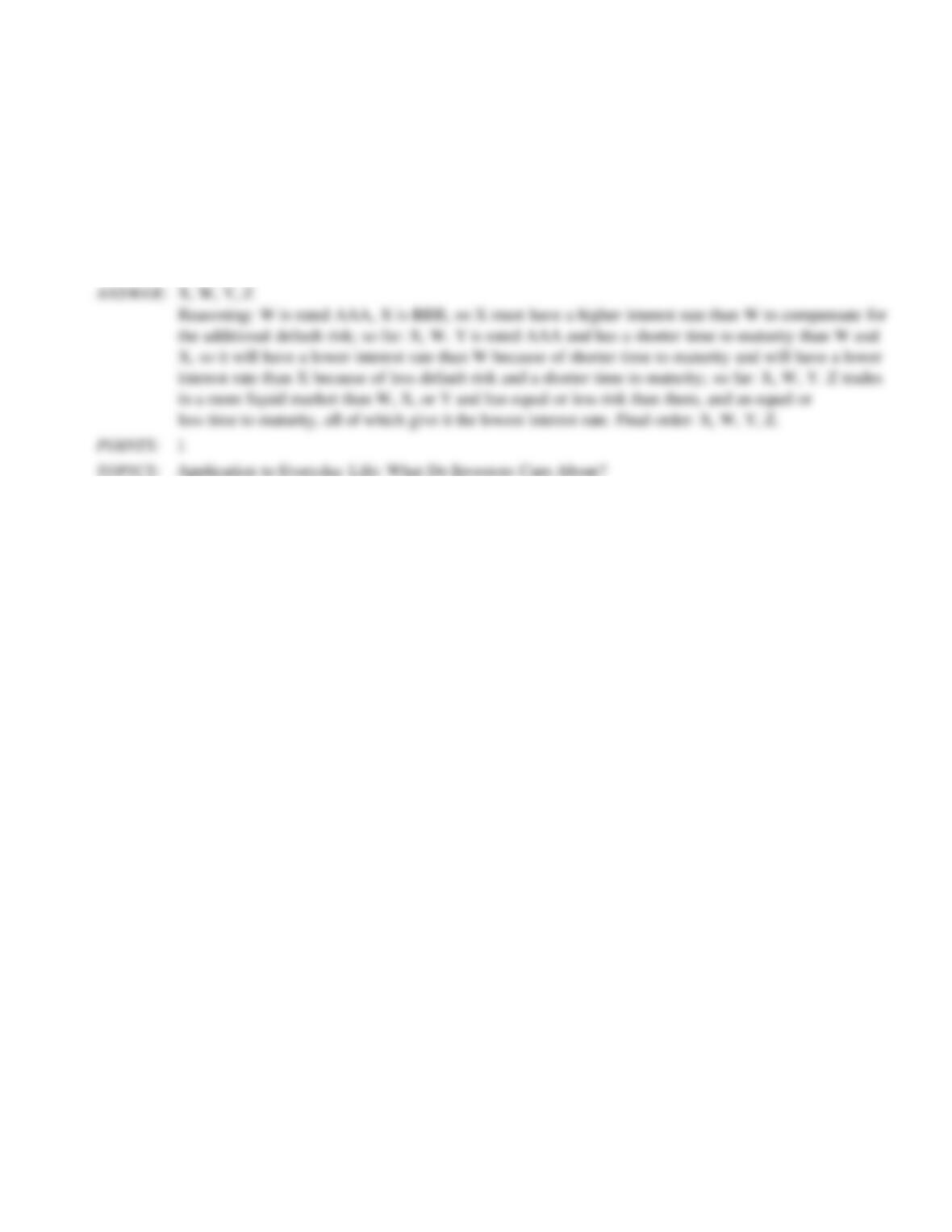
Which investment provides the highest after-tax return? Show your work.
108. Consider the following four debt securities, which are identical in every characteristic except as noted:
W: A corporate bond rated AAA
X: A corporate bond rate BBB
Y: A corporate bond rated AAA with a shorter time to maturity than bonds W and X
Z: A corporate bond rated AAA with the same time to maturity as bond Y that trades in a
more liquid market than bonds W, X, or Y
List the bonds in the most likely order of the interest rates (yields to maturity) of the bonds from highest to lowest.
Explain your work.
109. Suppose you are an investor with a choice between three securities that are identical in every way except in terms
of their rates of return and risk.
Investment A: Total return = 10 percent with probability 50 percent
Total return = 20 percent with probability 50 percent
Investment B: Total return = 12 percent with probability 40 percent
Total return = 18 percent with probability 60 percent
Investment C: Total return = 5 percent with probability 60 percent
Total return = 25 percent with probability 40 percent
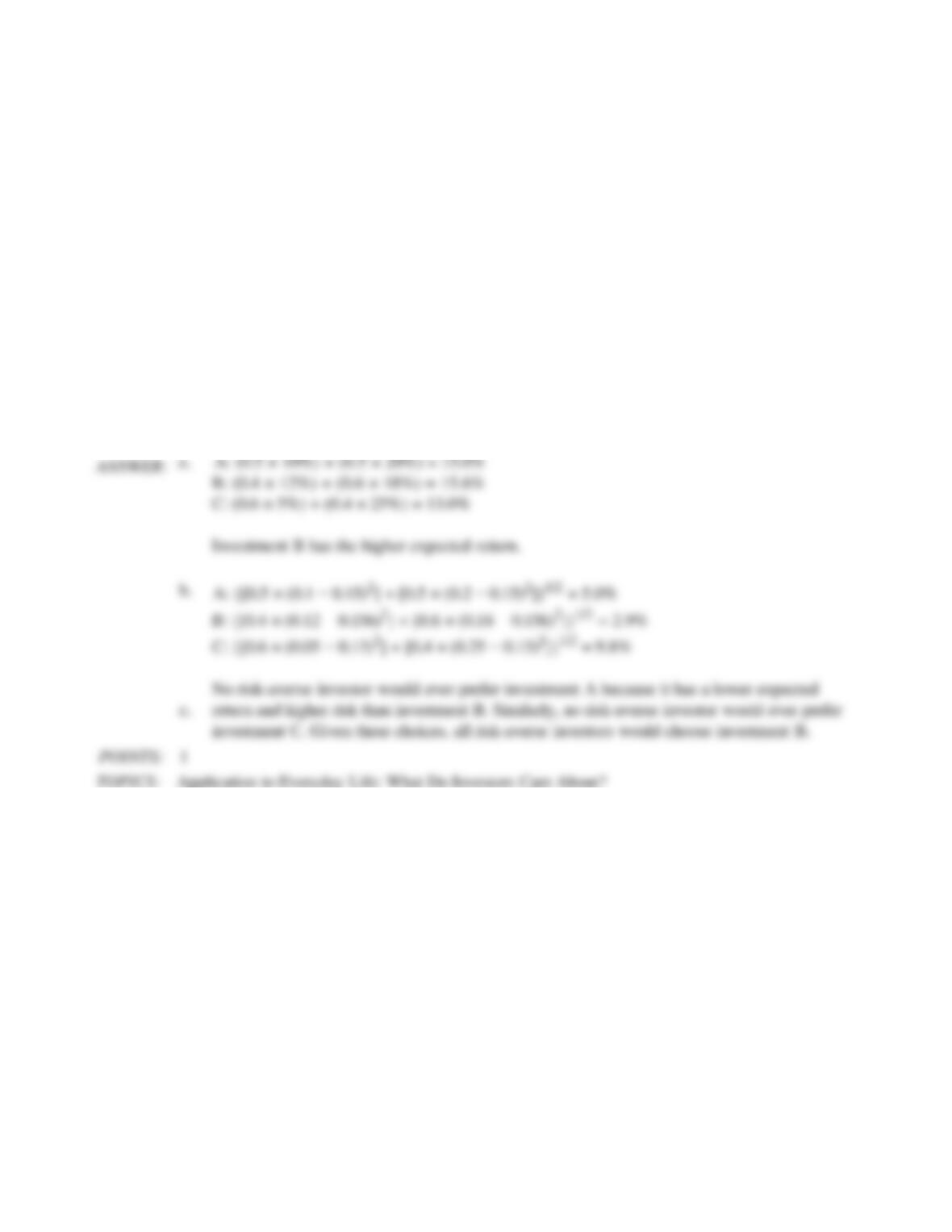
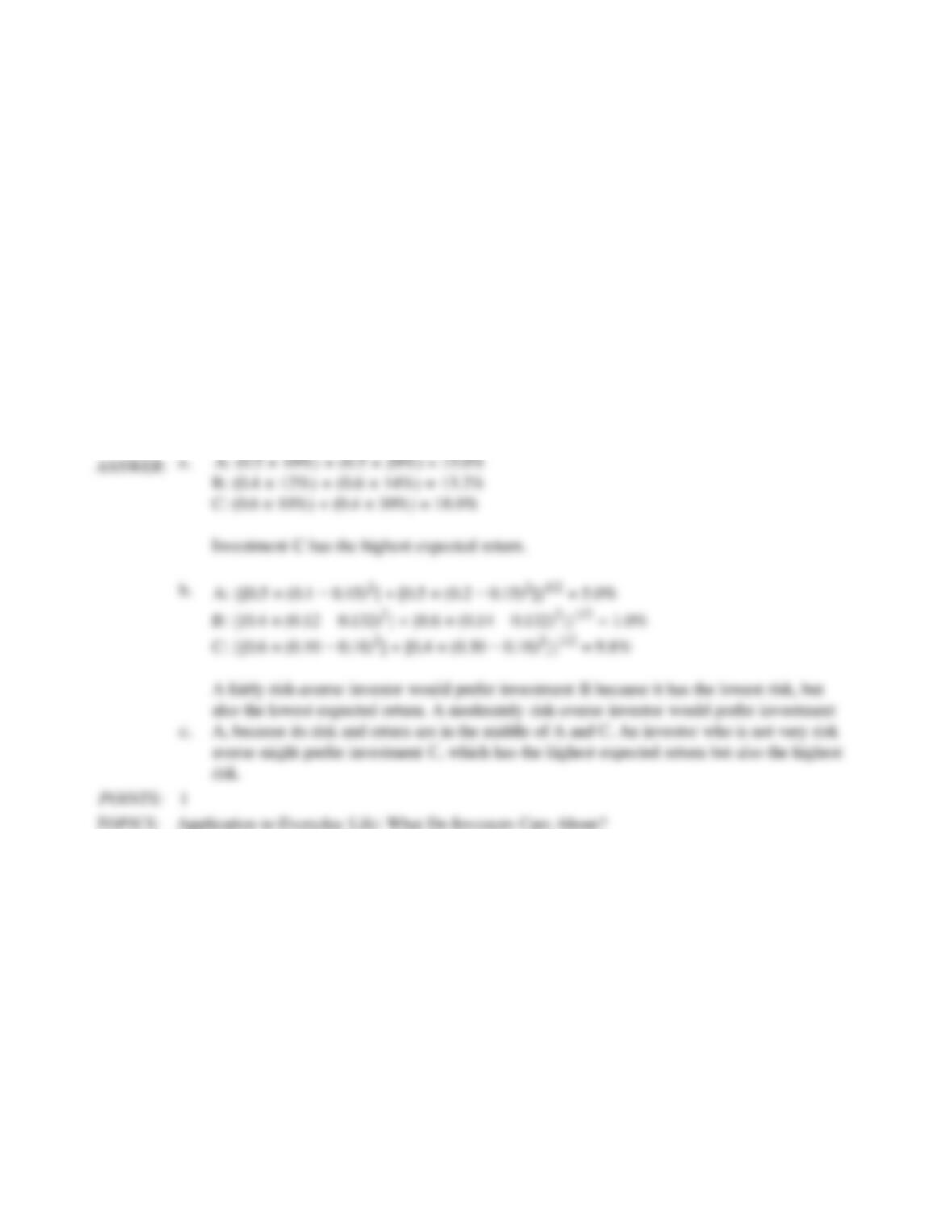
a. Which investment provides the highest expected return? Show your work by calculating the
expected return of all three investments.
b. Calculate the standard deviation of all three investments.
c. What type of investor might prefer investment A? Who might prefer investment B?
110. Suppose you are an investor with a choice between three securities that are identical in every way except in terms
of their rates of return and risk.
Investment A: Total return = 10 percent with probability 50 percent
Total return = 20 percent with probability 50 percent
Investment B: Total return = 12 percent with probability 40 percent
Total return = 14 percent with probability 60 percent
Investment C: Total return = 10 percent with probability 60 percent
Total return = 30 percent with probability 40 percent
a. Which investment provides the highest expected return? Show your work by calculating the
expected return of all three investments.
b. Calculate the standard deviation of all three investments.
c. What type of investor might prefer investment A? Who might prefer investment B?
111. Suppose that the price of a stock is $50 at the beginning of a year and $53 at the end of the year, and it pays a
dividend of $2 during the year.
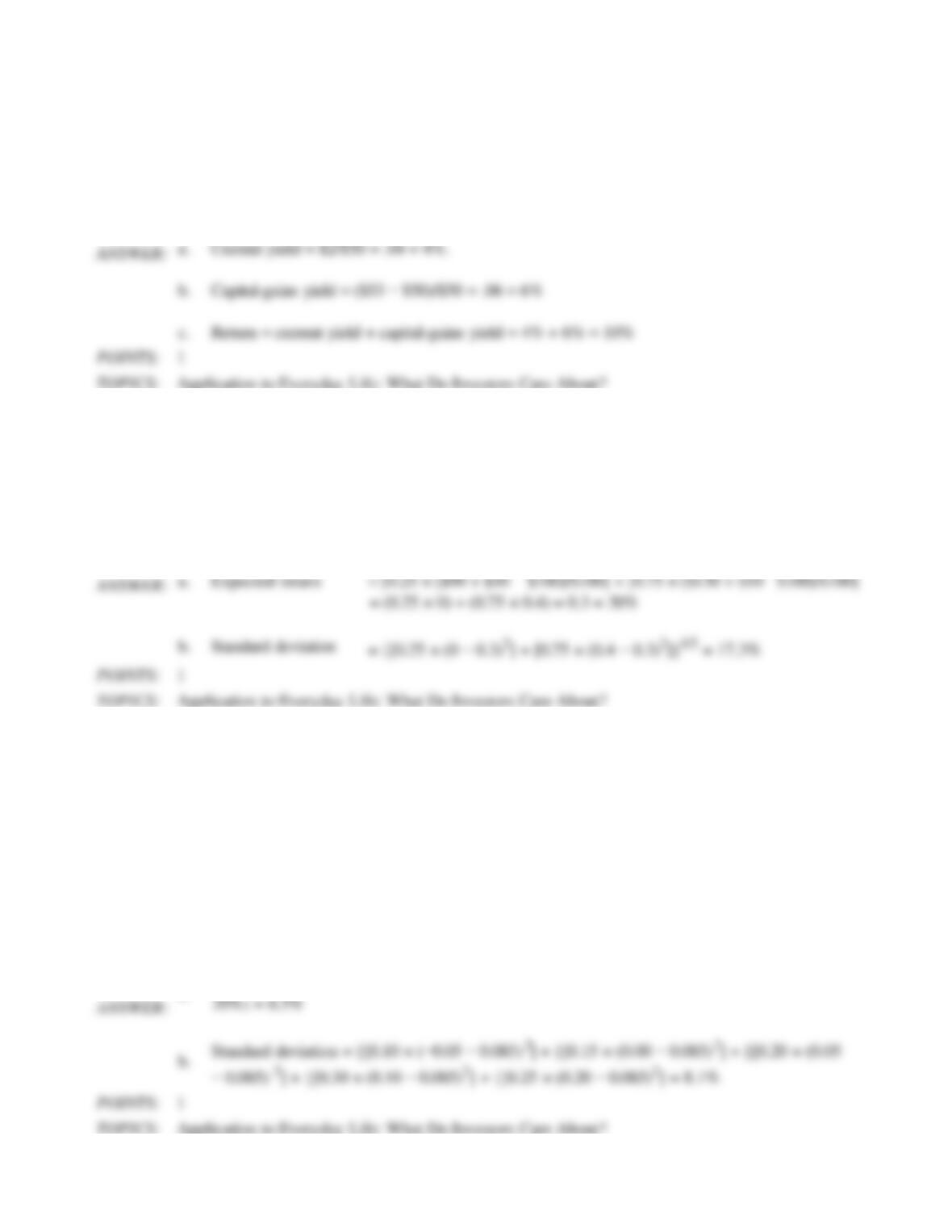
a. What is the stock’s current yield?
b. What is the stock‘s capital-gains yield?
c. What is the stock’s return?
112. A stock‘s price is $100 at the beginning of a year. There is a 25 percent chance that the price will be $90 at the end
of the year, and a 75 percent chance that the price will be $130 at the end of the year. The stock will pay a
dividend of $10 during the year.
a. Calculate the stock’s expected return.
b. Calculate the standard deviation of the stock’s return.
113. The probabilities of different returns on a stock over the year are:
Probability Return
10% −5%
15% 0%
20% 5%
30% 10%
25% 20%
a. Calculate the stock’s expected return.
b. Calculate the stock’s standard deviation.
a. Expected return = (0.10 × −5%) + (0.15 × 0%) + (0.20 × 5%) + (0.30 × 10%) + (0.25 ×