39. Suppose the economy is thought to be 1 percent below its potential output (i.e., the output gap is −1 percent). The
potential output is growing at 4% a year. Suppose the Fed is following the Taylor rule, with an inflation rate of 4
percent over the past year. The equilibrium real fed funds rate is 3 percent, the weight on the output gap is 0.75 and
the weigh on the inflation gap is 0.25. The inflation target is 1 percent. What should the federal funds rate be?
a. 7 percent
b. 8 percent
c. 9 percent
d. 10 percent
40. The Taylor rule implies that the nominal federal funds rate should be increased if there is a
inflation gap.
a. positive; positive
b. positive; negative
c. negative; positive
d. negative; negative
output gap or a
41. The central bank of a country follows the Taylor rule to set its interest rate. If the equilibrium real interest rate rises
by 1 percentage point, all other variables remaining unchanged,
a. the central bank should raise the nominal interest rate by 1 percentage point.
b. the central bank should lower the nominal interest rate by 1 percentage point.
c. the central bank should raise the nominal interest rate by 0.5 percentage points.
d. the central bank should lower the nominal interest rate by 0.5 percentage points.
42. Suppose the economy is thought to be 5 percent below potential (i.e., the output gap is −5 percent), when potential
output grows 3 percent per year. Suppose the Fed is following the Taylor rule, with an inflation rate of 6 percent
over the past year. The equilibrium real fed funds rate is 3 percent and the weights on the output gap and inflation
gap are 0.5 each. The inflation target is 1 percent. What should the federal funds rate be?
a. 4 percent
b. 6 percent
c. 8 percent
d. 9 percent
43. Suppose the economy is thought to be 1 percent below potential (i.e., the output gap is −1 percent), when potential
output grows 4 percent per year. Suppose the Fed is following the Taylor rule, with an inflation rate of 4 percent
over the past year. The equilibrium real fed funds rate is 3 percent and the weights on the output gap and inflation
gap are 0.5 each. The federal funds rate is 8.5 percent. What is the inflation target?
a. 0 percent
b. 1 percent
c. 2 percent
d. 3 percent
44. Suppose the Fed follows the Taylor rule. Which of the following is likely to happen if the Fed overestimates potential
output?
a. The inflation rate will rise.
b. The federal funds rate will fall.
c. The money supply will decrease.
d. The income tax rates will increase.
45. If the Fed follows the Taylor rule and actual inflation is below the inflation target set by the Fed,
a. the Fed should reduce the nominal federal funds rate.
b. the Fed should reduce the supply of money.
c. the Fed should charge a higher tax rate.
d. the Fed should spend lesser money.
46. Taylor’s rule implies that monetary policy should have been easier than the Fed’s actual policy in the
a. 1950s
b. 1960s
c. 1970s
d. 1980s
47. New Zealand was the first country to implement a system of
a. disinflation.
b. deflation.
c. inflation targeting.
d. expectations traps.
48. Suppose the federal funds rate is 6 percent. If the output gap increases by 2 percentage points and the weight on
output gap is 0.6, by how much should the federal funds rate increase according to the Taylor rule if all other
variables remain unchanged?
a. It should increase by 0.4 percentage points.
b. It should increase by 0.6 percentage points.
c. It should increase by 2 percentage points.
d. It should increase by 1.2 percentage points.
49. A system in which the central bank attempts to achieve a certain rate of change in the overall price level within
some period is referred to as
a. disinflation equilibrium.
b. deflation.
c. inflation targeting.
d. rational expectations trapping.
50. In inflation targeting, the range that represents the goal for the inflation rate is known as the
a. target band.
b. optimal range.
c. central tendency.
d. ultimate goal.
51. A central bank that is explicit about its goals and plans is said to be
a. obvious.
b. transparent.
c. translucent.
d. opaque.
52. Usually inflation targets are set for a
a. low but positive inflation rate.
b. high and positive inflation rate.
c. negative inflation rate.
d. zero inflation rate.
53. Which of the following is a disadvantage of inflation targeting?
a. It reduces the flexibility of the central bank.
b. It makes the goals of the central bank explicit.
c. It leads to the problem of time inconsistency.
d. It raises the expected inflation rate.
54. Central banks that use inflation targeting usually communicate their goals and plans in a document known as the
a. directive.
b. inflation report.
c. target analysis.
d. communique.
55. Which of the following happened as a result of inflation targeting in New Zealand ?
a. It made the goals of the central bank explicit.
b. It led to a higher expected inflation rate.
c. It increased the inflation rate in the country.
d. It lowered the credibility of the central bank.
56. Which of the following best describes the reason why policymakers do not generally like to commit to following a
rule for monetary policy?
a. Because changes to the economy’s structure will prevent any rule from working well for long
b. Because rules do not effectively prevent time-inconsistency
c. Because rules without credibility are worse than discretion
d. Because central bankers like to feel important
57. A benefit to policymakers of following rules rather than discretion is
a. they could employ a larger staff of economists.
b. they will contribute to the formation of an expectations trap.
c. they would not be able to pursue time-inconsistent policies.
d. they would gain flexibility in case the economy’s structure changed.
58. What causes the formation of an expectations trap and how can the Fed prevent one from forming?
59. How does a central bank establish credibility?
60. Describe time inconsistency and explain how it can be avoided by a central bank setting monetary policy.
61. Why have economists abandoned the use of money-growth rules in the United States? Explain.
62. Why do monetarists favor the use of a nonactivist rule for monetary policy?
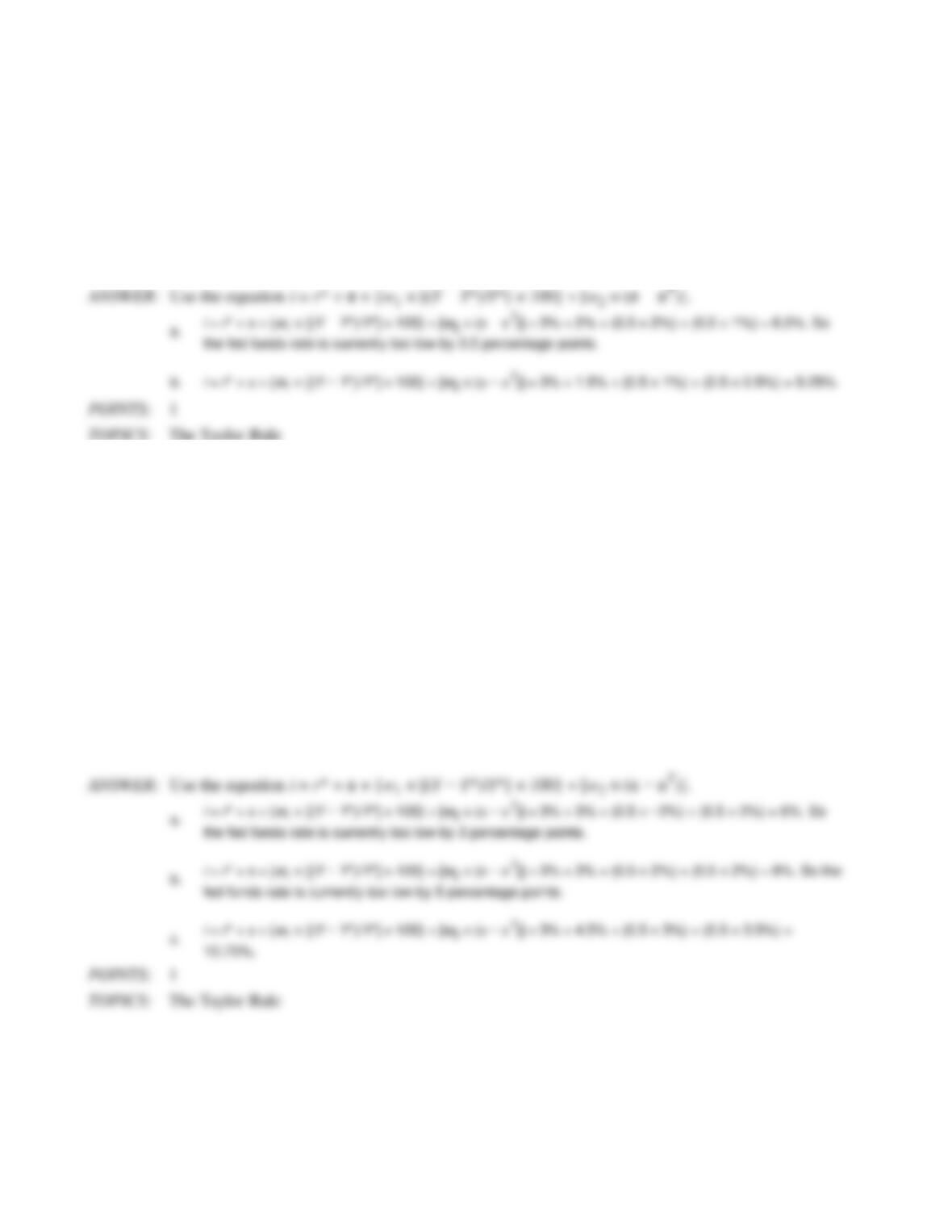
63. Suppose the economy is thought to be 2 percent above potential (i.e., the output gap is 2 percent), when potential
output grows 4 percent per year. Suppose the Fed is following the Taylor rule, with an inflation rate of 2 percent
over the past year. The federal funds rate is currently 3 percent. The equilibrium real fed funds rate is 3 percent and
the weights on the output gap and inflation gap are 0.5 each. The inflation target is 1 percent.
a. Is the fed funds rate currently too high or too low? By how much? Show your work.
Suppose a year has gone by, output is now just 1 percent above potential, and inflation rate
b. was 1.5 percent over the year. What federal funds rate should the Fed now set (assuming the
inflation target does not change)?
64. Suppose the economy is thought to be 2 percent below potential (i.e., the output gap is −2 percent), when potential
output grows 4 percent per year. Suppose the Fed is following the Taylor rule, with an inflation rate of 3 percent
over the past year. The federal funds rate is currently 3 percent. The equilibrium real fed funds rate is 3 percent and
the weights on the output gap and inflation gap are 0.5 each. The inflation target is 1 percent.
a. Is the fed funds rate currently too high or too low? By how much? Show your work.
Suppose that all the conditions are the same as described above, except that the output gap is
b. +2 percent instead of −2 percent. Is the fed funds rate currently too high or too low? By how
much? Show your work.
Suppose a year has gone by, output is now 3 percent above potential, and the inflation rate
c. was 4.5 percent over the year. What federal funds rate should the Fed now set (assuming the
inflation target does not change)? Show your work.
65. Answer the questions below.
a. Write down the equation for the Taylor rule for monetary policy. Explain what each term in
the equation means, in one sentence.
Suppose the Fed is following the Taylor rule. Suppose the growth rate of potential output is 4
percent, the output gap is 3 percent, the weights on the output gap and inflation gap are each
b. 1/2, the Fed’s inflation target is 2 percent, the Fed believes the equilibrium real federal funds
rate is 2 percent, and inflation has been 3 percent over the past year. At what rate does the
Fed set the federal funds rate?
Suppose the Fed thinks that the equilibrium federal funds rate is 2 percent, as in part b above,
c. but in fact the equilibrium real fed funds rate is 3 percent. What do you think will happen to
the inflation rate in the long run?
66. Answer the questions below.
Suppose (real) output is thought to be 2 percent above potential with an inflation rate of 3
a. percent over the past year. The weights on the output gap and inflation gap are each 1/2. The
inflation target is 1 percent. If you are sure that the equilibrium real federal funds rate is 3
percent, what is the Fed’s setting for the federal funds rate, according to the Taylor rule?
b. If you are sure that the equilibrium real federal funds rate is 2 percent, what is the Fed’s
setting for the federal funds rate, according to the Taylor rule?
67. Suppose the federal funds rate is 4.4 percent and you know that the Fed is following the Taylor rule. You don’t know
the Fed’s inflation target, but the equilibrium real interest rate is 4 percent, the inflation rate is 3 percent, the weight
on the GDP gap is 0.4, the weight on the inflation gap is 0.6 and nominal GDP is 2 percent points below its target.
Calculate the Fed’s inflation target from this information.
68. Why does the Taylor rule have such wide appeal?
69. In general, periods in which the Taylor rule suggested tighter monetary policy than the Fed actually put in place are
periods of rising inflation. Periods in which the Taylor rule suggested that monetary policy should be easier than the
Fed actually put in place are periods of declining inflation. Describe a recent exception to these results.
70. What challenges do policymakers and researchers face in using the Taylor rule?
71. If a shock raises inflation, how fast should the central bank reduce it to its target level?
72. What are the major advantages and disadvantages of inflation targeting?
73. Why are policymakers willing to use rules for monetary policy as general guides, but unlikely to follow such rules
blindly?