38. Okun’s Law relates
a. the unemployment gap and the inflation rate.
b. the unemployment gap and the inflation gap.
c. the inflation gap and the output gap.
d. the unemployment gap and the output gap.
39. In an economy, the actual inflation rate is increasing while the ideal inflation rate is constant. In such a case, the
inflation gap in the economy will
a. increase over time.
b. decrease over time.
c. stay the same.
d. initially decrease then increase.
40. If the actual inflation rate in an economy is 6% and the ideal inflation rate is 4%, the inflation gap in the economy is
a. -2%.
b. -4%.
c. 2%.
d. 6%.
41. If the ideal inflation rate in an economy is 3% and the inflation gap is 8%, the actual inflation rate in the economy
must be
a. 3%.
b. 5%.
c. 8%.
d. 11%.
42. An equation that summarizes the total cost to the economy when output differs from potential and inflation rate
differs from the ideal inflation rate is referred to as the
a. cost of disinflation.
b. Fed‘s objective function.
c. Sharpe ratio.
d. Phillips curve.
43. An equation that sums the squared output gap to the squared inflation gap, with a weight that determines the tradeoff
between them is referred to as the
a. Fed‘s objective function.
b. cost of disinflation.
c. Sharpe ratio.
d. Phillips equation.
44. The Fed’s loss function is another name for the Fed’s
a. expense ratio.
b. objective function.
c. inflation gap.
d. output gap.
45. The misery index is the sum of the
a. unemployment rate and the output gap.
b. unemployment gap and the output gap.
c. unemployment gap and the inflation gap.
d. unemployment rate and the inflation rate.
46. The tradeoff in the data between unemployment and inflation is represented by the
a. Taylor rule.
b. Say’s law.
c. Okun‘s law.
d. Phillips curve.
47. The Phillips curve, modified with the addition of expected inflation into the analysis, is known as
a. the expectations-augmented Phillips curve.
b. the long-run Phillips curve.
c. the inflation–surprise theory.
d. the Phillips-curve non-accelerating inflation theory of unemployment.
48. If the equation for the Phillips curve is
π = πe − 0.5(U − 5),
then the natural rate of unemployment is
a. 10 percent.
b. 5 percent.
c. 2.5 percent.
d. 0.5 percent.
49. The equation for the Phillips curve in an economy is
π = πe − 0.5(U − 5),
If the inflation rate is 2 percent and the expected inflation rate is 4 percent, the unemployment rate in the economy
must be
a. 3.0 percent.
b. 4.5 percent.
c. 8.0 percent.
d. 9.0 percent.
50. The equation for the Phillips curve in an economy is
π = πe − 0.5(U − 5),
If the inflation rate is 4 percent and the unemployment rate is 6 percent, then the expected inflation rate in the
economy must be
a. 2.5 percent.
b. 4.0 percent.
c. 4.5 percent.
d. 5.0 percent.
51. The inflation surprise is defined as
a. the sum of the natural rate of unemployment and the ideal inflation rate.
b. the difference between the actual inflation rate and the expected inflation rate.
c. the expected inflation rate in an economy multiplied by the population of the economy.
d. the non-accelerating inflation rate of unemployment (NAIRU).
52. Describe the lags in the policymaking process and how they might lead to instability.
53. Why is there an effectiveness lag for monetary policy?
54. Why is it difficult for policymakers to set policy based on the value of the unemployment rate relative to the natural
rate of unemployment?
55. Describe the three major costs of unanticipated inflation and give an example of each.
56. What are the five major costs of anticipated inflation?
57. What happens to the Phillips curve if the actual rate of inflation remains above the expected rate of inflation over
time?
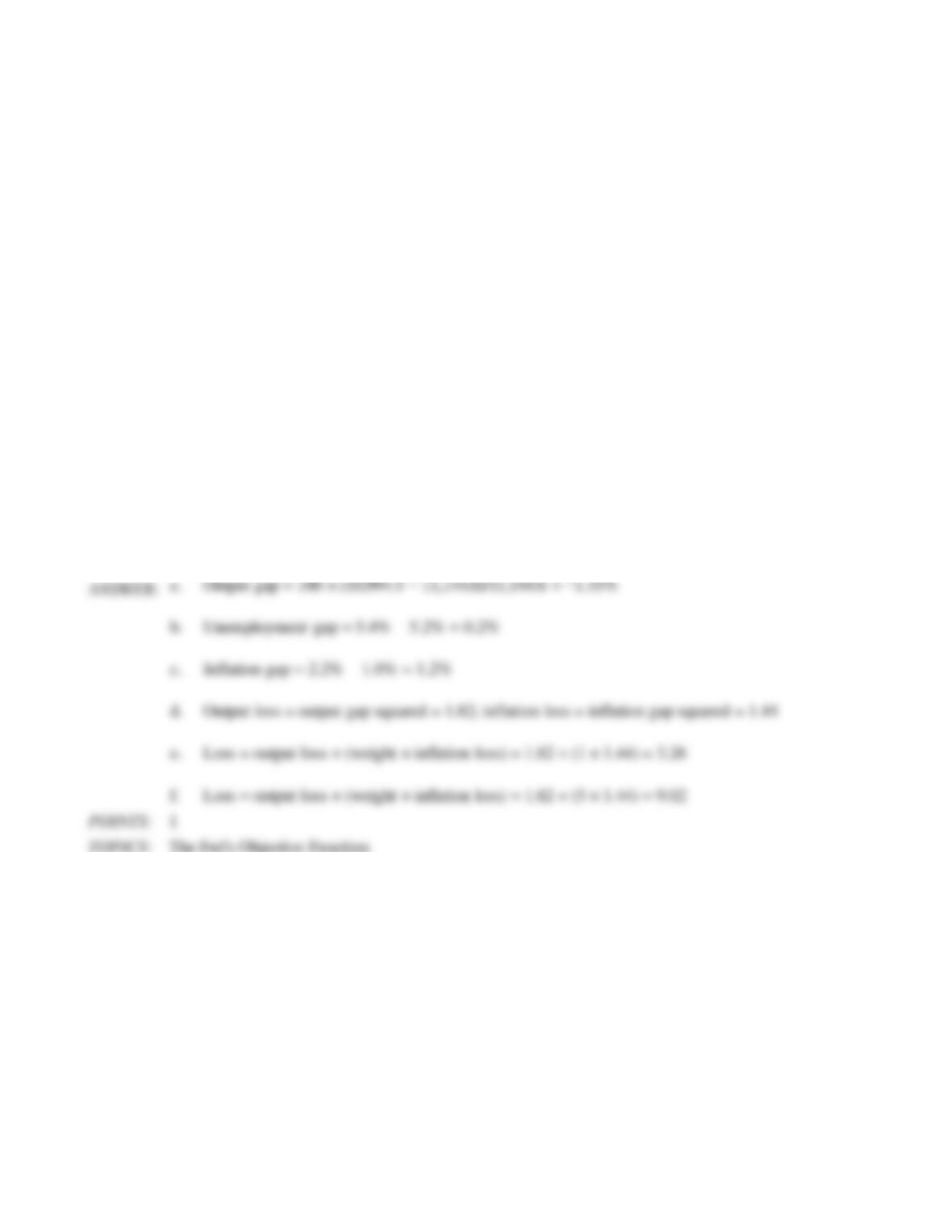
58. In the fourth quarter of 2004, economic statistics showed the following:
Real GDP
Unemployment rate
Inflation rate
$10,994.3 billion
5.4%
2.2%
The conceptual variables corresponding to these data are:
Potential output
Natural rate of unemployment
Ideal inflation rate
$11,144.6 billion
5.2%
1.0%
a. Calculate the output gap in percentage. Show your work.
b. Calculate the unemployment gap in percentage. Show your work.
c. Calculate the inflation gap in percentage. Show your work.
d. Calculate the output loss and the inflation loss. Show your work.
e. Calculate the total loss in the fourth quarter of 2004 if the weight on the inflation loss equals
1. Show your work.
f. Calculate the total loss in the fourth quarter of 2004 if the weight on the inflation loss equals
5. Show your work.
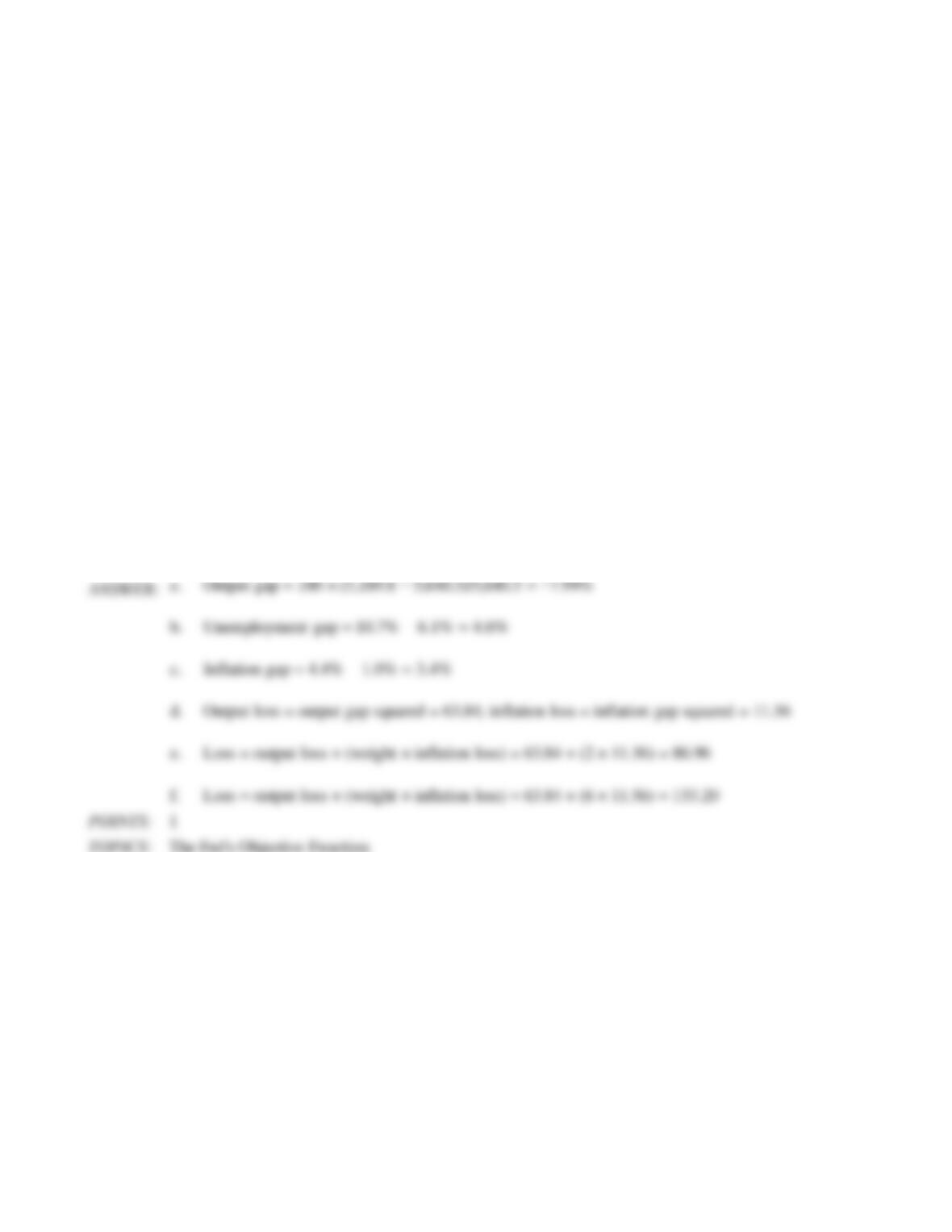
59. In the fourth quarter of 1982, economic statistics showed the following:
Real GDP
Unemployment rate
Inflation rate
$5,189.8 billion
10.7%
4.4%
The conceptual variables corresponding to these data are:
Potential output
Natural rate of unemployment
Ideal inflation rate
$5,640.3 billion
6.1%
1.0%
a. Calculate the output gap in percentage points. Show your work.
b. Calculate the unemployment gap in percentage points. Show your work.
c. Calculate the inflation gap in percentage points. Show your work.
d. Calculate the output loss and the inflation loss. Show your work.
e. Calculate the total loss in the fourth quarter of 1982 if the weight on the inflation loss equals
2. Show your work.
f. Calculate the total loss in the fourth quarter of 1982 if the weight on the inflation loss equals
6. Show your work.
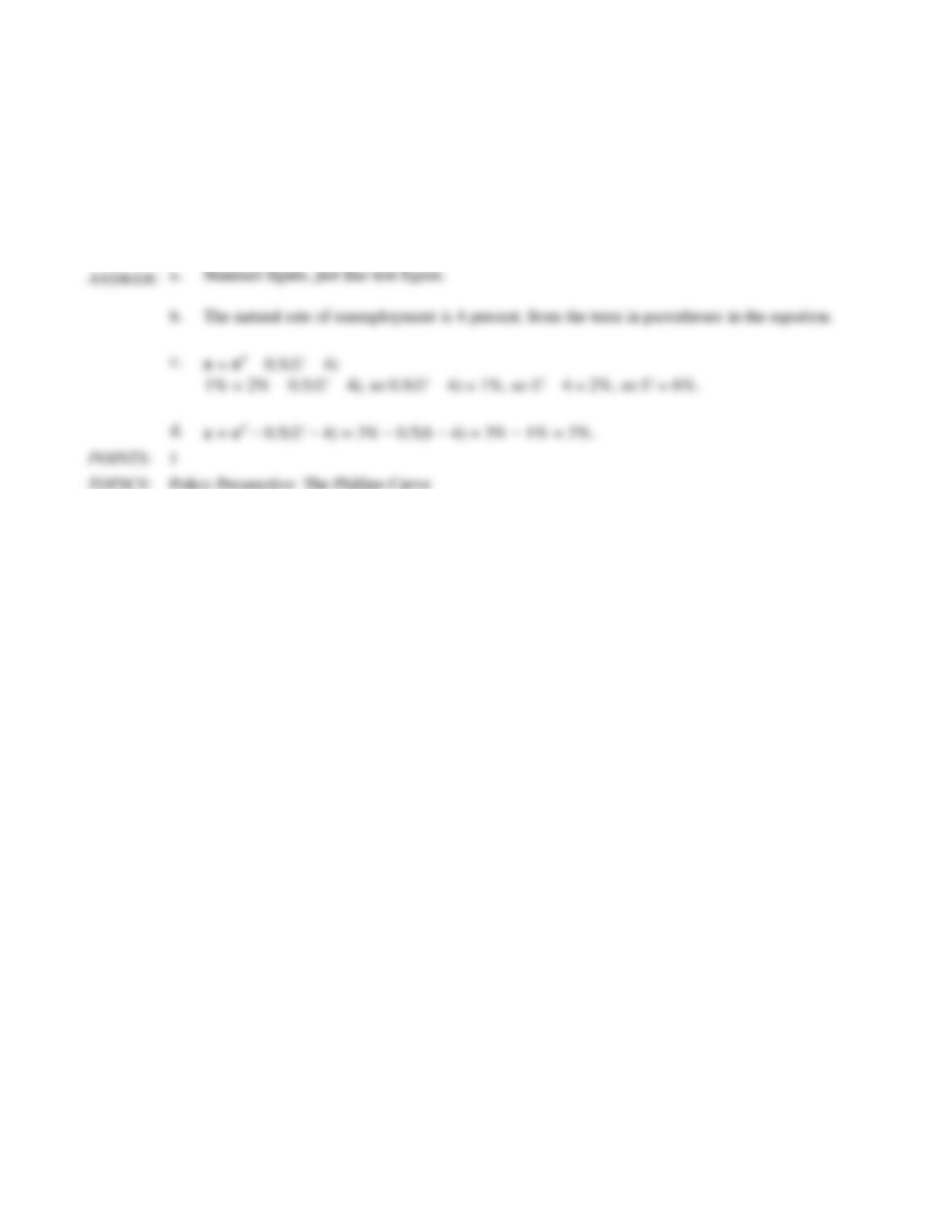
60. The relationship between inflation and unemployment in an economy is given by
π = πe − 0.5(U − 4).
a. What is the value of the natural rate of unemployment?
b. If actual inflation is 1 percent and expected inflation is 2 percent, what is the unemployment rate?
c. If expected inflation is 3 percent and the unemployment rate is 6 percent, what is the inflation rate?
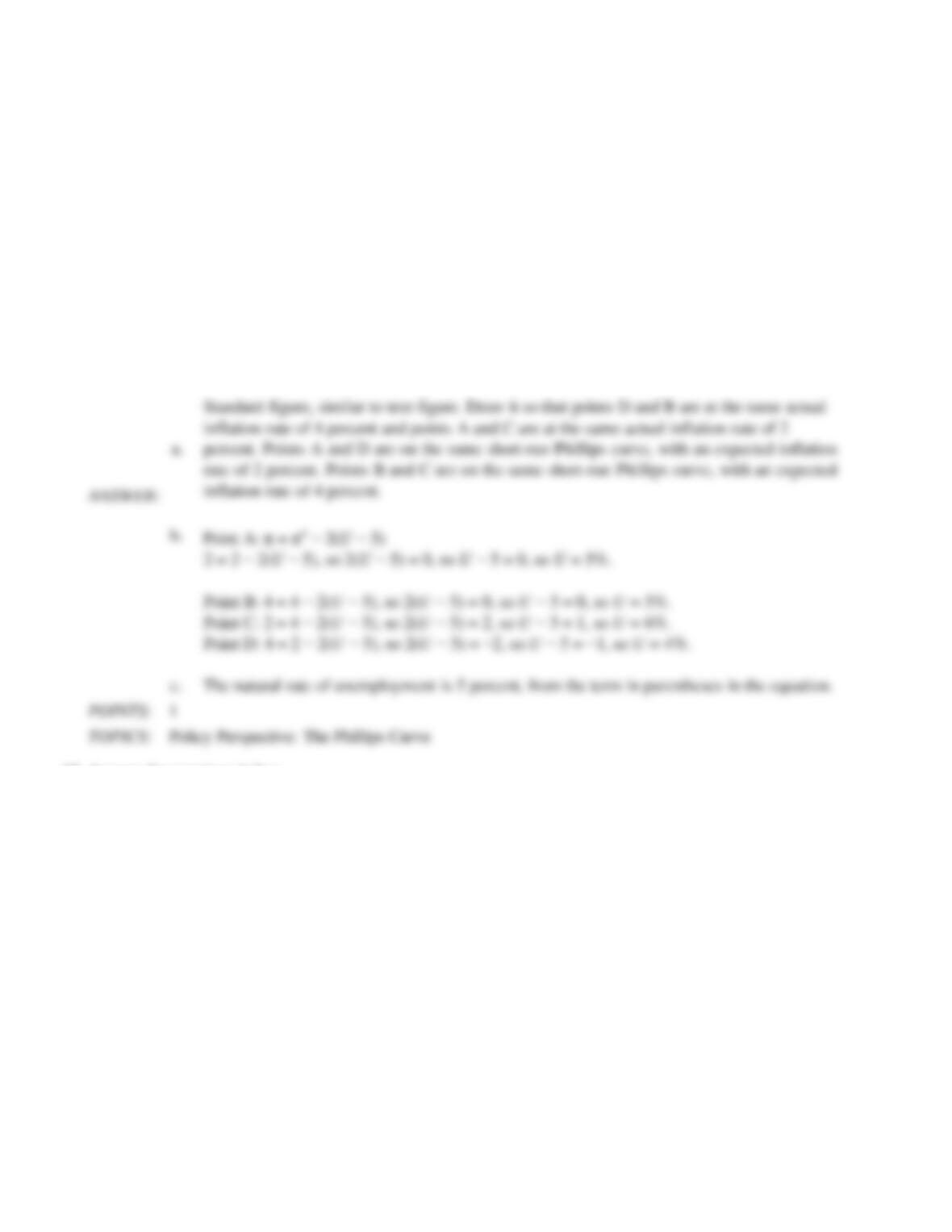
61. Answer the questions below on the basis of the following data.
Actual
inflation
Expected
inflation
Point A:
2%
2%
Point B:
4%
4%
Point C:
2%
4%
Point D:
4%
2%
a. Suppose the equation describing the Phillips curve is
π = πe − 2(U − 5).
For each of the points: A, B, C, and D, calculate the unemployment rate.
b. Based on the equation in part a, what is the numerical value of the natural rate of
unemployment?
62. Answer the questions below.
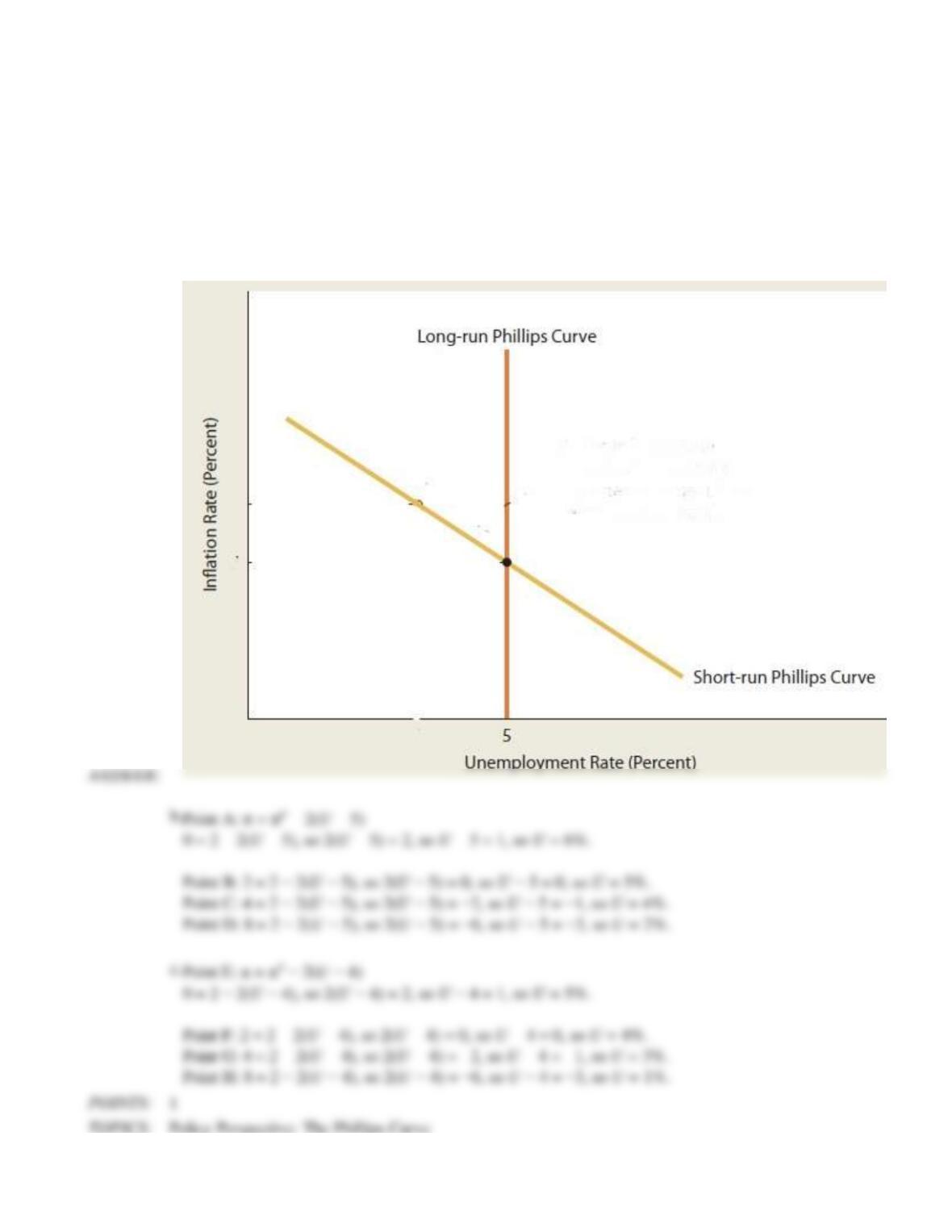
a. Suppose the equation describing the Phillips curve in an economy is
π = πe − 2(U − UN).
If the expected inflation rate is 2 percent and the natural rate of unemployment is 5%,
draw a diagram showing the long–run Phillips curve and the current short-run Phillips
curve.
b.
Calculate the unemployment rate corresponding to each of the following points.
Actual
Point A:
inflation
0%
Point B:
2%
Point C:
4%
Point D:
8%
If the natural rate of unemployment were to fall to 4 percent, but the expected inflation
c.
rate remained unchanged at 2 percent, what would be the unemployment rate
corresponding to each of the following points on the short–run Phillips curve?
Actual
Point E:
inflation
0%
Point F:
2%
Point G:
4%
Point H:
8%
Standard figure, just like text figure.
a.