Chapter 17 – The Central Bank Balance Sheet and the Money Supply Process
99. One of the changes to the Fed’s balance sheet that has occurred in recent years is the
virtual elimination of a category of loans called float. How is float created and why has this
item on the balance sheet almost disappeared?
100. In terms of foreign exchange reserve holdings, how does the Fed’s balance sheet compare
to that of the European Central Bank (ECB)?
Chapter 17 – The Central Bank Balance Sheet and the Money Supply Process
101. Why do most central banks publish their balance sheets so frequently?
102. Suppose a student writes a check in the amount of $300 to the college bookstore for
textbooks. Discuss briefly the impact on the student’s balance sheet, his/her bank’s balance
sheet and the balance sheet of the Fed.
Chapter 17 – The Central Bank Balance Sheet and the Money Supply Process
103. Explain the impact on the Fed’s balance sheet from a $10 million open market purchase
of U.S. Treasury Securities. Be sure to identify which categories of assets and liabilities
change and by what amounts.
104. Follow a $1 billion purchase of U.S. Treasury bonds by the Fed from commercial banks.
Discuss the changes that occur to the balance sheet of the banking system and the balance
sheet of the Fed.
Chapter 17 – The Central Bank Balance Sheet and the Money Supply Process
105. If the Fed sells euros valued at $100 million to commercial banks, will this change the
size of the Fed’s liabilities and assets? Explain.
106. Given the prevalence of electronic payment mechanisms like credit cards and debit cards
and the safety of checks, why is the amount of currency in the hands of the public increasing?
Chapter 17 – The Central Bank Balance Sheet and the Money Supply Process
107. The Treasury usually requires most businesses to regularly deposit taxes withheld from
employees into accounts at designated commercial banks. On a regular basis, the funds in
these accounts are transferred to the Treasury’s account at the Fed. Discuss what is happening
to the balance sheet of the banking system as the businesses are making deposits and these tax
accounts are increasing. What happens to the Banking system’s balance sheet when the funds
are transferred to the Fed?
108. You receive a $1,000 gift from your grandmother when you graduate from college. Your
grandmother withdrew the $1,000 from her checking account and gave you ten $100 bills.
You deposit the ten bills into your checking account. Discuss the impact of these transactions
on your grandmother’s balance sheet, your balance sheet, and the Fed’s balance sheet.
Chapter 17 – The Central Bank Balance Sheet and the Money Supply Process
109. What happens to the monetary base if people, fearing a bank run, convert their checking
deposits into currency holdings?
110. The required reserve rate set by the Fed is ten percent of all checkable deposits. A bank
sells $1 million of U.S. Treasury securities it owns to the Fed. Describe what this transaction
does to the bank’s total reserves, its required reserves and its excess reserves.
Chapter 17 – The Central Bank Balance Sheet and the Money Supply Process
111. If reserves do not earn any interest for the bank, why would a bank hold any excess
reserves?
112. Traveler’s checks have no reserve requirements and are included in M1. When people
travel during the summer and convert some of their checking account deposits into traveler’s
checks, explain what happens to the monetary base.
Chapter 17 – The Central Bank Balance Sheet and the Money Supply Process
113. Why is it more correct to say that the Fed (the central bank) controls the monetary base
than to say it controls the amount of reserves?
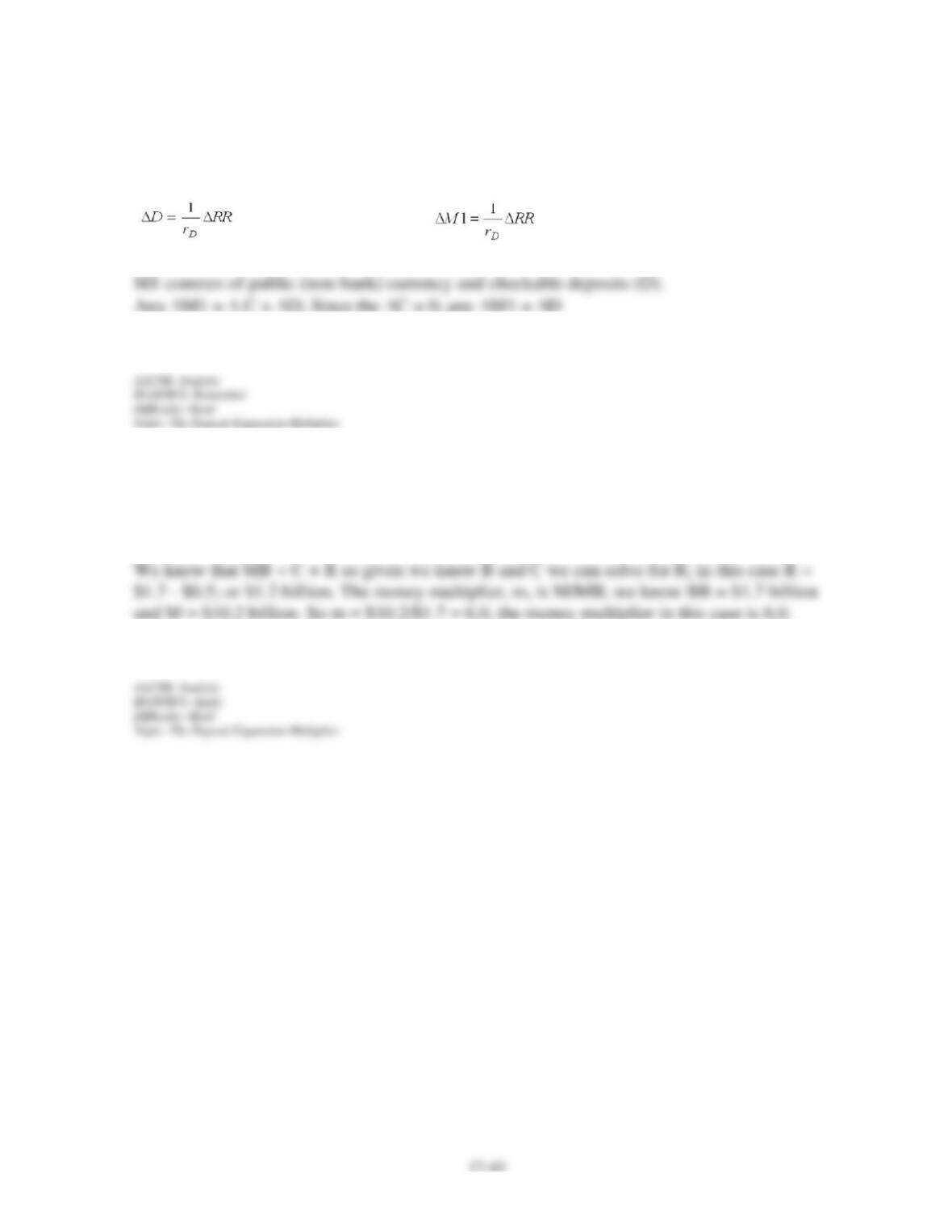
114. If we assume the required reserve rate is ten percent (0.1), and that the public does not
change their currency holdings and that banks do not hold any excess reserves, what will be
the change in deposits resulting from a $150 million open market purchase by the Fed?
Chapter 17 – The Central Bank Balance Sheet and the Money Supply Process
115. Why would it be correct to say that, if we assume that people do not change their
currency holdings and that banks do not hold any excess reserves, the equation
really could be stated as ?
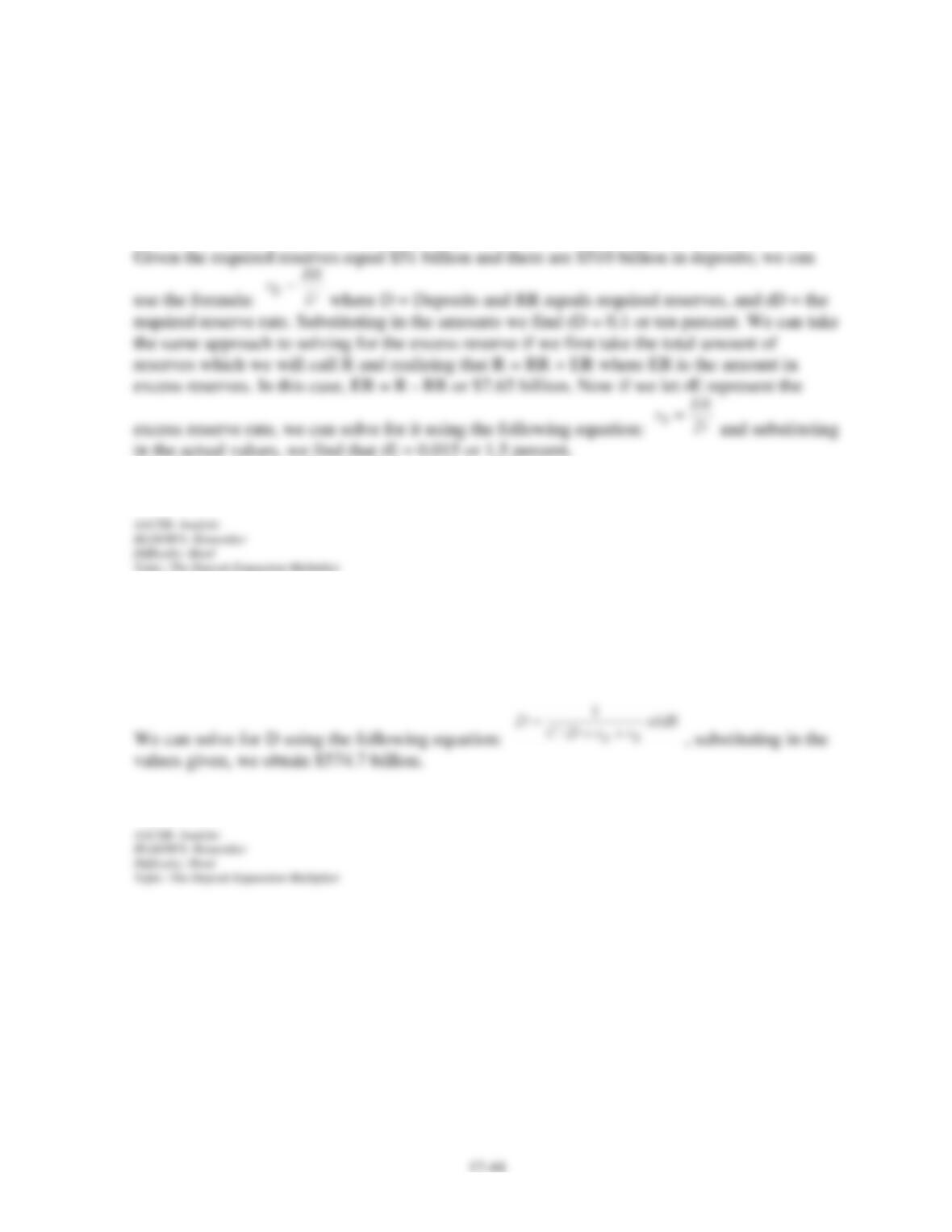
116. What would be the change in deposits resulting from a $10 million open market purchase
by the Fed if we assume the required reserve rate is ten percent (0.1) and that banks will hold
excess reserves in the amount of two percent (0.02) of deposits?
Chapter 17 – The Central Bank Balance Sheet and the Money Supply Process
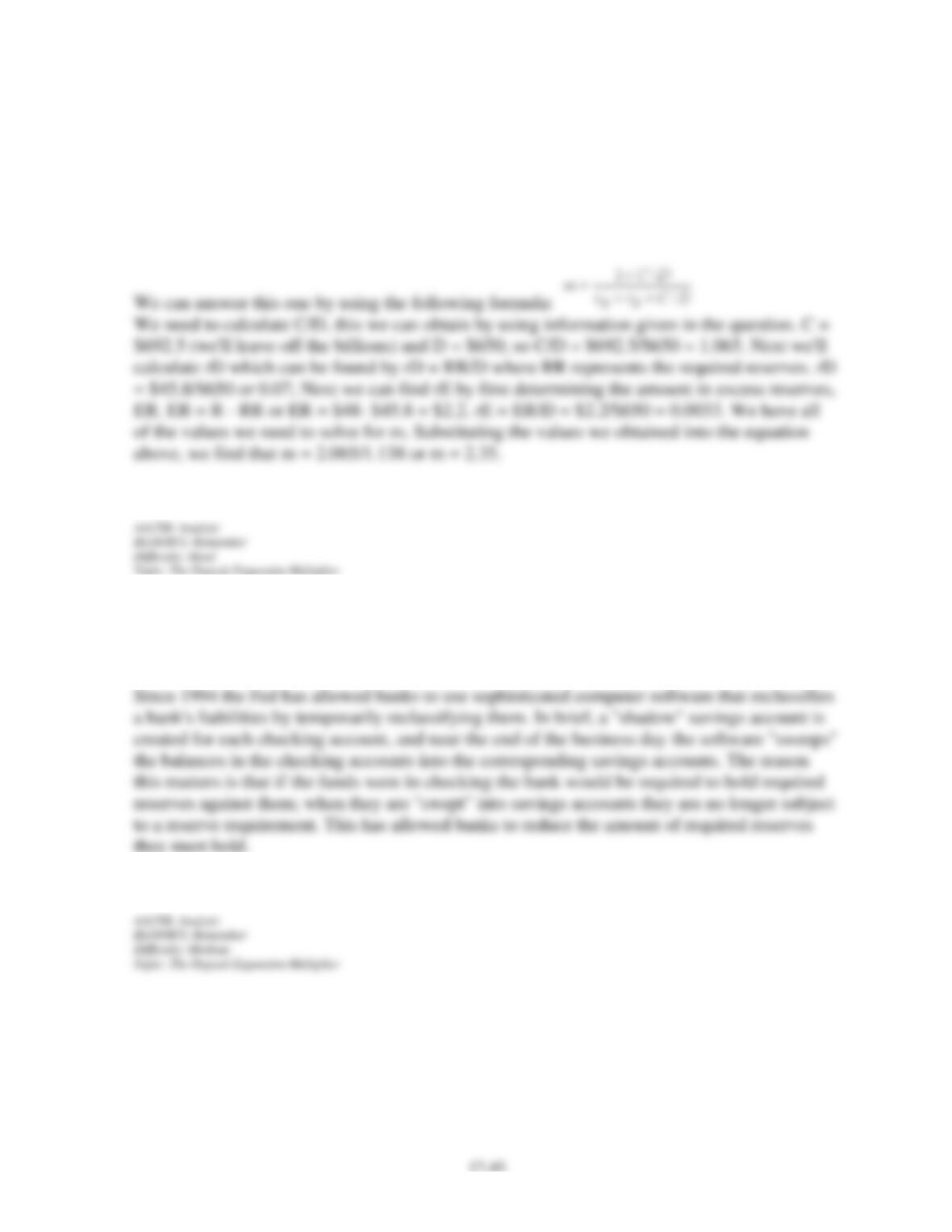
117. Total banking system reserves equal $58.65 billion. The total banking system checkable
deposits subject to reserve requirements are $510 billion. The required reserves are $51
billion. What is the required reserve rate, and what is the excess reserve rate?
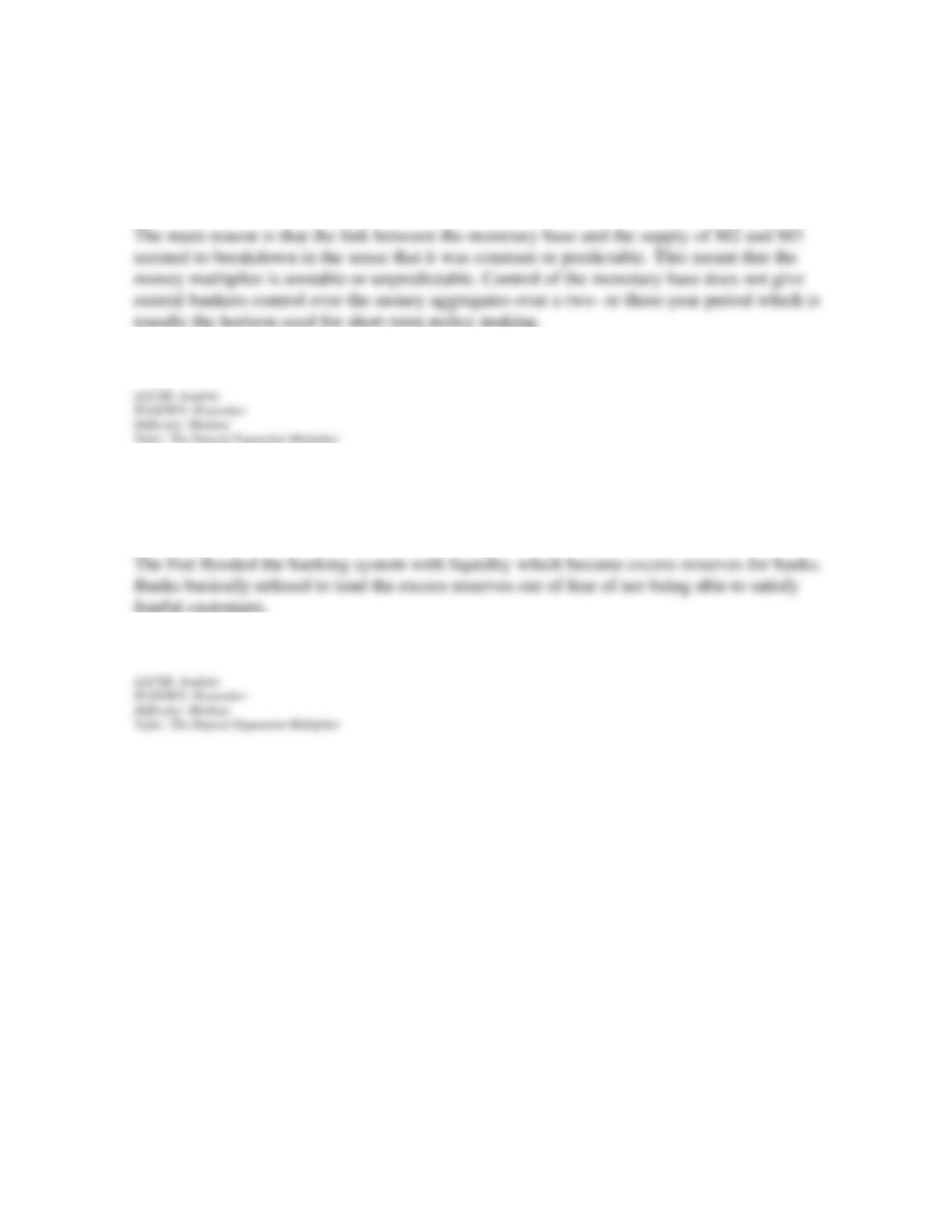
118. What would be the amount of deposits D, given that the monetary base MB = $750
billion, the required reserve rate (rD) = 0.1, the excess reserve rate (rE) = 0.005, and non-bank
currency to deposits (C/D) equaled 1.2?
Chapter 17 – The Central Bank Balance Sheet and the Money Supply Process
119. You are given the following information: Reserves (R) in the banking system amount to
$48 billion, of which $45.8 billion are required. Currency in the hands of the public amounts
to $692.5 billion while checkable deposits amount to $650 billion. Calculate the money
multiplier.
120. What is deposit sweeping and how does it affect the amount of required reserves that
banks must hold?
Chapter 17 – The Central Bank Balance Sheet and the Money Supply Process
17–46
121. What was the main reason the Fed stopped announcing growth targets for money
aggregates in the early 2000s?
122. During the financial crisis of 2007-2009, the deposit expansion multiplier plummeted to
a fraction of its normal value. Why?
Essay Questions
Chapter 17 – The Central Bank Balance Sheet and the Money Supply Process
123. Explain why the Fed making more discount loans to banks, or an open market purchase,
or an increase in foreign exchange reserves all have the same effect on its balance sheet. What
is that effect on the monetary base?
124. Within two days following the September 11, 2001 terrorists attacks, the float in the
banking system increased by almost a hundred fold. Float is an asset of the Fed since it
represents loans being made to banks by the Fed, yet this dramatic increase in float caused the
Fed to actually have to increase reserves to keep the payments system from coming to a halt.
Explain why this was the case.
Chapter 17 – The Central Bank Balance Sheet and the Money Supply Process
125. Considering changes to the monetary base, are discount loans and federal funds
borrowing equivalent? Explain.
126. If banks never held any excess reserves and if the currency holdings of the public never
changed, do you think the Fed would still focus on an interest-rate target?