1. The money supply in an economy equals
a. monetary base plus money multiplier.
b. monetary base divided by money multiplier.
c. money multiplier divided by monetary base.
d. money multiplier multiplied by monetary base.
2. The main asset on the Federal Reserve’s balance sheet is
a. discount loans.
b. securities.
c. monetary base.
d. capital.
3. The main liability on the Federal Reserve’s balance sheet is
a. discount loans.
b. securities.
c. the monetary base.
d. capital.
4. Currency held by the nonbank public plus banks‘ vault cash plus banks’ deposits at the Fed equals
a. the Fed’s capital stock.
b. discount loans.
c. the monetary base.
d. required clearing balances.
5. Green bank has transaction accounts worth $200 million. If the required reserve ratio is 10%, Green bank holds
as required reserves.
a. $220 million
b. $180 million
c. $60 million
d. $20 million
6. Third Bank has reserves of $12.3 million and transaction accounts of $115 million. If required reserves are 10
percent of transactions accounts, Third Bank has excess reserves of
a. −$0.8 million.
b. $0.
c. $0.8 million
d. $0.08 million
7. Consider a bank that has $10 million as reserves, $5million as securities, and $100 million as transaction accounts. If
a customer, who is a government securities dealer, sells $2 million in securities to the Fed
a. the bank’s transaction accounts reduce to $98 million.
b. the bank‘s securities reduce by $4 million.
c. the bank’s reserves increase to $12 million.
d. the bank’s loans reduce by $2 million.
8. The money multiplier equals
a. the money supply divided by the monetary base.
b. currency held by the non–bank public plus banks’ reserves.
c. currency held by the non-bank public plus transaction accounts.
d. M2 divided by M1.
9. M1 money multiplier equals
a. (transaction accounts + currency) ÷ monetary base
b. (transaction accounts – currency) ÷ monetary base
c. (transaction accounts + currency) × monetary base
d. (transaction accounts – currency) × monetary base
10. M2 money multiplier equals
a. (nontransaction accounts + money market funds) ÷ monetary base
b. (M1 + nontransaction accounts – money market funds) × reserves
c. (M2 – money market funds) ÷ excess reserves
d. (M1 + nontransaction accounts + money market funds) ÷ monetary base
11. If a bank in the economy has excess reserves of $3 million, and required reserves are 10 percent of transactions
accounts under the assumptions of the simple multiplier formula, then eventually the money supply will increase by
a. −$3 million.
b. $3 million.
c. $10 million.
d. $30 million.
12. If the M2 multiplier is 8.3, how much would the Fed need to add to the monetary base in order to increase the M2
measure of the money supply by $830 million?
a. $10 million
b. $100 million
c. $1 billion
d. $6.889 billion
13. If the M1 multiplier is 3 and the Fed engages in open-market sales in the amount of $3 billion, then M1 will
a. increase by $1 billion.
b. decline by $1 billion.
c. decline by $9 billion.
d. increase by $9 billion.
14. Another name for the monetary base is
a. commodity money.
b. fiat money.
c. high–powered money.
d. bank reserves.
15. An increase in interest rates
a. decreases the M2 money multiplier.
b. decreases the ratio of excess reserves to transaction accounts held by banks
c. increases the money supply for a given amount of monetary base.
d. increases the ratio of excess reserves to transaction accounts held by banks
16. If the excess reserves held by banks increase, the money multiplier is likely to
a. rise.
b. fall.
c. remain unchanged.
d. rise at first, then decline later.
17. If the M2 multiplier is currently 8 and people decide to increase the ratio of currency they hold relative to the amount
of transactions accounts they hold, the M2 multiplier will
a. not change.
b. increase substantially.
c. decrease.
d. increase slightly.
18. Suppose the M1 multiplier is currently 1.95 and the M2 multiplier is currently 8.03. If the ratio of retail money-market
mutual funds to transaction accounts increases, the M1 multiplier will and the M2 multiplier will .
a. not change; increase
b. increase; also increase
c. decrease; also decrease
d. increase; not change
19. Suppose the M1 multiplier is currently 1.95 and the M2 multiplier is currently 8.03. If people decide to decrease the
ratio of nontransaction accounts they hold relative to the amount of their transactions accounts, the M1 multiplier will
and the M2 multiplier will .
a. not change; decrease
b. increase; also increase
c. decrease; also decrease
d. increase; not change
20. If the ratio of currency to transaction accounts is 2, the ratio of nontransaction accounts to transaction accounts is 5,
the ratio of retail money-market funds to transaction accounts is 1, the ratio of required reserves to transaction
accounts is 0.08, and the ratio of excess reserves to transaction accounts is 0.02, the M1 multiplier is about
a. 1.42.
b. 2.12.
c. 2.81.
d. 4.24.
21. If the ratio of currency to transaction accounts is 2, the ratio of nontransaction accounts to transaction accounts is 5,
the ratio of retail money-market funds to transaction accounts is 1, the ratio of required reserves to transaction
accounts is 0.08, and the ratio of excess reserves to transaction accounts is 0.02, the M2 multiplier is about
a. 1.43.
b. 2.12.
c. 2.83.
d. 4.25.
22. If the Open-Market Desk at the Fed sells securities, the most likely effect is that the
a. federal funds rate decreases.
b. primary credit discount rate decreases.
c. primary credit discount rate increases.
d. federal funds rate increases.
23. If the Open-Market Desk at the Fed buys securities, the most likely effect is that the
a. federal funds rate decreases.
b. primary credit discount rate decreases.
c. primary credit discount rate increases.
d. federal funds rate increases.
24. During the holiday season in December, people use more currency than usual. To offset this increase in demand for
money, the Fed increases the money supply through
a. defensive open-market operations.
b. dynamic open–market operations.
c. discount loans for profit.
d. discount loans for business needs.
25. The Fed undertakes defensive open-market operations
a. when it wants to change fiscal policy.
b. because of seasonal effects or to offset a temporary change in money demand.
c. to offset a permanent change in money demand.
d. when it wants to change monetary policy.
26. If the Fed decides to tighten monetary policy, it uses to the money supply.
a. defensive open-market operations; decrease
b. dynamic open-market operations; increase
c. defensive open-market operations; increase
d. dynamic open-market operations; decrease
27. The Fed undertakes dynamic open-market operations
a. when it wants to change monetary policy.
b. because of seasonal effects.
c. when it wants to change fiscal policy.
d. to offset a temporary change in money demand.
28. The extra collateral the Fed requires above the value of a discount loan is known as
a. the term premium.
b. a haircut.
c. a covenant.
d. secondary credit.
29. If the haricut charged by the Fed is very large
a. banks will be discouraged from borrowing.
b. transaction accounts held by banks increase.
c. the Fed loses a lot of money if banks default on their loans.
d. the Fed’s discount rate rises.
30. A bank in good condition may take out a loan without the Fed questioning the purpose or nature of the loan. Such a
loan is known as
a. a no documentation discount loan.
b. a haircut.
c. a covenant.
d. a primary credit discount loan.
31. A bank in poor condition may take out a loan under close Fed scrutiny. Such a loan is known as
a. a secondary credit discount loan.
b. a haircut.
c. a covenant.
d. a primary credit discount loan.
32. A secondary credit discount loan has an interest rate that is
a primary credit discount loan.
a. 1/4
b. 1/2
c. 1
d. 2
percentage point(s) higher than the interest rate on
33. A is a loan from the Fed to a small agricultural bank.
a. federal credit discount loan
b. secondary credit discount loan
c. primary credit discount loan
d. seasonal credit discount loan
34. Before 2008, an increase in reserve requirements by the Fed
a. would increase the money multiplier.
b. would increase money supply.
c. would decrease the money multiplier.
d. would decrese the amount of reserves held by banks.
35. The amount of nonborrowed reserves equals
a. the monetary base plus the amount of discount loans.
b. the amount of reserves plus the amount of discount loans.
c. the amount of reserves minus the sum of the amount of discount loans and currency.
d. the monetary base minus the sum of the amount of discount loans and currency.
36. Primary credit discount loans for profit will be zero when
a. primary credit discount rate is equal to secondary credit discount rate.
b. primary credit discount rate is greater than federal funds rate.
c. primary credit discount rate is lesser than federal funds rate.
d. primary credit discount rate is equal to nominal short-term interest rate.
37. The supply curve of reserves in an economy is
discount rate.
a. downward-sloping
b. upward-sloping
c. horizontal
d. vertical
when the federal funds rate is less than the primary credit
38. The supply curve of reserves in an economy is horizontal when
a. the federal funds rate is greater than the seasonal credit discount rate.
b. the federal funds rate is less than the secondary credit discount rate.
c. the federal funds rate equals the primary credit discount rate.
d. the federal funds rate is less than the primary credit discount rate.
39. An increase in the amount of discount loans by the Fed
a. increases the money supply by an amount equal to the increase in the loans times the multiplier.
b. decreases the money supply by an amount equal to the increase in the loans times the multiplier.
c. decreases the money supply by an amount greater than the increase in the loans times the multiplier.
d. increases the money supply by an amount lower than the increase in the loans times the multiplier.
40. The sum of seasonal credit discount loans, secondary credit discount loans, and primary credit discount loans that
banks take out because of temporary problems are known as
a. unsubstantiated discount loans.
b. discount loans for profit.
c. discount loans that arise for business needs.
d. inelastic discount loans.
41. If the federal funds rate is below its target, the Fed is likely to securities in the open market, which will cause
the federal funds rate to .
a. buy; increase
b. buy; decrease
c. sell; decrease
d. sell; increase
42. If the federal funds rate equals the primary credit discount rate, the Fed is likely to securities in the open
market, which will cause the federal funds rate to .
a. buy; increase
b. buy; decrease
c. sell; decrease
d. sell; increase
43. If the Open-Market Desk at the Fed buys securities when the federal funds rate is below the primary credit discount
rate, the most likely effect is that the
a. federal funds rate decreases.
b. primary credit discount rate decreases.
c. primary credit discount rate increases.
d. federal funds rate increases.
44. A is a situation in which additions to an economy’s monetary base do not lead to an increase in the economy’s
money supply or decline in the interest rate.
a. liquidity trap
b. recession
c. financial crisis
d. credit crunch
45. Which of the following is true of an economy in a liquity trap?
a. The money supply in the economy increases rapidly as additions are made to the monetary base.
b. The economy’s nominal short-term interest rates become close to zero.
c. The banks in the economy do not hold any reserves.
d. The economy’s interest rates decline when there is an increase in the monetary base.
46. Which of the following is true of an economy that has hit the zero lower bound?
a. The money supply in the economy increases rapidly as additions are made to the monetary base.
b. Any increase increase in its monetary base is exactly offset by a decline in its money multipliers. c.
Any short-term bond would provide a return that is much lower than the return from holding cash. d.
The economy’s interest rates decline when there is an increase in the monetary base.
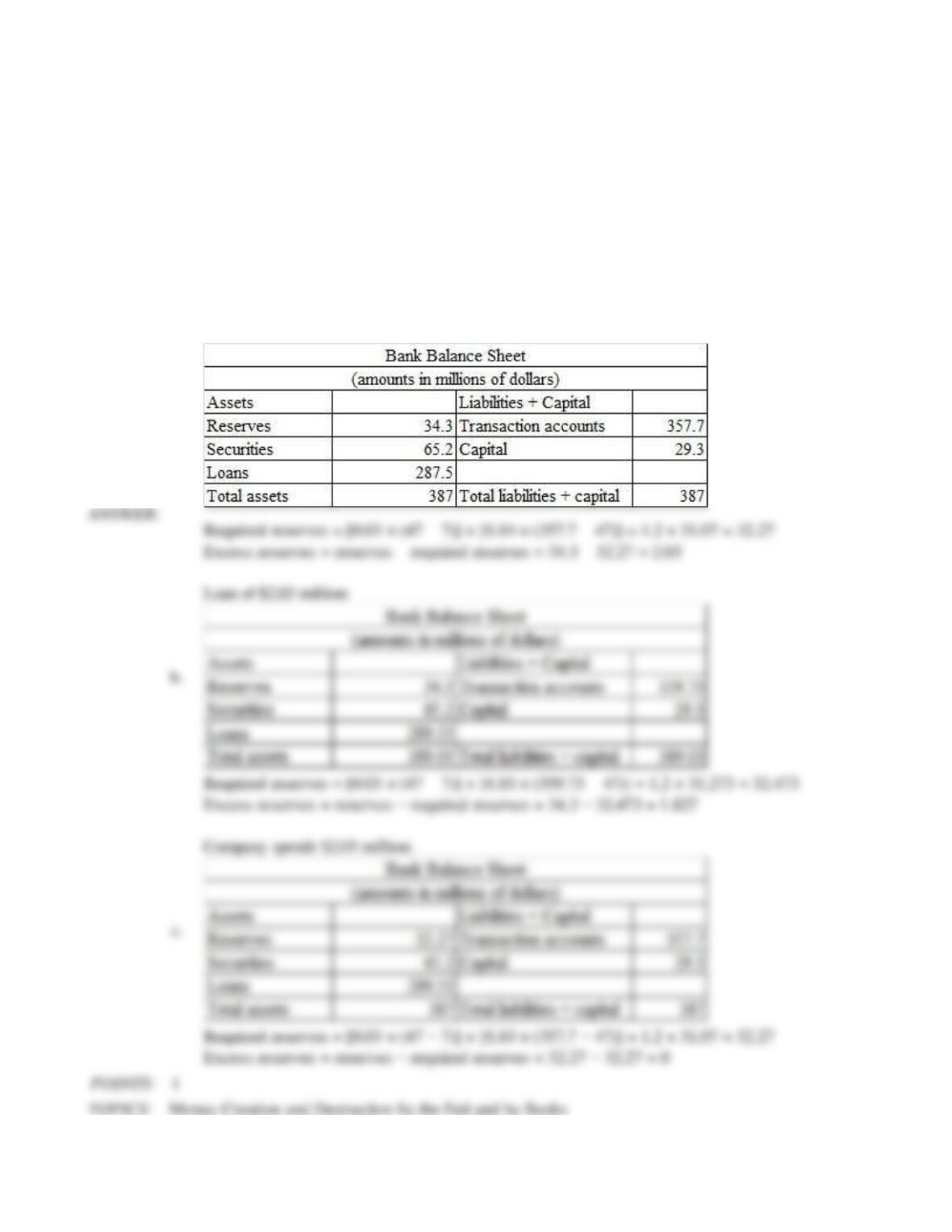
47. A bank has reserves of $34.3 million, securities of $65.2 million, and loans of $287.5 million. It has transaction
accounts totaling $357.7 million and capital of $29.3 million. The reserve requirement is 0 percent on the first $7
million of transaction accounts, 3 percent on transaction accounts from $7 million to $47 million, and 10 percent on
transaction accounts above $47 million.
a. Draw up the bank’s balance sheet and calculate the bank’s excess reserves.
Suppose the bank makes a loan equal to the amount of its excess reserves that you calculated
b. in part a. Draw up the bank’s balance sheet before the customer spends the proceeds of the
loan. What are the bank’s excess reserves?
c. Now suppose the customer spends the proceeds of the loan. Draw up the bank’s balance
sheet and calculate its excess reserves.
a.
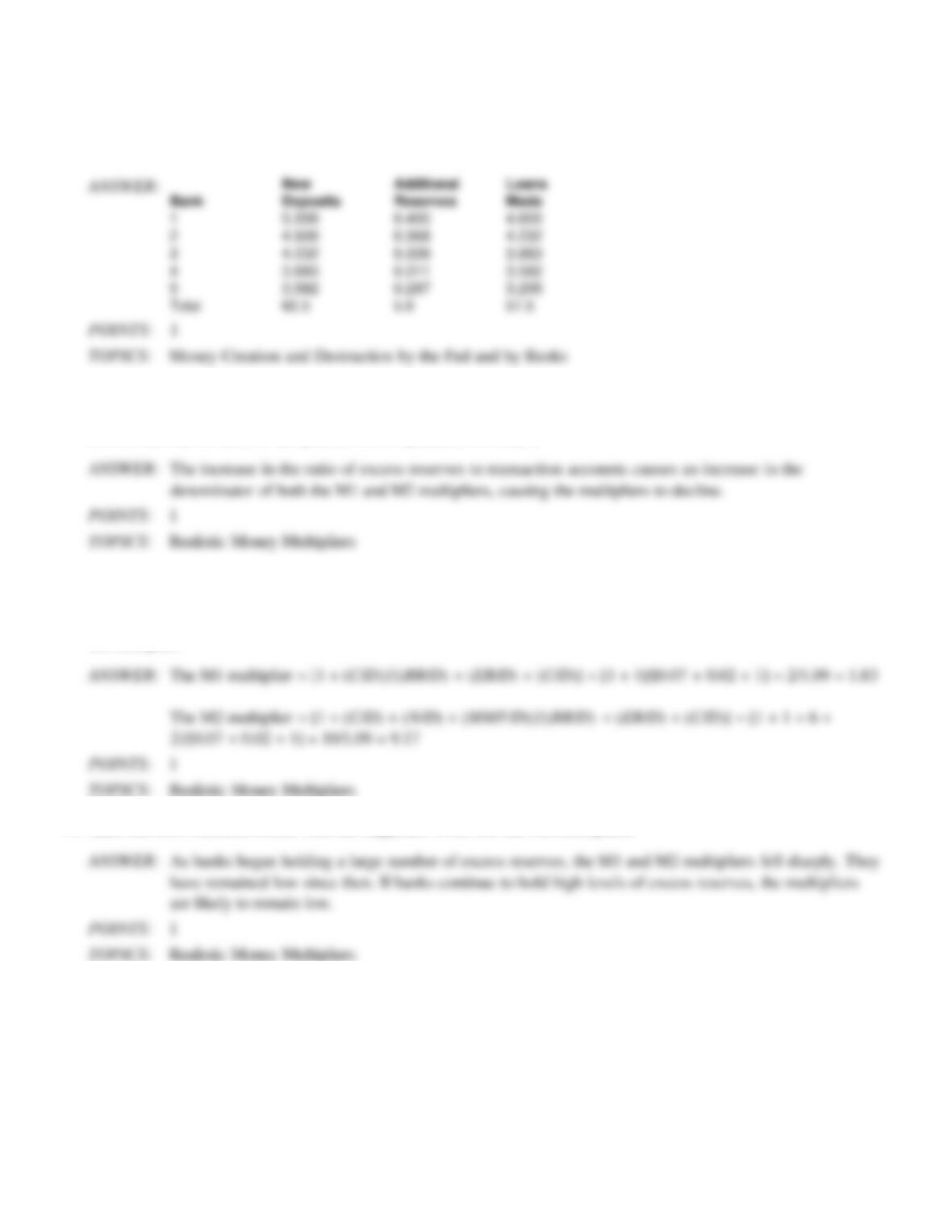
48. The Fed makes an open-market purchase of $5 million in an economy in which no bank holds excess reserves and
the assumptions of the simple multiplier hold with a reserve requirement of 8 percent. Draw up a table to show the
amount of new deposits in each new bank (show the amounts in the first five of them), the additional reserves held
by that bank, and the loans made by that bank, as each successive bank lends out its excess reserves. Finally,
calculate the total amount of new deposits, of additional reserves, and of loans made in the economy.
49. Suppose the M1 multiplier is currently 2.23 and the M2 multiplier is currently 7.95. If banks decide to increase the
ratio of excess reserves they hold relative to the amount of transaction accounts they hold, how will the multipliers
for M1 and M2 be affected (in qualitative, not quantitative, terms)?
50. If the ratio of currency to transaction accounts is 1, the ratio of nontransaction accounts to transaction accounts is 6,
the ratio of retail money-market funds to transaction accounts is 2, the ratio of required reserves to transaction
accounts is 0.07, and the ratio of excess reserves to transaction accounts is 0.02, calculate the M1 multiplier and the
M2 multiplier.
51. Since the 2008 financial crisis, what has happened to the M1 and M2 multipliers?
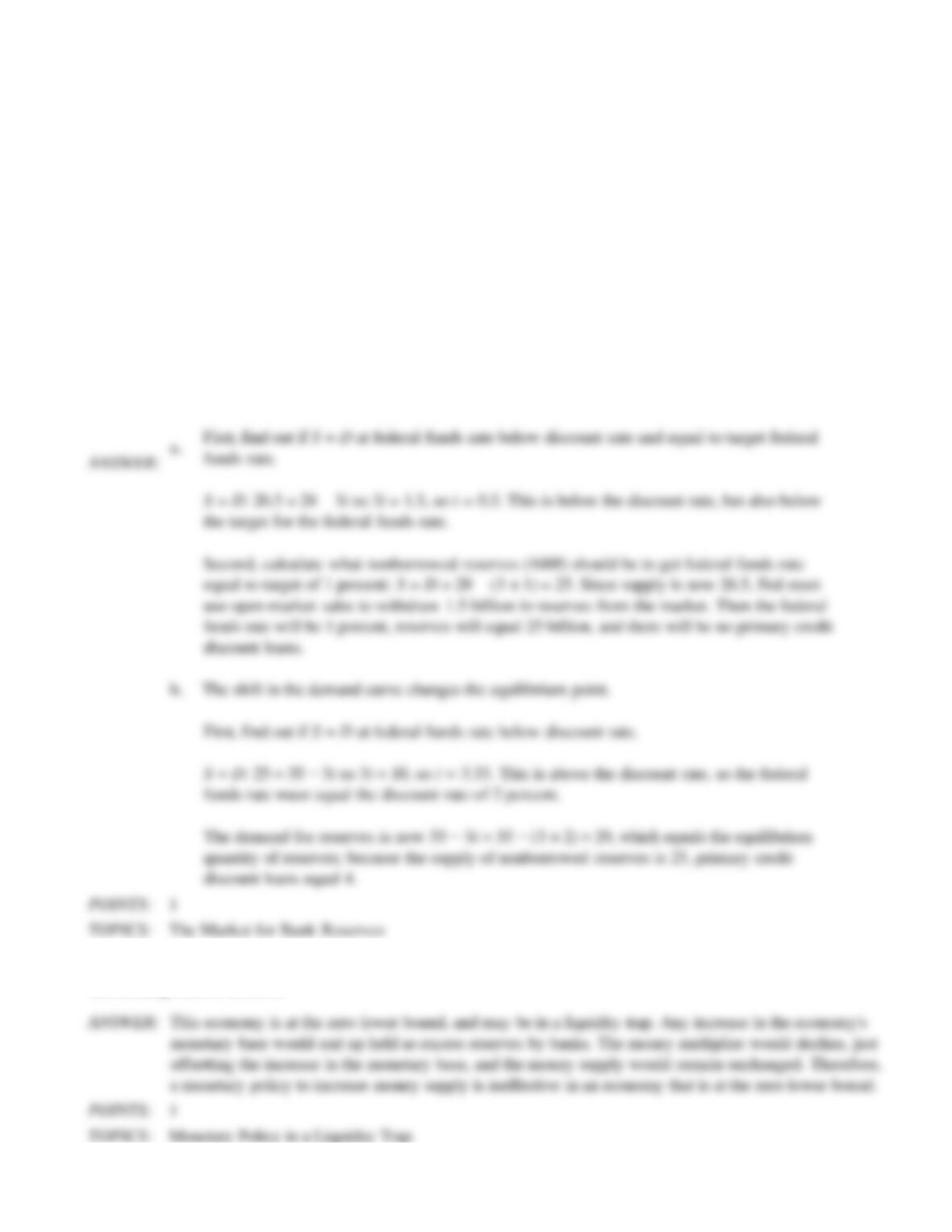
52. Suppose the Fed’s Open-Market Desk thinks the downward-sloping portion of the demand for reserves is given by
the equation
D = 28 − (3 × i),
where i is the federal funds rate in percent and D is expressed in billions of dollars. Suppose the Fed is currently
supplying $26.5 billion in nonborrowed reserves. There are no secondary or seasonal credit discount loans. The
primary credit discount rate is currently set at 2 percent and the interest rate on reserves is 0.30 percent. The Fed’s
target for the federal funds rate is 1 percent.
Does the Desk need to change the supply of reserves in the market? How much does it need
a. to add or withdraw from the market? After carrying out its daily actions, what will be the
equilibrium amount of reserves and discount loans?
b. Suppose the demand curve for reserves shifts to
D = 35 − (3 × i).
The Fed does not realize that the demand curve has shifted, so it keeps the supply of
nonborrowed reserves at the level you determined in part a. Calculate the equilibrium federal
funds rate, reserves, and the amount of primary credit discount loans.
53. Discuss the effectiveness of a monetary policy in an economy in which banks are indifferent between holding bonds
and holding cash as reserves.
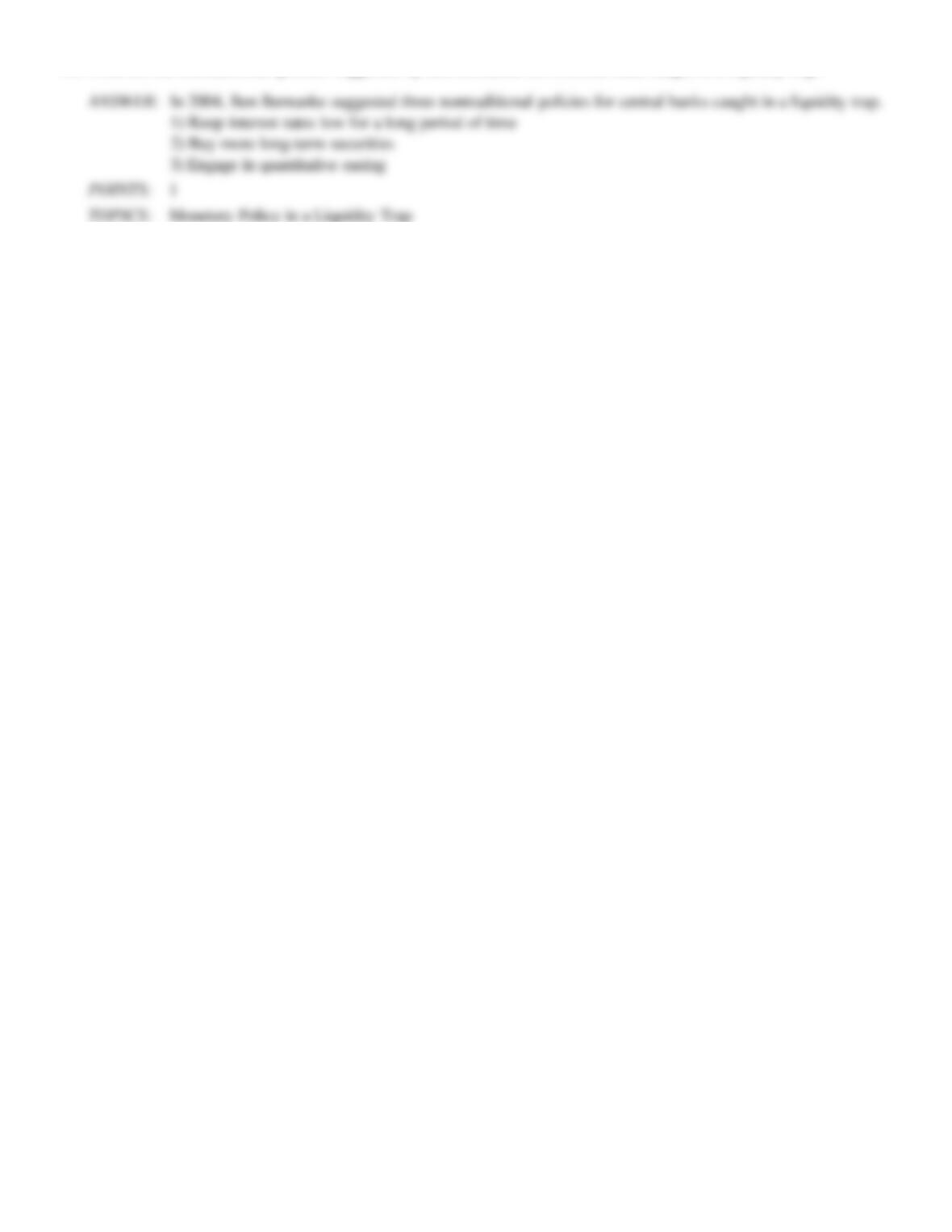
54. What are the nontraditional policies suggested by Ben Bernanke for a central bank caught in a liquidity trap?