1. An unexpected change in an exogenous variable is known as
a. a shock.
b. a fluctuation.
c. an anachronism.
d. a calibration.
2. Which of the following statements is true?
a. A shock affects all countries to the same extent.
b. Some shocks are positive and some are negative.
c. Some shocks benefit one country and harm others.
d. The same shock cannot affect more than one country at once.
3. In the late 1980s and the 1990s, the correlation between output growth in the
a. United States and Europe rose while the correlation between output growth between the United States and
Japan fell.
b. United States and Europe fell while the correlation between output growth between the United States and
Japan rose.
c. United States and Europe and the United States and Japan, both fell.
d. United States and Europe and the United States and Japan, both rose.
4. A correlation of
inversely related.
a. 0
b. 1
c. 100
d. less than 0
between output growth in two regions would mean that output in the two regions are
5. A correlation of between output growth in two regions would mean that output growth in both regions
changed at exactly the same time and by the same proportionate amount.
a. 0
b. less than 0
c. 1.0
d. 100
6. Shocks are transmitted internationally by all of the following mechanisms EXCEPT by
a. trade effects.
b. interest-rate effects.
c. exchange-rate effects.
d. expected-inflation effects.
7. If one country is hit with a shock that increases its income and its demands for imported goods and services from
other countries, thus increasing aggregate demand in those countries, then the business cycle is being transmitted
internationally through effect.
a. a trade
b. an interest-rate
c. an exchange-rate
d. an expected-inflation
8. A country engages in a contractionary monetary policy that causes its income to decline and its interest rate to rise.
This causes investors from other countries to increase their financial investments in that country, causing the interest
rate in the investors’ countries to rise. In this case, the business cycle is being transmitted internationally through
____ effect.
a. a trade
b. an interest-rate
c. an exchange-rate
d. an expected-inflation
9. If one country is hit with a shock that increases the value of its currency and causes its net exports to decline and
the net exports and income of other countries to rise, then the business cycle is being transmitted internationally
through effect.
a. a trade
b. an interest-rate
c. an exchange-rate
d. an expected-inflation
10. If 1 euro is equal to 1.20 dollars,
a. $1 would trade for 0.83 euros.
b. $1 would trade for 2.20 euros.
c. $1 would trade for 0.20 euros
d. $1 would trade for 0.33 euros.
11. From 1970 to 2000, the U.S. dollar
a. appreciated against the U.K. pound and depreciated against the Canadian dollar.
b. depreciated against the U.K. pound and appreciated against the Canadian dollar.
c. appreciated against both the U.K. pound and the Canadian dollar.
d. depreciated against both the U.K. pound and the Canadian dollar.
12. From 1970 to 2000, the U.S. dollar against the Japanese yen and against the German mark.
a. depreciated against both the Japanese yen and the German mark.
b. appreciated against both the Japanese yen and the German mark.
c. depreciated against the Japanese yen and appreciated against the German mark.
d. appreciated against the Japanese yen and depreciated against the German mark.
13. If the nominal exchange rate is 5 French francs per U.S. dollar, then the exchange rate can also be written as
a. 5 dollars per franc.
b. 0.5 dollars per franc.
c. 0.25 dollars per franc.
d. 0.2 dollars per franc.
14. In 1990, exchange rates were: 1.61 U.S. dollars per U.K. pound and 144 Japanese yen per U.S. dollar. In 1980, the
exchange rates were: 2.22 U.S. dollars per U.K. pound and 240 Japanese yen per U.S. dollar. Based on these data,
from 1980 to 1990 the U.S. dollar
a. depreciated versus the U.K. pound and appreciated versus the Japanese yen.
b. appreciated versus the U.K. pound and depreciated versus the Japanese yen.
c. depreciated versus both the U.K. pound and the Japanese yen.
d. appreciated versus both the U.K. pound and the Japanese yen.
15. In 1990, exchange rates were: 1.61 U.S. dollars per U.K. pound and 144 Japanese yen per U.S. dollar. In 2000, the
exchange rates were: 1.62 U.S. dollars per U.K. pound and 102 Japanese yen per U.S. dollar. Based on the data,
a. the U.S. dollar appreciated versus the U.K. pound and the U.S. dollar depreciated versus the Japanese yen.
b. the U.S. dollar appreciated versus both the U.K. pound and the Japanese yen.
c. the U.S. dollar depreciated versus the U.K. pound and the U.S. dollar appreciated versus the Japanese yen.
d. the U.S. dollar depreciated versus both the U.K. pound and the Japanese yen.
16. Suppose the only good traded between Mexico, the U.S., and Brazil is beef, which is produced by all three countries.
If the cost of producing a pound of beef is 5 pesos in Mexico, 2 dollars in the U.S., and 1 real in Brazil, the exchange
rates based on the law of one price would be pesos per dollar and dollars per real.
a. 2.5; 2
b. 2.5; 0.5
c. 0.4; 0.5
d. 0.4; 2
17. Suppose, the cost of production of a widget in Mexico is 5 pesos. Assume that initially the exchange rate between
the peso and the dollar is 2 pesos per dollar. Later, the exchange rate changes to 2.5 pesos per dollar. In the initial
situation, a widget sold in the U.S. would be priced at ; after the change in the exchange rate, the widget would
be priced at .
a. $2.50; $2.00
b. $2.50; $3.12
c. $0.50; $0.40
d. $0.40; $0.50
18. When a country’s currency appreciates,
a. the prices of its exports and imports both rise.
b. the price of its exports rise, and the price of its imports fall.
c. the prices of its exports and imports both fall.
d. the price of its exports fall and the price of its imports rise.
19. When a country’s currency depreciates,
a. the prices of its exports and imports both rise.
b. the prices of its exports rise and the prices of its imports fall.
c. the prices of its exports and imports both fall.
d. the prices of its exports fall and the prices of its imports rise.
20. Suppose, that participants in the underground economy in Europe suddenly decide to switch from using dollars to
using euros. Thus, they supply a huge volume of dollars to the market in exchange for euros. As a result,
a. the dollar appreciates and the euro depreciates.
b. the dollar and the euro both appreciate.
c. the dollar depreciates and the euro appreciates.
d. the dollar and the euro both depreciate.
21. If the supply of dollars in exchange for euro increases,
a. the dollar depreciates against the euro.
b. the dollar appreciates against the euro.
c. the exports of U.S. to Europe becomes costlier.
d. the demand for European goods increase in the U.S.
22. If only one good is traded between two countries and the price of the good is the same in both countries when
expressed in units of the same currency, then
a. people have rational expectations.
b. both countries have the same monetary policy.
c. there is interest-rate parity.
d. the law of one price holds.
23. If the exchange rate equals the ratio of price indexes in two countries, there is said to be
a. one price fits all.
b. absolute purchasing-power parity.
c. relative purchasing–power parity.
d. interest-rate parity.
24. Under absolute purchasing-power parity,
a. the exchange rate equals 1 if both the countries have equal price indices.
b. interest-rate parity holds.
c. relative purchasing–power parity cannot hold.
d. a currency depreciates relative to another currency by the amount by which the inflation rate is lower in the
first country than in the second country.
25. Under relative purchasing-power parity,
a. the exchange rate equals the ratio of price indexes in two countries.
b. interest-rate parity holds.
c. absolute purchasing-power parity also holds.
d. a currency depreciates relative to another currency by the amount by which the inflation rate is higher in the
first country than in the second country.
26. If inflation in Country X is 2 percent and 3 percent in the United States, the dollar would
power parity holds.
a. depreciate by 1 percent
b. depreciate by 5 percent
c. appreciate by 1 percent
d. appreciate by 5 percent
if relative purchasing
27. If the ratio of the price level in the U.S. to the price level in Canada is 1.3 and the nominal exchange rate is 0.75
Canadian dollars per U.S. dollar, then the real exchange rate is
a. 1.30.
b. 1.75.
c. 0.975.
d. 0.25.
28. If three bushels of rice produced in Japan trade for 2 bushels of rice produced in Guatemala, the
1.5.
a. inflation rate
b. interest rate
c. nominal exchange rate
d. real exchange rate
is equal to
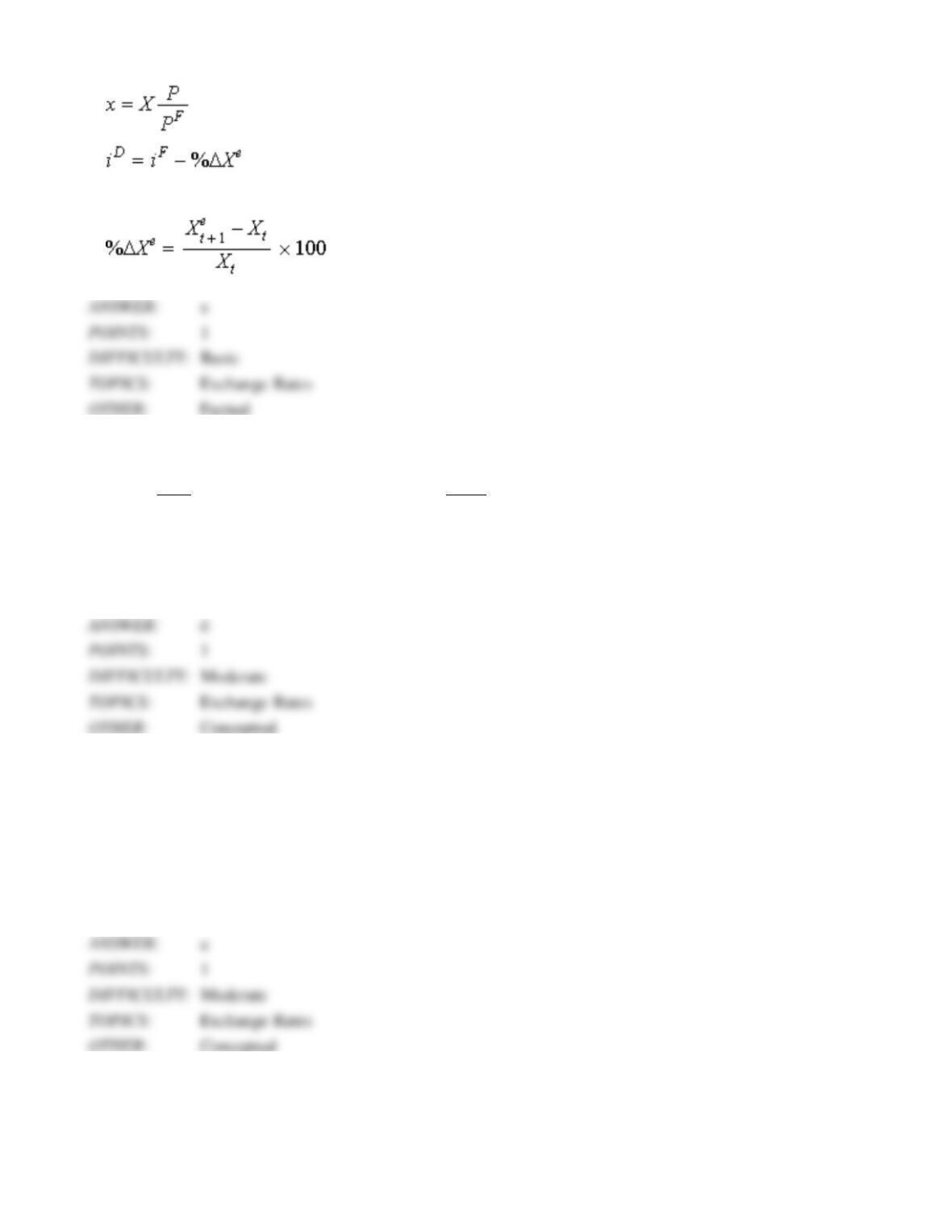
29. The real exchange rate is best described by the equation
a.
.
b.
.
c. %ΔX = %Δx + πF − π.
d.
.
30. A bushel of rice costs 500 yen in Japan and 100 pesos in Mexico. If someone could sell a bushel of rice in Japan for
yen, take those yen and exchange them for pesos, then buy a bushel of rice in Mexico, the nominal exchange rate
would be and the real exchange rate would be .
a. 5 pesos per yen; 6 pesos per yen.
b. 1 peso per yen; 4 pesos per yen.
c. 1 peso per yen; 2 pesos per yen.
d. 5 pesos per yen; 1 peso per yen.
31. The real exchange rate between the domestic currency of a country and the foreign currency increases by 2
percent. If the domestic price level increases by 4 percent while the foreign price level increases by 3 percent, the
nominal exchange rate will
a. increase by 1 percent.
b. decrease by 3 percent
c. increase by 2.5 percent
d. decrease by 3 percent
32. Suppose the inflation rate in Canada is 1 percent and the inflation rate in Mexico is 3 percent. If the nominal
exchange rate in terms of Mexican pesos per Canadian dollar falls by 4 percent, by how much will the real exchange
rate (in terms of Mexican goods per Canadian good) change?
a. +6 percent
b. +2 percent
c. −2 percent
d. −6 percent
33. If the annual inflation rate is 3 percent in France and 5 percent in Italy, by how much will the real exchange rate
change over a year? Assume that both countries use the euro so their nominal exchange rate cannot change.
a. 2 percent
b. 3/5 percent
c. −3/5 percent
d. −2 percent
34. suggests that the interest rate on a domestic bond equals the interest rate on a foreign bond minus the
expected appreciation of the domestic currency.
a. One–price–fits-all condition
b. Absolute purchasing-power parity
c. Relative purchasing-power parity
d. Interest-rate parity.
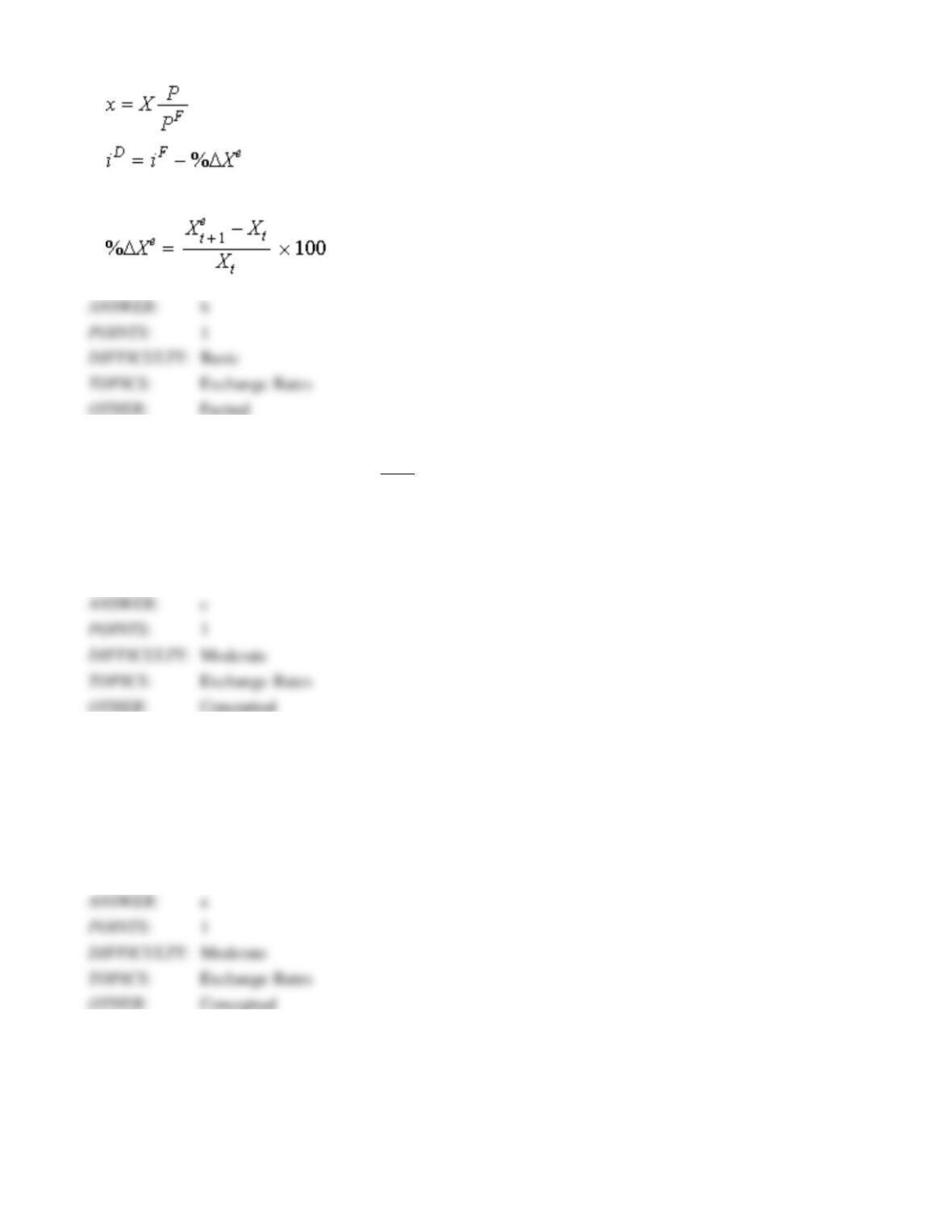
35. Interest-rate parity is best described by the equation
a.
.
b.
.
c. %ΔX = %Δx + πF − π.
d.
.
36. If interest-rate parity holds and the interest rate in Japan is 3 percent while in France it is 5 percent, then we would
expect the yen per euro exchange rate to percent.
a. appreciate by 8
b. appreciate by 2
c. depreciate by 2
d. depreciate by 8
37. Suppose the interest rate in Japan is 2 percent and the yen per euro exchange rate is expected to appreciate by 1
percent. If interest-rate parity holds, then the interest rate in France is
a. 3 percent.
b. 1 percent.
c. −1 percent.
d. −3 percent.
38. An investor bought a one-year government bond of Country X with a nominal interest rate of 6 percent. If the
current exchange rate between the U.S. dollar and Country X’s currency is 50 units per dollar and the expected
exchange rate after a year is 48 units per dollar, what is the expected dollar return of investing in Country X’s bond?
a. 4 percent
b. 3 percent
c. 8 percent
d. 12 percent
39. In broad nominal terms, the dollar
a. depreciated against other currencies from 1988 to 2001 and from 2001 to 2008.
b. depreciated against other currencies from 1988 to 2001 and appreciated against those currencies from 2001 to
2008.
c. appreciated against other currencies from 1988 to 2001 and from 2001 to 2008.
d. appreciated against other currencies from 1988 to 2001 and depreciated against those currencies from 2001 to
2008.
40. During the 2008 financial crisis, the dollar in nominal terms.
a. appreciated sharply
b. appreciated slightly
c. depreciated slightly
d. depreciated sharply