
36. Researchers who support the RBC model found out that an RBC model could account for as much as
fluctuations in output growth.
a. 70 percent
b. 60 percent
c. 50 percent
d. 75 percent
37. Critics of RBC models argue that
a. they cannot be solved analytically.
b. are subject to measurement errors.
c. it is not possible to replicate the models.
d. the models are estimated imprecisely.
38. In RBC models, the government
a. is the main source of business cycles.
b. plays little role in the business cycle.
c. can affect the business cycle through predictable fiscal policy.
d. can affect the business cycle through predictable monetary policy.
of the

39. Which of the following is the third step in the procedure of conducting a research by researchers using a DSGE
model?
a. To match up the model with economic data, using statistical techniques to calculate the size of shocks that
occur.
b. To pose the question to be answered.
c. To simulate the model and compare statistical properties of the model with those of the data.
d. To develop a model containing major elements needed to answer the question, and to analyze the decision that
each economic agent must face.
40. DSGE models that contain households and firms that are identical are known as
a. heterogeneous-agent models.
b. homogeneous-agent models.
c. dynamic models.
d. multi-layered models.
41. DSGE models that contain many different types of households and firms are known as
a. heterogeneous-agent models.
b. homogeneous-agent models.
c. dynamic models.
d. multi-layered models.

42. A simple statistical model that assumes that the value of a variable at any date depends just on its own past values
plus an error term is known as a
a. vector autoregression (VAR) model.
b. univariate time-series model.
c. structural VAR model.
d. structural equilibrium model.
43. A statistical model that assumes that the value of a variable at any date depends on its own past values, plus the past
values of other variables, plus an error term is known as a
a. vector autoregression (VAR) model.
b. univariate time-series model.
c. structural VAR model.
d. structural equilibrium model.
44. A disadvantage of univariate time-series models and VARs is
a. they cannot be used easily to analyze the effects of monetary policy.
b. they are based on classical, rather than Keynesian, economic theory.
c. they provide poor forecasts.
d. they are not based on data.

45. Which of the following is a criticism leveled against VAR models?
a. VAR models are based on classical rather than Keynesian economic theory.
b. Var models are not based on data.
c. VAR models are unable to isolate the effects of policy variables because those variables are not exogenous.
d. VAR models isolate the effects of policy variables because those variables are exogenous variables.
46. In a structural VAR, a restriction that describes the impact of the current-period value of one variable on the
current-period value of another variable is known as a restriction.
a. contemporaneous
b. long-run
c. short-run
d. structural
47. In a structural VAR, a restriction that describes the impact of the current-period value of one variable on the value
of another variable in the distant future is known as a restriction.
a. contemporaneous
b. long-run
c. short-run
d. structural

48. An economy has fifty households, all of which have incomes of $25,000 each in period 2. The twenty-five poor
households have incomes of $10,000 each in period 1, while the twenty-five rich households have incomes of $20,000
each in period 1. Assume that the price of the good is $1 in both periods. Suppose that each household decides that
its consumption in period 1 will equal 50 percent of the present value of its income from both periods.
Calculate the present value of income for poor households as a function of the interest rate.
a. Calculate the amount that poor households will spend on consumption, as a function of the
interest rate. Calculate the amount that poor households will save as a function of the real
interest rate. Show your work.
Calculate the present value of income for rich households as a function of the interest rate.
b. Calculate the amount that rich households will spend on consumption, as a function of the
interest rate. Calculate the amount that rich households will save as a function of the real
interest rate. Show your work.
Given the equations you calculated for savings for each type of household and assuming that
c. the households borrow from each other, find the equilibrium value of the interest rate. Show
your work.
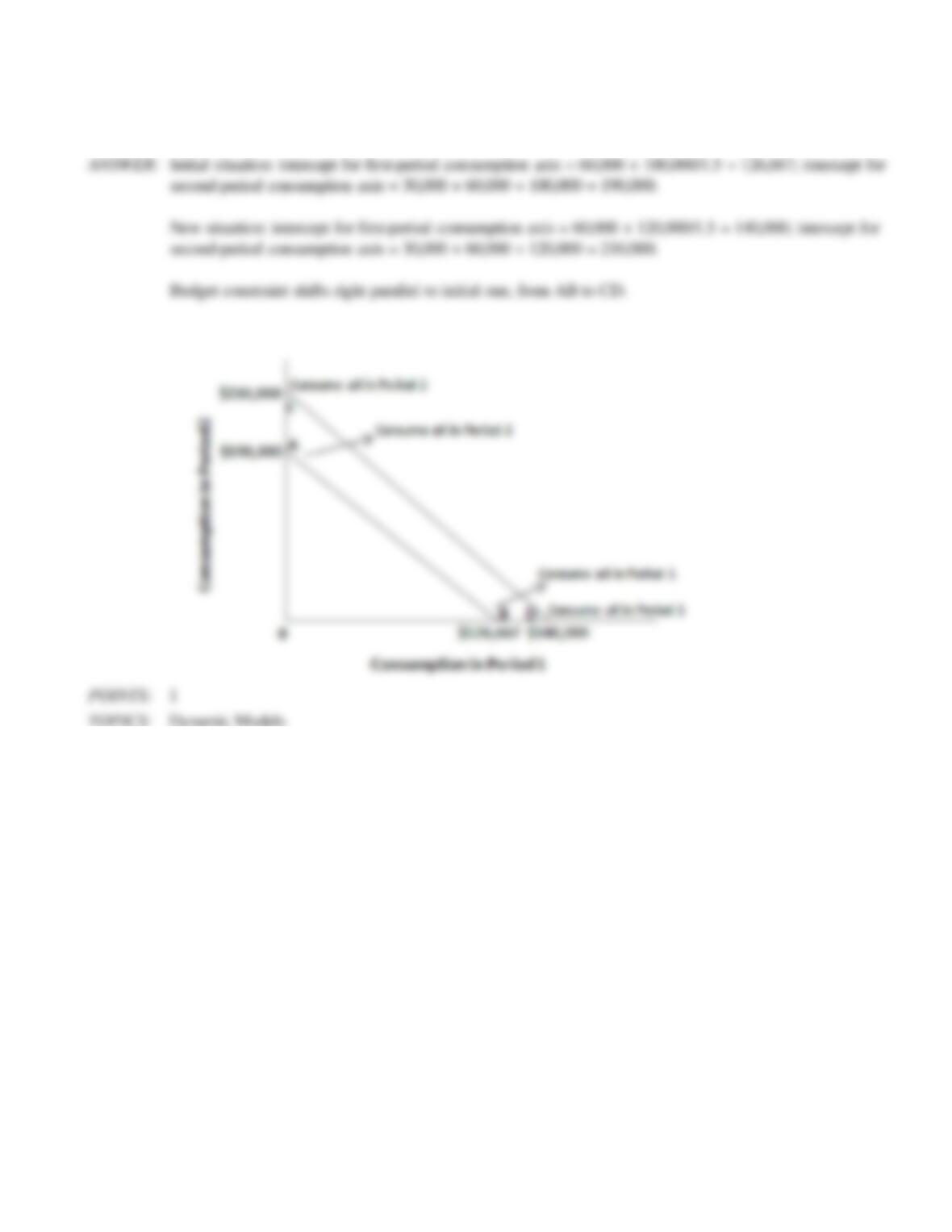
49. In the two-period model, suppose a household‘s income in the first period is $60,000, income in the second period is
$100,000, and the real interest rate is 50 percent. Draw a diagram showing the budget constraint. Now, suppose the
household’s income in the second period increased to $120,000. Draw the new budget constraint. For the budget
constraints you have drawn, be sure to show the values of the intercepts on each axis. Show your work.
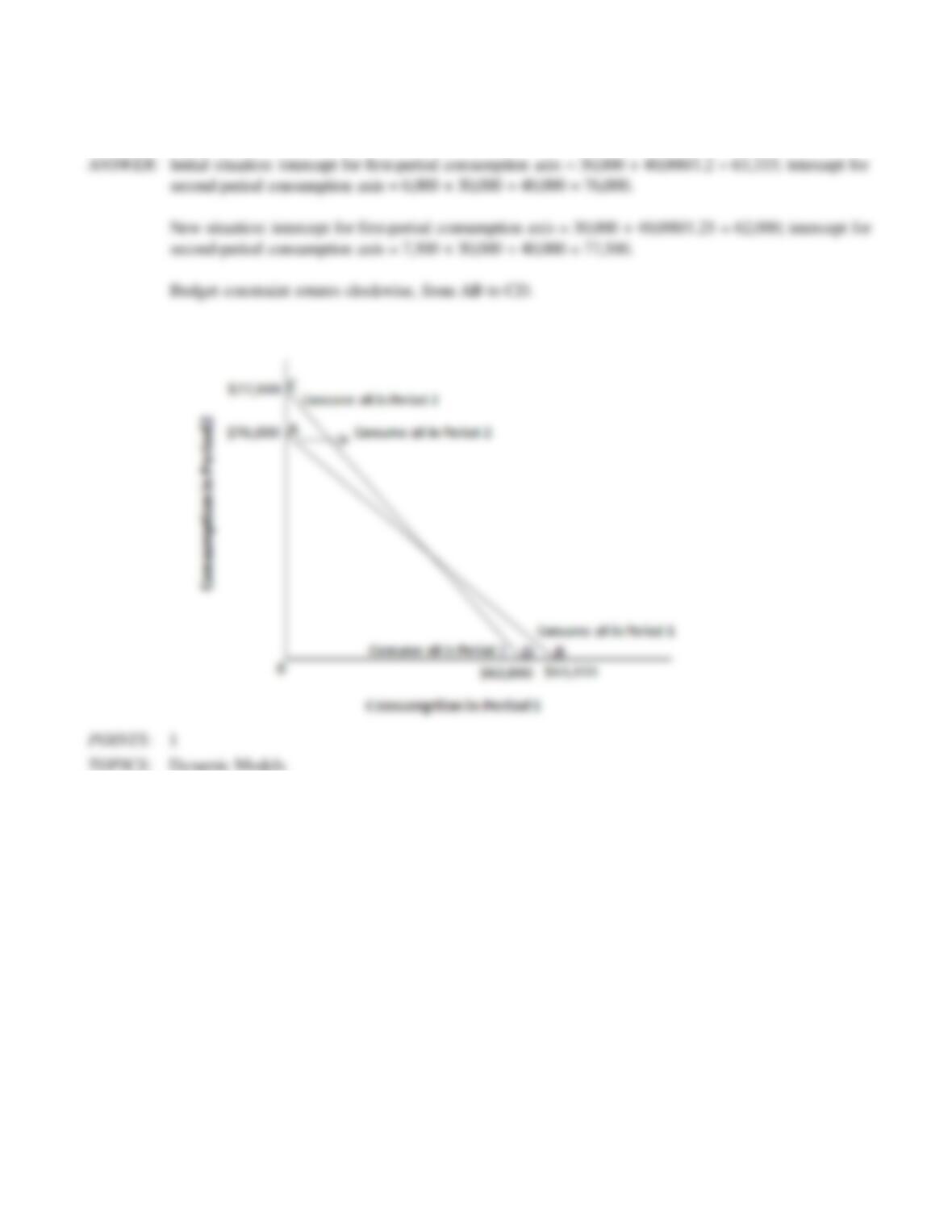
50. In the two-period model, suppose a household‘s income in the first period is $30,000, income in the second period is
$40,000, and the real interest rate is 20 percent. Draw a diagram showing the budget constraint. Now, suppose the
real interest rate rises to 25 percent. Draw the new budget constraint. For the budget constraints you have drawn, be
sure to show the values of the intercepts on each axis. Show your work.
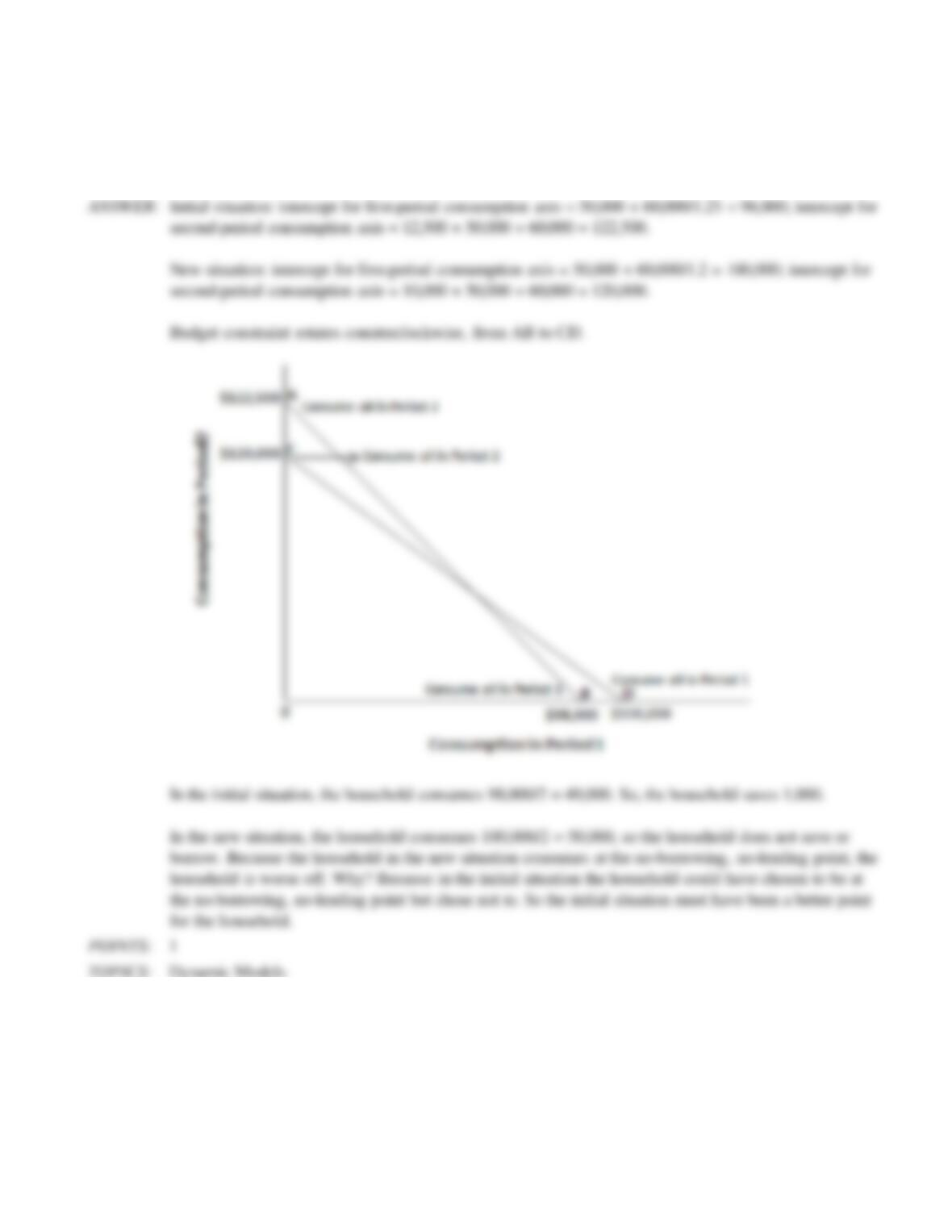
51. In the two-period model, suppose a household‘s income in the first period is $50,000, income in the second period is
$60,000, and the real interest rate is 25 percent. Draw a diagram showing the budget constraint. Now, suppose the
real interest rate declines to 20 percent. Draw the new budget constraint. For the budget constraints you have
drawn, be sure to show the values of the intercepts on each axis. If the household decides that its consumption in
period 1 should always be one half of the present value of income, determine whether the household is worse off or
better off because of the decline in the real interest rate. Show your work.
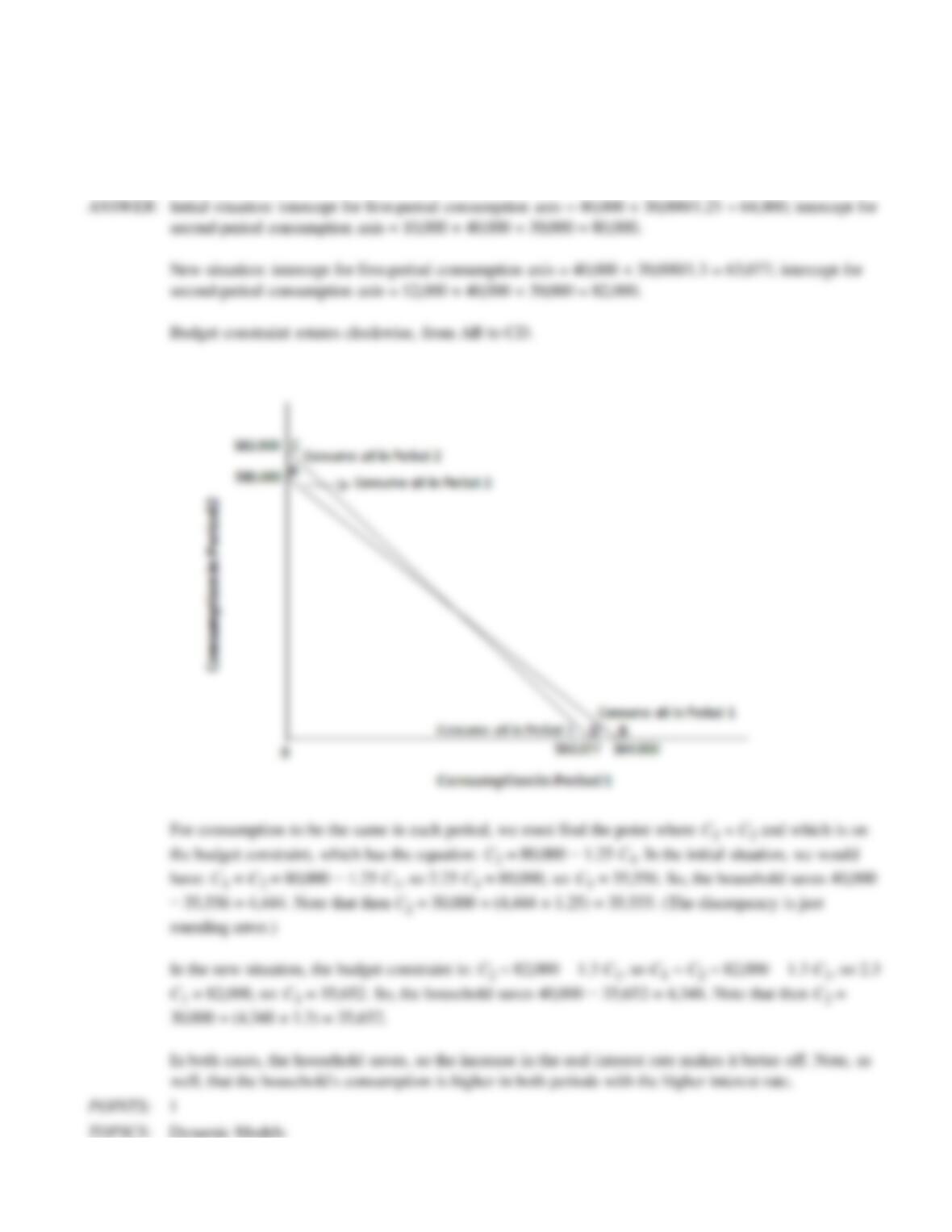
52. In the two-period model, suppose a household‘s income in the first period is $40,000, income in the second period is
$30,000, and the real interest rate is 25 percent. Draw a diagram showing the budget constraint. Now, suppose the
real interest rate rises to 30 percent. Draw the new budget constraint. For the budget constraints you have drawn, be
sure to show the values of the intercepts on each axis. If the household decides that its consumption in period 1
should always equal its consumption in period 2, determine whether the household is worse off or better off because
of the decline in the real interest rate. Show your work.

53. Describe the general procedures followed by DSGE researchers creating a new model.
54. What are the advantages and disadvantages of VAR models?
55. Describe the new neoclassical synthesis.
56. Can VARs be used to analyze the effects of monetary policy?