38. In the aggregate demand-aggregate supply model, a decrease in the expected price level, everything else remaining
unchanged, causes to in the short run.
a. output; increase
b. output; decline
c. output; remain unchanged
d. inflation; increase
39. In the aggregate demand-aggregate supply model, an increase in the expected price level, everything else remaining
unchanged, causes the curve to shift .
a. short-run aggregate supply; right
b. short-run aggregate supply; left
c. aggregate-demand; left
d. aggregate-demand; right
40. In the aggregate demand-aggregate supply model, everything else remaining unchanged, an increase in production
costs shifts the curve to the .
a. long–run aggregate supply; right
b. long–run aggregate supply; left
c. short-run aggregate supply; right
d. short-run aggregate supply; left
41. In the aggregate demand-aggregate supply model, everything else remaining unchanged, an increase in money
supply shifts the curve to the .
a. aggregate demand; right
b. aggregate demand; left
c. aggregate supply; right
d. aggregate supply; left
42. In the aggregate demand-aggregate supply model, everything else remaining unchanged, a decrease in government
spending shifts the curve to the .
a. aggregate demand; right
b. aggregate demand; left
c. aggregate supply; right
d. aggregate supply; left
43. Suppose an economy is producing an output above its full-employment level. To return the economy to long-run
equilibrium, a(n) monetary policy can be used, which would cause the price level to .
a. expansionary; increase
b. expansionary; decline
c. contractionary; decline
d. contractionary; increase
44. If an economy is in a recession, with output below its full-employment level, a(n)
to return the economy to its long-run equilibrium, which would cause the price level to
a. expansionary; increase
b. expansionary; decline c.
contractionary; decline d.
contractionary; increase
monetary policy can be used
.
45. If the Fed does not change its monetary policy in an economy that is producing an output lower than the full-
employment level of output, the short-run aggregate supply curve will eventually shift
____.
a. left; increase
b. left; decline
c. right; decline
d. right; increase
46. If an economy is in a recession, with output below its full-employment level, a(n)
return the economy to its long-run equilibrium, which would cause the price level to
a. expansionary; increase
b. expansionary; decline c.
contractionary; decline d.
contractionary; increase
, and the price level will
fiscal policy can be used to
.
47. If there is no policy action in an economy that is producing an output below its full-employment level, then
a. the output returns to full-employment level quickly.
b. the price level declines slowly.
c. the price level rises quickly.
d. the output stays below full-employment for a short period, then rises quickly.
48. In some sophisticated macroeconomic models, if monetary policy is used to combat recession, the real interest rate
, whereas the real interest rate if fiscal policy is used.
a. increases; decreases
b. decreases; increases
c. remains unchanged; increases
d. decreases; remains unchanged
49. Macroeconomic models from the 1950s and 1960s that consist of hundreds of equations that describe the economy
in great detail are called
a. real business-cycle models.
b. large, structural macroeconomic models.
c. VARs.
d. structural VARs.
50. The development of the large structural macroeconomic models was spearheaded by economists.
a. Keynesian
b. classical
c. Ricardian
d. institutional
51. One of the reasons that led to the inconsistency of the large structural macroeconomic models was
a. that endogenous variables such as foreign output were treated as exogenous.
b. that all equations were estimated together to test their interrelations with one another.
c. that individual equations were estimated in isolation with one another.
d. that exogenous variables such as level of technology were treated as endogenous.
52. According to , people use all available information in making their economic decisions.
a. Keynesian theory
b. monetarist theory
c. the Lucas critique
d. the theory of rational expectations
53. A key failure of large structural macroeconomic models, according to the theory of rational expectations, is that the
models assumed that expected inflation is independent of
a. monetary policy.
b. past inflation.
c. interest rates.
d. aggregate demand.
54. The argument that a change in policy systematically alters the structure of econometric models is known as the
a. Keynesian cross.
b. cross-equation restriction.
c. Lucas critique.
d. endogeneity principle.
55. The believe that it takes a long time for prices and wages to change to restore equilibrium in an economy.
a. Keynesians
b. classical economists
c. monetarists
d. institutional economists
56. The believe that an economy will adjust on its own without any government policy interventions.
a. Keynesians
b. classical economists
c. monetarists
d. institutional economists
57. Which of the following is a difference in the views of Keynesian and classical economists?
a. Keynesians believe that prices and wages adjust quickly, whereas the classicals believe they adjust slowly.
b. Keynesians believe that policymakers have full knowledge about the state of an economy, whereas the
classicals believe they don‘t.
c. Keynesians believe that policymakers cannot offset shocks to an economy, whereas the classicals believe
they can.
d. Keynesians believe that most shocks to an economy are to long-run aggregate supply, whereas the classicals
believe the shocks are to aggregate demand.
58. Answer the questions below.
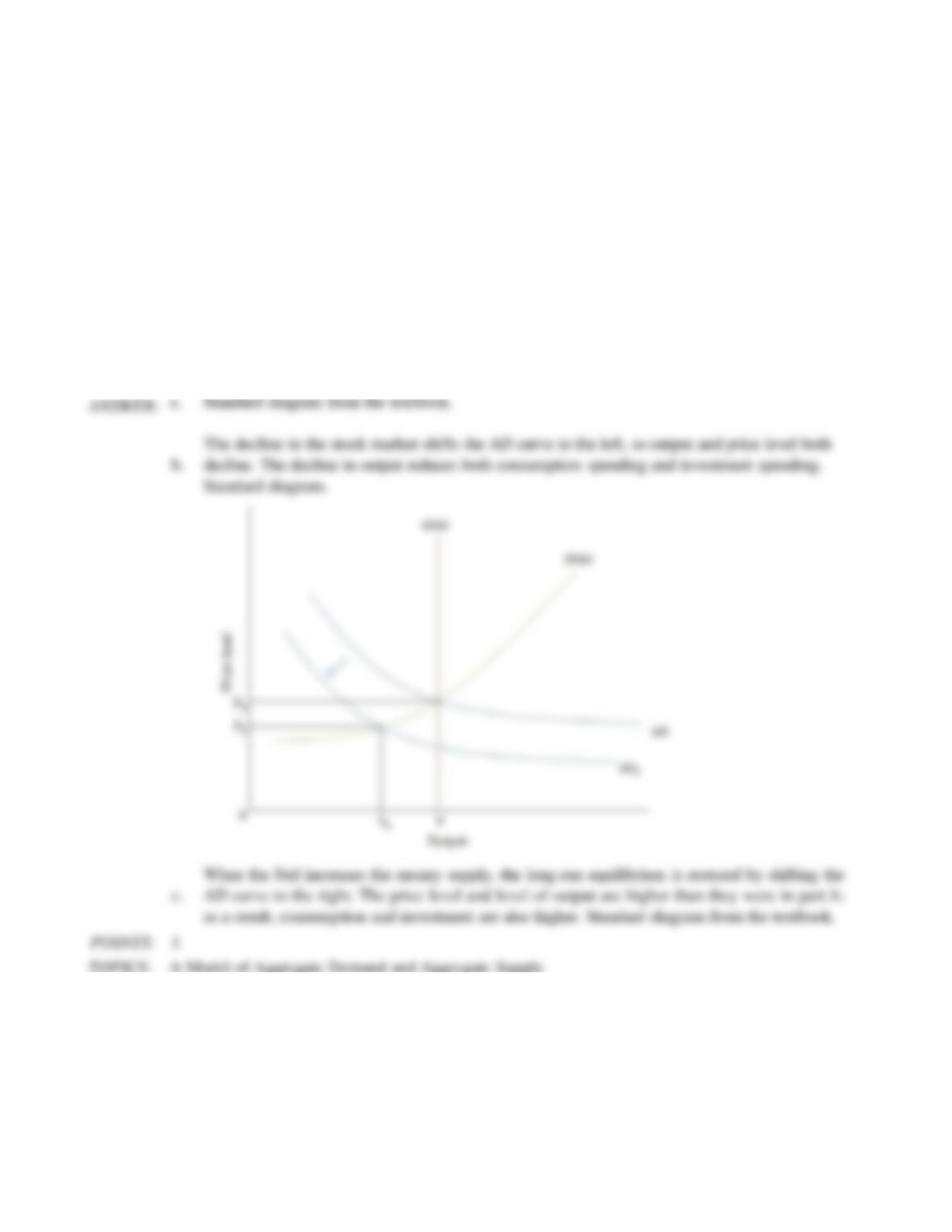
a. Suppose the economy is initially in long–run equilibrium in the AD–AS model. Draw a diagram
showing long-run equilibrium, including the AD, LRAS, and SRAS curves.
Now suppose stock prices decline sharply. Draw a new diagram showing the AD, LRAS, and
b. SRAS curves. How have the level of output and the price level changed? What happens to
consumption spending and investment spending?
Redraw your diagram from part b, then draw new lines to show what would happen if the
Fed changed monetary policy to return the economy to full-employment equilibrium. Does the
c. money supply increase or decrease? Which curve (AD, LRAS, or SRAS) shifts as a result of
the Fed’s policy change? What happens to the price level and level of output compared with
what they were in part b? What happens to consumption spending and investment spending
compared with what they were in part b?
59. Suppose business firms collectively become pessimistic about prospects for future profits because of continued
worries about terrorism. Explain how this would affect investment, aggregate demand, output, and the price level in
the short run and the long run.
60. Suppose ATM costs increased because of additional security required to prevent electronic fraud. Explain how this
would affect money demand, aggregate demand, output, and the price level in the short run and the long run.
61. Suppose increased costs for security raised the costs of production for all firms. Explain how this would affect
aggregate supply, output, and the price level in the short run and the long run.
62. Suppose another breakthrough in computer technology greatly increases total factor productivity. Explain how this
would affect aggregate supply, output, and the price level in the short run and the long run.
63. Describe the effect of expansionary monetary policy in a recession. Contrast the results with no monetary policy
action.
64. Describe what monetary policymakers should do if they want to keep the price level in an economy permanently
low.
65. Describe the arguement put forward by the Nobel laurete Robert E. Lucas about the flaws in the large structural
macroeconomic models.