1. In which period was the rate of output growth the fastest in the U.S. economy?
a. 1929−1949
b. 1949−1970
c. 1970−1982
d. 1982−2010
2. The labor force consists of
a. those employed plus those on temporary layoff.
b. those employed plus those unemployed.
c. the working-age population minus those who are in the military or institutionalized.
d. the working-age population plus those who are in the military or institutionalized.
3. 15 million people in a country are employed and 2.5 million are unemployed while 1 million are retired workers. The
size of the country‘s labor force is
a. 15 million. b.
18.5 million c.
17.5 million d.
11.5 million.
4. Country X has a population of 70 million, of which 32 million are employed and 8 million are unemployed but looking
for employment. The size of the labor force in Country X is .
a. 40 million
b. 32 million
c. 38 million
d. 62 million
5. Suppose a country has a population of 61 million, of which 37 million are in the working-age population. Of those, 11
million are not in the labor force and 23 million are employed. The labor-force participation rate is
a. 42.6 percent.
b. 60.7 percent.
c. 70.3 percent.
d. 88.5 percent.
6. A country has a total population of 100 million. Out of this, 60 million people are of working age. Out of this 60
million people, 43.2 million people are employed and 4.8 million are unemployed. The unemployment rate in the
country is .
a. 10 percent
b. 16.67 percent
c. 8 percent
d. 13.3 percent
7. Suppose a country has a population of 61 million, of which 37 million are in the working-age population. Of those, 11
million are not in the labor force and 23 million are employed. The unemployment rate is
a. 12.7 percent.
b. 11.5 percent.
c. 8.1 percent.
d. 4.9 percent.
8. If the population of a country is 320 million, the working–age population is 215 million, the labor force is 145 million,
and the number of people who are employed is 137 million, then the unemployment rate is
a. 3.7 percent.
b. 5.5 percent.
c. 63.7 percent.
d. 94.5 percent.
9. A country has a working population of 85 million. Out of the 85 million people, 51 million are employed and 17 million
are unemployed. The labor-force participation rate of the country is
a. 80 percent
b. 60 percent
c. 20 percent
d. 75 percent
10. If the working-age population in a country is 215 million, the labor force is 145 million, and the number of employed
people is 137 million, then the labor–force participation rate in the country is
a. 2.5 percent.
b. 67.4 percent.
c. 45.3 percent.
d. 94.5 percent.
11. If the population in a country is 182 million, the working-age population is 134 million, the number of employed people
is 73 million, and the number of unemployed people is 14 million, then the unemployment rate in the country is
a. 3.7 percent.
b. 7.7 percent.
c. 10.4 percent.
d. 16.1 percent.
12. If the population in a country is 182 million, the working-age population is 134 million, the number of employed
people is 73 million, and the number of unemployed people is 14 million, then the labor-force participation rate in the
country is
a. 47.8 percent.
b. 64.9 percent.
c. 73.6 percent.
d. 82.1 percent.
13. In 2001, the number of unemployed people in a country increased from 5.7 million to 8.3 million, while the labor force
increased from 141.5 million to 142.3 million. By how much did the unemployment rate increase?
a. 1.8 percentage points
b. 2.6 percentage points
c. 3.25 percentage points
d. 5.8 percentage points
14. In 2004, the number of unemployed people in a country decreased from 8.8 million to 8.1 million, while the labor
force increased from 146.5 million to 147.4 million. By how much did the unemployment rate decrease?
a. 0.5 percentage point
b. 0.7 percentage point
c. 0.9 percentage point
d. 1.1 percentage point
15. In 2004, the number of people in the working-age population in a country increased from 221.2 million to 223.4
million, while the labor force increased from 146.5 million to 147.4 million. By how much did the labor-force
participation rate change?
a. −0.2 percentage point
b. 0.0 percentage point
c. 0.2 percentage point
d. 0.4 percentage point
16. In 2001, the number of people in the working-age population in a country increased from 212.6 million to 215.1
million, while the labor force increased from 141.5 million to 142.3 million. By how much did the labor-force
participation rate change?
a. −0.4 percentage point
b. −0.2 percentage point
c. 0.0 percentage point
d. 0.2 percentage point
17. Labor productivity is calculated as
a. output minus net exports.
b. the average product of labor minus the marginal product of labor.
c. total factor productivity divided by the amount of capital.
d. output produced by labor divided by hours worked.
18. Labor productivity multiplied by the number of hours worked gives
a. the hourly wage rate.
b. the average product of labor.
c. total factor productivity.
d. total output.
19. If output grew 3.9 percent last year and hours worked grew 1.3 percent,then by how much did labor productivity
grow over the year?
a. 0.3 percent
b. 2.6 percent
c. 3.0 percent
d. 5.2 percent
20. If output grew 2.8 percent last year and labor productivity grew 1.1 percent, then by how much did hours worked
grow over the year?
a. 1.1 percent
b. 1.3 percent
c. 1.7 percent
d. 3.9 percent
21. If hours worked grew 1.5 percent last year and labor productivity grew 2.2 percent, then by how much did output
grow over the year?
a. −0.7 percent
b. 0.7 percent
c. 3.7 percent
d. 4.3 percent
22. If output grew 5.5 percent and labor productivity grew 2 percent during a decade, the number of hours worked grew
by over the year.
a. 3.50 percent.
b. 2.25 percent.
c. 7.50 percent.
d. 1.0 percent.
23. The economic liftoff period in the U.S. occurred from
a. 1929−1949.
b. 1950−1970.
c. 1970−1982.
d. 1982−present.
24. The reorganization period in the U.S. occurred from
a. 1929−1949.
b. 1949−1970.
c. 1971−1982.
d. 1982−present.
25. The long boom period in the U.S. occurred from
a. 1929−1949.
b. 1949−1970.
c. 1970−1982.
d. 1983−2007.
26. In which of the following periods was output growth the fastest in the U.S. economy?
a. Long boom period
b. Economic liftoff period
c. Great Depression period
d. Reorganization period
27. In which of the following periods was output growth the slowest in the U.S. economy?
a. Long boom period
b. Economic liftoff period
c. Post 2009
d. Reorganization period
28. In which of the following periods was unemployment the highest in the U.S. economy?
a. Great Depression
b. Economic liftoff period
c. Long boom period
d. Reorganization period
29. In which of the following periods was labor productivity growth the fastest in the U.S. economy?
a. Long boom
b. Economic liftoff period
c. Great Depression
d. Reorganization period
30. In which of the following periods was labor productivity growth the slowest in the U.S. economy?
a. Long boom
b. Economic liftoff period
c. 1995−2005
d. Reorganization period
31. The change in output that is not accounted for by either changes in the amount of capital or the amount of labor is
known as
a. total factor productivity.
b. real output.
c. gross domestic value added.
d. attributable to net exports.
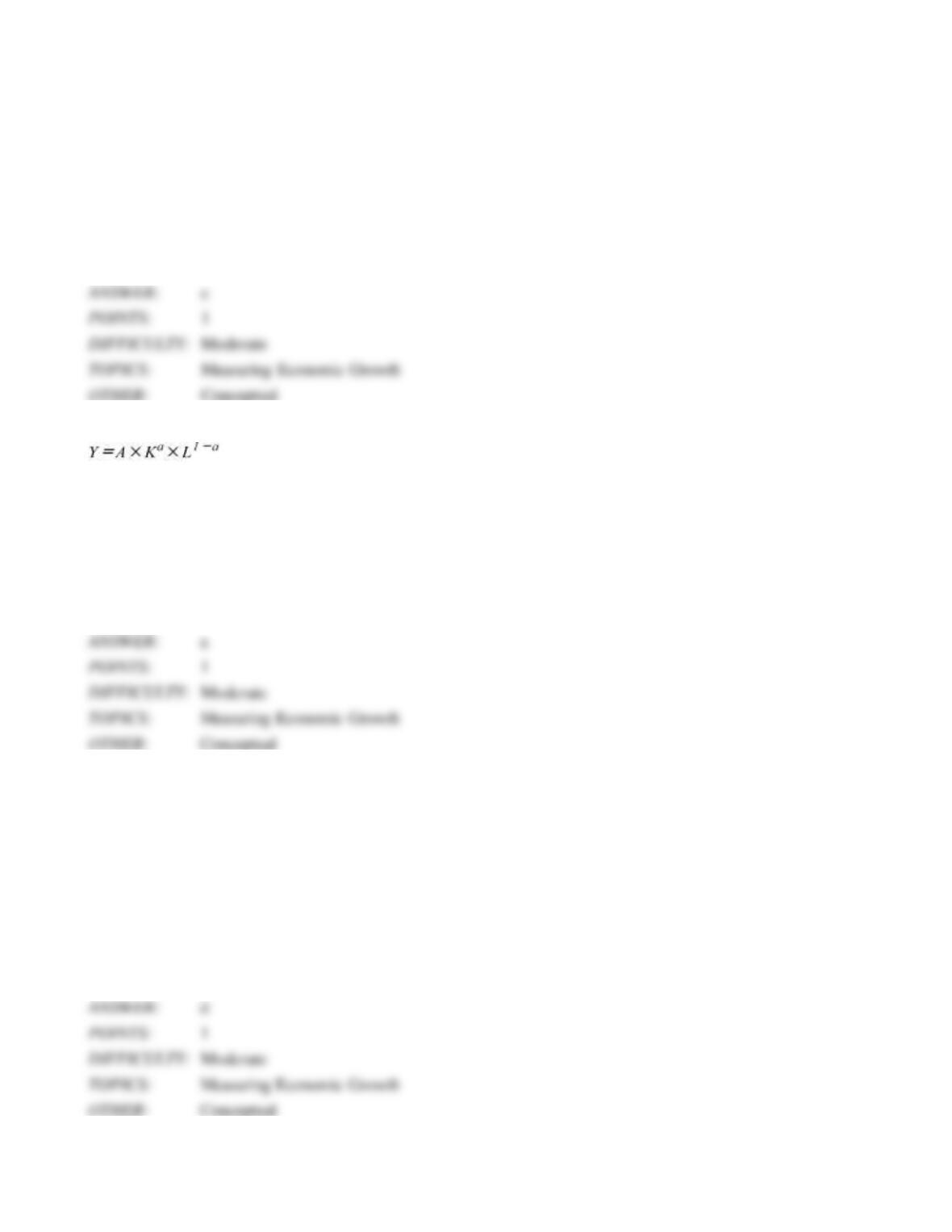
32. Consider the following production function
Y = A×Ka×L1
−
a.
If a = 0.3, and over the past year total factor productivity grew 2.3 percent, capital grew 2 percent, and labor grew 3
percent, what was the growth rate of output?
a. 0 percent
b. 5 percent
c. 2 percent
d. 7 percent
33. Consider the following production function
Y = A×Ka×L1
−
a.
If a = 0.4, and over the past year output grew 4 percent, capital grew 2 percent, and labor grew 1 percent, what was
the growth rate of total factor productivity (TFP)?
a. 1.0 percent
b. 2.0 percent
c. 2.4 percent
d. 2.6 percent
34. Consider the following production function
Y = A×Ka×L1
−
a.
If a = 0.3, and over the past year total factor productivity (TFP) grew 2.3 percent, capital grew 2 percent, and output
grew 5 percent, what was the growth rate of labor?
a. 2 percent
b. 3 percent
c. 4 percent
d. 5 percent
35. Consider the following production function
Y = A×Ka×L1
−
a.
If a = 0.4, and over the past year total factor productivity (TFP) grew 2.6 percent, capital grew 2 percent, and labor
grew 1 percent, what was the growth rate of output over the year?
a. 2 percent
b. 3 percent
c. 4 percent
d. 5 percent
36. Consider the following production function
If a = 0.4, over the past year output grew 4 percent, total factor productivity grew 2 percent, and capital grew 3
percent, labor grew by
a. 1.33 percent
b. 2.5 percent
c. 3.2 percent
d. 3.88 percent
37. Consider the following production function
Y = A×Ka×L1
−
a.
If a = 0.4, and over the past year output grew 4 percent, total factor productivity (TFP) grew 2.6 percent, and capital
grew 2 percent, what was the growth rate of labor?
a. 4 percent
b. 3 percent
c. 2 percent
d. 1 percent
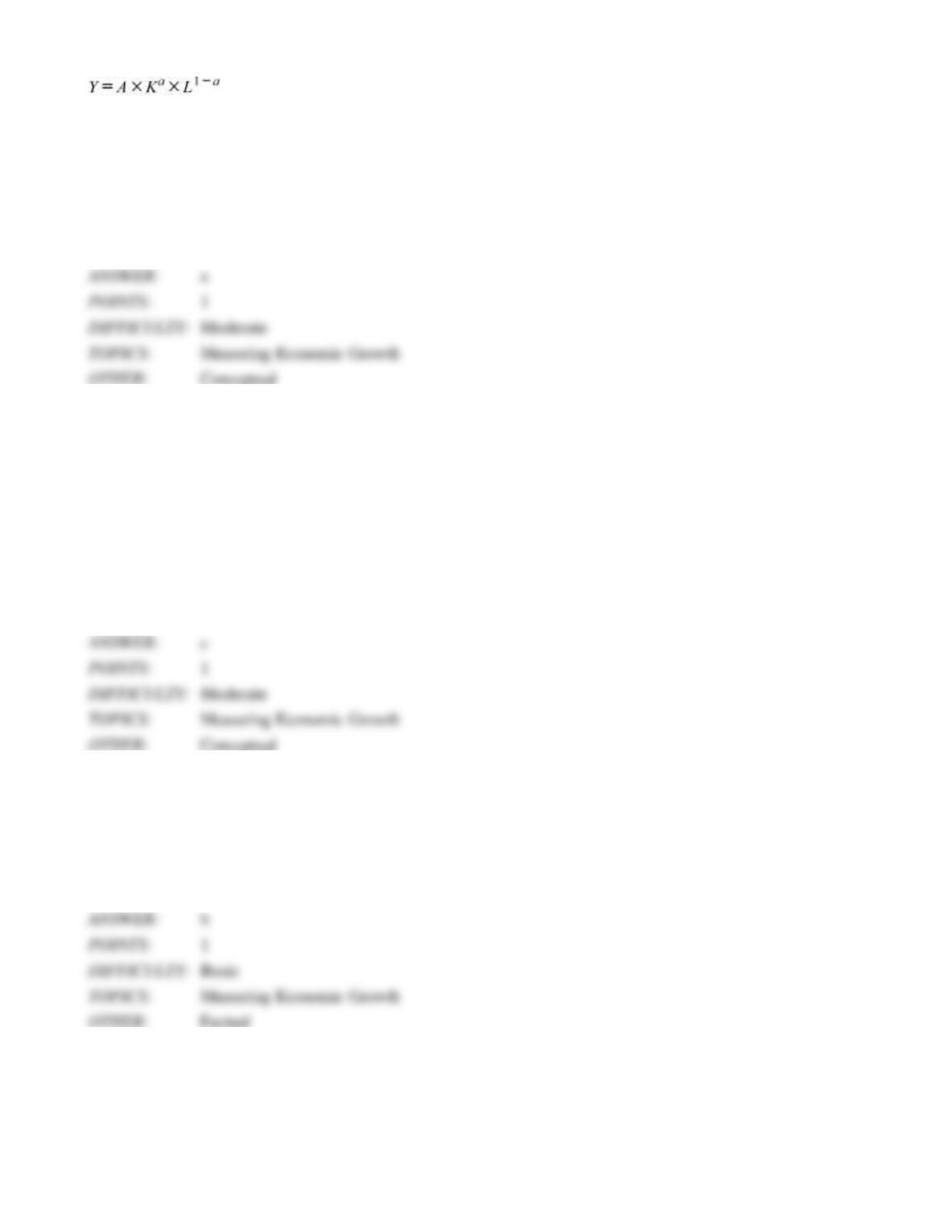
38. Consider the following production function
.
If a = 0.5, over the past year output grew by 2 percent, total factor productivity grew 1 percent , and labor grew by 1
percent, capital grew by
a. 1 percent.
b. 0.5 percent
c. 2 percent.
d. 2.5 percent.
39. Consider the following production function
Y = A×Ka×L1
−
a.
If a = 0.4, and over the past year output grew 4 percent, total factor productivity (TFP) grew 2.6 percent, and labor
grew 1 percent, what was the growth rate of capital?
a. 4 percent
b. 3 percent
c. 2 percent
d. 1 percent
40. In which of the following periods was total factor productivity growth the fastest in the U.S. economy?
a. Long boom
b. Economic liftoff period
c. Great Depression
d. Reorganization period