Chapter 10 – Foreign Exchange
Multiple Choice Questions
1. From October 1997 to January 1998, the economy of South Korea was in turmoil. One of
the problems was:
A. The currency of South Korea appreciated considerably making it very difficult for Korean
exporters to sell goods abroad
2. An American traveling to Europe will find it easier to make purchases now because:
A. Most countries in Europe accept U.S. dollars
Chapter 10 – Foreign Exchange
3. The nominal exchange rate:
A. Is the amount of one country’s goods that could be obtained with the same goods of
another country
4. If an American traveling abroad can obtain 115 euros for $100 U.S, the current euro per $
exchange rate is:
D. 1euro/1.15$
5. If in late 2003 one U.S. dollar exchanged for 118 euros and in mid-2004 one U.S. dollar
exchanged for 127 euros, then:
D. American goods became more expensive to Americans
Chapter 10 – Foreign Exchange
6. If the Japanese yen appreciates against the U.S. dollar:
A. Americans should find Japanese goods are now less expensive
7. The nominal exchange rate:
A. Is the price of a good in one country expressed in units of the same good in another
country
8. Which of the following statements is most correct?
A. If the U.S. $ depreciates relative to the yen, then it is likely also depreciating relative to the
euro
Chapter 10 – Foreign Exchange
9. In quoting exchange rates:
A. One should always quote these as units of foreign currency over a unit of domestic
currency
10. The forward exchange rate:
D. Is always above the spot rate since it carries greater risk
11. The answer to the question of whether or not a U.S. dollar will buy more in the U.S. or in
a foreign country is determined by:
D. You cannot determine the answer until you travel to the foreign country and convert $ to
the foreign currency
Chapter 10 – Foreign Exchange
12. The real exchange rate is defined as:
A. The nominal exchange rate plus the rate of inflation
13. If the current exchange rate is 1€/1$U.S. and bagels cost 1€ in France and 1$ in the U.S.
and the current exchange rate for bagels is 0.74 European bagel/1U.S. bagel and if the bagels
are identical:
D. The nominal exchange rate and the real exchange rate are equal
14. If the current exchange rate is 1€/1$U.S. and bagels cost 1€ in France and 1$ in the U.S.
and the current exchange rate for bagels is 0.74 European bagel/1U.S. bagel and if the bagels
are identical:
A. The nominal exchange rate is 0.74€/$
Chapter 10 – Foreign Exchange
15. If the current exchange rate is 1€/1$U.S. and bagels cost 1€ in France and 1$ in the U.S.
and the current exchange rate for bagels is 0.74 European bagel/1U.S. bagel and if the bagels
are identical:
D. Americans should import French bagels
16. If a Japanese Toyota sells for 2,500,000 yen and the nominal exchange rate is 110
yen/$U.S., then the dollar price of the Japanese automobile is:
A. 22,727 yen
17. A bagel cost $1 in New York and 0.5 euros in Paris. If the real exchange rate is one-half
of a New York bagel for a Parisian bagel, how many euros should you receive in exchange for
one dollar?
A. 0.1
Chapter 10 – Foreign Exchange
18. Appreciation of the real exchange rate:
D. Benefits all U.S. residents
19. The real and nominal exchange rates differ in the sense that:
A. The real exchange rate does not express differences in the purchasing power of a currency
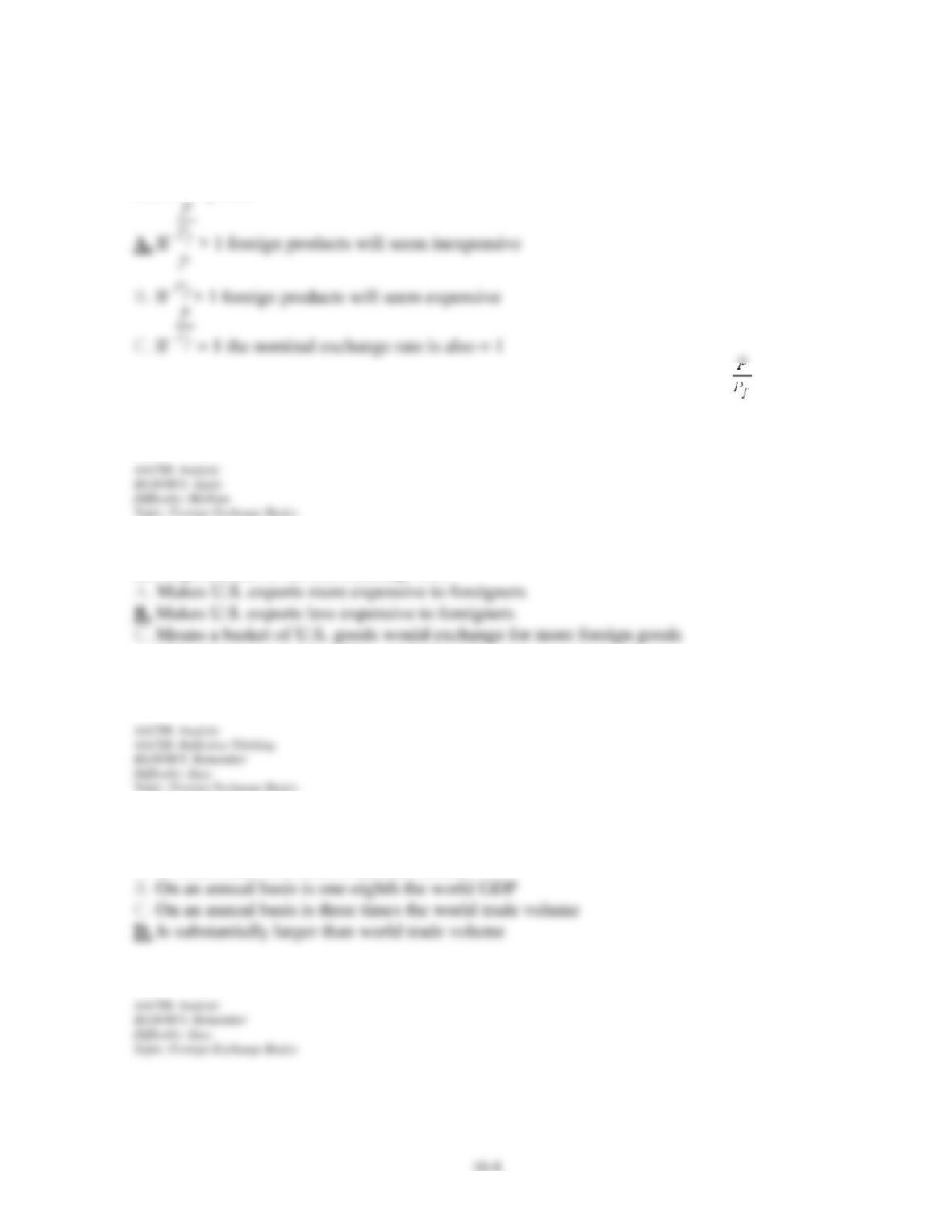
20. If we let P = the domestic price of a basket of goods and P f = the foreign price of the
same basket of goods, and = the nominal exchange rate of foreign currency/$U.S., the real
exchange rate is best expressed as:
D.
Chapter 10 – Foreign Exchange
21. If we let P = the domestic price of a basket of goods and Pf = the foreign price of the same
basket of goods:
D. You cannot determine the relative prices of foreign goods from the equation
22. Depreciation of the real exchange rate:
D. Means an appreciation of the nominal exchange rate
23. The daily volume of Foreign Exchange Basics transactions:
A. Is small relative to most financial markets
Chapter 10 – Foreign Exchange
24. Considering Foreign Exchange Basics transactions:
A. The U.S. dollar is exchanged in roughly 50% of all currency transactions
25. The law of one price:
D. Is a mathematical concept that is not useful in explaining exchange rates
26. If the euro/$ U.S. exchange rate is 1.1€/$ in New York but 1.05€/$ in London, we should
see:
D. The $ should appreciate in New York relative to the euro
Chapter 10 – Foreign Exchange
27. If we ignore transportation costs and the price of a pair of Nike shoes in Detroit is $100
U.S. what should be the price of the Nike shoes in Windsor, Canada (in Canadian dollars) if
the nominal exchange rate is 1.36Canadian dollars/1 U.S. dollar?
28. Considering the law of one price, evidence shows:
29. Which of the following does not contribute to the failure of the law of one price?
Chapter 10 – Foreign Exchange
30. The law of one price fails as a result of:
A. Low tariffs
31. Which of the following does not contribute to the failure of the law of one price?
A. Tariffs
32. Concrete likely does not follow the law of one price due to:
A. Technical differences
Chapter 10 – Foreign Exchange
33. The law of one price is a useful theory only when applied to:
D. International trade
34. The theory of purchasing power parity implies the real exchange rate between two
countries is:
A. Flexible
35. The theory of purchasing power parity says:
D. The real exchange rate is always less than one
Chapter 10 – Foreign Exchange
D. Oil
37. A tariff disrupts the workings of the law of one price because tariffs:
D. Are only applied to commodity products
38. One reason the theory of purchasing power parity may not explain price differences
between countries is:
A. Real exchange rates are almost impossible to calculate
Chapter 10 – Foreign Exchange
10–14
39. Purchasing power parity says that:
D. For inflation to change the exchange rate, the rate of inflation has to be the same between
countries
40. The theory of purchasing power parity:
A. Contradicts the law of one price
41. If Great Britain experiences higher rates of inflation than the United States over a long
period of time, we should expect the British (pound) per U.S. $ (dollar) exchange rate to:
D. Hold constant since exchange rates are fixed
42. If inflation in the United States averages more than inflation in Europe over a long period
of time, we should expect:
A. The dollar to appreciate relative to the euro
43. The theory of purchasing power parity assumes:
A. The real exchange and nominal exchange rates are fixed
44. Considering the theory of purchasing power parity, if inflation in Mexico is 5% while
prices in the U.S. are stable; we should expect:
D. The real exchange rate of U.S. goods / Mexican goods to appreciate 5%
Chapter 10 – Foreign Exchange
45. The empirical evidence on purchasing power parity seems to point out that:
A. The higher a country’s inflation rate, the greater is the appreciation in the country’s
46. The empirical evidence on purchasing power parity seems to point out that:
D. Inflation and a country’s rate of currency appreciation are positively correlated
47. Differences in inflation rates between two countries can explain
A. Short-run changes in the exchange rate but not long-run changes
Chapter 10 – Foreign Exchange
48. When a currency is described as overvalued, this implies:
A. It is overvalued relative to the exchange rate set by the nation’s central bank
49. When a currency is described as undervalued, this implies:
D. The exchange rate is lower than one year previous
50. A country’s current account represents:
A. The amount one country owes to another country
Chapter 10 – Foreign Exchange
51. A country with a current account surplus:
A. Has imported more than it has exported
52. A country that exports more than it imports will:
A. Have a current account deficit and a capital account deficit
53. A country that exports less than it imports will:
A. Have a current account deficit and a capital account deficit
Chapter 10 – Foreign Exchange
54. A country’s capital account:
A. Is synonymous with the current account
55. When a country’s current account balance is added to its capital account balance, the sum
should be:
D. Negative
56. A country running a current account deficit over a long time should see its exchange rate:
A. Hold steady
Chapter 10 – Foreign Exchange
57. A country running a current account surplus over many years should see its exchange
rate:
D. The rate can rise, fall, or hold steady; the current account and the exchange rate are not
linked
58. A country that has a capital account deficit:
A. Is a net seller of assets
59. A country that has a capital account surplus:
D. Will see its currency remain steady