What three classes of stars are most likely to house life like ours? Why?
Neutral hydrogen clouds appear ________ when viewed visually.
Contrast the original and present uses of the Cosmological Constant.
For a galaxy 200 Mpc away, a useful standard candle would be the ________.
A typical protostar may be several thousand times more luminous than our Sun; where
does this energy come from?
Type I supernovae result from white dwarf stars that have reached a mass of ________
solar masses from material transferred by a giant companion.
On rare occasions, Mercury and Venus can transit the Sun, crossing directly between us
and our Sun. If you were watching the event closely, such as on June 5, 2012, you
might note a “tear-drop” effect as Venus came on and left the solar disk, very different
from the disk of Mercury. Explain.

The universe’s density, compared to the critical density, determines the ________ of
space.
The light-gathering power of a telescope varies with the ________ of the diameter of
the lens or mirror.
The time for a planet to revolve around the Sun is its ________.
Name two observable consequences of the Earth’s tidal pull on the Moon.
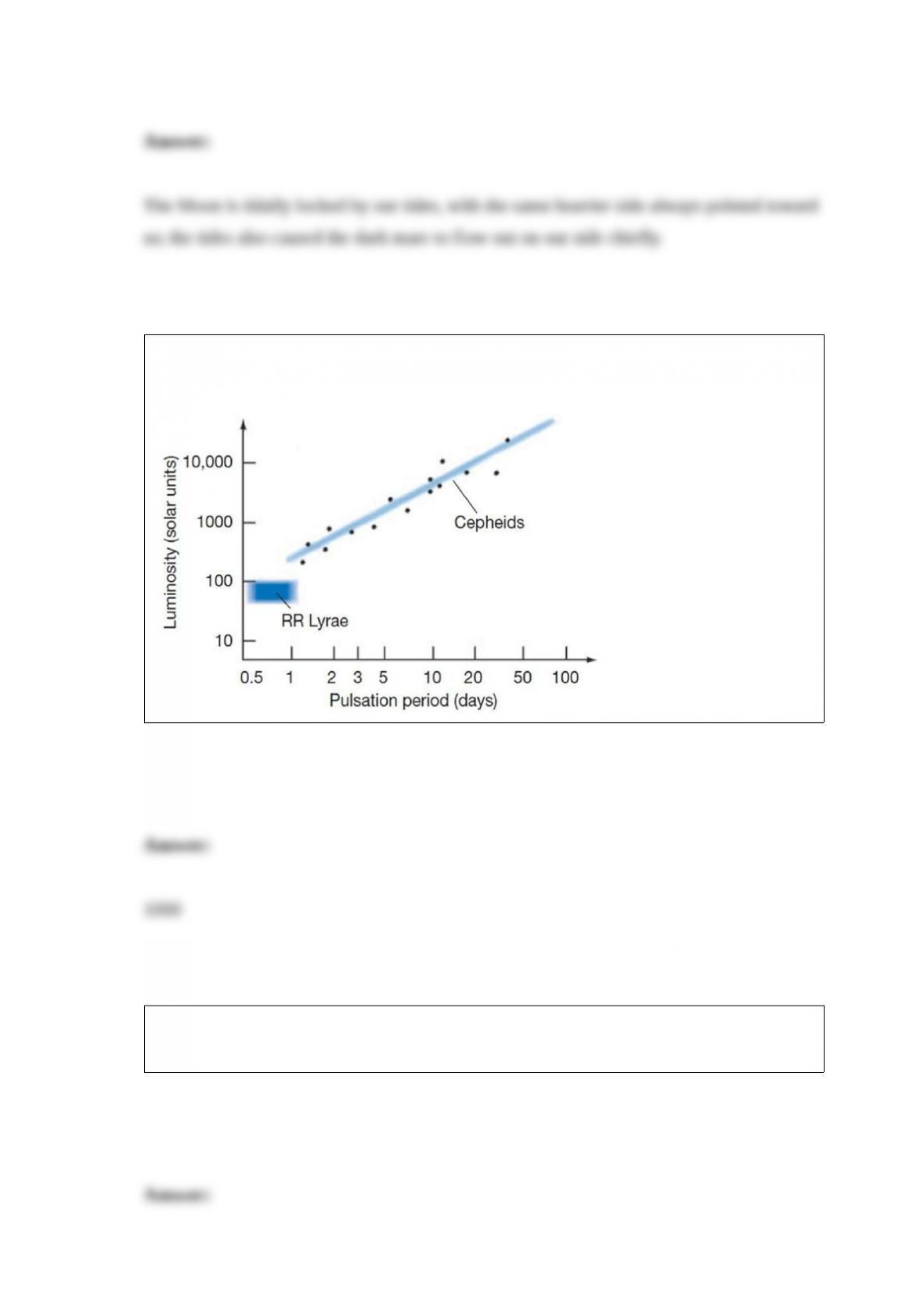
This diagram shows the period-luminosity relationship. A Cepheid variable with a
period of 5 days will have a luminosity of ________ solar luminosities.
What is the mass of the black hole believed to be at the center of the Milky Way? How
do we know?
For measuring the distances to galaxies within 17 Mpc, we rely primarily on ________
variable stars.
The distance from a wave’s crest to its undisturbed position is the ________.
Contrast the orbits of asteroids and Kuiper Belt bodies.