3.9: Late Modern and Contemporary Art: from Abstract Expressionism in the
1940s to the Present Day
1. Artwork in the twentieth and twenty-first centuries can be ________.
a.
representational
d.
all of the previous answers
b.
abstract
e.
none of the previous answers
c.
non-objective
2. Jackson Pollock made paintings by:
a.
flinging paint from a pinwheel onto canvases hanging in his studio
b.
spitting glitter through a straw onto a plaster wall
c.
dripping paint onto a canvas on the floor
d.
dancing on ceramic tiles with paint on the bottom of his feet
e.
spilling paint onto a dust sheet while painting his living room
3. Jackson Pollock’s Number 1A is ________.
a.
so small it has to be looked at with a microscope
b.
small enough to be held in a person’s hand
c.
as big as the page of a book so it can sit on a tabletop
d.
the same size as human being
e.
so large that it dominates the viewer’s field of vision
4. The way that Jackson Pollock painted focused on the process of making art.
5. The formal element that Mark Rothko focused on is ________.
a.
color
d.
time
b.
line
e.
motion
c.
texture
6. In his Untitled (1950), Mark Rothko wanted to emphasize ________.
a.
a narrative story
b.
a deep, almost religious experience
c.
purely the color relationships
d.
a popular icon of contemporary culture
e.
all of the other answers
7. The technique used to make Andy Warhol’s Thirty Are Better than One is ________.
a.
silkscreen
d.
photomontage
b.
assemblage
e.
readymade
c.
collage
8. Andy Warhol used commercial processes to create many of his works because ________.
a.
his professor in art school told him to
b.
he wasn’t an artist at all
c.
he wanted his work to have a depersonalized and mass-produced quality
d.
he wanted to be able to hide his work in a grocery store for safe keeping
e.
all of the other answers
9. What kind of dialogue exists or is created when an artist appropriates an existing object or
artwork? Consider the relationship between an appropriation and the original artwork it represents
(for example Andy Warhol’s Thirty Are Better than One and Leonardo’s Mona Lisa). What are the
aims of the artist for each artwork? How does the comparison impact your understanding of each
artwork? How has your understanding of contemporary art changed as a result of making this
comparison?
10. Pop art aimed to undermine the “high art” tendency to value only works that were “original” and
“unique.” To what extent do you think it is important for artists to strive toward creating something
new and original? How can such works as Andy Warhol’s Thirty Are Better than One, that reuse
earlier art, also be seen as creative and valuable?
11. The technique used by Roy Lichtenstein to show gradations in color in his Girl in Mirror was
________.
a.
taught to him by Marcel Duchamp
b.
borrowed from newspaper printing and comics
c.
very subtle and hard to see
d.
not at all what he intended in the first place
e.
none of the other answers
12. Roy Lichtenstein challenged traditional notions of the subject matter and appearance of fine art
painting by embracing everyday subjects.
13. The work of Minimalist artists is generally made out of natural materials with an organic quality.
14. Donald Judd ordered the boxes for his Untitled artwork, made in 1967, from a factory.
15. Donald Judd’s Untitled (1967) is part of which movement?
a.
Impressionism
d.
Minimalism
b.
Cubism
e.
Arte Povera
c.
Futurism
16. Consider Mark Rothko’s Untitled (3.9.3) and Donald Judd’s Untitled (3.9.6). Identify the stylistic
movement to which each artwork belongs, and explain why each artist chose not to provide a
narrative or descriptive title. Your answer should reflect both the intentions of the artist and the
aims of the movement of which he was a part.
17. The medium of Dan Flavin’s 1996 Untitled installation is ________.
a.
stainless steel and Plexiglass
d.
aluminum foil over wood
b.
fluorescent light tubes
e.
video projection
c.
polished brass and stone
18. Dan Flavin’s Untitled (1996) builds on ________.
a.
Marcel Duchamp’s concept of readymades
b.
Vasily Kandinsky’s concept of inner spiritual necessity
c.
Pierre-Auguste Renoir’s concept of pleasurable experiences
d.
Louis Sullivan’s credo that form follows function
e.
Albert Einstein’s theory of relativity
19. Marcel Duchamp’s Fountain is an example of ________.
a.
a silkscreen print
d.
a photomontage
b.
an automatic drawing
e.
a readymade
c.
a collage
20. Who is the artist of Untitled (After Marcel Duchamp, A.P.).
a.
Marcel Duchamp
d.
Ana Mendieta
b.
Jasper Johns
e.
Richard Prince
c.
Sherrie Levine
21. Which earlier form of artwork is directly referenced in Untitled (After Marcel Duchamp, A.P.)?
a.
kinetic sculpture
d.
performance
b.
readymades
e.
none of the other answers
c.
functional pottery
22. Conceptual art emphasizes ________.
a.
the way the final artwork looks and exists in the world
b.
the ideas behind the artwork over its realization
c.
how many theories an artwork can reference
d.
what is actually there over what we know to be there
e.
all of the other answers
23. Joseph Kosuth’s One and Three Chairs consists of ________.
a.
three chairs belonging to world leaders
b.
one chair reflected in a three-way mirror
c.
copies of chairs from three famous artworks
d.
three things that a chair could be
e.
three things that a chair could never be
24. Ana Mendieta uses ________ as an artistic medium in her work “Untitled” (3.9.11).
a.
her body
b.
dirt and flowers
c.
natural elements
d.
all of the previous answers
e.
none of the previous answers
25. The main message in Ana Mendieta’s “Untitled” (3.9.11) is that women’s bodies should only be
passive receivers of the male gaze.
26. What is the medium of Andy Goldsworthy’s Japanese Maple Leaves?
a.
acrylic paint
d.
cherry blossoms and syrup
b.
graphite and red paint
e.
the medium is unknown
c.
color photography
27. Andy Goldsworthy’s Japanese maple leaves is an example of the kind of earthwork that is so large
it could not fit inside a typical gallery space.
28. Which of the following statements is true?
a.
Andy Goldsworthy makes temporary sculptures out of natural materials
b.
Andy Goldsworthy makes permanent sculptures out of natural materials
c.
Andy Goldsworthy makes temporary sculptures out of man-made materials
d.
Andy Goldsworthy makes permanent materials out of man-made materials
e.
Andy Goldsworthy does not make sculptures
29. What is the medium of Romare Bearden’s Three Folk Musicians?
a.
silkscreen
d.
photomontage
b.
assemblage
e.
readymade
c.
collage
30. Romare Bearden, the artist of Three Folk Musicians, was particularly influenced by which of the
following?
a.
Minimalism, Polaroid cameras, and classical music
b.
Cubism, African masks, and the Harlem Renaissance
c.
the Italian Renaissance, yo-yos, and gardening magazines
d.
Afro-Cuban dance, metal spatulas, and Where the Wild Things Are
e.
none of the other answers
31. Xenobia Bailey established herself as an artist by making ________.
a.
stained-glass windows
d.
lemonade
b.
crocheted hats
e.
all of the other answers
c.
traditional paintings
32. Xenobia Bailey’s (Re)Possessed was influenced by ________.
a.
African, Hindu, and Chinese elements
b.
Kandinsky’s, Rothko’s, and Twombly’s artworks
c.
The Cosby Show
d.
Orville and Wilbur Wright
e.
Ruby Bridges and Rosa Parks
33. Jolene Rickard builds on her ________ heritage in her work.
a.
African-American
d.
Swiss
b.
Iranian
e.
British
c.
Native American
34. Jolene Rickard’s Corn Blue Room is an example of ________.
a.
a silkscreen print
d.
photomontage
b.
installation art
e.
a readymade
c.
collage
35. Shirin Neshat builds on her ________ heritage in her work.
a.
African-American
d.
Swiss
b.
Iranian
e.
British
c.
Native American
36. Shirin Neshat’s Rapture is a film that separates ________ onto different screens.
a.
the colors of red and green
d.
all of the other answers
b.
a street scene and a garden
e.
none of the other answers
c.
men and women
37. Many of the Postmodern artworks in this chapter deal with issues of identity. Choose one example
from this chapter, perhaps an artwork by Xenobia Bailey, Jolene Rickard, or Shirin Neshat. Begin
by briefly describing the appearance and content of your chosen work. Next, give a definition of
Postmodernism and list some of its characteristics. Discuss the connection between the personal
experience of the artist as seen in the artwork and the movement of Postmodernism. In what ways
does the movement allow for explorations of this kind?
38. Gerrit Rietveld’s Schröder House is an example of ________ architecture.
a.
Cubist
d.
ancient
b.
Modernist
e.
none of the other answers
c.
Postmodernist
39. Designer Gerrit Rietveld preferred a limited color palette of ________.
a.
red only
d.
black and white only
b.
pastel hues
e.
black, white, and primary colors
c.
violet and green
40. Michael Graves’s Portland Public Services Building is an example of ________ architecture.
a.
Cubist
d.
ancient
b.
Modernist
e.
all of the other answers
c.
Postmodernist
41. Design features of the Portland Public Services Building include:
a.
drab colors
d.
a mural
b.
circular windows
e.
none of the other answers
c.
huge flowers on the facade
42. Postmodernist architect Michael Graves incorporated diverse ideas and inspirations into his design
for the Portland Public Services Building.
43. Identify a newly built construction in your town. If necessary, take a photograph or make a sketch
of this building to study at home or in class. What is the function of this building? How does its
design relate to its function? Would you describe the building as Postmodern? Can you identify
any parts of the building in which the architect has been influenced by historical precedent?
44. Visionary artists intentionally make work that does not follow the rules of the mainstream art
world.
45. James Hampton is considered a ________.
a.
Renaissance master
d.
late bloomer
b.
non-objective painter
e.
all of the other answers
c.
visionary artist
46. James Hampton’s The Throne of the Third Heaven of the Nations’ Millennium General Assembly
was made using ________.
a.
discarded chewing gum that the artist collected from movie theater seats
b.
artworks created by other people, on top of which the artist painted his own work
c.
fine gold and silver jewelry that the artist melted down
d.
found objects that the artist transformed
e.
none of the other answers
47. Why are words crossed out in Jean-Michel Basquiat’s The Nile?
a.
because he was not good at spelling
b.
because someone else tagged his graffiti
c.
because he changed his mind while making the piece
d.
because he wanted to challenge existing meanings
e.
all of the other answers
48. Which of the following influenced Jean-Michel Basquiat, as seen in his painting The Nile?
a.
African heritage
d.
linguistics
b.
African-American experience
e.
all of the other answers
c.
earlier artworks
49. Which of the following approaches is characterized by artworks that have aggressive lines, rough
textures, and personal narrative?
a.
visionary art
d.
Neo-Expressionism
b.
readymades
e.
Performance and body art
c.
Pop art
50. Pipilotti Rist’s Ever Is Over All shows ________.
a.
a woman smashing out car windows with a flower
b.
women in chadors sailing out into the open water
c.
a family painting a room in their house
d.
a fairy princess being rescued from her turret
e.
none of the other answers
51. Pipilotti Rist builds on her Swiss heritage as a central feature in all of her films.
52. The medium of Matthew Barney’s Cremaster 5 is ________.
a.
silkscreen print
d.
film
b.
installation
e.
readymade
c.
collage
53. Matthew Barney explains that the complexity in his Cremaster series relates to ________.
a.
the editing process that he used
b.
the nature of the specific stories he was trying to tell
c.
his own wandering interests
d.
the rules of American football
e.
all of the other answers
54. What is the medium of I Wasn’t Made to Play the Son?
a.
found-object installation
d.
taxidermy animals
b.
clay animation and digital video
e.
bronze sculpture and note cards
c.
discarded car parts and glitter
55. Who is the artist of I Wasn’t Made to Play the Son?
a.
Nathalie Djurberg
d.
Shirin Neshat
b.
Rachel Whiteread
e.
Ana Mendieta
c.
Tara Donovan
56. Nathalie Djurberg is known for making claymation movies with dark, carnivalesque humor.
57. What is the medium of Tara Donovan’s Untitled (2003)?
a.
plastic drinking straws
d.
pillow cases
b.
styrofoam cups
e.
none of the other answers
c.
thumb tacks
Match the term with its definition:
a.
an everyday object presented as a work of art
b.
art by a self-taught artist following a personal vision
c.
a construction or arrangement of objects, which has been conceived to orchestrate a space
d.
an artwork made out of three-dimensional found objects
e.
a method of painting that uses the movement of the human body to apply paint to a surface
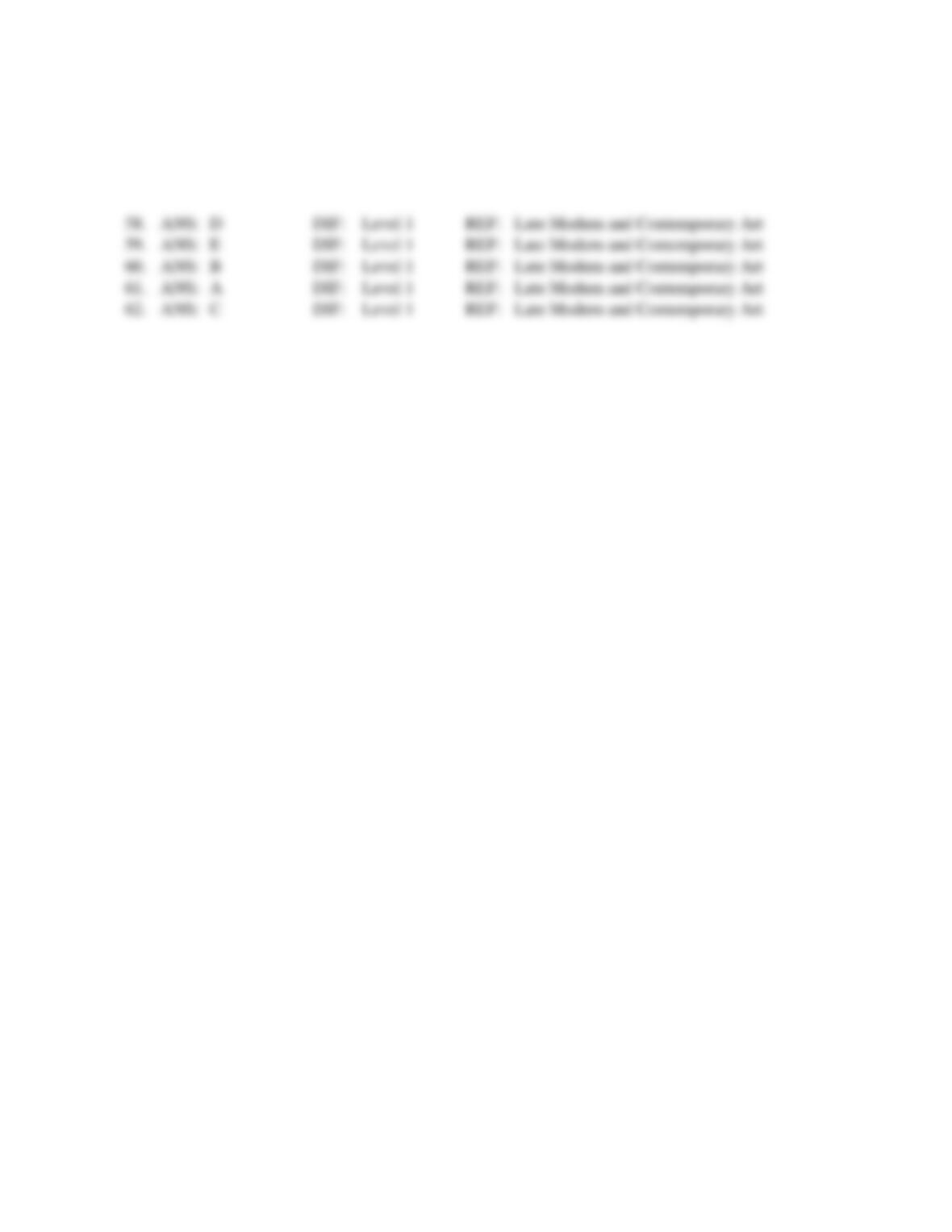
58. assemblage
59. action painting
60. visionary art
61. readymade
62. installation