
Chapter Tests
and Problems
ChaPTer 20 eleCTriCal and
eleCTroniC drafTing TesT
INSTRUCTIONS
Answer the questions with short, complete statements or draw–
ings as needed.
QUESTIONS
1. Explain the basic difference between electrical and electronic
drafting.
2. Define electrical circuit.
3. Describe a pictorial diagram.
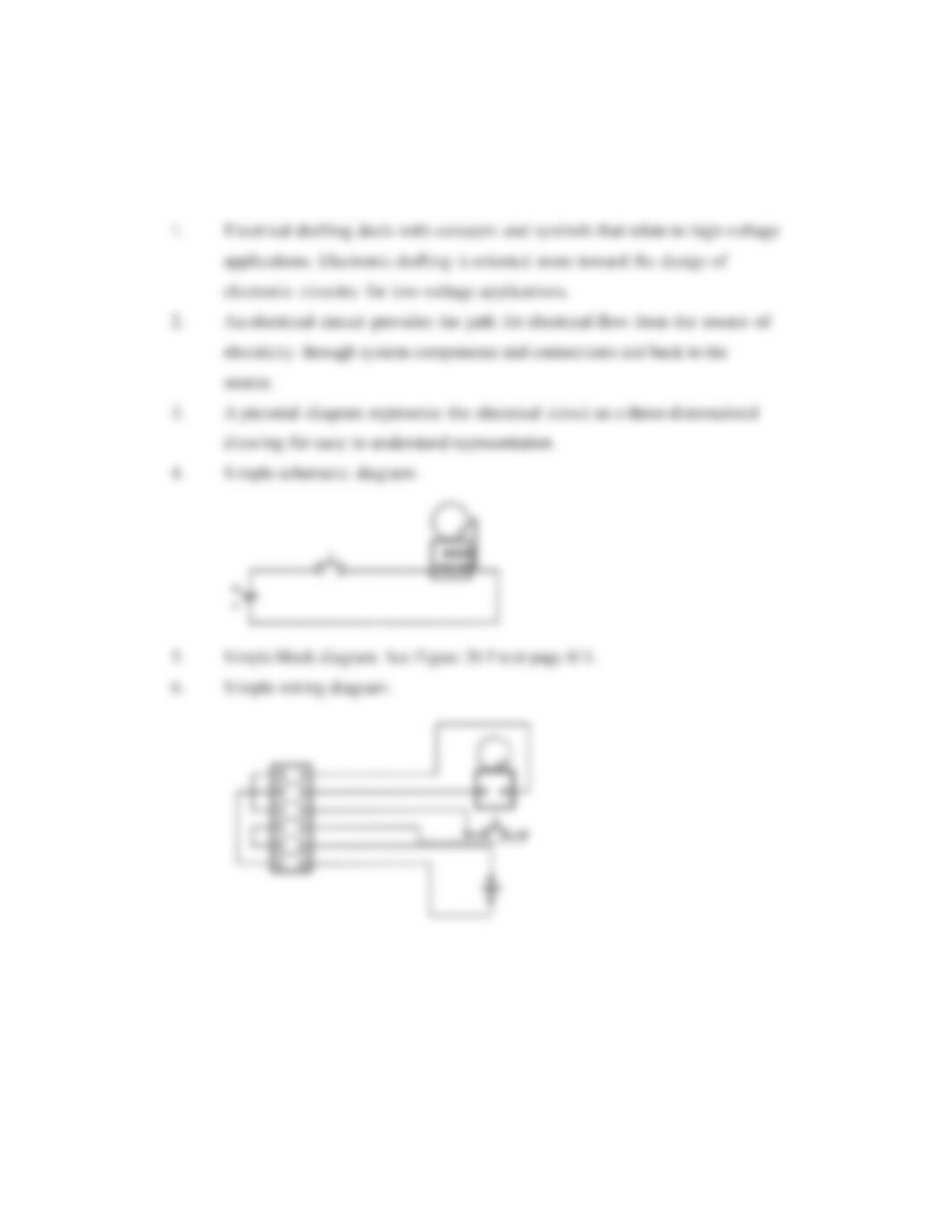
4. Draw or sketch a simple schematic diagram.
5. Draw or sketch a simple block diagram.
6. Draw or sketch a simple wiring diagram.
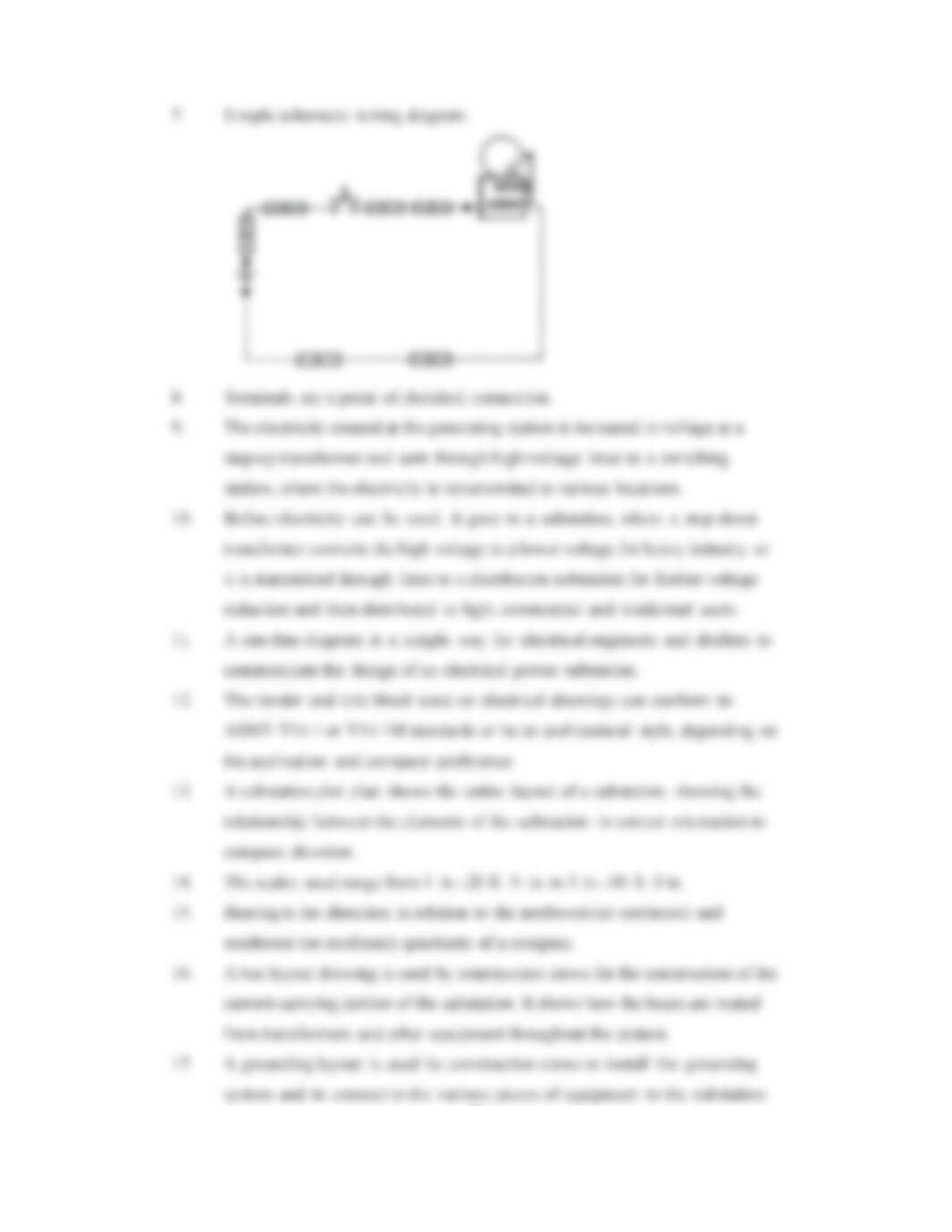
7. Draw or sketch a simple schematic wiring diagram.
8. Define terminals.
9. Briefly describe the transmission and distribution of
electricity.
10. Describe the function of a substation.
11. Explain the purpose of a block diagram in an electrical power
system design.
12. Describe the border and title block used on electrical
drawings.
13. Describe the purpose of a substation plot plan.
14. What are the scales most commonly used to draw plot plans?
15. Define bearing.
16. Explain the purpose of a bus layout drawing.
17. What is the purpose of a ground layout?
18. What do grounding details show and at what scale are they
drawn?
19. Define conduit.
20. Describe the purpose of conduit installation details.
21. What is the standard lettering height used on electrical
floor plans?
22. How should switch symbols be drawn in relation to the wall
upon which they are located?
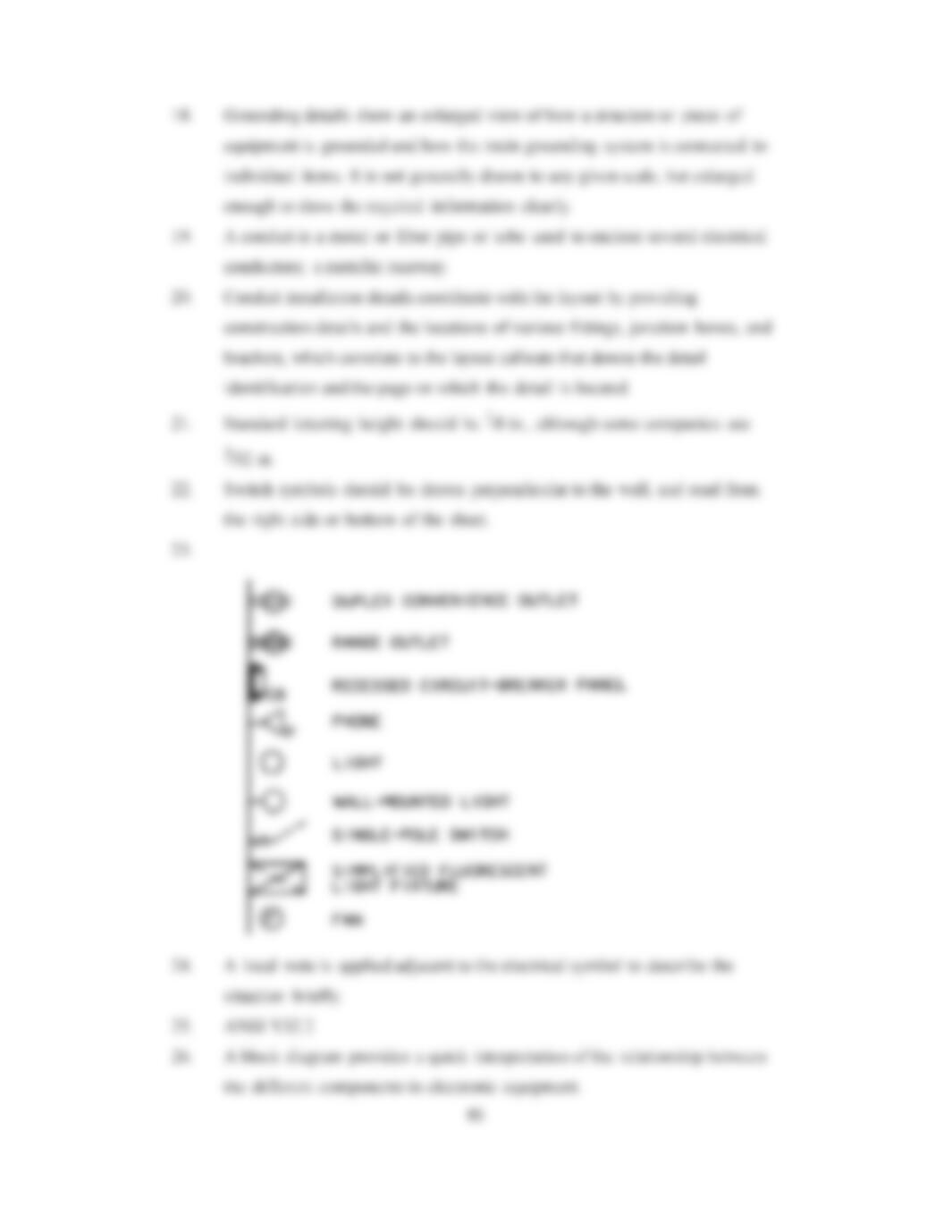
23. Draw or sketch the following electrical symbols:
Duplex convenience outlet
Range outlet
Recessed circuit breaker panel
Phone
Light
Wall-mounted light
Single-pole switch
Simplified fluorescent light fixture
Fan
24. What method is used to describe special characteristics in an
electrical plan layout?
25. Name the American National Standards Institute document
that governs the use of electrical and electronic drafting
symbols.
26. Describe the purpose of a block diagram.
27. What is the function of a capacitor?
28. Define inductance.
29. Describe the function of a resistor.
30. Define semiconductor.
31. Name two components that are considered semiconductors.
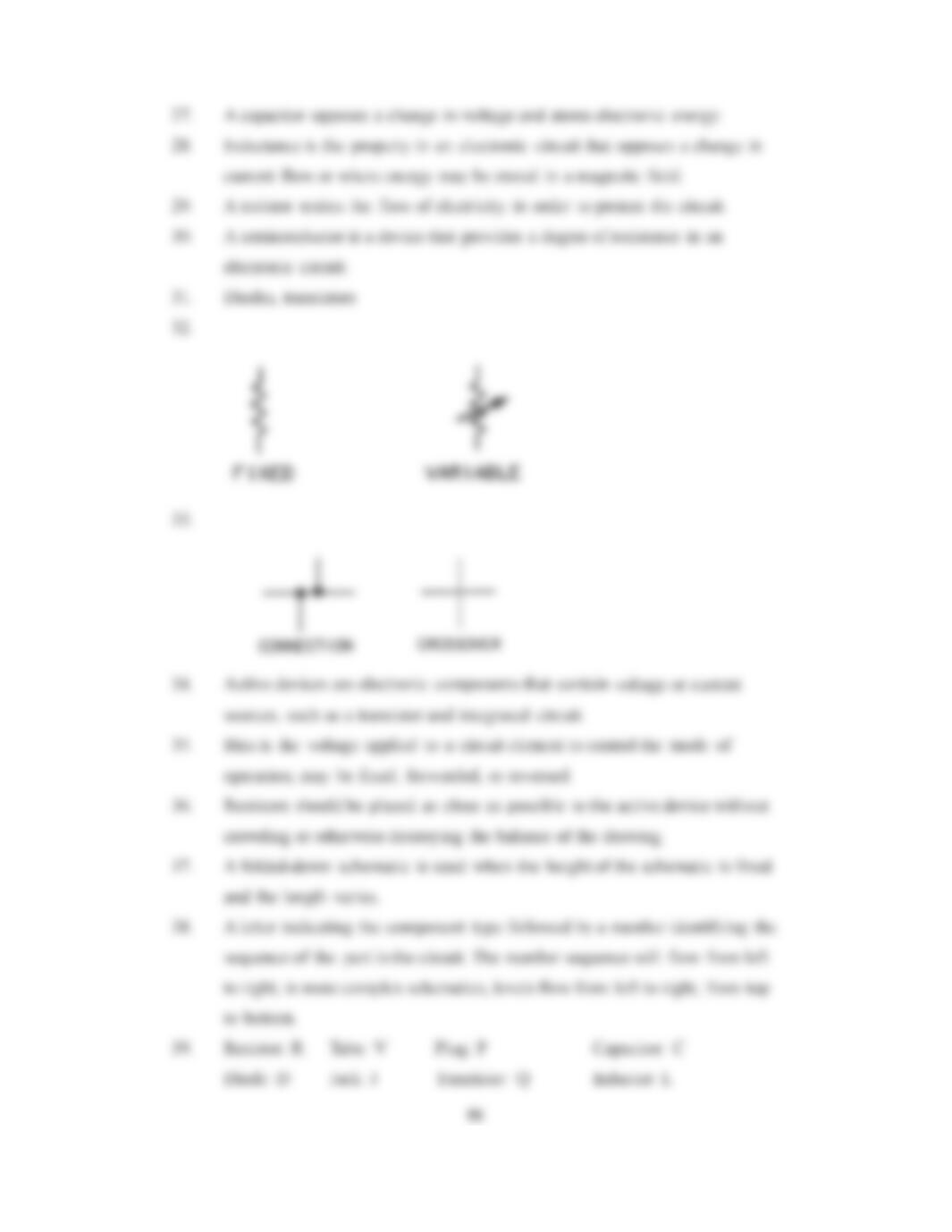
32. Draw or sketch and label a fixed and variable resistor.
33. Draw or sketch and label a circuit connection and a crossover.
34. Define active devices.
35. Define bias.
36. How should resistors be placed in relationship to the active
devices?
37. What is the advantage of a folded-down schematic?
38. Describe the common sequence standard for component
identification.
39. Give the standard letter identification for the following
components: resistor, capacitor, transistor, tube, diode, in–
ductor, plug, and jack.
40. Reduce the value 4,000 ohms to its simplest form.
41. Reduce the value 0.000000000001 farads to its simplest form.
42. Reduce the value 1,000,000 henrys to its simplest form.
59728_ch20_EOC_ptg01.indd 1 22/02/16 10:50 am

2
43. Draw or sketch an example of a horizontal capacitor
(C1, 5μf ) and a vertical resistor (R1, 1,000 ohms) connected,
and use the most popular labeling technique to show the
identification and value of each.
44. Define amplifier.
45. Define integrated circuit.
46. What does the dashed line box around an internal IC sche-
matic diagram denote?
47. Define gate.
48. Why is it possible that an IC schematic may be much easier
to lay out and draw than a conventional schematic?
49. What does the abbreviation LSI stand for?
50. How are electronic pictorials used in industry?
51. What is the main advantage of surface-mounted devices?
52. Printed circuits are used for what purpose?
53. Describe pads in PCB layout.
54. Why are holes drilled at the pad location?
55. Identify three factors that influence the size of conductor
traces.
56. Make a general statement describing printed circuit
artwork.
57. What scale is the master pattern?
58. Briefly explain the function of a grid system in preparing
master pattern artwork.
59. Why is the PCB prepared at an enlarged scale?
60. Describe the following: single-layer boards, multilayer
boards, multilayer sandwich boards.
61. Describe a solder mask.
62. Briefly describe unsupported holes, and plated-through
holes.
63. Give the general note used to identify that all holes are
plated through.
64. Describe a ground plane.
65. Give another name for printed circuit board art pieces for
terminal areas.
66. Describe a marking drawing.
67. Explain the function of a drilling drawing.
68. List the components of a complete engineering drawing.
69. Describe an SMD and give its advantage over a conventional
PCB.
70. List at least five functions of the CAE program in electronics
engineering.
59728_ch20_EOC_ptg01.indd 2 22/02/16 10:50 am
83
Chapter 20
Electrical and Electronic Drafting
Answers to End-of-Chapter Test Questions
84
90