Chapter 12 SeCtionS,
revolutionS, and Conventional
BreakS teSt
INSTRUCTIONS
Answer the questions with short, complete statements or draw–
ings as needed on an A-size drawing sheet.
QUESTIONS
1. Describe the potential advantage of a sectional view over a
multiview.
2. Explain and use a sketch to show the relationship of the
cutting-plane line arrowheads to the sectional view.
3. How much of the object does a full section actually
remove?
4. At what angles are section lines typically drawn, and what
basic rules are followed when drawing section lines?
5. What are coded section lines?
6. Describe the purpose and advantage of a half section.
7. What type of line is used in a half-sectional view to separate
the sectioned area from the nonsectioned area?
8. List four items that remain unsectioned in a sectional view
when the cutting-plane line cuts through parallel to the axes
of the items.
9. Describe a situation when a cutting-plane line is omitted in
sectioning drawings.
10. Discuss the advantage of using conventional revolutions.
Chapter tests
and problems
11. Discuss the cutting-plane line associated with a broken-out
section, and explain how the broken-out section is drawn.
12. What type of break line is generally associated with a
broken-out section?
13. In what situations are conventional breaks commonly used?
14. Discuss the difference between a revolved and removed sec-
tion. An example can be used.
15. Show an example of conventional breaks for the following
shapes: (a) Solid cylindrical shape [.5 in.; (b) Tube [.5 in.
with .06 in. wall thickness; (c) Solid steel h.5 in.
16. Describe the arrowheads used on cutting-plane lines.
17. Describe two ways that a cutting-plane line can be drawn,
not including the arrow method.
18. Give the text height used for cutting-plane line labels and
the correlated view identification.
19. When can the cutting-plane line be omitted?
20. How are section lines commonly treated when sectioning
very thin parts, less than .016 in. (4 mm) thick?
21. Briefly describe the centerline method for drawing a
removed section without a cutting-plane line.
22. Describe how multiple removed sections are generally
arranged on the sheet.
23. Explain the use of reference arrow method for identifying
sections.
24. Describe the use of cross-reference zoning for sectioning
applications.
25. Describe the error found in the following drawings: (a), (b),
(c), (d), and (e) on next page.
59728_ch12_EOC_ptg01.indd 1 03/02/16 10:27 am
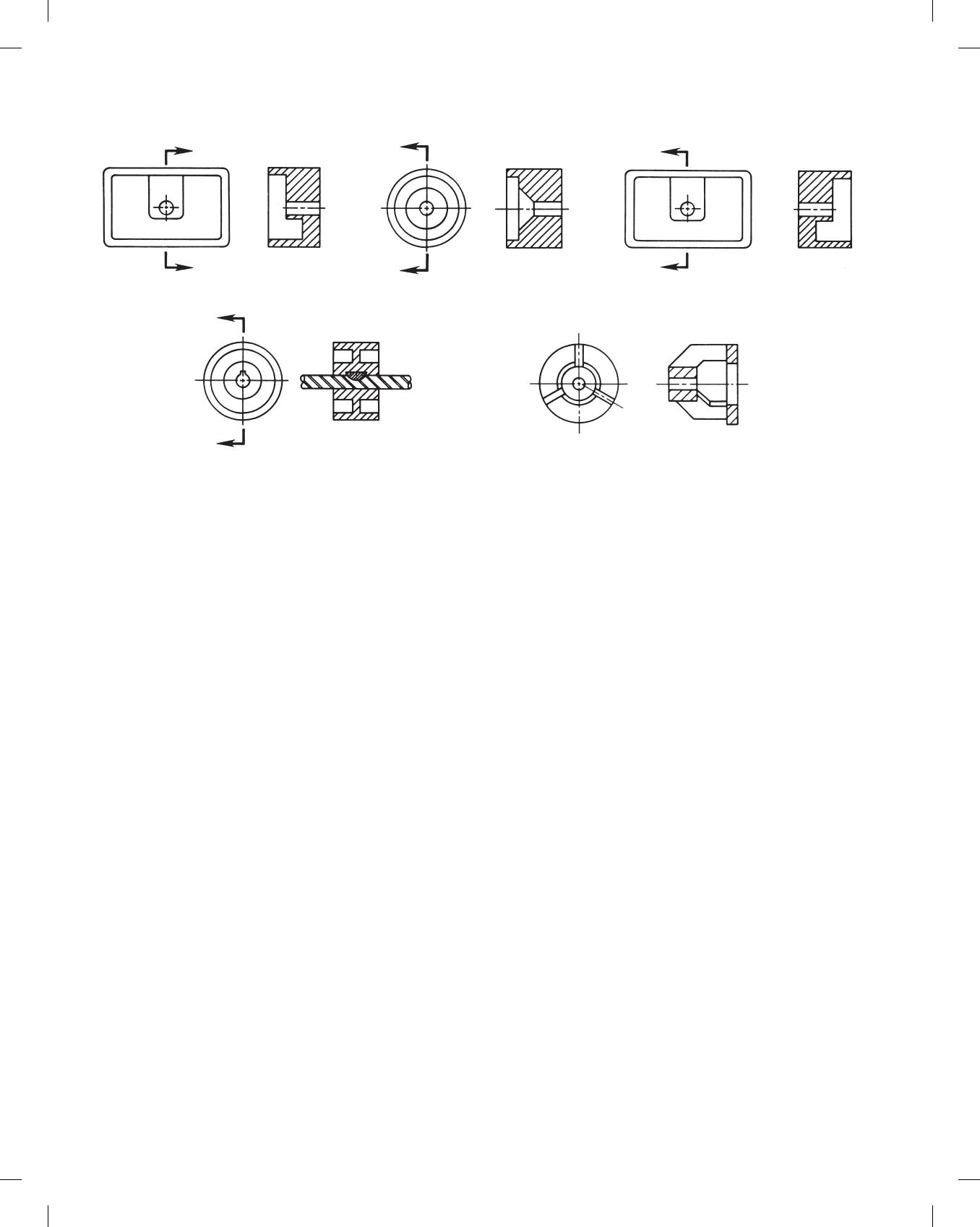
(a)
(d) (e)
(b) (c)
59728_ch12_EOC_ptg01.indd 2 03/02/16 10:27 am
Chapter 12
Sections, Revolutions, and Conventional Breaks
Answers to End-of-Chapter Test Questions
54