50. Tail Winds Corporation acquired the following equity securities during 2013:
TICO Industries capital stock, 150 shares
$11,250
Thankful Products capital stock, 400 shares
10,200
The company’s investment in these two companies is passive and classified as available-for-sale. During 2013, TICO paid a dividend of $1.10 per
share and Thankful paid a dividend of $1.75 per share. At December 31, 2013, the market value of these securities was $79 per share for TICO and
$23 per share for Thankful.
A)
Prepare journal entries to record the purchase of these two investments and the receipt of dividends.
B)
Calculate the market value of the company’s short-term investment portfolio at December 31, 2013.
C)
Prepare the necessary journal entry at December 31, 2013.
D)
How should these investments be disclosed in the company’s December 31, 2013, financial statements?
A)
21,450
Cash
21,450
Cash
Total: $11,850 + $9,200 = $21,050
C)
Unrealized Loss on Available-for-Sale Securities
51. Tidewater Management, Inc. had no investments in short-term marketable securities prior to 2013. During
2013, the company engaged in the following investment transactions:
1.
Purchased 300 shares of Toucan Taxi Company stock for $14 per share.
2.
Received a $2.50 per share dividend on the Toucan Taxi stock.
3.
Sold 200 shares of the Toucan Taxi stock for $16 per share.
At the end of 2013, the Toucan Taxi stock had a market value of $15 per share.
A)
Prepare journal entries for each of the three transactions assuming they are available-for-sale securities.
B)
Prepare journal entries, if required, to recognize the year-end market value. What is the income statement effect of the entry, if any?
C)
How will this investment be reported on the company’s balance sheet at December 31, 2013?
A)
4,200
Cash
4,200
Cash
750
Dividend Income
750
Cash
3,200
2,800
Gain on Sale of Investments
400
B)
Unrealized Gain on Available-for-Sale Securities
100
52. Treasure Distributors, Inc. had no investments in short-term marketable securities prior to 2012. During
2012, the company engaged in the following investment transactions:
1.
Purchased 500 shares of Toledo Company stock for $24 per share.
2.
Received a $2.15 per share dividend on the Toledo Company stock.
3.
Sold 450 shares of the Toledo Company stock for $19 per share.
At the end of 2012, the Toledo Company stock had a market value of $18 per share.
A)
Prepare journal entries for the three transactions assuming the stock is classified as trading securities.
B)
Prepare the journal entry, if required, to recognize the investment’s year-end market value. What is the income statement effect of
the entry, if any?
C)
How will this investment be reported on the company’s balance sheet at December 31, 2012?
D)
Determine the realized gain or loss if Treasure Distributors, Inc. sells the remaining Toledo Company stock for $18.50 per share in
early 2013.
A)
12,000
Cash
12,000
Cash
1,075
Dividend Income
1,075
Cash
8,550
Loss on Sale of Investments
2,250
10,800
B)
Unrealized Loss on Trading Securities
300
Allowance to Adjust Trading Securities to Market
300
statement.
D)
Cash $925 less Investment book value $900 = $25
53. Trattoria, Inc. engaged in the following investment transactions during 2013:
1.
Purchased 200 shares of Tarbet Corporation stock for $11,500.
2.
Received a $1.50 per share dividend on the Tarbet stock.
3.
Sold 50 shares of the Tarbet stock for $55 per share.
At December 31, 2013, the market value of Tarbet’s stock was $54.
A)
Prepare journal entries to record this investment assuming management intends to hold this investment for less than a month.
B)
Calculate the market value of the company’s investment at December 31, 2013.
C)
Prepare the necessary journal entry at December 31, 2013.
D)
How should this investment be disclosed in the December 31, 2013 financial statements?
A)
1.
11,500
Cash
2.
Cash
300
Dividend income
3.
Cash (50 x $55)
2,750
Loss on Sale of Investments
125
B)
Tarbet: 150 shares @ $54 = $8,100
C)
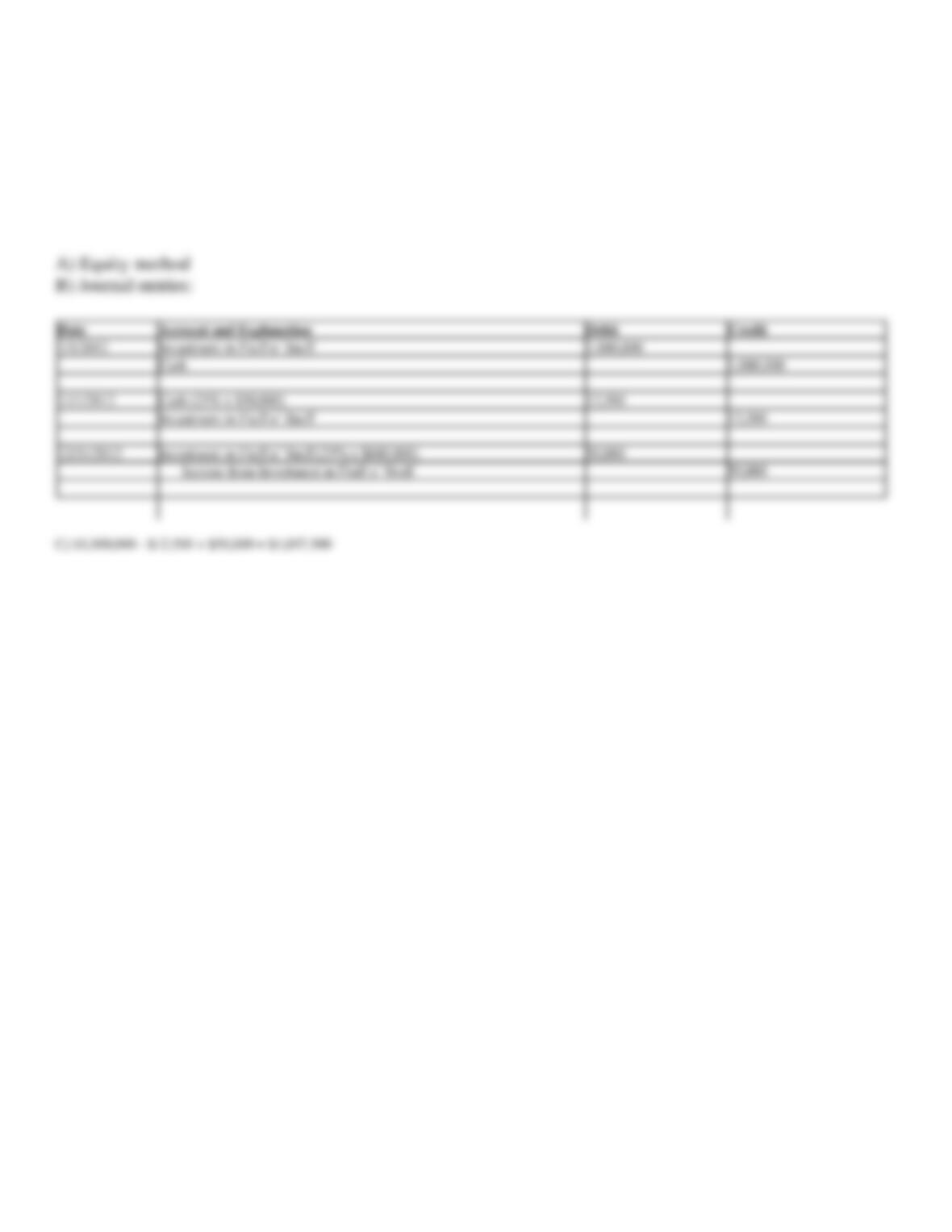
54. On January 1, 2012, Teddy Bear Company purchased 25 percent of the common stock of one of its major
suppliers—Fluff n’ Stuff, for $1,000,000 cash. On November 1, 2012, Fluff n’ Stuff declared and paid a cash
dividend of $50,000. Further, for the year ended December 31, 2012, Fluff n’ Stuff reported net income of
$200,000.
A) Which method of accounting for investments should be used for the Fluff n’ Stuff stock?
B) Record all of the necessary journal entries for this investment during 2012.
C) What will be the balance in the investment account at December 31, 2012?
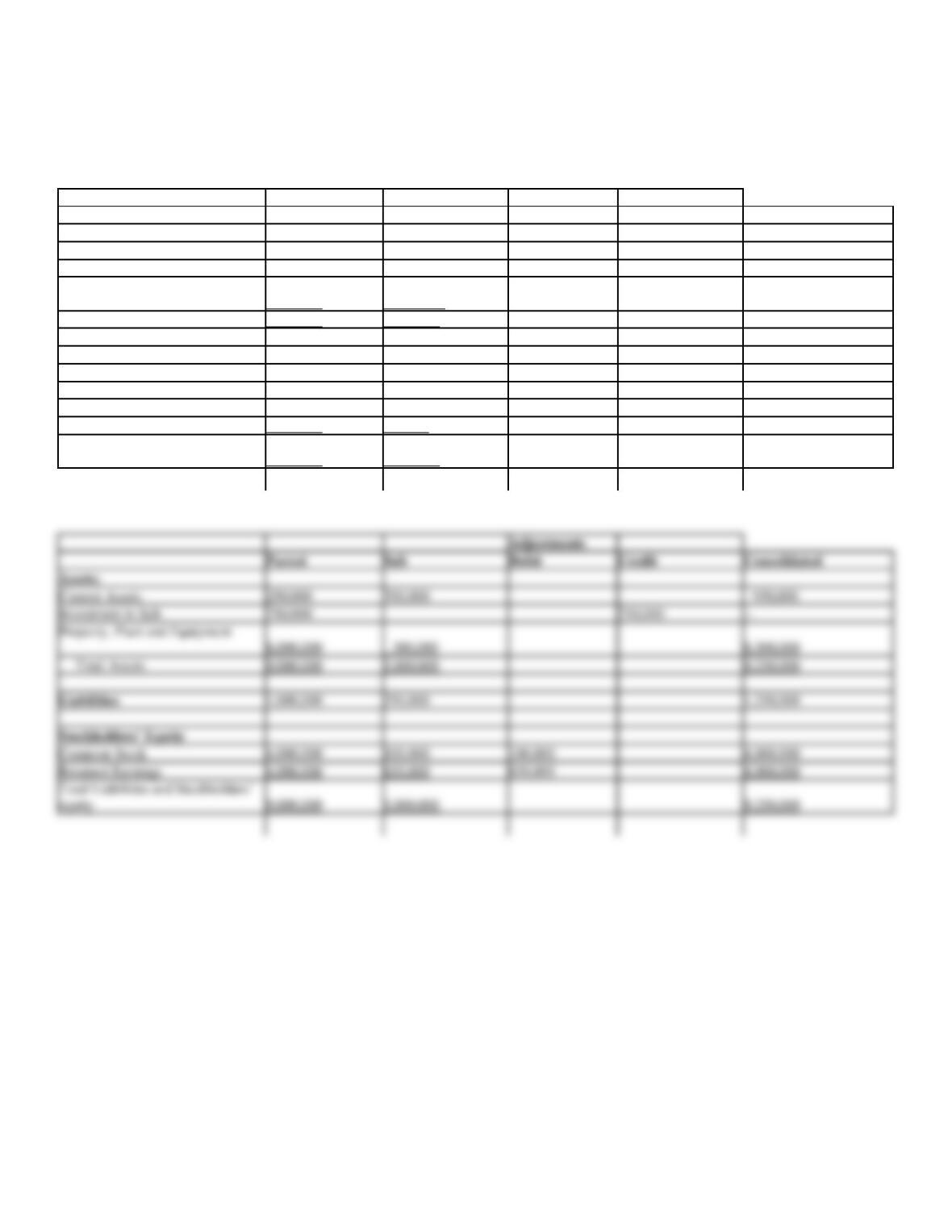
55. On January 1, 2012, Parent, Inc., purchases all the outstanding common stock of Sub Corporation for
$750,000. Since Parent has control over Sub, a consolidated balance sheet must be prepared from the
individual balance sheets of both companies. Complete the following worksheet to prepare the consolidated
balance sheet on January 1, 2012.
Adjustments
Parent
Sub
Debit
Credit
Consolidated
Assets:
Current Assets
250,000
700,000
Investment in Sub
750,000
Property, Plant and Equipment
8,000,000
300,000
Total Assets
9,000,000
1,000,000
Liabilities
1,000,000
250,000
Stockholders’ Equity
Common Stock
4,000,000
100,000
Retained Earnings
4,000,000
650,000
Total Liabilities and Stockholders’
equity
9,000,000
1,000,000
Adjustments
Parent
Sub
Debit
Credit
Consolidated
Assets:
Current Assets
250,000
700,000
950,000
Investment in Sub
750,000
750,000
Total Assets
9,000,000
1,000,000
9,250,000
Liabilities
1,000,000
250,000
1,250,000
Stockholders’ Equity
Common Stock
4,000,000
100,000
100,000
4,000,000
Retained Earnings
4,000,000
650,000
650,000
4,000,000
Total Liabilities and Stockholders’
equity
9,000,000
1,000,000
9,250,000
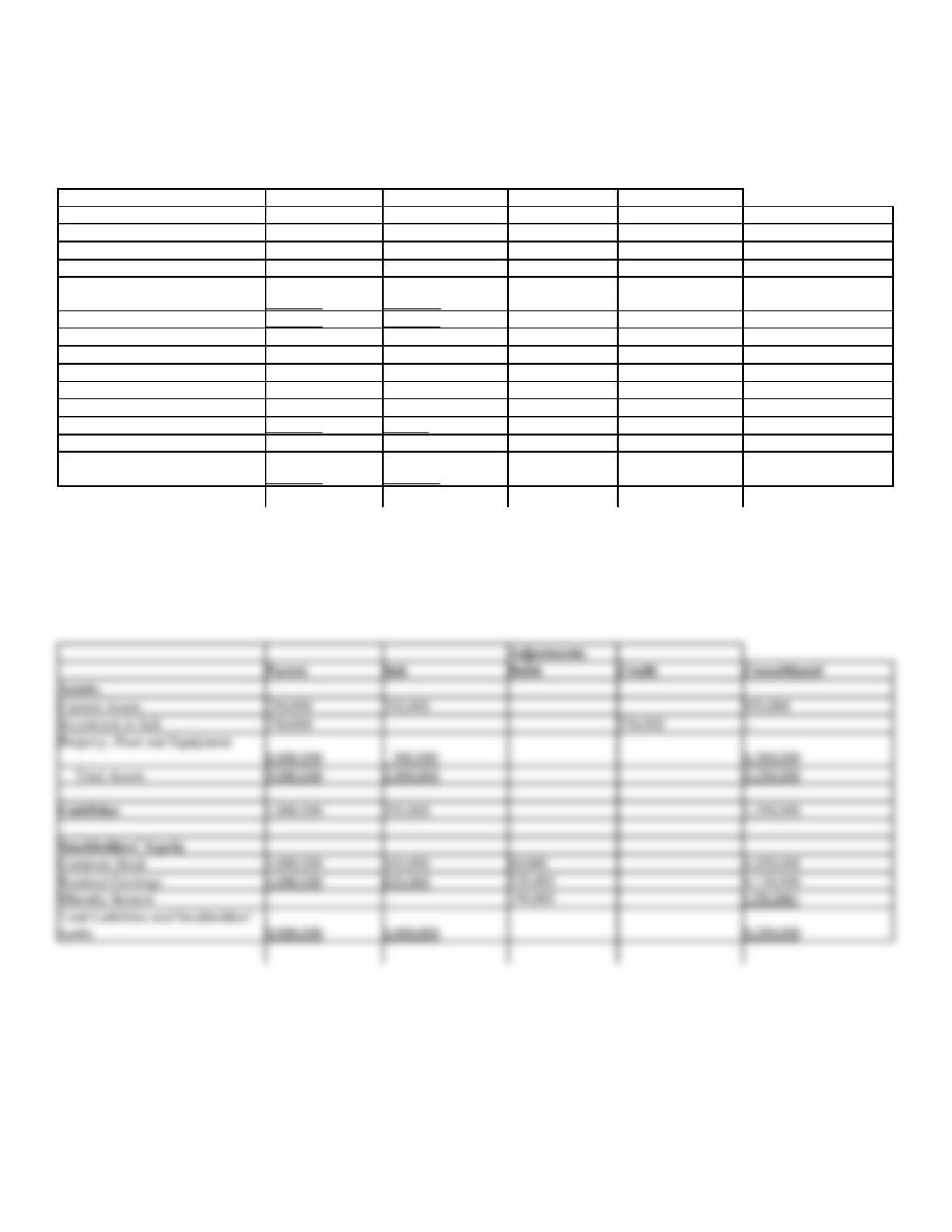
56. On January 1, 2012, Parent, Inc., purchased 80% of the outstanding common stock of Sub Corporation for
$750,000. Since Parent has control over Sub, a consolidated balance sheet must be prepared from the
individual balance sheets of both companies. Complete the following worksheet to prepare the consolidated
balance sheet on January 1, 2012.
Adjustments
Parent
Sub
Debit
Credit
Consolidated
Assets:
Current Assets
250,000
700,000
Investment in Sub
750,000
Property, Plant and Equipment
8,000,000
300,000
Total Assets
9,000,000
1,000,000
Liabilities
1,000,000
250,000
Stockholders’ Equity
Common Stock
4,000,000
100,000
Retained Earnings
4,000,000
650,000
Total Liabilities and Stockholders’
equity
9,000,000
1,000,000
The minority interest is $150,000 [20% x ($100,000 + $650,000)] and this amount must be shown as a
component of stockholders’ equity on the consolidated balance sheet.
Adjustments
Parent
Sub
Debit
Credit
Consolidated
Assets:
Current Assets
250,000
700,000
950,000
Investment in Sub
750,000
750,000
Property, Plant and Equipment
Total Assets
9,000,000
1,000,000
9,250,000
Liabilities
1,000,000
250,000
1,250,000
Common Stock
4,000,000
100,000
80,000
4,020,000
Retained Earnings
4,000,000
650,000
520,000
4,130,000
Minority Interest
150,000
(150,000)
Total Liabilities and Stockholders’
equity
9,000,000
1,000,000
9,250,000
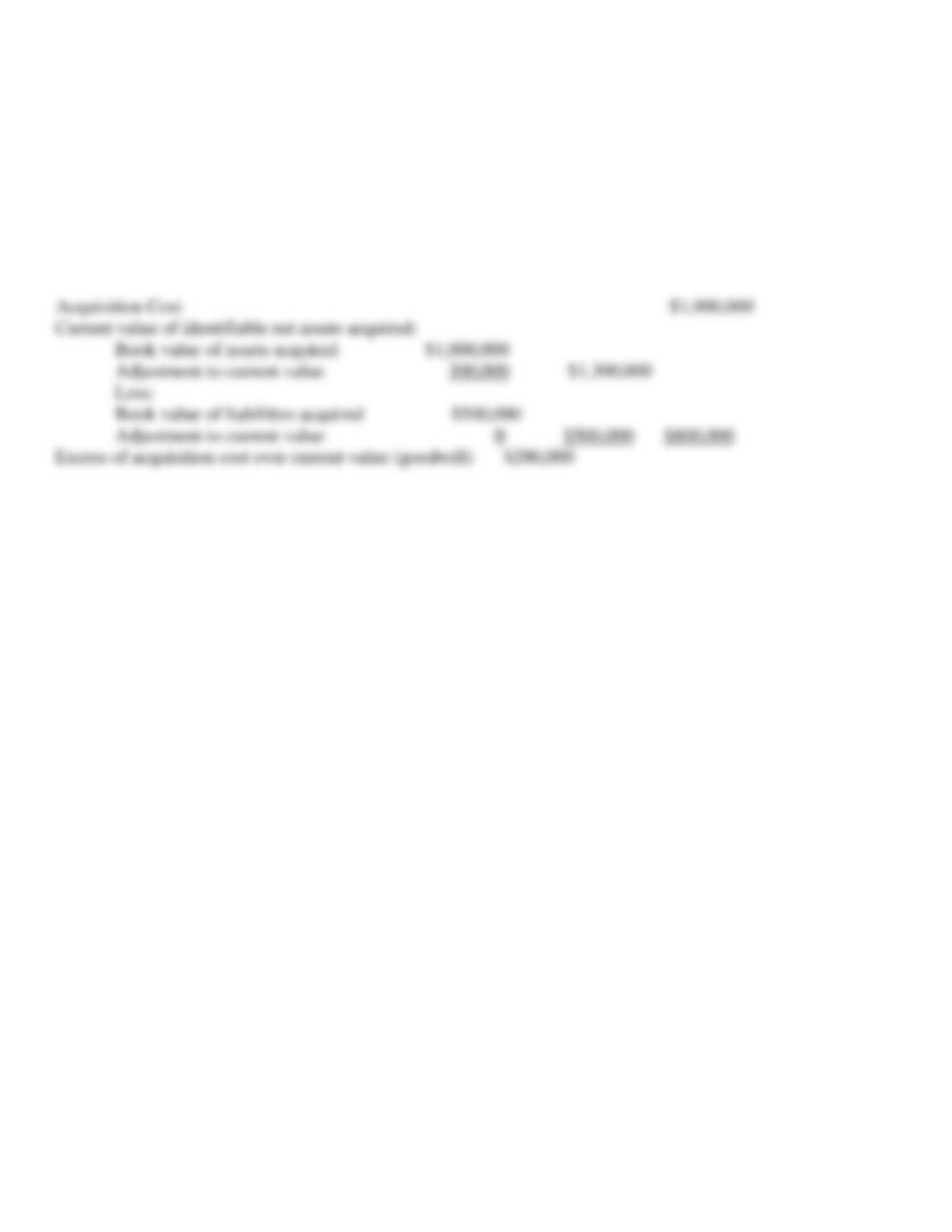
57. Tusk Company acquired all of the assets of Tinsel Company for $1,000,000. With the approval of Tinsel’s
stockholders and creditors, Tinsel transferred all of its assets and liabilities to Tusk Company and distributed the
cash to Tinsel’s stockholders. On the acquisition date, Tinsel’s stockholders’ equity was $500,000. Tusk
Company determined that Tinsel’s liabilities of $500,000 are correctly valued, but its identifiable assets are
worth $300,000 more than their book value of $1,000,000.
Determine the amount of goodwill to be recognized by Tusk Company as a result of its acquisition of Tinsel
Company.
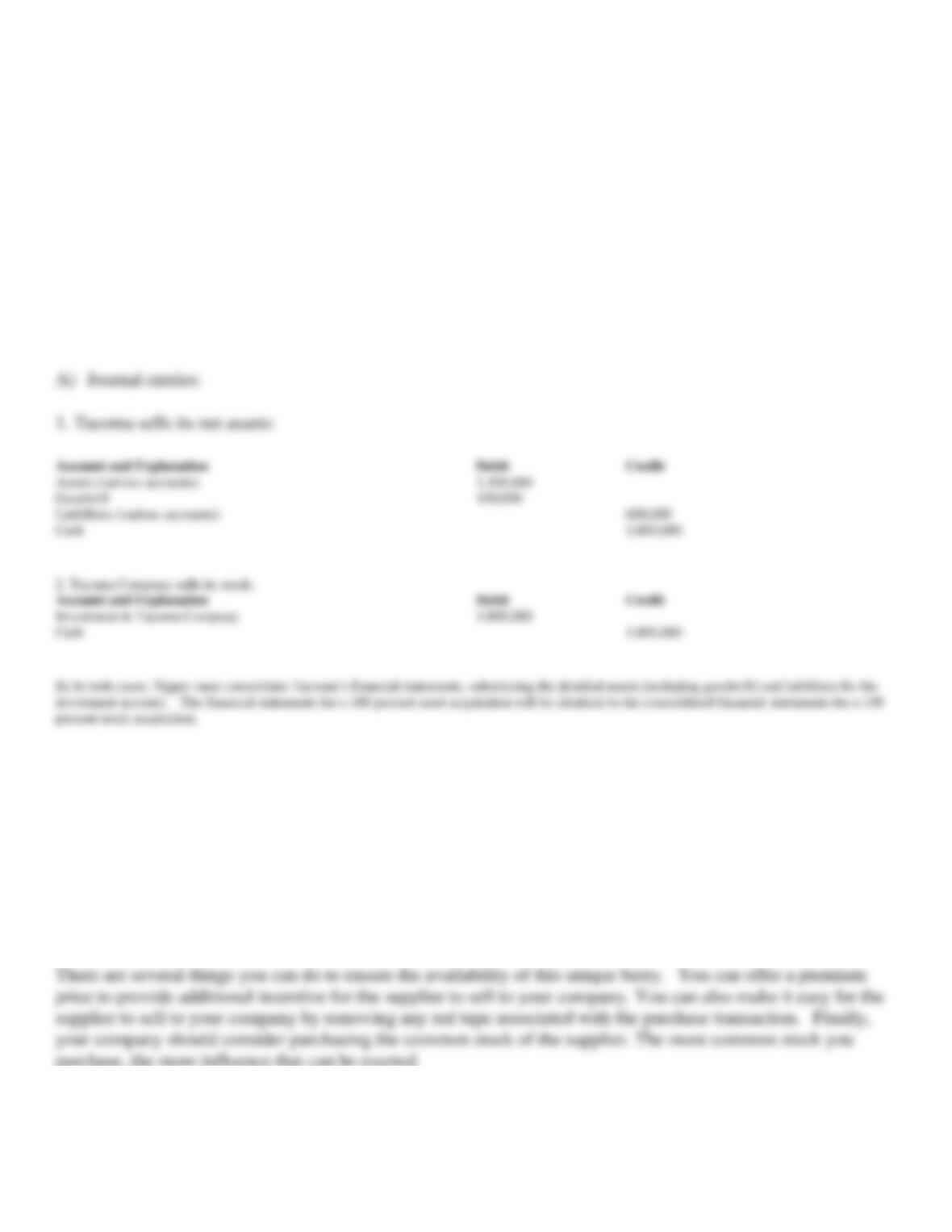
The acquisition cost exceeds the current value of the net assets (assets minus liabilities) acquired by $200,000:
58. Tipper Company acquires Tacoma Company for $1,000,000. On the acquisition date, Tacoma has the
following balances:
Assets
Assets
$1,500,000
Liabilities
600,000
A) Record the entry Tipper Company will make to acquire Tacoma Company under each of the following assumptions:
1. Tacoma Company sells Tipper Company its net assets and goes out of existence as a corporation; and
2. Tacoma Company sells Tipper Company its stock but continues as a legal entity.
B) Explain the difference in the consolidated financial statements for the two companies.
59. “You Decide” Essay
You are the owner of a company that produces an energy drink that has unique properties. Its primary
ingredient, a berry found only in the South American rain forest, causes a significant prolonged increase in the
drinker’s metabolism rate. You have found only a single supplier of this berry, Tropical Supplies, Inc., a
publicly traded company.
What are some things you can do to assure your company of access to this important raw material?
Assets (various accounts)
1,500,000
Goodwill
100,000
Liabilities (various accounts)
600,000
Cash
1,000,000
60. “You Decide” Essay
You are the accounting manager for a mid-sized electronics retailer. Your accounting intern is having trouble
understanding how your company accounts for its investments in the stock of other companies. You just spent
the better part of the morning reviewing in detail all of the recording and reporting requirements but the intern is
still fuzzy.
Complete the following table to compare and contrast for your intern the requirements for the different types of
stock investments that your company might make. Be sure to use the legend provided.
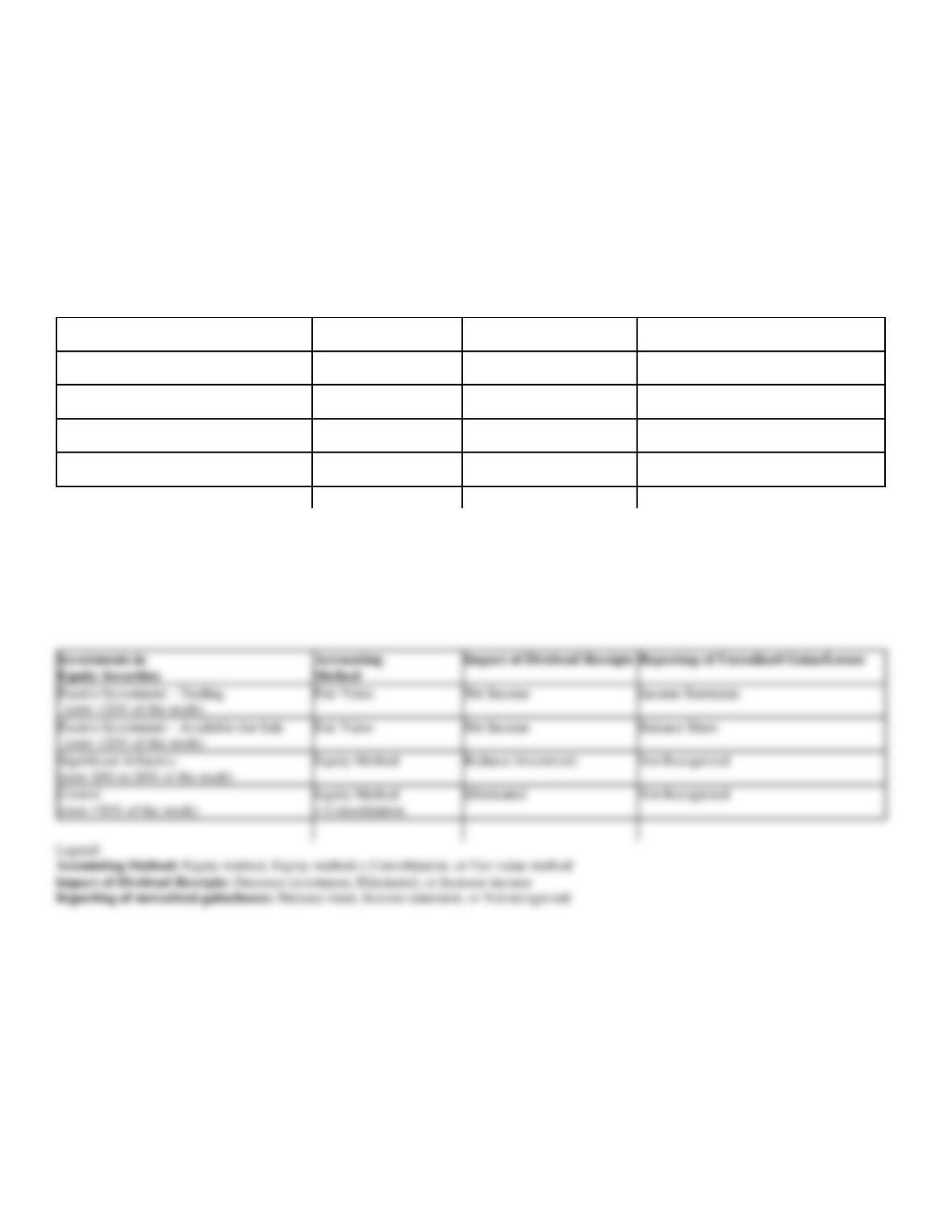
Investments in Equity Securities
Investments in
Equity Securities
Accounting
Method
Impact of Dividend Receipts
Reporting of Unrealized Gains and
Losses
Passive Investment – Trading
(own <20% of the stock)
Passive Investment – Available-for-Sale
(own <20% of the stock)
Significant Influence
(own 20% to 50% of the stock)
Control
(own >50% of the stock)
Legend:
Accounting Method: Equity method, Equity method + Consolidation, or Fair value method
Impact of Dividend Receipts: Decrease investment, Eliminated, or Increase income
Reporting of unrealized gains/losses: Balance sheet, Income statement, or Not recognized
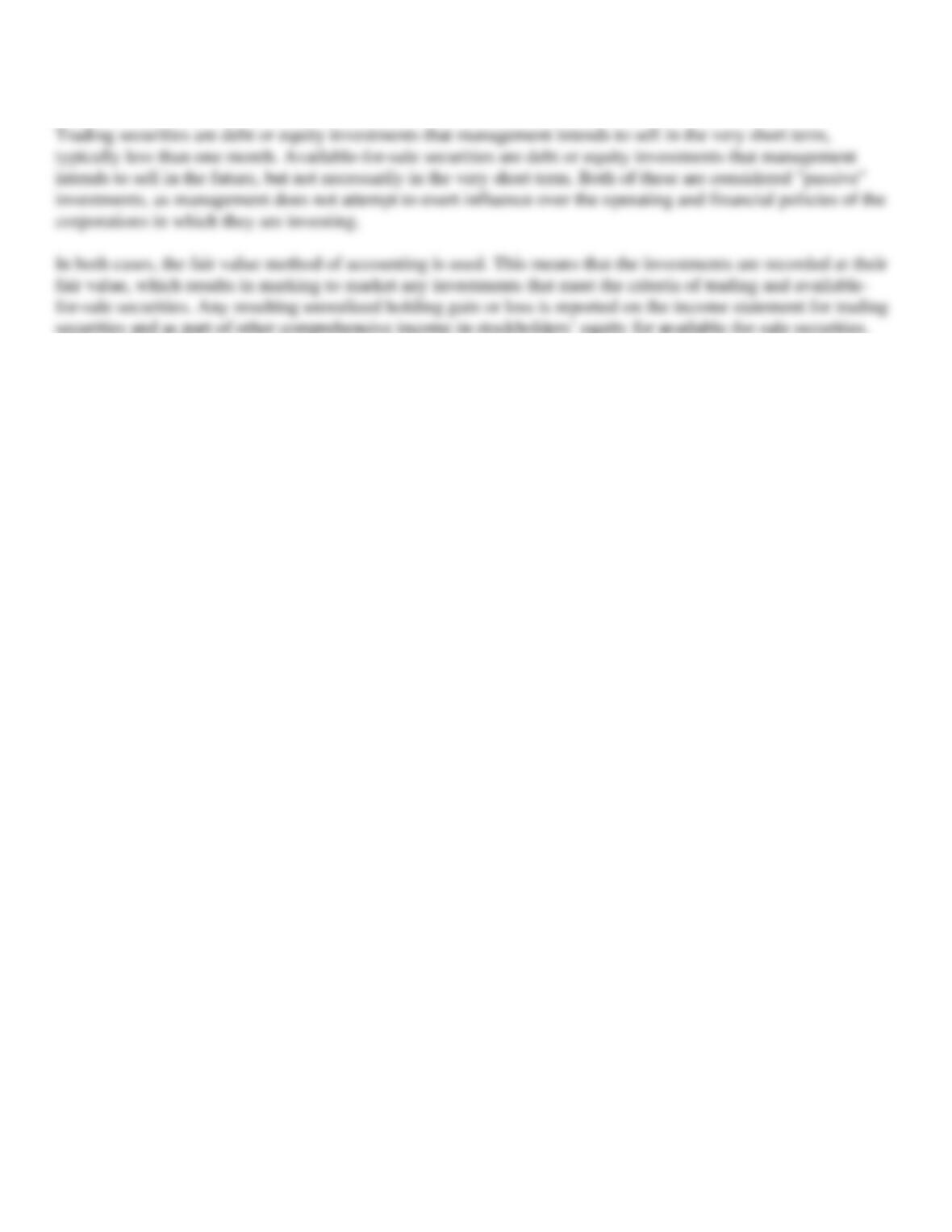
Accounting for Investments in Debt and Equity Securities
Investments in
Equity Securities
Accounting
Method
Impact of Dividend Receipts
Reporting of Unrealized Gains/Losses
Passive Investment – Trading
(own <20% of the stock)
Fair Value
Net Income
Income Statement
Passive Investment – Available-for-Sale
(own <20% of the stock)
Fair Value
Net Income
Balance Sheet
Significant Influence
(own 20% to 50% of the stock)
Equity Method
Reduces Investment
Not Recognized
Control
(own >50% of the stock)
Equity Method
+ Consolidation
Eliminated
Not Recognized
61. What is the difference between trading securities and available-for-sale securities? What are the similarities
in terms of their accounting treatment?