
Appendix 2—Investments Key
1. Securities issued by a corporation as a form of ownership in the business, such as common stock and
preferred stock, are called equity securities.
2. The equity method of accounting is used if the investor owns between 20-50% of another company and the
investor is able to exert influence over the other company.
3. A debt security exists when another entity owes the security holder some combination of interest and
principal.
4. If the investor owns over 50 percent of the outstanding common stock, the investor is deemed to have control
over the operating and financial policies of the investee.
5. Held-to-maturity securities are equity and debt investments that management intends to sell in the future, but
not necessarily in the near term.
6. The fair value method should be used to account for stock investments of less than 20 percent of the
outstanding shares.
7. An advantage of the equity method over the fair value method is that it prevents an investor from
manipulating its own income by exerting influence over the amount and timing of investee dividends.

8. If the investor holds enough common stock to control the investee (50 percent or more common stock
ownership), then the two corporations are no longer separate accounting entities and therefore they no longer
may maintain separate accounting records.
9. If the parent owns 90 percent of the subsidiary’s stock, then 90 percent of the subsidiary’s assets and
liabilities are included in the consolidated balance sheet.
10. If the investor holds 50 percent or more of the investee’s outstanding common stock, then the investor is
referred to as the parent and the investee is called the subsidiary.
11. Any transaction or set of transactions that brings together two or more previously separate entities to form a
single accounting entity is called a business combination.
12. The excess of acquisition cost over the current value of the investee’s identifiable net assets, referred to as
goodwill, may not be recorded by the investor under current generally accepted accounting principles.
13. A purchased company must be recorded at the value of the cash and other consideration given by the
acquiring company.
14. If the acquisition cost exceeds the current value of the net assets (assets minus liabilities) acquired, the
investor must also be purchasing an intangible asset arising from attributes that are not separable from the
business—such as customer satisfaction, product quality, skilled employees, and business location.
15. Minority (or noncontrolling) interest is disclosed when the parent owns more than 50 percent, but less than
100 percent of the outstanding common stock.

16. When an investor is able to exert significant influence over another company, the ____________________
method of accounting is used for the investment.
17. Ownership in a corporation is represented by shares of common or preferred stock called
____________________ securities.
18. ____________________ securities, such as bonds, exist when another entity owes the security holder some
combination of principal and interest.
19. ____________________ securities are equity or debt investments that are bought and sold frequently and
are typically owned for less than one month.
20. ____________________ securities are debt investments that are accounted for on an amortized cost basis
because management intends to hold the investment until the debt contract requires the borrower to completely
repay the debt.
21. If the investor holds 50 percent or more of the common stock of the investee, then the two corporations are
no longer separate accounting entities and therefore must prepare ____________________ financial
statements, which combine information about the two corporations as if they were a single company.
22. If the investor holds 50 percent or more of the common stock of the investee, then the investor is referred to
as the ____________________ and the investee is referred to as the ____________________.
23. Consolidation is required when a parent acquires between 50 and 100 percent of the subsidiary’s
stock. Any voting stock not held by the parent is called the ____________________.

24. Any transaction or set of transactions that brings together two or more previously separate entities to form a
single accounting entity is called a ____________________.
25. The excess of the investor’s acquisition cost over the current value of the investee’s identifiable net assets is
recorded as an intangible asset called ____________________.
26. Business combinations can occur through either an asset or ____________________ acquisition.
27. A business combination is recorded at the cost of acquisition, without regard to the seller’s
____________________ value.
28. Match the following terms to their correct definition:
1. Situation where the investor owns over 50 percent of
2. Name given to an investor who owns over 50
percent of the outstanding common stock of the
3. Debt investments that management intends to hold
until the debt contract requires the borrower to repay
4. Method of accounting for all investments in debt
securities that are classified as held-to-maturity
5. Method of accounting required for all passive
investments in which the investment is valued at the
6. Result when the value of securities must be written
up or down to fair market value at the balance sheet
together two or more previously separate entities to
7. Any transaction or set of transactions that brings
8. Equity or debt investments that management intends
9. Equity and debt investments that management
intends to sell in the future, but not necessarily in the
investor acquires between 50 and 100 percent of the
10. Any voting stock not held by the parent in
situations where consolidation is required because the
11. Exists when another entity owes the security holder
12. Name given to the investee when an investor owns
over 50 percent of the investee’s outstanding common
13. Device that facilitates combining the financial
14. Method of accounting for investments where the
investor possesses significant influence (20 to 50
15. Represents an ownership interest in a corporation,
16. Situation where the investor owns 20 to 50 percent
of the outstanding common stock of the investee and is
17. An intangible asset arising from attributes that are
not separable from the business—such as customer
18. Situation where the investor owns less than 20
percent of the common stock of another company and
29. When a company purchases less than 50% of the equity securities of another company, which of the
following statements is true?
30. The equity method of accounting for an investment is used when a company purchases
31. What are the effects on the accounting equation from the purchase of a short-term investment?
32. What are the effects on the accounting equation from the recognition of an unrealized loss on trading
securities?
33. The practice of adjusting the market value of securities that are accounted for using the fair value method is
referred to as:
34. A passive investment is one in which:
35. A company is referred to as a parent if it owns
36. On January 1, 2011, P Company purchased all of the outstanding common stock of S Company. The
consolidation of the two balance sheets requires a
37. On January 1, 2011, P Company purchased all of the outstanding common stock of S Company. Which of
the following represents the worksheet entry needed to consolidate the balance sheets of the two companies?
38. Select the correct statement from the following:
39. Select the incorrect statement from the following:
40. Any transaction or set of transactions that brings together two or more previously separate entities to form a
single accounting entity is called a
41. A transaction that brings together two or more previously separate entities to form a single legal entity is
called
42. P Company paid $500,000 for 100% of the net assets (assets less liabilities) of S Company. The book value
of S Company’s net assets was only $475,000. As a result of this acquisition, P Company must recognize
43. Select the incorrect statement from the following:
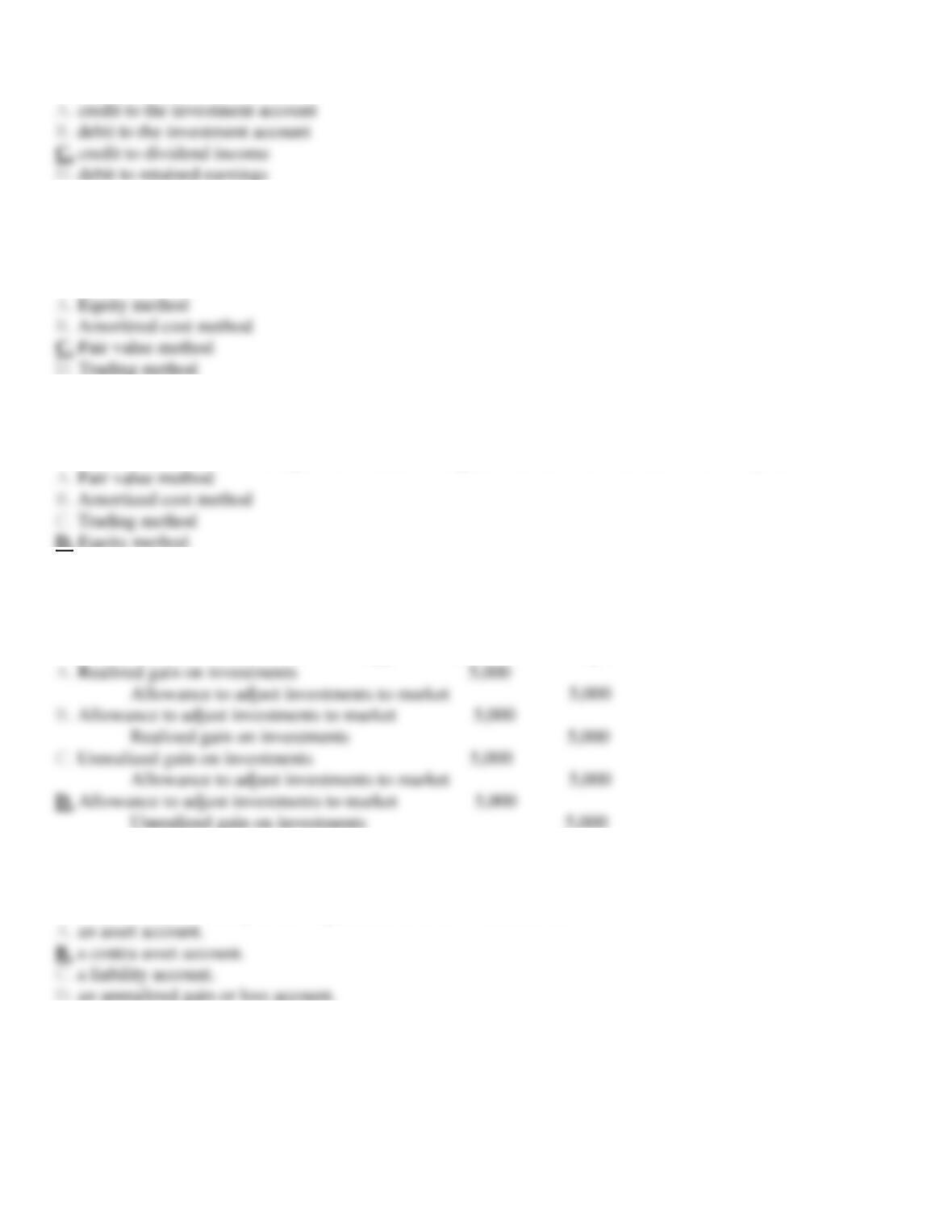
44. The journal entry required to record the receipt of dividends under the fair value method of accounting for
investments includes a
45. Which method of accounting for investments results in unrealized gains and losses because the investments
must be marked to market?
46. Which method of accounting for investments recognizes income when income is earned by the investee?
47. An investor’s available-for-sale securities had increased in market value from $50,000 to $55,000 as of the
balance sheet date. Which of the following journal entries would be required?
48. The Allowance to Adjust Trading Securities to Market account is
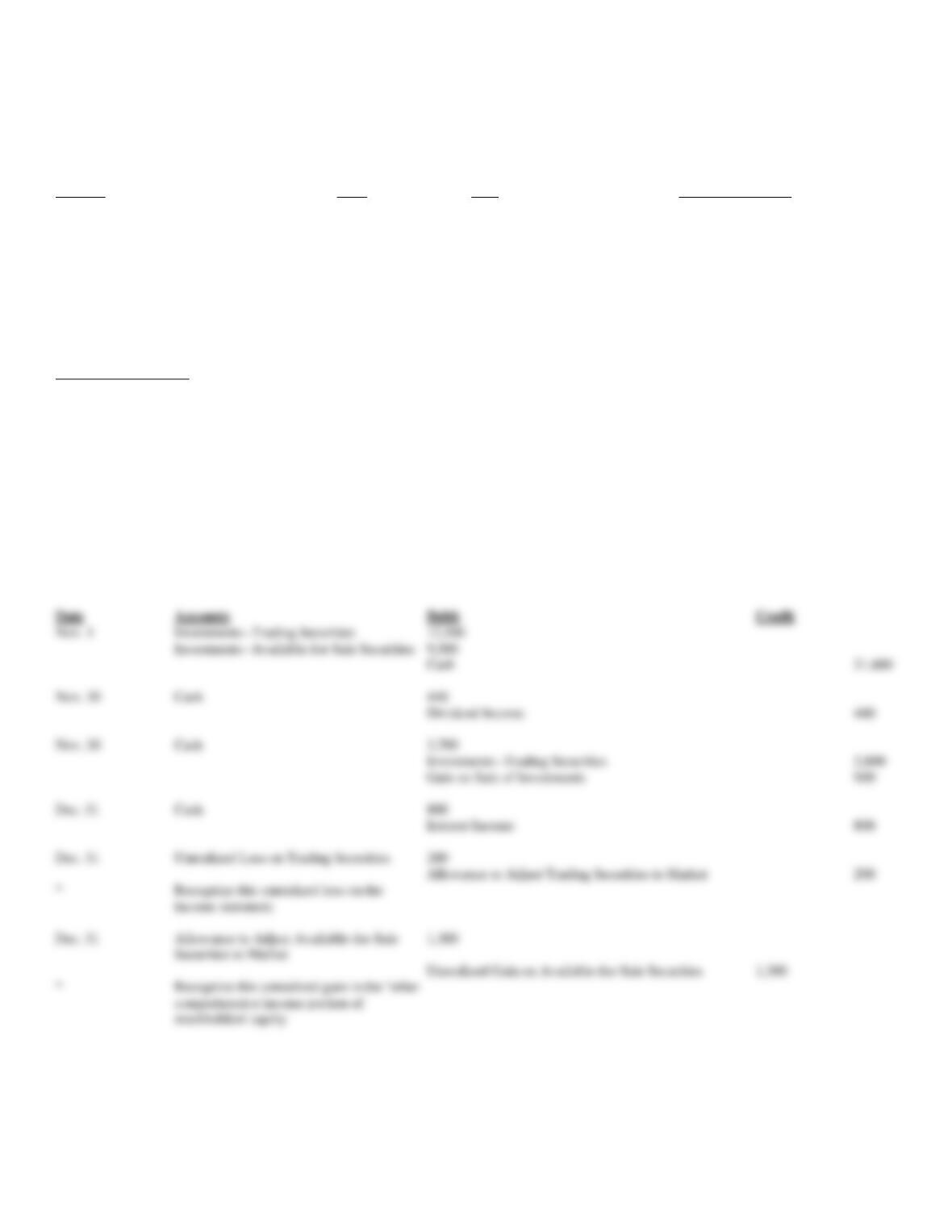
49. Thomkin Enterprises purchased several investment securities on November 1, 2012. Various transactions
and market activities occurred regarding these investments between acquisition and December 31st (the
company’s year-end), as shown below:
Acquisition
Market Value on
Security
Type
Cost
December 31, 2012
Trading Securities:
Today’s Bank & Trust
Debt
$5,000
$5,100
Tommy’s Wholesale
Equity
4,300
4,000
TRL
Equity
2,800
N/A
Available-for-Sale Securities:
Time Saver
Debt
$8,000
$8,900
Tug Boat, Inc.
Equity
1,500
1,900
Additional information:
1.
On November 30, the company received cash dividends of $140 from Tommy’s Wholesale and $300 from Tug Boat, Inc..
2.
The market price of TRL stock rose considerably, and so the company decided to sell these securities on November 30 when the
market price was $3,700
3.
On December 31, the company collected interest totaling $800 from its two debt securities.
Prepare journal entries to record the purchase of the securities, the receipt of dividends and interest, the sale of the TRL stock, and the end-of-year
mark-to–market adjustments. For the end-of–year entries, indicate how the resulting gains or losses should be recognized in Thomkin’s year-end
financial statements.
Nov. 1
12,100
9,500
Cash
Nov. 30
Cash
Dividend Income
Nov. 30
Cash
3,700
Gain on Sale of Investments
Dec. 31
Cash
800
Interest Income
Dec. 31
Unrealized Loss on Trading Securities
200
Allowance to Adjust Trading Securities to Market
Dec. 31
Allowance to Adjust Available-for-Sale
1,300
Unrealized Gain on Available-for-Sale Securities
1,300