Appendix I
Continuous Individual Tax Return Problems and Comprehensive Tax Return
Problems for 2011
Solutions to Continuous Individual Tax Return Problems
Solutions to the continuous individual tax return problem are found on the following
pages.
3-2 Continuous Tax Return
a. The marginal tax rate is 25% based on the tax schedule for married filing
jointly. The average tax rate is 16.7% ($15,606 income tax / $93,412 taxable
b. If they both contribute $4,000 for a total of $8,000, they could claim a
deduction which at first glance would save them $2,000 (25% × $8,000).
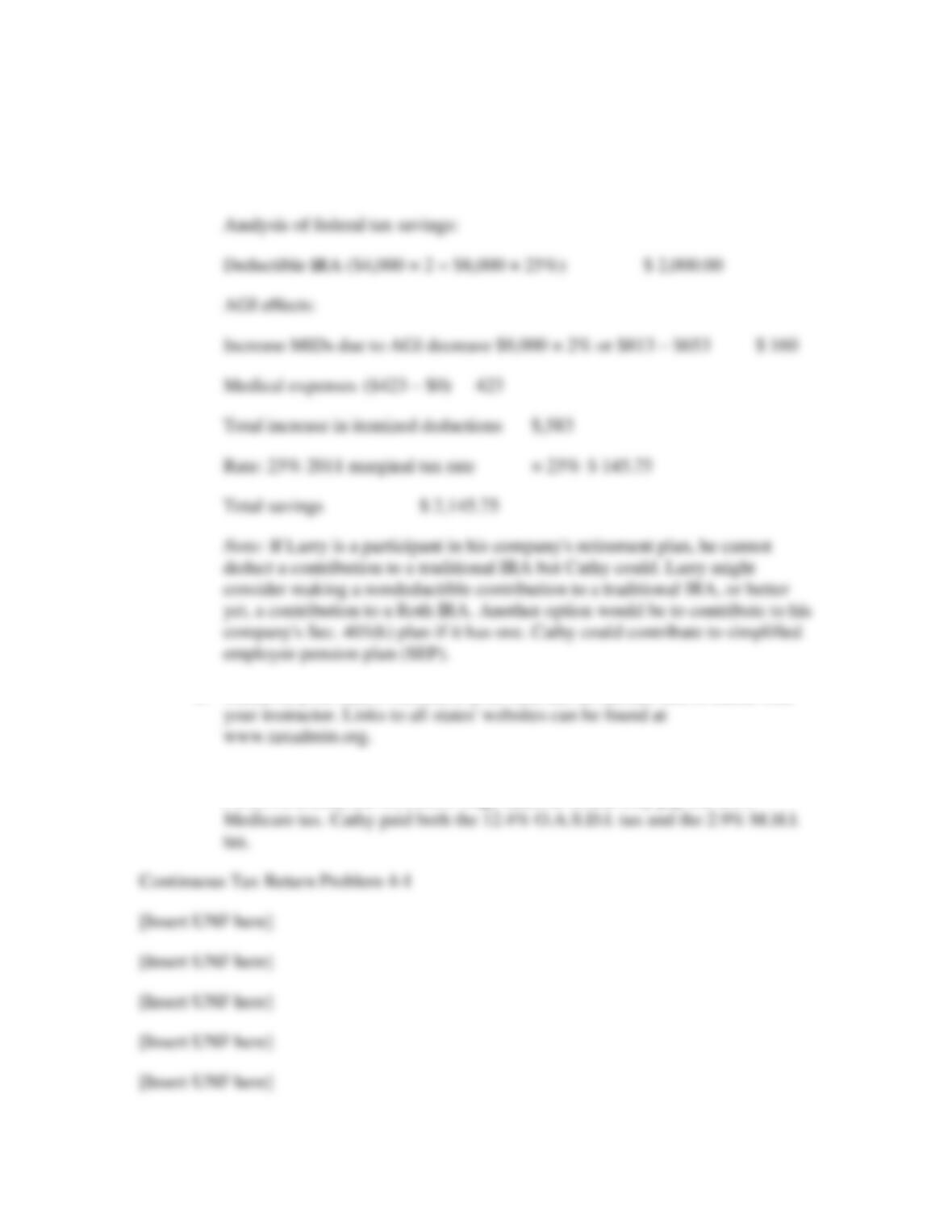
Zepp’s Federal tax w/ IRA contribution (using 2011 tax tables and no SE
taxes) (13,456)
Difference with IRA contributions of $8,000 $ 2,150
c. Check on your state’s website, if your state has an income tax, or check with
d. Statement 4 is true. Since Larry’s wages (assuming they are subject to
F.I.C.A.) exceed the O.A.S.D.I wage base, he would only pay the 2.9%
4-3 The solutions below were obtained assuming the tax year was 2011.
a. Although the tax goes down due to the dependency exemptions, the $10,000
reduction in withholding triggers an estimated tax penalty. In order to avoid
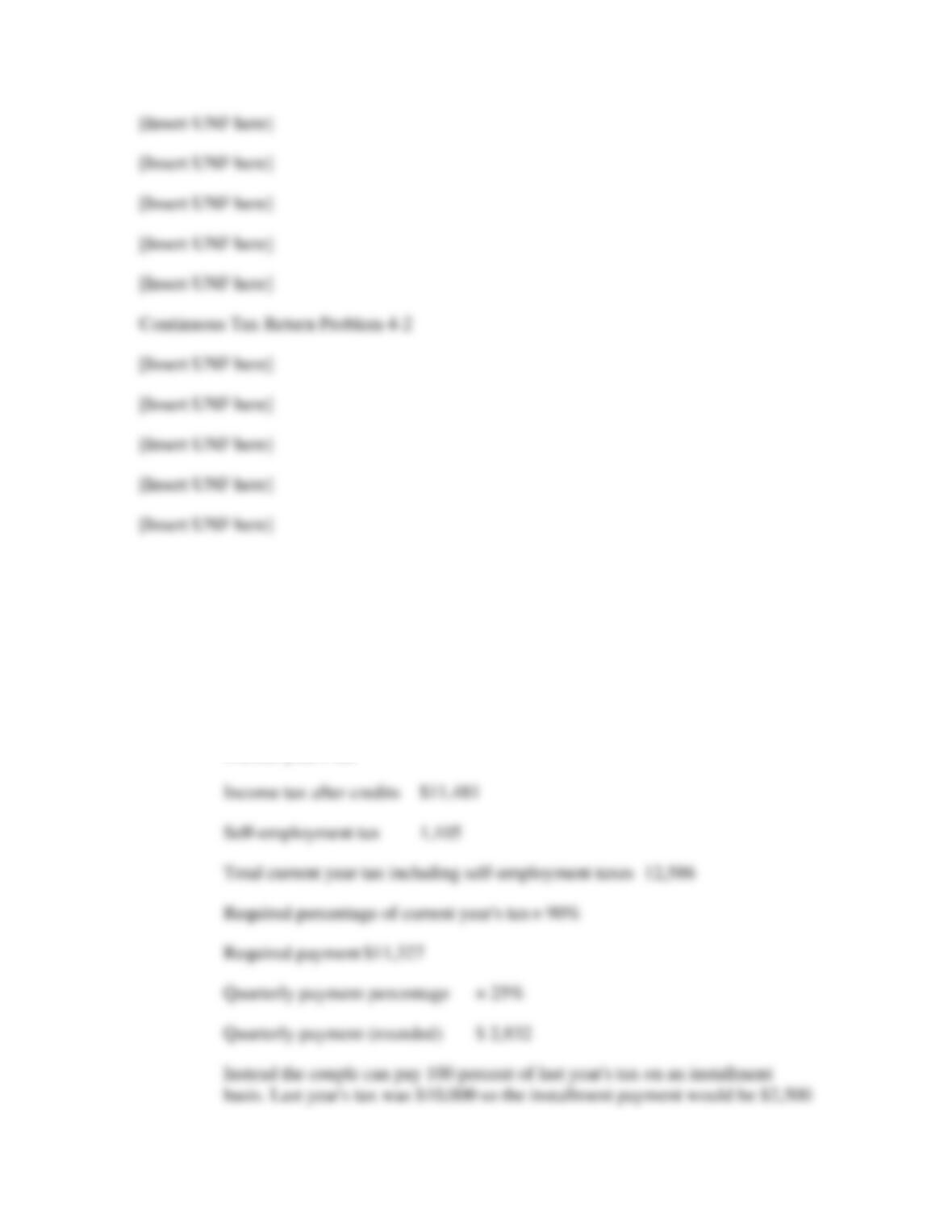
the penalty for failure to pay estimated taxes, taxpayers normally must pay 90
percent of the current year tax (after credits) or 100 percent of last year’s tax
(after credits) on a quarterly basis. This amount is computed on Form 2210 of
the tax return. The required payment based on the current year’s tax is
Current year’s tax
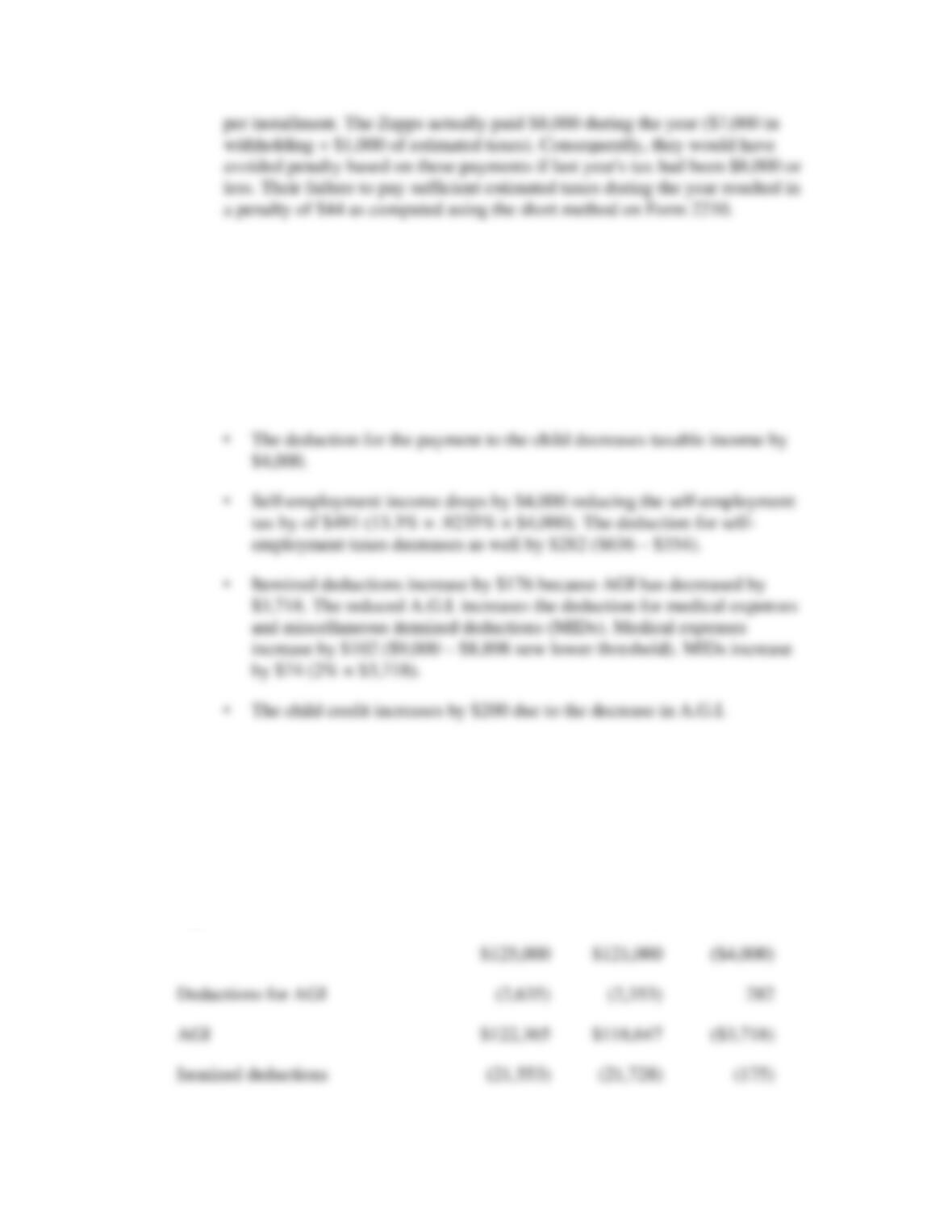
b. (The table below accompanies this explanation.) The $4,000 payment to the
child saves the couple taxes of $1,666 (using the rate schedules). Note that
there is no tax to the child since (1) the child is entitled to a standard
deduction equal to his or her earned income plus $300 and (2) there is no
employment taxes on wages paid by parents to their children under 18. Also
observe that the payment does not simply reduce the parents’ tax by $1,000
($4,000 × 25% marginal rate). The parents’ total tax decrease is summarized
below:
A comparison of the tax consequences with and without the payment to the
child is shown below (note that the taxes were computed using the rate
schedules):
No Payment Payment Difference
Income $125,000 $125,000 0
Payment to child — (4,000) ($4,000)
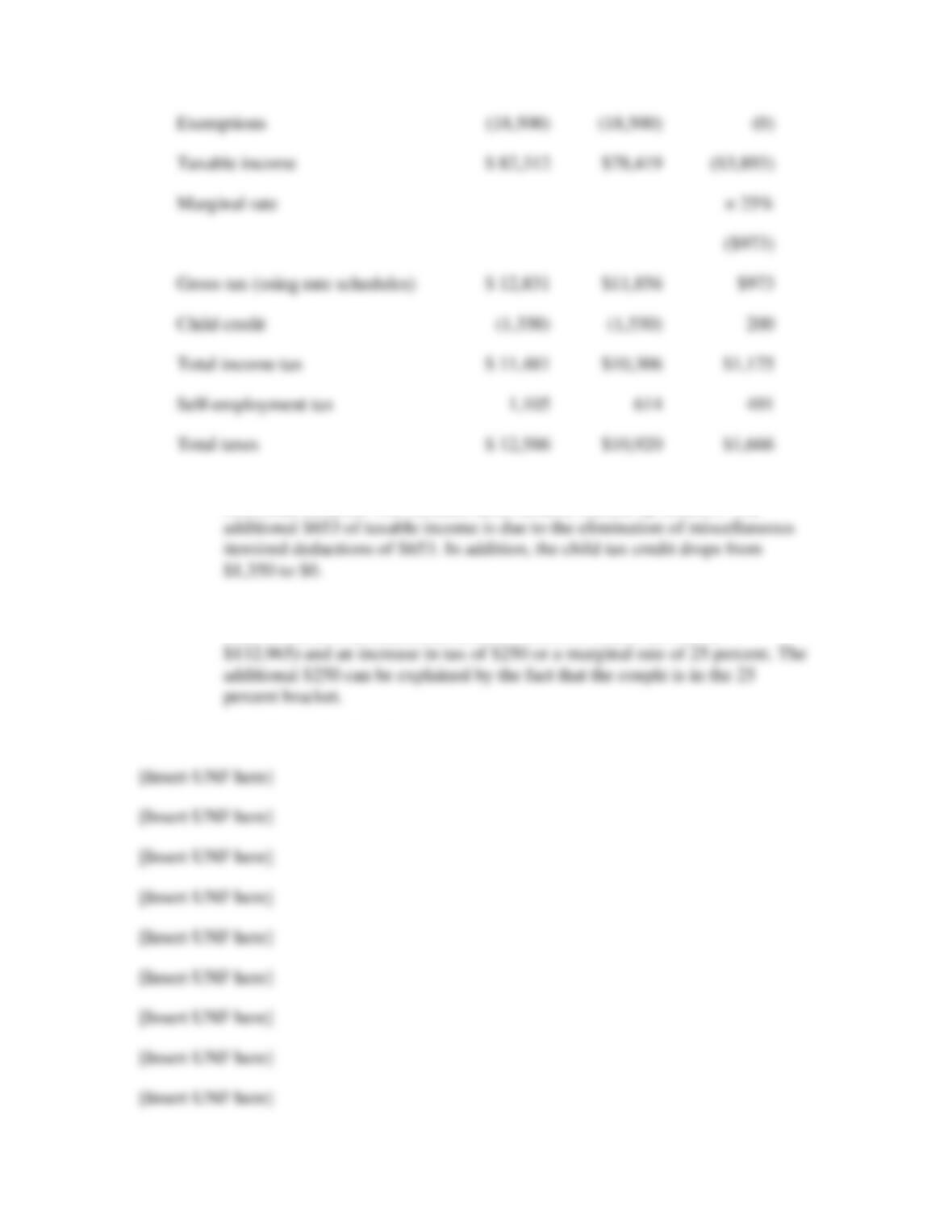
c. The $50,000 increase in wages actually increases their taxable income by
more than $50,000. The increase raises taxable income by $50,653. The
d. Assuming the couple has increased AGI of $50,000, an additional increase of
$1,000 results in an additional taxable income of $1,000 ($133,965 –
Continuous Tax Return Problem 5-1
[Insert UNF here]
5-2
a. The distributions do not effect the couple’s taxable income. However, Larry’s
share of partnership income, $200, flows through and is taxable to Larry
regardless of the amount distributed to him. A partnership is not a separate
taxable entity but is considered a conduit or flow-through entity. It files a
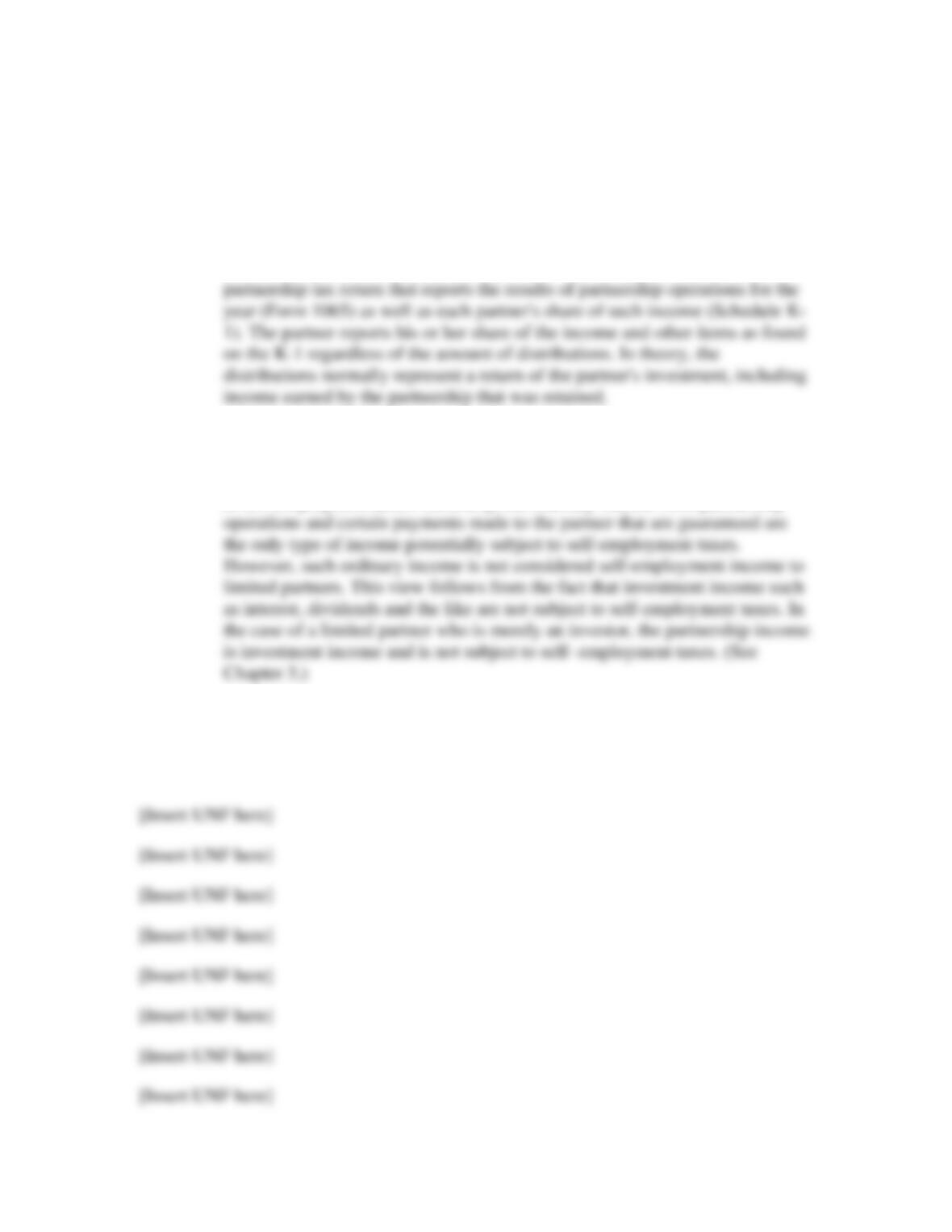
b. Larry’s share of the partnership income, $200, is not self-employment income
because he is a limited partner as indicated on the Schedule K-1. Income that
flows from the partnership to an individual partner may or may not be subject
to self-employment taxes. Generally, the ordinary income from partnership
c. Cathy is required to report the value of the membership, $500, as taxable
income.
Continuous Tax Return Problem 6-1
6-2 The answers to the additional questions to the continuous tax return problem are
given below.
6-3
a. The tax return for Jennifer Zepp is shown on the following pages.
b. Although the kiddie tax applies, the favorable reduced rates on dividends for
2011 and 2012 (15% and 5%) are still available for computing both the child’s
tax and the parental tax. The child’s taxable income is $1,600 ($4,000 – $950
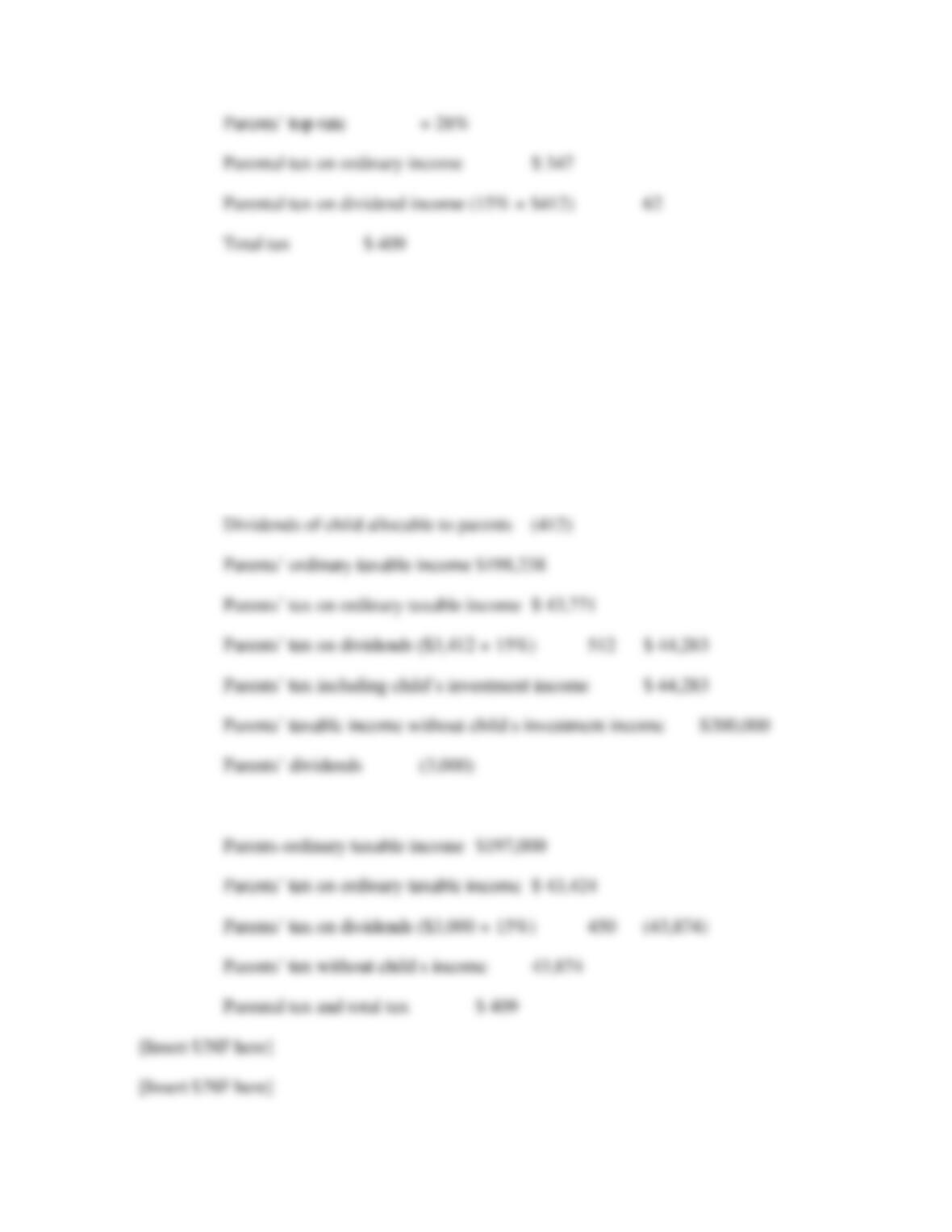
Alternative Calculation
Parents’ taxable income $200,000
Child’s taxable income (including $412 of dividends) 1,650
Parents’ taxable income with child’s investment income $201,650
Dividends of parents (3,000)
7-1 Several items should be noted when using this problem.
• The solution allocates all of the tax preparation expense to Schedule C on the
theory that but for the Schedule C, the taxpayer would not have paid for tax
preparation.
• The solution assumes that the taxpayer received the Schedule K-1 found in the
Chapter 5 version of this problem.
Continuous Tax Return Problem 7-1
7-2
a. Answer (4) is correct. Larry’s expenses are related to his employment and,
b. If Larry is considered a statutory employee, he is permitted to deduct all of his
employment related expenses of $3,050 as deductions for A.G.I. Such
expenses are deductible on Schedule C. If he reported the expenses on
Schedule C, the couple’s taxable income would decrease by $765 computed as
follows:
c. Yes. The health insurance premiums are deductible for A.G.I. but they are not
reported on Schedule C. For 2010, the amounts do reduce self-employment
d. In Rev. Rul. 92-29, 1992-1 C.B. 20, the IRS ruled taxpayers who own a
business, farm, or rental real estate or have royalty income may allocate a
Continuous Tax Return Problem 8-1
[Insert UNF here]
[Insert UNF here]
[Insert UNF here]
8-2
a. Cathy has three options: (1) deduct the $1,000 expense as a qualified
education expense for AGI; (2) claim the 20% life time learning credit; or (3)
deduct the expense as a business expense on Schedule C. The best option is to
b. The moving expenses are not deductible since the taxpayer fails the distance
test because he did not change job locations. His commute had he not moved
Solutions to Comprehensive Tax Return Problems
COMPREHENSIVE TAX RETURN PROBLEM 1
1. David R. and Susan L. Holman
a. In addition to personal exemptions for themselves, the Holmans may claim a
dependency exemption deduction for each of their two children.
b. The $1,500 prepayment penalty for early retirement of the Dallas home
mortgage should be treated as qualified residence interest and deducted on
Schedule A.
c. In computing travel and lodging costs (excluding meals) to be reported as
moving expenses on Form 3903, the Holmans should use the automatic
mileage rate of 16.5 (2010) cents per mile for driving to California. The cost
d. The $8,000 paid as points to acquire the mortgage on their new home should
be deducted by the Holmans as interest expense on line 10 of Schedule A.
e. David’s $75,000 of wages as an employee will effect the computation of his
f. David’s income and expenses from the appraisal business must be reported on
Schedule C. Since (1) the prepaid rent for September 2010 was required to be
prepaid and (2) the benefits of the payment (use of the office space) do not
g. The Holmans’ interest income must be reported on Schedule B since it
exceeds $400. Note that the $800 of interest earned on the municipal bonds is
h. Since the dividend income exceeds $400, it must also be reported on Schedule
B. Note, however, that the General Motors stock dividend is nontaxable (and
i. The Holmans must respond to the two questions in Part III, Schedule B, Form
1040, regarding financial accounts in foreign countries and foreign trusts.
j. The Holmans must report their stock transactions on Schedule D.
(1) David’s basis in each share of IBM stock sold is the fair market value
(FMV) of the inherited property on the date of his uncle’s death or $170 or
(2) Susan’s basis in each share of General Motors stock sold is $37.25,
computed as follows:
Donor’s basis ($35 per share × 1,000 shares) $35,000
Plus: Gift tax paid adjustment
(3) The Holmans’ $4,500 gain on the sale of the Eastman Kodak stock must
be reported in the current year even though the sales proceeds were not
k. Note that the solution reflects a deduction of $2,950 for state income taxes
rather than a deduction for state sales taxes. Alternatively, the taxpayers may
claim a deduction of $1,485 in sales taxes paid on the new automobile plus an
additional amount of state taxes calculated using the optional sales tax tables.
Also, note that the Holmans cannot deduct the $250 political campaign
contribution.
Their deductible interest of $24,950 includes $5,250 for the home in Dallas,
$10,200 for the home in Los Angeles and should include the $1,500 mortgage
l. The Holmans should calculate the credit for child care expenses on Form
m. The name and social security number of each child should be reported on line
n. Estimated tax payments are reported on line 62, page 2 of Form 1040. Note
that we have not calculated an underpayment penalty. This amount will vary
depending on what students estimate to have been the Holman’s 2009 federal
income tax liability before credits or prepayments—an amount we failed to
provide in the fact pattern.
Schedule A, Form 1040:
Interest expense deduction 24,950
Total itemized deductions allowed 50,950
Schedule C, Form 1040—Total deductions 41,225
Schedule D, Form 1040—Net long-term gain 15,012
[Insert UNF here]
[Insert UNF here]
COMPREHENSIVE TAX RETURN PROBLEM 2
2. Richard M. and Anna K. Wilson
a. In addition to personal exemptions for themselves, the Wilsons may claim
dependency exemptions for each of their three children and for Anna’s
mother, Ruth Knapp.
Even though their son Michael is 20 years old and earned $4,750 from a
summer job, the parents are entitled to a dependency exemption because he is
a qualifying child. He meets the relationship test (he is their son); he meets the
b. The state income taxes withheld from Richard’s salary should be added to the
other state income taxes reported as paid in item j. below and reported on
Schedule A.
c. Anna’s income and expenses from the travel agency must be reported on
Schedule C. Note that Anna is allowed to treat the amounts paid to her
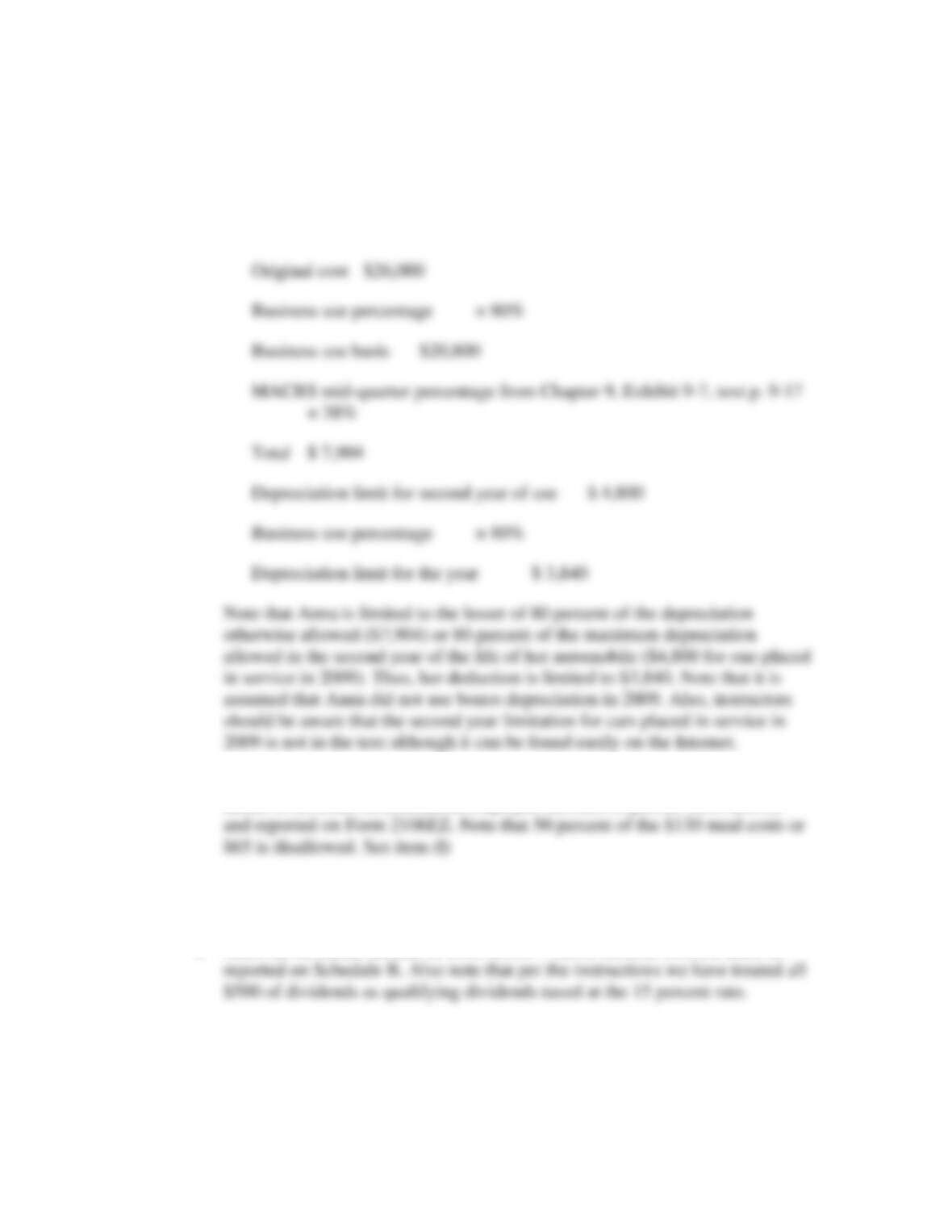
Form 4562 must be used to compute Anna’s depreciation deduction. Since the
total dollar amount of her purchases of furniture and equipment of $18,000
($8,900 + $5,700 + $1,500 + $1,600 + $300) during the year does not exceed
the amount allowed for 2010, the entire $18,000 of qualifying property should
be expensed under the § 179 optional expensing rule. Anna’s depreciation
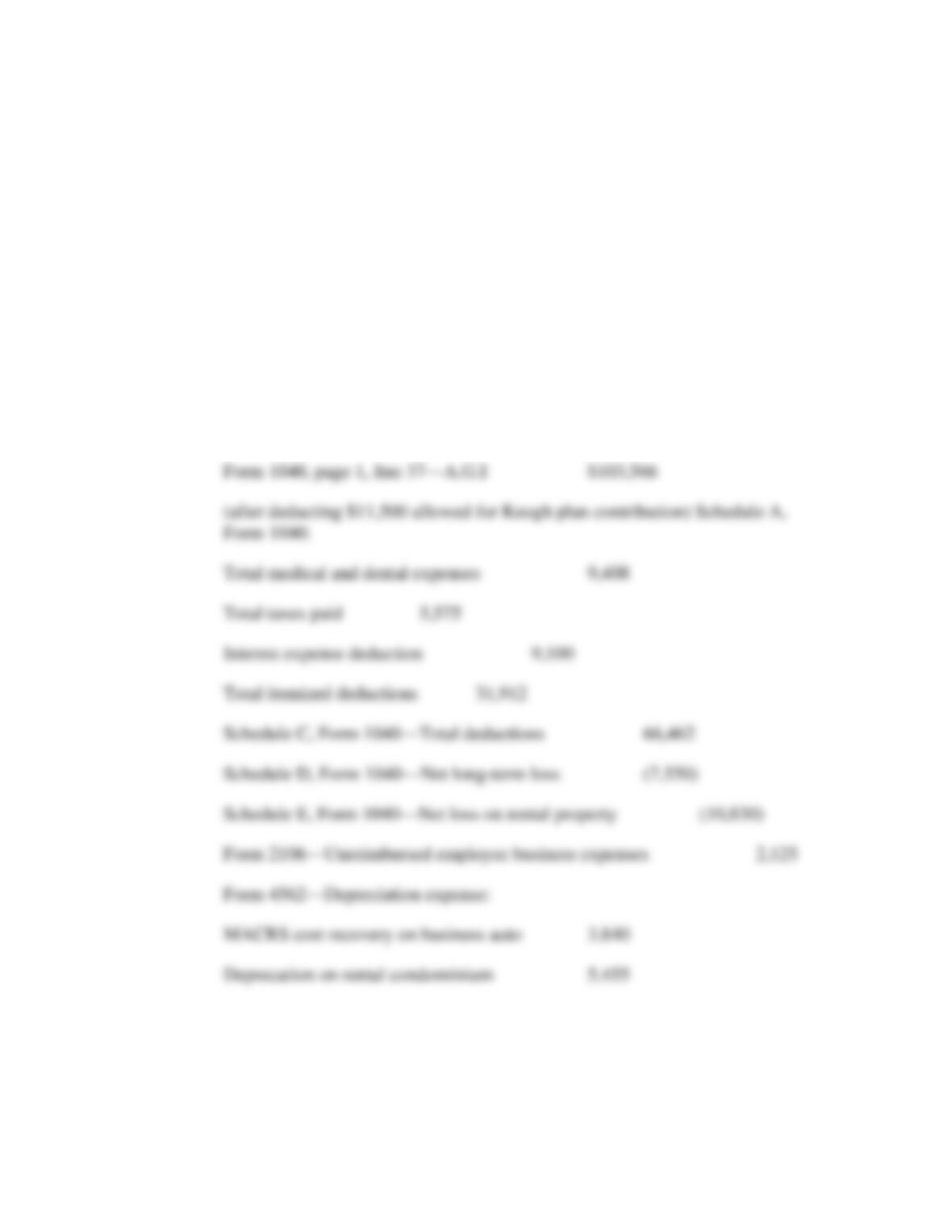
deduction for the business auto is $3,840, computed as follows:
d. Richard’s unreimbursed expenses from the Washington, D.C. trip should be
added to his other unreimbursed employee business expenses from item (l)
e. The Wilsons’ interest income of $2,500 ($845 + $900 + $755) must be
reported on Schedule B since it exceeds $400.
f. Since the dividend income of $500 ($300 + $200) exceeds $400, it must be
g. The Wilsons must respond to the two questions in Part III, Schedule B, Form
1040.
h. The Wilsons must report their stock transactions on Schedule D.
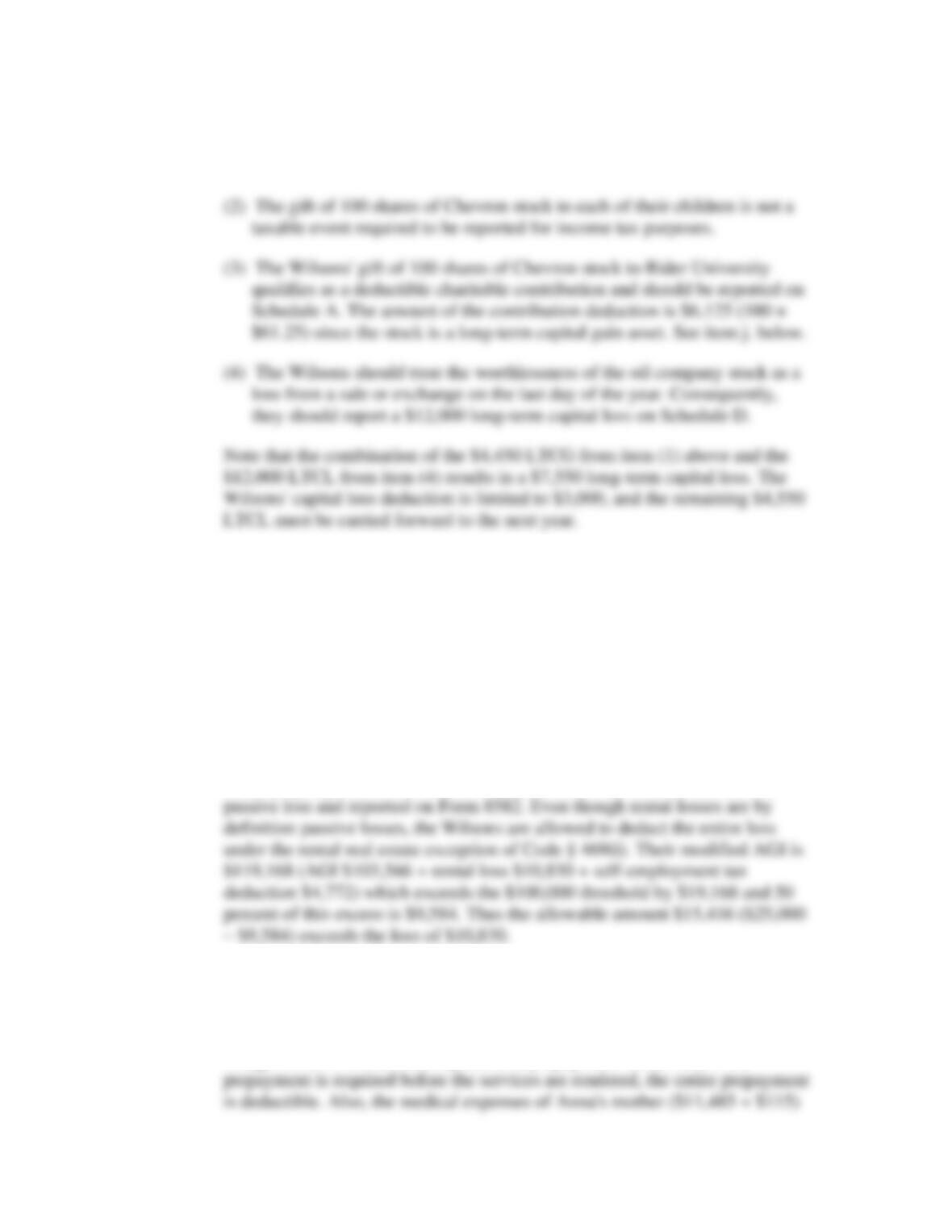
(1) The sale of 300 shares of Chevron stock results in a $4,450 long-term
capital gain [$14,950 sales proceeds – (300 × $35 basis per share =
$10,500)].
i. The Wilsons’ income and expense from the rental condominium must be
reported on Schedule E. Depreciation on the property should be calculated as
follows:
Depreciable basis of condo $150,000
MACRS percentage from Exhibit 9.6, text p. 9-12 × 3.636%
2010 depreciation allowed $ 5,455
When the depreciation is added to the other $21,775 of expenses from this
rental property, the Wilsons have a $10,830 loss. The loss is considered a
j. The Wilsons must report their itemized deductions on Schedule A.
Deductible medical expenses of $17,175 ($425 + $1,595 + $2,750 + $805 +
$115 + $11,485) should include the entire $2,750 paid to the dentist—even
though some of this amount represents a prepayment. Recall that if the
The Wilsons should claim a $6,125 contribution deduction (100 shares at
$61.25 FMV per share) for the gift of Exxon stock to Richard’s alma mater
since the stock is long-term capital gain property. Form 8283 should be used
to report this noncash charitable contribution, describing the property and
valuation method used. Note that an independent appraisal is not be necessary
for this gift since it is a publicly traded stock. Stock market quotes for the date
of the gift should suffice.
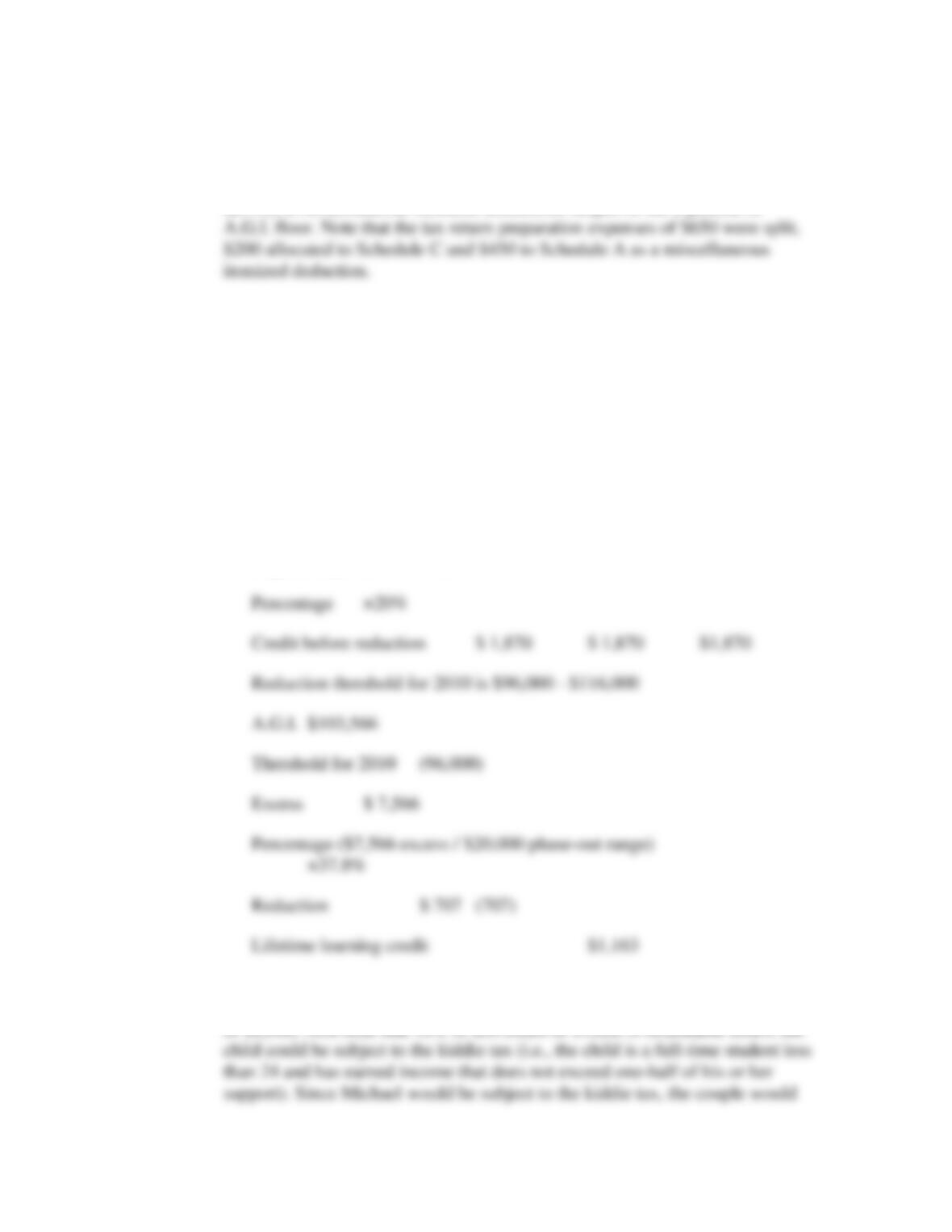
The Wilsons’ miscellaneous itemized deductions are calculated as follows:
Richard’s unreimbursed expenses from trip to Washington D.C. [item d.]:
All expenses except meals $1,110
Meals (50% of $130) 65
k. Anna must treat the $11,500 contribution to her Keogh plan as a deduction in
arriving at A.G.I.
l. The Wilsons should treat the unreimbursed employee business expenses of
$2,125 [professional dues ($450), professional journals ($385) and office gifts
($115)] as miscellaneous itemized deductions subject to the 2 percent of
m. Either a deduction or a credit could be claimed for Michael’s education
expenses. However, in this case, the credit is claimed since it is worth more
than the deduction. Only the tuition of $9,350 is eligible for either the
deduction or credit since the cost of books are not qualified tuition expenses.
The deduction for the expenses is limited to $4,000 and is for A.G.I. Since the
couple’s taxable income puts them in the 15 percent marginal tax bracket, the
deduction is approximately worth $600. Another option is the lifetime
learning credit. They could claim the lifetime learning credit for the expenses
of $1,163 as computed below.
Lifetime learning credit
Eligible expenses $ 9,350
The best alternative for the couple is the American Opportunity Credit. This
credit is 100% of the first $2,000 and 25% of the next $2,000 for a maximum
be entitled to a credit of $2,500 none of which would be refundable.
n. Since they itemized their deductions for 2009, the Wilsons must include the
$130 state income tax refund in gross income for 2010 under the tax benefit
rule.
o. Estimated tax payments of $9,000 are reported on line 62, page 2 of Form
1040.
p. The name and social security number of each child should be reported on line
6c, page 1 of Form 1040. In addition, the social security number of Ruth
Knapp (Anna’s mother) must be reported in order to claim her as a dependent.
The return ignores the “making work pay” credit.
Check Figures for Wilson Tax Return
Comprehensive Tax Return Problem 2
[Insert UNF here]
[Insert UNF here]
[Insert UNF here]
[Insert UNF here]
[Insert UNF here]
[Insert UNF here]