
APPENDIX F
PAYROLL ACCOUNTING
SUMMARY OF QUESTIONS BY OBJECTIVES AND BLOOM’S TAXONOMY
Item
LO
BT
Item
LO
BT
Item
LO
BT
Item
LO
BT
Item
LO
BT
True-False Statements
1.
1
K
3.
1
K
5.
2
K
7.
3
C
9.
3
C
2.
1
K
4.
2
K
6.
2
K
8.
3
C
10.
3
K
Multiple Choice Questions
11.
1
K
15.
1
AP
19.
2
C
23.
3
K
27.
3
K
12.
1
AP
16.
1
K
20.
2
C
24.
3
K
13.
1
AP
17.
1
K
21.
2
K
25.
3
K
14.
1
K
18.
1
C
22.
2
K
26.
3
K
Brief Exercises
28.
1
AP
29.
1,2
AN
Exercises
30.
1,2
AP
32.
1,2
AP
34.
2
AP
31.
1,2
AP
33.
2
AP
35.
3
AP
Completion Statements
36.
1
K
37.
2
K
38.
2
K
Matching: 39, Short Answer: 40
SUMMARY OF LEARNING OBJECTIVES BY QUESTION TYPE
Item
Type
Item
Type
Item
Type
Item
Type
Item
Type
Item
Type
Item
Type
Learning Objective 1
1.
TF
11.
MC
14.
MC
17.
MC
29.
Be
32.
Ex
2.
TF
12.
MC
15.
MC
18.
MC
30.
Ex
36.
C
3.
TF
13.
MC
16.
MC
28.
Be
31.
Ex
Learning Objective 2
4.
TF
19.
MC
22.
MC
31.
Ex
34.
Ex
5.
TF
20.
MC
29.
Ex
32.
Ex
37.
C
6.
TF
21.
MC
30.
Ex
33.
Ex
38.
C
Learning Objective 3
7.
TF
9.
TF
23.
MC
25.
MC
27.
MC
8.
TF
10.
TF
24.
MC
26.
MC
35.
Ex
Note: TF = True-False Ex = Exercise
MC = Multiple Choice C = Completion
Be = Brief Exercise
Matching: 39, Short Answer: 40

Test Bank for Accounting: Tools for Business Decision Making, Fifth Edition
F – 2
CHAPTER LEARNING OBJECTIVES
1. Compute and record the payroll for a pay period. The computation of the payroll involves
gross earnings, payroll deductions, and net pay. In recording the payroll, Salaries and Wages
Expense is debited for gross earnings, individual tax and other liability accounts are credited
for payroll deductions, and Salaries and Wages Payable is credited for net pay. When the
payroll is paid, Salaries and Wages Payable is debited, and Cash is credited.
2. Describe and record employer payroll taxes. Employer payroll taxes consist of FICA,
federal unemployment taxes, and state unemployment taxes. The taxes are usually accrued
at the time the payroll is recorded by debiting Payroll Tax Expense and crediting separate
liability accounts for each type of tax.
3. Discuss the objectives of internal control for payroll. The objectives of internal control for
payroll are (1) to safeguard company assets against unauthorized payments of payrolls, and
(2) to ensure the accuracy of the accounting records pertaining to payrolls.
TRUE-FALSE STATEMENTS
1. FICA taxes and federal income taxes are levied on employees‘ earnings without limit.
2. FICA taxes withheld and federal income taxes withheld are mandatory payroll deductions.
3. An employee earnings record is a cumulative record of each employee’s gross earnings,
deductions, and net pay during the year.
4. The employer incurs a payroll tax expense equal to the amount withheld from the
employees’ wages for federal income taxes.
5. The state unemployment tax rate is usually 5.4% on the first $7,000 of wages paid to an
employee during the year.
6. A Wage and Tax Statement shows gross earnings, FICA taxes withheld, and income
taxes withheld for the year.
7. Internal control over payroll is not necessary because employees will complain if they do
not receive the correct amount on their payroll checks.

Payroll Accounting
F – 3
8. A good internal control feature is to have a written hiring authorization form completed
before a new employee is added to the payroll.
9. A good internal control feature is to have several employees choose one person to punch
all of their time cards.
10. An employee’s time card is used to record the number of exemptions claimed by the
employee for income tax withholding purposes.
Answers to True-False Statements
Item
Ans.
Item
Ans.
Item
Ans.
Item
Ans.
Item
Ans.
MULTIPLE CHOICE QUESTIONS
11. Which one of the following payroll taxes does not result in a payroll tax expense for the
employer?
a. FICA tax
b. Federal income tax
c. Federal unemployment tax
d. State unemployment tax
12. Lucie Ball’s regular rate of pay is $15 per hour with one and one-half times her regular
rate for any hours which exceed 40 hours per week. She worked 48 hours last week.
Therefore, her gross wages were
a. $720.
b. $600.
c. $780.
d. $1,080.
13. Assuming a FICA tax rate of 7.65% on the first $110,100 in wages, and a federal income
tax rate of 20% on all wages, what would be an employee’s net pay for the year if he
earned $92,000?
a. $84,962
b. $65,430
c. $73,600
d. $66,562

Test Bank for Accounting: Tools for Business Decision Making, Fifth Edition
F – 4
14. Most companies involved in interstate commerce are required to compute overtime at
a. the worker’s regular hourly wage.
b. 1.25 times the worker’s regular hourly wage.
c. 1.5 times the worker’s regular hourly wage.
d. 2.5 times the worker’s regular hourly wage.
15. Jerri Rice has worked 44 hours this week. Her regular hourly wage is $12 per hour. What
are Jerri’s gross wages for the week? (The company Jerri works for is in compliance with
the Fair Labor Standards Act.)
a. $528
b. $552
c. $792
d. $576
16. FICA taxes do not provide workers with
a. life insurance.
b. supplemental retirement.
c. employment disability.
d. medical benefits.
17. Employees claim allowances for income tax withholding on
a. Form W-4.
b. Form W-2.
c. Form 1040.
d. Schedule A.
18. The journal entry to record the payroll for a period will include a credit to Salaries and
Wages Payable for the gross
a. amount less all payroll deductions.
b. amount of all paychecks issued.
c. pay less taxes payable.
d. pay less voluntary deductions.
19. Which one of the following payroll taxes is not withheld from the employee’s wages
because it is not levied on the employee?
a. Federal income tax
b. Federal unemployment tax
c. State income tax
d. FICA tax

Payroll Accounting
F – 5
20. By January 31 following the end of a calendar year, an employer is required to provide
each employee with a(n)
a. state unemployment tax form.
b. federal unemployment tax form 940.
c. wage and tax statement form W-2.
d. employee’s withholding allowance certificate form W-4.
21. The tax that is paid equally by the employer and employee is the
a. federal income tax.
b. federal unemployment tax.
c. state unemployment tax.
d. FICA tax.
22. The effective federal unemployment tax rate is usually
a. 6.2%.
b. 0.8%.
c. 5.4%.
d. 8.0%.
23. Changes in pay rates during employment should be authorized by the
a. personnel department.
b. payroll department.
c. treasurer’s department.
d. timekeeping department.
24. Which of the following employees would likely receive a salary instead of wages?
a. Store clerk
b. Factory employee
c. Sales manager
d. Manual laborer
AICPA-PC: Problem Solving/Decision Making, IMA: Business Economics, Sector: General, IFRS: No
25. Control over timekeeping does not include
a. having one employee punch the time cards for several employees in the same work
area.
b. time clock procedure monitoring by a supervisor.
c. pay period time reports kept by a supervisor for salaried personnel.
d. overtime approval by a supervisor.
Test Bank for Accounting: Tools for Business Decision Making, Fifth Edition
F – 6
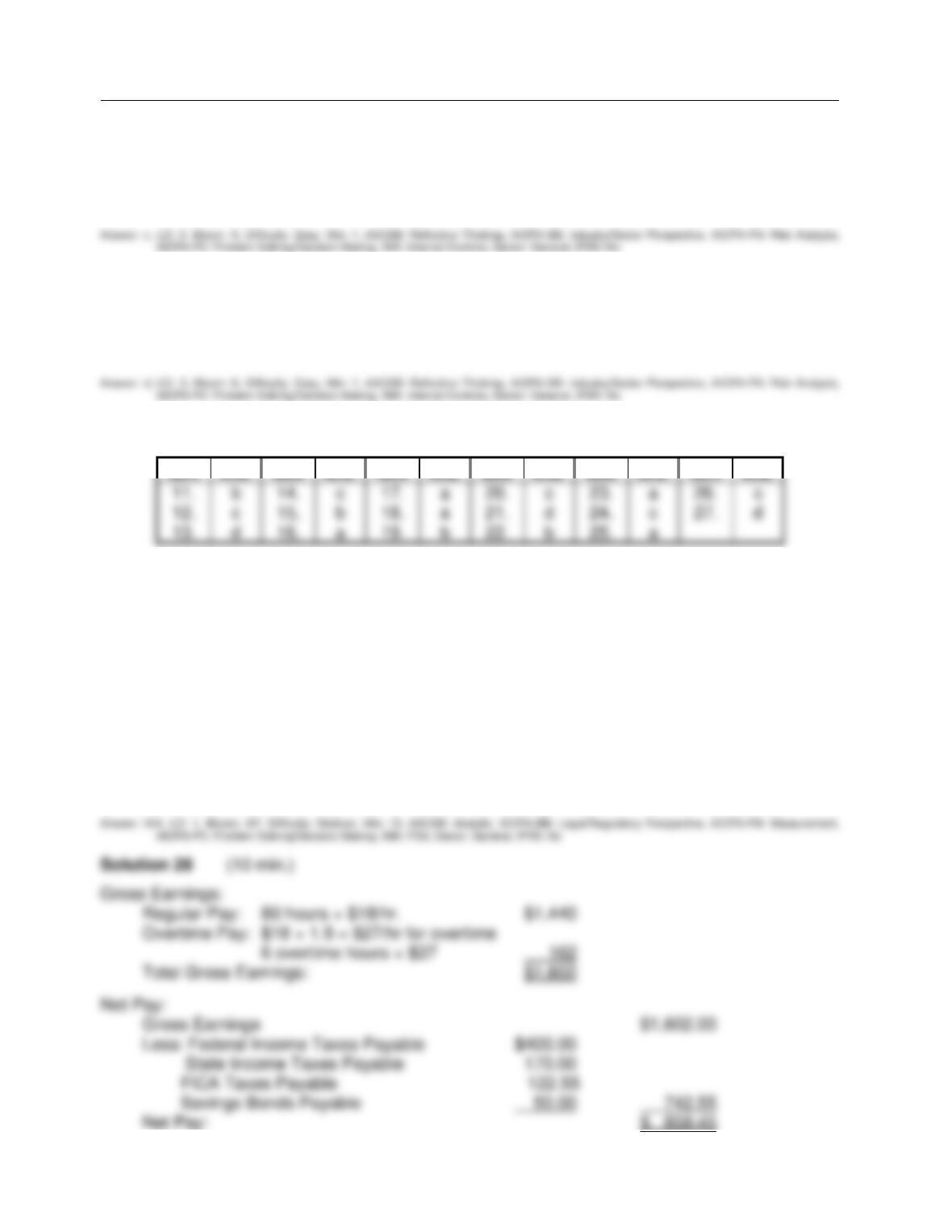
26. Which of the following is not performed by the payroll department?
a. Preparation of payroll checks
b. Maintaining payroll records
c. Signing of payroll checks
d. Preparation of payroll tax returns
27. The payroll is paid by the
a. personnel department.
b. payroll department.
c. cashier.
d. treasurer’s department.
Answers to Multiple Choice Questions
BRIEF EXERCISES
Be. 28
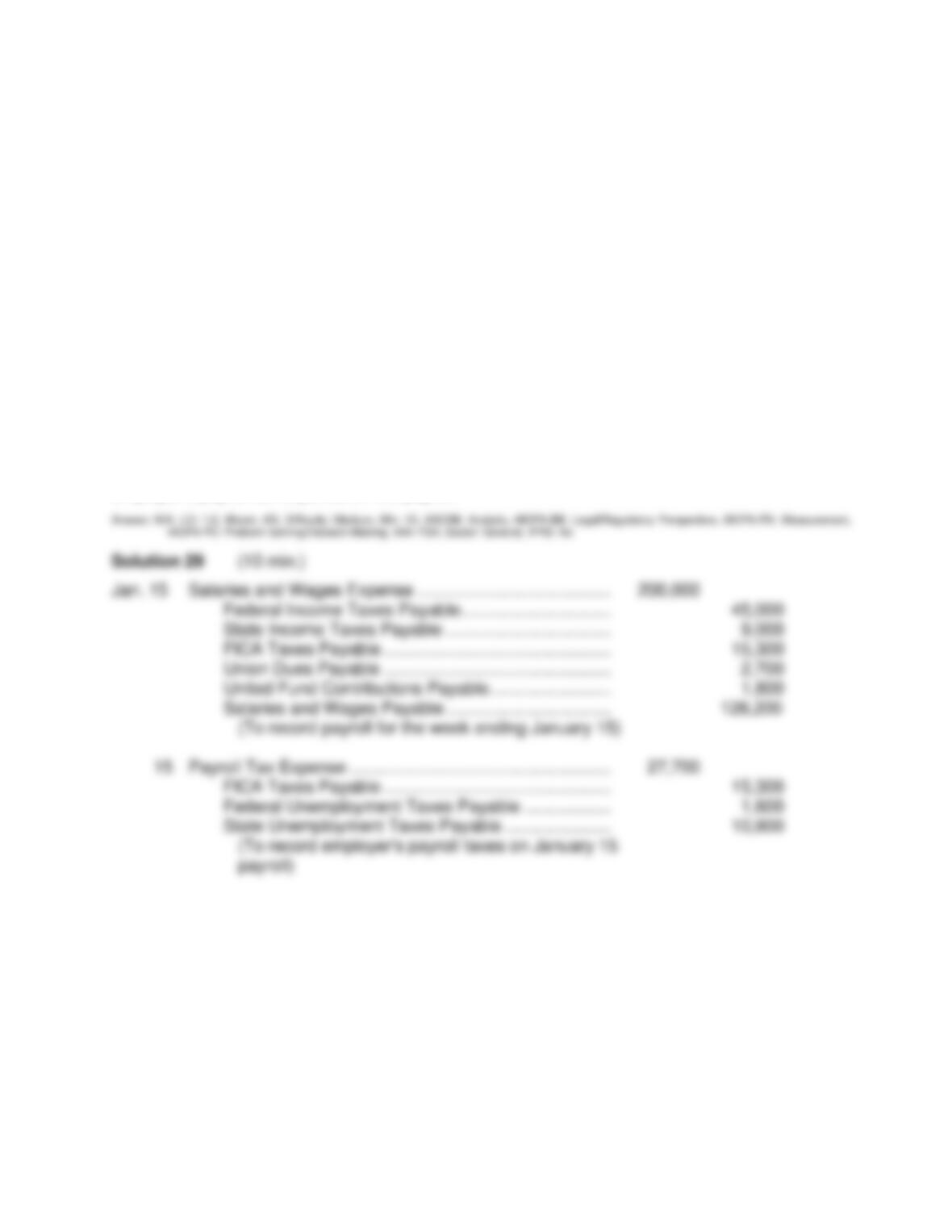
Ann Hech’s regular hourly wage is $18 an hour. She receives overtime pay at the rate of time and
a half. The FICA tax rate is 7.65%. Ann is paid every two weeks. For the first pay period in
January, Ann worked 86 hours of which 6 were overtime hours. Ann’s federal income tax
withholding is $400 and her state income tax withholding is $170. Ann has authorized that $50 be
withheld from her check each pay period for savings bonds.
Instructions
Compute Ann Hech‘s gross earnings and net pay for the pay period showing each payroll
deduction in arriving at net pay.
Payroll Accounting
F – 7
Be. 29
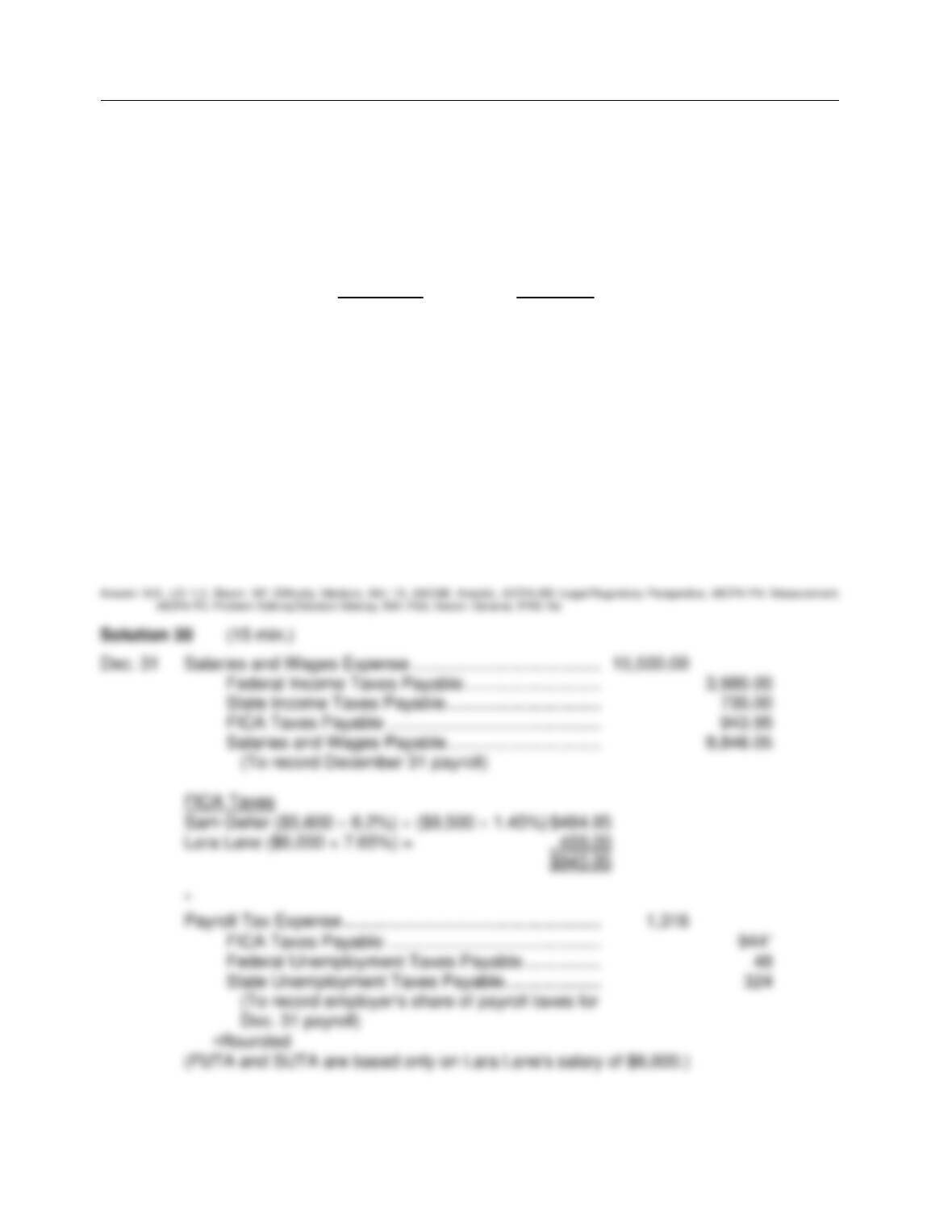
Warren Company’s payroll for the week ending January 15 amounted to $200,000 for salaries
and wages. None of the employees has reached the earnings limits specified for federal or state
employer payroll taxes. The following deductions were withheld from employees’ salaries and
wages:
Federal Income Tax $45,000
State Income Tax 9,000
FICA Taxes 15,300
Union Dues 2,700
United Fund 1,800
Federal unemployment tax (FUTA) rate is 6.2% less a credit equal to the rate paid for state
unemployment taxes. The state unemployment tax (SUTA) rate is 5.4%.
Instructions
Prepare the journal entries to record the weekly payroll ending January 15 and also the
employer’s payroll tax expense on the payroll.
Test Bank for Accounting: Tools for Business Decision Making, Fifth Edition
F – 8
EXERCISES
Ex. 30
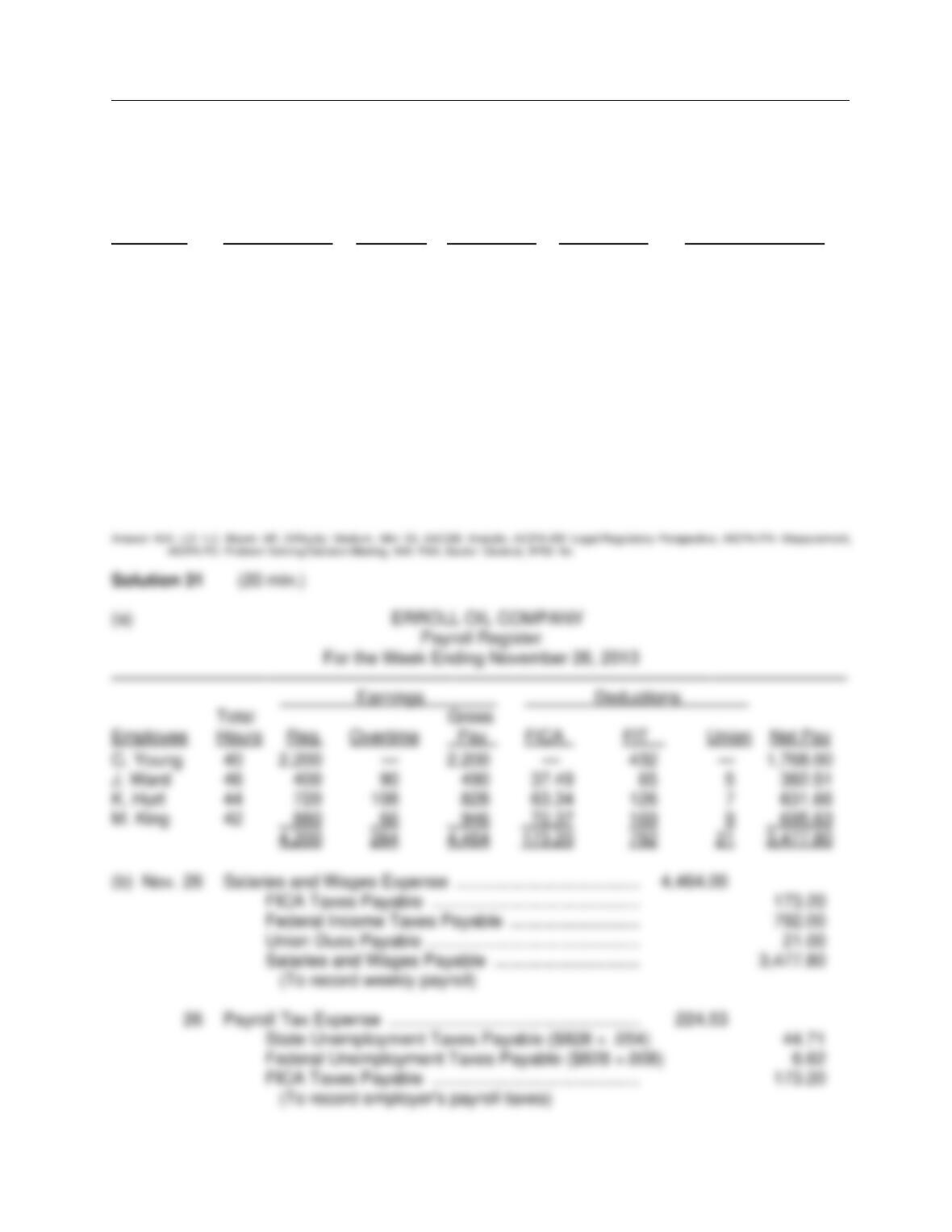
Sam Geller had earned (accumulated) salary of $104,500 through November 30. His December
salary amounted to $9,500. Lara Lane began employment on December 1 and will be paid her
first month’s salary of $6,000 on December 31. Income tax withholding for December for each
employee is as follows:
Sam Geller Lara Lane
Federal Income Tax $2,780 $1,200
State Income Tax 490 240
The following payroll tax rates are applicable:
FICA tax on first $110,100 7.65 (1.45% over $110,100)
FUTA tax on first $7,000 6.2%*
SUTA tax on first $7,000 5.4%
*Less a credit equal to the state unemployment contribution
Instructions
Record the payroll for the two employees at December 31 and record the employer‘s share of
payroll tax expense for the December 31 payroll.
Payroll Accounting
F – 9
Ex. 31
Assume that the payroll records of Erroll Oil Company provided the following information for the
weekly payroll ended November 26, 2013.
Year-to-Date
Hourly Federal Earnings Through
Employee Hours Worked Pay Rate Income Tax Union Dues Previous Week
C. Young 40 $55 $432 — $111,000
J. Ward 46 10 65 $5 23,200
K. Hurt 44 18 126 7 5,100
M. King 42 22 169 9 49,500
Additional information: All employees are paid overtime at time and a half for hours worked in
excess of 40 per week. The FICA tax rate is 7.65% for the first $110,100 of each employee’s
annual earnings. The employer pays unemployment taxes of 6.2% (5.4% for state and .8% for
federal) on the first $7,000 of each employee’s annual earnings.
Instructions
(a) Prepare the payroll register for the pay period.
(b) Prepare general journal entries to record the payroll and payroll taxes.
Test Bank for Accounting: Tools for Business Decision Making, Fifth Edition
F – 10
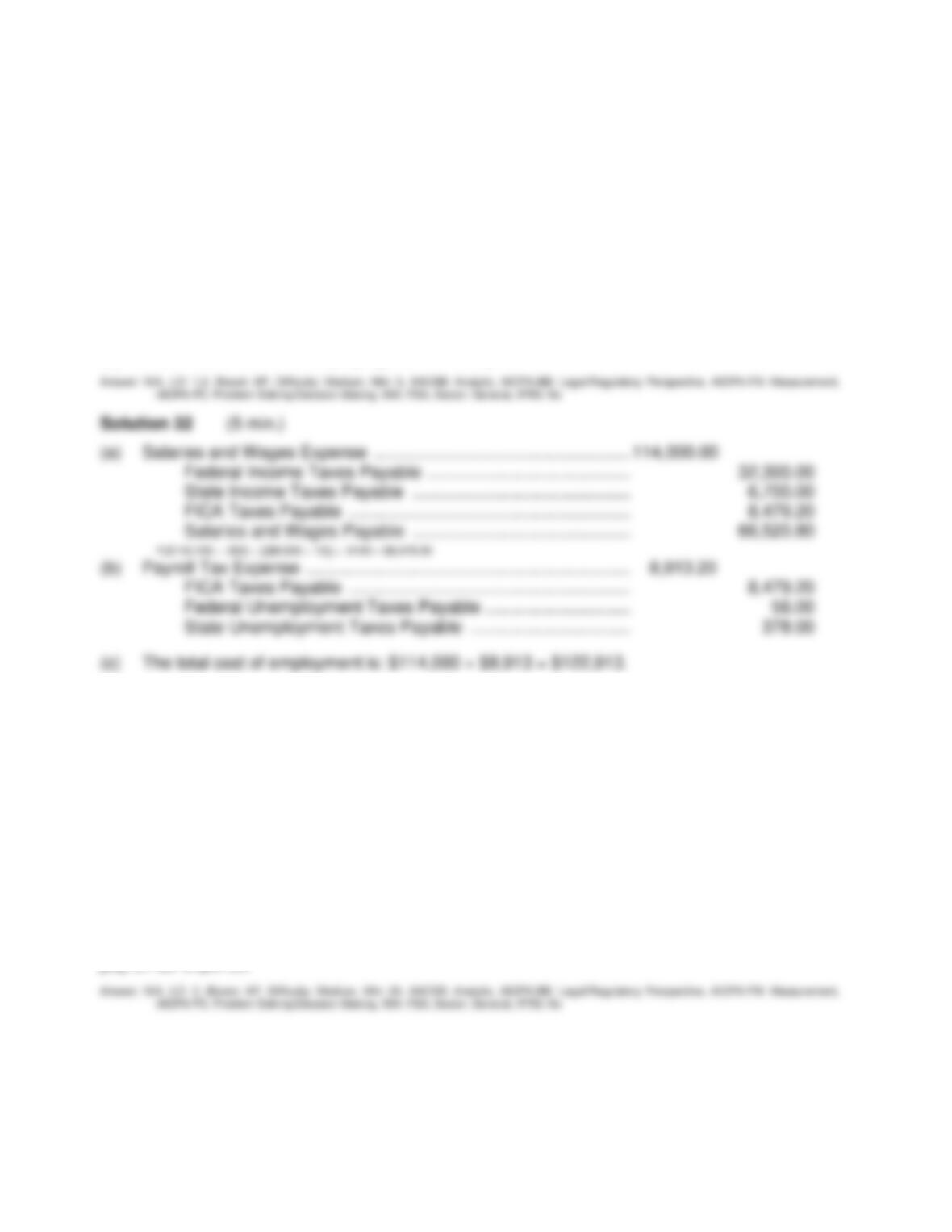
Ex. 32
Diane Lane earns a salary of $9,500 per month during the year. FICA taxes are 7.65% on the first
$110,100 of gross earnings. Federal unemployment insurance taxes are 6.2% of the first $7,000;
however, a credit is allowed equal to the state unemployment insurance taxes of 5.4% on the
$7,000. During the year, $32,300 was withheld for federal income taxes and $6,700 was withheld
for state income taxes.
Instructions
(a) Prepare a journal entry summarizing the payment of Lane’s total salary during the year.
(b) Prepare a journal entry summarizing the employer payroll tax expense on Lane’s salary for
the year.
(c) Determine the cost of employing Lane for the year.
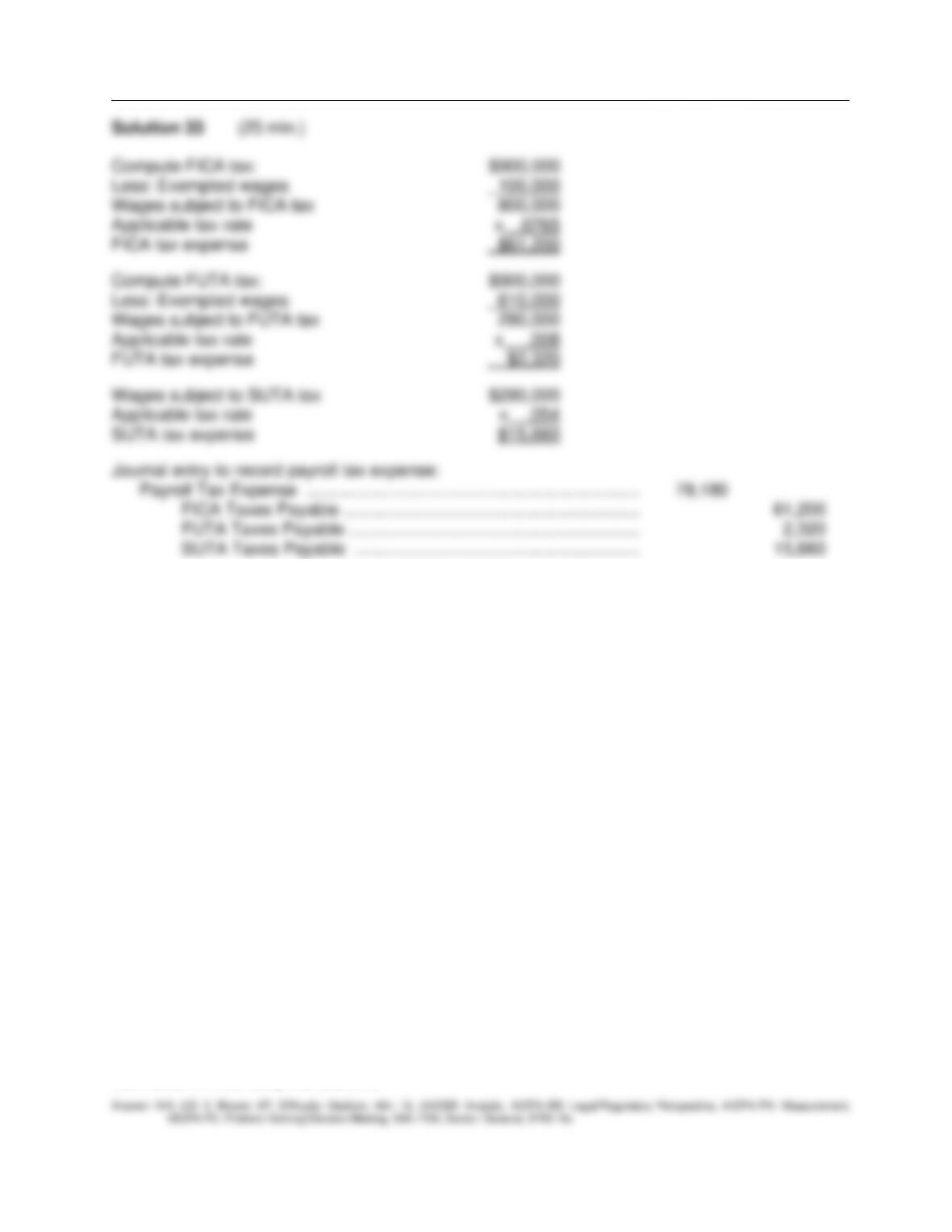
Ex. 33
Banner Company had the following payroll data for the year:
Gross earnings of employees $900,000
Employee earnings not subject to FICA tax 100,000
Employee earnings not subject to FUTA or SUTA tax 610,000
Assume the following:
FICA tax rate 7.65%
State Unemployment tax rate 5.4% (SUTA)
Federal Unemployment tax rate .8% (FUTA)
Instructions
Compute Banner’s payroll tax expense for the year. Make a summary journal entry to record the
payroll tax expense.
Payroll Accounting
F – 11
Ex. 34
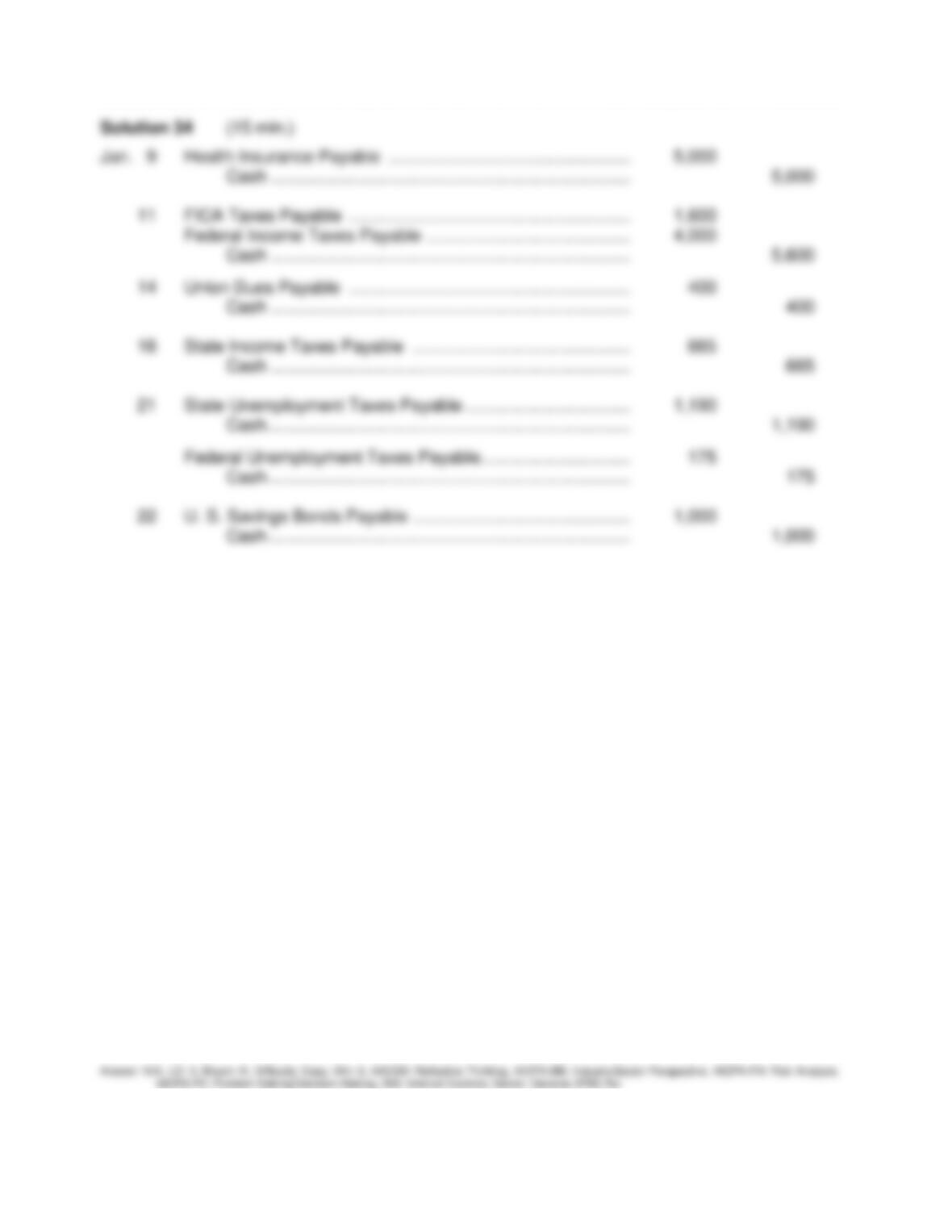
The following payroll liability accounts are included in the ledger of Clementine Company on
January 1, 2013:
FICA Taxes Payable $1,600
Federal Income Taxes Payable 4,000
State Income Taxes Payable 665
Federal Unemployment Taxes Payable 175
State Unemployment Taxes Payable 1,190
Union Dues Payable 400
Health Insurance Payable 5,000
U. S. Savings Bonds Payable 1,000
In January, the following transactions occurred:
Jan. 9 Sent a check for $5,000 to Blue Cross and Blue Shield.
11 Deposited a check for $5,600 in Federal Reserve Bank for FICA taxes and federal
income taxes withheld.
14 Sent a check for $400 to the union treasurer for union dues.
18 Paid state income taxes withheld from employees.
21 Paid state and federal unemployment taxes.
22 Purchased U. S. Savings Bonds for employees by writing a check for $1,000.
Instructions
Journalize the January transactions
Test Bank for Accounting: Tools for Business Decision Making, Fifth Edition
F – 12
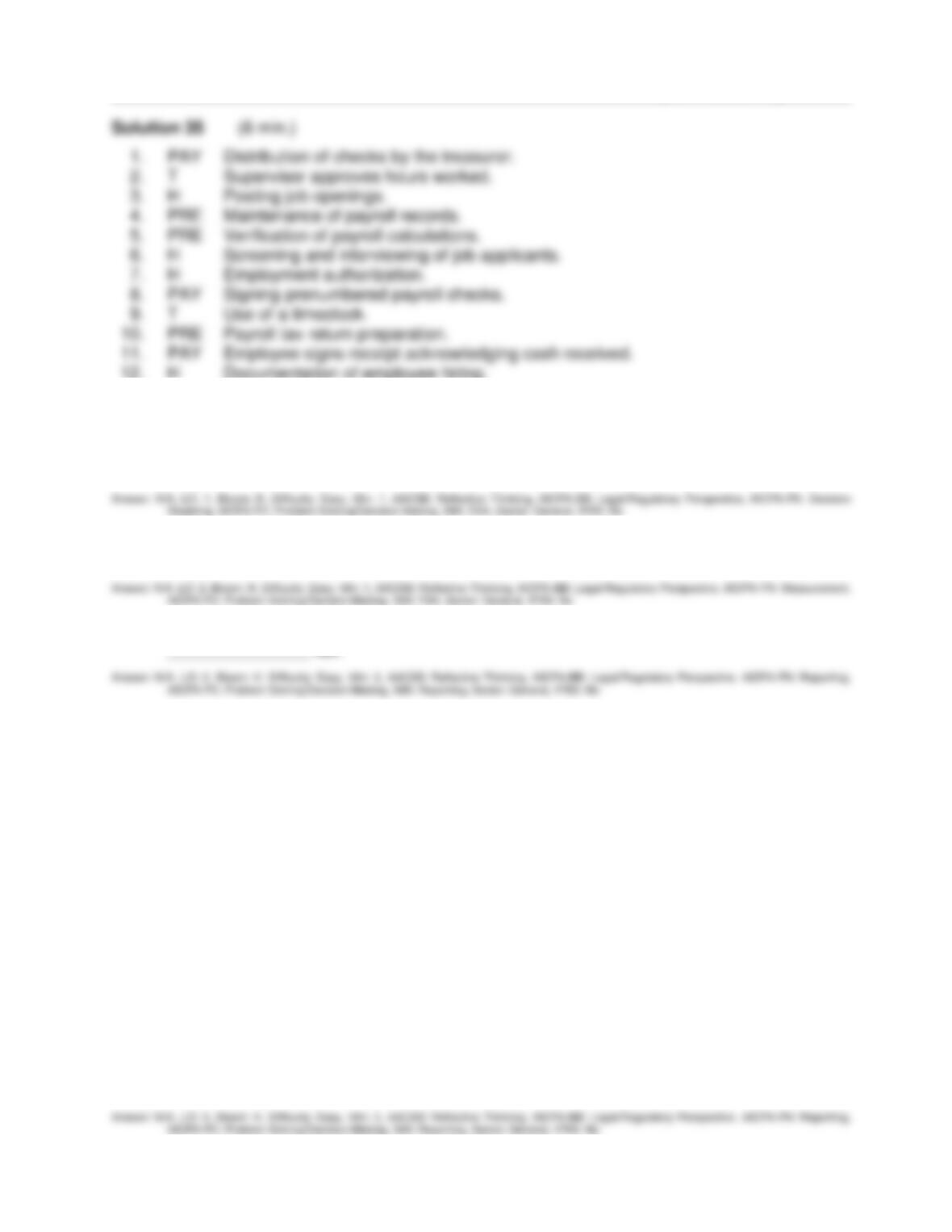
Ex. 35
Match the codes assigned to the following payroll functions to the procedures listed below:
H = Hiring Employees PRE = Preparing the Payroll
T = Timekeeping PAY = Paying the Payroll
1. ____ Distribution of checks by the treasurer.
2. ____ Supervisor approves hours worked.
3. ____ Posting job openings.
4. ____ Maintenance of payroll records.
5. ____ Verification of payroll calculations.
6. ____ Screening and interviewing of job applicants.
7. ____ Employment authorization.
8. ____ Signing prenumbered payroll checks.
9. ____ Use of a timeclock.
10. ____ Payroll tax return preparation.
11. ____ Employee signs receipt acknowledging cash received.
12. ____ Documentation of employee hiring.
Payroll Accounting
F – 13
12. H Documentation of employee hiring.
COMPLETION STATEMENTS
36. Two federal taxes which are levied against employees’ wages that must be deducted in
arriving at net pay are (1) ________________ taxes and (2) _______________ taxes.
37. The employer incurs a payroll tax expense equal to the amount contributed by each
employee for ______________ taxes.
38. A payroll tax expense which is borne entirely by the employer is the federal
_______________ tax.
Answers to Completion Statements
36. FICA, federal income
37. FICA
38. unemployment MATCHING
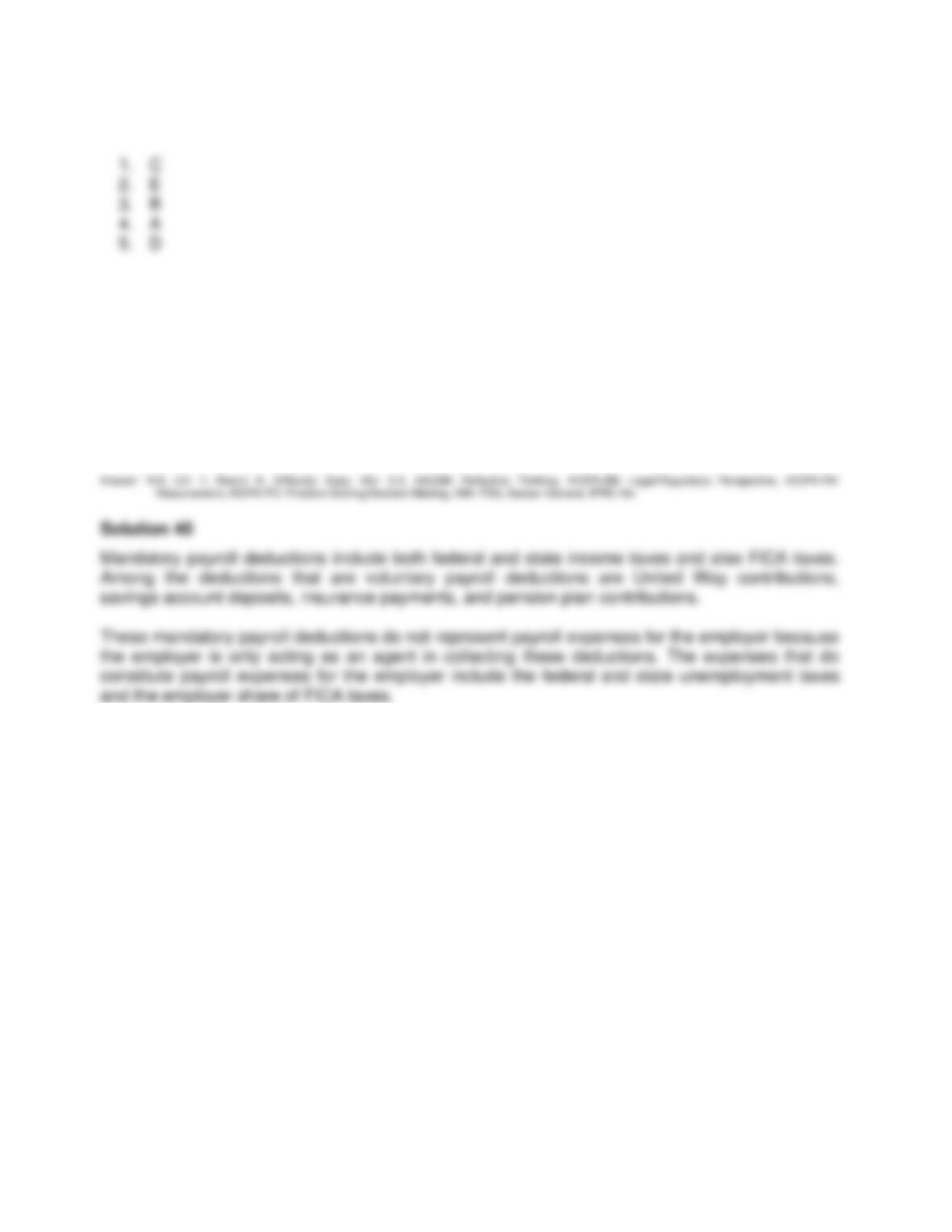
39. Match the items below by entering the appropriate code letter in the space provided.
A. Wage and Tax Statement D. FICA taxes
B. Net pay E. Federal unemployment taxes
C. Federal income taxes
____ 1. Levied against employees’ wages without limit.
____ 2. A payroll tax expense levied only against the employer based on employees’ wages.
____ 3. Gross earnings less payroll deductions.
____ 4. A form showing gross earnings and income taxes withheld.
____ 5. Levied against employees’ wages with a maximum limit.
Test Bank for Accounting: Tools for Business Decision Making, Fifth Edition
F – 14
Answers to Matching
SHORT-ANSWER ESSAY
S-A E 40
An employee’s net pay consists of gross pay less mandatory and voluntary payroll deductions.
Identify the mandatory payroll deductions and give two or three examples of common voluntary
deductions. Are these deductions recognized as payroll expenses by the employer? What type of
payroll expenses does the employer incur related to having a payroll?