
FOR INSTRUCTOR USE ONLY
APPENDIX E
REPORTING AND ANALYZING INVESTMENTS
SUMMARY OF QUESTIONS BY LEARNING OBJECTIVE AND BLOOM’S TAXONOMY
Item
LO
BT
Item
LO
BT
Item
LO
BT
Item
LO
BT
Item
LO
BT
True-False Statements
1.
1
K
9.
2
C
17.
3
C
25.
4
K
33.
5
K
2.
1
K
10.
2
K
18.
3
K
26.
4
K
34.
5
C
3.
1
K
11.
3
C
19.
3
C
27.
5
C
35.
5
C
4.
1
K
12.
3
K
20.
3
K
28.
5
C
36.
5
C
5.
1
K
13.
3
K
21.
3
K
29.
5
K
37.
6
K
6.
2
K
14.
3
C
22.
3
C
30.
5
K
38.
6
K
7.
2
K
15.
3
K
23.
3
K
31.
5
K
39.
6
K
8.
2
K
16.
3
C
24.
4
K
32.
5
C
40.
6
K
Multiple Choice Questions
41.
1
K
67.
2
AP
93.
3
AP
119.
3
K
145.
5
AP
42.
1
K
68.
2
AP
94.
3
K
120.
3
C
146.
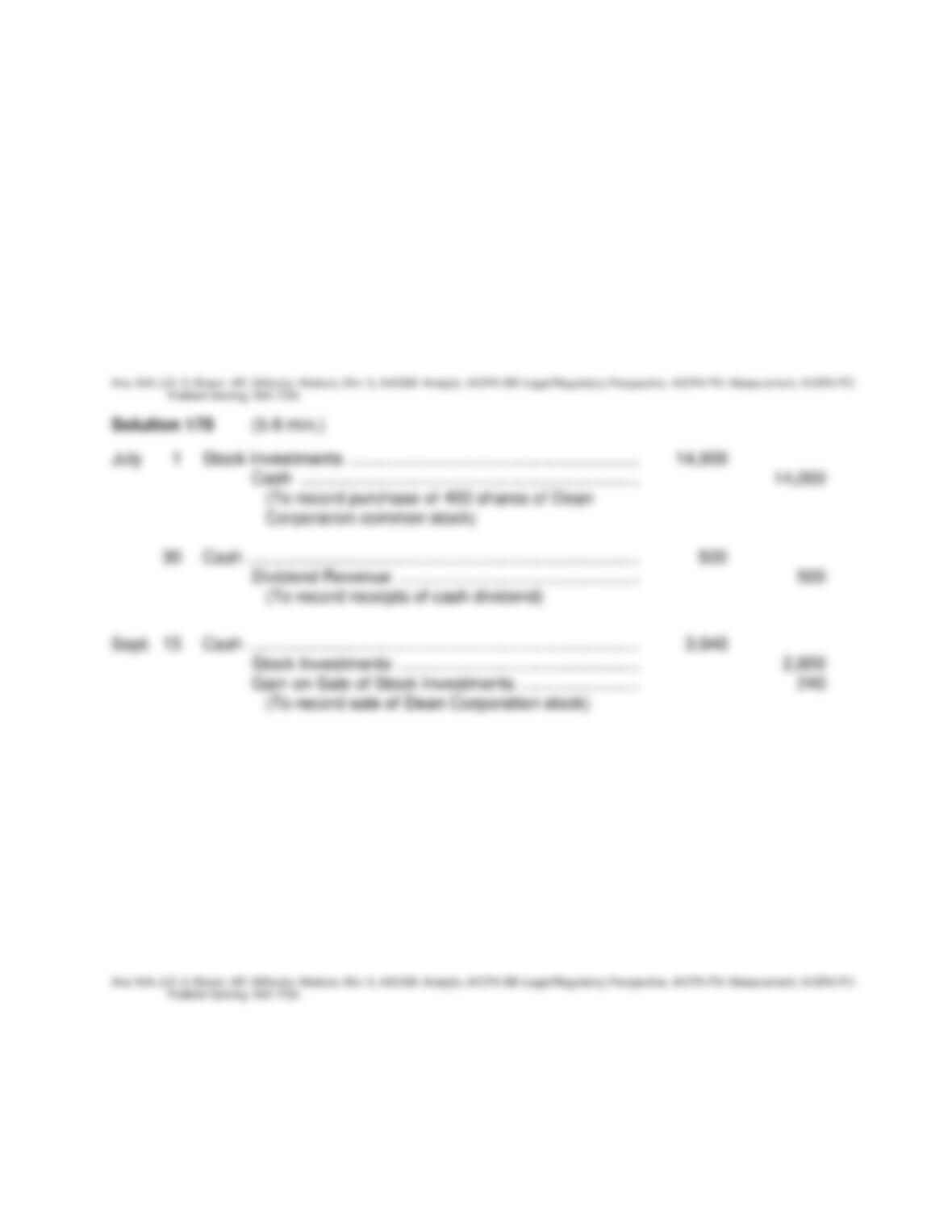
5
AP
43.
1
K
69.
2
AP
95.
3
C
121.
3
C
147.
5
AP
44.
1
K
70.
2
AP
96.
3
C
122.
3
C
148.
5
K
45.
1
K
71.
2
AP
97.
3
K
123.
3
C
149.
5
C
46.
1
K
72.
2
K
98.
3
C
124.
3
AP
150.
5
K
47.
1
K
73.
2
AP
99.
3
K
125.
3
K
151.
5
C
48.
2
K
74.
2
K
100.
3
K
126.
3
K
152.
5
K
49.
2
AP
75.
3
AP
101.
3
K
127.
3
AP
153.
5
K
50.
2
AP
76.
3
AP
102.
3
K
128.
3
AP
154.
5
AP
51.
2
AP
77.
3
AP
103.
3
K
129.
3
AP
155.
5
AP
52.
2
C
78.
3
AP
104.
3
C
130.
4
K
156.
5
AP
53.
2
AP
79.
3
AP
105.
3
K
131.
4
K
157.
5
AP
54.
2
AP
80.
3
K
106.
3
AP
132.
4
K
158.
5
K
55.
2
AP
81.
3
AP
107.
3
AP
133.
4
K
159.
5
AP
56.
2
AP
82.
3
K
108.
3
AP
134.
4
K
160.
5
AP
57.
2
AP
83.
3
AP
109.
3
AP
135.
4
C
161.
5
K
58.
2
AP
84.
3
AP
110.
3
AP
136.
4
K
162.
5
C
59.
2
AP
85.
3
K
111.
3
AP
137.
5
C
163.
6
C
60.
2
AP
86.
3
AP
112.
3
AP
138.
5
K
164.
6
K
61.
2
AP
87.
3
AP
113.
3
AP
139.
5
K
165.
6
K
62.
2
AP
88.
3
AP
114.
3
AP
140.
5
AP
166.
6
K
63.
2
AP
89.
3
AP
115.
3
K
141.
5
K
167.
6
K
64.
2
AP
90.
3
AP
116.
3
K
142.
5
K
168.
6
K
65.
2
AP
91.
3
AP
117.
3
K
143.
5
K
66.
2
AP
92.
3
AP
118.
3
K
144.
5
AP
Brief Exercises
169.
2
AP
171.
3
AP
173.
3
AP
170.
3
AP
172.
3
AP
174.
5
AP
Exercises
175.
2
AP
178.
3
AP
181.
3
AP
184.
3
AP
187.
3, 5,
AP
176.
2
AP
179.
3
AP
182.
3
AP
185.
3
AP
188.
3, 5,
AP
177.
2, 3
AP
180.
3
AP
183,
3
AP
186.
3, 5
AP
189.
5, 6
AP
Completion Statements
190.
1
K
193.
3
K
196.
5
K
199.
5
K
191.
2
K
194.
3
AP
197.
5
K
200.
5
K
192.
3
K
195.
4
K
198.
5
K
201.
6
K
Test Bank for Financial Accounting: Tools for Business Decision Making, Seventh Edition
FOR INSTRUCTOR USE ONLY
E-2
Matching
202.
1-6
K
Short-Answer Essay
203.
1
K
205.
3
C
207.
4
C
209.
5
C
211.
5
E
204.
3
K
206.
3
C
208.
5
K
210.
5
C
212.
5
C
SUMMARY OF LEARNING OBJECTIVES BY QUESTION TYPE
Learning Objective 1
Item
Type
Item
Type
Item
Type
Item
Type
Item
Type
Item
Type
1.
TF
4.
TF
42.
MC
45.
MC
190.
C
2.
TF
5.
TF
43.
MC
46.
MC
202.
Ma
3.
TF
41.
MC
44.
MC
47.
MC
203.
SA
Learning Objective 2
6.
TF
50.
MC
57.
MC
64.
MC
71.
MC
177.
Ex
7.
TF
51.
MC
58.
MC
65.
MC
72.
MC
191.
C
8.
TF
52.
MC
59.
MC
66.
MC
73.
MC
202.
Ma
9.
TF
53.
MC
60.
MC
67.
MC
74.
MC
10.
TF
54.
MC
61.
MC
68.
MC
169.
Be
48.
MC
55.
MC
62.
MC
69.
MC
175.
Ex
49.
MC
56.
MC
63.
MC
70.
MC
176.
Ex
Learning Objective 3
11.
TF
78.
MC
94.
MC
110.
MC
126.
MC
185.
Ex
12.
TF
79.
MC
95.
MC
111.
MC
127.
MC
186.
Ex
13.
TF
80.
MC
96.
MC
112.
MC
128.
MC
187.
Ex
14.
TF
81.
MC
97.
MC
113.
MC
129.
MC
188.
Ex
15.
TF
82.
MC
98.
MC
114.
MC
170.
Be
192.
C
16.
TF
83.
MC
99.
MC
115.
MC
171.
Be
193.
C
17.
TF
84.
MC
100.
MC
116.
MC
172.
Be
194.
C
18.
TF
85.
MC
101.
MC
117.
MC
173.
Be
202.
Ma
19.
TF
86.
MC
102.
MC
118.
MC
177.
Ex
204.
SA
20.
TF
87.
MC
103.
MC
119.
MC
178.
Ex
205.
SA
21.
TF
88.
MC
104.
MC
120.
MC
179.
Ex
206.
SA
22.
TF
89.
MC
105.
MC
121.
MC
180.
Ex
23.
TF
90.
MC
106.
MC
122.
MC
181.
Ex
75.
MC
91.
MC
107.
MC
123.
MC
182.
Ex
76.
MC
92.
MC
108.
MC
124.
MC
183.
Ex
77.
MC
93.
MC
109.
MC
125.
MC
184.
Ex
Learning Objective 4
24.
TF
130.
MC
133.
MC
136.
MC
207.
SA
25.
TF
131.
MC
134.
MC
195.
C
26.
TF
132.
MC
135.
MC
202.
Ma

Reporting and Analyzing Investments
FOR INSTRUCTOR USE ONLY
E-3
Learning Objective 5
Item
Type
Item
Type
Item
Type
Item
Type
Item
Type
Item
Type
27.
TF
36.
TF
145.
MC
154.
MC
174.
Be
200.
C
28.
TF
137.
MC
146.
MC
155.
MC
186.
Ex
202.
Ma
29.
TF
138.
MC
147.
MC
156.
MC
187.
Ex
208.
SA
30.
TF
139.
MC
148.
MC
157.
MC
188.
Ex
209.
SA
31.
TF
140.
MC
149.
MC
158.
MC
189.
Ex
210.
SA
32.
TF
141.
MC
150.
MC
159.
MC
196.
C
211.
SA
33.
TF
142.
MC
151.
MC
160.
MC
197.
C
212.
SA
34.
TF
143.
MC
152.
MC
161.
MC
198.
C
35.
TF
144.
MC
153.
MC
162.
MC
199.
C
Learning Objective 6
37.
TF
39.
TF
163.
MC
165.
MC
167.
MC
201.
C
38.
TF
40.
TF
164.
MC
166.
MC
168.
MC
202.
Ma
Note: TF = True-False C = Completion
MC = Multiple Choice Ex = Exercise
Ma = Matching
CHAPTER LEARNING OBJECTIVES
1. Identify the reasons corporations invest in stocks and debt securities. Corporations
invest for three common reasons: (a) They have excess cash. (b) They view investment
income as a significant revenue source. (c) They have strategic goals such as gaining
control of a competitor or supplier or moving into a new line of business.
2. Explain the accounting for debt investments. Entries for investments in debt securities
are required when companies purchase bonds, receive or accrue interest, and sell bonds.
3. Explain the accounting for stock investments. Entries for investments in common stock
are required when companies purchase stock, receive dividends, and sell stock. When
ownership is less than 20%, the cost method is used–the investment is recorded at cost.
When ownership is between 20% and 50%, the equity method should be used–the investor
records its share of the net income of the investee in the year it is earned. When ownership
is more than 50%, consolidated financial statements should be prepared.
4. Describe the purpose and usefulness of consolidated financial statements. When a
company owns more than 50% of the common stock of another company, consolidated
financial statements are usually prepared. These statements are especially useful to the
stockholders, board of directors, and management of the parent company.
5. Indicate how debt and stock investments are valued and reported in the financial
statements. Investments in debt and stock securities are classified as trading, available-for-
sale, or held-to-maturity for valuation and reporting purposes. Trading securities are reported
as current assets at fair value, with changes from cost reported in net income. Available-for-
sale securities are also reported at fair value, with the changes from cost reported in
stockholders’ equity. Available-for-sale securities are classified as short-term or long-term
depending on their expected realization.
Test Bank for Financial Accounting: Tools for Business Decision Making, Seventh Edition
E-4
6. Distinguish between short-term and long-term investments. Short-term investments are
securities held by a company that are readily marketable and intended to be converted to
cash within the next year or operating cycle, whichever is longer. Investments that do not
meet both criteria are classified as long-term investments.
TRUE-FALSE STATEMENTS
1. Corporations purchase investments in debt or equity securities generally for one of two
reasons.
2. A reason some companies purchase investments is because they generate a significant
portion of their earnings from investment income.
3. Pension funds and mutual funds are corporations that regularly invest for strategic
reasons.
4. The purchase of a company that is in the same industry, but involved in a different activity,
is called a vertical acquisition.
5. When investing excess cash for short periods of time, corporations invest in debt securities
and stock securities.
6. In accordance with the historical cost principle, brokerage fees should be added to the cost
of an investment.
7. In accordance with the historical cost principle, the cost of debt investments includes
brokerage fees and accrued interest.
8. The accounting for short-term debt investments and for long-term debt investments is
similar.
9. When investments in bonds are sold, any difference between the sales price and the fair
value of the bonds is recorded as a gain or loss.
Reporting and Analyzing Investments
E-5
10. Debt investments are investments in government and corporation bonds.
11. Dividends received on stock investments of less than 20% should be credited to the Stock
Investments account.
12. Dividends received on investments are accounted for in the same way under the cost and
the equity method.
13. Unless there is evidence to the contrary, an investor owning 25% of the stock of an
investee is assumed to have significant influence.
14. If the cost method is used to account for an investment in stock, the Stock Investments
account is increased by the amount of dividends received during the period.
15. Under the equity method the investor records a proportionate share of the investee’s
income in the year when it is earned.
16. When the cost method is used to account for an investment in stock, dividends received
are accounted for as a reduction in the investment account.
17. Using the cost method of accounting for a stock investment, the journal entry to record the
receipt of dividends involves a credit to Dividend Revenue.
18. If an investor owns between 20% and 50% of an investee’s common stock, it is presumed
that the investor has significant influence on the investee.
19. The Stock Investments account is debited at acquisition under both the equity method and
cost method of accounting for investments in common stock.
20. Under the equity method, the investment in common stock is initially recorded at cost, and
the Stock Investments account is adjusted annually.
Test Bank for Financial Accounting: Tools for Business Decision Making, Seventh Edition
E-6
21. Under the equity method, the receipt of dividends from the investee company results in an
increase in the Stock Investments account.
22. Under the equity method, the receipt of dividends from the investee company results in a
credit to the Dividend Revenue account.
23. In accounting for stock investments of less than 20%, the equity method is typically used.
24. Consolidated financial statements are prepared in place of the financial statements for the
parent and subsidiary companies.
25. Consolidated financial statements should be prepared only when a subsidiary company
has a controlling interest in the parent company.
26. Consolidated financial statements are appropriate when an investor controls an investee
by ownership of more than 50% of the investee‘s common stock.
27. If the fair value of an available-for-sale security exceeds its cost, the security should be
written up to fair value and a realized gain should be recognized.
28. The Fair Value Adjustment account can only have a credit balance or a zero balance.
29. Unrealized gains and losses are recognized on trading securities.
30. Trading securities are valued on the balance sheet at market value.
31. Unrealized gains and losses on available-for-sale securities are reported on the income
statement.
32. The valuation of available-for-sale securities is similar to the procedures followed for
trading securities, except that changes in fair value are not recognized in current income.
Reporting and Analyzing Investments
FOR INSTRUCTOR USE ONLY
E-7
33. An unrealized gain or loss on trading securities is reported as a separate component of
stockholders’ equity.
34. For available-for-sale securities, the unrealized gain or loss account is carried forward to
future periods.
35. The account Fair Value Adjustment-Trading appears as a contra account in the income
statement.
36. A decline in the fair value of a trading security is recorded by debiting an unrealized loss
account and crediting the Fair Value Adjustment account.
37. To be classified as a short-term investment, the investment must be readily marketable
and intended to be converted into cash within the next year or operating cycle.
38. An investment in short-term equity securities should be charged to a nominal account
since the investment is temporary.
39. An investment is readily marketable if it is management‘s intent to sell the investment.
40. Stocks traded on the New York Stock Exchange are considered readily marketable.
Answers to True-False Statements
Test Bank for Financial Accounting: Tools for Business Decision Making, Seventh Edition
E-8
MULTIPLE CHOICE QUESTIONS
41. Corporations invest in other companies for all of the following reasons except to
a. house excess cash until needed.
b. generate earnings.
c. meet strategic goals.
d. increase trading of the other companies’ stock.
42. When investing excess cash for short periods of time, corporations invest in
a. stocks of companies in a related industry.
b. debt securities.
c. low-risk, highly liquid securities.
d. stock securities.
43. The purchase of a company that is in the same industry but involved in a different activity
is called a
a. controlling acquisition.
b. horizontal acquisition.
c. parent acquisition.
d. vertical acquisition.
44. The purchase of a company that is in the same industry and involved in the same activity is
called a
a. controlling acquisition.
b. horizontal acquisition.
c. parent acquisition.
d. vertical acquisition.
45. Why do corporations generally invest in debt or equity securities?
a. They have excess cash.
b. They want to generate earnings from investment income.
c. They invest for strategic reasons.
d. All of these answer choices are correct.
46. Why do pension and mutual funds invest in debt and equity securities?
a. They have excess cash.
b. They want to generate earnings from investment income.
c. They invest for strategic reasons.
d. They invest for speculative reasons.
Reporting and Analyzing Investments
E-9
47. Which is not a strategic reason to invest?
a. There has been a change in the economic climate.
b. To establish a presence in a related industry.
c. To exercise some influence over a customer or supplier.
d. To enter a new industry without starting from scratch.
48. Which of the following is a debt security?
a. IBM stock.
b. Treasury stock.
c. Treasury bills.
d. None of these answer choices are correct.
49. Mazzeo Company acquires 80 Dodd’s 10%, 5 year, $1,000 bonds on January 1, 2014 for
$80,000. The journal entry to record this investment includes a debit to
a. Debt Investments for $88,000.
b. Debt Investments for $80,000.
c. Cash for $80,000.
d. Stock Investments for $80,000.
50. Mazzeo Company acquires 80 Dodd’s 10%, 5 year, $1,000 bonds on January 1, 2014 for
$80,000. Assume Dodd’s pays interest semiannually and the July 1 entry was done
correctly. Mazzeo’s journal entry at December 31, 2014 would include a credit to
a. Interest Receivable for $4,000.
b. Interest Revenue for $8,000.
c. Interest Expense for $8,000.
d. Interest Revenue for $4,000.
51. Mazzeo Company acquires 80 Dodd’s 10%, 5 year, $1,000 bonds on January 1, 2014 for
$80,000. If Mazzeo sells all of its Dodd’s Bonds for $78,400 what gain or loss is
recognized?
a. Loss of $9,600
b. Loss of $1,600
c. Gain of $1,600
d. Gain of $9,600
Test Bank for Financial Accounting: Tools for Business Decision Making, Seventh Edition
E-10
52. At the time of acquisition of a debt investment
a. no journal entry is required.
b. the historical cost principle applies.
c. the Stock Investments account is debited when bonds are purchased.
d. the investment account is credited for its cost plus brokerage fees.
53. On January 1, 2014, the LaRoche Company purchased at face value, a $1,000, 4%, bond
that pays interest on January 1 and July 1. LaRoche Company has a calendar year end.
The entry for the receipt of interest on July 1, 2014, is
a. Cash 20
Interest Revenue 20
b. Cash 40
Interest Revenue 40
c. Interest Receivable 20
Interest Revenue 20
d. Interest Receivable 40
Interest Revenue 40
54. On January 1, 2014, the LaRoche Company purchased at face value, a $1,000, 4%, bond
that pays interest on January 1 and July 1. LaRoche Company has a calendar year end.
The adjusting entry on December 31, 2014, is
a. not required.
b. Cash 20
Interest Revenue 20
c. Interest Receivable 20
Interest Revenue 20
d. Interest Receivable 20
Debt Investments 20
55. On January 1, 2014, the LaRoche Company purchased at face value, a $1,000, 4%, bond
that pays interest on January 1 and July 1. LaRoche Company has a calendar year end.
The entry for the receipt of interest on January 1, 2015 is
a. Cash 40
Interest Revenue 40
b. Cash 40
Interest Receivable 40
c. Cash 20
Interest Revenue 20
d. Cash 20
Interest Receivable 20
Reporting and Analyzing Investments
E-11
56. On January 1, 2014, JBT Company purchased at face value, a $1,000 6%, bond that pays
interest on January 1 and July 1. JBT Company has a calendar year end. The entry for the
receipt of interest on July 1, 2014, is
a. Cash 60
Interest Revenue 60
b. Cash 30
Interest Revenue 30
c. Interest Receivable 30
Interest Revenue 30
d. Interest Receivable 60
Interest Revenue 60
57. On January 1, 2014, JBT Company purchased at face value, a $1,000 6%, bond that pays
interest on January 1 and July 1. JBT Company has a calendar year end. The adjusting
entry on December 31, 2014, is
a. not required.
b. Cash 30
Interest Revenue 30
c. Interest Receivable 30
Interest Revenue 30
d. Interest Receivable 30
Debt Investments 30
58. On January 1, 2014, JBT Company purchased at face value, a $1,000 6%, bond that pays
interest on January 1 and July 1. JBT Company has a calendar year end. The entry for the
receipt of interest on January 1, 2015 is
a. Cash 60
Interest Revenue 60
b. Cash 60
Interest Receivable 60
c. Cash 30
Interest Revenue 30
d. Cash 30
Interest Receivable 30
Test Bank for Financial Accounting: Tools for Business Decision Making, Seventh Edition
E-12
59. On January 1, 2014, Tri-State Supply Company purchased at face value, a $1,000 7%,
bond that pays interest annually on January 1. Tri-State Company has a calendar year
end. The adjusting entry on June 30, 2014, is
a. not required.
b. Cash 35
Interest Revenue 35
c. Interest Receivable 35
Interest Revenue 35
d. Interest Receivable 35
Debt Investments 35
60. On January 1, 2014, Tri-State Supply Company purchased at face value, a $1,000 7%,
bond that pays interest annually on January 1. Tri-State Company has a calendar year
end. The adjusting entry on December 31, 2014, is
a. not required.
b. Cash 70
Interest Revenue 70
c. Interest Receivable 70
Interest Revenue 70
d. Interest Receivable 70
Debt Investments 70
61. On January 1, 2014, Tri-State Company purchased at face value, a $1,000 7%, bond that
pays interest annually on January 1. Tri-State Company has a calendar year end. The
entry for the receipt of interest on January 1, 2015 is
a. Cash 70
Interest Revenue 70
b. Cash 70
Interest Receivable 70
c. Cash 35
Interest Revenue 35
d. Cash 35
Interest Receivable 35
62. Vangaurd Co. purchased 50, 6% McLaughlin Company bonds for $50,000 cash. Interest is
payable semiannually on July 1 and January 1. The entry to record the purchase would
include debit to
a. Debt Investments for $51,500.
b. Cash for $53,000.
c. Debt Investments for $50,000.
d. Stock Investments for $50,000.
Reporting and Analyzing Investments
E-13
63. Charleston Co. purchased 60, 6% APS Company bonds for $60,000 cash. Interest is
payable semiannually on July 1 and January 1. The entry to record the July 1 semiannual
interest payment would include a
a. debit to Interest Receivable for $1,800.
b. credit to Interest Revenue for $1,800.
c. credit to Interest Revenue for $3,600.
d. credit to Debt Investments for $1,800.
64. Charleston Co. purchased 60, 6% APS Company bonds for $60,000 cash plus brokerage
fees of $500. Interest is payable semiannually on July 1 and January 1. The entry to record
the December 31 interest accrual would include a
a. debit to Interest Receivable for $1,800.
b. debit to Interest Revenue for $1,800.
c. credit to Interest Revenue for $3,600.
d. debit to Debt Investments for $1,800.
65. Cedar Co. purchased 120, 6% LKN Company bonds for $120,000 cash. Interest is payable
semiannually on July 1 and January 1. If 60 of the securities are sold July 1 for $61,500 the
entry would include a credit to Gain on Sale of Debt Investments of
a. $1,000.
b. $1,800.
c. $3,600.
d. $1,500.
66. On January 1, Vega Company purchased as an investment a $1,000, 8% bond for $1,000.
The bond pays interest on January 1 and July 1. The bond is sold on October 1 for $1,080
plus accrued interest. Interest has not been accrued since the last interest payment date.
What is the entry to record the cash proceeds at the time the bond is sold?
a. Cash 1,080
Debt Investments 1,080
b. Cash 1,100
Debt Investments 1,000
Gain on Sale of Debt Investments 80
Interest Revenue 20
c. Cash 1,100
Debt Investments 1,080
Interest Revenue 20
d. Cash 1,100
Debt Investments 1,000
Interest Revenue 100
Test Bank for Financial Accounting: Tools for Business Decision Making, Seventh Edition
E-14
67. On January 1, U.K. Enterprise purchased as an investment a $1,000, 6% bond for $1,000.
The bond pays interest on January 1 and July 1. The bond is sold on September 1 for
$1,100 plus accrued interest. Interest has not been accrued since the last interest payment
date. What is the entry to record the cash proceeds at the time the bond is sold?
a. Cash 1,100
Debt Investments 1,100
b. Cash 1,100
Debt Investments 1,000
Gain on Sale of Debt Investments 100
Interest Revenue 10
c. Cash 1,110
Debt Investments 1,100
Interest Revenue 10
d. Cash 1,100
Debt Investments 1,000
Interest Revenue 160
68. On January 1, Connid Company purchased as an investment a $1,000, 8% bond for
$1,000. The bond pays interest on January 1 and July 1. What is the entry to record the
interest payment on July 1?
a. Cash 80
Debt Investments 80
b. Cash 80
Interest Revenue 80
c. Cash 40
Interest Revenue 40
d. Cash 40
Debt Investments 40
69. On January 1, Belvedere Company purchased as an investment a $1,000, 7% bond for
$1,000. The bond pays interest on January 1 and July 1. What is the entry to record the
interest accrual on December 31?
a. Interest Receivable 70
Interest Revenue 70
b. Debt Investments 35
Interest Revenue 35
c. Interest Receivable 35
Interest Revenue 35
d. Debt Investments 25
Interest Revenue 25
Reporting and Analyzing Investments
E-15
70. On January 1, Waverly Company purchased as an investment a $1,000, 6% bond for
$1,000. The bond pays interest on January 1 and July 1. What is the entry to record the
interest accrual on December 31?
a. Interest Receivable 30
Interest Revenue 30
b. Debt Investments 30
Interest Revenue 30
c. Interest Receivable 60
Interest Revenue 60
d. Debt Investments 60
Interest Revenue 60
71. On January 1, Bay View Company purchased as an investment a $1,000, 6% bond for
$1,000. The bond pays interest on January 1 and July 1. The bond is sold on September 1
for $1,050 plus accrued interest. Interest has not been accrued since the last interest
payment date. What is the entry to record the cash proceeds at the time the bond is sold?
a. Cash 1,050
Debt Investments 1,050
b. Cash 1,060
Debt Investments 1,000
Gain on Sale of Debt Investments 50
Interest Revenue 10
c. Cash 1,060
Debt Investments 1,050
Interest Revenue 10
d. Cash 1,050
Debt Investments 1,000
Interest Revenue 50
72. Which of the following is not a true statement about the accounting for long-term debt
investments?
a. The investment is initially recorded at cost.
b. The cost includes any brokerage fees.
c. Debt investments include investment in government and corporation bonds.
d. The cost includes any accrued interest.
73. If a debt investment is sold, the investment account is
a. debited for the book value of the bonds at the sale date.
b. credited for the cost of the bonds at the sale date.
c. credited for the fair value of the bonds at the sale date.
d. debited for the cost of the bonds at the sale date.
Test Bank for Financial Accounting: Tools for Business Decision Making, Seventh Edition
E-16
74. Porter Brothers Company purchased debt investment for $80,000 on January 1, 2014. On
July 1, 2014, Jamison received cash interest of $2,905. Assuming no interest has been
accrued, which of the following correctly presents the journals entries for the purchase and
the receipt of interest?
a. Jan 1 Debt Investments 80,000
Cash 80,000
July 1 Cash 2,905
Interest Revenue 2,905
b. Jan 1 Cash 80,000
Debt Investments 80,000
July 1 Interest Revenue 2,905
Cash 2,905
c. Jan 1 Debt Investments 80,000
Cash 80,000
July 1 Interest Revenue 2,905
Cash 2,905
d. Jan 1 Cash 80,000
Debt Investments 80,000
July 1 Cash 2,905
Interest Revenue 2,905
75. On August 1, Basil Company buys 2,000 shares of Zingo common stock for $61,500 cash.
On December 1, the stock investments are sold for $76,000 in cash. Which of the following
are the correct journal entries of record for the purchase and sale of the common stock?
a. Aug. 1 Cash 61,500
Stock Investments 61,500
Dec. 1 Cash 76,000
Stock Investments 61,500
Gain on Sale of Stock Investments 14,500
b. Aug. 1 Stock Investments 61,500
Cash 61,500
Dec. 1 Cash 76,000
Stock Investments 61,500
Gain on Sale of Stock Investments 14,500
c. Aug 1 Stock Investments 61,500
Cash 61,500
Dec. 1 Stock Investment 76,000
Cash 60,000
Gain on Sale of Stock Investments 16,000
d. Aug. 1 Cash 61,500
Stock Investments 61,500
Dec 1 Stock Investments 76,000
Cash 61,500
Gain on Sale of Stock Investments 14,500
Reporting and Analyzing Investments
E-17
76. Buford Industries owns 45% of Appalachian Company. For the current year, Appalachian
reports net income of $250,000 and declares and pays a $70,000 cash dividend. Which of
the following correctly presents the journal entries to record Buford’s equity in Appalachian
net income and the receipt of dividends from Appalachian?
a. Dec. 31 Stock Investments 112,500
Revenue from Stock Investments 112,500
Dec. 31 Cash 31,500
Stock Investments 31,500
b. Dec. 31 Stock Investments 112,500
Revenue from Stock Investments 112,500
Dec. 31 Cash 70,000
Stock Investments 70,000
c. Dec. 31 Stock Investments 81,000
Revenue from Stock Investments 81,000
d. Dec. 31 Revenue from Stock Investments 112,500
Stock Investments 112,500
Dec. 31 Stock Investments 31,500
Cash 31,500
77. On January 1, 2014, Chic Corp. paid $1,200,000 for 100,000 shares of Toto Company’s
common stock, which represents 40% of Toto’s outstanding common stock. Toto reported
income of $300,000 and paid cash dividends of $80,000 during 2014 Chic should report
the investment in Toto Company on its December 31, 2014, balance sheet at
a. $1,200,000
b. $1,320,000
c. $1,232,000
d. $1,288,000
78. McComb Inc. earns $900,000 and pays cash dividends for $300,000 during 2014. SFX
Corporation owns 70,000 of the 210,000 outstanding shares of McComb. What amount
should SFX show in the investment account at December 31, 2014 if the beginning of the
year balance in the account was $100,000?
a. $300,000
b. $200,000
c. $280,000
d. $400,000
Test Bank for Financial Accounting: Tools for Business Decision Making, Seventh Edition
E-18
79. McComb Inc. earns $900,000 and pays cash dividends for $300,000 during 2014. SFXl
Corporation owns 70,000 of the 210,000 outstanding shares of McComb. How much
revenue from investment should Cornwell report in 2014?
a. $100,000
b. $200,000
c. $300,000
d. $400,000
80. All of the following factors would be signs of an investor’s significant influence over an
investee except
a. the investor has representation on the investee‘s board of directors.
b. the investor participates in the investee’s policy-making process.
c. there are immaterial transactions between the investor and the investee.
d. the common stock held by other stockholders is dispersed.
81. On January 1, 2014, Orleans industries acquired a 15% interest in Florida Corporation
through the purchase of 12,000 shares of Florida Corporation common stock for $320,000.
During 2014, Florida Corp. paid $80,000 in dividends and reported a net loss of $100,000.
Orleans is able to exert significant influence on Florida. However, Orleans mistakenly
records these transactions using the cost method rather than the equity method of
accounting. Which of the following would show the correct presentation for Orlean’s
investment using the equity method?
Investment Net
Account Earnings (loss)
a. $100,000 ($20,000)
b. $293,000 ($15,000)
c. $305,000 ($15,000)
d. $305,000 ($3,000)
82. When a company holds stock of several different corporations, the group of securities is
identified as a(n)
a. affiliated investment.
b. consolidated portfolio.
c. investment portfolio.
d. controlling interest.
Reporting and Analyzing Investments
E-19
83. CGS Corporation makes an investment in 200 shares of Bama Company’s common stock.
The stock is purchased for $53 a share. The entry for the purchase is:
a. Debt Investments 10,000
Cash 10,000
b. Stock Investments 10,600
Cash 10,600
c. Stock Investments 10,000
Cash 10,000
d. Cash 10,600
Stock Investments 10,600
84. Gulf Coast Corporation makes an investment in 100 shares of Eta Company’s common
stock. The stock is purchased for $52 a share. The entry for the purchase is
a. Debt Investments 5,200
Cash 5,200
b. Stock Investments 5,200
Cash 5,200
c. Stock Investments 5,000
Cash 5,000
d. Cash 5,200
Stock Investments 5,200
85. For accounting purposes, the method used to account for investments in common stock is
determined by
a. the amount paid for the stock by the investor.
b. the extent of an investor’s influence over the operating and financial affairs of the
investee.
c. whether the stock has paid dividends in past years.
d. whether the acquisition of the stock by the investor was “friendly” or “hostile.”
86. Outer Banks Corporation sells 200 shares of common stock being held as an investment.
The shares were acquired six months ago at a cost of $40 a share. Outer Banks sold the
shares for $43 a share. The entry to record the sale is
a. Cash 8,000
Loss on Sale of Stock Investments 600
Stock Investments 8,600
b. Cash 8,600
Gain on Sale of Stock Investments 600
Stock Investments 8,000
c. Cash 8,600
Stock Investments 8,600
d. Stock Investments 8,000
Loss on Sale of Stock Investments 600
Cash 8,600
Test Bank for Financial Accounting: Tools for Business Decision Making, Seventh Edition
E-20
87. Ashland Corporation sells 100 shares of common stock being held as an investment. The
shares were acquired six months ago at a cost of $30 a share. Ashl and Keller sold the
shares for $38 a share. The entry to record the sale is
a. Cash 3,000
Loss on Sale of Stock Investments 800
Stock Investments 3,800
b. Stock Investments 3,800
Cash 3,800
c. Cash 3,800
Gain on Sale of Stock Investments 800
Stock Investments 3,000
d. Cash 3,800
Stock Investments 3,800
88. Crosby Corporation sells 300 shares of common stock being held as an investment. The
shares were acquired six months ago at a cost of $50 a share. Crosby sold the shares for
$46 a share. The entry to record the sale is:
a. Cash 13,800
Loss on Sale of Stock Investments 1,200
Stock Investments 15,000
b. Cash 15,000
Gain on Sale of Stock Investments 1,200
Stock Investments 13,800
c. Cash 13,800
Stock Investments 13,800
d. Stock Investments 13,800
Loss on Sale of Stock Investments 1,200
Cash 15,000
89. A purchase of common stock of Blue Wave Corporation for $14,500 was sold three months
later for $15,000. The entry to record the sale would include a
a. debit to Cash of $14,500.
b. credit to Gain on Sale of Stock Investments of $500.
c. credit to Stock Investments of $15,000.
d. credit to Interest Revenue of $500.
Reporting and Analyzing Investments
E-21
90. Hardin Park Company had these transactions pertaining to stock investments
Feb. 1 Purchased 2,500 shares of Raley Company (10%) for $44,500 cash.
June 1 Received cash dividends of $1 per share on Raley stock.
Oct. 1 Sold 1,000 shares of Raley stock for 19,500.
Dec. 1 Received cash dividends of $2 per share on Reley stock.
The entry to record the purchase of the Raley stock would include a
a. debit to the Stock Investments account for $43,500.
b. credit to Cash for $43,500
c. debit to the Stock Investments account for $44,500.
d. debit to Investment Expense for $1,000.
91. Hardin Park Company had these transactions pertaining to stock investments
Feb. 1 Purchased 2,500 shares of Raley Company (10%) for $44,500 cash.
June 1 Received cash dividends of $1 per share on Raley stock.
Oct. 1 Sold 1,000 shares of Raley stock for $19,500.
Dec. 1 Received cash dividends of $2 per share on Raley stock.
The entry to record the receipt of the dividends June 1 would include a
a. debit to Stock Investments of $2,500.
b. credit to Dividend Revenue of $2,500.
c. debit to Dividend Revenue of $2,500.
d. credit to the Stock Investments of $2,500.
92. Hardin Park Company had these transactions pertaining to stock investments
Feb. 1 Purchased 2,500 shares of Raley Company (10%) for $44,500 cash.
June 1 Received cash dividends of $1 per share on Raley stock.
Oct. 1 Sold 1,000 shares of Raley stock for $19,500.
Dec. 1 Received cash dividends of $2 per share on Raley stock.
The entry to record the sale of the stock would include a
a. debit to Cash for $17,800.
b. credit to Gain on Sale of Stock Investments for $680.
c. debit to Stock Investment for $17,800.
d. credit to Gain on Sale of Stock Investments of $1,700.
Test Bank for Financial Accounting: Tools for Business Decision Making, Seventh Edition
E-22
93. Hardin Park Company had these transactions pertaining to stock investments
Feb. 1 Purchased 2,500 shares of Raley Company (10%) for $44,500 cash.
June 1 Received cash dividends of $1 per share on Raley stock.
Oct. 1 Sold 1,000 shares of Raley stock for $19,500.
Dec. 1 Received cash dividends of $2 per share on Raley stock.
The entry to record the receipt of the dividends Dec. 1 would include a
a. debit to Stock Investments of $3,000.
b. credit to Dividend Revenue of $3,000.
c. debit to Dividend Revenue of $3,000.
d. credit to the Stock Investments of $3,000.
94. If an investor owns less than 20% of the common stock of another corporation as an
investment
a. the equity method of accounting for the investment should be employed.
b. no dividends can be expected.
c. it is presumed that the investor has relatively little influence on the investee.
d. it is presumed that the investor has significant influence on the investee.
95. If the cost method is used to account for an investment in common stock, dividends
received should be
a. credited to the Stock Investments account.
b. credited to the Dividend Revenue account.
c. debited to the Stock Investments account.
d. recorded only when 20% or more of the stock is owned.
96. Under the cost method of accounting for dividends
a. Investment Revenue is credited when dividends are received.
b. the Investment account is credited when the investee reports a net income.
c. the Investment account is credited when dividends are received.
d. Investment Revenue is credited when the investee reports a net income.
97. If 10% of the common stock of an investee company is purchased as an investment, the
appropriate method of accounting for the investment is
a. the cost method.
b. the equity method.
c. the preparation of consolidated financial statements.
d. determined by agreement with whomever owns the remaining 90% of the stock.

Reporting and Analyzing Investments
E-23
98. When the cost method is used to account for a stock investment the carrying value of the
investment is affected by
a. the earnings of the investee.
b. the dividend distributions of the investee.
c. the earnings and dividend distributions of the investee.
d. neither the earnings nor the dividends of the investee.
99. The cost method of accounting for investments in stock should be employed when the
a. investor owns more than 50% of the investee’s stock.
b. investor has significant influence on the investee and the stock held by the investor are
marketable equity securities.
c. market value of the shares held is greater than their historical cost.
d. investor’s influence on the investee is insignificant.
100. The equity method should generally be used to account for an investment in stock when
the level of ownership is
a. less than 10%.
b. between 10% and 20%.
c. between 20% and 50%.
d. 10% or more.
101. When an investor owns between 20% and 50% of the common stock of a corporation, it is
generally presumed that the investor
a. has insignificant influence on the investee and that the cost method should be used to
account for the investment.
b. should apply the cost method in accounting for the investment.
c. will prepare consolidated financial statements.
d. has significant influence on the investee and that the equity method should be used to
account for the investment.
102. The cost method of accounting for investments in stock should be used when the
investment is
a. influential and controlling.
b. influential and noncontrolling.
c. controlling.
d. non-influential and noncontrolling.
Test Bank for Financial Accounting: Tools for Business Decision Making, Seventh Edition
E-24
103. The ability of an investing company to affect the operating and financial activities of
another company, even though the investor holds less than 50% of the stock, is known as
a. significant influence.
b. control.
c. a combination.
d. influence and control.
104. Under the equity method of accounting for investments in common stock, when a dividend
is received from the investee company
a. the Dividend Revenue account is credited.
b. the Stock Investments account is increased.
c. the Stock Investments account is decreased.
d. no entry is necessary.
105. The receipt of dividends on an investment affects the Stock Investment account when
which of the following methods is used?
a. Cost method.
b. Equity method.
c. Combination method.
d. Market method.
106. Bing Company owns 30% interest in the stock of Yeti Corporation. During the year, Yeti
pays $60,000 in dividends to Bing, and reports $320,000 in net income. Bing Company’s
investment in Yeti l will increase Bing net income by
a. $96,000.
b. $78,000.
c. $60,000.
d. $18,000.
107. Chopper Company owns 10% interest in the stock of Elton Corporation. During the year,
Elton pays $10,000 in dividends to Chopper, and reports $400,000 in net income. Chopper
Company’s investment in Elton will increase Chopper net income by
a. $10,000.
b. $30,000.
c. $40,000.
d. $1,000.
Reporting and Analyzing Investments
E-25
108. Barcelona Company owns 40% interest in the stock of ABX Corporation. During the year,
ABX pays $20,000 in dividends to Barcelona, and reports $150,000 in net income.
Barcelona Company’s investment in ABX will increase Barcelona net income by
a. $52,000.
b. $60,000.
c. $52,000.
d. $8,000.
109. Barcelona Company owns 40% interest in the stock of ABX Corporation. During the year,
ABX pays $20,000 in dividends to Barcelona, and reports $150,000 in net income.
Barcelona Company’s investment in ABX will increase by
a. $52,000.
b. $60,000.
c. $8,000.
d. $40,000.
110. Jambon Company owns 10% interest in the stock of Fanth Corporation. During the year,
Fanth pays $8,000 in dividends to Jambon, and reports $200,000 in net income. Jambon
Company’s investment in Fanth will increase Jambon net income by
a. $20,000.
b. $2,000.
c. $8,000.
d. $12,000.
111. Eglin Company owns 30% interest in the stock of Bosco Corporation. During the year,
Rhodes pays $10,000 in dividends to Eglin, and reports a net loss of $250,000. Eglin
Company’s investment in Bosco will affect Eglin net income by a
a. $10,000 increase.
b. $75,000 increase.
c. $75,000 decrease.
d. $10,000 decrease.
112. FTX Company owns 10% interest in the stock of Zip Corporation. During the year, Zip pays
$4,000 in dividends to FTX, and reports a net loss of $100,000. FTX Company’s
investment in Zip will affect FTX net income by a
a. $4,000 increase.
b. $10,000 increase.
c. $10,000 decrease.
d. $4,000 decrease.
Test Bank for Financial Accounting: Tools for Business Decision Making, Seventh Edition
E-26
113. On January 1, 2014, Valentine Corporation purchased 25% of the common stock
outstanding of Betz Corporation for $100,000. During 2014, Betz Corporation reported net
income of $40,000 and paid cash dividends of $24,000. The balance of the Stock
Investments—Betz account on the books of Valentine Corporation at December 31, 2014,
is
a. $100,000.
b. $104,000.
c. $110,000.
d. $96,000.
114. On January 1, 2014, the Express Corporation purchased 30% of the common stock
outstanding of the Bangor Corporation for $200,000. During 2014, the Bangor Corporation
reported net income of $80,000 and paid cash dividends of $20,000. The balance of the
Stock Investments—Bangor account on the books of Express Corporation at December
31, 2014, is
a. $200,000.
b. $220,000.
c. $280,000.
d. $218,000.
115. Under the equity method, the Stock Investments account is increased when the
a. investee company reports net income.
b. investee company pays a dividend.
c. investee company reports a loss.
d. stock investment is sold at a gain.
116. Which of the following is the correct matching concerning an investor’s influence on the
operations and financial affairs of an investee?
% of Investor Ownership Presumed Influence
a. Less than 20% Short-term
b. Between 20%-50% Significant
c. More than 50% Long-term
d. Between 20%-50% Controlling
117. Which of the following is the correct matching concerning the appropriate accounting for
long-term stock investments?
% of Investor Ownership Accounting Guidelines
a. Less than 20% Cost method
b. Between 20%-50% Cost method
c. More than 50% Cost or equity method
d. Between 20%-50% Consolidated financial statements
Reporting and Analyzing Investments
E-27
118. If the cost method is used to account for an investment in common stock
a. it is presumed that the investor has significant influence on the investee.
b. the earning of net income by the investee is considered a proper basis for recognition
of income by the investor.
c. net income of the investee is not considered earned by the investor until dividends are
declared by the investee.
d. the investment account may be at times greater than the acquisition cost.
119. If a company acquires a 40% common stock interest in another company
a. the equity method is usually applicable.
b. all influence is classified as controlling.
c. the cost method is usually applicable.
d. the ability to exert significant influence over the activities of the investee does not exist.
120. If a stock investment is sold at a gain, the gain
a. is reported as operating revenue.
b. is reported under a special section, “Discontinued investments,” on the income
statement.
c. is reported in the Other Revenue and Gain section of the income statement.
d. contributes to gross profit on the income statement.
121. If the equity method is being used, cash dividends received
a. are credited to the Dividend Revenue account.
b. require no entry because investee net income has already been recorded at the proper
proportion on the investor’s books.
c. are credited to the Stock Investments account.
d. are credited to the Revenue from Investment in Stock account.
122. If the equity method is being used, the Revenue from Investment in Stock account is
a. just another name for a Dividend Revenue account.
b. credited when dividends are declared by the investee.
c. credited when net income is reported by the investee.
d. debited when dividends are declared by the investee.
123. Under the equity method, the Stock Investments account is credited when the
a. investee reports net income.
b. investee reports a net loss.
c. investment is originally acquired.
d. investee reports net income and when the investment is originally acquired.
Test Bank for Financial Accounting: Tools for Business Decision Making, Seventh Edition
E-28
124. King Corporation purchased 1,000 shares of Cable common stock ($50 par) at $73 per
share as a short-term investment. The shares were subsequently sold at $77 per share.
The cost of the securities purchased and gain or loss on the sale were
Cost Gain or Loss
a. $50,000 $27,000 loss
b. $50,000 $27,600 gain
c. $73,000 $4,000 loss
d. $73,000 $4,000 gain
125. Which of the following is not a method of accounting for stock investments?
a. Cost method.
b. Stock method.
c. Consolidated financial statements.
d. Equity method.
126. In order to use the cost method of accounting for stock investments, how much stock must
the investor own?
a. Less than 20%.
b. More than 50%.
c. Between 20% and 50%.
d. The cost method is always used for stock investments of any size.
127. Assume that Oslo Corp. acquires 30% of Celdon Corp. for $300,000 on January 1, 2014. If
Celdon declares and pays $100,000 in total dividends on February 14th, the journal entry
would include a credit to
a. Dividend Revenue for $100,000.
b. Dividend Revenue for $30,000.
c. Stock Investments for $30,000.
d. No entry is necessary.
128. Assume that Oslo Corp. acquires 30% of Celdon Corp. for $300,000 on January 1, 2014.
The journal entry on Oslo’s books assuming Celdon’s net income for 2014 was $500,000
would include a debit to
a. No entry is necessary.
b. Cash for $500,000.
c. Cash for $150,000.
d. Stock Investments for $150,000.
Reporting and Analyzing Investments
E-29
129. Mega Company receives net proceeds of $73,000 on the sale of stock investments that
cost $79,000. This transaction will result in reporting in the income statement a
a. loss of $6,000 under “Other expenses and losses.”
b. loss of $6,000 under “Operating expenses.”
c. gain of $6,000 under “Other revenues and gains.”
d. gain of $6,000 under “Operating revenues.”
130. Consolidated financial statements are useful to all of the following except
a. creditors of subsidiary companies.
b. management of the parent company.
c. stockholders of the parent company.
d. board of directors of the parent company.
131. When a company owns more than 50% of the common stock of another company
a. consolidated financial statements are usually prepared.
b. the cost method of accounting is used.
c. they are referred to as the subsidiary.
d. they recognize revenue when dividends are received.
132. The company whose stock is owned by the parent company is called the
a. controlled company.
b. subsidiary company.
c. investee company.
d. sibling company.
133. A company that owns more than 50% of the common stock of another company is known
as the
a. charge company.
b. subsidiary company.
c. parent company.
d. management company.
134. If one company owns more than 50% of the common stock of another company
a. the cost method should be used to account for the investment.
b. a partnership exists.
c. a parent–subsidiary relationship exists.
d. the company whose stock is owned must be liquidated.
Test Bank for Financial Accounting: Tools for Business Decision Making, Seventh Edition
E-30
135. If a parent company has two wholly owned subsidiaries, how many legal and economic
entities are there from the viewpoint of the shareholders of the parent company?
Legal Economic
a. 3 3
b. 1 2
c. 3 1
d. 2 1
136. When a company owns more than 50% of the common stock of another company
a. affiliated financial statements are prepared.
b. consolidated financial statements are prepared.
c. controlling financial statements are prepared.
d. significant financial statements are prepared.
137. In recognizing a decline in the fair value of short-term stock investments, an Unrealized
Loss account is debited because
a. management intends to realize this loss in the near future.
b. the securities have not been sold.
c. the stock market is volatile.
d. management cannot determine the exact amount of the loss in value.
138. Which of the following statements is true about investments classified as trading
securities?
a. The investor’s intent and ability is to hold them to maturity.
b. They are valued on the balance sheet at cost.
c. They can consist of debt, but not equity, securities.
d. Changes in market value are reflected as part of net income.
139. The Fair Value Adjustment account
a. is set up for each security in the company’s portfolio.
b. relates to the entire portfolio of securities held by the company.
c. is closed at the end of each accounting period.
d. appears on the income statement as Other Expenses and Losses.

Reporting and Analyzing Investments
E-31
140. At the end of the first year of operations, the total cost of the trading securities portfolio is
$179,000 and the total fair value is $174,000. What should the financial statements show?
a. A reduction of an asset of $5,000 and a realized loss of $5,000.
b. A reduction of an asset of $5,000 and an unrealized loss of $5,000 in the stockholders’
equity section.
c. A reduction of an asset of $5,000 in the current assets section and an unrealized loss
of $5,000 under “Other expenses and losses.”
d. A reduction of an asset of $5,000 in the current assets section and a realized loss of
$75,000 under “Other expenses and losses.”
141. Trading securities are reported on the balance sheet at
a. fair value.
b. cost.
c. cost, adjusted for the effects of interest.
d. lower of cost or market.
142. The Fair Value Adjustment account is a(n)
a. offset account.
b. adjustment account.
c. valuation allowance account.
d. opposite account.
143. Reporting investments at fair value is
a. applicable to equity securities only.
b. applicable to debt securities only.
c. applicable to both debt and equity securities.
d. a conservative approach because only losses are recognized.
144. Deutsche Corporation’s trading portfolio at the end of the year is as follows:
Investment Cost Market Value
Common Stock A $16,000 $18,000
Common Stock B 13,000 7,000
$29,000 $25,000
At the end of the year, Deutsche Corporation should
a. set up a Fair Value Adjustment account for Common Stock B.
b. set up a Fair Value Adjustment account for the portfolio.
c. recognize an Unrealized Gain or Loss—Income for $6,000.
d. report a loss on the income statement for $6,000 under “Other Expenses and Losses.”
Test Bank for Financial Accounting: Tools for Business Decision Making, Seventh Edition
E-32
145. Deutsche Corporation’s trading portfolio at the end of the year is as follows:
Investment Cost Market Value
Common Stock A $16,000 $18,000
Common Stock B 13,000 7,000
$29,000 $25,000
The year-end adjusting entry to reflect a decrease in the value of stock trading securities
includes a
a. credit to Fair Value Adjustment—Trading.
b. debit to Fair Value; Market Adjustment—Trading.
c. debit to Unrealized Gain—Income.
d. credit to Stock Investments.
146. Deutsche Corporation’s trading portfolio at the end of the year is as follows:
Investment Cost Market Value
Common Stock A $16,000 $18,000
Common Stock B 13,000 7,000
$29,000 $25,000
Deutsche subsequently sells Common Stock B for $17,000. What entry is made to record
the sale?
a. Cash 17,000
Stock Investments 17,000
b. Cash 17,000
Market Adjustment 4,000
Stock Investments 13,000
c. Cash 17,000
Stock Investments 13,000
Gain on Sale of Stock Investments 4,000
d. Cash 17,000
Stock Investments 7,000
Gain on Sale of Stock Investments 10,000
147. A stock investment classified as trading securities is purchased for $73,500. At year end,
when the market value of the stock is $65,000, the adjusting entry includes a
a. credit to Stock Investments.
b. debit to Loss on Sale of Stock Investment.
c. credit to Fair Value-Adjustment—Trading.
d. credit to Unrealized Loss—Income.
148. Which of the following would not be reported under “Other Revenues and Gains” on the
income statement?
a. Unrealized gain on available-for-sale securities.
b. Dividend revenue.
c. Interest revenue.
d. Gain on sale of debt investments.
Reporting and Analyzing Investments
E-33
149. If the cost of an available-for-sale security exceeds its fair value by $29,000, the entry to
recognize the loss
a. is not required since the share prices will likely rebound in the long run.
b. will show a debit to an expense account.
c. will show a credit to a valuation allowance account that appears in the stockholders’
equity section of the balance sheet.
d. will show a debit to an unrealized loss account that is deducted in the stockholders’
equity section of the balance sheet.
150. The balance in the Unrealized Loss—Equity account will
a. appear on the balance sheet as a contra asset.
b. appear on the income statement under Other Expenses and Losses.
c. appear as a deduction in the stockholders’ equity section.
d. not be shown on the financial statements until the securities are sold.
151. Assume that Chapman’s Inc.’s trading securities have a total cost of $185,000 and a total
fair value of $215,000 at year end. The related adjusting entry would include a debit to
a. Unrealized Gain for $30,000.
b. Fair Value Adjustment – Trading for $30,000.
c. No adjustment since only realized gains are recorded.
d. Fair Value Adjustment – Trading for $215,000.
152. Which of the following is not a category used for valuing and reporting investments?
a. Securities held for investing purposes.
b. Trading securities.
c. Held-to-maturity securities.
d. Available-for-sale securities.
153. Unrealized gains or losses on available-for-sale securities are reported where in the
financial statements?
a. Nowhere since only realized gains are reported.
b. In the “Other revenues and gains” or “Other expenses and losses” sections of the
income statement.
c. Below extraordinary items in the income statement.
d. In the stockholders’ equity section of the balance sheet.
Test Bank for Financial Accounting: Tools for Business Decision Making, Seventh Edition
E-34
154. At the end of its first year, the trading securities portfolio consisted of the following common
stocks. Cost Market
Draper Corporation $ 46,400 $ 50,000
Edmunds Inc. 62,000 55,800
Feazell Corporation 80,000 76,000
$188,400 $181,800
The unrealized loss to be recognized under the fair value method is
a. $4,400.
b. $10,200.
c. $6,600.
d. $4,000.
155. At the end of its first year, the trading securities portfolio consisted of the following common
stocks. Cost Market
Draper Corporation $ 46,400 $ 50,000
Edmunds Inc. 62,000 55,800
Feazell Corporation 80,000 76,000
$188,400 $179,800
In the following year, the Edmunds Bolen common stock is sold for cash proceeds of
$57,000. The gain or loss to be recognized on the sale is a
a. gain of $1,200.
b. loss of $5,000.
c. gain of $7,000.
d. loss of $1,200.
156. At the end of the first year of operations, the total cost of the trading securities portfolio is
$245,000. Total fair value is $250,000. The financial statements should show
a. an addition to an asset of $5,000 and a realized gain of $5,000.
b. an addition to an asset of $5,000 and an unrealized gain of $5,000 in the stockholders’
equity section.
c. an addition to an asset of $5,000 in the current assets section and an unrealized gain
of $5,000 in “Other revenues and gains.”
d. an addition to an asset of $5,000 in the current assets section and a realized gain of
$5,000 in “Other revenues and gains.”
Reporting and Analyzing Investments
E-35
157. Giphons Corp. has common stock of $3,000,000, Retained Earnings of $1,800,000,
unrealized gains on trading securities of $60,000 and unrealized losses on available-for-
sale securities of $110,000. What is the total amount of their stockholders’ equity?
a. $4,690,000.
b. $4,800,000.
c. $4,740,000.
d. $4,630,000.
158. Cost and fair value data for the trading securities of Beltway Company at December 31,
2014, are $100,000 and $84,000, respectively. Which of the following correctly presents
the adjusting journal entry to record the securities at fair value?
a. Dec. 31 Unrealized Loss⎯Income 16,000
Trading Securities 16,000
b. Dec. 31 Unrealized Gain⎯Income 16,000
Trading Securities 16,000
c. Dec. 31 Unrealized Loss⎯Income 16,000
Market Adjustment⎯Trading 16,000
d. Dec. 31 Fair Value Adjustment – Trading 16,000
Unrealized Gain-Income 16,000
159. At December 31, 2014, the trading securities for Blue Bell, Inc. are as follow
Fair Value
Security Cost 12/31/14
X-tra $ 90,000 $ 92,000
Yeti 150,000 142,000
Zeta 30,000 28,000
Blue Bell should report the following amount related to the securities transactions in its
2014 income statement
a. $2,000 gain.
b. $8,000 realized loss.
c. $8,000 unrealized loss.
d. $10,000 unrealized loss.
Test Bank for Financial Accounting: Tools for Business Decision Making, Seventh Edition
E-36
160. At December 31, 2014, Grey beard Inc. has these data on its security investments
Fair Value
Security Cost 12/31/14
Trading $140,000 $192,000
Available-for-sale 137,000 127,000
If the available-for-sale securities are held as long-term investments, which of the following
will be recorded to adjust the securities to fair value?
a. Securities 42,000
Unrealized Gain⎯Income 42,000
b. Unrealized Loss⎯Income 10,000
Securities 42,000
Unrealized Gain⎯Income 52,000
c. Fair Value Adjustment⎯Trading 52,000
Unrealized Gain⎯Income 52,000
Unrealized Gain or Loss⎯Equity 10,000
Fair Value Adjustment⎯Available-for-sale 10,000
d. Unrealized Gain – Income 52,000
Fair Value Adjustment⎯Trading 52,000
Fair Value Adjustment – Available-for-sale 10,000
Unrealized Gain or Loss⎯Equity 10,000
161. All of the following statements about financial statement gains and losses on investments
are true except
a. the account “Fair Value Adjustment – Available-For-Sale” is reported on the balance
sheet.
b. unrealized losses on trading securities are reported on the income statement.
c. unrealized losses on available-for-sale securities are reported on the income
statement.
d. the account “Fair Value Adjustment – Trading” is reported on the balance sheet.
162. Baggles Company owns stock in Hampshire Industries, which it intends to hold indefinitely
because of some negative tax consequences if sold. Which of the following statements is
true regarding Jonathan’s reporting of the stock?
a. The stock would be classified as trading securities.
b. The stock would be classified as available-for-sale securities.
c. The stock requires no market adjustments since there are no plans to sell it.
d. Any losses on the stock are recorded in the income statement.
163. All of the following statements about short-term investments are true except
a. short-term investments are also call marketable securities.
b. trading securities are always classified as short-term investments.
c. short-term investments are listed below accounts receivable in the current asset
section of the balance sheet.
d. short-term assets must be readily marketable.
Reporting and Analyzing Investments
E-37
164. Short-term investments are listed on the balance sheet immediately below
a. cash.
b. inventory.
c. accounts receivable.
d. prepaid expenses.
165. Short-term investments should be valued on the balance sheet at
a. the lower of cost or fair value.
b. the higher of cost or fair value.
c. cost.
d. fair value.
166. Which one of the following would not be classified as a short-term investment?
a. Marketable equity securities.
b. Marketable merchandise.
c. Marketable debt securities.
d. Short-term paper.
167. Short-term investments are securities that are readily marketable and intended to be
converted into cash within the next
a. year.
b. two years.
c. year or operating cycle, whichever is shorter.
d. year or operating cycle, whichever is longer.
168. Which of the following would not be classified as a short-term investment?
a. Short-term commercial paper.
b. Idle cash in a bank checking account.
c. Marketable equity securities.
d. Marketable debt securities.
Test Bank for Financial Accounting: Tools for Business Decision Making, Seventh Edition
FOR INSTRUCTOR USE ONLY
E-38
Answers to Multiple Choice Questions
BRIEF EXERCISES
Be. 169
Ingles Company had the following transactions pertaining to debt securities held as an investment.
Jan. 1 Purchased 60, 8%, $1,000 Omega Company bonds for $60,000 cash. Interest is payable
semiannually on July 1 and January 1.
July 1 Received $2,400 semiannual interest on Omega Company bonds.
Instructions
Journalize the purchase and the receipt of interest. Assume no interest has been accrued.
Reporting and Analyzing Investments
FOR INSTRUCTOR USE ONLY
E-39
Be. 170
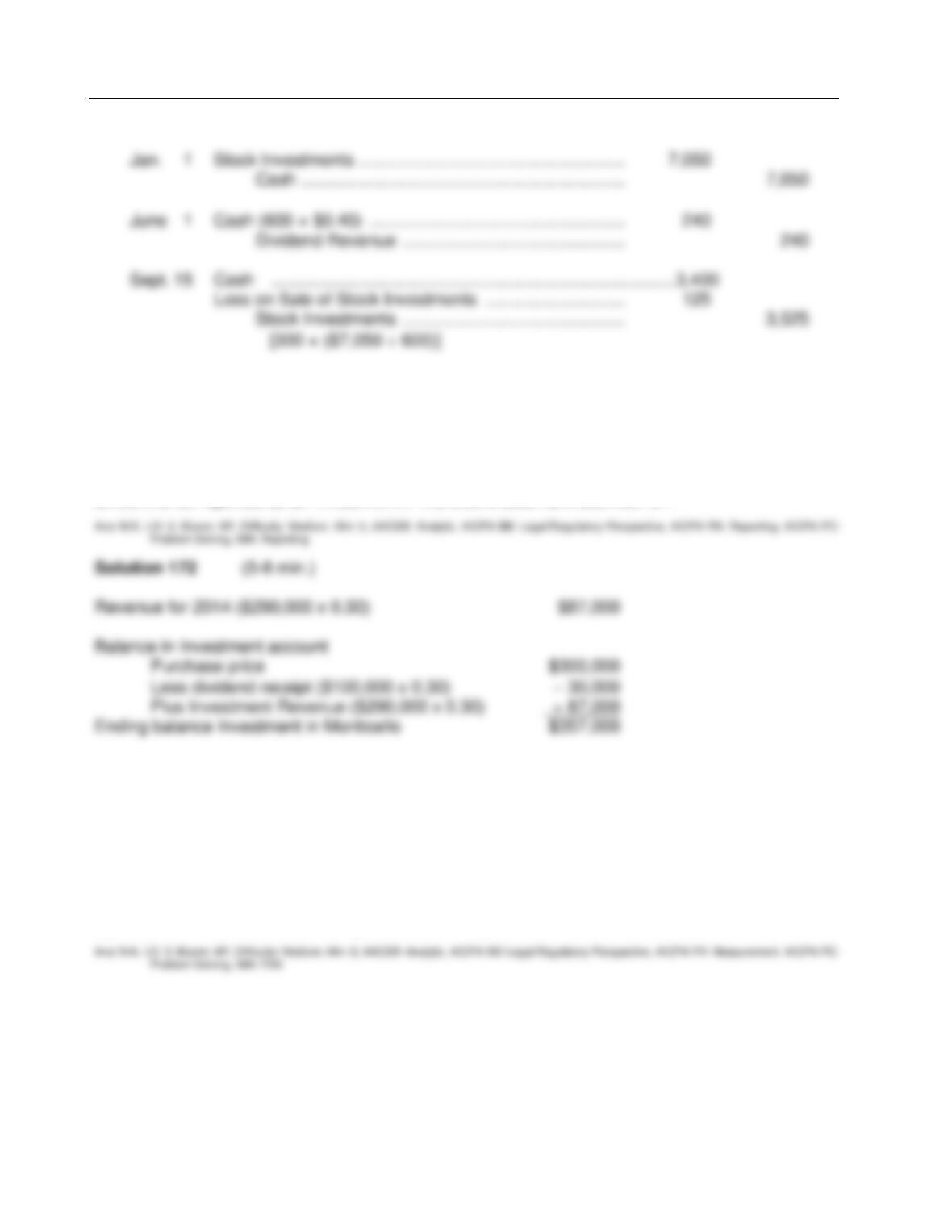
The following transactions were made by Aquavore Company. Assume all investments are
temporary.
July 1 Purchased 400 shares of Delta Corporation common stock for $35 per share.
30 Received a cash dividend of $1.25 per share from the Delta Corporation.
Sept. 15 Sold 80 shares of Delta Corporation stock for $38 per share.
Instructions
Journalize the transactions.
Be. 171
Cupcake Company had the following transactions pertaining to its temporary stock investments.
Jan. 1 Purchased 600 shares of La Crema Company stock for $7,050 cash .
June 1 Received cash dividends of $0.40 per share on the La Crema Company stock.
Sept. 15 Sold 300 shares of the La Crema Company stock for $3,400 cash.
Instructions
Journalize the transactions.
Test Bank for Financial Accounting: Tools for Business Decision Making, Seventh Edition
FOR INSTRUCTOR USE ONLY
E-40
Solution 171 (5 min.)
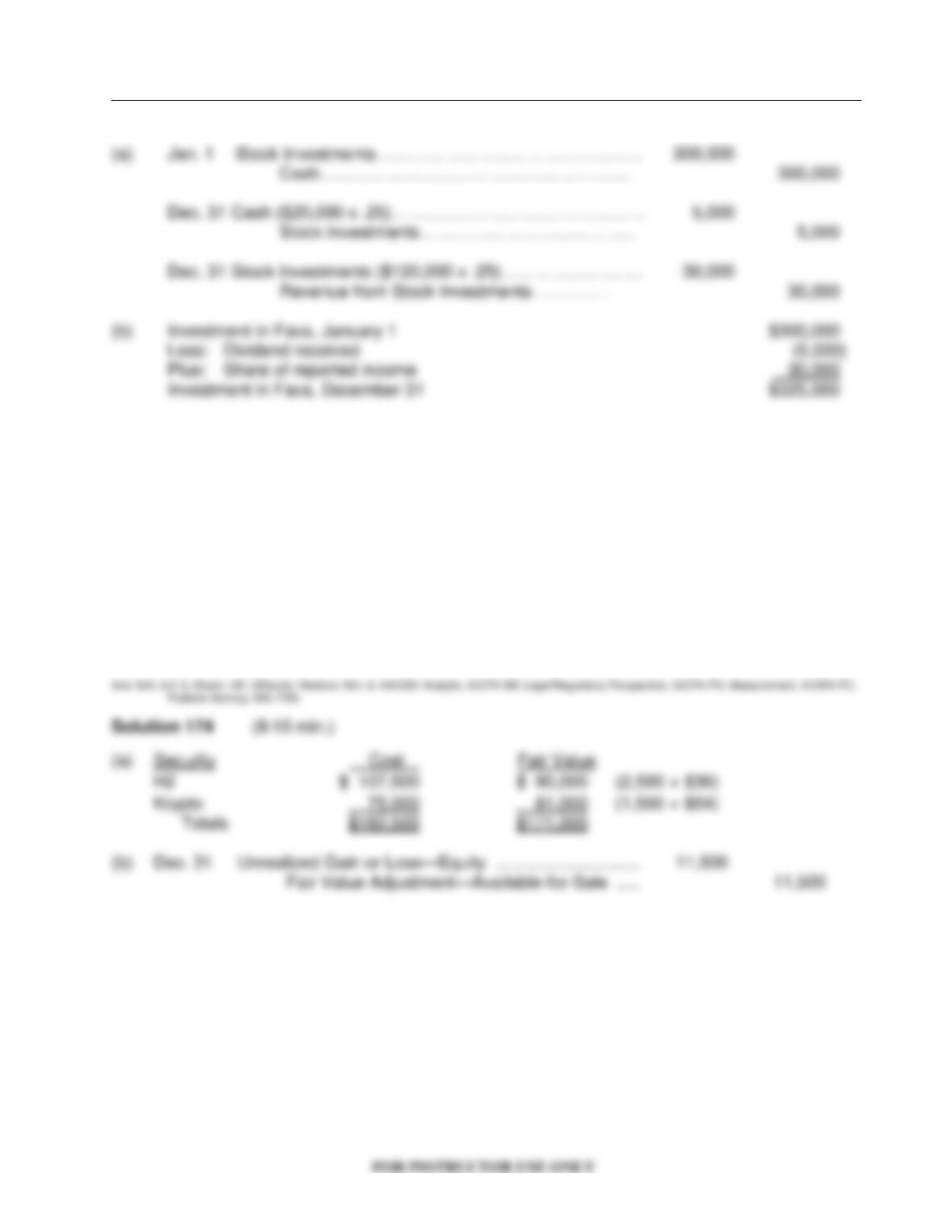
Be. 172
On January 1, 2014, Redwood Creek Company purchased 5,000 shares of Monticello Company
stock for $300,000. Redwood Creek investment represents 30 percent of the total outstanding
shares of Monticello. During 2014, Monticello paid total dividends of $100,000 and reported net
income of $290,000. What revenue does Garr report related to this investment and what is the
amount to be reported as an investment in Monticello stock at December 31.
Be. 173
On January 1, Ollinger Company purchased a 25% equity investment in Fava Company for
$300,000. At December 31 Fava declared and paid a $20,000 dividend and reported net income
of $120,000.
Instructions
(a) Journalize the transactions
(b) Determine the amount to be reported as an investment in Fava stock at December 31.
Reporting and Analyzing Investments
E-41
Solution 173 (8–12 minutes)
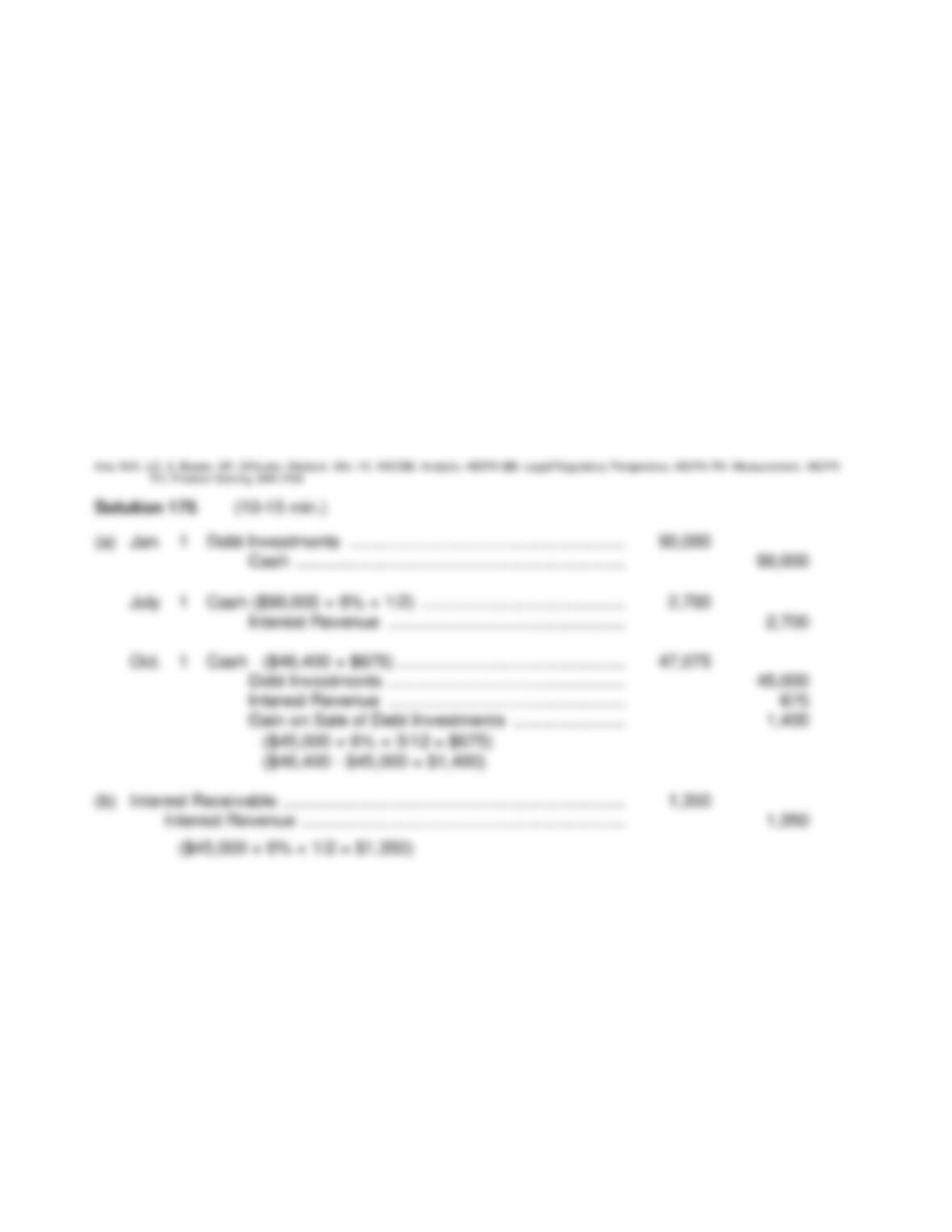
Be. 174
At January 1, 2014, the available-for-sale securities portfolio held by Darma Corporation consisted
of the following investments:
1. 2,500 shares of H2 common stock purchased for $43 per share.
2. 1,500 shares of Krypto common stock purchased for $50 per share.
At December 31, 2014, the fair values per share were H2 $36 and Krypto $54.
Instructions
(a) Prepare a schedule showing the cost and fair value of the portfolio at December 31, 2014.
(b) Prepare the adjusting entry to report the portfolio at fair value at December 31, 2014.
Test Bank for Financial Accounting: Tools for Business Decision Making, Seventh Edition
FOR INSTRUCTOR USE ONLY
E-42
EXERCISES
Ex. 175
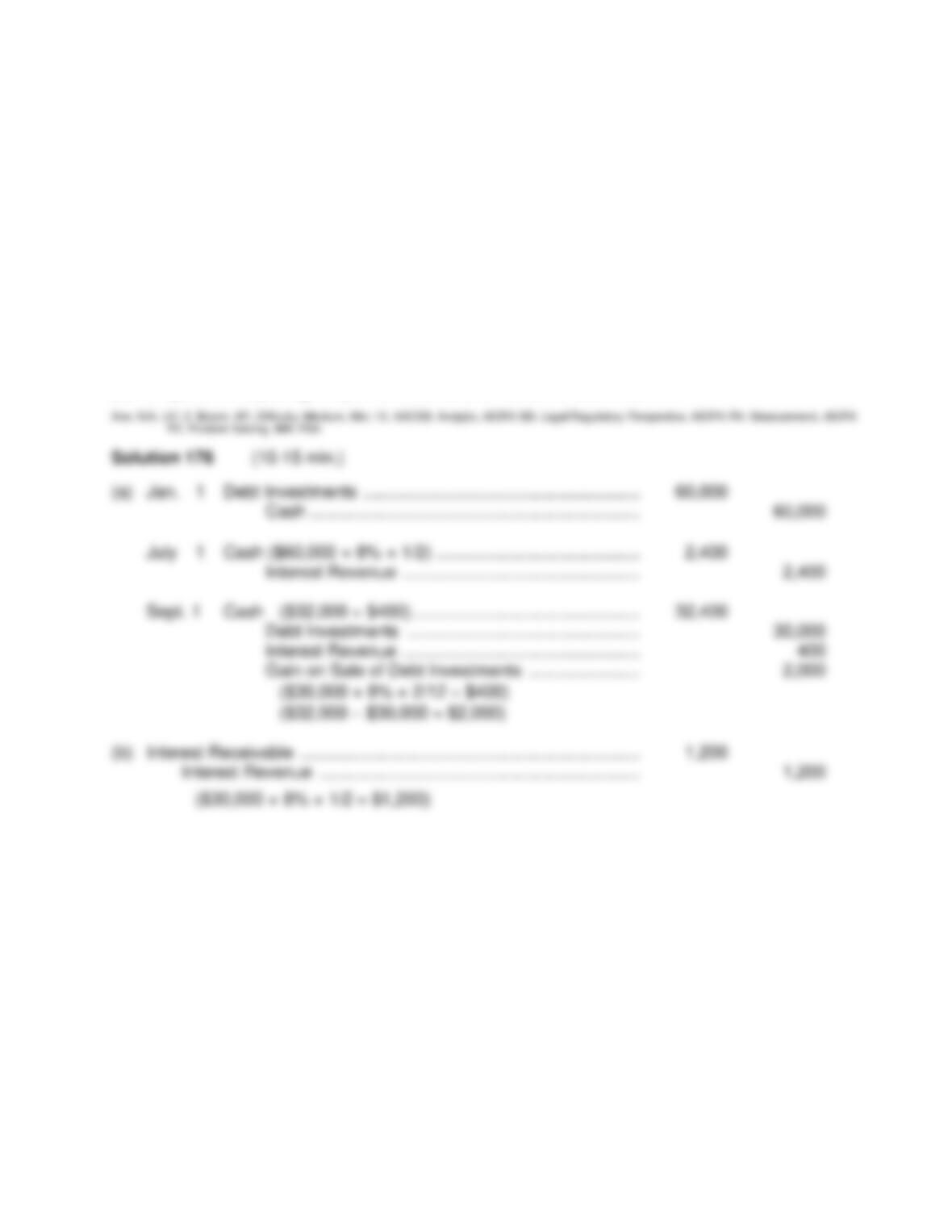
Le Tourneau Company had the following transactions pertaining to debt securities held as a I
short – term investment.
Jan. 1 Purchased 90, 6%, $1,000 Lido Company bonds for $90,000 cash. Interest is payable
semiannually on July 1 and January 1.
July 1 Received semiannual interest on Lido Company bonds.
Oct. 1 Sold 45 Lido Company bonds for $46,400 plus accrued interest.
Instructions
(a) Journalize the transactions.
(b) Prepare the adjusting entry for the accrual of interest on December 31.
Reporting and Analyzing Investments
FOR INSTRUCTOR USE ONLY
E-43
Ex. 176
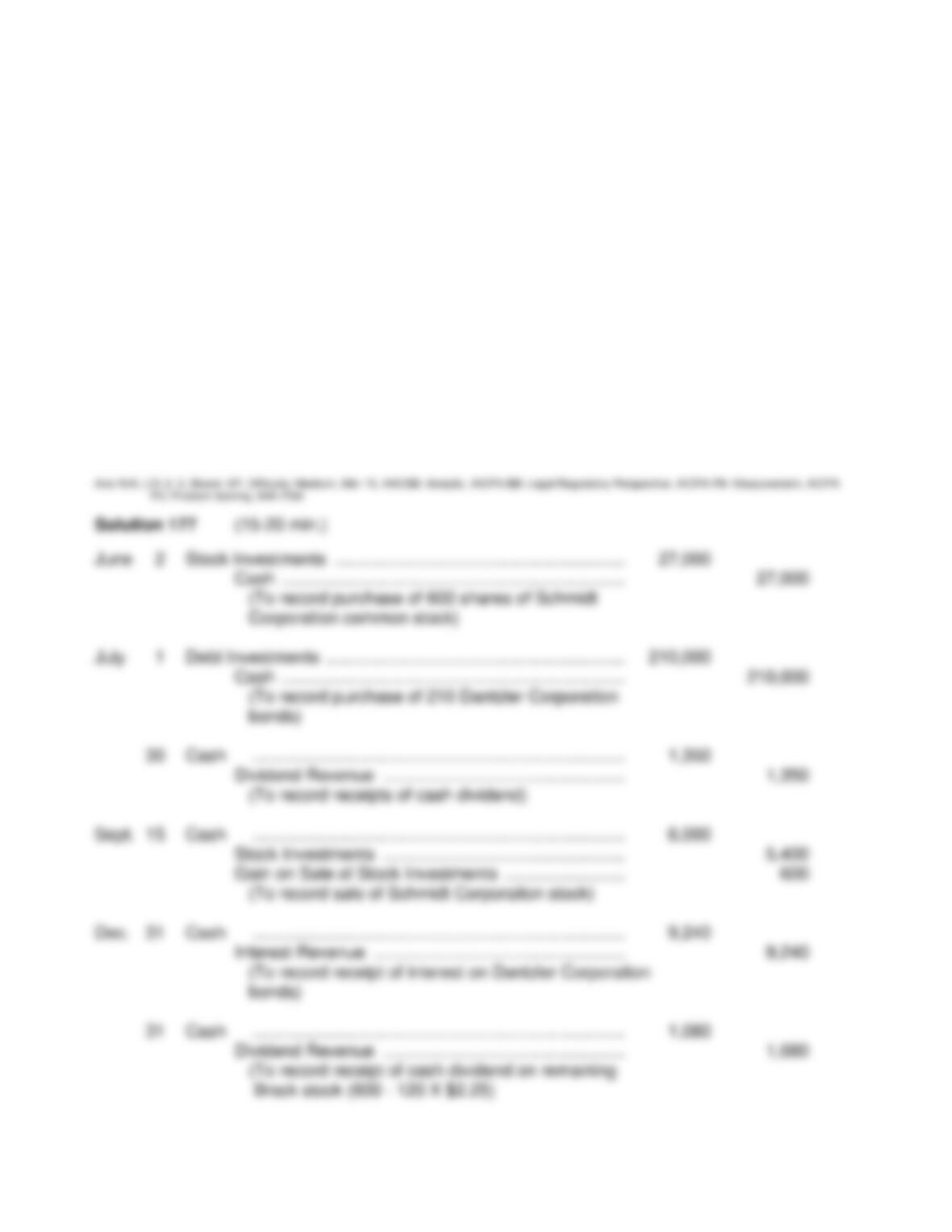
Trafton Company had the following transactions pertaining to debt securities held as an
investment.
Jan. 1 Purchased 60, 8%, $1,000 Hammond Company bonds for $60,000 cash. Interest is
payable semiannually on July 1 and January 1.
July 1 Received semiannual interest on Hammond Company bonds.
Sept. 1 Sold 30 Hammond Company bonds for $32,000 plus accrued interest.
Instructions
(a) Journalize the transactions.
(b) Prepare the adjusting entry for the accrual of interest on December 31.
Test Bank for Financial Accounting: Tools for Business Decision Making, Seventh Edition
FOR INSTRUCTOR USE ONLY
E-44
Ex. 177
The following transactions were made by Coral Company. Assume all investments are short-term.
June 2 Purchased 600 shares of Schmidt Corporation common stock for $45 per share.
July 1 Purchased 210 Dantzler Corporation bonds for $210,000.
30 Received a cash dividend of $2.25 per share from the Schmidt Corporation.
Sept. 15 Sold 120 shares of Schmidt Corporation stock for $50 per share.
Dec. 31 Received semiannual interest check for $9,240 from the Dantzler Corporation.
31 Received a cash dividend of $2.25 per share from the Schmidt Corporation.
Instructions
Journalize the transactions.
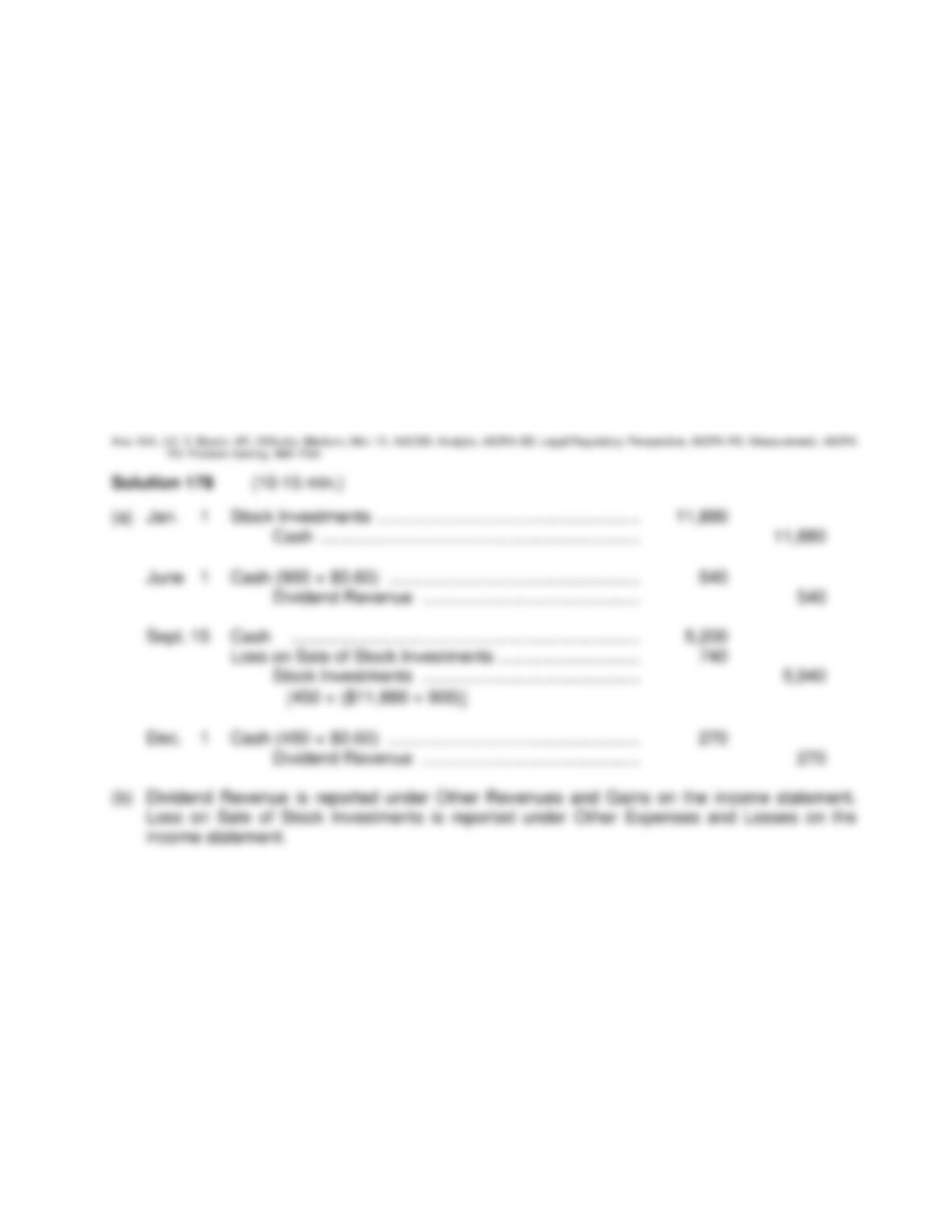
Reporting and Analyzing Investments
FOR INSTRUCTOR USE ONLY
E-45
Ex. 178
Eaton Company had the following transactions pertaining to its short-term stock investments.
Jan. 1 Purchased 900 shares of Stafford Company stock for $11,880 cash.
June 1 Received cash dividends of $0.60 per share on the Stafford Company stock.
Sept. 15 Sold 450 shares of the Stafford Company stock for $5,200.
Dec. 1 Received cash dividends of $0.60 per share on the Stafford Company stock.
Instructions
(a) Journalize the transactions.
(b) Indicate the income statement effects of the transactions.
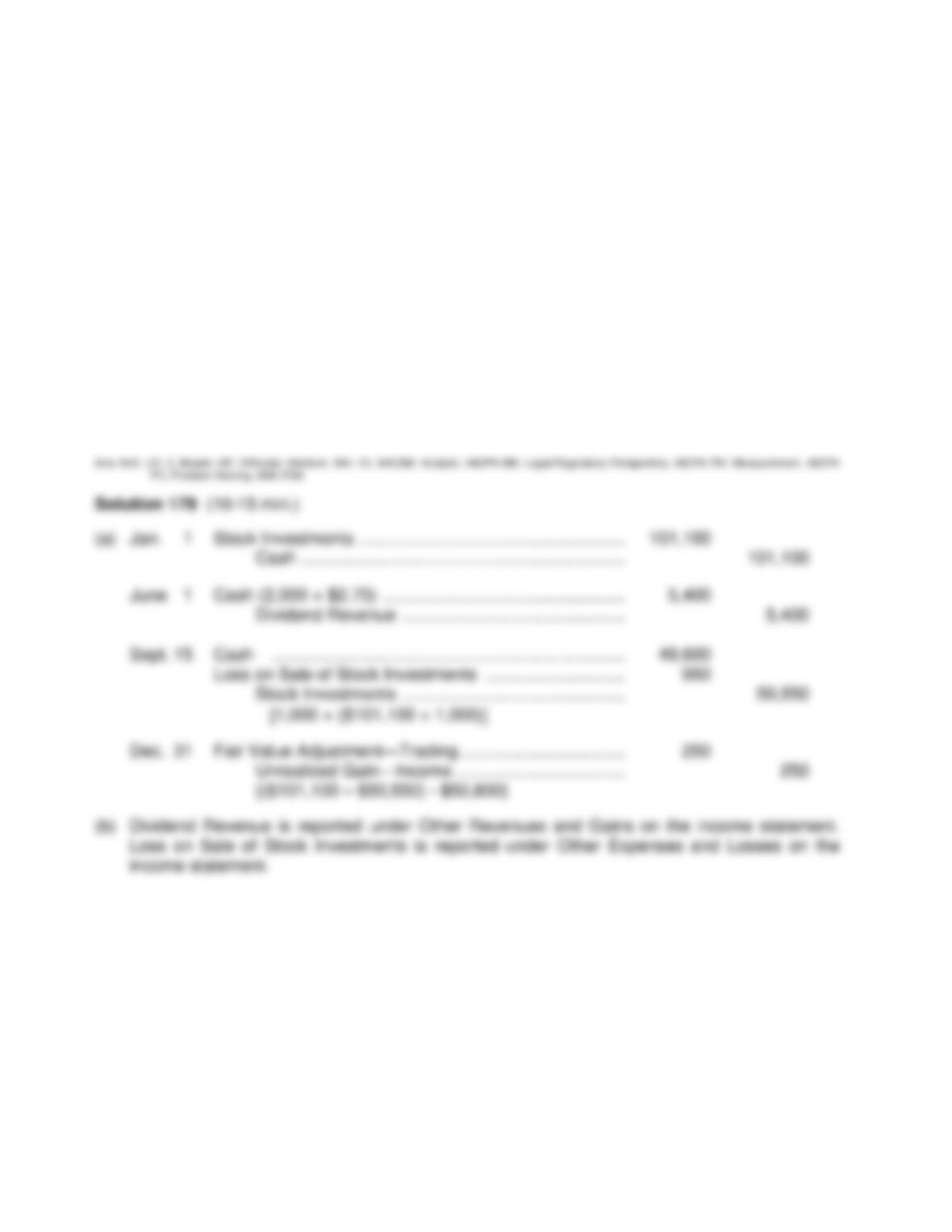
Test Bank for Financial Accounting: Tools for Business Decision Making, Seventh Edition
FOR INSTRUCTOR USE ONLY
E-46
Ex. 179
Grafton Company had the following transactions pertaining to its short-term stock investments.
Jan. 1 Purchased 2,000 shares of Hortez Company stock for $101,100 cash.
June 1 Received cash dividends of $2.70 per share on the Hortez Company stock.
Sept. 15 Sold 1,000 shares of the Hortez Company stock for $49,600.
Dec. 31 The fair values of the securities were $50,800. Prepare the adjusting entry to report
the portfolio at fair value.
Instructions
(a) Journalize the transactions.
(b) Indicate the income statement effects of the transactions.
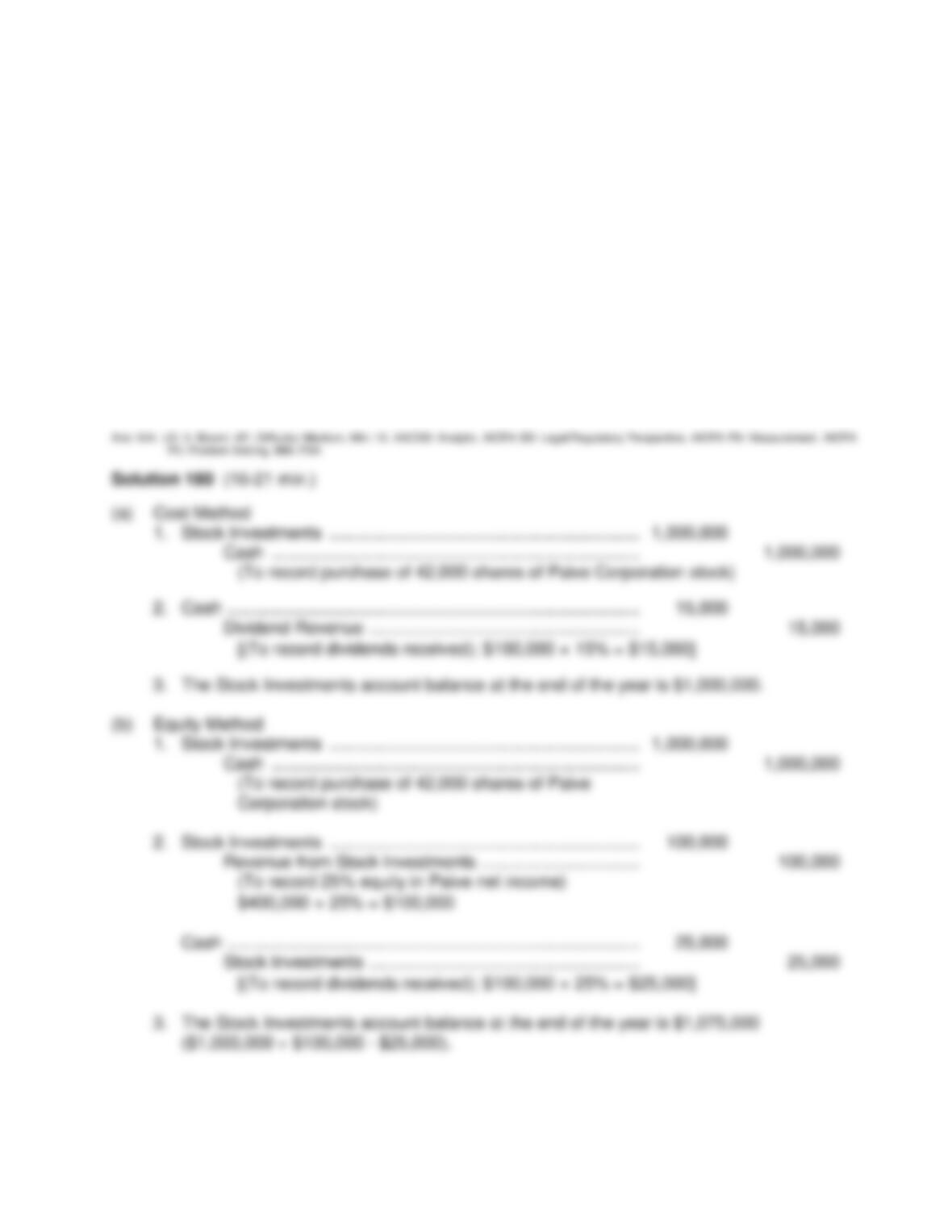
Reporting and Analyzing Investments
FOR INSTRUCTOR USE ONLY
E-47
Ex. 180
Crespo Company purchased 42,000 shares of common stock of the Paive Corporation as an
investment for $1,000,000. During the year, Paive Corporation reported net income of $400,000
and paid dividends of $100,000.
Instructions
(a) Assuming that the 42,000 shares represent a 15% interest in Paive Corporation:
1. Prepare the journal entry to record the investment in Paive stock.
2. Prepare any entries that Crespo Company should make in accounting for its investment
in Paive stock during the year.
3. What is the balance of the Stock Investments account on Crespo Company’s books at
the end of the year?
(b) Repeat requirement (a) above except assume that the 42,000 shares represent a 25%
interest in Paive Corporation.
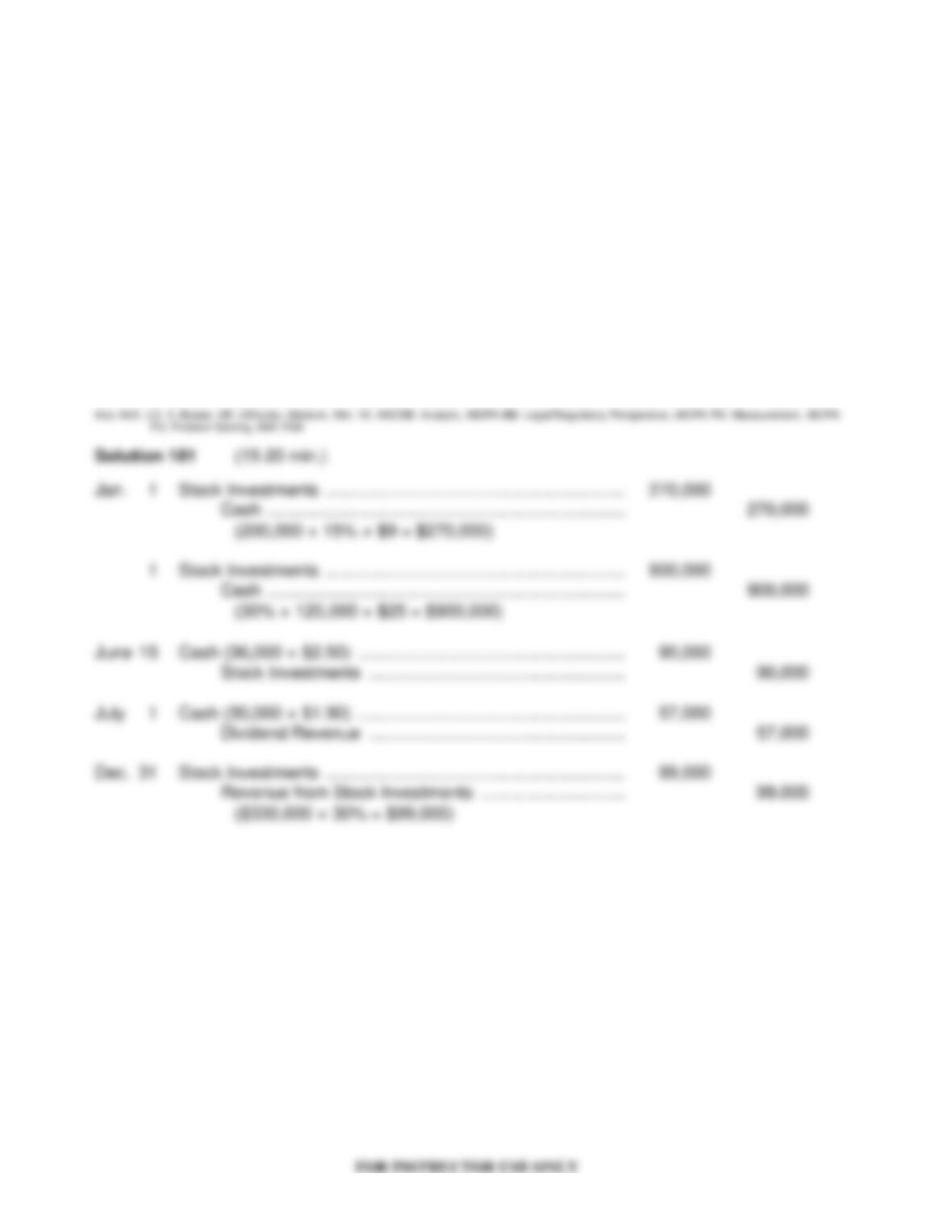
Test Bank for Financial Accounting: Tools for Business Decision Making, Seventh Edition
E-48
Ex. 181
Information pertaining to stock investments in 2012 by Com-ex Corporation follows:
Acquired 15% of the 200,000 shares of common stock of Buffalo Company at a total cost of $9 per
share on January 1, 2014. On July 1, Buffalo Company declared and paid a cash dividend of
$1.90 per share. On December 31, Bufflo reported net income was $675,000 for the year.
Obtained significant influence over Eta Company by buying 30% of Eta’s 120,000 outstanding
shares of common stock at a total cost of $25 per share on January 1, 2014. On June 15, Eta
Company declared and paid a cash dividend of $2.50 per share. On December 31, Eta‘s reported
net income was $330,000.
Instructions
Prepare all necessary journal entries for 2012 for Com-ex Corporation.
Reporting and Analyzing Investments
FOR INSTRUCTOR USE ONLY
E-49
Ex. 182
Sandafor Company had these transactions pertaining to stock investments:
Feb 1 Purchased 2,400 shares of BFF common stock (2% of outstanding shares) for
$16,500 cash.
July 1 Received cash dividends of $0.80 per share on BFF common stock.
Sept. 1 Sold 800 shares of BFF common stock for $7,900
Dec. 1 Received cash dividends of $.80per share on BFF common stock.
Instructions
Journalize the transactions.
Ex. 183
PWAT Inc. had these transactions pertaining to investments in common stock:
Jan 1 Purchased 2,000 shares of Pasco Corporation common stock (5% of outstanding
shares) for $96,500 cash.
July 1 Received a cash dividend of $1.70 per share.
Dec. 1 Sold 800 shares of Pasco Corporation common stock for $40,200.
31 Received a cash dividend of $1.70 per share.
Instructions
Journalize the transactions.
Test Bank for Financial Accounting: Tools for Business Decision Making, Seventh Edition
FOR INSTRUCTOR USE ONLY
E-50
Solution 183 (8 min.)
Ex. 184
Ultra Cosmetics acquired 10% of the 200,000 shares of common stock of Kardashian Fashion at a
total cost of $14 per share on March 18, 2014. On June 30 Kardashian declared and paid a
$96,000 dividend. On December 31 Kardashian reported net income of $244,000 for the year. At
December 31 the market price of Kardashian Fashion was $16 per share. The stock is classified
as available-for-sale.
Instructions
Prepare all the necessary entries for 2014 for Ultra Cosmetics.
Ex. 185
La Bouisse Inc. obtained significant influence over E-Stock Corporation by buying 40% of E-Stock
30,000 outstanding shares common stock at a total cost of $11 per share on January 1, 2014. On
June 15 E-Stock declared and paid a cash dividend of $32,000. On December 31 E-Stock
reported a net income of $120,000 for the year.
Instructions
Prepare all the necessary journal entries for 2014 for La Bouisse Inc.
Reporting and Analyzing Investments
FOR INSTRUCTOR USE ONLY
E-51
Solution 185 (5 min.)
Ex. 186
Cantor Corporation’s balance sheet at December 31, 2013, showed the following:
Short-term investments, at fair value $46,500
Cantor Corporation’s trading portfolio of stock investments consisted of the following at December
31, 2013:
Investment Number of Shares Cost
Interstate Common Stock 200 $30,000
Danforth Preferred Stock 400 6,000
Georgin Common Stock 300 9,000
$45,000
During 2014, the following transactions took place:
Feb. 5 Sold 50 shares of Interstate common stock for $7,900.
Mar. 30 Purchased 25 shares of Georgia common stock for $850.
Sept. 9 Purchased 50 shares of Georgia common stock for $2,000.
At year end on December 31, 2014, the fair values per share were:
Market Value Per Share
Interstate Common Stock $151.00
Danforth Delta Preferred Stock $ 13.00
Georgin Common Stock $ 33.00
Instructions
(a) Prepare the journal entries to record the 2014 stock transactions.
(b) On December 31, 2014, prepare any adjusting entry that might be necessary relative to the
trading portfolio.
(c) Show how the stock investments will appear on Cantor Corporation’s balance sheet at
December 31, 2014.
Test Bank for Financial Accounting: Tools for Business Decision Making, Seventh Edition
FOR INSTRUCTOR USE ONLY
E-52
Solution 186 (15-20 min.)
Ex. 187
On January 5, 2012, JBC Company purchased the following stock investments:
300 shares Getz Corporation common stock for $4,800.
500 shares Keller Corporation common stock for $10,000.
600 shares R-tel Corporation common stock for $18,000.
Assume that JBC Company cannot exercise significant influence over the activities of the investee
companies and that the cost method is used to account for the investments.
On June 30, 2014, JBC Company received the following cash dividends:
Getz Corporation…………………………………… $2.00 per share
Keller Corporation ………………………………… $3.00 per share
R-tel Corporation ………………………………….. $1.50 per share
On November 15, 2014, JBC Company sold 100 shares of R-tel Corporation common stock for
$3,600.
Reporting and Analyzing Investments
FOR INSTRUCTOR USE ONLY
E-53
Ex. 187 (Cont.)
On December 31, 2014, the fair value of the securities held by JBC Company is as follows:
Per Share
Getz Corporation common stock $12
Keller Corporation common stock 16
R-tel Corporation common stock 33
Instructions
Prepare the appropriate journal entries that the JBC Company should make on the following
dates:
January 5, 2014
June 30, 2014
November 15, 2014
December 31, 2014
Test Bank for Financial Accounting: Tools for Business Decision Making, Seventh Edition
FOR INSTRUCTOR USE ONLY
E-54
Ex. 188
Santos Corporation has the following trading portfolio of stock investments as of December 31,
2013.
Security Cost Fair Value
A $17,000 $16,000
B 23,000 25,000
C 32,000 28,000
$72,000 $69,000
On January 22, 2014, Santos Corporation sold security C for $30,000.
Instructions
(a) Prepare the adjusting entry for Santos Corporation on December 31, 2013 to report the
portfolio at fair value.
(b) Indicate the balance sheet and income statement presentation of the fair value data for the
Santos Corporation at December 31, 2013.
(c) Prepare the journal entry for the 2014 sale.
Ex. 189
King George Company has these data at December 31, 2014:
Securities Cost Fair Value
Trading $110,000 $119,000
Available-for-sale 100,000 95,000
The available-for-sale securities are held as a long-term investment.
Reporting and Analyzing Investments
E-55
Ex. 189 (Cont.)
Instructions
(a) Prepare the adjusting entries to report each class of securities at fair value.
(b) Indicate the statement presentation of each class of securities and the related unrealized
gain (loss) accounts.
COMPLETION STATEMENTS
190. The purchase of a company in the same industry that does the same activity is called a
______________ acquisition.
191. Debt investments are investments in government and _____________ bonds.
192. When an investor owns between 20% and 50% of the common stock of a corporation, it is
generally presumed that the investor has _______________ influence over the investee
and therefore, the appropriate method of accounting for this type of investment is the
_______________ method.
Test Bank for Financial Accounting: Tools for Business Decision Making, Seventh Edition
E-56
193. Under the cost method, dividends received from an investee company are credited to the
_______________ account, whereas under the equity method, dividends received from an
investee company are credited to the _______________ account.
194. At the beginning of the year, Dynamite Corporation acquired 15% of Tuesday Company
common stock for $600,000. Tuesday Company reported net income for the year of
$60,000 and paid $20,000 cash dividends during the year. The balance of the Stock
Investments account on the books of the Dynamite Corporation at the end of the year
should be $______________.
195. A company that owns more than 50% of the common stock of another company is known
as the ______________ company and _____________ financial statements are usually
prepared.
196. _______________ securities are bought and held primarily for sale in the near future.
197. Fair Value Adjustment is a valuation ____________ account, which is _______________
to (from) the cost of the investments.
198. At the end of an accounting period, if the fair value of the trading portfolio is less than its
cost, then the company should recognize an ______________ that is reported on the
_________________.
199. An unrealized loss on trading securities is reported under Other ____________________
in the income statement.
200. An unrealized gain or loss on available-for-sale securities is reported as a separate
component of _________________.
201. Short-term investments are securities that are _____________ and ______________ to be
converted into cash within the next year.
Reporting and Analyzing Investments
FOR INSTRUCTOR USE ONLY
E-57
Answers to Completion Statements
MATCHING
202. Match the items below by entering the appropriate code letter in the space provided.
A. Available-for-sale securities F. Consolidated financial statements
B. Subsidiary company G. Controlling interest
C. Equity method H. Fair Value Adjustment
D. Unrealized Gain or Loss—Equity I. Vertical acquisition
E. Fair value J. Long-term investments
____ 1. Valuation allowance account.
____ 2. Amount for which a security could be sold.
____ 3. Ownership of more than 50% of another company’s common stock.
____ 4. Securities that may be sold in the future.
____ 5. Investments that are not readily marketable.
____ 6. Financial statements that present the assets and liabilities controlled by the parent and
the aggregate profitability of the affiliated companies.
____ 7. The Stock Investments account is adjusted for net income and dividends received.
____ 8. Purchase of a company in the same industry but involved in a different activity.
____ 9. Entity whose stock is owned by the parent company.
____ 10. An account that is reported in the stockholders’ equity section.
Answers to Matching
Test Bank for Financial Accounting: Tools for Business Decision Making, Seventh Edition
FOR INSTRUCTOR USE ONLY
E-58
SHORT-ANSWER ESSAY QUESTIONS
S-A E 203
1. What are the reasons that corporations invest in securities?
Solution 203
S-A E 204
(a) When should a long-term investment in common stock be accounted for by the equity
method?
(b) When is revenue recognized under the equity method?
S-A E 205
If a company has a stock investment that is properly accounted for by the equity method, what will
be the effect on the financial statements when they receive a dividend from its investee?
S-A E 206
Distinguish between the cost and equity methods of accounting for investments in stocks.
Reporting and Analyzing Investments
FOR INSTRUCTOR USE ONLY
E-59
S-A E 207
A consolidated balance sheet reports the financial position of two or more legal entities just as if
they were one reporting unit. Explain why all the individual items appearing on the separate
balance sheets of each of the affiliated companies cannot be added together to arrive at a
consolidated total for each item.
S-A E 208
The Fair Value Adjustment account is a balance sheet account. Identify the asset account it is
related to. Explain how this account is increased and describe the procedure followed when its
related asset account is disposed of.
S-A E 209
When a year-end adjustment is made to reduce the trading securities portfolio to market, what
effect, if any, will the adjustment have on the balance sheet and the income statement?
Test Bank for Financial Accounting: Tools for Business Decision Making, Seventh Edition
FOR INSTRUCTOR USE ONLY
E-60
S-A E 210
When a year-end adjustment is made to reduce the available-for-sale securities portfolio to
market, what effect, if any, will the adjustment have on the balance sheet and the income
statement?
S-A E 211 (Ethics)
High Country Stables, Inc., operates several dog-racing tracks throughout the United States.
Since most facilities are outdoor tracks only, most of the cash receipts for High Country are
received from April through October. These funds are usually invested in temporary, very liquid
investments, such as stocks and bonds. Among the stocks purchased last year, was Vendable,
Inc. a company specializing in automatic vending equipment.
The company decided not to sell its Vendable stock at the end of last year, and has purchased
more of the stock this year. The company intends to continue to purchase stock until it holds
enough to make a takeover bid for the company. The accountants have been instructed to
continue to classify the investment as temporary until the takeover is accomplished, so that less
attention will be directed to it. (Presently, High Country has no long-term investment in stock at
all.)
Required:
1. Is it ethical for High Country to attempt to take over another company? Explain.
2. Is it ethical for High Country to leave its investment in the temporary investment category?
Explain.
Reporting and Analyzing Investments
FOR INSTRUCTOR USE ONLY
E-61
S-A E 212 (Communication)
Kalyn Gise is the daughter of Mark Gise, the founder and president of Carolina Blue Sky
Enterprises. She has been working in various departments during school vacations throughout
high school. She burst into the accounting department excitedly one morning. She said that the
stock price of several of the firm’s temporary investments are up, and that her father said that the
company had made over $10,000 because of this jump in stock prices. She asks to see how the
increase is recorded. It is a very busy time in the accounting department, and so her question is
deferred.
Required:
Prepare a brief note to answer Kalyn question.