Appendix D – Investments
69. For accounting purposes, the method used to account for investments in common stock is determined by
a.
the amount paid for the stock by the investor
b.
whether the acquisition of the stock by the investor was “friendly” or “hostile”
c.
the extent of an investor’s influence over the operating and financial affairs of the investee
d.
whether the stock has paid dividends in past years
70. An investor purchased 500 shares of common stock, $25 par, for $19,250. Subsequently, 100 shares were sold for $35
per share. What is the amount of gain or loss on the sale?
a.
$3,500 gain
b.
$350 gain
c.
$350 loss
d.
$500 gain
$35 × 100 – ( $19,250 / 500) × 100 = $3,500 – $3,850 = ($350)
71. When the cost method is used to account for an investment, the carrying value of the investment is affected by
a.
the dividend distributions of the investee
b.
the periodic net income of the investee
c.
the earnings and dividend distributions of the investee
d.
neither the earnings nor the dividends of the investee
Appendix D – Investments
72. On February 12, Addison, Inc. purchased 6,000 shares of Lucas Company at $22 per share plus a $240 brokerage
fee. On August 22, Lucas paid a $0.42 dividend per share. On November 10, 4,000 shares of Lucas stock were sold for
$28 per share less a $160 brokerage fee. The journal entry to record the purchase would include a
a.
debit to Investments for $132,000
b.
credit to Cash for $132,000
c.
debit to Investments for $132,240
d.
credit to Investments for $240
73. The company whose stock is more than 50% owned by another company is called the
a.
controlling company
b.
investee company
c.
subsidiary company
d.
sibling company
74. On February 12, Addison, Inc. purchased 6,000 shares of Lucas Company at $22 per share plus a $240 brokerage
fee. On August 22, Lucas paid a $0.42 dividend per share. On November 10, 4,000 shares of Lucas stock were sold for
$28 per share less a $160 brokerage fee. The journal entry for the sale would include a
a.
debit to Cash, $111,840
b.
credit to Investments, $112,000
c.
credit to Loss on Sale, $23,680
d.
debit to Cash, $112,000
Appendix D – Investments
75. If one company owns more than 50% of the common stock of another company
a.
a partnership exists
b.
a parent-subsidiary relationship exists
c.
the company whose stock is owned must be liquidated
d.
the cost method should be used to account for the investment
76. Held-to-maturity securities
a.
are reported at fair market value
b.
include stocks as well as bonds
c.
may be reported as current or noncurrent assets
d.
all of these
77. Yankton Company began the year without an investment portfolio. During the year, it purchased investments
classified as trading securities at a cost of $13,000. At the end of the year, the market value of the securities was $11,000.
Yankton Company’s financial statements for the current year should show
a.
a loss of $2,000 on the income statement and net trading securities of $13,000 on the balance sheet
b.
no loss on the income statement and net trading securities of $13,000 on the balance sheet
c.
no loss on the income statement; net trading securities of $11,000 and an unrealized loss of $2,000 as a
stockholders’ equity adjustment on the balance sheet
d.
a loss of $2,000 on the income statement and temporary investments of $11,000 on the balance sheet
Appendix D – Investments
78. Yankton Company began the year without an investment portfolio. During the year, it purchased investments
classified as available-for-sale securities at a cost of $13,000. At the end of the year, the market value of the securities was
$11,000. Yankton Company’s financial statements for the current year should show
a.
a loss of $2,000 on the income statement and available-for-sale investments of $13,000 on the balance sheet
b.
no loss on the income statement and available-for-sale investments of $13,000 on the balance sheet
c.
no loss on the income statement; available-for-sale investments netting to of $11,000 and an unrealized loss of
$2,000 as a stockholders’ equity adjustment on the balance sheet
d.
a loss of $2,000 on the income statement and temporary investments of $11,000 on the balance sheet
Original cost of the investment = $11,000 – $13,000 = ($2,000)
79. The price that would be received to sell an asset or pay off a liability is
a.
the fair value
b.
the market value
c.
the investing value
d.
the historical value
80. The account Unrealized Gain (Loss) on Available-for-Sale Investments should be included on the
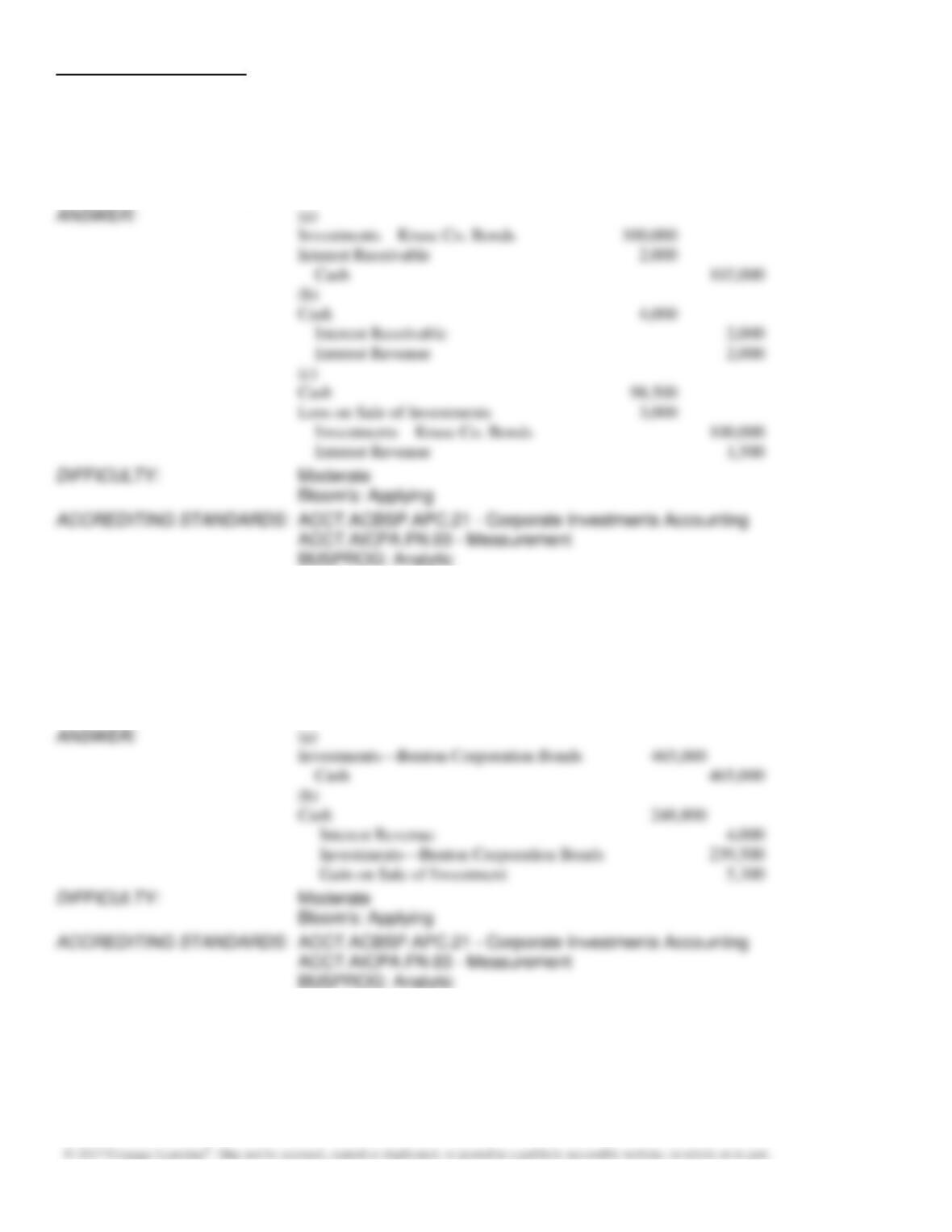
a.
income statement as other revenue (expense)
b.
balance sheet as an adjustment to the asset account
c.
balance sheet as an adjustment to stockholders’ equity
d.
statement of retained earnings
Appendix D – Investments
81. The account Unrealized Gain (Loss) on Trading Investments should be included on the
a.
income statement as other revenue (expense)
b.
balance sheet as an adjustment to the asset account
c.
balance sheet as an adjustment to stockholders’ equity
d.
statement of retained earnings
82. The Valuation Allowance for Trading Investments account is found on the
a.
income statement as other revenue (expense)
b.
balance sheet as an adjustment to the asset account
c.
balance sheet as an adjustment to stockholders’ equity
d.
statement of retained earnings
83. Held-to-maturity securities
a.
are reported at their fair market value on the balance sheet date
b.
include both stocks and bonds
c.
are primarily purchased to earn interest revenue
d.
all are correct
Appendix D – Investments
84. On January 1, Butte Company’s Valuation Allowance for Trading Investments account has a debit balance of
$23,200. On December 31, the cost of the trading securities portfolio was $80,000. The fair value was $98,000. Which
of the following would Butte report on the income statement for the current year?
a.
an unrealized loss on trading investments, $5,200
b.
an unrealized gain on trading investments, $5,200
c.
an unrealized gain on trading investments, $18,000
d.
an unrealized loss on trading investments, $18,000
Unrealized gain / (loss) on trading investments = $18,000 – $23,200 = ($5,200)
85. Trading securities are
a.
reported at fair value on the balance sheet and as unrealized gains or losses on the income statement
b.
not reported on the balance sheet
c.
reported as unrealized gains or losses on the income statement
d.
reported at fair value on the balance sheet
86. GAAP requires trading and available-for-sale investments to be recorded
a.
at their fair value
b.
at their historical cost
c.
at their market value
d.
at their net realizable value
Appendix D – Investments
87. Changes in the value of available-for-sale securities
a.
are reported as part of stockholders’ equity
b.
are recognized on the income statement
c.
are not recognized
d.
are recognized on the income statement and as part of stockholders’ equity
DIFFICULTY:
Easy
Bloom’s: Remembering
ACCREDITING STANDARDS:
ACCT.ACBSP.APC.21 – Corporate Investments Accounting
ACCT.AICPA.FN.03 – Measurement
BUSPROG: Analytic
88. Financial statements include assets listed at
a.
all of these
b.
their fair value
c.
their historical cost
d.
their market value
Match each of the definitions that follow with the appropriate investment term (a–j).
a.
debt securities
b.
equity securities
c.
investor
d.
investee
e.
cost method
f.
trading securities
g.
available-for-sale securities
h.
held-to-maturity securities
i.
equity method
j.
business combination
DIFFICULTY:
Easy
Bloom’s: Remembering
ACCREDITING STANDARDS:
ACCT.ACBSP.APC.21 – Corporate Investments Accounting
ACCT.AICPA.FN.03 – Measurement
BUSPROG: Analytic
Appendix D – Investments
89. debt and equity securities purchased and sold to earn short-term profits from changes in the market price
90. preferred and common stock that represent ownership in a company and do not have a fixed maturity date
91. the method of reporting an investment that represents less than 20% of the outstanding stock of another company
92. when using this, dividends are treated as a reduction of the investment
93. notes and bonds that pay interest and have a fixed maturity
94. debt investments that a company intends to keep until their maturity date
95. securities not held for trading or to maturity or other strategic reasons
96. the company investing in another company’s stock
97. what occurs when a company purchases 50% or more of another company’s stock
98. the company whose stock is purchased by another entity
Match each of the definitions that follow with the appropriate investment term (a–i).
a.
equity method
b.
parent company
c.
subsidiary company
d.
consolidated financial statements
e.
fair value
f.
unrealized gain or loss on investments.
g.
valuation allowance for investments
h.
amortized cost
i.
cost method
DIFFICULTY:
Easy
Bloom’s: Remembering
ACCREDITING STANDARDS:
ACCT.ACBSP.APC.21 – Corporate Investments Accounting
ACCT.ACBSP.APC.23 – Financial Statement Analysis
ACCT.AICPA.FN.03 – Measurement
ACCT.AICPA.FN.04 – Reporting
BUSPROG: Analytic
Appendix D – Investments
99. a corporation owning all or the majority of the voting stock of another corporation
100. a balance sheet account where the fair value adjustment for investments is reported
101. a corporation controlled by another corporation that owns all or the majority of its voting stock
102. the method for accounting for investments of 20–50% in another company’s stock
103. the market price that would be received if an investment were sold
104. combined reporting of a corporation and other corporations it controls
105. recognition of changes in the fair value of short-term investments
106. the value assigned to held-to-maturity securities
107. appropriate method for accounting for small stock investments
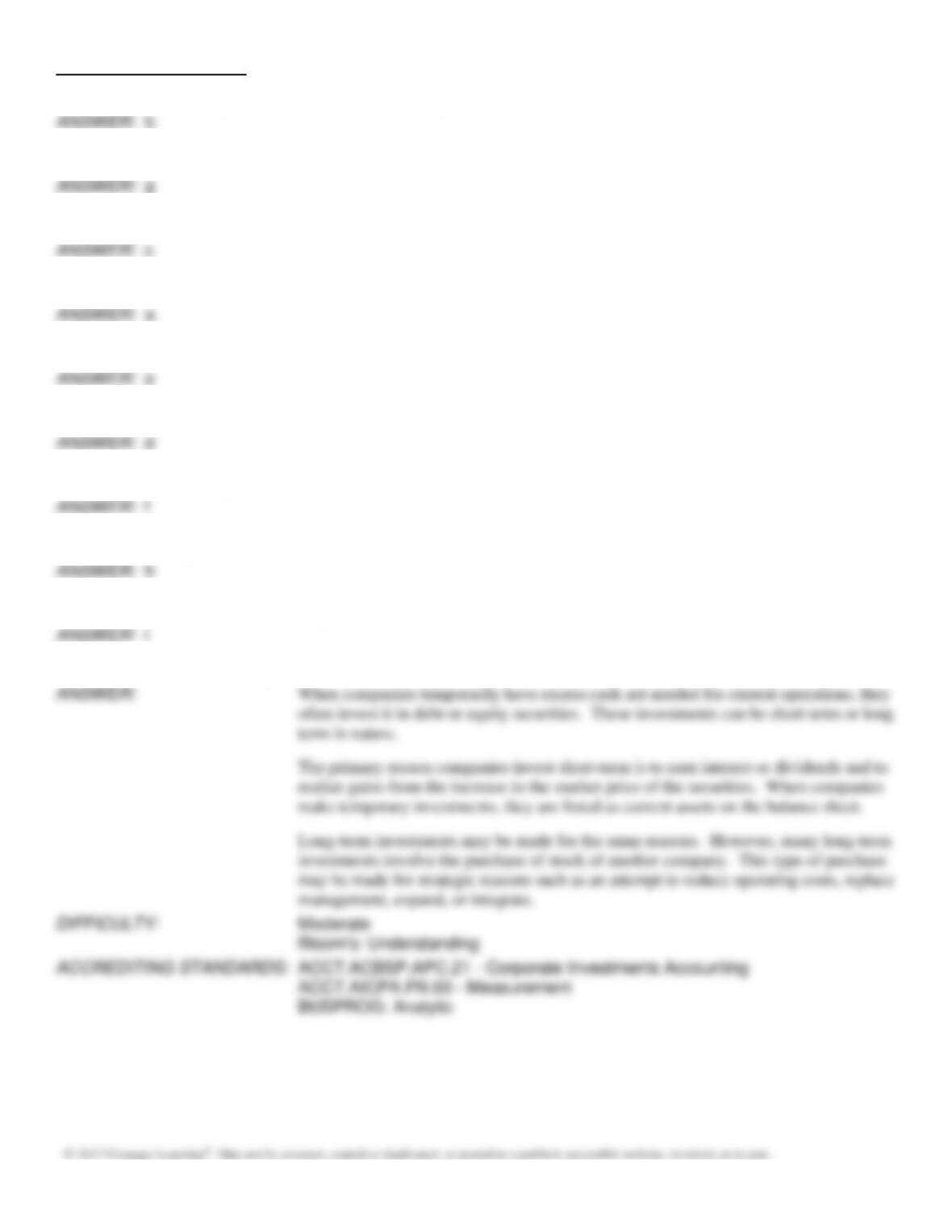
108. Compare and contrast why companies invest cash in short-term temporary investments vs. long-term investments.
Appendix D – Investments
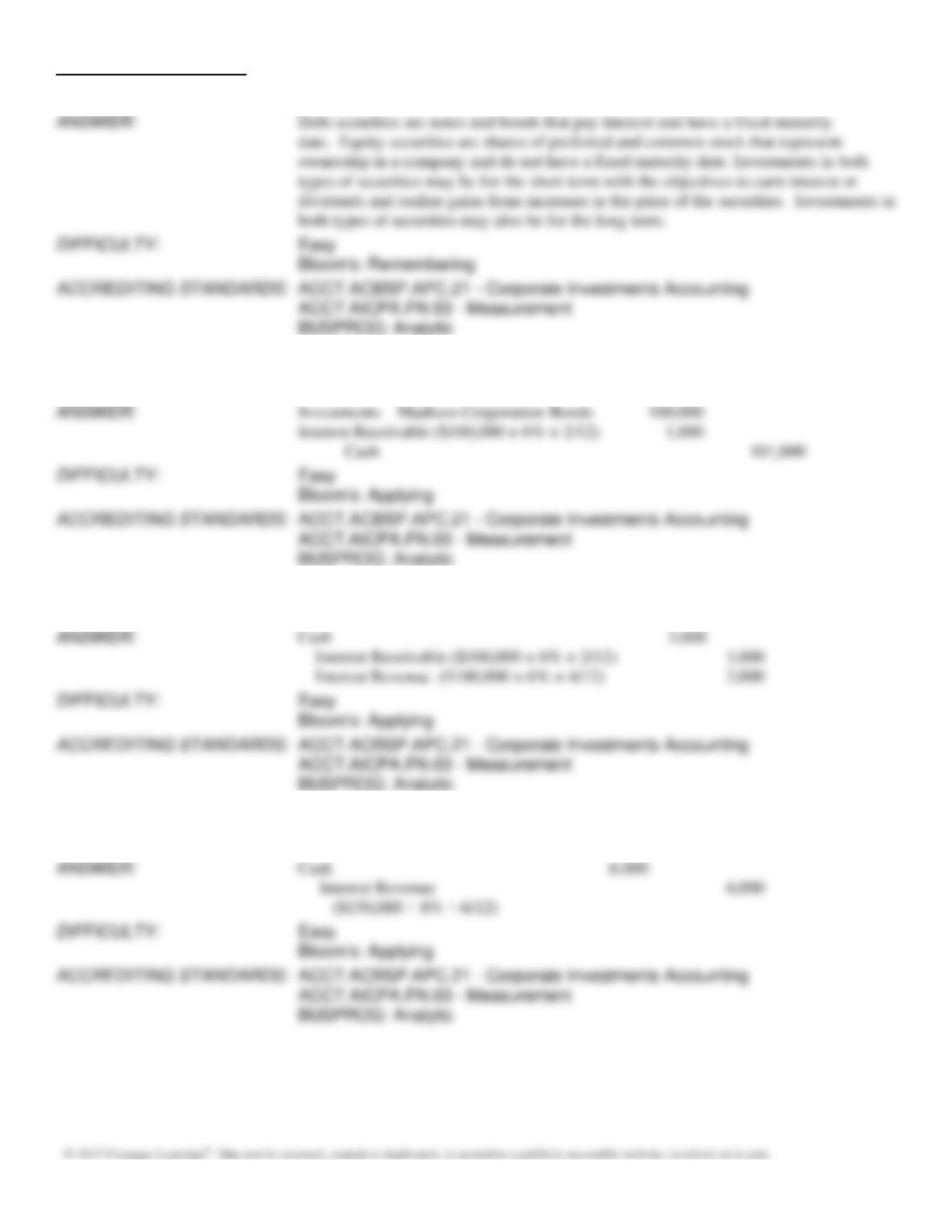
109. Define debt securities and equity securities. Include their similarities and differences in your discussion.
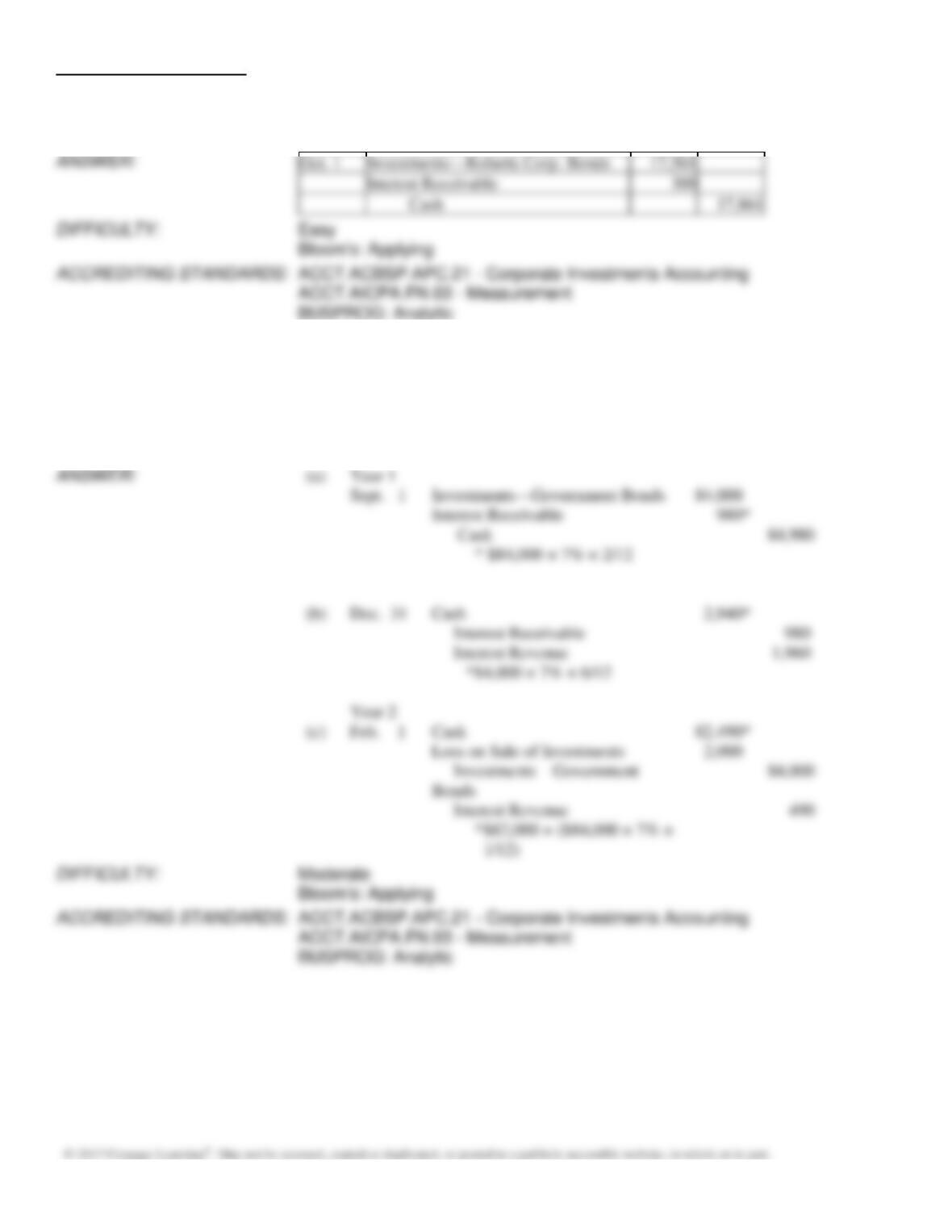
110. On May 1, Knox Inc. purchases $100,000 of 10-year, 6% Madison Corporation bonds dated March 1 at 100 plus
accrued interest. What entry would Knox record when purchasing the bonds?
111. On May 1, Cedar Inc. purchases $100,000 of 10-year, Madison Corporation 6% bonds dated March 1 at 100 plus
accrued interest. What entry would Cedar record when receiving its semiannual interest on September 1?
112. On May 1, Cedar Inc. purchases $150,000 of 10-year, Knox Corporation 8% bonds dated March 1 at 100 plus
accrued interest. What entry would Cedar record when receiving its semiannual interest on March 1?
Appendix D – Investments
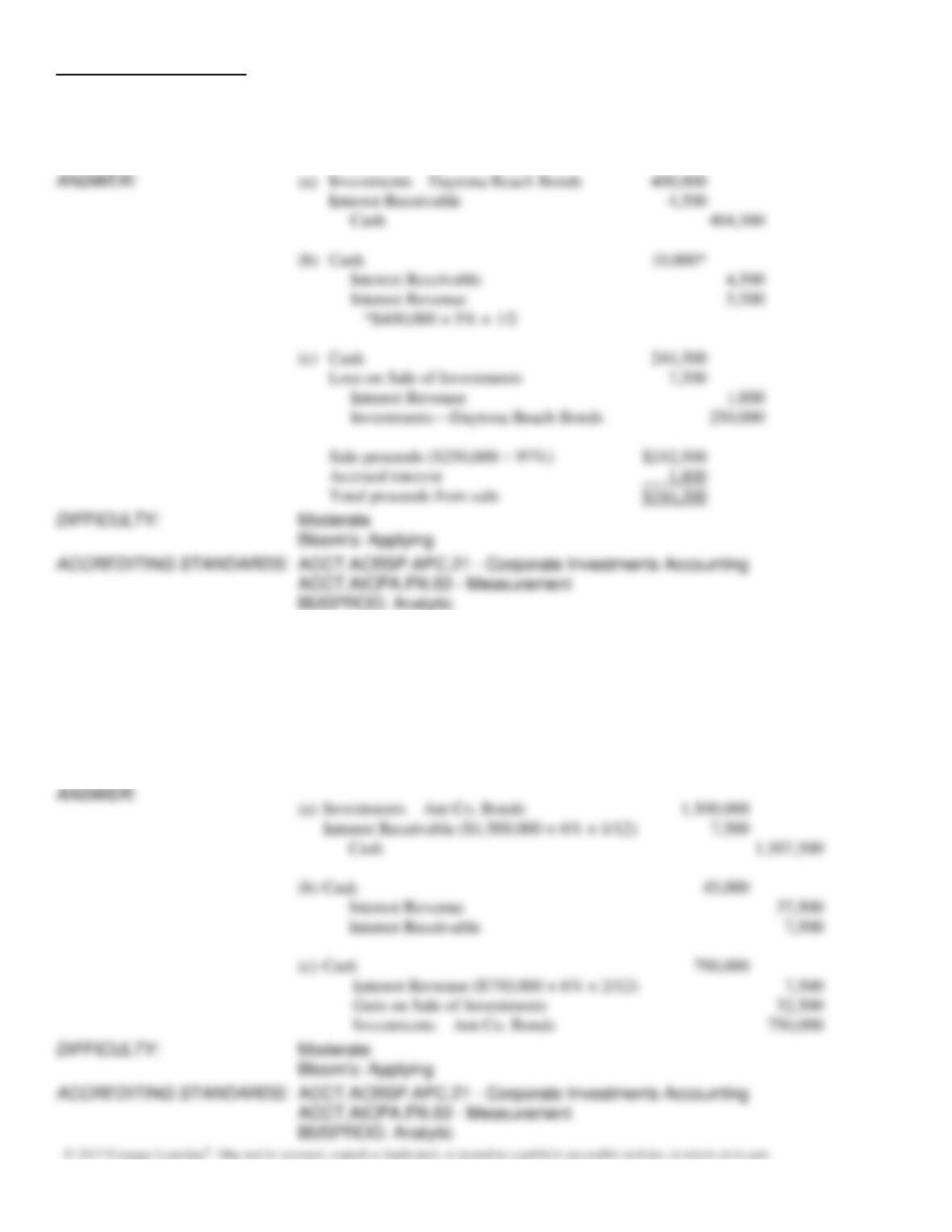
113. On October 1, Marcus Corporation purchased $20,000 of 6% bonds of Roberts Corporation, due in 8 1/2 years. The
bonds were purchased at a price of $17,561 plus interest of $300 accrued from July 1, the date of the last semiannual
interest payments. Journalize the purchase.
Oct. 1
Investments—Roberts Corp. Bonds
Interest Receivable
114. On September 1, Parsons Company purchased $84,000, 10-year, 7% government bonds at 100 plus accrued interest.
The semi-annual interest payment dates are June 30 and December 31. Interest calculations are done by the month.
(a)
Journalize the entry to record the bond purchase.
(b)
Journalize the receipt of interest on December 31 of the first year.
(c)
Journalize the sale of the bonds on February 1 of the second year for $82,000
plus accrued interest.
Appendix D – Investments
115. Journalize the entries to record the following selected bond investment transactions for Southwest Bank:
(a)
Purchased $400,000 of Daytona Beach 5% bonds at 100 plus accrued interest of $4,500.
(b)
Received the first semiannual interest.
(c)
Sold $250,000 of the bonds at 97, plus accrued interest of $1,800.
(a)
Investments—Daytona Beach Bonds
Interest Receivable
Cash
(b)
Cash
Interest Receivable
Interest Revenue
(c)
Cash
Loss on Sale of Investments
Interest Revenue
Investments—Daytona Beach Bonds
Sale proceeds ($250,000 × 97%)
$242,500
Accrued interest
Total proceeds from sale
$244,300
116. On August 1, Year 1, Ant Company sold Bee Company $1,500,000 of 10-year, 6% bonds, dated July 1 at 100 plus
accrued interest. On March 1, Year 2, Bee sold half of the bonds for $782,500 plus accrued interest. Present entries to
record the following transactions:
Bee Company:
(a)
Purchase of bonds on August 1, Year 1.
(b)
Receipt of first semiannual interest amount on December 31, Year 1.
(c)
The sale of the bonds on March 1, Year 2.
(a)
Investments—Ant Co. Bonds
Interest Receivable ($1,500,000 × 6% × 1/12)
(b)
Cash
Interest Receivable
(c)
Cash
Interest Revenue ($750,000 × 6% × 2/12)
Gain on Sale of Investments
Investments—Ant Co. Bonds
Appendix D – Investments
117. Journalize the entries to record the following selected transactions of Oliver Co.:
(a)
Purchased $100,000 of Kruse Co. 8% bonds at par value plus accrued interest of $2,000.
(b)
Received first semiannual interest payment.
(c)
Sold the bonds at 97 plus accrued interest of $1,500.
Investments—Kruse Co. Bonds
Interest Receivable
Cash
Cash
Loss on Sale of Investments
118. Albright Company purchased as a long-term investment $500,000 of Benton Corporation 10-year, 9%
bonds. Present entries to record the following selected transactions:
(a)
Purchased bonds at 93 for $465,000.
(b)
Sold half the bonds at 98 plus accrued interest of $4,000. The broker deducted $200 for
brokerage fees and taxes, remitting the balance. The bonds were carried at $479,000 at the
time of the sale.
Investments—Benton Corporation Bonds
Cash
Cash
Interest Revenue
Investments—Benton Corporation Bonds