Appendix D – Investments
1. Most companies invest excess cash in bonds as investments in order to profit long-term from the growth of the
investment.
a.
True
b.
False
2. As with other assets, the cost of a bond investment includes all costs related to the purchase.
a.
True
b.
False
3. If the bonds are purchased between interest dates, the purchase price includes accrued interest since the last interest
payment.
a.
True
b.
False
4. When a bond is purchased for an investment, the purchase price, minus the brokerage commission, plus any accrued
interest is recorded.
a.
True
b.
False
Appendix D – Investments
5. The amount of interest paid when buying a bond as an investment should be credited to Interest Revenue.
a.
True
b.
False
6. To record a bond investment made between interest payment dates, Investment in Bonds would be debited and Cash
and Interest Revenue would be credited.
a.
True
b.
False
7. When long-term investments in bonds are sold before their maturity date, the seller deducts any accrued interest since
the last interest payment date from the selling price.
a.
True
b.
False
8. If the proceeds from the sale of bond investments exceed the balance of the investment amount, a gain is realized.
a.
True
b.
False
Appendix D – Investments
9. Any gains or losses on the sale of bonds normally would be reported in the Other revenue (loss) section of the income
statement.
a.
True
b.
False
10. An equity investment in less than 20% of another company’s stock is accounted for using the cost method.
a.
True
b.
False
11. Ordinarily, a corporation owning a significant portion of the voting stock of another corporation accounts for the
investment using the equity method.
a.
True
b.
False
12. The investor carrying an investment by the equity method records cash dividends received as an increase in the
carrying amount of the investment.
a.
True
b.
False
Appendix D – Investments
13. Accounting for the sale of stock is the same for both the cost and the equity methods of accounting for investments.
a.
True
b.
False
14. The corporation owning all or a majority of the voting stock of another corporation is known as the parent company.
a.
True
b.
False
15. When a corporation owns less than 20% of the stock of another company, dividends received are not treated as
income.
a.
True
b.
False
16. The financial statements resulting from combining parent and subsidiary statements are called consolidated
statements.
a.
True
b.
False
Appendix D – Investments
17. It is not possible for one company to influence the operating policies of another company unless it owns more than
50% interest in that company.
a.
True
b.
False
18. The equity method is usually more appropriate for accounting for investments where the purchaser does not have
significant influence over the investee.
a.
True
b.
False
19. When bonds held as long-term investments are purchased at a price other than the face value, the premium or discount
should be amortized over the remaining life of the bonds.
a.
True
b.
False
20. Held-to-maturity securities are reported on the balance sheet at fair market value.
a.
True
b.
False
Appendix D – Investments
21. Held-to-maturity securities maturing beyond a year are reported as noncurrent assets.
a.
True
b.
False
22. Trading securities should be reported on the financial statements at fair market value.
a.
True
b.
False
23. Investments in bonds that management intends to hold to maturity are called trading securities.
a.
True
b.
False
24. Investment in Bonds is reported on the balance sheet at lower of cost or market.
a.
True
b.
False
Appendix D – Investments
25. Investment in Bonds is listed on the balance sheet after Bonds Payable.
a.
True
b.
False
26. Temporary investments are recorded at their cost, which would include broker’s commissions.
a.
True
b.
False
27. Trading securities are reported on the balance sheet at cost.
a.
True
b.
False
28. Any difference between the fair market values of the securities and their cost is a realized gain or loss.
a.
True
b.
False
Appendix D – Investments
29. Unrealized gains and losses on trading securities are not included in the calculation of income from operations.
a.
True
b.
False
30. Investments in stocks that are expected to be held for the long term are listed in the stockholder’s equity section of the
balance sheet.
a.
True
b.
False
31. In order to maintain a record of the original cost of a trading security, the fair value adjustments are debited or credited
to the account Valuation Allowance for Trading Investments.
a.
True
b.
False
32. Generally accepted accounting principles (GAAP) require the use of fair value accounting for all assets and liabilities.
a.
True
b.
False
Appendix D – Investments
33. Temporary investments
a.
are reported as current assets
b.
include cash equivalents
c.
do not include equity securities
d.
all are correct
34. Which of the following is not a reason to invest excess cash in temporary investments?
a.
earn interest revenue
b.
influence the operations of another company
c.
receive dividends
d.
realize gains from the increase in market value of the securities
35. The primary objectives of investing in temporary investments is to
a.
all of these
b.
realize gains from increases in market price of the securities
c.
receive dividends
d.
earn interest revenue
36. Long-term investments are held for all of the listed reasons below except
a.
to earn the interest or dividend income
b.
for their long-term gain potential
c.
to have influence over another business entity
d.
to meet current cash needs
Appendix D – Investments
37. Temporary investments such as in trading securities are
a.
recorded at cost but reported at fair market value
b.
recorded at cost and reported at cost
c.
recorded at cost but reported at lower of cost or fair market value
d.
recorded at fair market value and reported at fair market value
38. On June 1, $50,000 of treasury bonds were purchased between interest dates. The broker commission was $500. The
bonds pay interest at 12%, which is paid semiannually on January 1 and July 1. What is the total cost to be debited to the
Investment—Treasury Bonds account?
a.
$50,000
b.
$50,500
c.
$49,500
d.
$53,000
39. On June 1, $40,000 of treasury bonds were purchased between interest dates. The broker commission was $600. The
bonds pay interest at 12%, which is paid semiannually on January 1 and July 1. How much interest revenue will be
recorded on July 1?
a.
$400
b.
$406
c.
$2,000
d.
$2,400
Appendix D – Investments
40. Ruben Company purchased $100,000 of Evans Company bonds at 100 plus $1,500 in accrued interest. The bond
interest rate is 8% and interest is paid semiannually. The journal entry to record the purchase would be
a.
debit Investment—Evans Company Bonds, $101,500; credit Cash, $101,500
b.
debit Investment—Evans Company Bonds, $100,000; credit Interest Revenue, $1,500, and Cash, $98,500
c.
debit Investment—Evans Company Bonds, $100,000, and Interest Receivable $1,500; credit Cash $101,500
d.
debit Investment—Evans Company Bonds, $100,000; credit Cash $100,000
41. Ruben Company purchased $100,000 of Evans Company bonds at 100 plus $1,500 in accrued interest. The bond
interest rate is 8% and interest is paid semiannually. The journal entry to record the receipt of interest on the next interest
payment date would be
a.
debit Cash, $4,000; credit Interest Revenue, $4,000
b.
debit Cash, $4,000; credit Interest Receivable, $4,000
c.
debit Cash, $4,000; credit Interest Receivable, $1,500, and Interest Revenue, $2,500
d.
debit Cash, $2,500; credit Interest Revenue, $2,500
Appendix D – Investments
42. Ruben Company purchased $100,000 of Evans Company bonds at 100. Ruben later sold the bonds at $104,500 plus
$500 in accrued interest. The journal entry to record the sale of the bonds would be
a.
debit Cash, $105,000; credit Investment—Evans Company Bonds, $104,500, and Interest Revenue, $500
b.
debit Cash, $105,000; credit Investment—Evans Company Bonds, $100,000, and Gain on Sale of Investments,
$5,000
c.
debit Cash, $104,500, and Interest Receivable, $500; credit Investment—Evans Company Bonds, $100,000,
Gain on Sale of Investments, $4,500, and Interest Revenue, $500
d.
debit Cash, $105,000; credit Investment—Evans Company Bonds, $100,000, Gain on Sale of Investments,
$4,500, and Interest Revenue, $500
43. Jacks Corporation purchases $200,000 bonds plus accrued interest for 2 months of $2,000 from Kennedy Company on
March 1. The bonds have an annual interest rate of 6% payable on June 30 and December 31. The entry to record the
purchase of the bonds would include a
a.
debit to Interest Receivable for $2,000
b.
debit to Investment in Bonds for $202,000
c.
debit to Cash for $200,000
d.
credit to Interest Revenue for $2,000
Appendix D – Investments
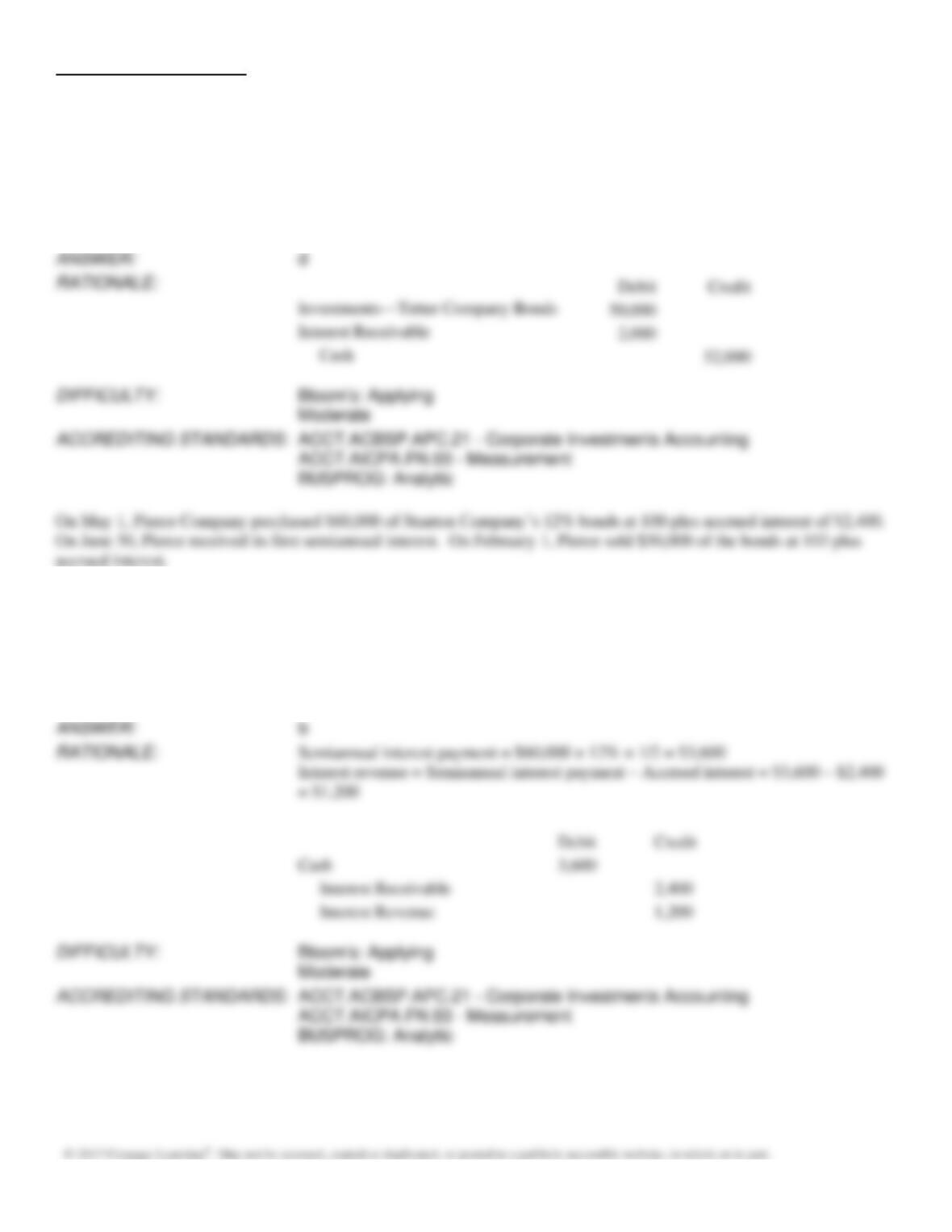
44. On April 1, Alliance Company purchased $50,000 of Tetter Company’s 12% bonds at 100 plus accrued interest of
$2,000. On June 30, Alliance received its first semiannual interest. On February 1, Alliance sold $40,000 of the bonds at
103 plus accrued interest. The journal entry Alliance will record on April 1 for the purchase of the bonds will include a
a.
credit to Interest Payable for $2,000
b.
debit to Investments—Tetter Company Bonds for $52,000
c.
debit for Cash of $50,000
d.
debit to Investments—Tetter Company Bonds for $50,000
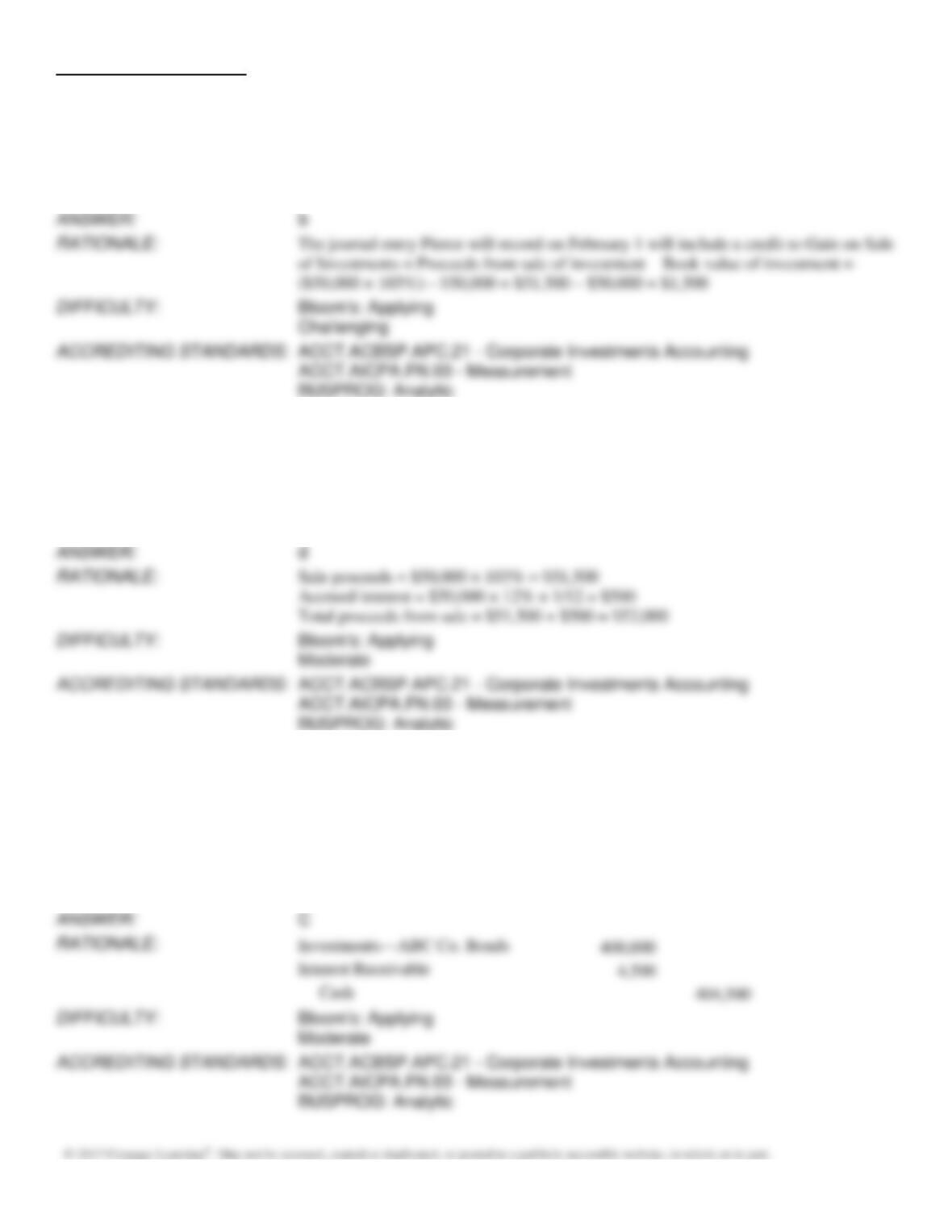
45. The journal entry Pierce will record on June 30 will include a
a.
credit to Interest Revenue for $2,400
b.
debit to Cash for $3,600
c.
credit to Cash for $2,400
d.
credit to Interest Receivable for $1,200
Appendix D – Investments
46. The journal entry Pierce will record on February 1 will include a
a.
credit to Interest Revenue for $1,500
b.
credit to Gain on Sale of Investments for $1,500
c.
credit to Cash for $52,500
d.
credit to Interest Receivable for $600
47. What are the total proceeds from the February 1 sale?
a.
$52,400
b.
$51,500
c.
$50,000
d.
$52,000
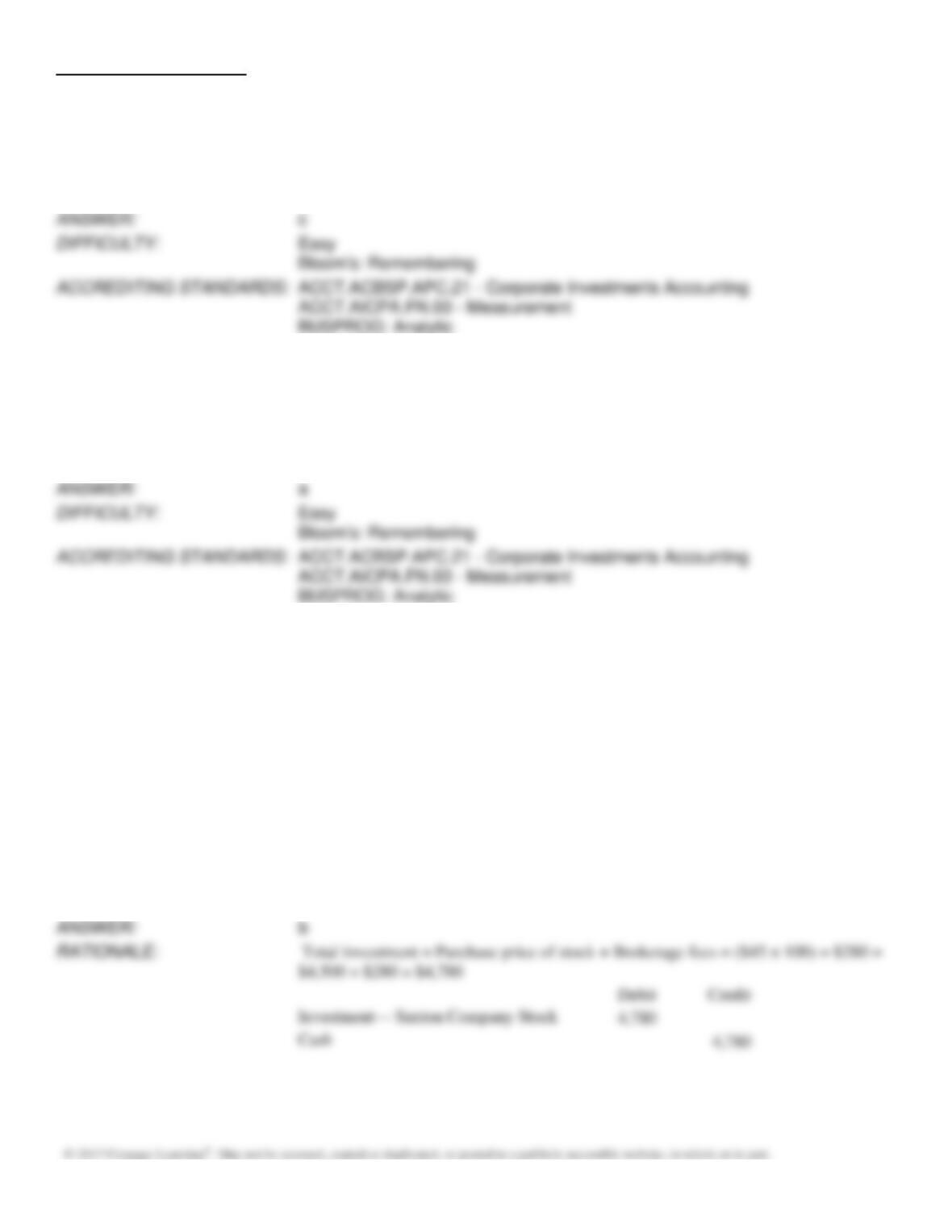
48. Alan Company purchased $400,000 of ABC Co. 5% bonds at 100 plus accrued interest of $4,500. Alan later sold
$250,000 of bonds at 97. The journal entry for the purchase would include a
a.
credit to Interest Receivable for $4,500
b.
credit to Interest Revenue for $4,500
c.
debit to Interest Receivable for $4,500
d.
debit to Interest Revenue for $4,500
Appendix D – Investments
49. Interest revenue on bonds is reported
a.
as an addition to the Investment in Bonds account
b.
as part of comprehensive income but not as part of net income
c.
as part of other revenue
d.
as part of operating income
50. Which of the following stock investments should be accounted for using the cost method?
a.
investments of less than 20%
b.
investments between 20% and 50%
c.
investments of less than 20% and investments between 20% and 50%
d.
all stock investments should be accounted for using the cost method
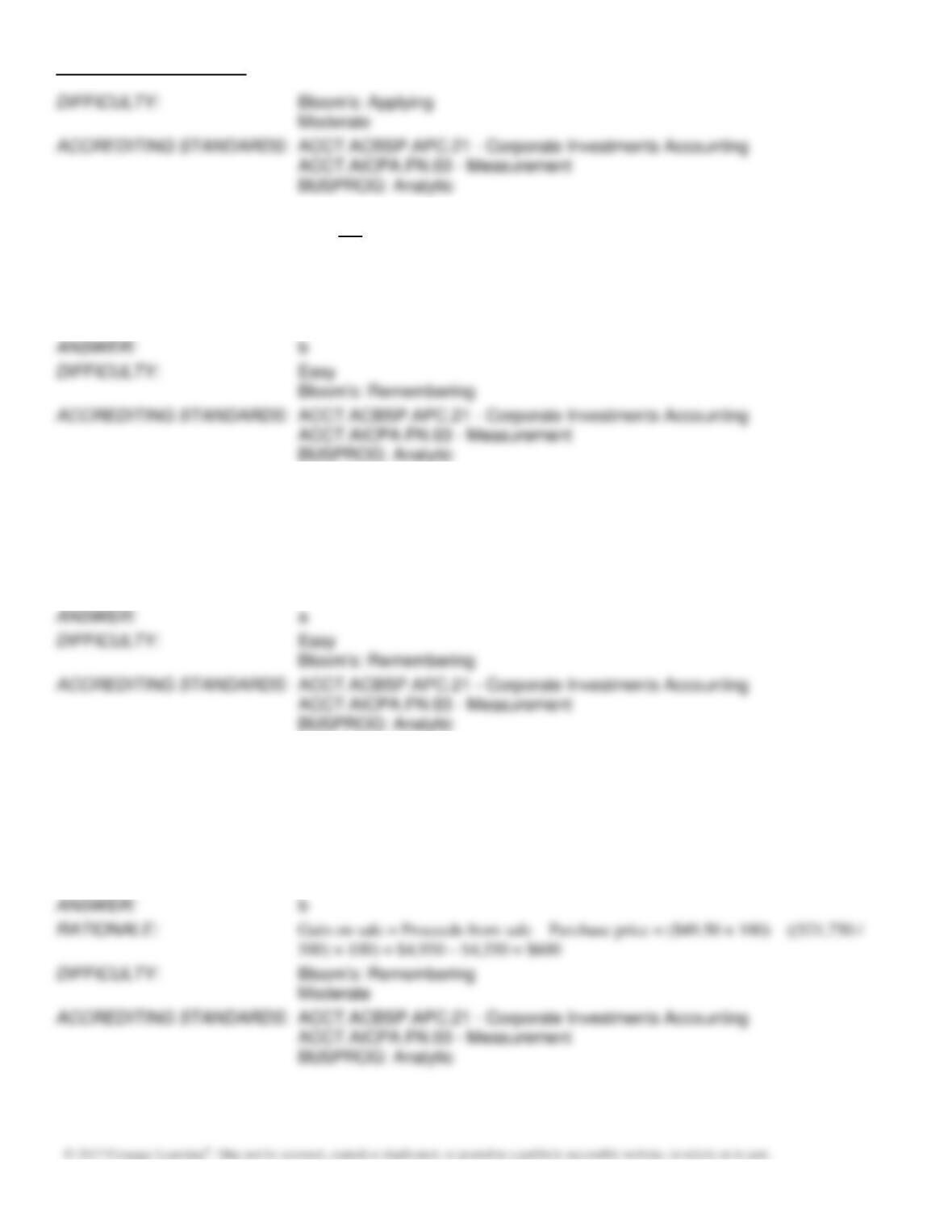
51. Jarvis Corporation makes an investment in 100 shares of Saxton Company’s common stock. The stock is purchased for
$45 a share plus brokerage fees of $280. The entry for the purchase is
a.
Cash 4,500
Investments—Saxton Company Stock 4,500
b.
Investments—Saxton Company Stock 4,780
Cash 4,780
c.
Investments—Saxton Company Stock 4,500
Brokerage Fee Expense 280
Cash 4,780
d.
Investments—Saxton Company Stock 4,500
Cash 4,500
Appendix D – Investments
52. Which of the following statements is not a reason a company may purchase another company’s stock?
a.
earning a return on excess cash
b.
sustain the other company’s stock price
c.
gaining control of another company’s operations
d.
developing or maintaining business relationships
53. The cost method of accounting for stock
a.
recognizes dividends as income
b.
is only appropriate as part of a consolidation
c.
requires the investment be increased by the reported net income of the investee
d.
requires the investment be decreased by the reported net income of the investee
54. An investor purchased 500 shares of common stock, $25 par, for $21,750. Subsequently, 100 shares were sold for
$49.50 per share. What is the amount of gain or loss on the sale?
a.
$12,750 gain
b.
$600 gain
c.
$600 loss
d.
$9,250 loss
Appendix D – Investments
55. The equity method of accounting for investments
a.
requires a year-end adjustment to revalue the stock to lower of cost or market
b.
requires the investment to be reported at its original cost
c.
requires the investment be increased by the reported net income of the investee
d.
requires the investment be increased by the dividends paid by the investee
56. Armando Company owns 17,000 of the 70,000 shares of common stock outstanding of Tito Company and exercises a
significant influence over its operating and financial policies. The investment should be accounted for by the
a.
equity method
b.
market method
c.
cost or market method
d.
cost method
57. Under the equity method, the receipt of cash dividends on an investment in common stock of Vallerio Corporation is
accounted for as a debit to Cash and a credit to
a.
Investment in Vallerio Corporation Stock
b.
Retained Earnings
c.
Dividend Revenue
d.
Dividend Receivables
58. The method of accounting for investments in equity securities in which the investor records its share of periodic net
income of the investee is the
a.
cost method
b.
market method
c.
income method
d.
equity method
Appendix D – Investments
59. When shares of stock held as an investment are sold, the difference between the proceeds and the balance of the
investment account is recorded as a(n)
a.
prior period adjustment
b.
operating income and losses
c.
paid-in capital addition
d.
gain or loss
60. Which of the following items would not affect the investor’s income for the period?
a.
interest received on a temporary investment in bonds
b.
dividends received on a long-term investment in stock where the investor owns 10% of the investee’s stock
c.
dividends received on a long-term investment in stock where the investor owns 30% of the investee’s stock
d.
interest received on a long-term investment in bonds
61. Wendell Company owns 28% of the common stock of Porter Company and accounts for the investment using the
equity method. Assuming that Wendell Company purchased the stock several years ago, the balance in the investment
account would be equal to the cost of the
a.
investment only
b.
investment plus Wendell’s share of Porter’s net income earned since the investment was purchased
c.
investment plus the total amount of dividends Wendell has received from Porter since the investment was
purchased
d.
investment plus Wendell’s share of Porter’s net income earned since the investment was purchased minus the
total amount of dividends Wendell has received from Porter since the investment was purchased
Appendix D – Investments
62. Blanton Corporation purchased 15% of the outstanding shares of common stock of Worton Corporation as a long-term
investment. Subsequently, Worton Corporation reported net income and declared and paid cash dividends. What journal
entry would Blanton Corporation use to record the dividends it receives?
a.
debit Investment in Worton Corporation; credit Cash
b.
debit Cash; credit Dividend Revenue
c.
debit Investment in Worton Corporation; credit Income of Worton Corporation
d.
debit Cash; credit Investment in Worton Corporation
63. Blanton Corporation purchased 35% of the outstanding shares of common stock of Worton Corporation as a long-term
investment. Subsequently, Worton Corporation reported net income and declared and paid cash dividends. What journal
entry would Blanton Corporation use to record the dividends it receives from Worton Corporation?
a.
debit Investment in Worton Corporation Stock; credit Cash
b.
debit Cash; credit Dividend Revenue
c.
debit Investment in Worton Corporation Stock; credit Income of Worton Corporation
d.
debit Cash; credit Investment in Worton Corporation Stock
64. Zach Company owns 45% of the voting stock of Tomas Corporation and uses the equity method in recording this
investment. Tomas Corporation reported a $20,000 net loss. Zach Company‘s entry would include a
a.
credit to cash for $9,000
b.
debit to the investment account for $9,000
c.
credit to the investment account for $9,000
d.
credit to a loss account for $9,000
Appendix D – Investments
65. Parker Company owns 83% of the outstanding stock of Tadeo Company. Parker Company is referred to as the
a.
parent
b.
minority interest
c.
affiliate
d.
subsidiary
66. Gale Company owns 87% of the outstanding stock of Leonardo Company. Leonardo Company is referred to as the
a.
parent
b.
minority interest
c.
affiliate
d.
subsidiary
Bloom’s: Remembering
67. Financial statements in which financial data for two or more companies are combined as a single entity are called
a.
conventional statements
b.
consolidated statements
c.
audited statements
d.
constitutional statements
Bloom’s: Remembering
68. In general, consolidated financial statements should be prepared
a.
when a corporation owns more than 20% and less than 40% of the common stock of another company
b.
when a corporation owns more than 50% of the common stock of another company
c.
only when a corporation owns 100% of the common stock of another company
d.
whenever the market value of the stock investment is significantly lower than its cost