FOR INSTRUCTOR USE ONLY
APPENDIX D
TIME VALUE OF MONEY
SUMMARY OF QUESTIONS BY LEARNING OBJECTIVES AND BLOOM’S
TAXONOMY
Item
LO
BT
Item
LO
BT
Item
LO
BT
Item
LO
BT
Item
LO
BT
True-False Statements
1.
1
K
5.
2
K
9.
4
K
13.
6
K
17.
7
K
2.
1
K
6.
2
K
10.
4
K
14.
6
K
18.
7
C
3.
1
K
7.
3
K
11.
5
K
15.
6
K
19.
7
K
4.
1
K
8.
3
K
12.
5
K
16.
6
K
20.
7
K
Multiple Choice Questions
21.
1
K
33.
3
AP
45.
5
AP
57.
5
AP
69.
6
AP
22.
1
K
34.
3
AP
46.
5
AP
58.
5
AP
70.
7
AP
23.
1
AP
35.
3
K
47.
5
K
59.
5
AP
71.
7
AP
24.
1
C
36.
3
AP
48.
5
AP
60.
5
AP
72.
7
K
25.
2
AP
37.
3
C
49.
5
AP
61.
6
AP
73.
7
K
26.
2
AP
38.
3
AP
50.
5
AP
62.
6
AP
74.
7
K
27.
2,3
AP
39.
3
K
51.
5
C
63.
6
AP
75.
7
K
28.
2
K
40.
4
K
52.
5
AP
64.
6
AP
76.
7
AP
29.
2
AP
41.
4
K
53.
5
AP
65.
6
K
77.
7
AP
30.
2
K
42.
4
K
54.
5
AP
66.
7
AP
78.
7
AP
31.
2
K
43.
5
AP
55.
5
AP
67.
6
AP
79.
7
AP
32.
2
AP
44.
5
AP
56.
5
AP
68.
6
AP
Brief Exercises
80.
2
AP
84.
3
AP
88.
5
AP
92.
6,7
AP
96.
7
AP
81.
2
AP
85.
3
AP
89.
5
AP
93.
6,7
AP
97.
7
AP
82.
2,3
AP
86.
5
AP
90.
6
AP
94.
7
AP
83.
2,3
AP
87.
5
AP
91.
6
AP
95.
7
AP
Completion Statements
98.
1
K
100.
3
K
102.
4
K
104.
6
K
99.
2
K
101.
3
K
103.
5
K
105.
7
K
Matching
106.
1-6
K
SUMMARY OF LEARNING OBJECTIVES BY QUESTION TYPE
Learning Objective 1
Item
Type
Item
Type
Item
Type
Item
Type
Item
Type
Item
Type
1.
TF
3.
TF
21.
MC
23.
MC
98.
C
2.
TF
4.
TF
22.
MC
24.
MC
Learning Objective 2
5.
TF
26.
MC
29.
MC
32.
MC
82.
Be
99.
C
6.
TF
27.
MC
30.
MC
80.
Be
83.
Be
25.
MC
28.
MC
31.
MC
81.
Be
Learning Objective 3
7.
TF
33.
MC
36.
MC
39.
MC
84.
Be
101.
C
8.
TF
34.
MC
37.
MC
82.
Be
85.
Be
27.
MC
35.
MC
38.
MC
83.
Be
100.
C
Test Bank for Financial Accounting: Tools for Business Decision Making, Seventh Edition
FOR INSTRUCTOR USE ONLY
D – 2
Learning Objective 4
Item
Type
Item
Type
Item
Type
Item
Type
Item
Type
Item
Type
9.
TF
10.
TF
40.
MC
41.
MC
42.
MC
102.
C
Learning Objective 5
11.
TF
46.
MC
51.
MC
56.
MC
86.
Be
12.
TF
47.
MC
52.
MC
57.
MC
87.
Be
43.
MC
48.
MC
53.
MC
58.
MC
88.
Be
44.
MC
49.
MC
54.
MC
59.
MC
89.
Be
45.
MC
50.
MC
55.
MC
60.
MC
103.
C
Learning Objective 6
13.
TF
16.
TF
63.
MC
66.
MC
69.
MC
92.
Be
14.
TF
61.
MC
64.
MC
67.
MC
90.
Be
93.
Be
15.
TF
62.
MC
65.
MC
68.
MC
91.
Be
Learning Objective 7
17.
TF
70.
MC
74.
MC
78.
MC
96.
Be
18.
TF
71.
MC
75.
MC
79.
MC
97.
Be
19.
TF
72.
MC
76.
MC
94.
Be
105.
C
20.
TF
73.
MC
77.
MC
95.
Be
Note: TF = True-False C = Completion
MC = Multiple Choice Ex = Exercise
Ma = Matching
CHAPTER LEARNING OBJECTIVES
1. Distinguish between simple and compound interest. Simple interest is computed on the
principal only while compound interest is computed on the principal and any interest earned
that has not been withdrawn.
2. Solve for future value of a single amount. Prepare a time diagram of the problem. Identify
the principal amount, the number of compounding periods, and the interest rate. Using the
future value of 1 table, multiply the principal amount by the future value factor specified at the
intersection of the number of periods and the interest rate.
3. Solve for future value of an annuity. Prepare a time diagram of the problem. Identify the
amount of the periodic payments, the number of compounding periods, and the interest rate.
Using the future value of an annuity of 1 table, multiply the amount of the payments by the
future value factor specified at the intersection of the number of periods and the interest rate.
4. Identify the variables fundamental to solving present value problems. The following
three variables are fundamental to solving present value problems: (1) the future amount, (2)
the number of periods, and (3) the interest rate (the discount rate).
5. Solve for present value of a single amount. Prepare a time diagram of the problem.
Identify the future amount, the number of discounting periods, and the discount (interest) rate.
Using the present value of a single amount table, multiply the future amount by the present
value factor specified at the intersection of the number of periods and the discount rate.
Time Value of Money
D – 3
6. Solve for present value of an annuity. Prepare a time diagram of the problem. Identify the
amount of future periodic receipts or payment (annuities), the number of discounting periods,
and the discount (interest) rate. Using the present value of an annuity of 1 table, multiply the
amount of the annuity by the present value factor specified at the intersection of the number
of periods and the interest rate.
7. Compute the present value of notes and bonds. Determine the present value of the
principal amount: Multiply the principal amount (a single future amount) by the present value
factor (from the present value of 1 table) intersecting at the number of periods (number of
interest payments) and the discount rate. Determine the present value of the series of interest
payments: Multiply the amount of the interest payment by the present value factor (from the
present value of an annuity of 1 table) intersecting at the number of periods (number of
interest payments) and the discount rate. Add the present value of the principal amount to the
present value of the interest payments to arrive at the present value of the note or bond.
TRUE-FALSE STATEMENTS
1. Interest is the difference between the amount borrowed and the principal.
2. Compound interest is computed on the principal and any interest earned that has not
been withdrawn.
3. The amount of interest involved in any financing transaction is based on two elements,
principal and interest rate.
4. Compound interest uses the accumulated balance—principal plus interest to date—at
each year-end to compute interest in the succeeding year.
5. The formula for the future value of a single amount is p × (1 + i)/n.
6. The future value of a single amount is the value at a future date of a given amount
invested assuming compound interest.
7. When the periodic payments are not equal in each period, the future value can be
computed by using a future value of an annuity of 1 table.
Test Bank for Financial Accounting: Tools for Business Decision Making, Seventh Edition
D – 4
8. In computing the future value of an annuity, it is necessary to know the interest rate, the
number of compounding periods, and the amount of the periodic payments or receipts.
9. The present value is based on two variables—the dollar amount to be received and the
length of time until the amount is received.
10. The process of determining the present value is referred to as discounting the future
amount.
11. A higher discount rate produces a higher present value.
12. The formula for the present value of a single amount is FV / (1 + i)N.
13. In computing the present value of an annuity, it is necessary to know only the discount
rate and the amount of the periodic receipts or payments.
14. A series of equal periodic receipts or payments are called annuities.
15. In computing the present value of an annuity, it is not necessary to know the number of
discount periods.
16. Discounting may be done on an annual basis or over shorter periods of time such as
semiannually.
17. The present value of a bond is a function of two variables: (1) the payment amounts and
(2) the discount rate.
18. When the discount rate is equal to the contractual rate, the present value of the bonds will
equal the bonds’ face value.
19. The present value of a long-term note is based on the payment amounts, the length of
time until the amounts are paid, and the discount rate.
Time Value of Money
D – 5
20. To compute the present value of a bond, both the interest payments and the principal
amount must be discounted using the bond’s contractual interest rate.
MULTIPLE CHOICE QUESTIONS
Note: Students will need time value of money tables for some questions.
21. Compound interest is the return on principal
a. only.
b. for one or more periods.
c. for two or more periods.
d. for one period.
22. The difference between the amount borrowed (or invested) and the amount repaid (or
collected) is commonly known as
a. simple interest.
b. an annuity.
c. interest
d. present value.
23. Ken Corsig invested $20,000 at 8% annual interest and left the money invested without
withdrawing any of the interest for 15 years. At the end of the 15 years, Ken withdrew the
accumulated amount of money. What amount did Ken withdraw, assuming the investment
earns simple interest?
a. $25,600
b. $44,000
c. $30,000
d. $24,000
Test Bank for Financial Accounting: Tools for Business Decision Making, Seventh Edition
D – 6
24. Parks Blair invested $5,000 at 8% annual interest and left the money invested without
withdrawing any of the interest for 15 years. At the end of the 15 years, Parks decided to
withdraw the accumulated amount of money. Parks has found the following values in
various tables related to the time value of money.
Present value of 1 for 15 periods at 8% 0.31524
Future value of 1 for 15 periods at 8% 3.17217
Present value of an annuity of 1 for 15 periods at 8% 8.55948
Future value of an annuity of 1 for 15 periods at 8% 27.15211
Which factor would he use to compute the amount he would withdraw, assuming that the
investment earns interest compounded annually?
a. 0.31524
b. 3.17217
c. 8.55948
d. 27.15211
25. Parks Blair invested $5,000 at 8% annual interest and left the money invested without
withdrawing any of the interest for 15 years. At the end of the 15 years, Parks decided to
withdraw the accumulated amount of money. Parks has found the following values in
various tables related to the time value of money.
Present value of 1 for 15 periods at 8% 0.31524
Future value of 1 for 15 periods at 8% 3.17217
Present value of an annuity of 1 for 15 periods at 8% 8.55948
Future value of an annuity of 1 for 15 periods at 8% 27.15211
To the closest dollar, which amount would he withdraw, assuming that the investment
earns interest compounded annually?
a. $42,797
b. $75,000
c. $1,576
d. $15,861
26. Brenda Draper borrowed $120,000 on June 1, 2013. This amount plus accrued interest at
8% compounded annually is to be repaid on June 1, 2026. Brenda has obtained the
following values related to the time value of money to help her with her financing process
and compounded interest decisions.
Present value of 1 for 13 periods at 8% 0.36770
Future value of 1 for 13 periods at 8% 2.71962
Present value of an annuity of 1 for 13 periods at 8% 7.90378
Future value of an annuity of 1 for 13 periods at 8% 21.49530
To the closest dollar, how much will Brenda have to repay on June 1, 2026?
a. $44,124
b. $948,454
c. $261,554
d. $326,354
Time Value of Money
D – 7
27. Jim and Aneta O‘Connor invested $12,000 in a savings account paying 5% annual
interest when their son, Austin, was born. They also deposited $500 on each of his
birthdays until he was 20 (including his 20th birthday). Jim and Aneta have obtained the
following values related to the time value of money to help them with their planning
process for their compounded interest decisions.
Present value of 1 for 20 periods at 5% 0.37689
Future value of 1 for 20 periods at 5% 2.65330
Present value of an annuity of 1 for 20 periods at 5% 12.46221
Future value of an annuity of 1 for 20 periods at 5% 33.06595
To the closest dollar, how much was in the savings account on his 20th birthday (after the
last deposit)?
a. $33,166
b. $48,373
c. $22,000
d. $28,533
28. The factor 1.08160 is taken from the 4% column and 2 periods row in a certain table.
From what table is this factor taken?
a. Future value of 1
b. Future value of an annuity of 1
c. Present value of 1
d. Present value of an annuity of 1
29. If $30,000 is put in a savings account paying interest of 4% compounded annually, what
amount will be in the account at the end of 5 years?
a. $25,644
b. $36,000
c. $35,096
d. $36,500
30. The future value of 1 factor will always be
a. equal to 1.
b. greater than 1.
c. less than 1.
d. equal to the interest rate.
31. All of the following are necessary to compute the future value of a single amount except
the
a. interest rate.
b. number of periods.
c. principal.
d. maturity value.
Test Bank for Financial Accounting: Tools for Business Decision Making, Seventh Edition
D – 8
32. If $10,000 is put in a savings account paying interest of 4% compounded annually, what
amount will be in the account at the end of 5 years?
a. $8,220
b. $12,000
c. $12,155
d. $12,167
33. Common Ground Corporation issued $8,000,000, 10-year bonds and agreed to make
annual sinking fund deposits of $620,000. The deposits are made at the end of each year
into an account paying 6% annual interest. Common Ground has the following values
related to the time value of money and compounded interest decisions.
Present value of 1 for 10 periods at 6% 0.55839
Future value of 1 for 10 periods at 6% 1.79085
Present value of an annuity of 1 for 10 periods at 6% 7.36009
Future value of an annuity of 1 for 10 periods at 6% 13.18079
To the closest dollar, what amount will be in the sinking fund at the end of 10 years?
a. $4,467,120
b. $4,563,256
c. $8,172,090
d. $12,800,000
34. If $13,000 is deposited in a savings account at the end of each year and the account pays
interest of 5% compound annually, what will be the balance of the account at the end of
10 years?
a. $13,650
b. $211,757
c. $163,512
d. $136,500
35. Which table has a factor of 1.00000 for 1 period at every interest rate?
a. Future value of 1
b. Future value of an annuity of 1
c. Present value of 1
d. Present value of an annuity of 1
Time Value of Money
D – 9
36. SCI Company deposits $15,000 in a fund at the end of each year for 7 years. The fund
pays interest of 3% compounded annually. The balance in the fund at the end of 7 years
is computed by multiplying
a. $15,000 by the future value of 1 factor.
b. $75,000 by 1.07.
c. $75,000 by 1.70.
d. $15,000 by the future value of an annuity factor.
37. The future value of an annuity factor for 2 periods is equal to
a. 1 plus the interest rate.
b. 2 plus the interest rate.
c. 2 minus the interest rate.
d. 2.
38. If $22,000 is deposited in a savings account at the end of each year and the account pays
interest of 5% compounded annually, what will be the balance of the account at the end of
10 years?
a. $23,100
b. $231,000
c. $276,714
d. $303,600
39. Which of the following is not necessary to know in computing the future value of an
annuity?
a. Amount of the periodic payments
b. Interest rate
c. Number of compounding periods
d. Year the payments begin
40. In present value calculations, the process of determining the present value is called
a. allocating.
b. pricing.
c. negotiating.
d. discounting.
41. Present value is based on
a. the dollar amount to be received.
b. the length of time until the amount is received.
c. the interest rate.
d. all of these answer choices are correct.
Test Bank for Financial Accounting: Tools for Business Decision Making, Seventh Edition
D – 10
42. Which of the following accounting problems does not involve a present value calculation?
a. The determination of the market price of a bond
b. The determination of the declining-balance depreciation expense
c. The determination of the amount to report for long-term notes payable
d. The determination of the amount to report for lease liability
43. If you are able to earn a 6% rate of return, what amount would you need to invest to have
$6,500 one year from now?
a. $6,011.79
b. $6,132.10
c. $5,817.50
d. $6,190.47
44. If you are able to earn a 15% rate of return, what amount would you need to invest to
have $6,500 one year from now?
a. $6,435.65
b. $5,687.50
c. $5,525.00
d. $5,652.20
45. If the single amount of $12,500 is to be received in 2 years and discounted at 11%, its
present value is
a. $11,363.75.
b. $10,145.25.
c. $11,261.25.
d. $10,330.63.
46. If the single amount of $5,000 is to be received in 3 years and discounted at 6%, its
present value is
a. $4,198.10.
b. $4,717.30.
c. $4,450.00.
d. $4,395.45.
Time Value of Money
D – 11
47. Which of the following discount rates will produce the smallest present value?
a. 6%
b. 7%
c. 8%
d. 3%
48. Suppose you have a winning lottery ticket and you are given the option of accepting
$3,000,000 three years from now or taking the present value of the $3,000,000 now. The
sponsor of the prize uses a 5% discount rate. If you elect to receive the present value of
the prize now, the amount you will receive is
a. $2,591,520.
b. $2,518,860.
c. $2,670,000.
d. $3,000,000.
49. The amount you must deposit now in your savings account paying 6% interest, in order to
accumulate $2,000 for a down payment 5 years from now on a new Vintage Convertible
Mustang is
a. $400.
b. $1,494.52.
c. $1,492.44.
d. $1,400.00.
50. The amount you must deposit now in your savings account paying 5% interest, in order to
accumulate $15,000 for your first tuition payment when you start college in 3 years is
a. $13,350.
b. $12,957.60.
c. $12,594.30.
d. $13,289.40.
51. The present value of $10,000 to be received in 5 years will be smaller if the discount rate
is
a. increased.
b. decreased.
c. not changed.
d. equal to the stated rate of interest.
Test Bank for Financial Accounting: Tools for Business Decision Making, Seventh Edition
D – 12
52. Mango Madness Company is considering purchasing equipment. The equipment will
produce the following cash flows:
Year 1 $40,000
Year 2 $30,000
Mango Madness requires a minimum rate of return of 10%. What is the maximum price
Mango Madness should pay for this equipment?
a. $61,157.10
b. $36,363.60
c. $70,000
d. $35,000
53. If Jane Key invests $15,501.28 now and she will receive $40,000 at the end of 11 years,
what annual rate of interest will she be earning on her investment?
a. 8%
b. 8.5%
c. 9%
d. 10%
54. Patrick Mazzeo has been offered the opportunity of investing $89,278.45 now. The
investment will earn 8% per year and at the end of its life will return $250,000 to Patrick.
How many years must Patrick wait to receive the $250,000?
a. 1011
b. 1112
c. 1213
d. 1314
55. Suppose you have a winning lottery ticket and you are given the option of accepting
$7,000,000 three years from now or taking the present value of the $7,000,000 now. The
sponsor of the prize uses a 6% discount rate. If you elect to receive the present value of
the prize now, the amount you will receive is
a. $5,877,340.
b. $6,046,880.
c. $6,230,000.
d. $7,000,000.
Time Value of Money
D – 13
56. The amount you must deposit now in your savings account paying 6% interest, in order to
accumulate $20,000 for a down payment 5 years from now on a new Ferrari 458 is
a. $4,000.00.
b. $14,945.20.
c. $14,924.40.
d. $14,000.00.
57. The amount you must deposit now in your savings account paying 5% interest, in order to
accumulate $18,000 for your first tuition payment when you start law school in 3 years is
a. $15,300.00.
b. $14,094.00.
c. $15,549.12.
d. $15,947.28.
58. Akers Company is considering purchasing a machine. The machine will produce the
following cash flows:
Year 1 $30,000
Year 2 $45,000
Akers requires a minimum rate of return of 10%. What is the maximum price Akers should
pay for this machine?
a. $64,462.95
b. $27,272.70
c. $75,000.00
d. $37,500.00
59. Koppernaes Corporation earns 12% on an investment that will return $1,350,000, 7 years
from now. Below is some of the time value of money information that Koppernaes has
compiled that might help in planning compounded interest decisions.
Present value of 1 for 7 periods at 12% 0.45235
Future value of 1 for 7 periods at 12% 2.21068
Present value of an annuity of 1 for 7 periods at 12% 4.56376
Future value of an annuity of 1 for 7 periods at 12% 10.08901
To the closest dollar, what is the amount Koppernaes should invest now to earn this rate
of return?
a. $298,442
b. $610,673
c. $1,134,,000
d. $616,107
Test Bank for Financial Accounting: Tools for Business Decision Making, Seventh Edition
D – 14
60. Dodd Company is considering an investment, which will return a lump sum of $675,000
four years from now. Below is some of the time value of money information that Dodd has
compiled that might help in planning compounded interest decisions.
Present value of 1 for 4 periods at 10% 0.68301
Future value of 1 for 4 periods at 10% 1.46410
Present value of an annuity of 1 for 4 periods at 10% 3.16986
Future value of an annuity of 1 for 4 periods at 10% 4.64100
To the closest dollar, what amount should Dodd Company pay for this investment to earn
a 10% return?
a. $405,000
b. $270,000
c. $461,032
d. $534,914
61. Montz Company is considering investing in an annuity contract that will return $80,000
annually at the end of each year for 12 years. Montz has obtained the following values
related to the time value of money to help in its planning process and compounded
interest decisions.
Present value of 1 for 12 periods at 9% 0.35554
Future value of 1 for 12 periods at 9% 2.81267
Present value of an annuity of 1 for 12 periods at 9% 7.16073
Future value of an annuity of 1 for 12 periods at 9% 20.14072
To the closest dollar, what amount should Montz Company pay for this investment if it
earns a 9% return?
a. $994,132
b. $1,185,014
c. $1,611,258
d. $572,858
62. Ando Company earns 11% on an investment that pays back $660,000 at the end of each
of the next 5 years. Ando finance department has the following values related to the time
value of money to help in its planning process and compounded interest decisions.
Present value of 1 for 5 periods at 11% 0.59345
Future value of 1 for 5 periods at 11% 1.68506
Present value of an annuity of 1 for 5 periods at 11% 3.69590
Future value of an annuity of 1 for 5 periods at 11% 6.22780
To the closest dollar, what is the amount Ando invested to earn the 11% rate of return?
a. $1,112,139
b. $391,677
c. $2,439,294
d. $178,577
Time Value of Money
D – 15
63. Wiggins Company is considering purchasing equipment. The equipment will produce the
following cash flows: Year 1, $50,000; Year 2, $90,000; Year 3, $130,000. Below is some
of the time value of money information that Wiggins has compiled that might help them in
their planning and compounded interest decisions.
1 period, 11%
2 periods, 11%
3 periods, 11%
Present value of 1
0.90090
0.81162
0.73119
Future value of 1
1.11000
1.23210
1.36763
Present value of an annuity of 1
0.90090
1.71252
2.44371
Future value of an annuity of 1
1.00000
2.12000
3.37440
Wiggins requires a minimum rate of return of 11%. To the closest dollar, what is the
maximum price Wiggins should pay for the equipment?
a. $219,137
b. $213,146
c. $218,099
d. $208,499
64. Travis Tucker invests $10,655.04 now for a series of $1,500 annual returns beginning one
year from now. Travis will earn 10% on the initial investment. How many annual payments
will Travis receive?
a. 10
b. 12
c. 13
d. 15
65. In order to compute the present value of an annuity, it is necessary to know the
1. discount rate.
2. number of discount periods and the amount of the periodic payments or receipts.
a. 1.
b. 2.
c. Both 1 and 2.
d. Something in addition to 1 and 2.
66. A $30,000, 8%, 10-year note payable that pays interest quarterly would be discounted
back to its present value by using tables that would indicate which one of the following
period-interest combinations?
a. 10 interest periods, 8% interest
b. 40 interest periods, 8% interest
c. 40 interest periods, 2% interest
d. 10 interest periods, 2% interest
Test Bank for Financial Accounting: Tools for Business Decision Making, Seventh Edition
D – 16
67. Porter Company has just purchased equipment that requires annual payments of $22,500
to be paid at the end of each of the next 4 years. The appropriate discount rate is 15%.
What is the present value of the payments?
a. $64,237
b. $90,000
c. $35,404
d. $81,107
68. Potter Company has purchased a patent that requires annual payments of $31,250 to be
paid at the end of each of the next 6 years. The appropriate discount rate is 12%. What
amount will be used to record the patent?
a. $187,500
b. $128,482
c. $172,679
d. $120,469
69. Mergenthaler Company has just purchased machinery that requires annual payments of
$50,000 to be paid at the end of each of the next 4 years. The appropriate discount rate is
15%. What is the present value of the payments?
a. $142,749
b. $200,000
c. $58,719
d. $225,201
70. Glover Company is about to issue $3,000,000 of 5-year bonds, with a contract rate of
interest of 8%, payable semiannually. The discount rate for such securities is 10%. How
much can Glover expect to receive from the sale of these bonds?
a. $2,768,338
b. $3,000,000
c. $3,243,315
d. $3,231,660
71. Valente Company is about to issue $3,000,000 of 5-year bonds, with a contract rate of
interest of 10%, payable semiannually. The discount rate for such securities is 8%. How
much can Valente expect to receive from the sale of these bonds?
a. $2,768,338
b. $3,000,000
c. $3,243,315
d. $3,231,660
Time Value of Money
D – 17
72. If a bond has a contract rate of interest of 6%, but the discount rate of interest is 8%, the
bond
a. will sell at a discount (less than face value).
b. will sell at a premium (more than face value).
c. may sell at either a premium or a discount.
d. will sell at its face value.
73. When determining the proceeds received when issuing a bond, the factor applied to the
amount of the interest payments is determined from the table of the
a. present value of 1.
b. present value of an annuity of 1.
c. future value of 1.
d. future value of an annuity of 1.
74. When determining the proceeds received when issuing a bond, the factor applied to the
amount of the bond principal is determined from the table of the
a. present value of 1.
b. present value of an annuity 1.
c. future value of 1.
d. future value of an annuity 1.
75. If a bond has a contract rate of 10% and is discounted at 10%, then the proceeds received
at issuance will be
a. equal to the face value of the bonds.
b. greater than the face value of the bonds.
c. less than the face value of the bonds.
d. zero.
76. Rhode Company is about to issue $4,000,000 of 5-year bonds, with a contract rate of
interest of 8%, payable semiannually. The discount rate for such securities is 10%. How
much can Rhode expect to receive from the sale of these bonds?
a. $3,691,117
b. $4,000,000
c. $4,324,440
d. $3,308,880
Test Bank for Financial Accounting: Tools for Business Decision Making, Seventh Edition
D – 18
77. Hale Corporation issues an 8%, 9-year mortgage note on January 1 2014, to obtain
financing for new equipment. The terms provide for semiannual installment payments of
$32,900. The following values related to the time value of money were available to Hale to
help them with their planning process and compounded interest decisions.
Present value of 1 for 9 periods at 8% 0.50025
Present value of 1 for 18 periods at 4% 0.49363
Future value of 1 for 9 periods at 8% 1.99900
Future value of 1 for 18 periods at 4% 2.02582
Present value of an annuity of 1 for 9 periods at 8% 6.24689
Present value of an annuity of 1 for 18 periods at 4% 12.65930
Future value of an annuity of 1 for 9 periods at 8% 12.48756
Future value of an annuity of 1 for 18 periods at 4% 25.64541
To the closest dollar, what were the cash proceeds received from the issuance of the
note?
a. $205,523
b. $236,880
c. $416,491
d. $410,841
78. Chenard Company is about to issue $3,000,000 of 8-year bonds paying a 12% interest
rate with interest payable semiannually. The discount rate for such securities is 10%.
Below are time value of money factors that Chenard uses to calculate compounded
interest.
8 periods,
10%
16 periods,
5%
8 periods,
12%
16 periods,
6%
Present value 1
0.46651
0.45811
0.40388
0.39365
Future value 1
2.14359
2.18287
2.47596
2.54035
Present value of an annuity of 1
5.33493
10.83777
4.96764
10.10590
Future value of an annuity of 1
11.43589
23.65749
12.29969
25.67253
To the closest dollar, how much can Chenard expect to receive for the sale of these
bonds?
a. $3,193,390
b. $2,293,710
c. $3,325,130
d. $5,400,000
Time Value of Money
FOR INSTRUCTOR USE ONLY
D – 19
79. Patterson Company is about to issue $8,000,000 of 10-year bonds paying an 8% interest
rate with interest payable semiannually. The discount rate for such securities is 10%.
Below are time value of money factors that Patterson uses to calculate compounded
interest.
10 periods,
8%
20 periods,
4%
10 periods,
10%
20 periods,
5%
Present value 1
0.46319
0.45639
0.38554
0.37689
Future value 1
2.15892
2.19112
2.59374
2.65330
Present value of an annuity of 1
6.71008
13.59033
6.14457
12.46221
Future value of an annuity of 1
14.48656
29.77808
15.93743
33.06595
To the closest dollar, how much can Patterson expect to receive for the sale of these
bonds?
a. $7,003,027
b. $5,852,740
c. $16,000,000
d. $28,110,060
Answers to Multiple Choice Questions
BRIEF EXERCISES
Be. 80
David Jones deposited $6,500 in an account paying interest of 5% compounded annually. What
amount would be in the account at the end of 4 years?
Be. 81
Balentyne Company borrowed $95,000 on January 2, 2014. This amount plus accrued interest of
5% compounded annually will be repaid at the end of 3 years. What amount will Balentyne repay
at the end of the third year?
Test Bank for Financial Accounting: Tools for Business Decision Making, Seventh Edition
FOR INSTRUCTOR USE ONLY
D – 20
Solution 81 (5 min.)
Be. 82
Fischer Company has decided to begin accumulating a fund for plant expansion. The company
deposited $20,000 in a fund on January 2, 2012. Fischer will also deposit $60,000 annually at the
end of each year, starting in 2012. The fund pays interest at 5% compounded annually. What is
the balance of the fund at the end of 2016 (after the 2016 deposit)?
Fund Balance at 12-31–16 $357,063.40
Be. 83
Gwen and Steve Jones Jeter invested $10,000 in a savings account paying 4% annual interest
when their daughter, Larrisa was born. They also deposited $5,000 on each of her birthdays until
she was 18 (including her 18th birthday). How much was in the savings account on her 18th
birthday (after the last deposit)?
Be. 84
Winek Company deposited $12,500 annually for 6 years in an account paying 5% interest
compounded annually. What is the balance of the account at the end of the 6th year?
Be. 85
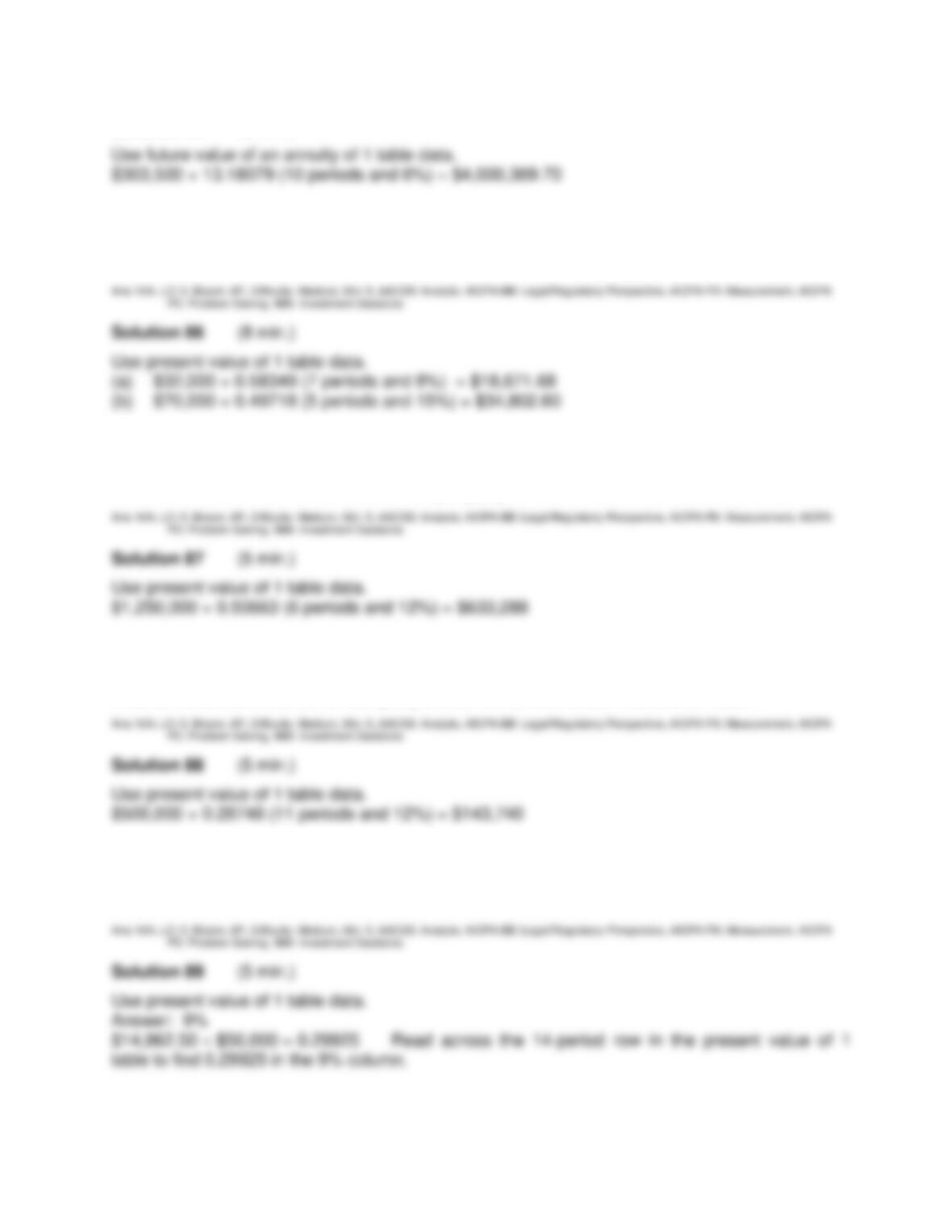
Toub Company issued $4,000,000, 10-year bonds and agreed to make annual deposits of
$303,500 to a fund. The deposits are made at the end of each year to a fund paying 6% interest
compounded annually. What amount will be in the fund at the end of the 10 years?
Time Value of Money
FOR INSTRUCTOR USE ONLY
D – 21
Solution 85 (5 min.)
Be. 86
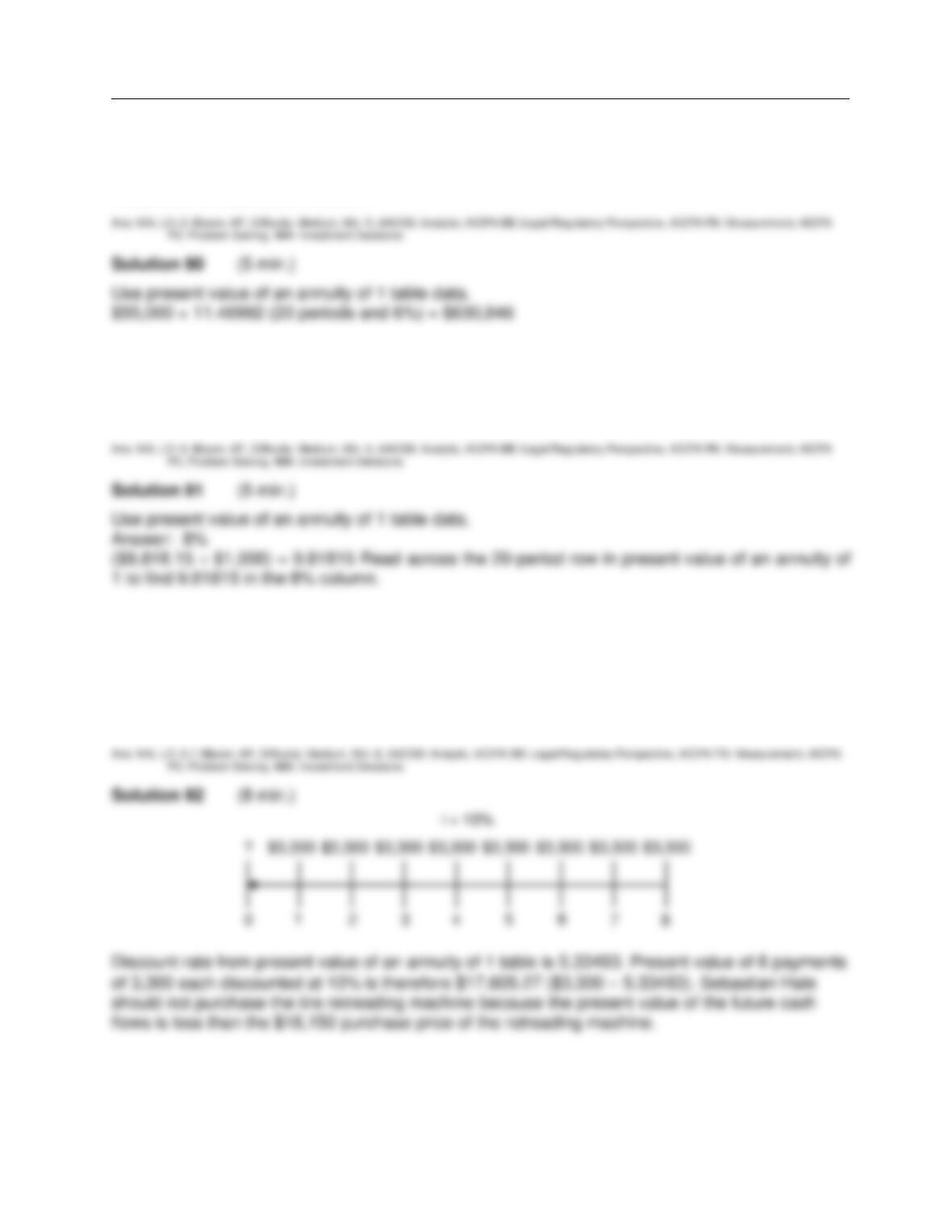
(a) What is the present value of $32,000 due 7 years from now, discounted at 8%?
(b) What is the present value of $70,000 due 5 years from now, discounted at 15%?
Be. 87
Sauls Company is considering an investment that will return a lump sum of $1,250,000 six years
from now. What amount should Sauls Company pay for this investment to earn a 12% return?
Be. 88
Lewis Company earns 12% on an investment that will return $500,000 eleven years from now.
What is the amount that Lewis Company should invest now to earn this rate of return?
Be. 89
If Claude Summers invests $14,962.50 now, she will receive $50,000 at the end of 14 years.
What annual rate of return will Claude earn on his investment?
Test Bank for Financial Accounting: Tools for Business Decision Making, Seventh Edition
FOR INSTRUCTOR USE ONLY
D – 22
Be. 90
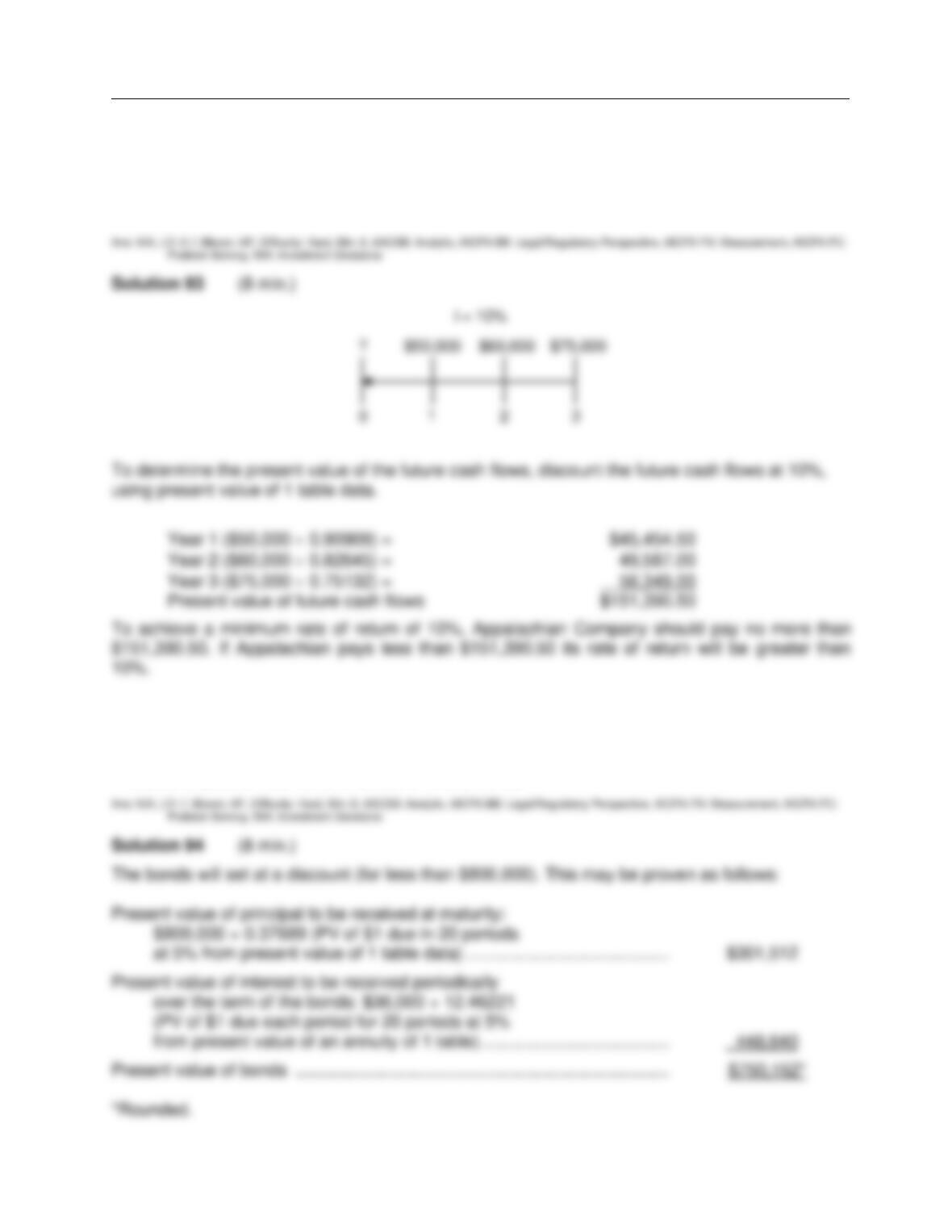
Wando Company is considering investing in an annuity contract that will return $55,000 annually
at the end of each year for 20 years. What amount should Wando Company pay for this
investment if it earns a 6% return?
Be. 91
Kenny Corsig purchased an investment for $9,818.15. From this investment, he will receive
$1,000 annually for the next 20 years starting one year from now. What rate of interest will Kenny
be earning on his investment?
Be. 92
Sebastian Hale owns a garage and is contemplating purchasing a tire retreading machine for
$18,150. After estimating costs and revenues, Sebastian projects a net cash flow from the
retreading machine of $3,300 annually for 8 years. Sebastian hopes to earn a return of 10
percent on such investments. What is the present value of the retreading operation? Should
Sebastian purchase the retreading machine?
Time Value of Money
FOR INSTRUCTOR USE ONLY
D – 23
Be. 93
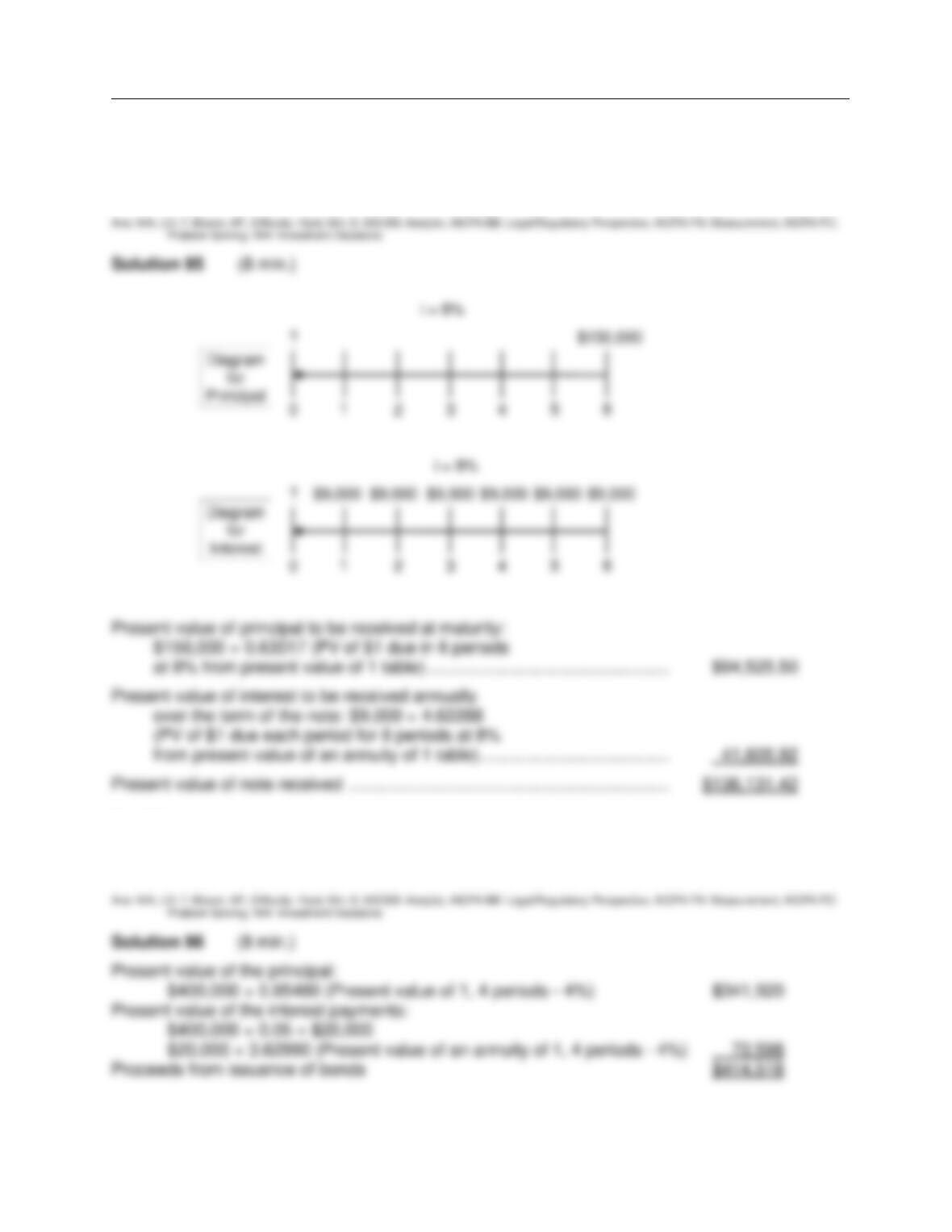
Appalachian Company is considering purchasing equipment. The equipment will produce the
following cash flows: Year 1, $50,000; Year 2, $60,000; Year 3, $75,000. Appalachian requires a
minimum rate of return of 10%. What is the maximum price Appalachian should pay for this
equipment?
Be. 94
Tweetsie Railroad Co. is about to issue $800,000 of 10-year bonds paying a 9% interest rate,
with interest payable semianually. The discount rate for such securities is 10%. How much can
Tweetsie expect to receive for the sale of these bonds?
Test Bank for Financial Accounting: Tools for Business Decision Making, Seventh Edition
FOR INSTRUCTOR USE ONLY
D – 24
Be. 95
The Chocolate Tree Company receives a $150,000, 6-year note bearing interest of 6% (paid
annually) from a customer at a time when the discount rate is 8%. What is the present value of
the note received by The Chocolate Tree?
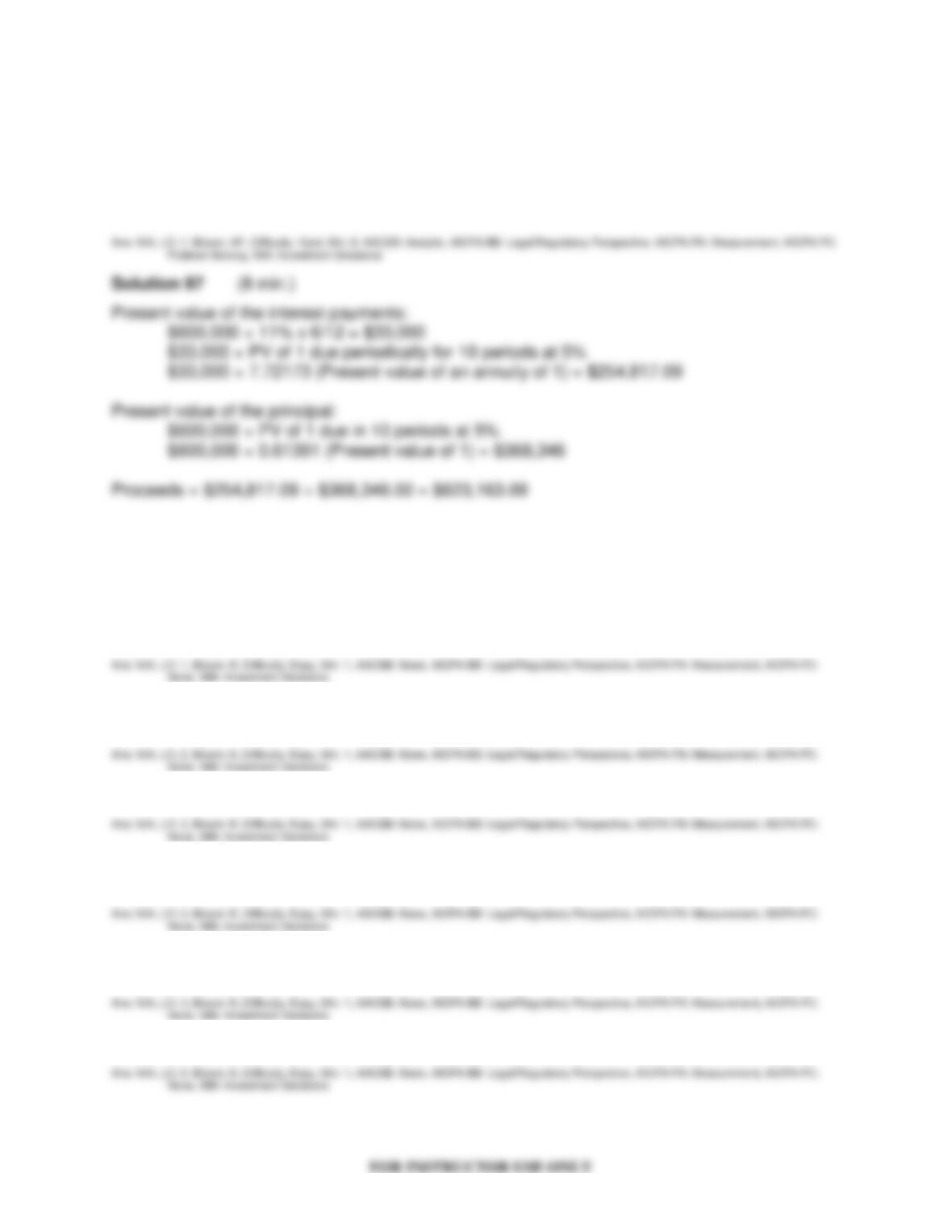
Be. 96
Beaufort Company issued $400,000, 10%, 2-year bonds that pay interest semiannually. Compute
the amount at which the bonds would sell if investors required a rate of return of 8%.
Time Value of Money
D – 25
Be. 97
SBB Company issued 11%, 5-year, $600,000 face value bonds that pay interest semi-annually on
October 1 and April 1. The bonds are dated April 1, 2014, and are issued on that date. The
discount rate of interest for such bonds on April 1, 2014, is 10%. What cash proceeds did SBB
Company receive from issuance of the bonds?
COMPLETION STATEMENTS
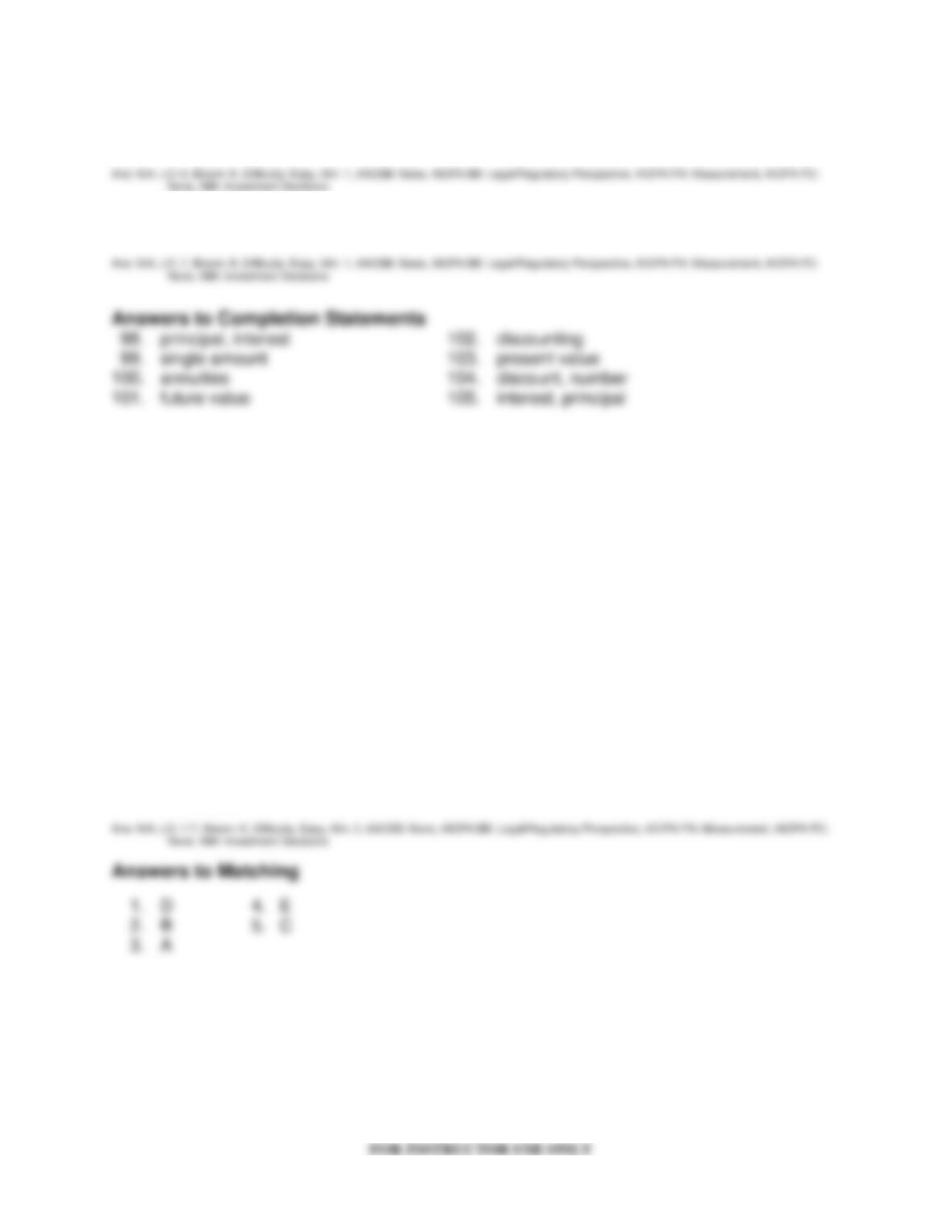
98. Compound interest is computed on the_____________ and on any _______________
earned that has not been paid or withdrawn.
99. The future value of a ________________ is the value at the future date of a given amount
invested, assuming compound interest.
100. Payments or receipts of equal dollar amounts are referred to as __________________.
101. The _____________________ of an annuity is the sum of all the payments plus the
accumulated compound interest on them.
102. The process of determining the present value is referred to as _________________ the
future amount.
103. The further removed from the present the future value is, the smaller the ____________.
Test Bank for Financial Accounting: Tools for Business Decision Making, Seventh Edition
D – 26
104. In computing the present value of an annuity, it is necessary to know the _____________
rate and the _____________ of discount periods.
105. To compute the present value of a bond, both the _______________ payments and the
________________ amount must be discounted.
MATCHING
106. Match the items below by entering the appropriate code letter in the space provided.
A. Compound interest D. Present value of a single amount
B. Future value of a single amount E. Present value of an annuity
C. Future value of an annuity
_____ 1. The value today of a future amount to be received or paid.
_____ 2. The value at a future date of a given amount invested.
_____ 3. Return on principal for two or more periods.
_____ 4. Value today of a series of future amounts to be received or paid.
_____ 5. The sum of all the payments or receipts plus the accumulated compound interest on
them.