APPENDIX A
TIME VALUE OF MONEY
SUMMARY OF QUESTIONS BY OBJECTIVES AND BLOOM’S TAXONOMY
Item
LO
BT
Item
LO
BT
Item
LO
BT
Item
LO
BT
Item
LO
BT
True-False Statements
1.
1
K
3.
1
K
5.
2
K
7.
2
C
9.
3
K
2.
1
K
4.
1
C
6.
2
K
8.
3
K
10.
4
K
Multiple Choice Questions
11.
1
K
17.
1
AP
23.
2
C
29.
2
AP
35.
2
AP
12.
1
C
18.
1
K
24.
2
AP
30.
2
AP
36.
2
AP
13.
1
AP
19.
1
AP
25.
2
AP
31.
2
AP
37.
2
C
14.
1
K
20.
1
K
26.
2
AP
32.
2
C
38.
2
AP
15.
1
K
21.
2
K
27.
2
AP
33.
2
AP
39.
2
AP
16.
1
C
22.
2
C
28.
2
C
34.
2
AP
40.
2
AP
Exercises
41.
1
AP
47.
1
AP
53.
2
AP
59.
2
AP
65.
2
AP
42.
1
AP
48.
1
AP
54.
2
AP
60.
2
AP
66.
2
AP
43.
1
AP
49.
1
AP
55.
2
AP
61.
2
AP
44.
1
AP
50.
1
AP
56.
2
AP
62.
2
AP
45.
1
AP
51.
1
AP
57.
2
AP
63.
2
AN
46.
1
AP
52.
2
AP
58.
2
AP
64.
2
AP
Completion Statements
67.
1
K
68.
1
K
69.
2
K
70.
3
K
Test Bank for Managerial Accounting, Seventh Edition
A – 2
SUMMARY OF LEARNING OBJECTIVES BY QUESTION TYPE
Item
Type
Item
Type
Item
Type
Item
Type
Item
Type
Item
Type
Item
Type
Learning Objective 1
1.
TF
11.
MC
15.
MC
19.
MC
43.
Ex
47.
Ex
51.
Ex
2.
TF
12.
MC
16.
MC
20.
MC
44.
Ex
48.
Ex
67.
C
3.
TF
13.
MC
17.
MC
41.
Ex
45.
Ex
49.
Ex
68.
C
4.
TF
14.
MC
18.
MC
42.
Ex
46.
Ex
50.
Ex
Learning Objective 2
5.
TF
24.
MC
30.
MC
36.
MC
53.
Ex
59.
Ex
65.
Ex
6.
TF
25.
MC
31.
MC
37.
MC
54.
Ex
60.
Ex
66.
Ex
7.
TF
26.
MC
32.
MC
38.
MC
55.
Ex
61.
Ex
69.
C
21.
MC
27.
MC
33.
MC
39.
MC
56.
Ex
62.
Ex
22.
MC
28.
MC
34.
MC
40.
MC
57.
Ex
63.
Ex
23.
MC
29.
MC
35.
MC
52.
Ex
58.
Ex
64.
Ex
Learning Objective 3
8.
TF
9.
TF
70.
C
Learning Objective 4
10.
TF
Note: TF = True-False C = Completion
MC = Multiple Choice Ex = Exercise
The chapter also contains one set of five Matching questions.
Time Value of Money
A – 3
CHAPTER LEARNING OBJECTIVES
1. Compute interest and future values. Simple interest is computed on the principal only,
while compound interest is computed on the principal and any interest earned that has not
been withdrawn.
2. Compute present value. The following three variables are fundamental to solving present
value problems: (1) the future amount, (2) the number of periods, and (3) the interest rate (the
discount rate).
3. Compute the present value in capital budgeting situations. Compute the present values
of all cash inflows and all cash outflows related to the capital budgeting proposal (an
4. Use a financial calculator to solve time value of money problems. Financial calculators
Test Bank for Managerial Accounting, Seventh Edition
A – 4
TRUE-FALSE STATEMENTS
1. Interest is the difference between the amount borrowed and the principal.
2. Compound interest is computed on the principal and any interest earned that has not
been paid or received.
3. The future value of a single amount is the value at a future date of a given amount
invested now, assuming compound interest.
4. When the periodic payments are not equal in each period, the future value can be
computed by using a future value of an annuity table.
5. The process of determining the present value is referred to as discounting the future
amount.
6. A higher discount rate produces a higher present value.
7. In computing the present value of an annuity, it is not necessary to know the number of
discount periods.
8. Many companies calculate the future value of the cash flows involved in an investment in
evaluating long-term capital investments.
9. The decision to make long-term capital investments is best evaluated using discounting
techniques that recognize the time value of money.
10. With a financial calculator, one can solve for any interest rate or for any number of periods
in a time value of money problem.
Answers to True-False Statements
Item
Ans.
Item
Ans.
Item
Ans.
Item
Ans.
Item
Ans.
Time Value of Money
A – 5
MULTIPLE CHOICE QUESTIONS
Note: Students will need future value and present value tables for some questions.
11. Compound interest is the return on principal
a. only.
b. for one or more periods.
c. plus interest for two or more periods.
d. for one period.
12. The factor 1.0609 is taken from the 3% column and 2 periods row in a certain table. From
what table is this factor taken?
a. Future value of 1
b. Future value of an annuity of 1
c. Present value of 1
d. Present value of an annuity of 1
13. If $40,000 is put in a savings account paying interest of 4% compounded annually, what
amount will be in the account at the end of 5 years?
a. $32,878
b. $48,000
c. $48,620
d. $48,666
14. The future value of 1 factor will always be
a. equal to 1.
b. greater than 1.
c. less than 1.
d. equal to the interest rate.
15. All of the following are necessary to compute the future value of a single amount except
the
a. interest rate.
b. number of periods.
c. principal.
d. maturity value.
16. Which table has a factor of 1.00000 for 1 period at every interest rate?
a. Future value of 1
b. Future value of an annuity of 1
c. Present value of 1
d. Present value of an annuity of 1
Test Bank for Managerial Accounting, Seventh Edition
A – 6
17. McGoff Company deposits $20,000 in a fund at the end of each year for 5 years. The fund
pays interest of 4% compounded annually. The balance in the fund at the end of 5 years
is computed by multiplying
a. $20,000 by the future value of 1 factor.
b. $100,000 by 1.04.
c. $100,000 by 1.20.
d. $20,000 by the future value of an annuity factor.
18. The future value of an annuity factor for 2 periods is equal to
a. 1 plus the interest rate.
b. 2 plus the interest rate.
c. 2 minus the interest rate.
d. 2.
19. If $30,000 is deposited in a savings account at the end of each year and the account pays
interest of 5% compounded annually, what will be the balance of the account at the end of
10 years?
a. $48,867
b. $315,000
c. $377,337
d. $450,000
20. Which of the following is not necessary to know in computing the future value of an
annuity?
a. Amount of the periodic payments
b. Interest rate
c. Number of compounding periods
d. Year the payments begin
21. In present value calculations, the process of determining the present value is called
a. allocating.
b. pricing.
c. negotiating.
d. discounting.
22. Present value is based on
a. the dollar amount to be received.
b. the length of time until the amount is received.
c. the interest rate.
d. All of these answers are correct.
Time Value of Money
A – 7
23. Which of the following accounting problems does not involve a present value calculation?
a. The determination of the market price of a bond.
b. The determination of the declining-balance depreciation expense.
c. The determination of the amount to report for long-term notes payable.
d. The determination of the amount to report for lease liability.
24. If you are able to earn an 8% rate of return, what amount would you need to invest to
have $30,000 one year from now?
a. $27,747
b. $27,778
c. $27,273
d. $29,700
25. If you are able to earn a 15% rate of return, what amount would you need to invest to
have $15,000 one year from now?
a. $14,852
b. $13,125
c. $12,750
d. $13,044
26. If the single amount of $2,000 is to be received in 2 years and discounted at 11%, its
present value is
a. $1,818.
b. $1,623.
c. $1,802.
d. $2,754.
27. If the single amount of $3,000 is to be received in 3 years and discounted at 6%, its
present value is
a. $2,519.
b. $2,830.
c. $2,600.
d. $2,820.
28. Which of the following discount rates will produce the smallest present value?
a. 8%
b. 9%
c. 10%
d. 4%
Test Bank for Managerial Accounting, Seventh Edition
A – 8
29. Suppose you have a winning lottery ticket and you are given the option of accepting
$3,000,000 three years from now or taking the present value of the $3,000,000 now. The
sponsor of the prize uses a 6% discount rate. If you elect to receive the present value of
the prize now, the amount you will receive is
a. $2,518,860.
b. $2,591,520.
c. $2,670,000.
d. $3,000,000.
30. The amount you must deposit now in your savings account, paying 6% interest, in order to
accumulate $6,000 for a down payment 5 years from now on a new car is
a. $1,200.
b. $4,484.
c. $4,477.
d. $4,200.
31. The amount you must deposit now in your savings account, paying 5% interest, in order to
accumulate $10,000 for your first tuition payment when you start college in 3 years is
a. $8,500.
b. $7,830.
c. $8,638.
d. $8,860.
32. The present value of $10,000 to be received in 5 years will be smaller if the discount rate
is
a. increased.
b. decreased.
c. not changed.
d. equal to the stated rate of interest.
33. Dexter Company is considering purchasing equipment. The equipment will produce the
following cash flows:
Year 1 $120,000
Year 2 $200,000
Dexter requires a minimum rate of return of 10%. What is the maximum price Dexter
should pay for this equipment?
a. $274,381
b. $165,290
c. $320,000
d. $160,000

Time Value of Money
A – 9
34. If Sloane Joyner invests $10,514.81 now and she will receive $30,000 at the end of 11
years, what annual rate of interest will she be earning on her investment?
a. 8%
b. 8.5%
c. 9%
d. 10%
35. Suzy Douglas has been offered the opportunity of investing $73,540 now. The investment
will earn 8% per year and at the end of its life will return $200,000 to Suzy. How many
years must Suzy wait to receive the $200,000?
a. 10
b. 11
c. 12
d. 13
36. Peter Johnson invests $35,516.80 now for a series of $5,000 annual returns beginning
one year from now. Peter will earn 10% on the initial investment. How many annual
payments will Peter receive?
a. 10
b. 12
c. 13
d. 15
37. In order to compute the present value of an annuity, it is necessary to know the
1. discount rate.
2. number of discount periods and the amount of the periodic payments or
receipts.
a. 1
b. 2
c. both 1 and 2
d. something in addition to 1 and 2
38. A $10,000, 6%, 5-year note payable that pays interest quarterly would be discounted back
to its present value by using tables that would indicate which one of the following period–
interest combinations?
a. 5 interest periods, 6% interest
b. 20 interest periods, 6% interest
c. 20 interest periods, 1.5% interest
d. 5 interest periods, 1.5% interest
Test Bank for Managerial Accounting, Seventh Edition
A – 10
39. Hazel Company has just purchased equipment that requires annual payments of $40,000
to be paid at the end of each of the next 4 years. The appropriate discount rate is 15%.
What is the present value of the payments?
a. $114,199
b. $160,000
c. $46,975
d. $150,135
40. Perdue Company has purchased equipment that requires annual payments of $30,000 to
be paid at the end of each of the next 6 years. The appropriate discount rate is 12%. What
amount will be used to record the equipment?
a. $180,000
b. $123,342
c. $165,772
d. $115,650
Answers to Multiple Choice Questions
Item
Ans.
Item
Ans.
Item
Ans.
Item
Ans.
Item
Ans.
Item
Ans.
EXERCISES
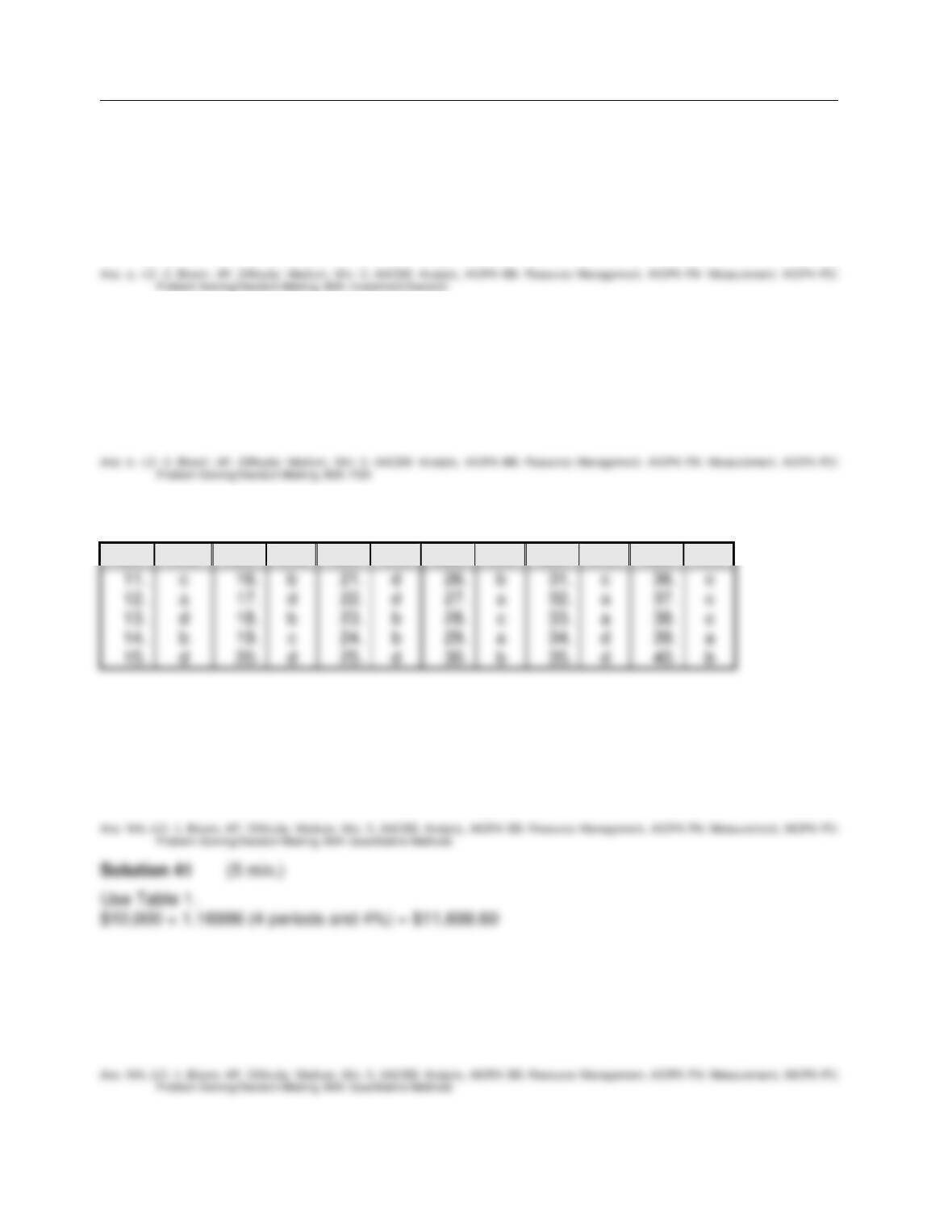
Ex. 41
Jose Reynolds deposited $10,000 in an account paying interest of 4% compounded annually.
What amount will be in the account at the end of 4 years?
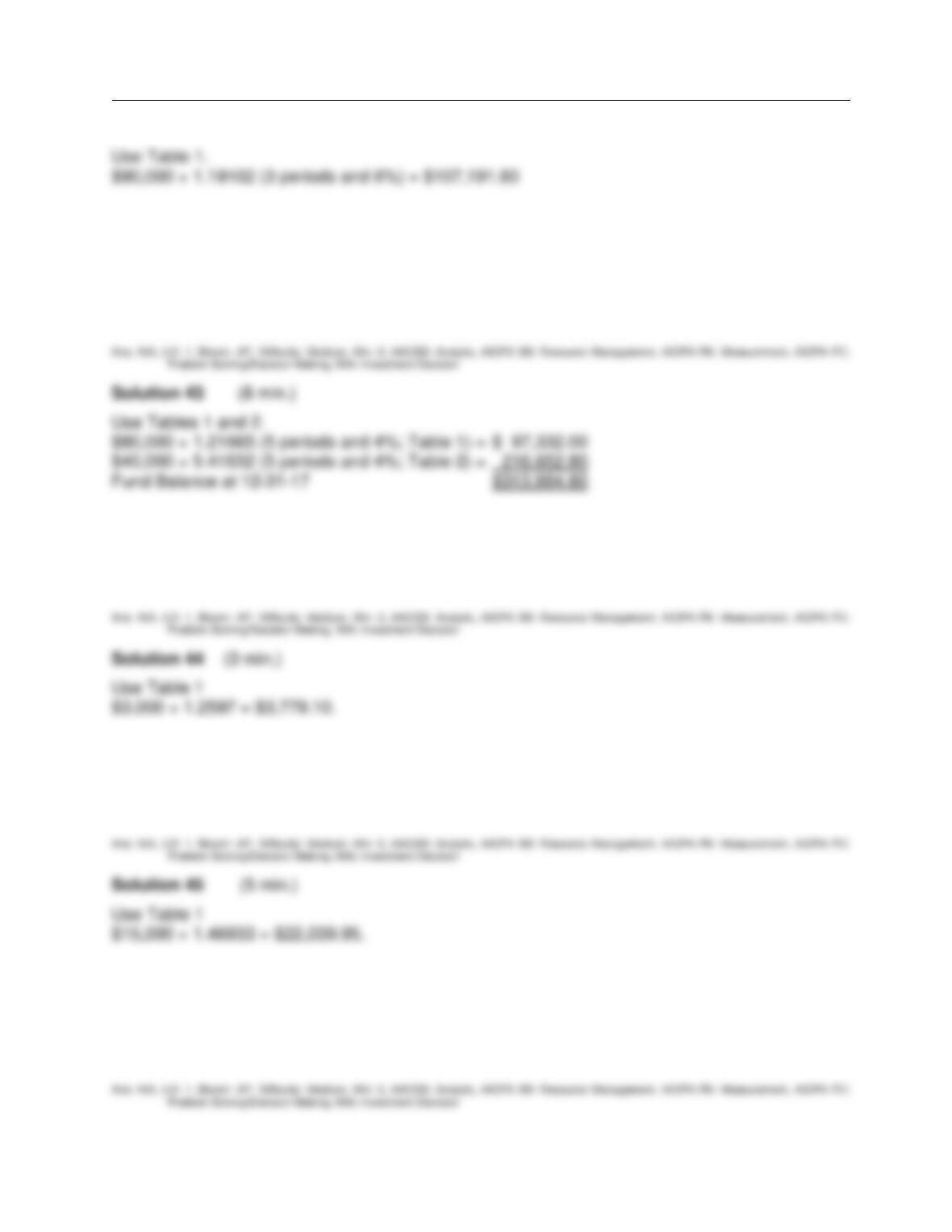
Ex. 42
Wingate Company borrowed $90,000 on January 2, 2017. This amount plus accrued interest of
6% compounded annually will be repaid at the end of 3 years. What amount will Wingate repay at
the end of the third year?
Time Value of Money
A – 11
Solution 42 (5 min.)
Ex. 43
Pleasant Company has decided to begin accumulating a fund for plant expansion. The company
deposited $80,000 in a fund on January 2, 2013. Pleasant will also deposit $40,000 annually at
the end of each year, starting in 2013. The fund pays interest at 4% compounded annually. What
is the balance of the fund at the end of 2017 (after the 2017 deposit)?
Ex. 44
Mandy How plans to buy an automobile and can deposit $3,000 toward the purchase today. If the
annual interest rate is 8%, how much can Mandy expect to have as a down payment in 3 years?
Ex. 45
Rob Honda plans to buy a home and can deposit $15,000 for the purchase today. If the annual
interest rate is 8%, how much can Rob expect to have for a down payment in 5 years?
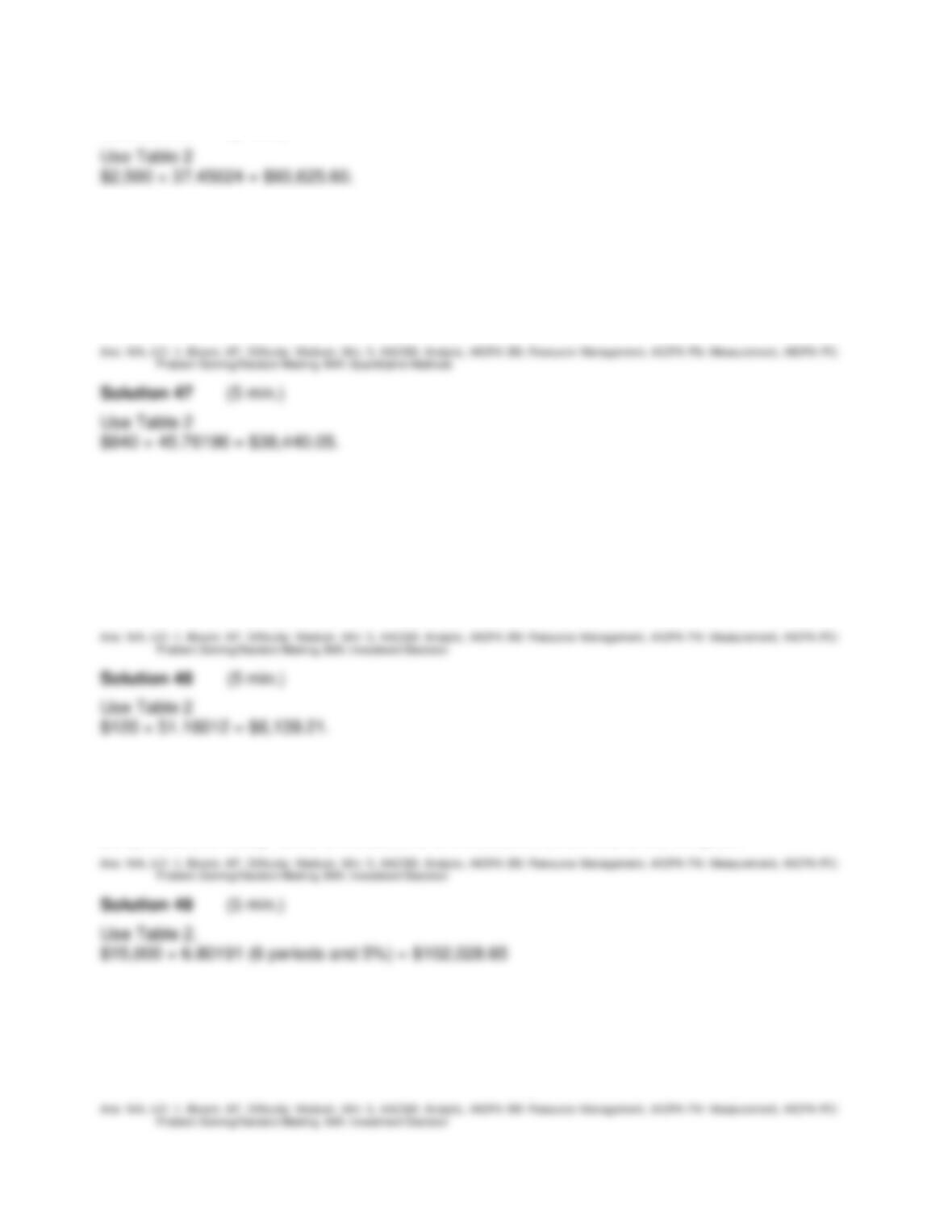
Ex. 46
Bill and Ellen Sweatt plan to invest $2,500 a year in an educational IRA for their granddaughter,
Sloane Martin. They will make these deposits on January 2nd of each year. Bill and Ellen feel they
can safely earn 8%. How much will be in this account on December 31 of the 18th year?
Test Bank for Managerial Accounting, Seventh Edition
A – 12
Solution 46 (5 min.)
Ex. 47
Bill Cigarettes acquired a bad habit of smoking in high school. Bill spends approximately $70 a
month or $840 a year on cigarettes. He is not concerned with health issues, but he is keenly
aware of financial issues. Show Bill how much he would have at retirement in 20 years if he
invested $840 a year at 8% instead of smoking.
Ex. 48
Robin Clark has a cell phone that she uses only for emergencies. The cost of the phone is $40 a
month. The cellular company is offering unlimited nights and weekends for an additional $10 a
month ($120 a year). Robin thinks it would be “cool” to have this benefit and after all $10 a month
is not so much. Show Robin how much she will have in 20 years if she invests this $120 a year at
9% instead of accepting the unlimited nights and weekends offer.
Ex. 49
Lamb Company deposited $15,000 annually for 6 years in an account paying 5% interest
compounded annually. What is the balance of the account at the end of the 6th year?
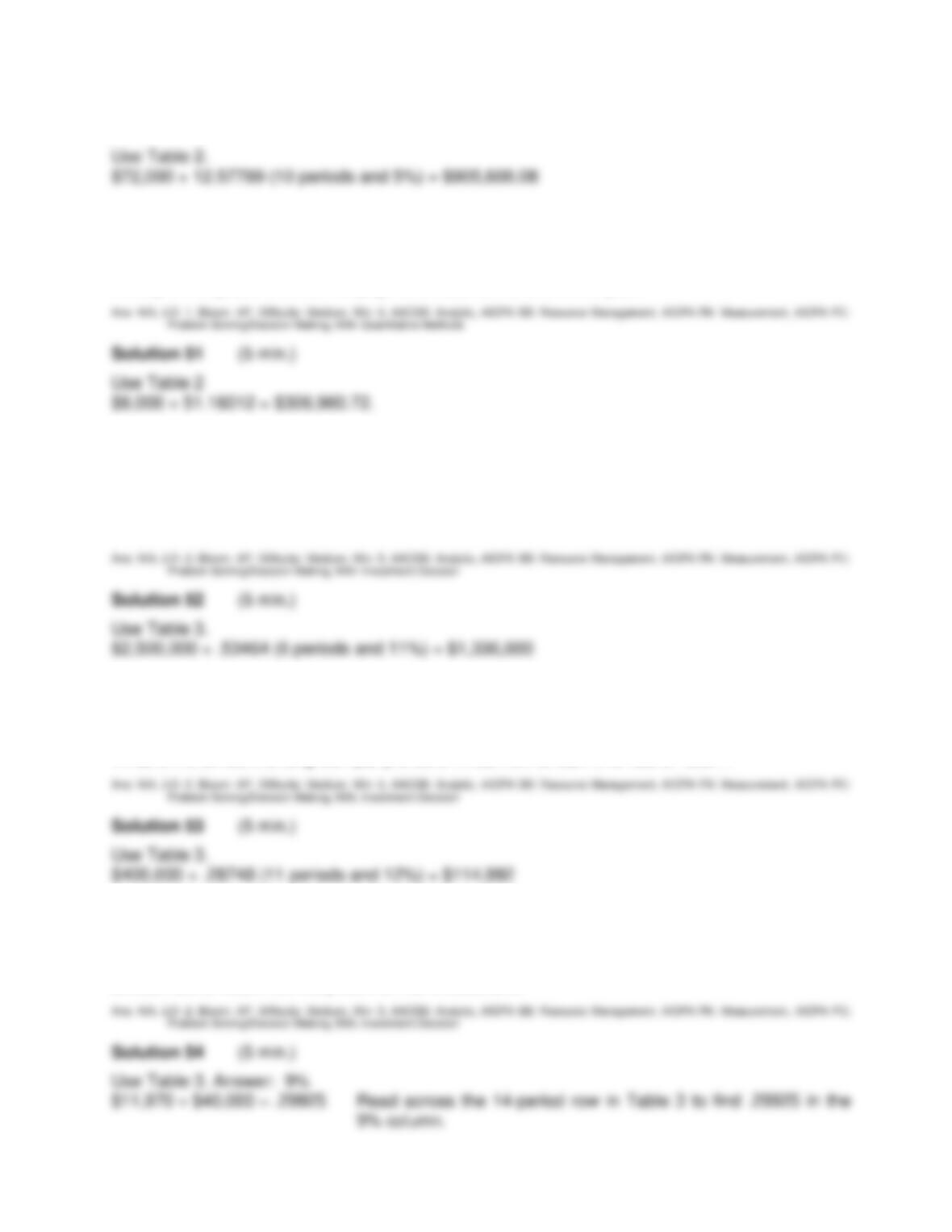
Ex. 50
Martin Company issued $900,000, 10-year bonds and agreed to make annual sinking fund
deposits of $72,000. The deposits are made at the end of each year to a fund paying 5% interest
compounded annually. What amount will be in the sinking fund at the end of the 10 years?
Time Value of Money
A – 13
Solution 50 (5 min.)
Ex. 51
Compute the future value of $6,000 invested every year at an interest rate of 9%. You invest the
money for 20 years with the first payment made at the end of the year.
Ex. 52
Flower Company is considering an investment which will return a lump sum of $2,500,000 six
years from now. What amount should Flower Company pay for this investment to earn an 11%
return?
Ex. 53
Chang Company earns 12% on an investment that will return $400,000 eleven years from now.
What is the amount Chang Company should invest now to earn this rate of return?
Ex. 54
If Kelly Cranford invests $11,970 now, she will receive $40,000 at the end of 14 years. What
annual rate of return will Kelly earn on her investment?
Test Bank for Managerial Accounting, Seventh Edition
A – 14
Ex. 55
Luis Rodriguez wants to buy a car in 3 years. He will need $3,000 for a down payment. The
annual interest rate is 9%. How much money must Luis invest today for the purchase?
Ex. 56
Amy Brown plans to buy a surround sound stereo system for $1,100 after 3 years. If the interest
rate is 6%, how much money should Amy set aside today for the purchase?
Ex. 57
(a) What is the present value of $90,000 due 7 years from now, discounted at 9%?
(b) What is the present value of $150,000 due 5 years from now, discounted at 12%?
Ex. 58
Kim Black plans to buy a truck for $24,000 after 3 years. If the interest rate is 6%, how much
money should Kim set aside today for the purchase?
Ex. 59
DMV leases a building for 20 years. The lease requires 20 annual payments of $12,000 each,
with the first payment due immediately. The interest rate in the lease is 10%. What is the present
value of the cost of leasing the building?
Time Value of Money
A – 15
Solution 59 (3 min.)
Ex. 60
Frye Company is considering investing in an annuity contract that will return $50,000 annually at
the end of each year for 20 years. What amount should Frye Company pay for this investment if it
earns an 8% return?
Ex. 61
Sarah Denny purchased an investment for $40,260.48. From this investment, she will receive
$6,000 annually for the next 10 years starting one year from now. What rate of interest will Sarah
be earning on her investment?
Ex. 62
You are purchasing a car for $25,000, and you obtain financing as follows: $2,500 down
payment, 12% interest, semiannual payments over 5 years.
Instructions
Compute the payment you will make every 6 months.
Test Bank for Managerial Accounting, Seventh Edition
A – 16
Ex. 63
Frostmore Company is considering investing in an annuity contract that will return $50,000
annually at the end of each year for 20 years. What amount should Frostmore pay for this
investment if it earns an 8% return?
Ex. 64
Cecilia Jeffries purchased an investment for $49,090.75. From this investment, she will receive
$5,000 annually for the next 20 years starting one year from now. What rate of interest will Cecilia
be earning on her investment?
Ex. 65
Lucky Lou has just won the lottery and will receive an annual payment of $100,000 every year for
the next 20 years. If the annual interest rate is 8%, what is the present value of the winnings?
Ex. 66
CVS leases a building for 20 years. The lease requires 20 annual payments of $10,000 each,
with the first payment due immediately. The interest rate in the lease is 10%. What is the present
value of the cost of leasing the building?
Time Value of Money
A – 17
COMPLETION STATEMENTS
67. Payments or receipts of equal dollar amounts are referred to as __________________.
68. The _____________________ of an annuity is the sum of all the payments plus the
accumulated compound interest on them.
69. The process of determining the present value is referred to as _________________ the
future amount.
70. If the present value of the cash ______________ exceeds the present value of the cash
________________, the investment should be rejected.
Answers to Completion Statements
MATCHING
71. Match the items below by entering the appropriate code letter in the space provided.
A. Compound interest D. Present value of a single amount
B. Future value of a single amount E. Present value of an annuity
C. Future value of an annuity
_____ 1. The value today of a future amount to be received or paid.
_____ 2. The value at a future date of a given amount invested.
_____ 3. Return on principal plus interest for two or more periods.
_____ 4. Value today of a series of future amounts to be received or paid.
_____ 5. The sum of all the payments or receipts plus the accumulated compound interest on
them.