APPENDIX A: INTERNATIONAL FINANCIAL REPORTING STANDARDS
1. All of the following statements are true about inflation except:
a. The U.S. and Germany adjust their financial statements for inflation.
b. In recent years, inflation has been more rampant in Latin America and South America than the rest of the world.
c. The FASB developed rules for companies in the United States to use to adjust for inflation.
d. U.S. companies no longer present financial information adjusted for the effects of inflation.
2. Which of the following statements is true regarding common law?
a. In common law countries, there are generally more statutes written into the laws.
b. In common law countries, there is less reliance on interpretation by the courts.
c. Because more details are written into U.S. law, FASB has shorter and more general accounting standards than
most countries.
d. The common law system has its roots in the United Kingdom.
3. Which of the following countries do not use a common law system?
a. The United States
b. Germany
c. The United Kingdom
d. Both a and c are correct.
4. All of the following are among the most important reasons why accounting standards differ around the world
except:
a. differences in the state of economic development
b. differences in taxation
c. differences in inflation
d. differences in code law in all countries around the world
5. All of the following are advantages available to companies if a single set of accounting standards were used except:
a. A single set of worldwide accounting standards would have no effect on accounting fee costs.
b. A single set of standards would make it much easier to decide whether to acquire a foreign company.
c. A single set of worldwide accounting standards would facilitate comparisons for investment purposes.
d. A single set of worldwide accounting standards would make it easier to access foreign capital markets
Appendix A: International Financial Reporting Standards
6. Which of the following is a commonly cited disadvantage of having a new unified set of accounting standards?
a. Acquiring foreign companies would become a more confusing proposition.
b. Corporations may find themselves more susceptible to lawsuits due to the principles-based system.
c. Time and money would not be saved in accessing capital markets abroad.
d. The SEC would be dissolved if international accounting standards were adopted.
7. Which organization would have the ultimate responsibility of deciding if the advantages outweigh the disadvantages in
the adoption of IFRS accounting standards in the U.S.?
a. FASB
b. SEC
c. IASB
d. AICPA
ANSWER: b
8. The benefits of a single set of accounting standards used around the world would include all of the following except:
a. They would eventually save companies considerable money in accounting fees.
b. They would prevent competitors from acquiring each other.
c. They would allow easier comparisons by analysts and investors.
d. They would facilitate access to foreign capital markets.
ANSWER: b
9. The group with primary responsibility for development of a single set of accounting standards around the world is the:
a. FASB
b. SEC
c. IFRS
d. IASB
10. During what year did the IASB and FASB reaffirm their commitment to achieving convergence of accounting
standards in the U.S.?
a. 2007
b. 2009
c. 2002
d. 2008
Appendix A: International Financial Reporting Standards
11. The International Accounting Standards Committee was established in 1973 to develop worldwide standards.
Which group replaced it in 2001?
a. FASB
b. IFRS
c. IASB
d. IIA
ANSWER: c
12. What is the name of the formalized commitment of the IASB and the FASB to converge U.S. and international
accounting standards?
a. The Sarbanes-Oxley Act
b. The Norwalk Agreement
c. The IFRS Foundation
d. The Conceptual Framework
13. On the reporting of liabilities where a range of values exists as a possible outcome, IFRS requires which of the
following points to be recorded as a provision, if the outcome is probable?
a. Low end of the range
b. High end of the range
c. Midpoint of the range
d. IFRS presents no specific guidance as to this point
14. Which of the following inventory costing methods is prohibited under IFRS?
a. FIFO
b. Weighted-average
c. LIFO
d. Perpetual
Appendix A: International Financial Reporting Standards
15. When comparing U.S. GAAP and IFRS, regarding the level of details in the standards and the level of disclosure
required, which of the following is correct?
U.S. GAAP IFRS
a. Detail: More Detail: Less
Disclosure: More Disclosure: Less
b. Detail: More Detail: Less
Disclosure: Less Disclosure: More
c. Detail: Less Detail: More
Disclosure: Less Disclosure: More
d. Detail: Less Detail: More
Disclosure: More Disclosure: Less
16. When analyzing foreign statements, all of the following are accurate positions of non-current liabilities listings
except:
a. After current liabilities
b. Before current liabilities
c. After share capital
d. After total equity
17. Significant differences exist in terms on financial statements around the world. For example, another name for what
we know as Capital Stock in the U.S. is:
a. Share Capital
b. Capital Reserves
c. Provisions for other Risks
d. Deferred Income
18. Significant differences exist in terms on financial statements around the world. For example, another name for what
we know as Additional Paid-In Capital in the U.S. is:
a. Share Capital
b. Capital Reserves
c. Provisions for Other Risks
d. Deferred Income
Appendix A: International Financial Reporting Standards
19. Significant differences exist in terms on financial statements around the world. For example, another name for what
we know as Contingent Liabilities in the U.S. is:
a. Share Capital
b. Capital Reserves
c. Provisions for Other Risks
d. Deferred Income
20. What is the name for the balance sheet under international accounting standards?
a. Assets and Equity Attributable to Shareholders
b. Statement of Financial Position
c. Statement of Balance
d. The Equitable Claims Statement
21. Which of the following presents the proper ordering of assets, liabilities and equities on the statement of financial
position used by some countries that is different from the U.S.?
a. current assets, long-term assets, current liabilities
b. inventories, trade-receivables, cash
c. assets, liabilities, equities
d. current liabilities, long-term liabilities, equities
ANSWER: b
22. Which of the following is a true statement about the terms used on the balance sheet?
a. U.S. GAAP requires a standard set of terms on the balance sheet.
b. IFRS requires a standard set of terms on the balance sheet.
c. Terminology is consistent across all countries.
d. Neither IFRS nor U.S. GAAP requires a standard set of terms on the balance sheet.
23. The state of economic development can affect accounting standards.
a. True
b. False
Appendix A: International Financial Reporting Standards
24. Japan has a greater number of differences than the U.S. between the amount of income reported to stockholders and
that reported to the taxing authorities.
a. True
b. False
25. No single explanation can be given for the divergence of accounting standards.
a. True
b. False
26. In countries, like Japan and much of Europe, fewer differences between the amount of income reported to
stockholders and that reported to the taxing authorities exist than in the U.S.
a. True
b. False
27. According to the text, in economies like those that made up the former Soviet Union, accounting standards are
relatively less complex due to the fact that they are just beginning to be developed.
a. True
b. False
28. Ultimately, it will be the responsibility of the FASB in the U.S. to decide if the advantages of IFRS’s outweigh the
disadvantages.
a. True
b. False
29. A single set of accounting standards could help a U.S. company save time and money in the acquisition of a German
company.
a. True
b. False
ANSWER: True
30. IFRS is now mandatory in all member states of the economic and political organization known as the European Union.
a. True
b. False
Appendix A: International Financial Reporting Standards
31. Companies in Mexico had to begin using IFRS by 2012.
a. True
b. False
32. The U.S. accounting standards are more principle-based than IFRS.
a. True
b. False
33. While U.S. GAAP requires a complete set of financial statements, including a balance sheet, statement of
stockholders’ equity, income statement, and statement of cash flows, IFRS does not.
a. True
b. False
34. U.S. GAAP requires companies to present a balance sheet with classifications for current and long-term liabilities,
while IFRS does not.
a. True
b. False
35. Both U.S. GAAP and IFRS apply the lower-of-cost-or market rule in a similar manner to inventory.
a. True
b. False
36. Both U.S. GAAP and IFRS classify gains and losses that are both unusual in nature and infrequent in occurrence as
extraordinary and present them in a separate section of the income statement.
a. True
b. False
37. Regarding the valuation of operating assets, IFRS allows companies to use fair value.
a. True
b. False
Appendix A: International Financial Reporting Standards
38. Under IFRS, if inventory is written down to a new lower market value, this cannot be reversed in later periods.
a. True
b. False
39. Essentially, the entire statement of financial position is inverted compared to what is commonly seen in the United
States.
a. True
b. False
40. There is a standard format in various countries for the statement of financial position.
a. True
b. False
41. McDonald Corp. owns a building with an original cost of $2,000,000 and accumulated depreciation at the balance sheet
date of $300,000. Based on a recent appraisal, the fair value of the building is $1,800,000.
REQUIRED:
1. At what amount will the building be reported on the year–end balance sheet if McDonald follows U.S. GAAP?
2. Does McDonald have a choice in the amount to report for the building if instead it follows IFRS? What are those
choices?
ANSWER: 1. $2,000,000 – $300,000 = $1,700,000.
42. During the most recent year, Grace paid $109,000 in interest to its lenders and $78,000 in dividends to its stockholders.
REQUIRED:
1. In which category of the statement of cash flows (operating, investing, or financing) should each of these amounts
be shown if Grace follows U.S. GAAP? If more than one category is acceptable, indicate what the choices are.
2. In which category of the statement of cash flows (operating, investing, or financing) should each of these amounts
be shown if Grace follows IFRS? If more than one category is acceptable, indicate what the choices are.
Appendix A: International Financial Reporting Standards
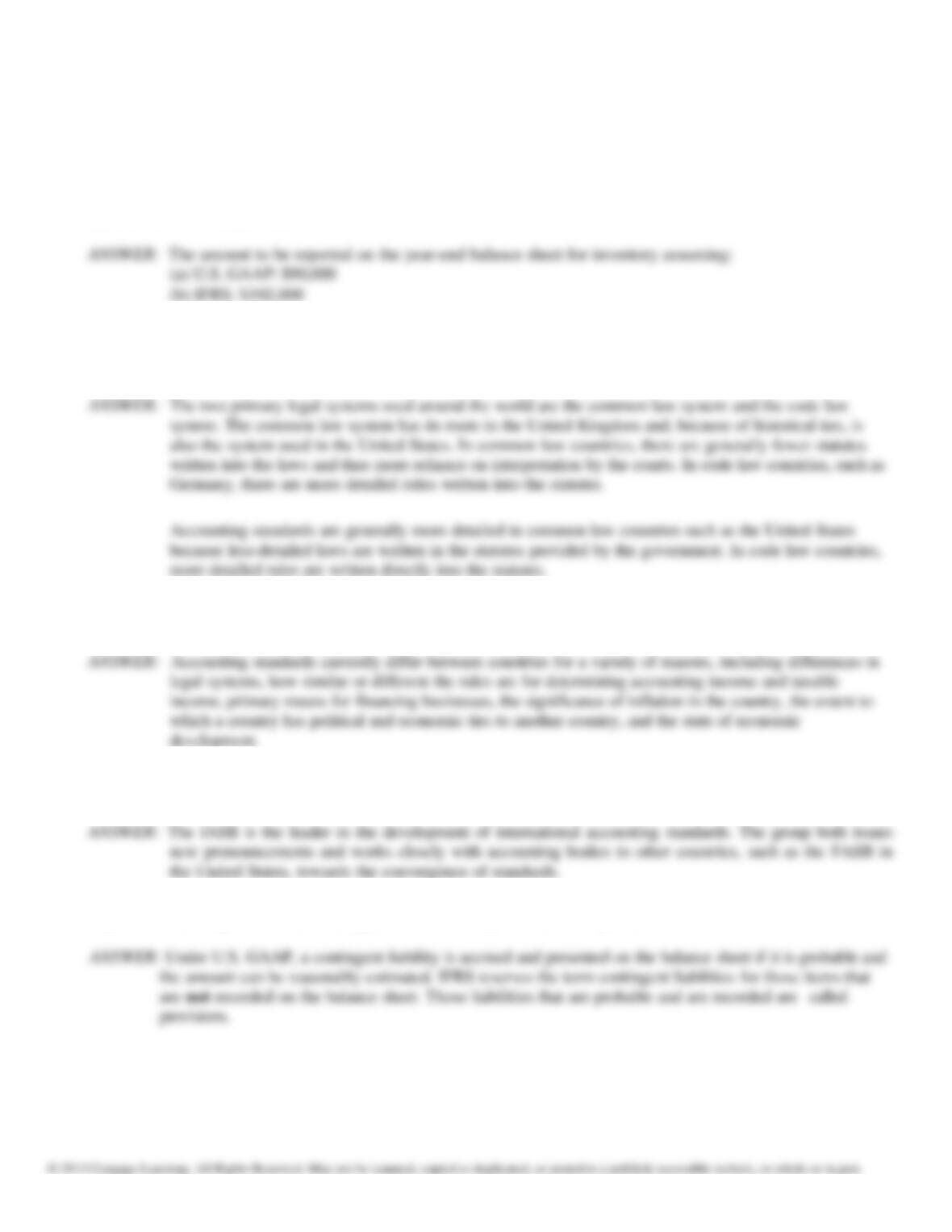
43. The cost of Fulton’s inventory at the end of the year was $145,000. Due to obsolescence, the cost to replace the
inventory was only $90,000. Net realizable value—what the inventory could be sold for—is $102,000.
REQUIRED:
Determine the amount Fulton should report on its year-end balance sheet for inventory assuming the company follows
(a) U.S. GAAP and (b) IFRS.
44. Explain the two primary legal systems used around the world and what these differences have to do with accounting
standards.
45. Discuss at least four reasons that accounting standards currently differ between countries.
46. How would you describe the current role of the IASB in setting accounting standards?
47. Explain the meaning of the terms contingent liabilities and provisions as they relate to U.S. GAAP and IFRS?
Appendix A: International Financial Reporting Standards
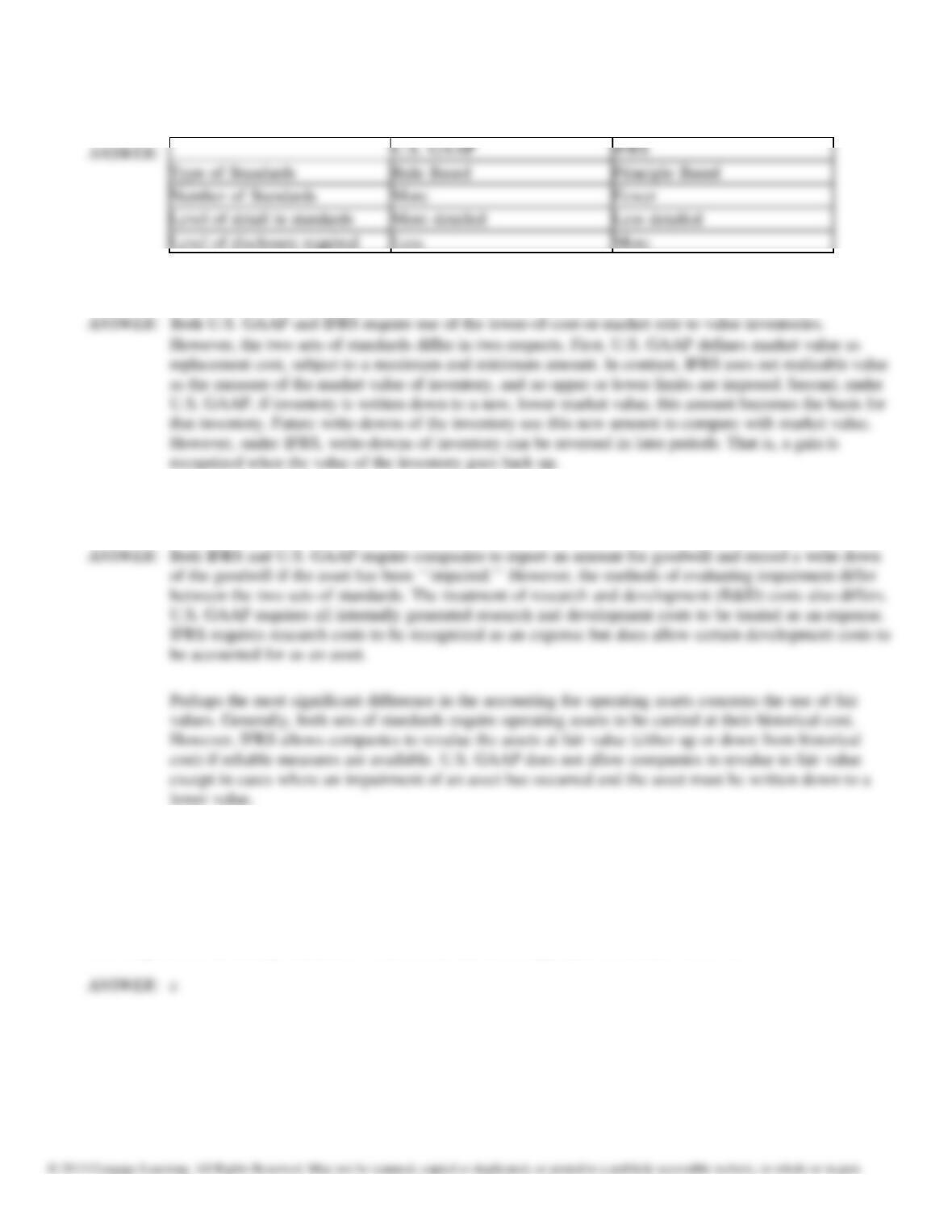
48. Summarize some of the common differences between U.S. GAAP and IFRS.
49. How does the application of the lower-of–cost-or-market rule differ between U.S. GAAP and IFRS?
50. Explain some of the differences in accounting for operating assets that exist between U.S. GAAP and IFRS.
51. All of the following statements are true regarding international legal systems except:
a. The common law system has its roots in the United Kingdom.
b. In common law countries, there are generally fewer statutes written into the laws.
c. In code law countries, there is more reliance on interpretations by the courts than in common law countries.
d. Divergence in accounting standards is linked to differences in legal systems around the world.
Appendix A: International Financial Reporting Standards
52. In which of the following countries do significant differences exist between accounting income and taxable income?
a. Japan
b. The United States
c. Germany
d. France
53. Which of the following statements regarding inflation and accounting is false?
a. The SEC requires U.S. companies to present supplemental financial information adjusted for the effects of inflation.
b. Instability of the measuring unit that is the currency occurs in countries with rampant inflation.
c. In some in Latin American and South American countries, companies have been required to adjust their financial
statements to take into account the effects of inflation.
d. The FASB developed rules for companies in the United States to use to adjust for inflation.
54. Which of the following statements is false regarding the reasons for differing accounting systems around the world?
a. Countries that have strong political and economic ties often share similar accounting practices.
b. Canada and Mexico, two former British colonies, can traced their accounting roots to those found in the United
Kingdom.
c. The state of economic development typically mirrors the development stage of accounting rules in countries.
d. In some less-developed countries of the world, where the forces of capitalism are less prevalent, accounting
standards have developed at a much slower pace than they have in more advanced economies.
ANSWER: b
55. When did the SEC drop its long-standing rule that required foreign companies that filed financial statements with it to
adjust those statements to conform with U.S. GAAP and allow them to use IFRS?
a. 2001
b. 2007
c. 2009
d. 2013
ANSWER: b
56. Which of the following statements is true regarding extraordinary items on the income statement?
a. U.S. GAAP prohibits the presentation of extraordinary items on the income statement.
b. IFRS prohibits the presentation of extraordinary items on the income statement.
c. U.S. GAAP allows extraordinary gains and losses on the balance sheet.
d. IFRS allows the classification of gains and losses on the income statement as
extraordinary as long as long as they are both unusual in nature and infrequent in occurrence.
Appendix A: International Financial Reporting Standards
57. Which of the following statements is false regarding U.S. GAAP versus IFRS financial statement presentation?
a. U.S. GAAP does not require the presentation of a classified balance sheet.
b. IFRS requires the classification of assets and liabilities as current and noncurrent.
c. If a range of values is available for reporting an outcome in a loss contingency, U.S. GAAP requires a company to
report the high end of the range as a probable outcome.
d. If a range of values is available for reporting an outcome in a loss contingency, IFRS requires a company to record
the mid-point of the range as a probable outcome.
ANSWER: c
58. Which of the following statements is true regarding the treatment of leases on the financial statements?
a. U.S. GAAP prohibits the presentation of leases on the financial statements since they are off-balance sheet
transactions.
b. U.S. GAAP criteria for lease capitalization are less strict than IFRS.
c. The criteria concerning whether a lease is a capital lease are very different for IFRS and U.S. GAAP.
d. The criteria required for lease capitalization under IFRS are considered more like guidelines rather than strict rules.