23
CHAPTER 7
PERSONNEL MANAGEMENT
SHORT ANSWER
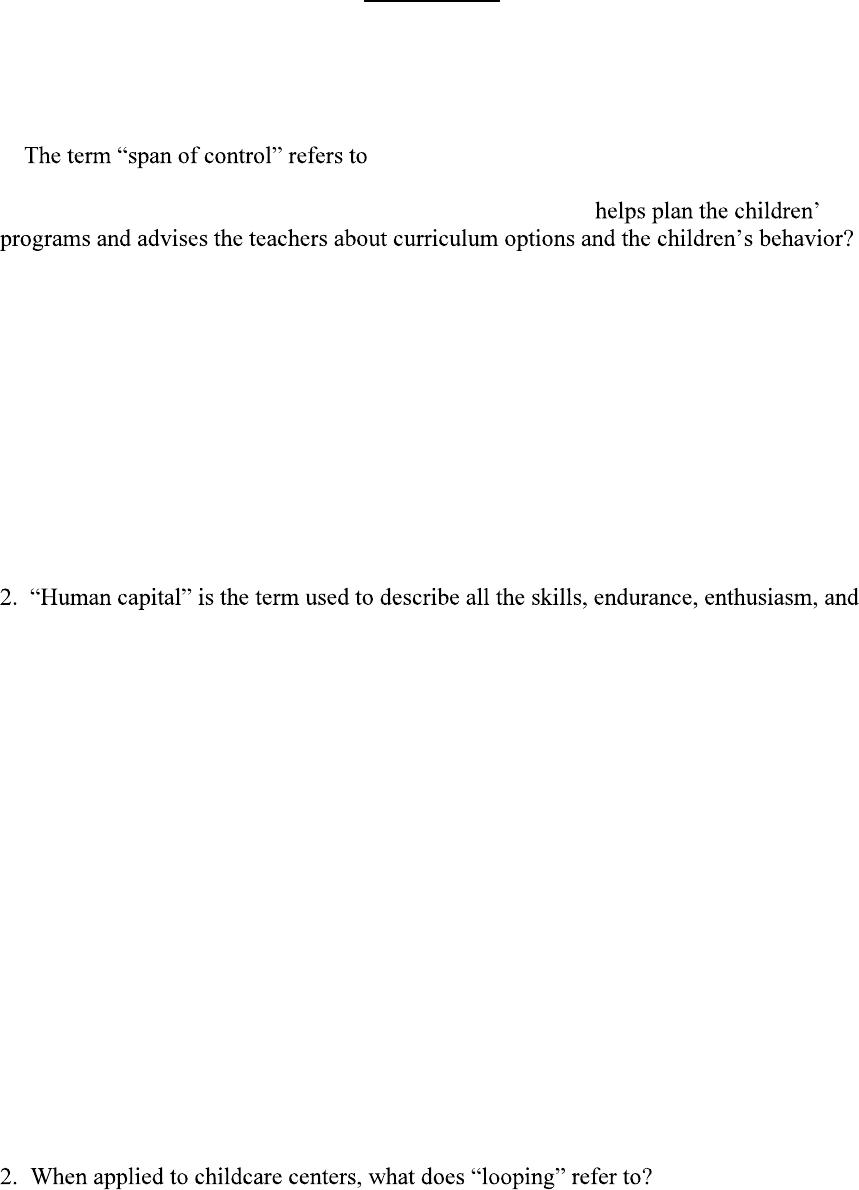
1. __________.
2. What is the term for someone who reports to the manager, s
______________
TRUE OR FALSE
Please circle the correct answer.
1. A center provides 3 hours paid planning time per week and closes 1 day a year for
long-range planning. This center meets the 1998 recommendations of the Center for the
Child Care Workforce.
true
false
love shown by the staff of a child-care center.
true
false
3. The Child Development Associate Credential combines on-the-job training and formal
study.
true
false
Multiple Choice
Select the best answer.
1. What is a job specification?
a. a list of the qualifications needed to do a particular job
b. a description of the duties and responsibilities involved in a particular job
c. something used in advertising the position
d. all of the above
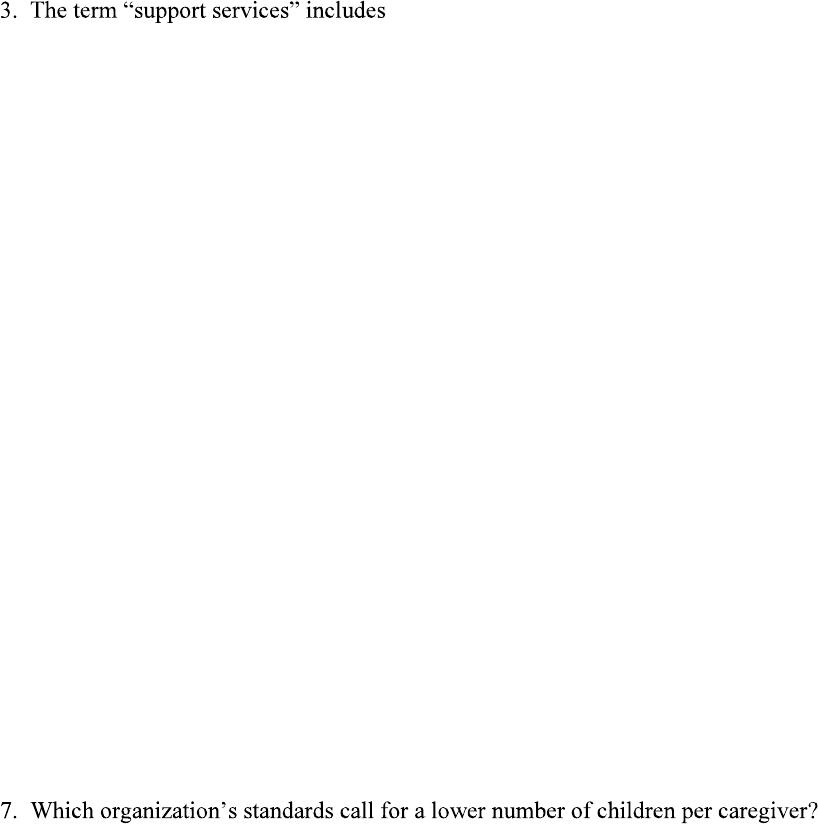
a. keeping children of different ages separate
24
b. putting children of different ages into the same group
c. keeping the same teacher with a group of children for more than one year
d. rotating teachers on a regular basis
:
a. office services
b. food services
c. transportation services
d. all of the above
4. Which of the following has the highest mathematical ratio?
a. 12 children and 2 caregivers
b. 18 children and 3 caregivers
c. 24 children and 4 caregivers
d. They all have the same mathematical ratio.
5. Which of the following has the highest human ratio?
a. 12 children and 2 caregivers
b. 18 children and 3 caregivers
c. 24 children and 4 caregivers
d. They all have the same human ratio.
6. According to the accreditation guidelines of the NAEYC, small group sizes usually
result in:
a. a higher quality of care.
b. a lower quality of care.
c. the same quality of care as with larger group sizes.
d. NAEYC has taken no position on this issue.
a. NAEYC
b. American Public Health Association
c. the American Academy of Pediatrics
d. They are all the same.
8. Food service standards for childcare centers are set by what group?
a. NAEYC
b. state licensing agencies
c. the United States Congress
d. the U.S. Department of Agriculture
25
9. The position known as pedagogista is likely to be found in a child-care program based
on the programs of:
a. Montessori.
b. Piaget.
c. Reggio Emilia.
d. Freud.
10. NAEYC accreditation standards require that all teachers have at least:
a. a high school diploma.
b. an associates degree or equivalent.
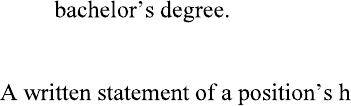
c. a
d. experience with young children.
11. ours, duties and responsibilities is known as:
a. a job specification
b. a job description
c. a job coordination
d. a job classification
12. Your center has 16 employees. Which of the following laws apply to you?
a. the Age Discrimination in Employment Act of 1967
b. the Americans with Disabilities Act of 1990
c. the Pregnancy Discrimination Act of 1978
d. all of the above
13. When conducting a job interview, antidiscrimination laws mean that in most cases
you CANNOT ask questions about:
a. child-care plans
b. medical problems
c. criminal record
d. all of the above
14. Sometimes when you call people listed as references you cannot fully trust what you
hear, either because the references have been chosen by the job applicant or because the
references are afraid of being sued if they give a negative recommendation. What is the
best way to handle this problem?
a. Ask the reference for the name of someone else that you can contact about the
applicant.
b. Pretend to be a police officer.
26
c. Promise the references not to repeat anything they might say.
d. none of the above
15. A job candidate who asks a lot of questions about the position is most likely:
a. not interested in the job.
b. a potential troublemaker.
c. someone who has done enough research on the position to ask questions.
d. someone who knows little about child care.
16. Hiring someone for a position also means not hiring the other applicants. The best
way to handle unsuccessful applicants is to:
a. do nothing.
b. tell them, if they call, that the search is still continuing.
c. tell them the bad news only if they ask.
d. notify them immediately.
62
Chapter 7
SHORT ANSWER: