9
CHAPTER 3
APPLYING THEORIES IN MANAGING A CHILD DEVELOPMENT CENTER
SHORT ANSWER
1. What are the four types of theories of human development?
1 _______
2 _______
3 _______
4 _______
2. A teacher hands out stickers with smiley faces when children in her care do something
particularly well. Which theory of child development is she following? _______
3. When children talk aloud to themselves while engaging in a physical task, Lev Vygotsky
would call this ______________.
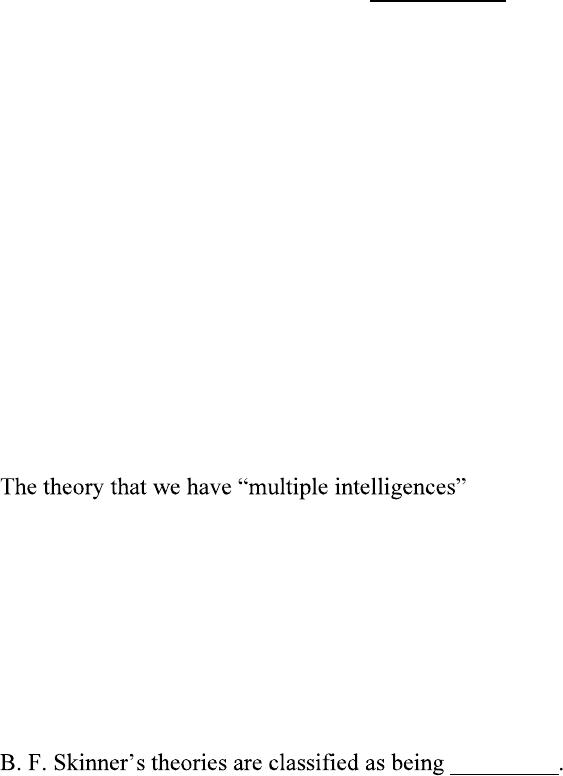
4. (different ways of knowing the world) was
first set forth by _________________.
5. What are the names given to the four stages in the historical evolution of organization theory?
1 _______
2 _______
3 _______
4 _______
6.
7. A coherent system of related concepts and principles used to describe how to manage an
organization is known as _____________
8. What are the five basic processes that all managers use?
1 _______
2 _______
3 _______
4 _______
5 _______
TRUE OR FALSE
Please circle the correct answer.
1. Parents would be correct to believe that if kindergarten focuses on social-emotional
development, it is doing nonessential things and is neglecting the true role of kindergarten: to

10
teach the academic skills (such as reading and arithmetic) that children will need in elementary
school.
true
false
tellectual and emotional
intelligences are two different things.
true
false
3. A good manager of a child care facility sees that it meets all the licensing standards, but does
not waste effort on doing more than is required.
true
false
4. Systems theory believes that every phenomenon has parts that are connected
true
false
MULTIPLE CHOICE
Select the best answer.
1. Which of the following is NOT true of a theory?
a. It appears in writing.
c. It has been tested by independent scholars.
d. It has been published so that all can read it.
2. After watching a child try to tie his shoe but fail repeatedly, a teacher does it for him and says,
opment is she
following?
a. Ecological
b. Maturationist
c. Interactionist
d. Environmentalist
3. Constructivist theories, like those of Jean Piaget, believe that:
a. children learn from constructing things, like block towers.
b. children should have the chance to visit construction sites.
c. children have to discover things for themselves in order to know them.
d. children should be urged to build things, not tear them down.
11
4. If Eric Erikson saw a preschool where the children had lots of time for free, self-initiated
play, he would conclude that this facility:
a. was encouraging the children to develop initiative.
b. was not really teaching the children.
c. did not have enough staff or resources for organized activities.
d. children.
:
a. ecological.
b. maturationist.
c. interactionist.
d. environmentalist.
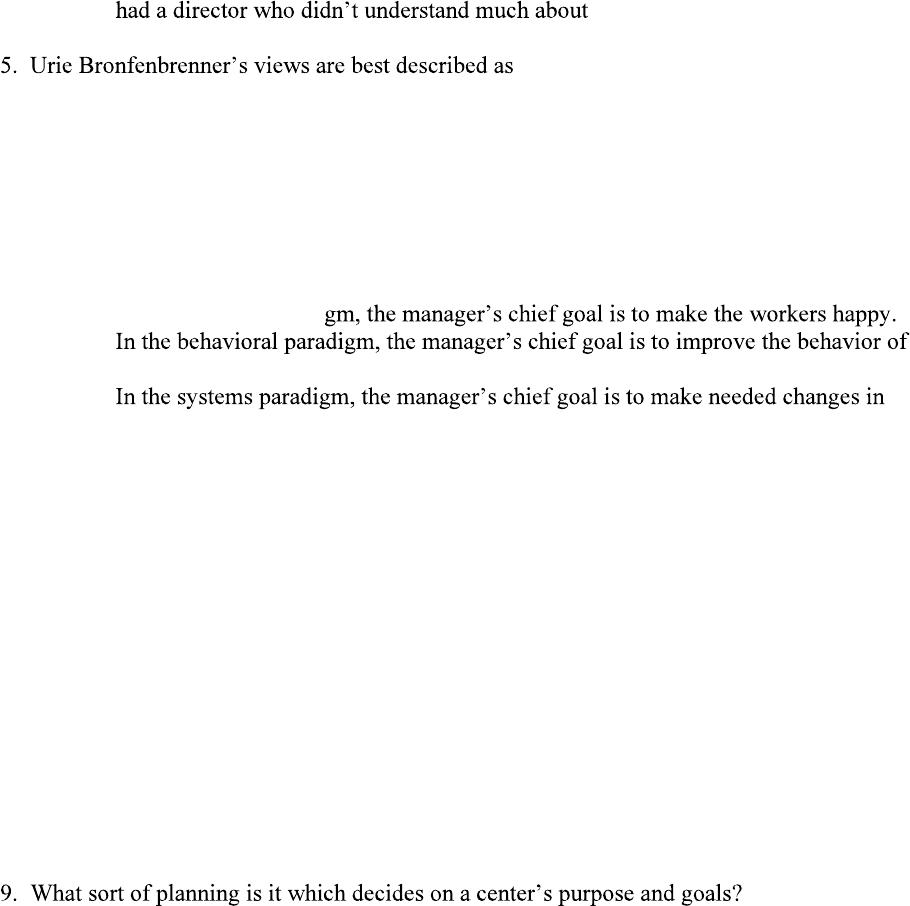
6. Which of the following statements is true of the theoretical paradigms of management?
a. In the classical paradi
b.
the workers.
c.
response to changes in the environment.
d. The three paradigms are pretty much the same.
7. If a child development program were to use the Total Quality Management Approach,
a. the employees and managers would share responsibility for determining policies.
b. the children would study Japanese.
c. a good preschool program would never change how it operates.
d. the employees would do whatever the managers asked them to do.
8. Planning which decides what jobs individual employees will do is:
a. operational.
b. tactical.
c. strategic.
d. none of the above
a. strategic.
b. tactical.
c. operational.
d. all of the above
12
10. A good leader:
a. takes part in community activities outside the center.
b. inspires the staff to do a good job.
c. makes choices and takes actions which are for the good of the center.
d. all of the above
55
Chapter 3
SHORT ANSWER:

56