
49
CHAPTER 15
ASSESSMENT AND EVALUATION
SHORT ANSWER
1. What are the evaluative and action functions needed to maintain high quality in any
service known as?
1 ___________________
2 ___________________
2. What are the steps in the monitoring and controlling process?
1 ___________________
2 ___________________
3 ___________________
4 ___________________
5 ___________________
3. When a good teacher notices that the children are not able to successfully do a planned
activity, what are two good alternatives for her to select?
1 ___________________
2 ___________________
4. What are the two kinds of evaluation that determine how well programs provide the
conditions needed for children to thrive?
1 ___________________
2 ___________________
TRUE OR FALSE
Please circle the correct answer.
1. Standards set a minimum level of quality for a particular purpose.
true
false
2. NAEYC accreditation has to do only with standards for physical space, nutrition, and
teacher qualifications. It has nothing to do with how a center is administered.
true
false
3. Licensing standards vary from state to state.
true
false
50
4. Observational assessments are likely to be more authentic than assessments using
standardized instruments.
true
false
5. When evaluating food service, as long as the children are eating the food and it does
not cost too much, that is all that you need to worry about.
true
false
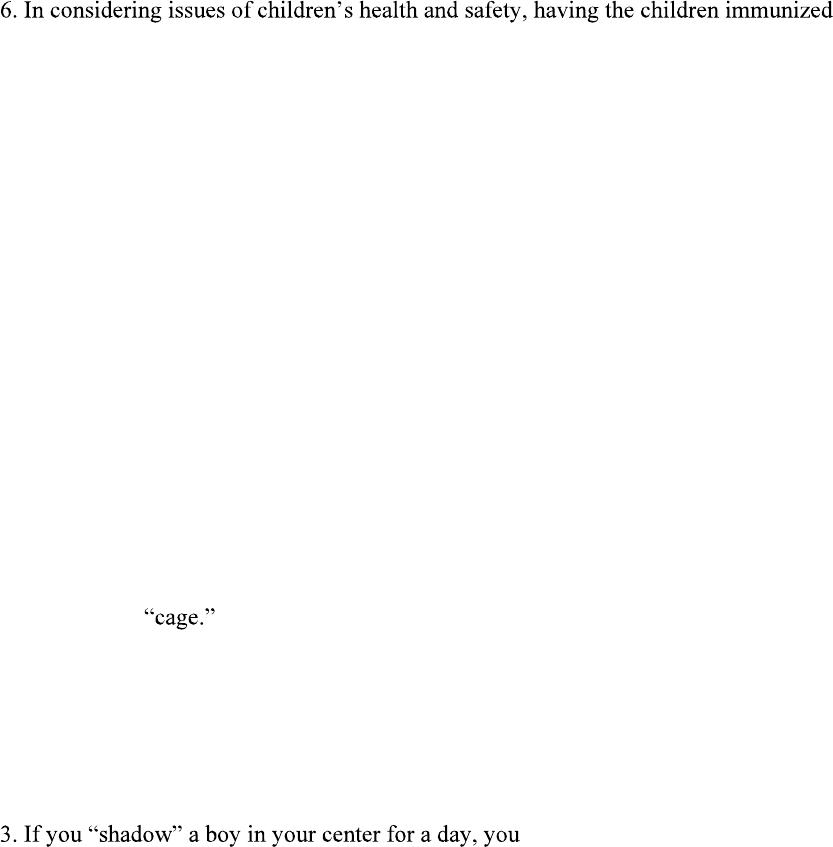
against childhood diseases is not really necessary.
true
false
MULTIPLE CHOICE
Select the best answer.
1. In 1995, a Cost, Quality and Child Outcomes in Child Care Centers Study found that
in the United States, most centers provided care that was:
a. very good.
b. good.
c. better than average.
d. bad to barely average.
2. In the example in this chapter, the solution to the time and space management
issues created by the infant-toddler group and the 3-to-5-year-old group sharing outside
time in the same location was building a fence to protect the infant-toddler group. This
was a good solution because:
a. the older children were amused by seeing the younger children in a
b. the solution allowed both teachers to find common ground and agree on a
resolution.
c. the teacher for the older children got what she wanted.
d. the teacher for the younger children did not understand the situation, but
got outside time anyway.
:
a. keep him inside out of the sun.
b. draw a picture of him with a dark pencil.
c. follow him and keep a record of what he says and does.
d. play a game with shadows on a screen.
4. Attempting to view your center from the standpoint of the children who attend it is
known as:
51
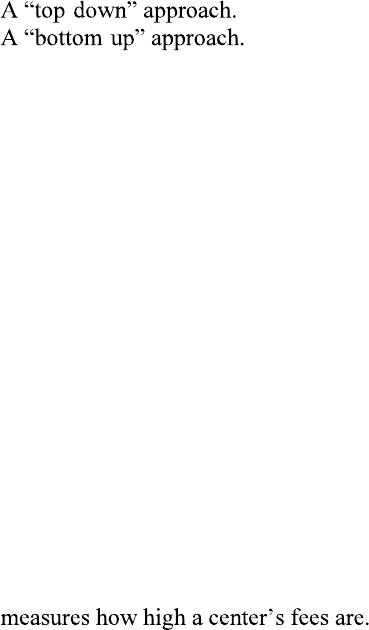
a. a behaviorist approach.
b. –
c. –
d. A Montessori approach.
5. Many early childhood professionals believe that a strong reliance on standardized
tests:
a. indicates that a center is of high quality.
b. will overshadow the importance of social, emotional and physical development.
c. will allow the center to charge higher fees.
d. none of the above
6. In performing evaluations of your staff members, it is best to use a system:
a. that remains secret.
b. that the staff vote on together
c. that lets the staff members do their own evaluations.
d. that the staff are able to review in advance
7. In contrast to assessment, evaluation:
a. measures how well a program is doing.
b.
c. measures were the children are developmentally.
d. Is always done only by an outside agency.
8. In dealing with parents, which of the following is absolutely essential?
a. having your advertisement and brochures up to date
b. having a clear understanding with your staff about who should deal with any
concerns that the parents might raise
c. keeping the parents informed about your policies on food services and health
d. all of the above
9. The Program Administration Scale devised by Talon and Bloom:
a. is broader in scope than many other scales.
b. applies only to centers affiliated with a college or university.
c. is required only if a center receives federal funds.
d. is no different from other scales used to assess programs.
10. NAEYC accreditation standards require:
a. a satisfactory score on every item.
b. a satisfactory score on 80% of the items.
c. a high score on one item to balance out a low score on another item.
52
d. all of the above
71
Chapter 15
SHORT ANSWER: