
39
CHAPTER 12
EDUCATIONAL PROGRAMMING
SHORT ANSWER
Accreditation Criteria focus on?
1 ___________________
2 ___________________
3 ___________________
4 ___________________
2. The High/Scope Curriculum is based on the theories of
___________________
3. The Project Approach favored by Lilian Katz is based on the theories of
_____________
4. According to the recommendations of the American Academy of Pediatrics, young children
over the age of 2 should be limited to how many hours of TV watching per day?
_______________
TRUE OR FALSE
Please circle the correct answer.
1. If state standards focus intently on development in one domain, there is a danger that the
result may be to neglect other domains that are equally important.
true
false
2. A developmentally appropriate program believes that children need intensive instruction in
the areas in which they are weak.
true
false
3. A developmentally appropriate program believes that if children are allowed to think for
themselves, they will develop wrong ways of thinking that will hurt them later in school.
true
false
4. When adults disregard what children are interested in and attempt to teach them things that
they will need later in school, there is a real danger that what really happens is that
development will be slowed.
40
true
false
5. In order to become a Reggio Emilia certified school, the manager of the school must study in
Italy.
true
false
MULTIPLE CHOICE
Select the best answer.
1. What is the chief difference between licensing and accreditation?
a. Accreditation is required, while licensing is optional.
b. Centers with only a few children can be licensed, while one with many more children
has to be accredited.
c. Accreditation has higher standards than licensing.
d. These are two words for the same process.
2. Which of the following statements in NOT true of the NAEYC accreditation standards?
a. -worth.
b. The program stresses academics, to prepare each child for kindergarten.
c. The program is sensitive to issues of being developmentally and culturally sensitive.
d. The program promotes learning in several domains.
that:
a. the school demonstrates a concern for the natural environment.
b. the school demonstrates concern for the man-made environment
c. the school makes sure that everything is prepared before the start of the day.
d. The school has child-sized furnishings and materials displayed on low shelves
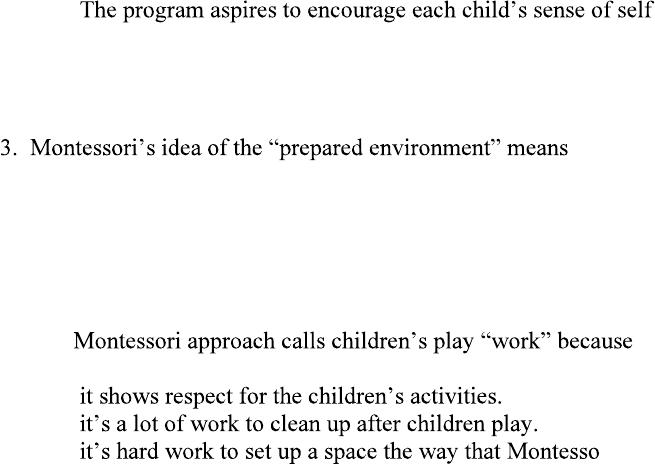
4. The :
a.
b.
c. ri wants it.
d. all of the above
5. How does the thematic approach differ from the project approach?
a. The thematic approach uses complex ideas, while the project approach is just playing.
b. The thematic approach is more appropriate for mature children.
41
c. The project approach stems from what the children appear to be interested in.
d. There is no real difference.
6. How does the Reggio Emilia approach view children?
a. As wild creatures who need to be tamed
b. As immature people who need a lot of teaching
c. As empty minds that need to be filled with knowledge
d. As capable, competent people who have a right to learn at their own pace
7. The work of Elena Bodrova and Deborah Leong draws heavily on the theories of:
a. Piaget.
b. Vygotsky.
c. John Dewey.
d. Lilian Katz.
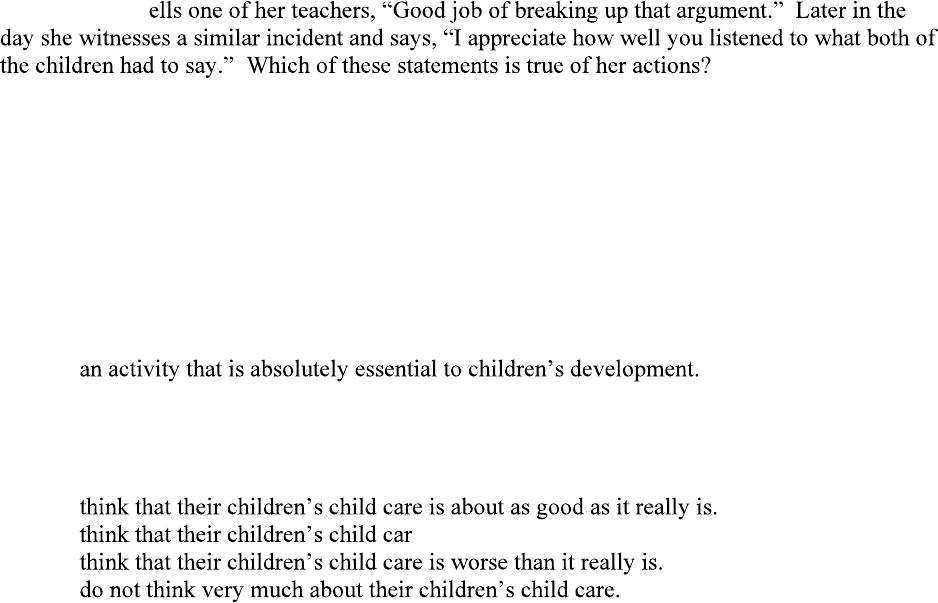
8. A manager t
a. The first time she was engaging in praise, and the second time in encouragement.
b. In both instances she was engaging in praise.
c. The first time she was engaging in encouragement, and the second time in praise.
d. There was no difference in what she did.
9. When it comes to scheduling time for various activities, play is considered:
a. something not as important as real learning.
b. something that is necessary but should be limited.
c.
d. something that is acceptable for children who are not very smart.
10. According to the survey done by the Cost, Quality & Child Outcomes Team, most parents:
a.
b. e is better than it really is.
c.
d.
11. Interesting, enriching experiences for children are most likely to happen if we:
a. drill them on what they need to know in kindergarten.
b. just let them do whatever they feel like doing.
c. have a large budget for equipment and supplies.
d. plan activities carefully after noticing what excites their interest.

67
Chapter 12
SHORT ANSWER: