Which of the following would not be accounted for using the prospective approach? A.
A change to LIFO from FIFO for inventory costing.
B. A change in price indexes used under the LIFO method of inventory costing.
C. A change in estimate.
D. A change from the cash basis to accrual accounting.
Answer:
Ignatius Corporation had 7 million shares of common stock outstanding during the
current calendar year. It issued ten thousand $1,000, convertible bonds on January 1.
Each bond is convertible into 50 shares of common stock. The bonds were issued at
face amount and pay interest quarterly at an annual rate of 10%. On June 30, Ignatius
issued 100,000 shares of $100 par 6% cumulative preferred stock. Dividends are
declared and paid semiannually. Ignatius has an effective tax rate of 40%. Ignatius
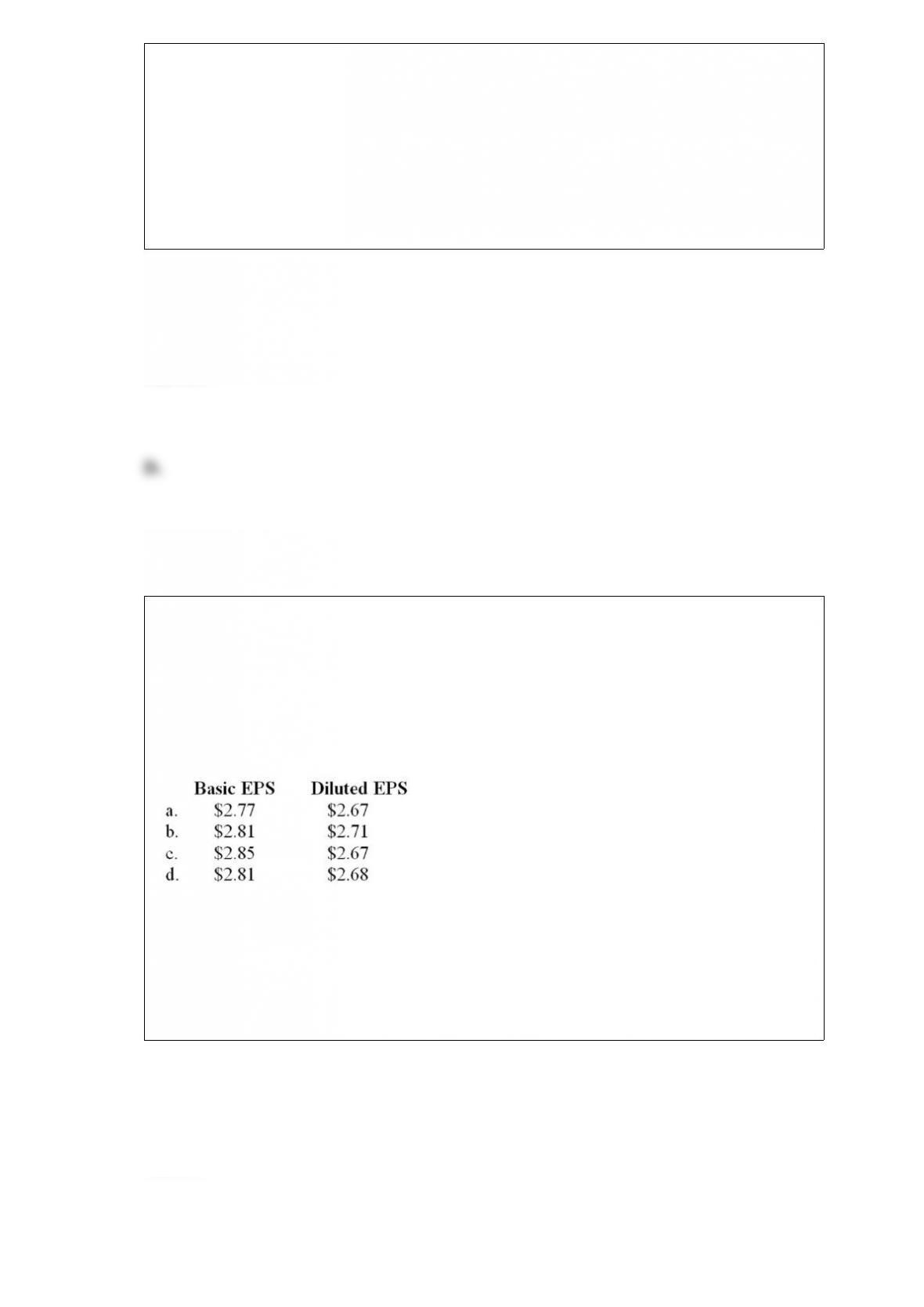
would report the following EPS data (rounded) on its net income of $20 million:
A. Option a
B. Option b
C. Option c
D. Option d
Answer:

When an equipment dealer receives a long-term note in exchange for equipment, the
present value of the future cash flows received on the notes: A. Is treated as a current
liability at the exchange date.
B. Is recorded as interest revenue at the exchange date.
C. Is recorded as interest receivable at the exchange date.
D. Is credited to sales revenue at the exchange date.
Answer:
When bonds and other debt are issued, costs such as legal costs, printing costs, and
underwriting fees are referred to as debt issuance costs (called transaction costs under
IFRS). If Brown Imports prepares its financial statements using IFRS: A. The increase
in the effective interest rate caused by the transaction costs is reflected in the interest
expense.
B. The decrease in the effective interest rate caused by the transaction costs is reflected
in the interest expense.
C. The transaction costs are recorded separately as an asset.

D. The recorded amount of the debt is increased by the transaction costs.
Answer:
Data for 2013 were as follows: PBO, January 1, $240,000 and December 31, $270,000;
pension plan assets (fair value) January 1, $180,000, and December 31, $230,000. The
projected benefit obligation was underfunded at the end of 2013 by: A. $30,000.
B. $60,000.
C. $20,000.
D. $40,000.
Answer:
ATC’s inventory turnover ratio for 2013 is: A. 2.42.
B. 2.76.
C. 3.21.

D. None of the above is correct.
Answer:
A statement of cash flows and its related disclosure note typically do not report: A. An
acquisition of the use of a building with a lease agreement.
B. The purchase of treasury stock.
C. Stock dividends.
D. Notes payable issued for a tract of land.
Answer:
Giada Foods reported $940 million in income before income taxes for 2013, its first
year of operations. Tax depreciation exceeded depreciation for financial reporting
purposes by $100 million. The company also had non-tax-deductible expenses of $80
million relating to permanent differences. The income tax rate for 2013 was 35%, but
the enacted rate for years after 2013 is 40%. The balance in the deferred tax liability in
the December 31, 2013, balance sheet is: A. $16 million.
B. $35 million.
C. $40 million.
D. $56 million.
Answer:
On November 1, 2013, Jamison Inc. adopted a plan to discontinue its barge division,
which qualifies as a separate component of the business according to GAAP regarding
discontinued operations. The disposal of the division was expected to be concluded by
April 30, 2014. On December 31, 2013, the company’s year-end, the following
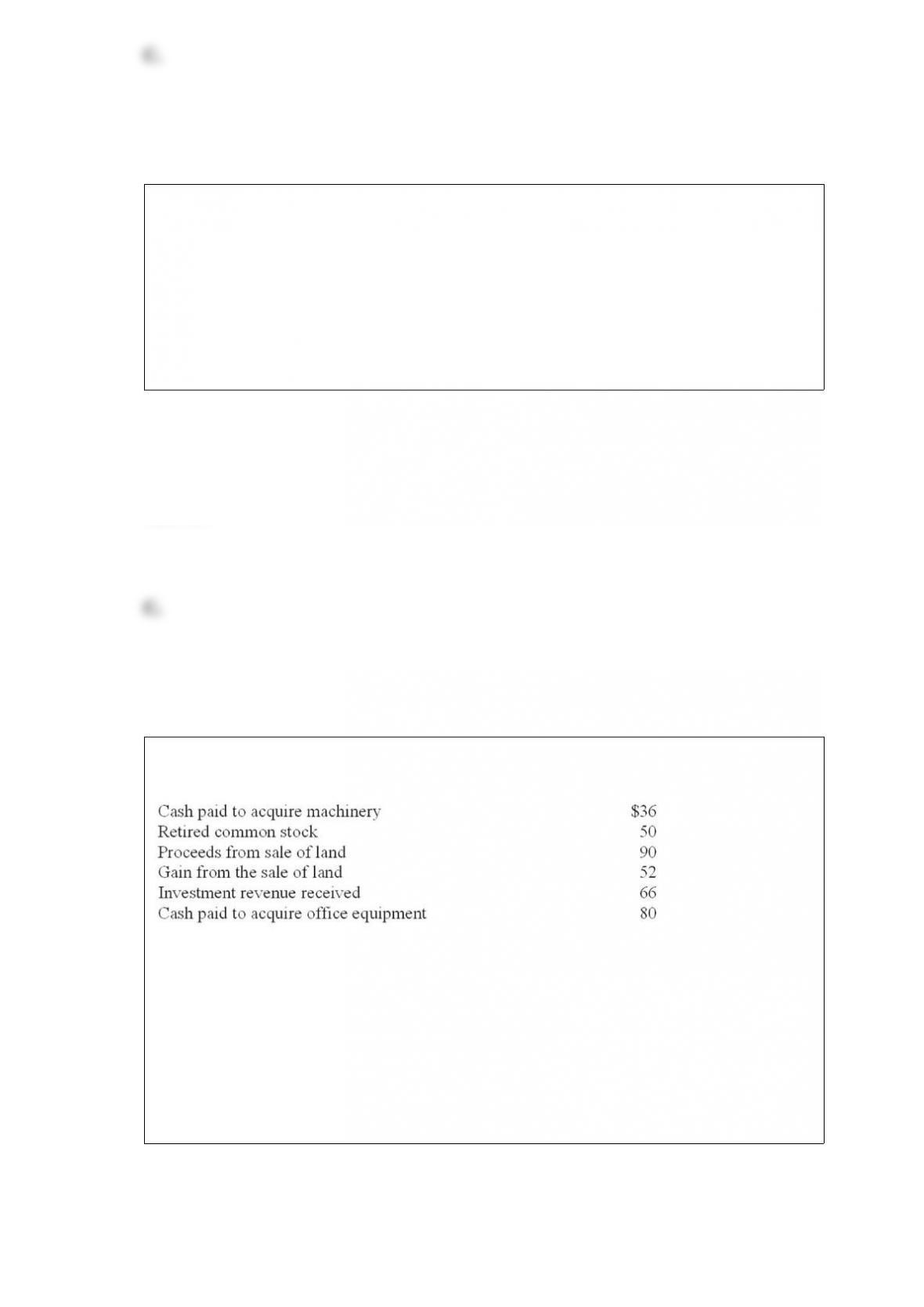
information relative to the discontinued division was accumulated:
In its income statement for the year ended December 31, 2013, Jamison would report a
before-tax loss on discontinued operations of: A. $65 million.
B. $50 million.
C. $130 million.
D. $145 million.
Answer:

In the statement of cash flows, by using the indirect method for determining cash flows
from operating activities, a decrease in deferred tax liabilities is:A. Added to net
income.
B. Subtracted from net income.
C. Ignored.
D. Included under financing activities.
Answer:
Gore Inc. recorded a liability in 2013 for probable litigation losses of $2 million.
Ultimately, $5 million in legitimate warranty claims were filed by Gore’s customers. A.
Gore has made a change in accounting principle, requiring retrospective adjustment.
B. Gore needs to correct an accounting error.
C. Gore is required to adjust a change in accounting estimate prospectively.
D. Gore is not required to make any accounting adjustments.
Answer:
Two of the three primary account classifications within shareholders’ equity are: A.
Preferred stock and retained earnings.
B. The par value of common stock and retained earnings.
C. Paid-in capital and retained earnings.
D. Preferred and common stock.
Answer:
Selected information from Peridot Corporation’s accounting records and financial
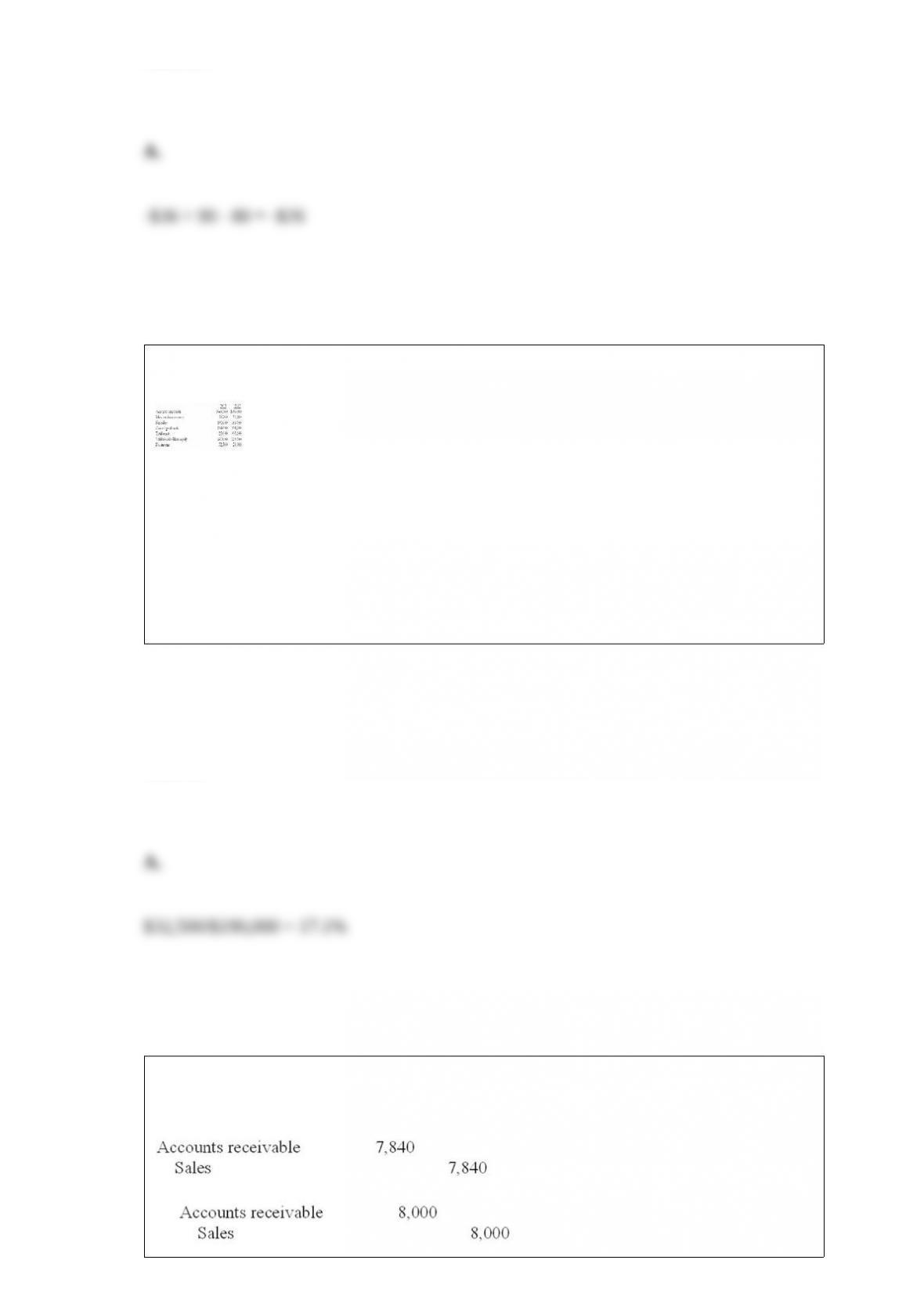
statements for 2013 is as follows ($ in millions):
In its statement of cash flows, Peridot should report net cash outflows from investing
activities of: A. $26 million.
B. $46 million.
C. $72 million.
D. $78 million.
Answer:
Excerpts from Hulkster Company’s December 31, 2013 and 2012, financial statements
are presented below:
Hulkster’s 2013 profit margin is (rounded): A. 17.1%.
B. 13.5%.
C. 7.6%.
D. 4.5%.
Answer:
On November 10 of the current year, Flores Mills sold carpet to a customer for $8,000
with credit terms 2/10, n/30. Flores uses the gross method of accounting for cash
discounts. What is the correct entry for Flores on November 10? A.
B.
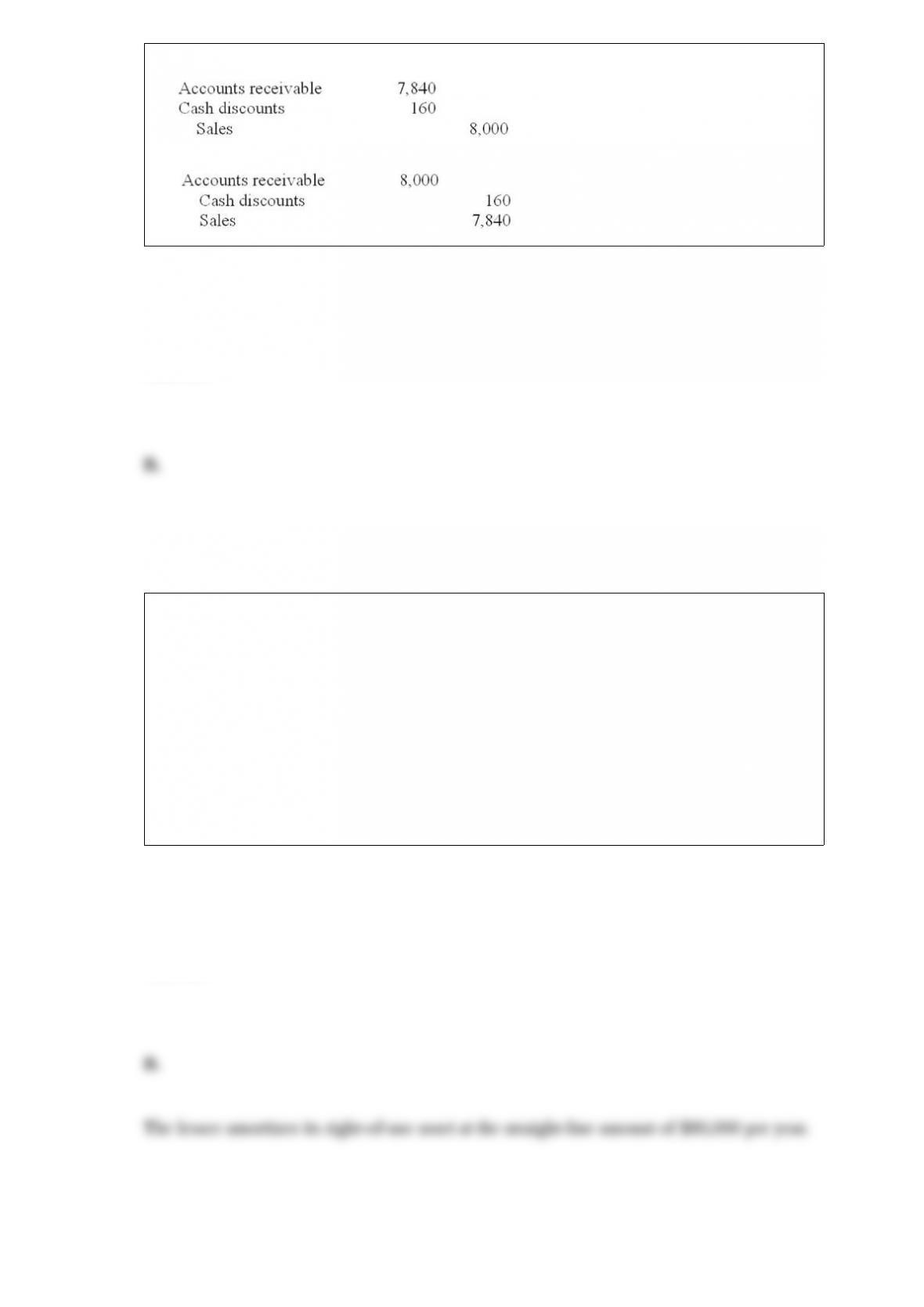
C.
D.
Answer:
Warren Co. recorded a right-of-use asset of $800,000 in a 10-year lease under which no
profit was recorded at commencement by the lessor. The interest rate charged the lessee
was 10%. Under the new ASU, the balance in the right-of-use asset after two years will
be: A. $648,000.
B. $640,000.
C. $880,000.
D. $968,000.
Answer:

In each succeeding payment on an installment note:A. The amount of interest paid
increases.
B. The amount of principal paid increases.
C. The amount of interest paid is unchanged.
D. The amounts paid for both interest and principal increase proportionately.
Answer:
The amount of impairment loss is the excess of book value over: A. Carrying value.
B. Undiscounted future cash flows.
C. Fair value.
D. Future revenues.
Answer:
Which is a shareholders’ equity account in the balance sheet? A. Accumulated
depreciation.
B. Paid-in capital.

C. Dividends payable.
D. Marketable securities.
Answer:
On September 30, 2013, Bricker Enterprises purchased a machine for $200,000. The
estimated service life is 10 years with a $20,000 residual value. Bricker records
partial-year depreciation based on the number of months in service. Depreciation (to the
nearest dollar) for 2013, using sum-of-the-years’ digits, would be: A. $9,091.
B. $24,545.
C. $27,273.
D. $8,182.
Answer:
Retained earnings represent: A. Earned capital.
B. Cash.

C. Assets.
D. Net assets.
Answer:
Amortizing a net gain for pensions and other postretirement benefit plans will: A.
Increase retained earnings and increase accumulated other comprehensive income.
B. Decrease retained earnings and decrease accumulated other comprehensive income.
C. Increase retained earnings and decrease accumulated other comprehensive income.
D. Decrease retained earnings and increase accumulated other comprehensive income.
Answer:
During 2013, Angel Corporation had 900,000 shares of common stock and 50,000
shares of 6% preferred stock outstanding. The preferred stock does not have cumulative
or convertible features. Angel declared and paid cash dividends of $300,000 and
$150,000 to common and preferred shareholders, respectively, during 2013.
On January 1, 2012, Angel issued $2,000,000 of convertible 5% bonds at face value.
Each $1,000 bond is convertible into five common shares.
Angel’s net income for the year ended December 31, 2013, was $6 million. The income
tax rate is 20%.
What will Angel report as diluted earnings per share for 2013, rounded to the nearest
cent? A. $6.43.
B. $6.25.
C. $6.22.
D. None of these is correct.
Answer:
The compensation associated with executive stock option plans is: A. The book value of
a share of the company’s shares times the number of options.
B. The estimated fair value of the options.
C. Allocated to expense over the number of years until expiration.
D. Recorded as compensation expense on the date of grant.
Answer:
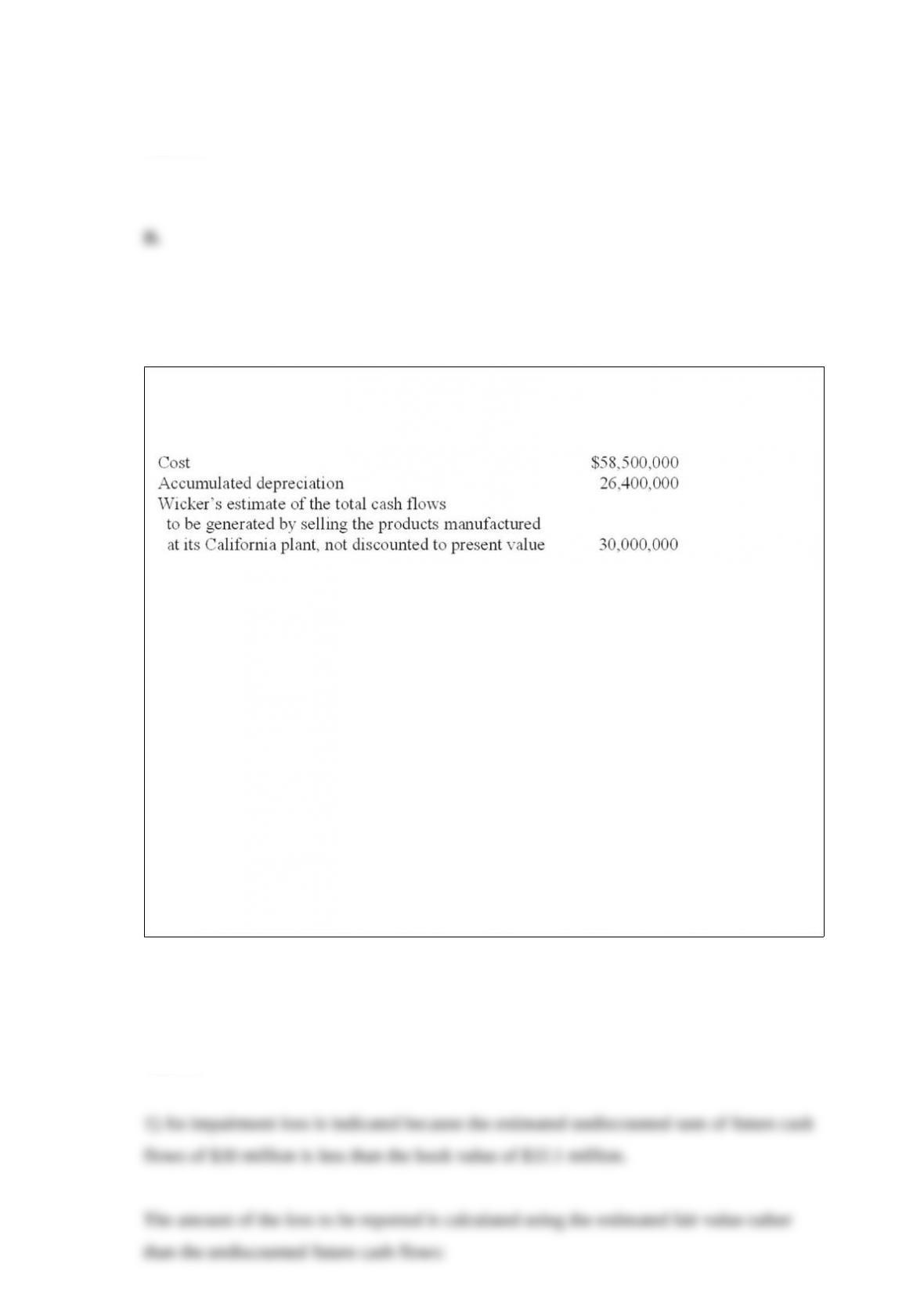
Wicker Corporation operates a manufacturing plant in California. Due to a change in
business climate, an impairment test is deemed appropriate. Management has acquired
the following information for the assets at the plant:
The fair value of the California plant is estimated to be $24,000,000.
Required:
1. Determine the amount of impairment loss, if any.
2. If a loss is indicated, where would it appear in Wicker’s multiple-step income
statement?
3. If a loss is indicated, prepare the entry to record the loss.
4. Repeat requirement 1 assuming that the estimated undiscounted sum of future cash
flows is $27,000,000 instead of $30,000,000.
5. Repeat requirement 1 assuming that the estimated undiscounted sum of future cash
flows is $34,000,000 instead of $30,000,000.
Answer:
Information for Kent Corp. for the year 2013:
Reconciliation of pretax accounting income and taxable income:
Cumulative future taxable amounts all from depreciation temporary differences:
The enacted tax rate was 30% for 2012 and thereafter.
What should Kent report as the current portion of its income tax expense in the year
2013? A. $45,900.
B. $49,500.
C. $54,000.
D. None of the above is correct.
Answer:
Murgatroyd Co. purchased equipment on January 1, 2011, for $500,000, estimating a
four-year useful life and no residual value. In 2011 and 2012, Murgatroyd depreciated
the asset using the sum-of-years’-digits method. In 2013, Murgatroyd changed to
straight-line depreciation for this equipment. What depreciation would Murgatroyd
record for the year 2013 on this equipment? A. $75,000.
B. $125,000.
C. $150,000.
D. None of the above is correct.
Answer:

On June 30, 2013, Prego Equipment purchased a precision laser-guided steel punch that
has an expected capacity of 300,000 units and no residual value. The cost of the
machine was $450,000 and is to be depreciated using the units-of-production method.
During the six months of 2013, 24,000 units of product were produced. At the
beginning of 2014, engineers estimated that the machine can realistically be used to
produce only another 230,000 units. During 2014, 70,000 units were produced.
Prego would report depreciation in 2013 of: A. $36,000.
B. $43,900.
C. $18,000.
D. $21,950.
Answer:
When using the cost recovery method of accounting for long-term contracts under
IFRS, early in the life of the contract it is typically the case that:A. Expenses in excess
of revenues are recognized.
B. Revenues in excess of expenses are recognized.
C. An equal amount of revenue and expense is recognized.
D. There is no predictable pattern of revenue and expense.
Answer:
A 10% stock dividend is reported in connection with a statement of cash flows as: A. A
financing activity.
B. An investing activity.
C. A noncash activity.
D. Not reported in the statement of cash flows.
Answer:
Spartan Sportswear’s current assets consist of cash, marketable securities, accounts
receivable, and inventories. The following data were abstracted from a recent financial
statement:
Required:
Compute the following for Spartan:

Noncurrent assets
Answer:
Atlas Trucking incurred the following costs during 2013:
1) Spent $15,000 on a major overhaul for a tractor-trailer rig. The overhaul is expected
to increase the service life of the rig by three years.
2) Repaired the air-conditioning system for $3,000.
3) Rearranged and reconfigured the maintenance, loading, and unloading facilities at a
cost of $75,000. The rearrangement is expected to result in substantial cost savings and
increased efficiency over the next several years.
Required:
Prepare journal entries to record the above costs.
Answer:
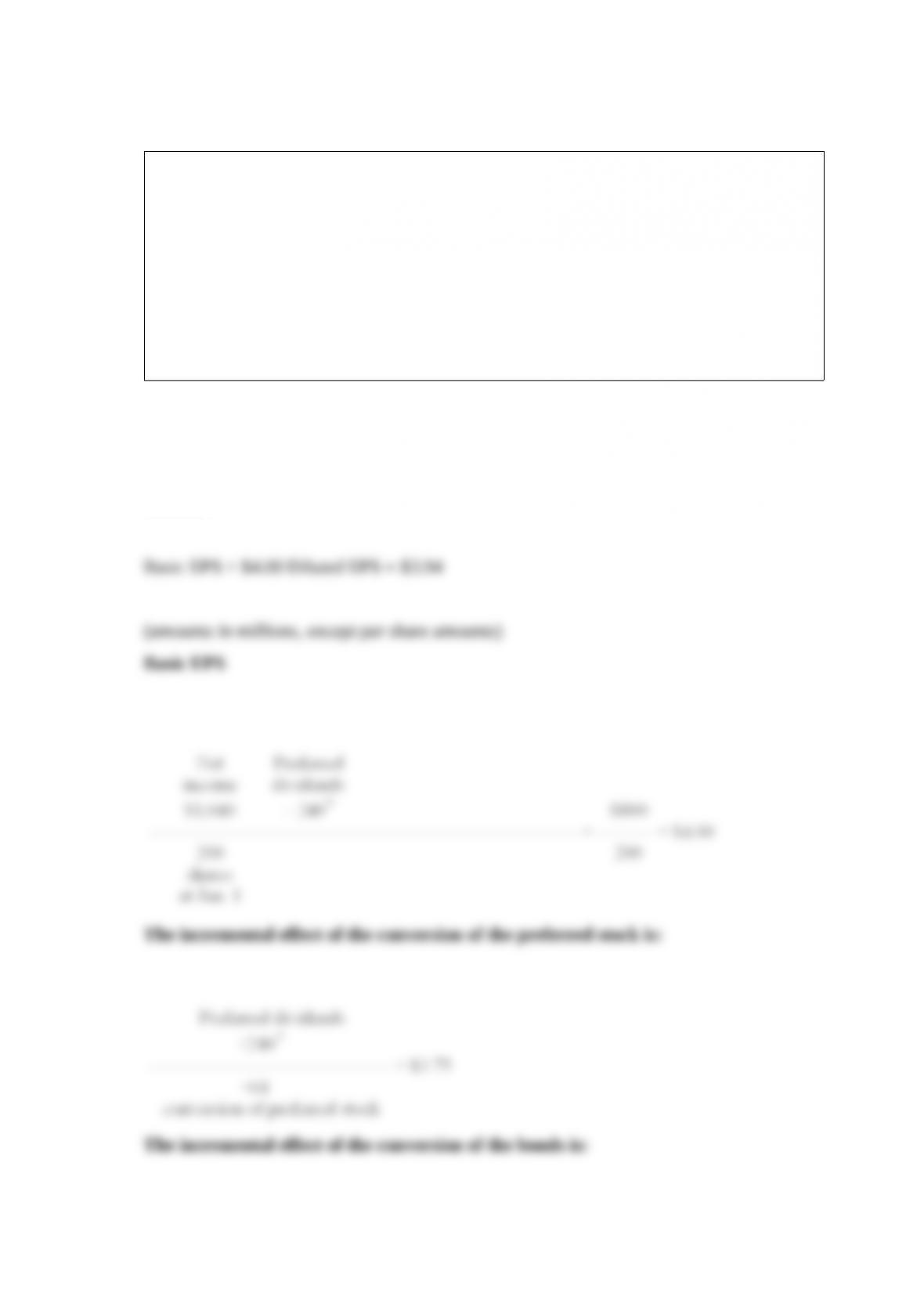
At December 31, 2013, MedX Corporation had outstanding 200,000 shares of common
stock. Also outstanding were 120,000 shares of preferred stock convertible into 64,000
common shares and $1,800,000 of 10% bonds convertible into 27,000 common shares
MedX’s net income for the year ended December 31, 2013, is $1,040,000. The income
tax rate is 40%. MedX paid dividends of $2 per share on its preferred stock during
Required:
Compute basic and diluted earnings per share for the year ended December 31, 2013,
considering possible antidilutive effects.
Answer:
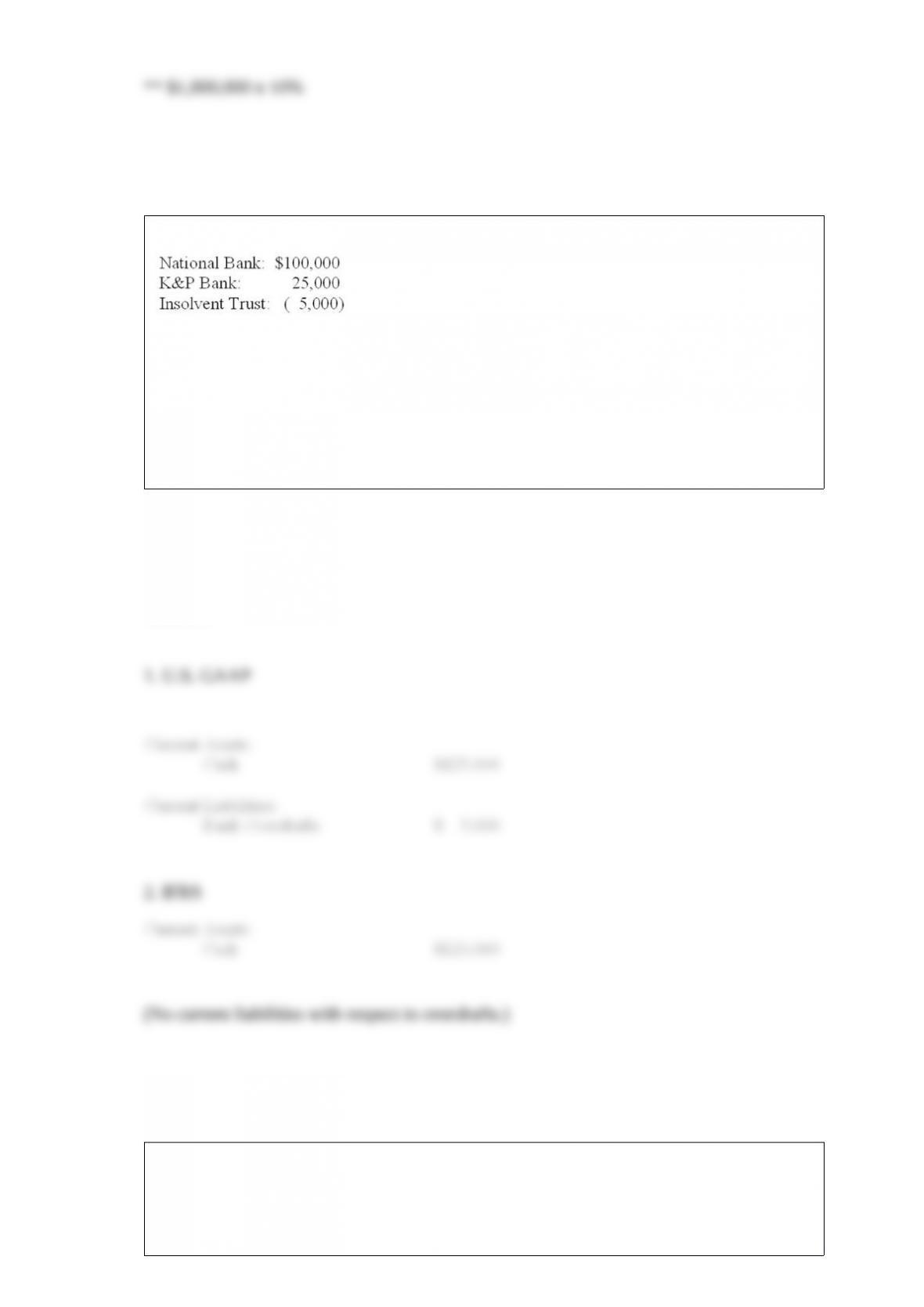
Costa Co. has the following cash balances at local banks as of 12/31/2013:
Required:
1. Prepare the Current Assets and Current Liabilities section of Costa’s 2013 balance
sheet, assuming Parker reports under U.S. GAAP.
2. Prepare the Current Assets and Current Liabilities section of Costa’s 2013 balance
sheet, assuming Parker reports under IFRS.
Answer:
At the beginning of 2013, Scarlet Industries began offering a three-year warranty on its
products. The warranty program was expected to cost Scarlet 2% of net sales,
approximately equally over the three-year warranty period. Net sales made under
warranty in 2013 were $270 million. Thirteen percent of the units sold were returned in

2013 and repaired or replaced at a cost of $2 million. This amount was debited to
warranty expense as incurred.
Required:
Prepare the appropriate adjusting entry to adjust warranty expense on December 31,
2013. Show calculations.
Answer:
Iowa Development (ID) made the following land sales and had the following cash
collections:
Assume ID cannot estimate uncollectible accounts accurately and recognizes revenue
using the cost recovery method.
Required: Prepare journal entries to record the sale, cash collections, and recognition
of gross profit (if appropriate) in 2012 and
Answer:
Bourne, Inc., acquired 50% of David Webb Enterprises for $5,000,000 on January 1,
2013. The total fair value and book value of Webb’s identifiable net assets was
$8,000,000 on that date. During 2013 Webb recognized net income of $1,000,000 and
paid dividends of $1,200,000. Webb had a fair value of $11,000,000 as of December 31,
Required:
Determine the amounts that will be associated with the Investment in Webb account and
the Goodwill on Bourne’s balance sheets, assuming Bourne accounts for the Webb
investment (1) under the equity method under IFRS, and (2) under proportionate
consolidation as allowed by IFRS.
Answer:
Muller Corp. pays its employees monthly. The payroll information listed below is for
January 2013, the first month of Muller’s fiscal year.
Required:
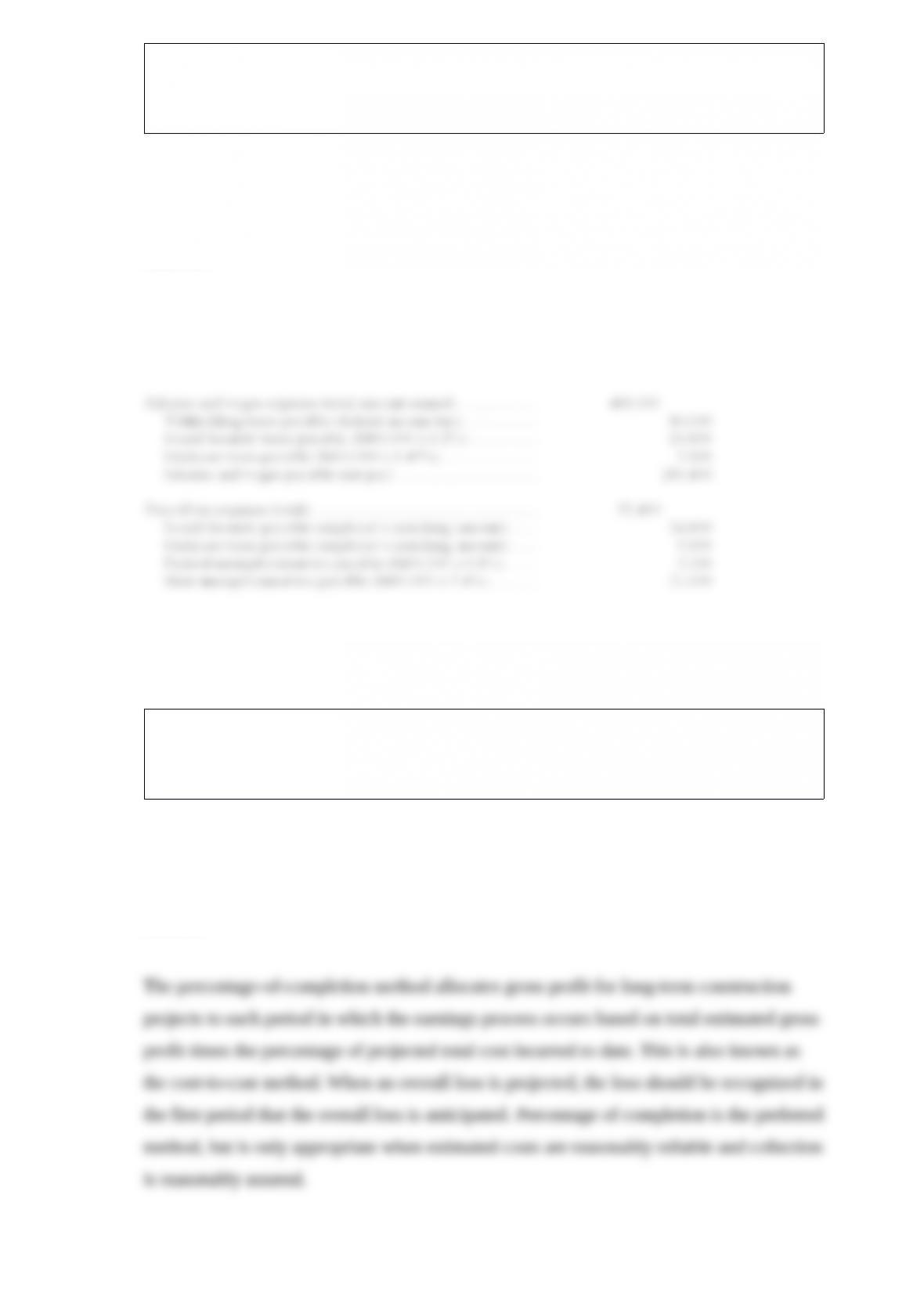
Prepare the appropriate journal entries to record salaries and wages expense and payroll
tax expense for the January 2013 pay period.
Answer:
Briefly explain how gross profit is recorded under the percentage-of-completion
method of accounting for long-term construction projects. Also explain when this
method should be used.
Answer:
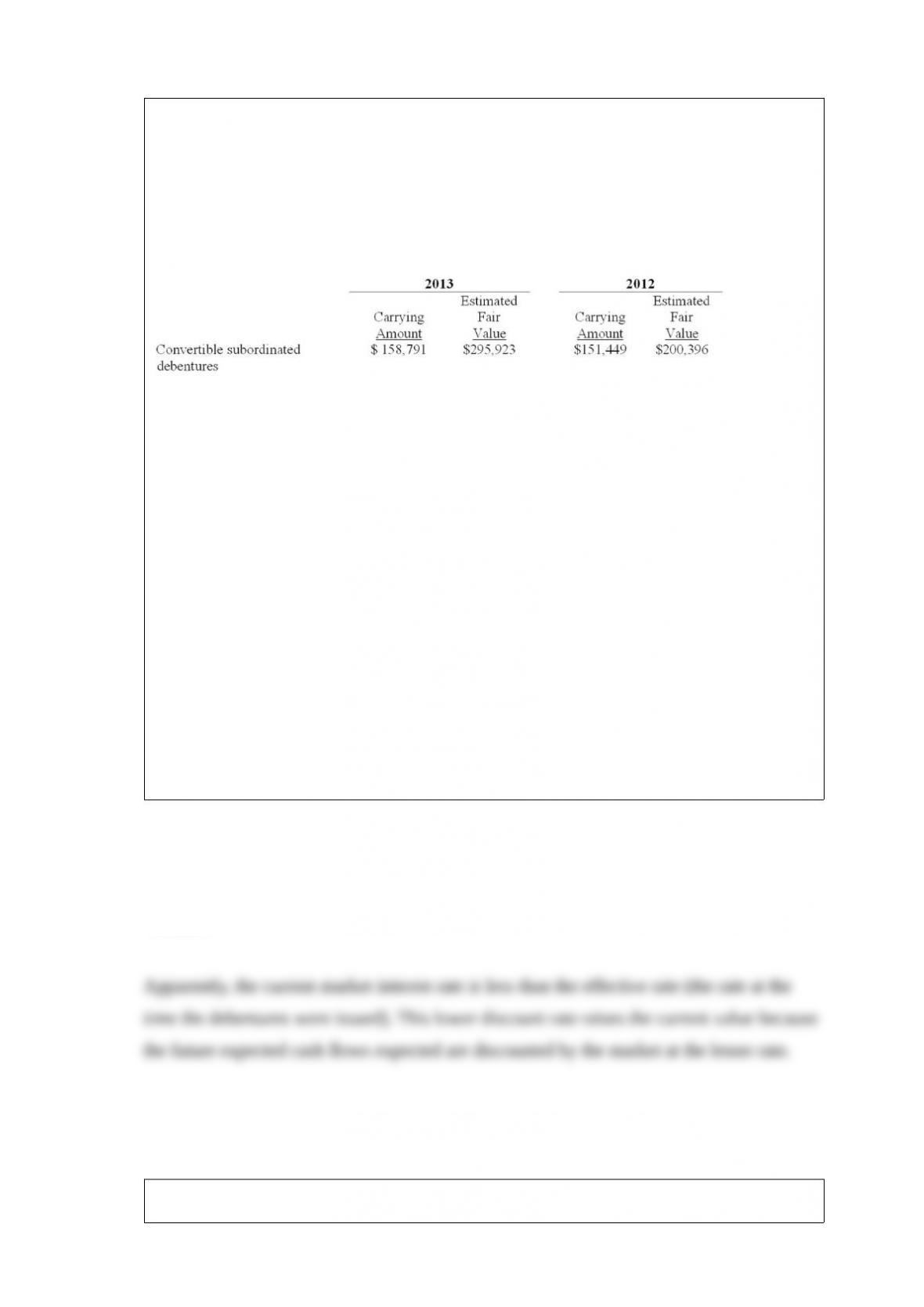
In its 2013 annual report to shareholders, Health Foods, Inc., disclosed the following
information about some of its indebtedness:
The fair value of convertible subordinated debentures is estimated using quoted market
prices. Carrying amounts and estimated fair values of our financial instruments other
than those for which carrying amounts approximate fair values as noted above are as
follows (in thousands)
In addition, the company disclosed the following:
We have outstanding zero coupon convertible subordinated debentures which had a
carrying amount of approximately $158.8 million and $151.4 million at September 26,
2013, and September 28, 2012, respectively. The debentures have an effective yield to
maturity of 5 percent and a principal amount at maturity on March 2, 2027, of
approximately $308.8 million. The debentures are convertible at the option of the
holder, at any time on or prior to maturity, unless previously redeemed or otherwise
purchased. The debentures have a conversion rate of 10.640 shares per $1,000 principal
amount at maturity, representing 3,285,632 shares. The debentures may be redeemed at
the option of the holder on March 2, 2017, or March 2, 2022, at the issue price plus
accrued original discount totaling approximately $188 million and $241 million,
respectively.
Required:
Explain why the estimated fair value of the debentures exceeds their carrying amount at
the end of fiscal year 2013.
Answer:
Missoula Inc. reported the following selected financial statement data:
Required: Compute the receivables turnover ratio for 2013.
Answer:
Answer:
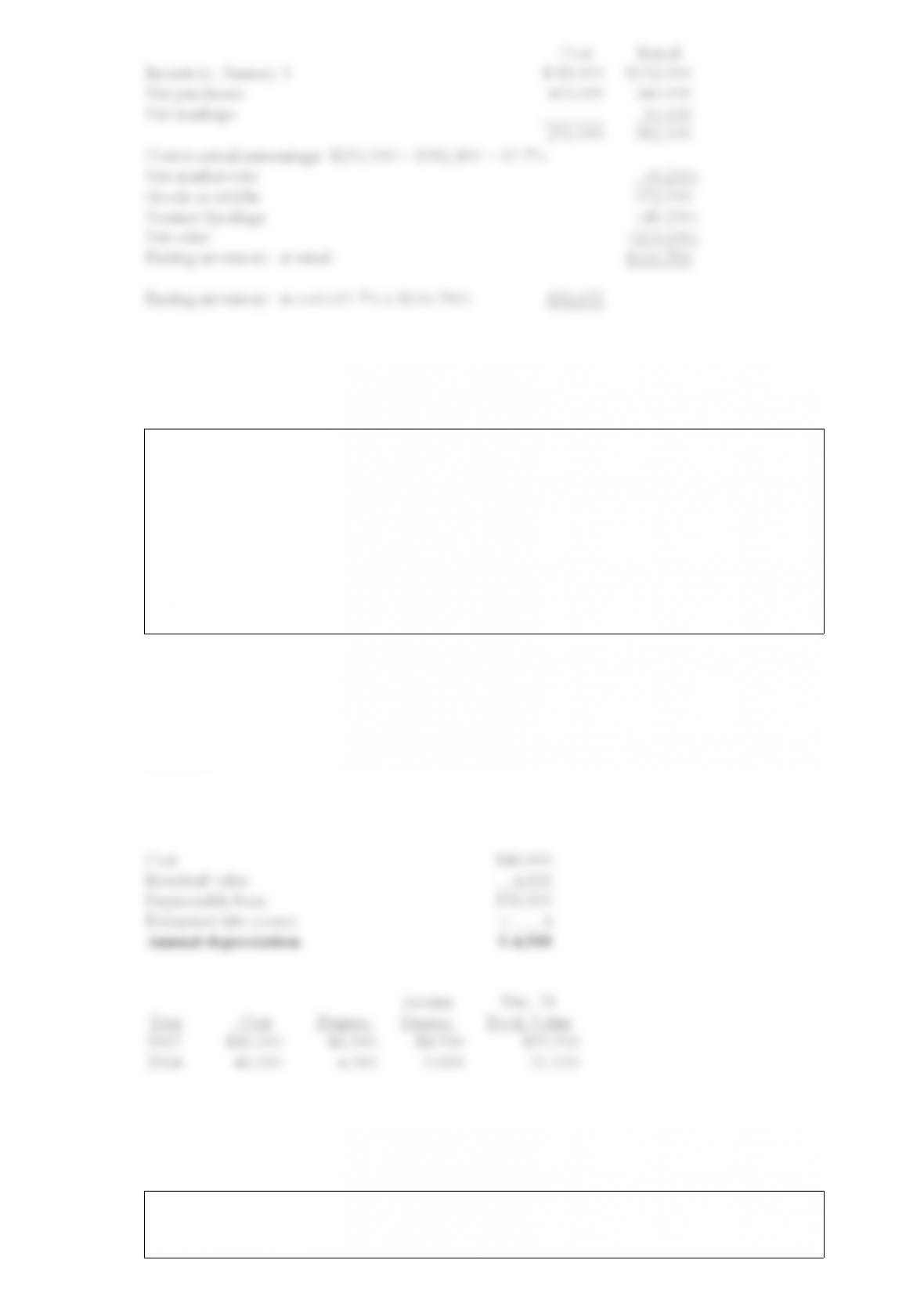
Zanesville Pots Co. uses the conventional retail method to estimate ending inventories.
The following data has been summarized for the year ended December 31, 2013:
Required:
Estimate the cost of ending inventory applying the conventional retail method.
Answer:
On January 1, 2013, Morrow Inc. purchased a spooler at a cost of $40,000. The
equipment is expected to last eight years and have a residual value of $4,000. During its
eight-year life, the equipment is expected to produce 250,000 units of product. In 2013
and 2014, 42,000 and 76,000 units respectively were produced.
Required:
Compute depreciation for 2013 and 2014 and the book value of the spooler at
December 31, 2013 and 2014, assuming the straight-line method is used.
Answer:
What are the key provisions of the Public Company Accounting Reform and Investor
Protection (Sarbanes-Oxley) Act of 2002?
Answer: