
A company purchased a new truck at a cost of $42,000 on July 1, 2009. The truck is
estimated to have a useful life of 6 years and a salvage value of $3,000. The company
uses the straight-line method of depreciation. How much depreciation expense will be
recorded for the truck for the year ended December 31, 2009?
A.$3,250.
B.$3,500.
C.$4,000.
D.$6,500.
E.$7,000.
Technology
A.Has replaced accounting.
B.Has not changed the work that accountants do.
C.Has closely linked accounting with consulting, planning, and other financial services.
D.In accounting has replaced the need for decision makers.
E.In accounting is only available to large corporations.

A difficult problem in calculating the total costs and expenses of a department is:
A.Determining the gross profit ratio.
B.Assigning direct costs to the department.
C.Assigning indirect expenses to the department.
D.Determining the amount of sales of the department.
E.Determining the direct expenses of the department.
If a company applies overhead to production with a predetermined rate, a credit balance
in the Factory Overhead account at the end of the period means that:
A.The bookkeeper has made an error because the debits don’t equal the credits.
B.The balance will be carried forward to the next period as an overhead cost.
C.Actual overhead was less than the overhead amount charged to production.
D.The overhead was underapplied for the period.
E.Actual overhead was greater than the overhead amount charged to production.
Estimated liabilities commonly arise from:
A.Warranties.
B.Vacation benefits.

C.Income taxes.
D.Employee benefits.
E.All of these.
Yamaguchi Company’s break even point in units is 1,000. The sales price per unit is $10
and variable cost per unit is $7. If the company sells 2,500 units, what will net income
be?
A.$ 4,500
B.$ 7,500
C.$17,000
D.$35,000
E.Fixed costs must be known in order to predict net income.
Louise Company reported the following income statement information for Year 1 and
Year 2:
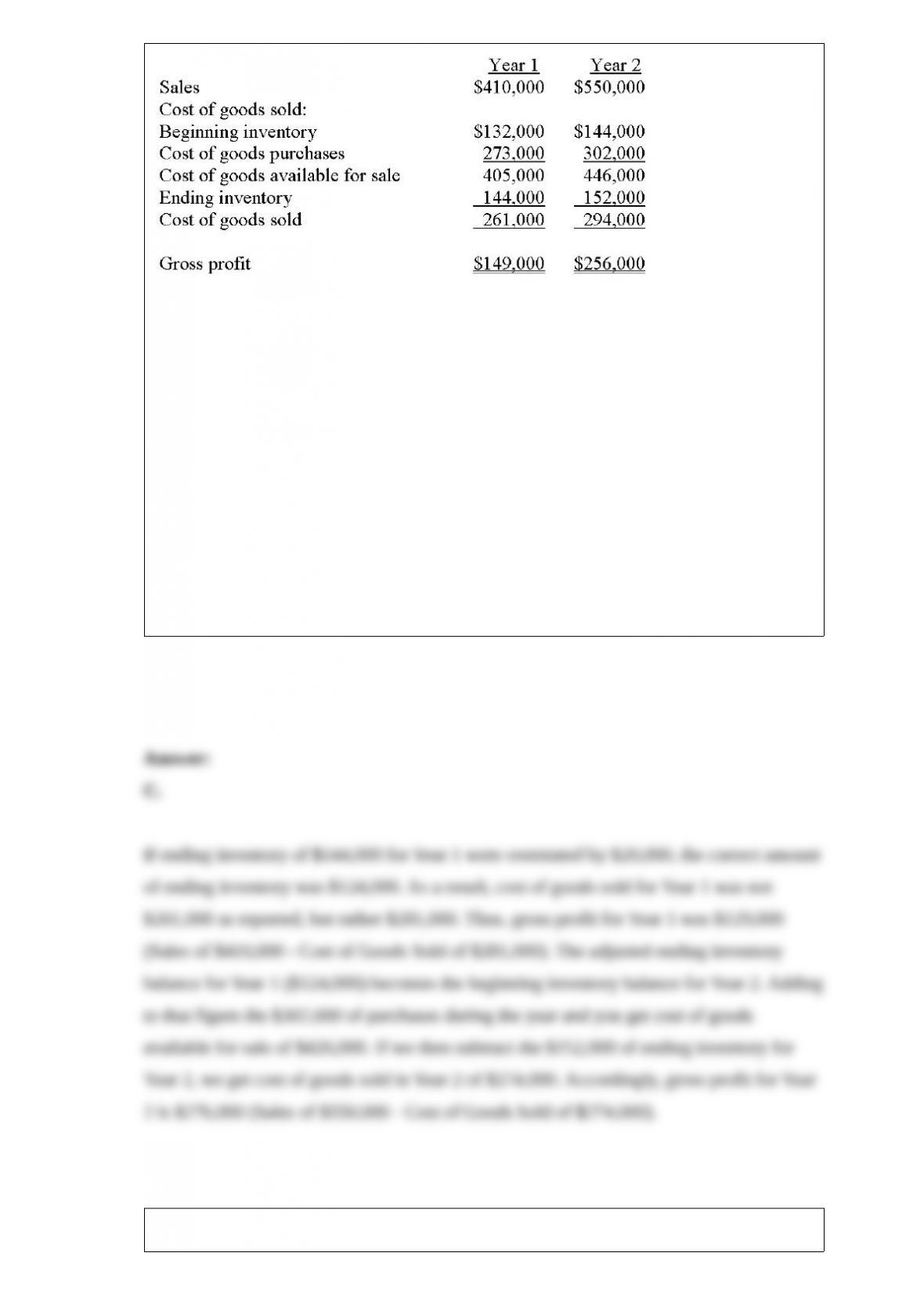
The beginning inventory balance for Year 1 is correct. The ending inventory balance for
Year 2 is also correct. However, the ending inventory figure for Year 1 was overstated
by $20,000. Given this information, the correct gross profit figures for Year 1 and Year
2 would be:
A.$129,000 for Year 1 and $256,000 for Year 2.
B.$281,000 for Year 1 and $274,000 for Year 2.
C.$129,000 for Year 1 and $276,000 for Year 2.
D.$169,000 for Year 1 and $236,000 for Year 2.
E.$169,000 for Year 1 and $276,000 for Year 2.
A corporation issued 300 shares of its $5 par value common stock in payment of a

$1,800 charge from its accountant for assistance in filing its charter with the state. The
entry to record this transaction will include:
A.A $1,800 credit to Common Stock.
B.A $1,500 debit to Organization Expenses.
C.A $300 credit to Paid-in Capital in Excess of Par Value, Common Stock.
D.A $1,800 debit to Legal Expenses.
E.A $1,800 credit to Cash.
The amount of bad debt expense can be estimated by:
A.The percent of sales method.
B.The percent of accounts receivable method.
C.The aging of accounts receivable method.
D.All of these.
E.Only B and C.
A company issues 9%, 20-year bonds with a par value of $750,000. The current market
rate is 9%. The amount of interest owed to the bondholders for each semiannual interest
payment is.
A.$ 0.

B.$ 33,750.
C.$ 67,500.
D.$ 750,000.
E.$1,550,000.
Which of the following statements is true?
A.Interest on bonds is tax deductible.
B.Interest on bonds is not tax deductible.
C.Dividends to stockholders are tax deductible.
D.Bonds do not have to be repaid.
E.Bonds always decrease return on equity.
The understatement of the beginning inventory balance causes:
A.Cost of goods sold to be understated and net income to be understated.
B.Cost of goods sold to be understated and net income to be overstated.

C.Cost of goods sold to be overstated and net income to be overstated.
D.Cost of goods sold to be overstated and net income to be understated.
E.Cost of goods sold to be overstated and net income to be correct.
The total amount of cash and other assets received by a corporation from its
stockholders in exchange for common stock is:
A.Always equal to its par value.
B.Always equal to its stated value.
C.Referred to as paid-in capital.
D.Referred to as retained earnings.
E.Always below its stated value.
Match the following terms with the appropriate definitions.
1) Information storage
2) Sales journal
3) Cost-benefit principle
4) Schedule of accounts receivable
5) Special journal

6) Cash receipts journal
7) Controlling account
8) Purchases journal
9) Segment return on assets
10) Compatibility principle
A) A journal used to record sales of merchandise on credit.
B) A general ledger account, the balance of which (after posting) equals the sum of the
balances of the accounts in a related subsidiary ledger.
C) An information system principle requiring that the benefits from an activity in an
accounting information system outweigh the costs of that activity.
D) The component of an accounting system that keeps data in a form accessible to
information processors.
E) The special journal that is used to record all receipts of cash.
F) A list of each customer from the accounts receivable ledger with their balances and
the total.
G) A measure of the profitability of a segment, calculated as segment operating income
divided by segment average assets.
H) An information system principle requiring that an accounting information system
conform with a company’s activities, personnel, and structure.
I) Any journal used for recording and posting transactions of a similar type.
J) A journal used to record all purchases on credit.
When closing entries are made:
A.All ledger accounts are closed to start the new accounting period.

B.All temporary accounts are closed but not the permanent accounts.
C.All real accounts are closed but not the nominal accounts.
D.All permanent accounts are closed but not the nominal accounts.
E.All balance sheet accounts are closed.
A bond traded at 102 means that:
A.The bond pays 2.5% interest.
B.The bond traded at $1,025 per $1,000 bond.
C.The market rate of interest is 2.5%.
D.The bonds were retired at $1,025 each.
E.The market rate of interest is 2 % above the contract rate.
A company had inventory of 5 units at a cost of $20 each on November 1. On
November 2, it purchased 10 units at $22 each. On November 6 it purchased 6 units at
$25 each. On November 8, it sold 18 units for $54 each. Using the LIFO perpetual
inventory method, what was the cost of the 18 units sold?
A.$395.
B.$410.
C.$450.
D.$510.
E.$520.
Financial statements are typically prepared in the following order:
A.Balance sheet, statement of owner’s equity, income statement.
B.Statement of owner’s equity, balance sheet, income statement.
C.Income statement, balance sheet, statement of owner’s equity.
D.Income statement, statement of owner’s equity, balance sheet.
E.Balance sheet, income statement, statement of owner’s equity.
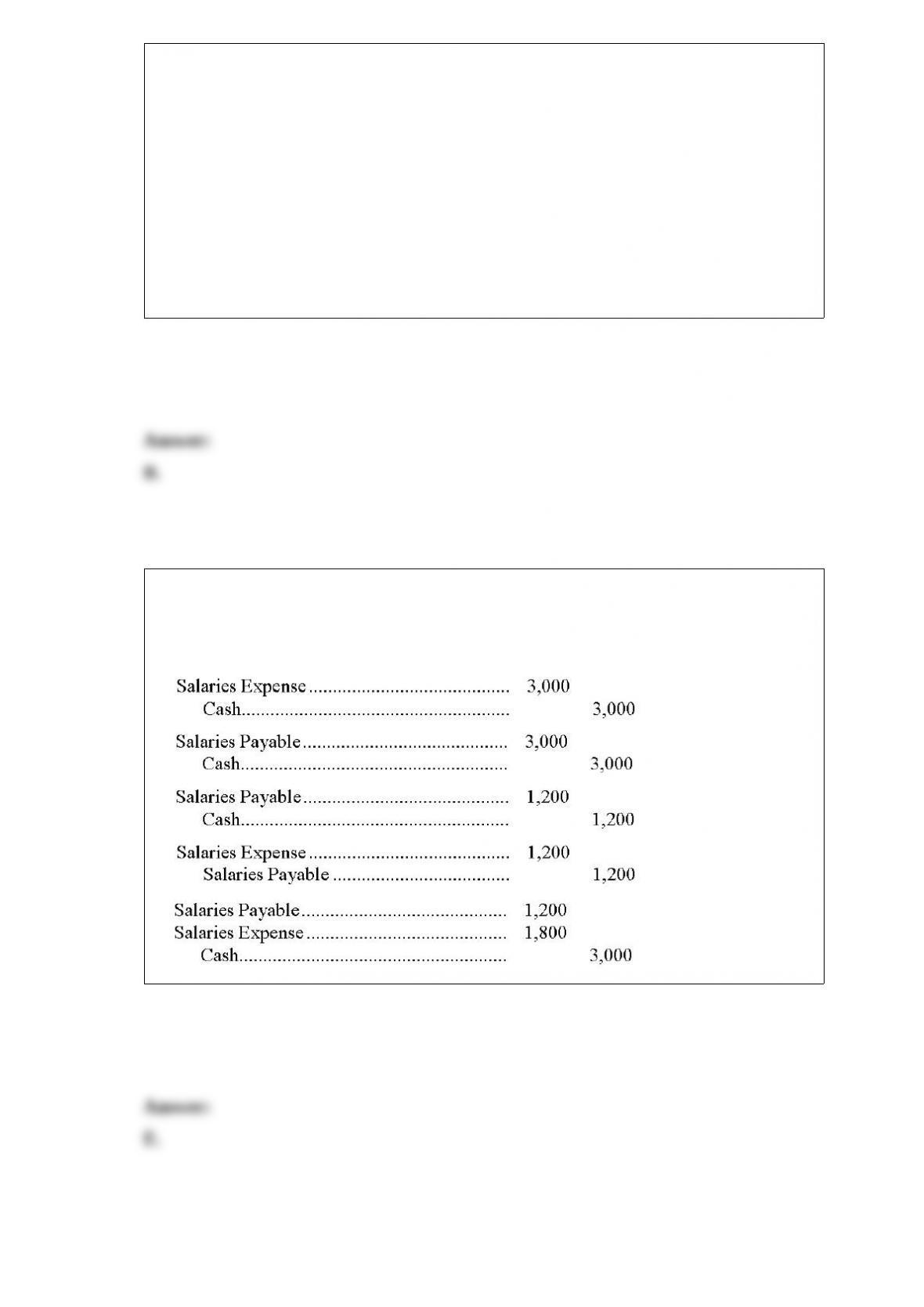
The following selected company information was reported:
Calculate the following company ratios:

(a) Accounts receivable turnover.
(b) Inventory turnover.
(c) Days’ sales uncollected.
Double-entry accounting is an accounting system:
A.That records each transaction twice.
B.That records the effects of transactions and other events in at least two accounts with
equal debits and credits.
C.In which each transaction affects and is recorded in two or more accounts but that
could include two debits and no credits.
D.That may only be used if T-accounts are used.
E.That insures that errors never occur.
Bonds with a par value of less than $1,000 are known as:
A.Junk bonds.
B.Baby bonds.
C.Callable bonds.
D.Unsecured bonds.
E.Convertible bonds.
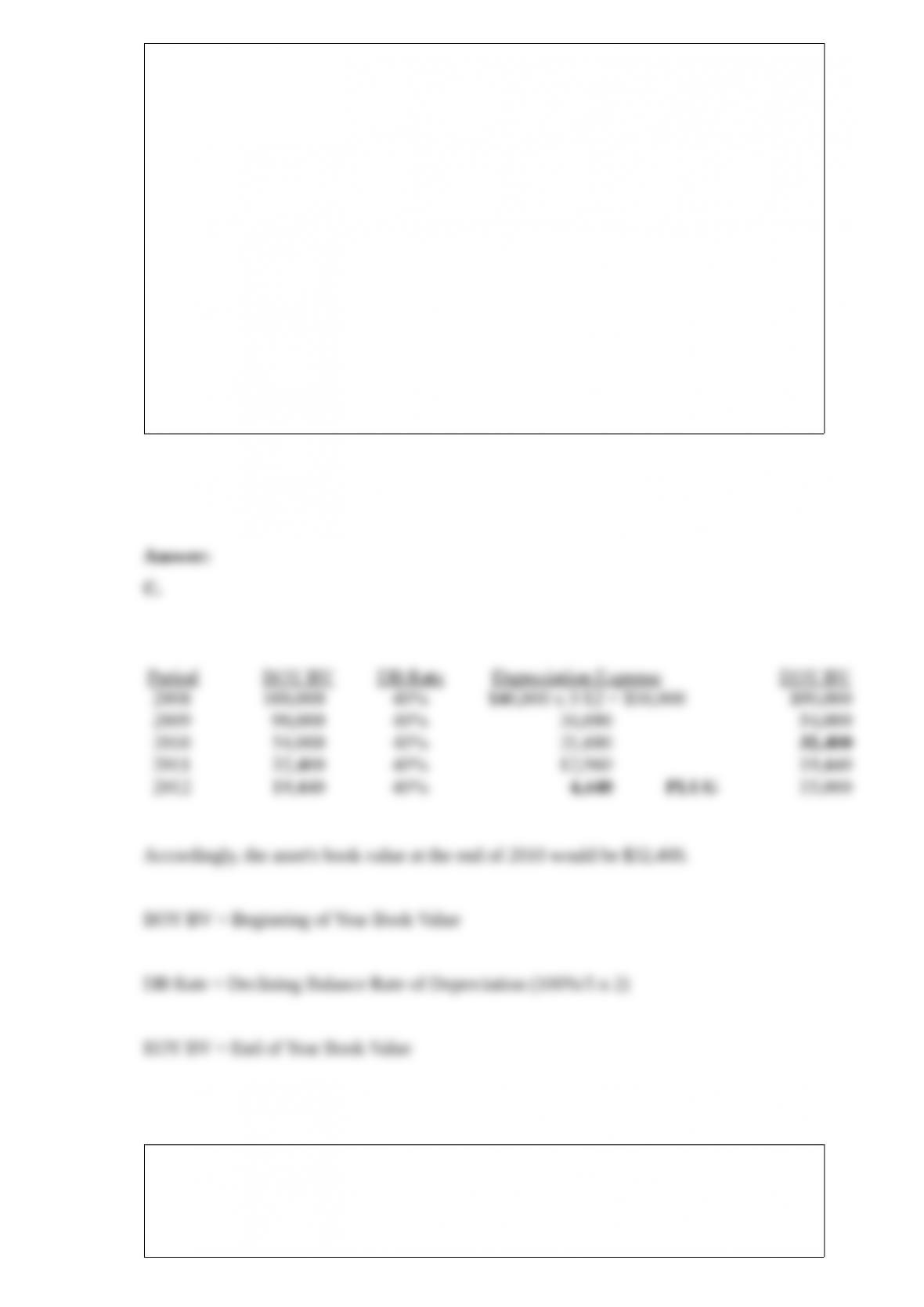
An adjusting entry was made on December 31, 2009 to accrue salary expense of
$1,200. Which of the following entries would be prepared to record the next payment of
salaries, on January, 2010 in the amount of $3,000?
A.
B.
C.
D.
E.

Which of the following does not require an adjusting entry at year-end?
A.Accrued interest on notes payable.
B.Supplies used during the period.
C.Cash invested by owner.
D.Accrued wages.
E.Expired portion of prepaid insurance.
A company issued 5-year, 7% bonds with a par value of $100,000. The company
received $97,947 for the bonds. Using the straight-line method, the amount of interest
expense for the first semiannual interest period is:
A.$3,294.70.
B.$3,500.00.
C.$3,705.30.
D.$7,000.00.
E.$7,410.60.

A June sales forecast projects that 6,000 units are going to be sold at a price of $10.50
per unit. The desired ending inventory of units is 15% higher than the beginning
inventory of 1,000 units. Total June sales are anticipated to be:
A.$63,000.
B.$67,500.
C.$61,250.
D.$74,250.
E.$60,000.
In the absence of a partnership agreement, the law says that income (and loss) should be
allocated based on:
A.A fractional basis.
B.The ratio of capital investments.
C.Salary allowances.
D.Equal shares.
E.Interest allowances.
Thomas Enterprises purchased a depreciable asset on October 1, 2008 at a cost of
$100,000.
The asset is expected to have a salvage value of $15,000 at the end of its five-year
useful life. If the asset is depreciated on the double-declining-balance method, the
asset’s book value on December 31, 2010 will be:
A.$27,540
B.$21,600
C.$32,400
D.$18,360
E.$90,000
A process cost summary is a managerial accounting report that describes:
A.The costs charged to a department.

B.The equivalent units of production by the department.
C.How the costs were assigned to the output.
D.Physical transfers for a department.
E.All of these.
Bonds can be issued:
A.At par.
B.At a premium.
C.At a discount.
D.Between interest payment dates.
E.All of these.
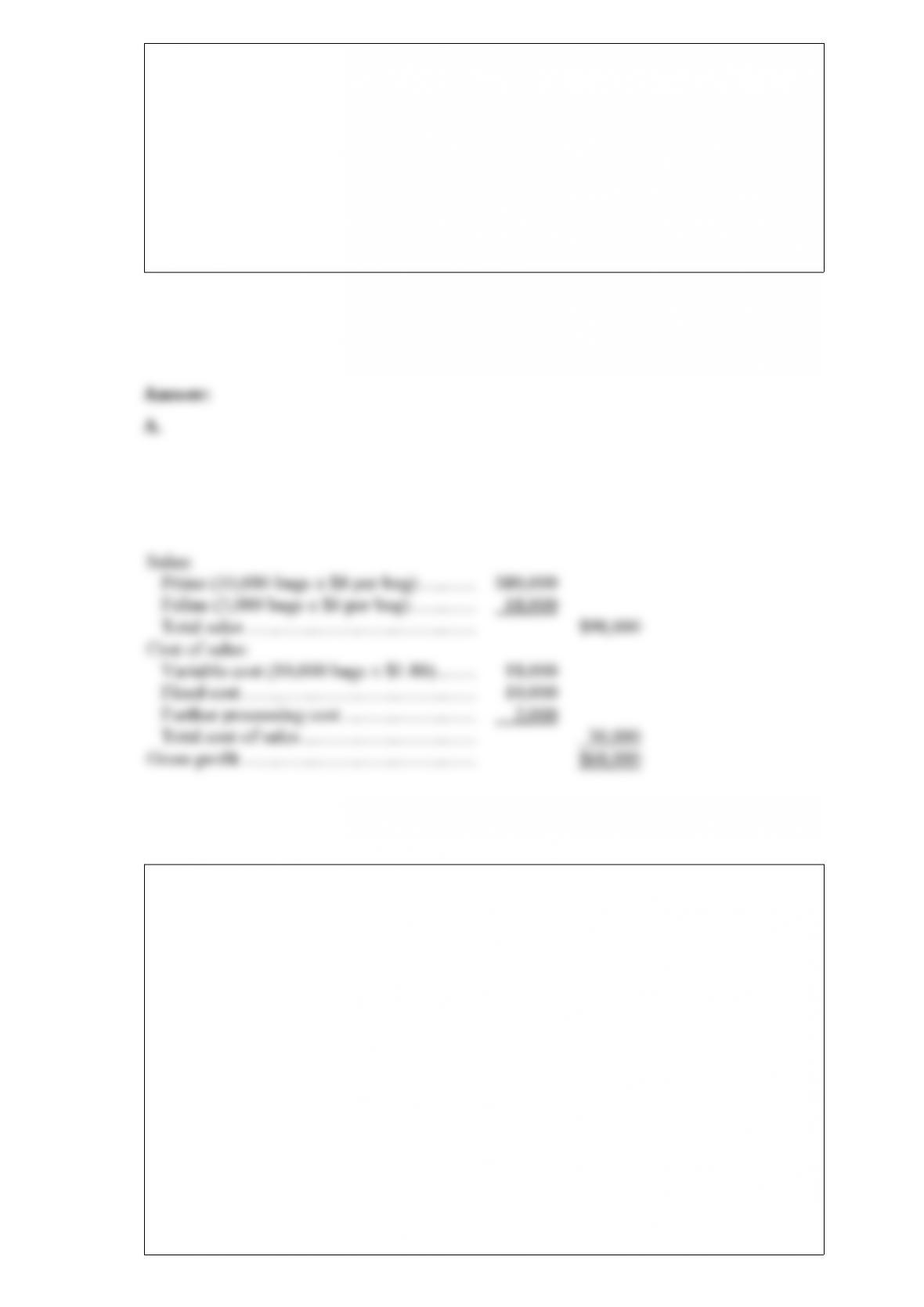
Marsden manufactures a cat food product called Special Export. Marsden currently has
10,000 bags of Special Export on hand. The variable production costs per bag are $1.80
and total fixed costs are $10,000. The cat food can be sold as it is for $9.00 per bag or
be processed further into Prime Cat Food and Feline Surprise at an additional $2,000
cost. The additional processing will yield 10,000 bags of Prime Cat Food and 3,000
bags of Feline Surprise, which can be sold for $8 and $6 per bag, respectively.
If Special Export is processed further into Prime Cat Food and Feline Surprise, the total
gross profit would be:
A.$ 68,000.
B.$ 78,000.
C.$ 96,000.
D.$ 98,000.
E.$100,000.
Classify each of the following items as either:
a. Current liability
b. Long-term liability
c. Not a liability
1)Warranty work completed this year
2) Salaries payable
3)Payment of a 30-year term loan due this year
4) FICA taxes payable
5)Payment of a 4-year term loan due this year

6)Payment of a 30-year term loan due next year (The company’s operating cycle is 2
months.)
7)30-day promissory note
8)Debt guarantees
9)Income taxes payable
10)Accounts payable
An employer’s federal unemployment taxes (FUTA) are reported:
A.Annually.
B.Semiannually.
C.Quarterly.
D.Monthly.
E.Weekly.
A partnership that has at least two classes of partners, general and limited, allows the
limited partners to have no personal liability beyond the amounts they invest in the
partnership, and the limited partners have no active role except as specified in the
partnership agreement is a ________________________ partnership.
A primary purpose of ________________ is to make information in financial
statements relevant, reliable and comparable.
Cycle time is calculated by process time plus inspection time plus move time plus
_____________________.
What is an adjusted trial balance? Why is it prepared?
On October 1 of the current year a corporation sold, at par plus accrued interest,
$1,000,000 of its 12% bonds, which were dated July 1 of this year. What amount of
bond interest expense should the company report on its current year income statement?
Assets removed from the business by the business owner for personal use are called
____________.
The ______________________ method of assigning costs to inventory and cost of
goods sold assumes that the most recent purchases are sold first.
What is the acid-test ratio? How does it measure a company’s liquidity?
______________________ are costs that increase the usefulness of land, but have
limited useful lives and are thus depreciated.
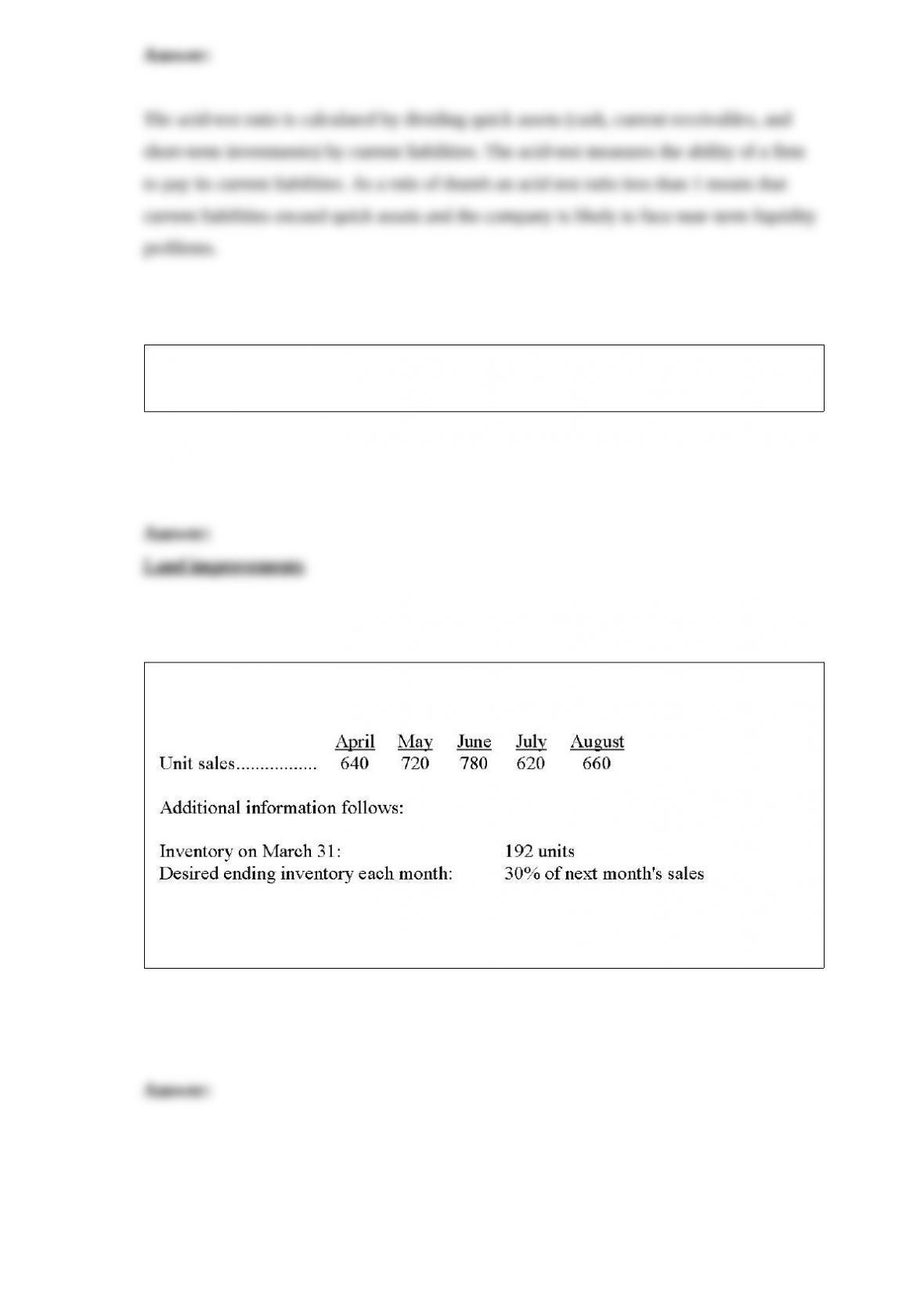
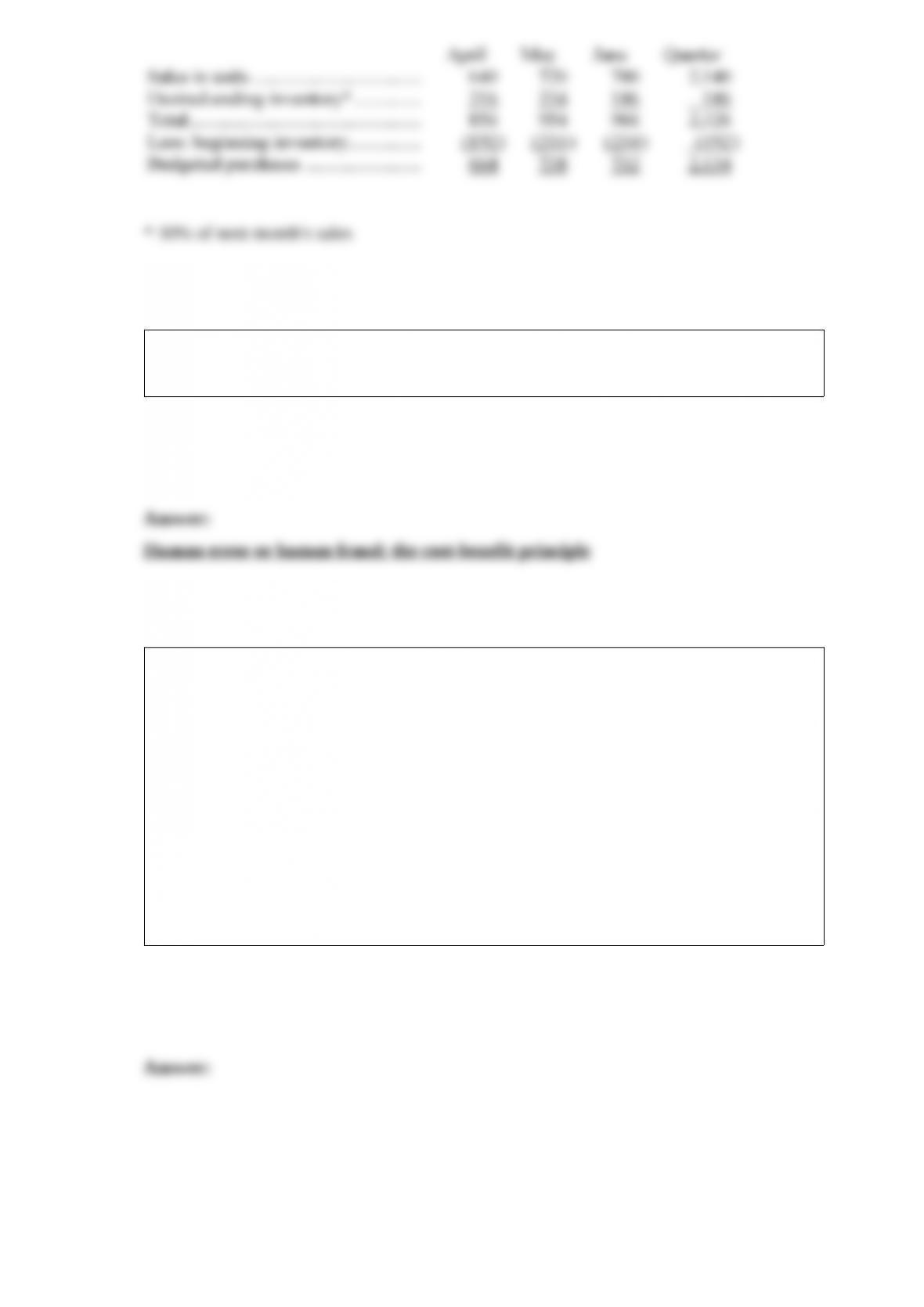
Nano, Inc., is preparing its budget for the second quarter. The following sales data have
been forecasted:
How many units should be purchased in April, May, and June? How many units should
be purchased in the second quarter in total?
Two limitations of internal control systems are ____________________ and
________________.
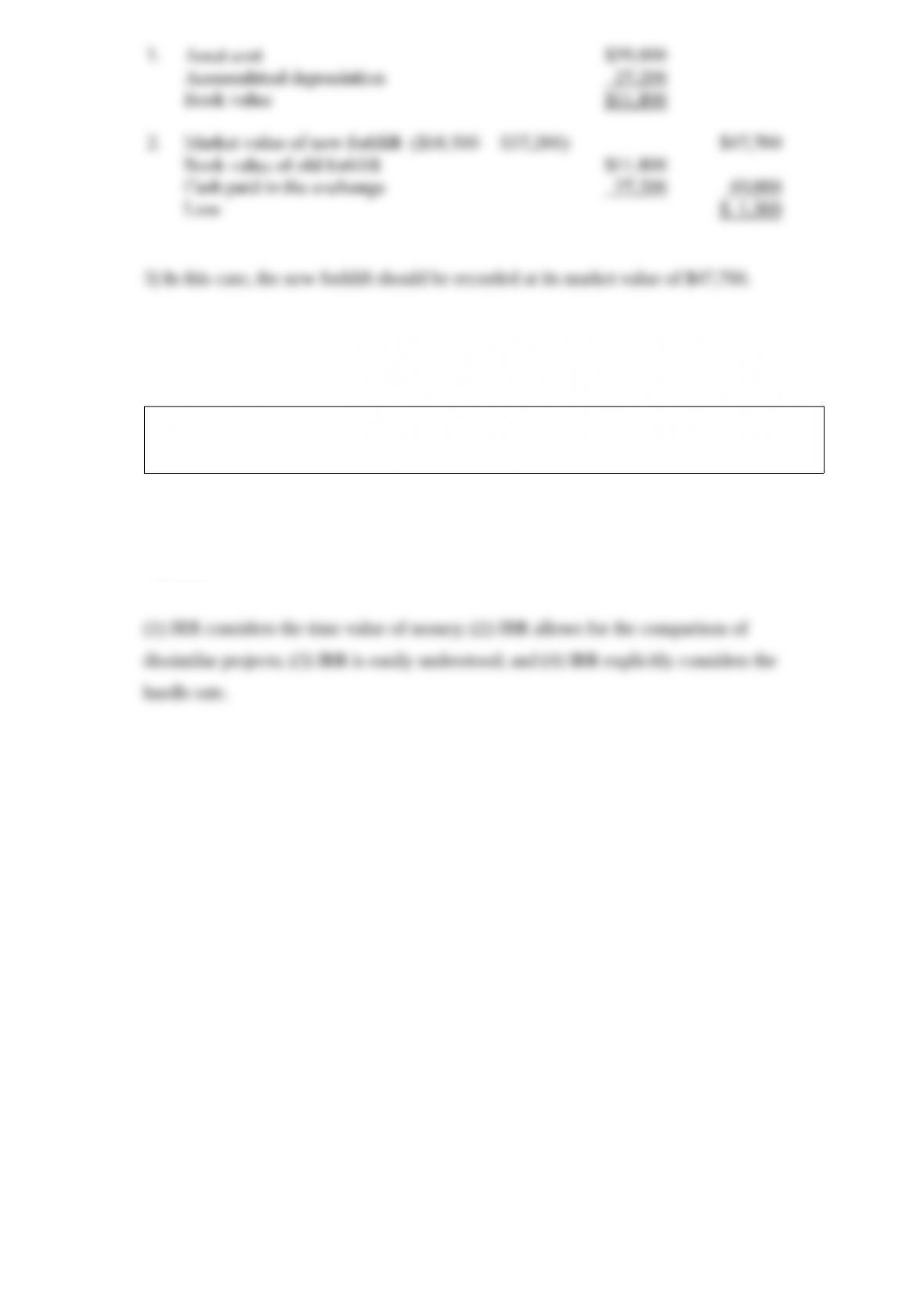
A company traded an old forklift for a new forklift, receiving a $10,500 trade-in
allowance and paying the remaining $37,200 in cash. The old forklift had cost $39,000,
and straight-line accumulated depreciation of $27,200 had been recorded as of the
exchange date under the assumption it would last five years and have a $5,000 salvage
value.
1) What was the book value of the old forklift on the date of the exchange?
2) What amount of gain or loss (indicate which) should be recognized in recording the
exchange, assuming the transaction has commercial substance?
3) What amount should be recorded as the cost of the new forklift?
Identify at least three reasons for managers to favor the internal rate of return (IRR)
over other capital budgeting approaches.