Which of the following is reported as a financing activity in the statement of cash
flows? A. The amortization of a patent.
B. The exchange of common stock for a building.
C. The acquisition of long-term investments.
D. The repayment of bonds issued at face value.
Answer:
On January 1, 2013, Wellburn Corporation leased an asset from Tabitha Company. The
asset originally cost Tabitha $300,000. The lease agreement is an operating lease that
calls for four annual payments beginning on January 1, 2013, in the amount of $36,000.
The other three remaining payments will be made on January 1 of each subsequent year.
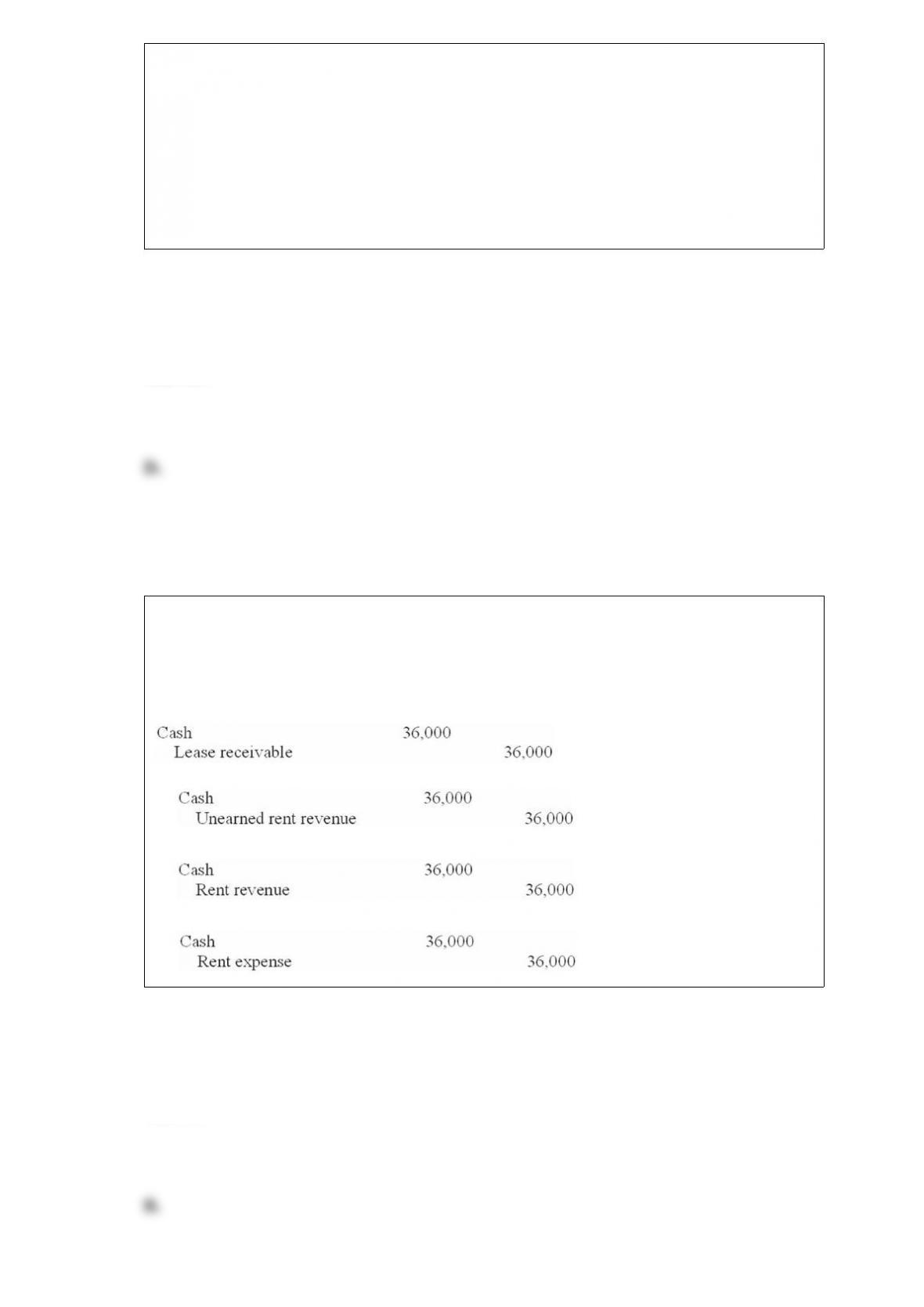
Which of the following journal entries should Tabitha record on January 1, 2013? A.
B.
C.
D.
Answer:
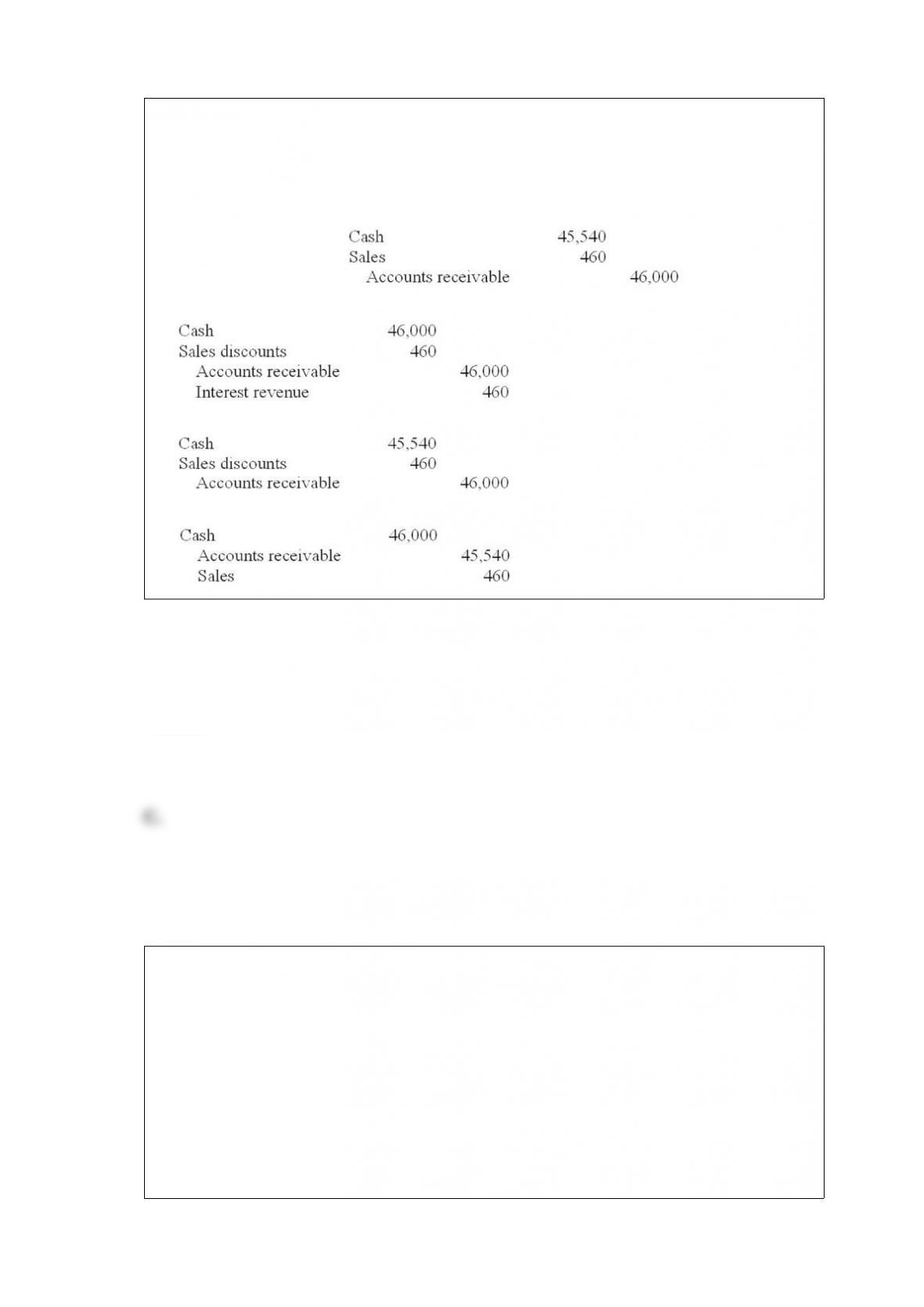
Oswego Clay Pipe Company sold $46,000 of pipe to Southeast Water District #45 on
April 12 of the current year with terms 1/15, n/60. Oswego uses the gross method of
accounting for cash discounts.
What entry would Oswego make on April 23, assuming the customer made the correct
payment on that date? A.
B.
C.
D.
Answer:
Which of the following is not true about derivatives? A. Large losses on derivative
investments have been reported in the press.
B. Derivatives are so named because their value is derived from some underlying
measure.
C. Derivatives are useful instruments for managing risk.
D. Accounting for derivatives is fully resolved and no additional rules or interpretations
are likely.

Answer:
A discount on a noninterest-bearing note payable is classified in the balance sheet as: A.
An asset.
B. A component of shareholders’ equity.
C. A contingent liability.
D. A contra liability.
Answer:
In the Norwalk Agreement, the FASB and IASB pledged to: A.Combine their
organizations to form the BUSYB.
B.Make progress on specific MOU projects.
C.Achieve convergence by the year 2015.
D.Remove existing differences between their standards.
Answer:
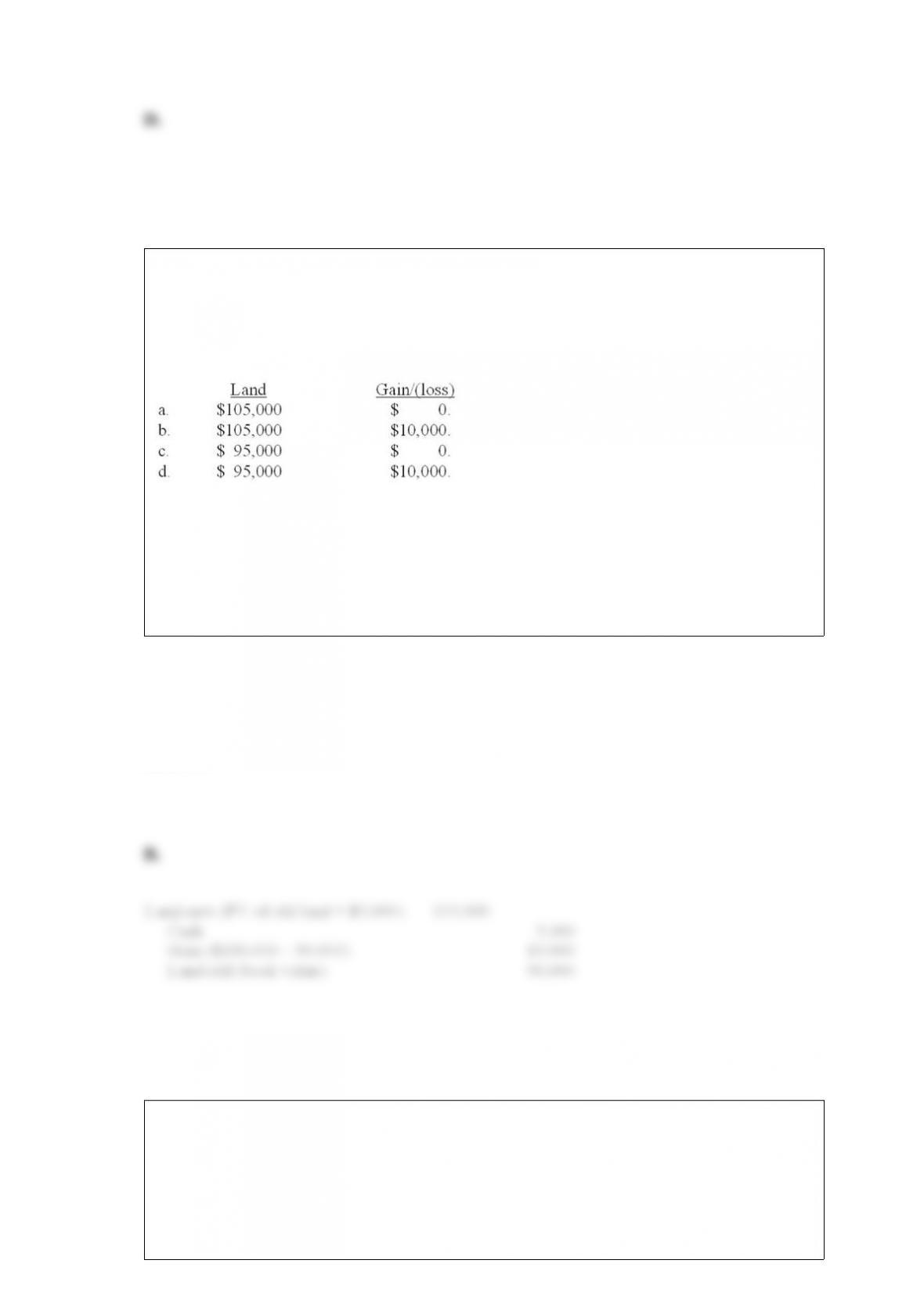
Horton Stores exchanged land and cash of $5,000 for similar land. The book value and
the fair value of the land were $90,000 and $100,000, respectively.
Assuming that the exchange has commercial substance, Horton would record land-new
and a gain/(loss) of:
A. Option a
B. Option b
C. Option c
D. Option d
Answer:
Lucid Company declared a property dividend of 20,000 shares of $1 par Polk Company
common stock. The Polk stock was purchased for $5 per share. Market value was $10
per share on the declaration date and $11 per share on the distribution date. What is the
amount of the dividend? A. $100,000.
B. $200,000.

C. $220,000.
D. $300,000.
Answer:
Cost of goods sold as reported in the income statement will be less than cash paid to
suppliers if:A. The increase in accounts payable is greater than the increase in inventory
during the period.
B. The decrease in accounts payable is equal to the increase in inventory during the
period.
C. The decrease in accounts payable is less than the decrease in inventory during the
period.
D. The increase in accounts payable is equal to the decrease in inventory during the
period.
Answer:
On March 1, 2013, E Corp. issued $1,000,000 of 10% nonconvertible bonds at 103, due

on February 28, 2023. Each $1,000 bond was issued with 30 detachable stock warrants,
each of which entitled the holder to purchase, for $50, one share of Evan’s $25 par
common stock. On March 1, 2013, the market price of each warrant was $4. By what
amount should the bond issue proceeds increase shareholders’ equity? A. $0.
B. $30,000.
C. $90,000.
D. $120,000.
Answer:
If the fair value of a held-to-maturity investment declines for a reason that is viewed as
“other than temporary” because the company has incurred a credit loss on the
investment: A. The investment is written down to fair value, and only the noncredit-loss
component of the impairment loss is recognized in net income.
B. The investment is written down to fair value, and the entire impairment loss is
recognized in net income.
C. The investment is written down to fair value, and only the credit-loss component of
the impairment loss is recognized in net income.
D. The investment is written down to fair value, but none of the impairment loss is
recognized in net income.
Answer:
Major Co. reported 2013 income of $300,000 from continuing operations before
income taxes and a before-tax extraordinary loss of $80,000. All income is subject to a
30% tax rate. In the 2013 income statement, Major Co. would show the following
line-item amounts for income tax expense and net income: A. $66,000 and $210,000.
B. $90,000 and $154,000.
C. $90,000 and $276,000.
D. $66,000 and $220,000.
Answer:
For a capital lease, an amount equal to the present value of the minimum lease
payments should be recorded by the lessee as a(n): A. Asset and a liability.
B. Asset and a different amount should be recorded as a liability.
C. Liability and a different amount should be recorded as an asset.
D. Expense.

Answer:
For the current year ($ in millions), Centipede Corp. had $80 in pretax accounting
income. This included warranty expense of $6 and $20 in depreciation expense. Two
million of warranty costs were incurred, and MACRS depreciation amounted to $35. In
the absence of other temporary or permanent differences, what was Centipede’s income
tax payable currently, assuming a tax rate of 40%? A. 19.6 million.
B. 25.2 million.
C. 27.6 million.
D. 29.2 million.
Answer:
Additional lessor conditions for classification as a capital lease are consistent with the
criteria of the: A. Matching principle.
B. Cause and effect principle.
C. Materiality concept.
D. Realization principle.
Answer:
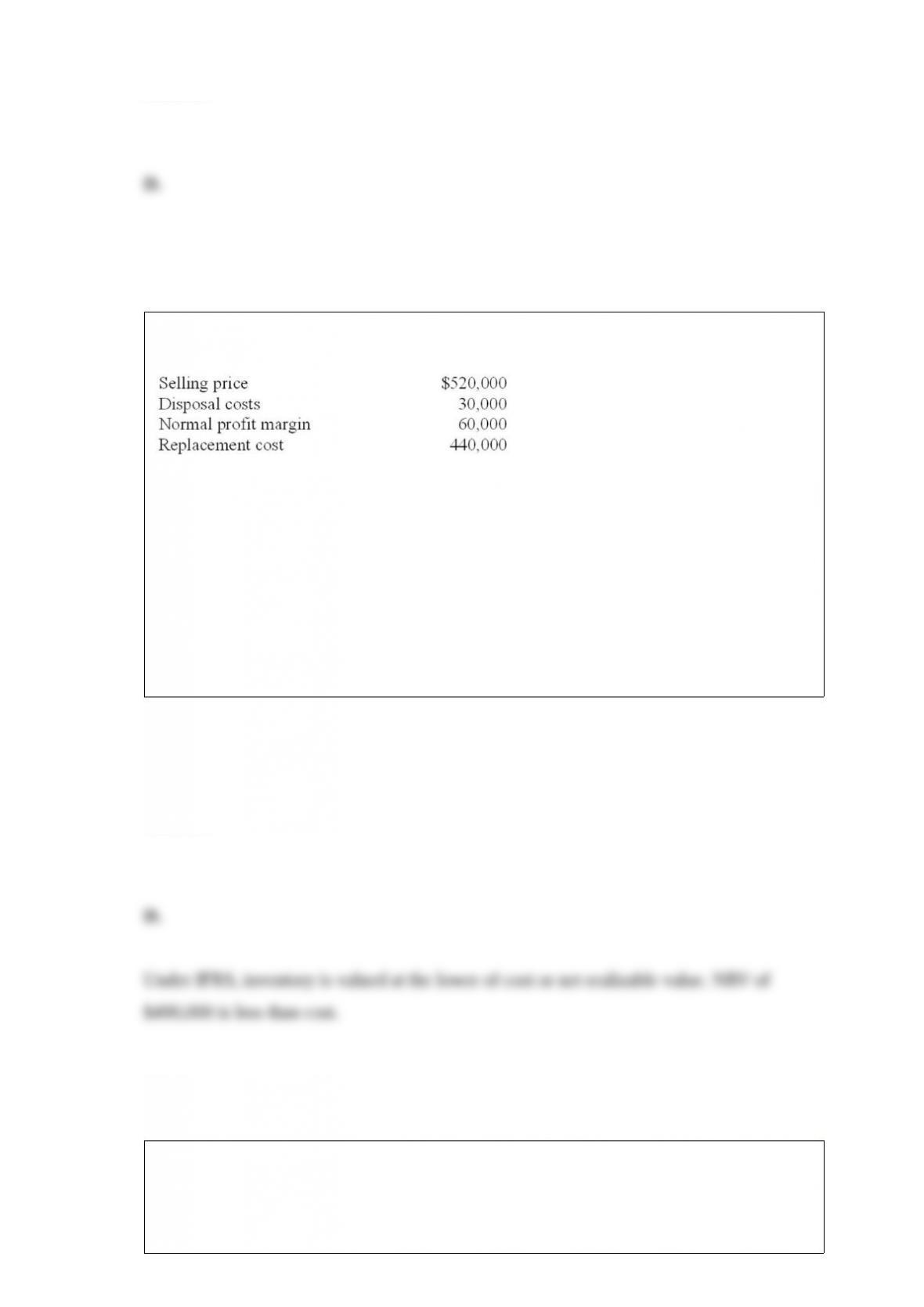
Sullivan Corporation has determined its year-end inventory on a FIFO basis to be
$500,000. Information pertaining to that inventory is as follows:
What should be the carrying value of Sullivan’s inventory if the company prepares its
financial statements according to International Financial Reporting Standards? A.
$500,000.
B. $440,000.
C. $430,000.
D. $490,000.
Answer:
Calistoga Produce estimates bad debt expense at ½% of credit sales. The company
reported accounts receivable and allowance for uncollectible accounts of $471,000 and
$1,650, respectively, at December 31, 2012. During 2013, Calistoga’s credit sales and
collections were $315,000 and $319,000, respectively, and $1,720 in accounts

receivable were written off.
Calistoga’s 2013 bad debt expense is: A. $1,720.
B. $1,650.
C. $1,505.
D. $1,575.
Answer:
A firm’s comprehensive income always: A.Is the same as its net income.
B.Is greater than its net income.
C.Is less than its net income.
D.Could be greater than or less than net income.
Answer:

Fulbright Corp. uses the periodic inventory system. During its first year of operations,
Fulbright made the following purchases (listed in chronological order of acquisition):
– 40 units at $100
– 70 units at $80
– 170 units at $60
Sales for the year totaled 270 units, leaving 10 units on hand at the end of the year.
Ending inventory using the FIFO method is: A. $650.
B. $1,000.
C. $707.
D. $600.
Answer:
Ordinarily, the proceeds from the sale of a bond issue will be equal to: A. The face
amount of the bond.
B. The total of the face amount plus all interest payments.
C. The present value of the face amount plus the present value of the stream of interest
payments.
D. The face amount of the bond plus the present value of the stream of interest
payments.

Answer:
On its tax return at the end of the current year Webnet Inc. has $6 million of tax
depreciation in excess of depreciation in its income statement. A disclosure note reveals
that $1 million of the $6 million difference will reverse itself next year, and the
remainder will reverse over the next 4 years. In the absence of other temporary
differences, in the balance sheet at the end of the current year Webnet would report: A.
Both a current deferred tax asset and a noncurrent deferred tax asset.
B. A noncurrent deferred tax asset.
C. Both a current deferred tax liability and a noncurrent deferred tax liability.
D. A noncurrent deferred tax liability.
Answer:
Company A is identical to Company B in every regard except that Company A uses
FIFO and Company B uses LIFO. In an extended period of rising inventory costs,
Company A’s gross profit and inventory turnover ratio, compared to Company B’s,
would be:
A. Option a
B. Option b
C. Option c

D. Option d
Answer:
Which of the following is not an identified valuation technique in GAAP regarding fair
value measurement? A.Cost approach.
B.Market approach.
C.Cost-benefit approach.
D.Income approach.
Answer:
Consolidated financial statements are prepared when one company has: A. Accounted
for the investment using the equity method.
B. Accounted for the investment as securities available for sale.
C. Control over another company.
D. None of the above is correct.
Answer:
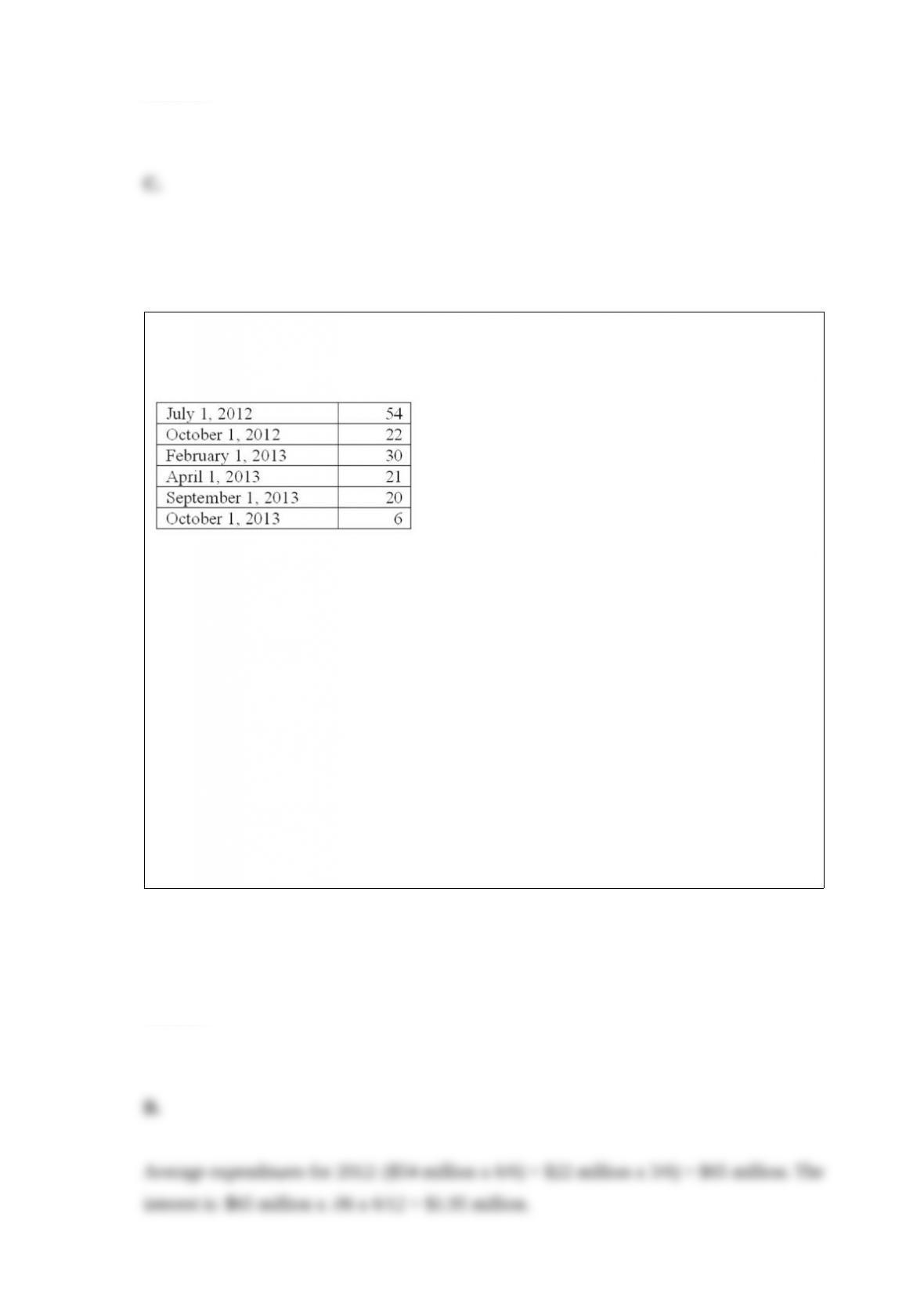
On June 1, 2012, the Crocus Company began construction of a new manufacturing
plant. The plant was completed on October 31, 2013. Expenditures on the project were
as follows ($ in millions):
On July 1, 2012, Crocus obtained a $70 million construction loan with a 6% interest
rate. The loan was outstanding through the end of October, 2013. The company’s only
other interest-bearing debt was a long-term note for $100 million with an interest rate of
8%. This note was outstanding during all of 2012 and 2013. The company’s fiscal
year-end is December 31.
What is the amount of interest that Crocus should capitalize in 2012, using the specific
interest method? A. $1.90 million.
B. $1.95 million.
C. $2.96 million.
D. None of the above is correct.
Answer:

When the investor’s level of influence changes, it may be necessary to change to the
equity method from another method. When the level of ownership rises from less than
20% to a range of 20% to 50%, the equity method typically would become appropriate
and the investment account balance should be: A. Retrospectively adjusted to the
balance that would have existed if the equity method had been in effect for prior years.
B. Carried over as is with no adjustment necessary.
C. Carried over at fair value on date of transfer.
D. Adjusted to reflect amortized cost.
Answer:
Patrick Roch International issued 5% bonds convertible into shares of the company’s
common stock. Roch applies U.S. GAAP. Upon issuance, Patrick Roch International
should record: A. The proceeds of the bond issue as part debt and part equity.
B. The proceeds of the bond issue entirely as debt.
C. The proceeds of the bond issue entirely as equity.
D. The proceeds of the bond issue entirely as debt if the bonds are mandatorily
redeemable.
Answer:

In a statement of cash flows prepared under International Financial Reporting
Standards, each of the following items is typically classified as a financing cash flow
except: A. Interest paid.
B. Dividends paid.
C. Proceeds from the issuance of long-term debt.
D. Dividends received.
Answer:
GAAP requires that some lease agreements be accounted for as purchases. The
theoretical justification for this treatment is that a lease of this type: A. Complies with
the concept of form over substance.
B. Reflects the relationship of cause and effect.
C. Satisfies the concept of historical cost.
D. Conveys most of the risks and benefits of property ownership.
Answer:

On November 1, 2013, Tim’s Toys borrows $30,000,000 at 9% to finance the holiday
sales season. The note is for a six-month term and both principal and interest are
payable at maturity. What is the balance of interest payable for the loan as of December
31, 2013? A. $112,500.
B. $225,000.
C. $450,000.
D. $1,350,000.
Answer:
When preparing a statement of cash flows using the direct method, accrual of payroll
expense is: A. Reported as an operating activity.
B. Reported as an investing activity.
C. Reported as a financing activity.
D. None of the above is correct.
Answer:

The most common type of liability is: A. One that comes into existence due to a loss
contingency.
B. One that must be estimated.
C. One that comes into existence due to a gain contingency.
D. One to be paid in cash and for which the amount and timing are known.
Answer:
Listed below are five terms followed by a list of phrases that describe or characterize
each of the terms. Match each phrase with the correct term. 1)Credit
2)Closing entries
3)General journal
4)General ledger
5)Debit
A. Contains all the accounts of an entity.
B. Refers to the right side of an account.
C. Used to record any type of transaction in chronological order.
D. Asset and expense accounts normally have this type of balance.
E. Used to reset temporary accounts to a zero balance.

Answer:
Assume that at the beginning of the current year, a company has a net gain-AOCI of
$25,000,000. At the same time, assume the PBO and the plan assets are $200,000,000
and $150,000,000, respectively. The average remaining service period for the
employees expected to receive benefits is 10 years. What is the amount of amortization
to pension expense for the year? A. $3,000,000.
B. $500,000.
C. $2,500,000.
D. $1,500,000.
Answer:
If the fair value of a debt investment that is classified as an available-for-sale
investment declines for a reason that is viewed as “other than temporary” because the
company has incurred a credit loss on the investment: A. The investment is written
down to fair value, and only the noncredit-loss component of the impairment loss is
recognized in net income.
B. The investment is written down to fair value, and the entire impairment loss is
recognized in net income.
C. The investment is written down to fair value, and only the credit-loss component of
the impairment loss is recognized in net income.
D. The investment is written down to fair value, but none of the impairment loss is
recognized in net income.
Answer:
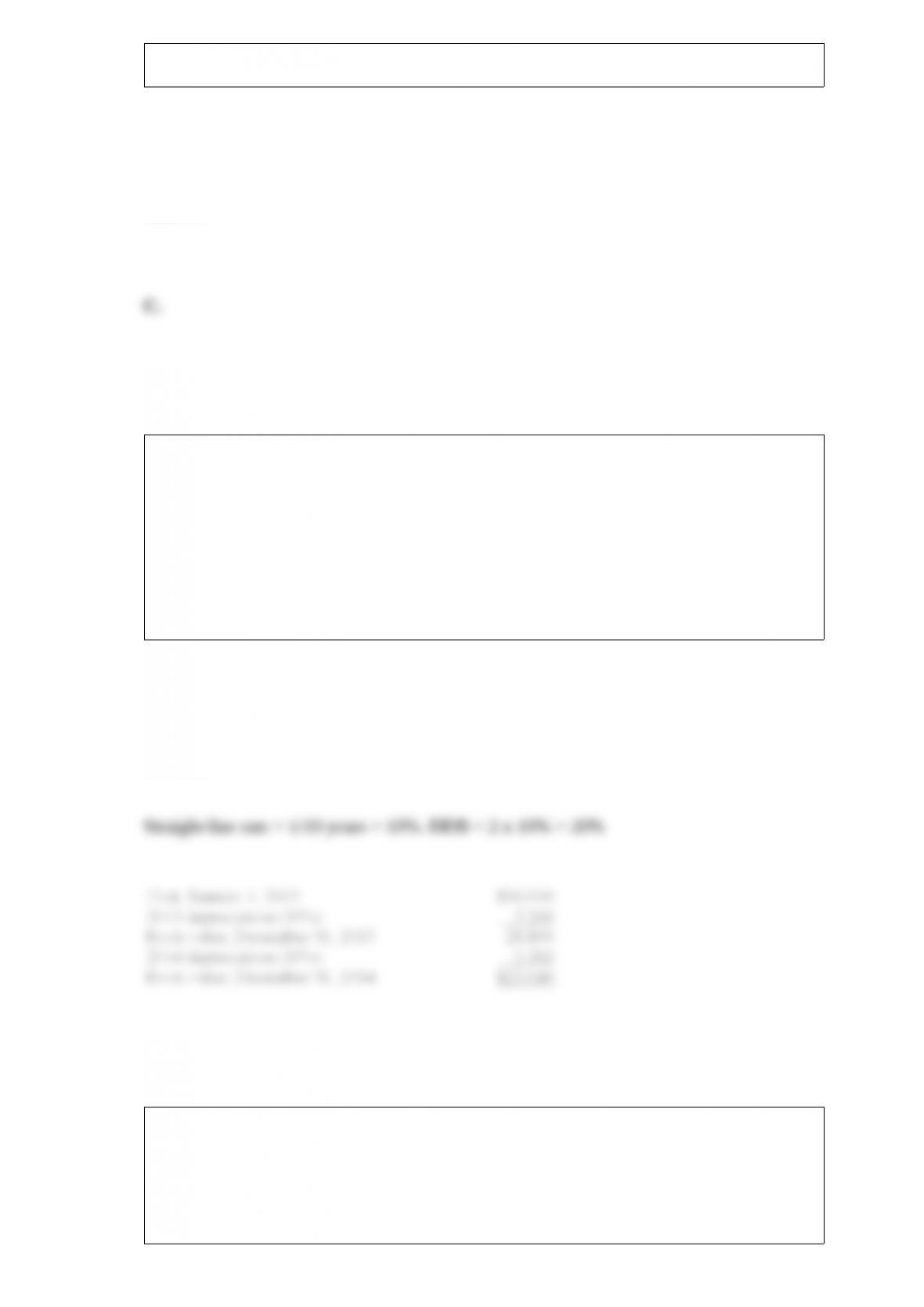
On January 1, 2013, Hobart Mfg. Co. purchased a drill press at a cost of $36,000. The
drill press is expected to last 10 years and has a residual value of $6,000. During its
10-year life, the equipment is expected to produce 500,000 units of product. In 2013
and 2014, 25,000 and 84,000 units, respectively, were produced.
Required:
Compute depreciation for 2013 and 2014 and the book value of the drill press at
December 31, 2013 and 2014, assuming the double-declining-balance method is used.
Answer:
Shown below is activity for one of the products of Denver Office Equipment:
January 1 balance, 500 units @ $55 $27,500
Purchases:
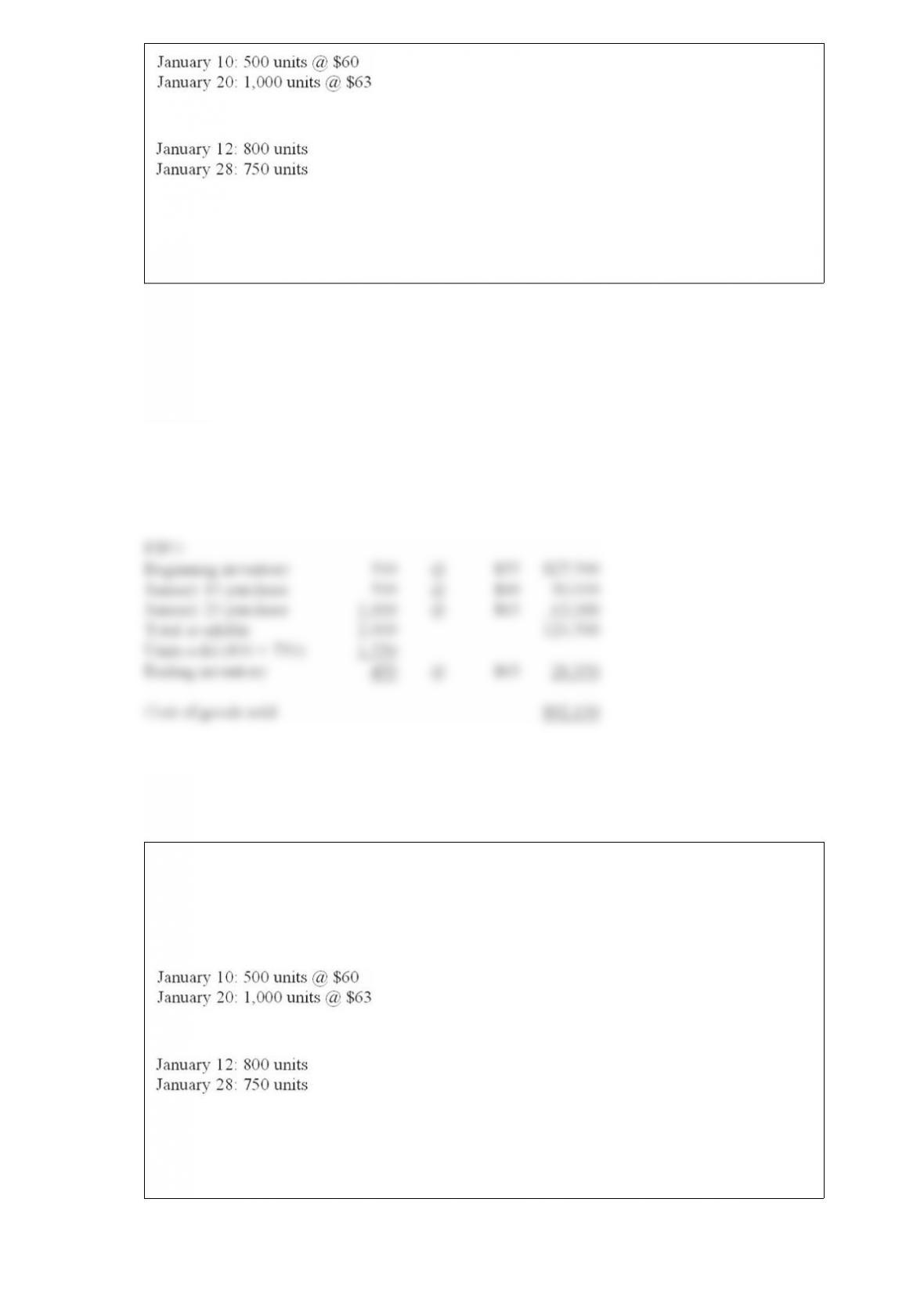
Sales:
Required:
Compute the January 31 ending inventory and cost of goods sold for January, assuming
Denver uses FIFO.
Answer:
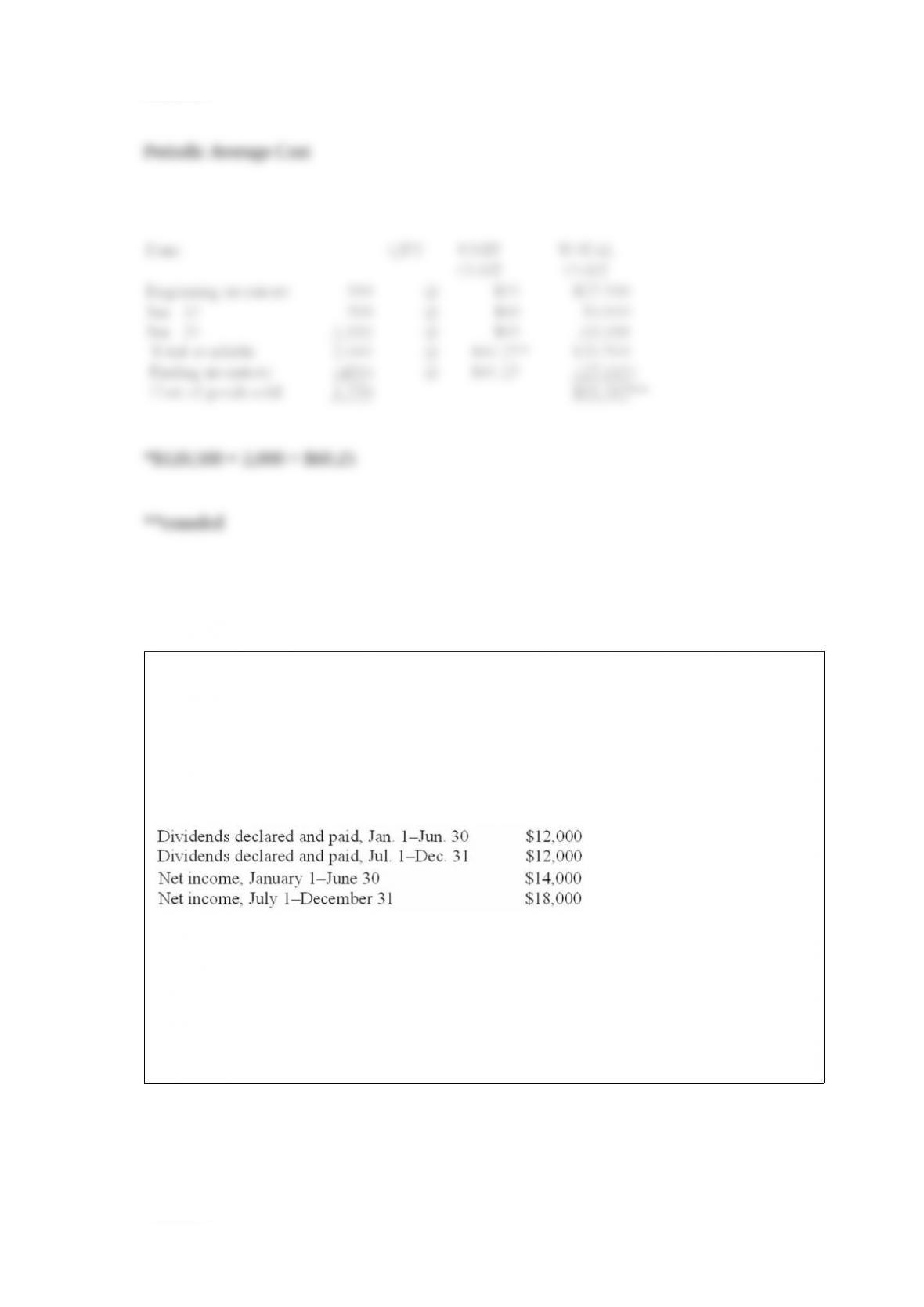
Shown below is activity for one of the products of Denver Office Equipment:
January 1 balance, 500 units @ $55 $27,500
Purchases:
Sales:
Required:
Compute the January 31 ending inventory and cost of goods sold for January, assuming
Denver uses average cost and a periodic inventory system.
Answer:
On July 1, 2013, Clearwater Inc. purchased 6,000 shares of the outstanding common
stock of Mountain Corporation at a cost of $140,000. Mountain had 30,000 shares of
outstanding common stock. The total book value and total fair value of Mountain’s
individual net assets on July 1, 2013, are both $700,000. The total fair value of the
30,000 shares of Mountain’s common stock on December 31, 2013, is $760,000. Both
companies have a January through December fiscal year. The following data pertains to
Mountain Corporation during 2013:
Required:
1) Prepare the necessary entries for 2013 under the equity method (other than for the
purchase).
2) Prepare any necessary entries for 2013 (other than for the purchase) that would be
required if the securities are classified as available for sale.
Answer:
On January 1, 2013, Hobart Mfg. Co. purchased a drill press at a cost of $36,000. The
drill press is expected to last 10 years and has a residual value of $6,000. During its
10-year life, the equipment is expected to produce 500,000 units of product. In 2013
and 2014, 25,000 and 84,000 units, respectively, were produced.
Required:
Compute depreciation for 2013 and 2014 and the book value of the drill press at
December 31, 2013 and 2014, assuming the straight-line method is used.
Answer:
Describe the difference between external events and internal events, and give two
examples of each.
Answer:
Provide an example of a liability that would not require the payment of cash?
Answer:
The following footnote appeared in a recent annual report to stockholders of Sprint
Corporation: “Certain wireless activation fees associated with unbundled sales continue
to be deferred and amortized over the average life of the subscriber. Certain local
installation fees are deferred and amortized over the average life of the customer.”
Briefly explain why Sprint recognizes this type of revenue as it does.
Answer:
What are the situations deemed to constitute a change in reporting entity? Describe the
way changes in reporting entity are reported.
Answer:
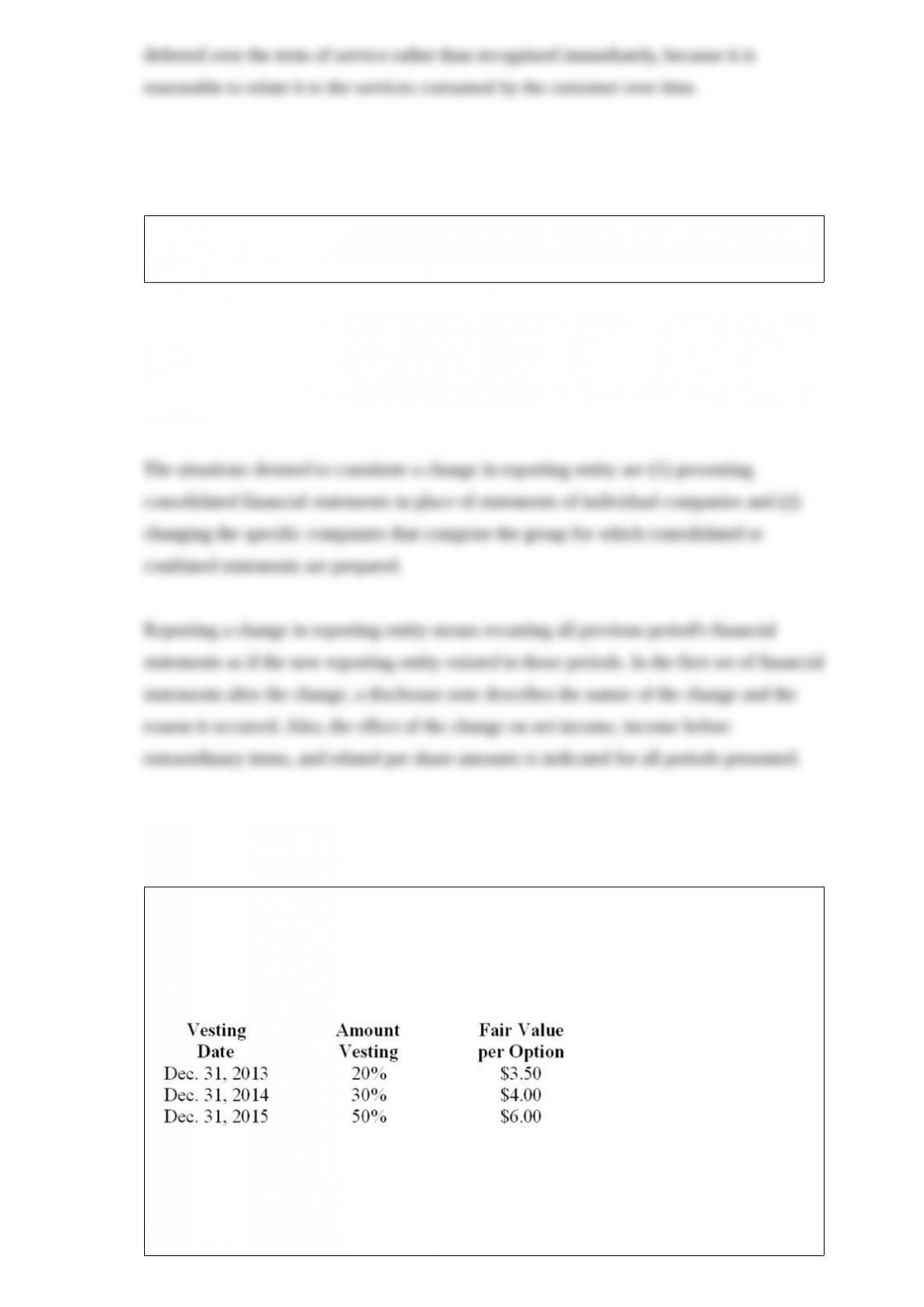
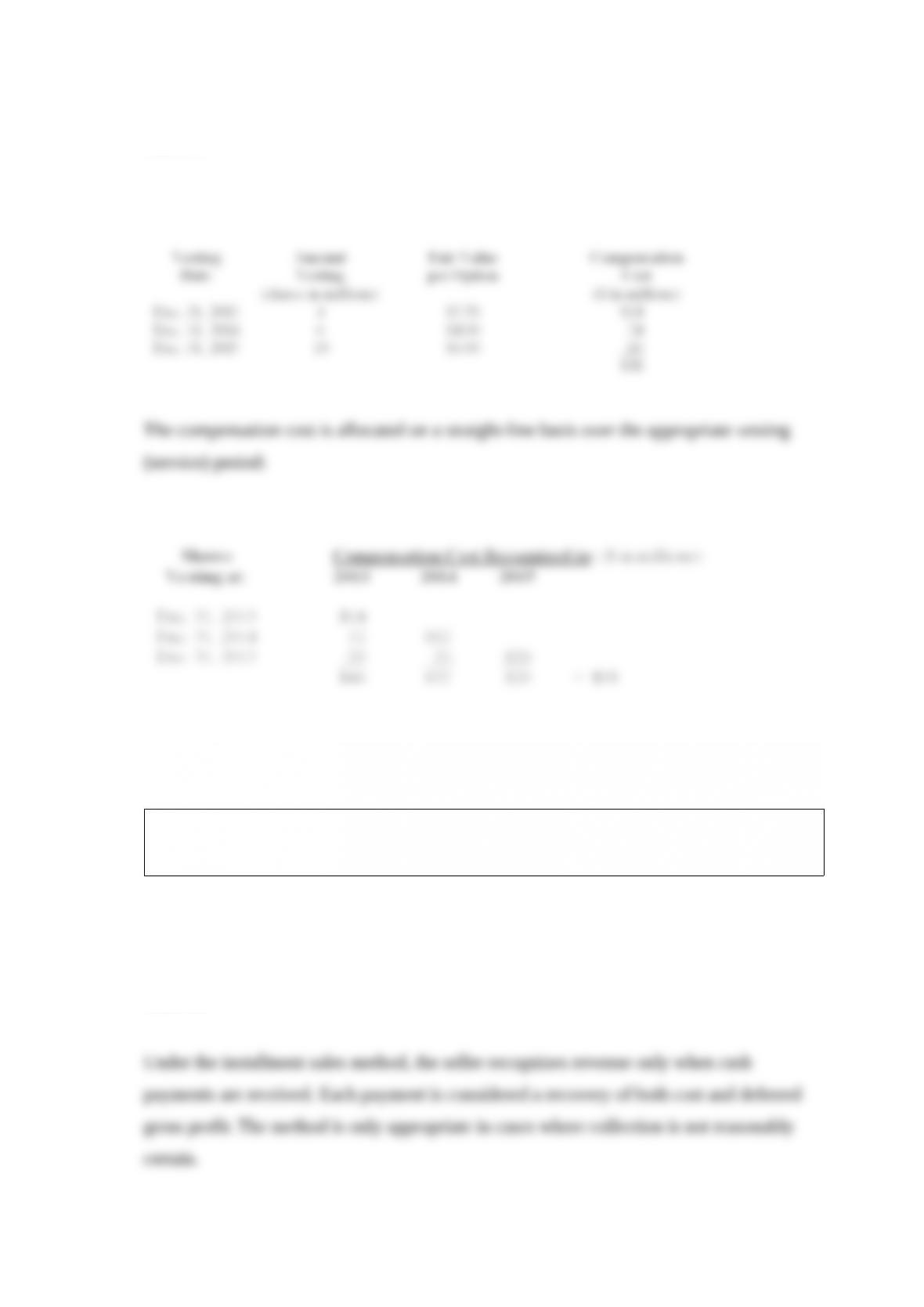
Pastner Brands is a calendar-year firm with operations in several countries. As part of
its executive compensation plan, at January 1, 2013, the company had issued 20 million
executive stock options permitting executives to buy 20 million shares of stock for $25.
The vesting schedule is 20% the first year, 30% the second year, and 50% the third year
(graded-vesting). The fair value of the options is estimated as follows:
Required:
Determine the compensation expense related to the options to be recorded each year for
2013-2015, assuming Pastner prepares its financial statements in accordance with
International Financial Reporting Standards.
Answer:
Briefly explain how revenue is recorded under the installment sales method. Include in
your answer an explanation of when use of the method would be appropriate.
Answer:
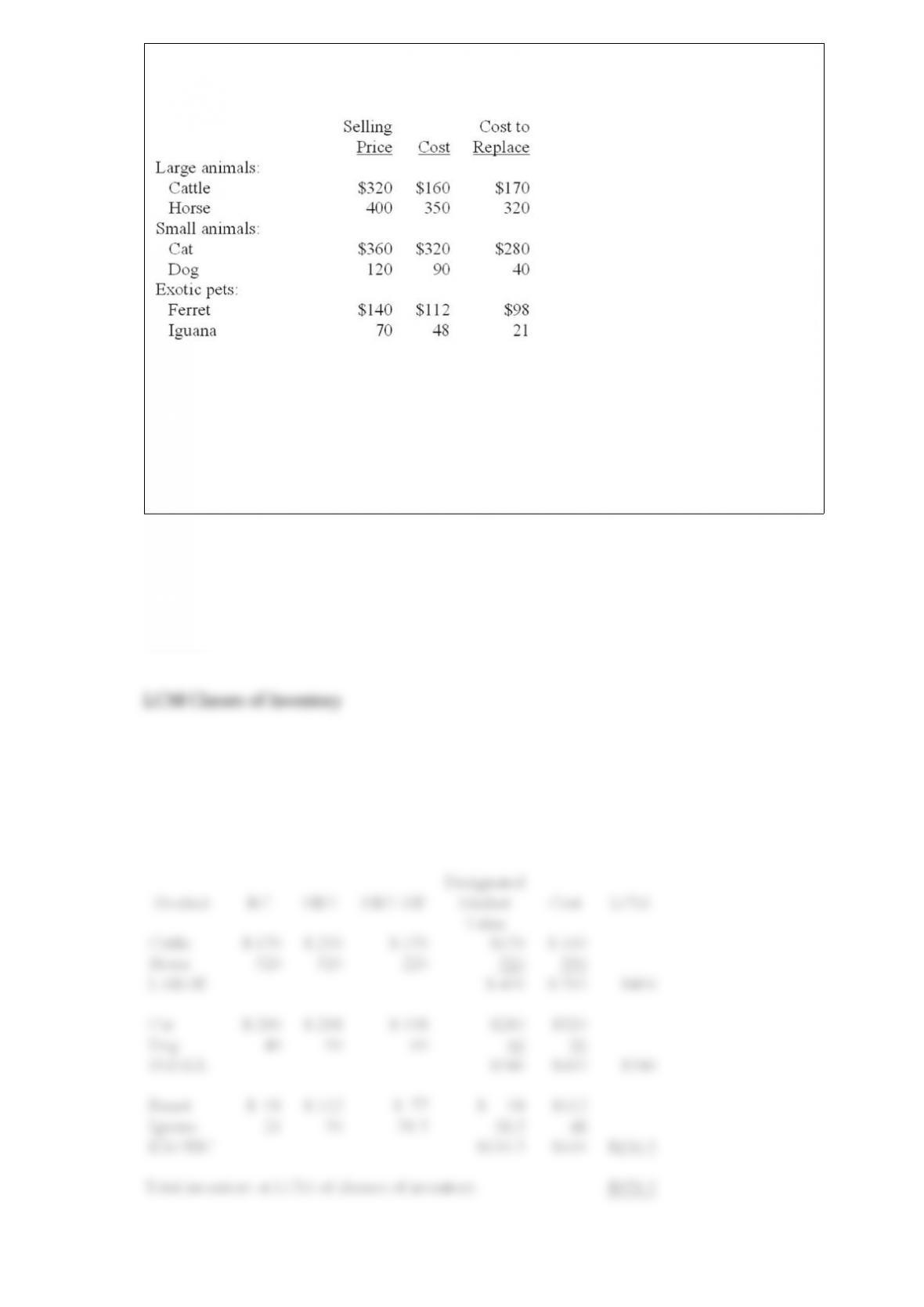
Weldon Animal Feeds has developed the following data for lower-of-cost-or-market
valuation for its products (in thousands):
The normal profit margin on all feed is 25% of selling price and disposal costs are 20%
of selling price.
Required:
Determine the balance sheet inventory carrying value assuming the LCM rule is applied
to classes of feeds.
Answer:
On September 30, 2013, Sternberg Company sold office equipment for $12,000. The
equipment was purchased on March 31, 2010, for $24,000. The asset was being
depreciated over a five-year life using the straight-line method, with depreciation based
on months in service. No residual value was anticipated.
Required:
Prepare the journal entries to record 2013 depreciation and the sale of the equipment.
Answer:
Contrast the asset/liability and revenue/expense approaches to accounting standard
setting.
Answer:

Below is a list of accounts in no particular order. Assume that all accounts have normal
balances.
Required:
In column A, indicate whether a debit will:
1. Increase the account balance, or
2. Decrease the account balance.
In column B, classify each account according to the following scheme. For contra
accounts, indicate the classification of the account to which it relates.
1. A current asset in the balance sheet.
2. A noncurrent asset in the balance sheet.
3. A current liability in the balance sheet.
4. A long-term liability in the balance sheet.
5. A permanent equity account in the balance sheet.
6. A revenue account in the income statement.
7. An expense account shown in the income statement.
8. Account does not appear in either the balance sheet or the income statement.
Retained earnings

Answer:
Shown below is activity for one of the products of Denver Office Equipment:
January 1 balance, 500 units @ $55 $27,500
Purchases:
Sales:
Required:
Compute the January 31 ending inventory and cost of goods sold for January, assuming
Denver uses LIFO and a periodic inventory system.
Answer:
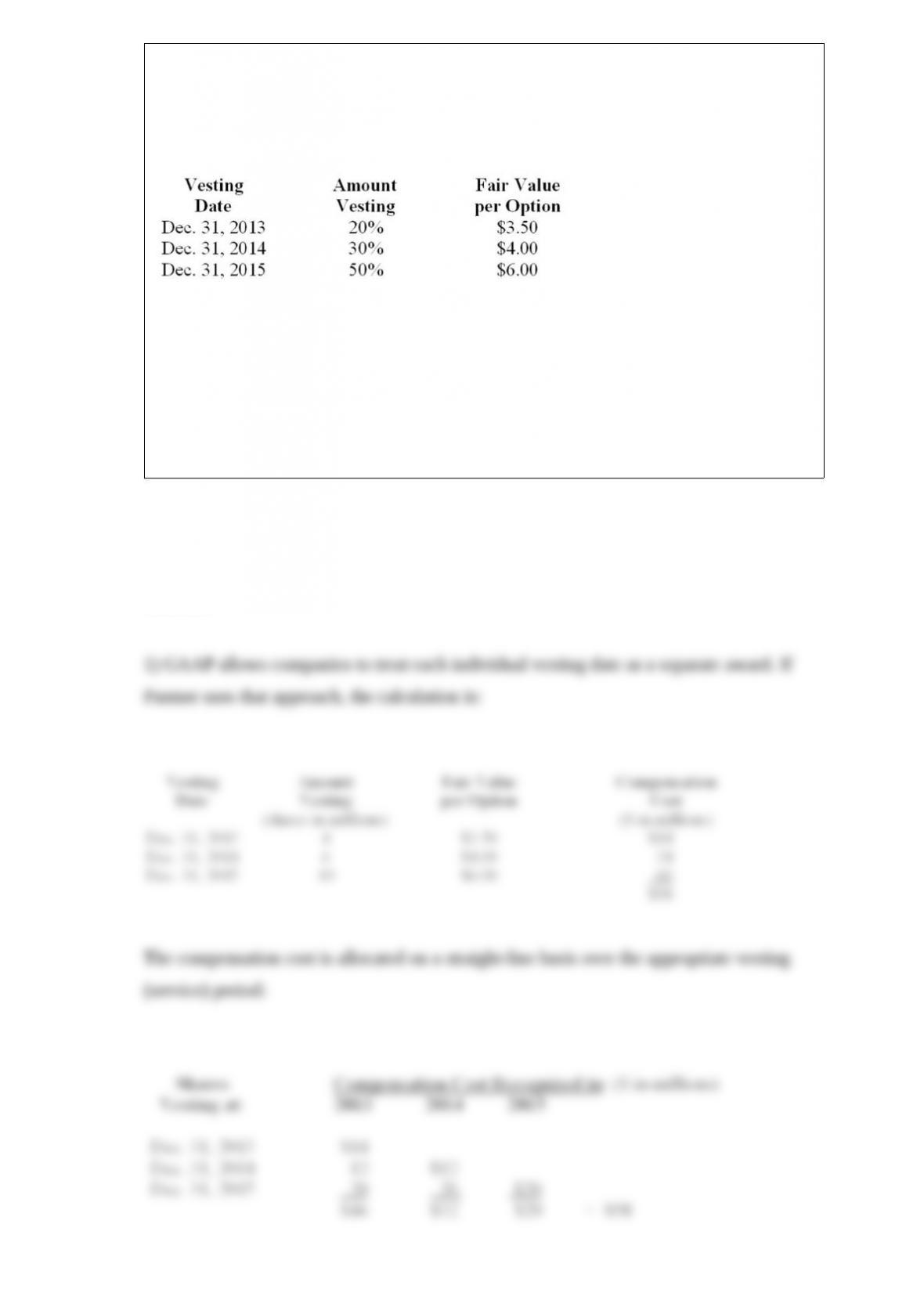
Pastner Brands is a calendar-year firm with operations in several countries. As part of
its executive compensation plan, at January 1, 2013, the company had issued 20 million
executive stock options permitting executives to buy 20 million shares of stock for $25.
The vesting schedule is 20% the first year, 30% the second year, and 50% the third year
(graded-vesting). The fair value of the options is estimated as follows:
Required:
1) Determine the compensation expense related to the options to be recorded each year
for 2013-2015, assuming Pastner accounts for each vesting date as a separate award.
2) Determine the compensation expense related to the options to be recorded each year
for 2013-2015, assuming Pastner uses the straight-line method over the three-year
vesting period.
Answer: