
Loreen Tina is the chief lawyer for Tamara Incorporated. The CEO of Tamara
Incorporated asks Loreen whether the company should periodically delete all company
e-mail. If Loreen is well-versed in AIS best practices, she would mostly likely respond,
A) Yes, if we are ever sued, the other attorney will not be able to comb through our
e-mail for evidence.
B) Yes, since e-mail requires a lot of storage space, deleting it periodically will reduce
the amount of information we need to store.
C) No, deleting an organization’s e-mail is against the law.
D) No, if we are ever sued we will not be able to draw upon our e-mail records to
defend ourselves.
The results of an internal audit finds that there is a problem with inaccurate time data
being entered into the payroll system. What is an applicable control that can help
prevent this event from occurring in the future?
A) Proper segregation of duties.
B) Automation of data collection.
C) Sound hiring procedures.
D) Review of appropriate performance metrics.
Which statement is true regarding file systems?
A) Transaction files are similar to ledgers in a manual AIS.
B) Multiple master files create problems with data consistency.
C) Transaction files are permanent.
D) Individual records are never deleted in a master file.

The best solution for maintaining accurate automated perpetual inventory system is to
use
A) closed-loop verification when inventory is received from vendors and recorded.
B) point of sale devices integrated with inventory records.
C) periodic physical counts to reconcile with perpetual inventory records.
D) RFID tags.
Which of the following is not one of the basic actions that an organization must take to
preserve the confidentiality of sensitive information?
A) Identification of information to be protected.
B) Backing up the information.
C) Controlling access to the information.
D) Training.
Using a combination of symmetric and asymmetric key encryption, Sofia sent a report
to her home office in Indiana. She received an e-mail acknowledgement that her report
had been received, but a few minutes later she received a second e-mail that contained a
different hash total than the one associated with her report. This most likely explanation
for this result is that
A) the public key had been compromised.
B) the private key had been compromised.
C) the symmetric encryption key had been compromised.
D) the asymmetric encryption key had been compromised.

Using the database depicted above, how many foreign keys are in the database?
A) 0
B) 3
C) 4
D) 5
The deceptive method by which a perpetrator gains access to the system by pretending
to be an authorized user is called
A) masquerading.
B) bluebugging.
C) eavesdropping.
D) podslurping.
Effective AIS training involves
A) instruction on new hardware and software.
B) orientation to new policies and operations.
C) planning and scheduling so it occurs before system testing and conversion.
D) All of the above are correct.
The more information a company provides vendors in its request for proposal, the better
the chances of receiving a system that meets the organization’s requirements. Which of
the below statements identifies why errors may decrease?
A) All responses are in the same format and based on the same information.
B) Both parties possess the same expectations and pertinent information is captured in
writing.
C) The chances of overlooking important factors are reduced.
D) The same information is provided to all vendors.
How does an MRP inventory system reduces inventory levels?
A) by reducing the uncertainty regarding when materials are needed
B) by receiving materials exactly when needed and in exact quantities
C) by computing the exact costs of purchasing and carrying inventory
D) none of the above
Which of the following describes a phase-in conversion?
A) Both the old and new AIS are operated simultaneously.
B) Elements of the old AIS are replaced gradually with elements of the new AIS.
C) The new AIS is introduced into a segment, rather than the whole organization.
D) The old AIS is terminated as the new AIS is introduced.
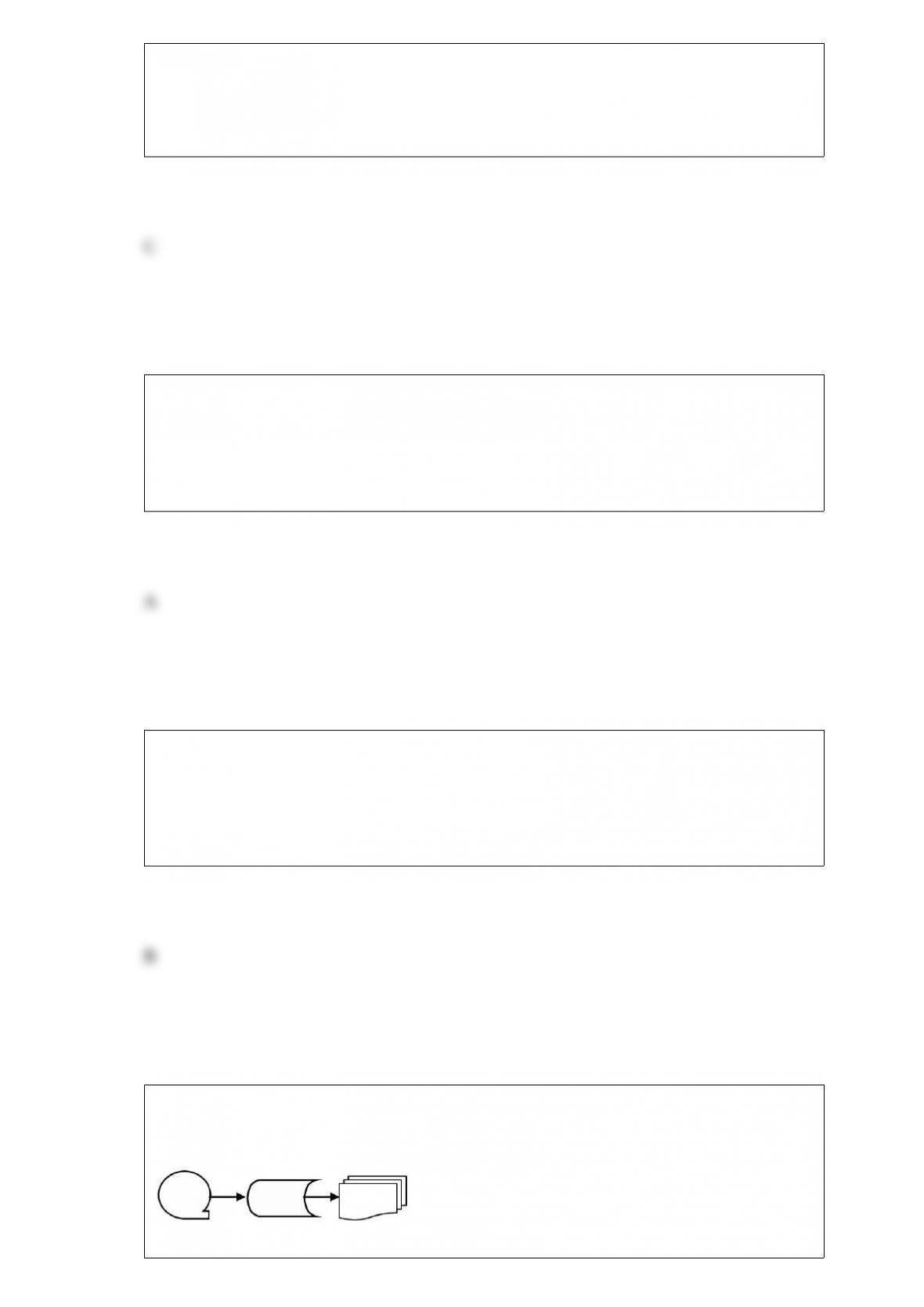
A report is generated from data stored on a hard drive. Which one of the following
diagrams represents this activity?
A)
B)

C)
D)
XBRL stands for
A) extensible business reporting language.
B) external business reporting ledgers.
C) external business reporting language.
D) extensive business report logic.
If duties are properly segregated, the authorization function is performed by ________,
the recording function is performed by ________, and cash handling is performed by
the ________.
A) accounts payable; purchasing; cashier
B) purchasing; accounts payable; cashier
C) purchasing; cashier; accounts payable
D) purchasing; accounts payable; treasurer

The process of defining a database so that it faithfully represents all aspects of the
organization including its interactions with the external environment is called
A) data modeling.
B) data designing.
C) data development.
D) data definition.
Identify one control that can be used to mitigate the threat of poor product design that
results in excess costs.
A) production planning systems
B) analysis of warranty and repair costs
C) encryption
D) insurance
Which of the following is not a threat to the revenue cycle sales order entry process?
A) incomplete orders
B) invalid orders
C) cash flow problems
D) uncollectible accounts
A ________ determines the correctness of the logical relationship between two data

items.
A) range check
B) reasonableness test
C) sign check
D) size check
Identify a key feature associated with materials requirements planning.
A) determining economic order quantity for all materials
B) minimizing or eliminating carrying and stockout costs
C) determining the optimal reorder points for all materials
D) reducing required inventory levels by scheduling production, rather than estimating
needs
The auditor uses ________ to continuously monitor the system and collect audit
evidence while live data are processed.
A) test data processing
B) parallel simulation
C) concurrent audit techniques
D) analysis of program logic
The AIS compiles and feeds information among the business cycles. What is the
relationship between the revenue and production cycles regarding the exchange of
information?

A) The revenue cycle provides sales forecast and customer order information to the
production cycle, but the production cycle sends information back to revenue about
finished goods production.
B) The revenue cycle receives information from the production cycle about raw
materials needs.
C) The production cycle sends cost of goods manufactured information back to the
revenue cycle.
D) The production cycle does not exchange information with the revenue cycle.
Individuals who buy the malware are referred to as
A) malware owners.
B) malware writers.
C) botnet owners.
D) bad actors.
Which of the following is an example of output fraud?
A) A man used desktop publishing to prepare bills for office supplies that were never
ordered or delivered and mailed them to local companies. The invoices were for less
than $300, an amount that often does not require purchase orders or approvals. A high
percentage of the companies paid the bills.
B) Two accountants without the appropriate access rights hacked into Cisco’’s stock
option system, transferred over $6.3 million of Cisco stock to their brokerage accounts,
and sold the stock. They used part of the funds to support an extravagant lifestyle,
including a $52,000 Mercedes-Benz, a $44,000 diamond ring, and a $20,000 Rolex
watch.
C) The office manager of a Wall Street law firm sold information to friends and
relatives about prospective mergers and acquisitions found in Word files. They made
several million dollars trading the securities.
D) A fraud perpetrator scanned a company paycheck, used desktop publishing software
to erase
the payee and amount, and printed fictitious paychecks.

When a subsystem’s goals are inconsistent with the goals of another subsystem or with
the system as a whole, it creates
A) system inconsistence.
B) system conflict.
C) goal inconsistence.
D) goal conflict.
Which of the following controls can minimize the threat of unauthorized disclosure of
sensitive information?
A) The use of innovative performance metrics.
B) The use of periodic physical counts of inventory and reconciliation of those counts
to recorded quantities.
C) The use of encryption.
D) The use of production planning systems.
Identify the event below where information associated with the event most likely will
need to be retained for years.
A) The actual cost associated with repairing a customer’s car.
B) The employee who answered a customer service phone call.
C) The amount of cash received from issuing stock.
D) A list of services offered by the company as of the start of a fiscal year.

The AIS must include controls to ensure
A) safety and availability of data.
B) marketing initiatives match corporate goals.
C) information produced from data is accurate.
D) both A and C
The evidence collection method that examines all supporting documents to determine
the validity of a transaction is called
A) review of documentation.
B) vouching.
C) physical examination.
D) analytical review.
It costs ________ times as much to acquire a new customer as it does to make a sale to
an existing customer.
A) two
B) five
C) eight
D) ten

Identify the aspect of a well-structured database that is incorrect.
A) Data is consistent.
B) Redundancy is minimized and controlled.
C) All data is stored in one table or relation.
D) The primary key of any row in a relation cannot be null.
The auditor’s objective is to seek ________ that no material error exists in the
information audited.
A) absolute reliability
B) reasonable objectivity
C) reasonable evidence
D) reasonable assurance