The two categories – valued-added and non-value added – are defined from the
organization’s management perspective.
The major factor in the amount of material used in production is the quality of the
material.
The Theory of Constraints seeks to maximize throughput contribution, which equals
sales revenue less direct materials cost.
Since a mixed cost has both a fixed and a variable component, both the total cost and
the unit cost will vary with changes in the level of activity.
Budgets assist managers in the areas of planning, controlling, evaluating, and decision
making.
A variable cost is one that varies in proportion to a business activity.
Decision makers might have a long list of information they would find helpful, and they
are generally not willing to sacrifice accuracy for having the information quickly.
Deviations from the budget can occur because of good decisions, bad decisions, or
events.
A lagging indicator “lags ” the time period when a performance is measured.
Activities that involve external funding are called financing activities.
Customer profit margin divides customer net profit by customer revenues to obtain the
profit percentage the customer generates for the company.

A static budget is one that
a. is based on the actual sales volume achieved during the period.
b. Is developed for a single level of expected output.
c. Is one component of the operating budget.
d. None of these answer choices are correct.
Generally Accepted Accounting Principles (GAAP) require companies to
a. Report selected information about operating segments in the annual report.
b. Prepare financial statements using a cash basis.
c. Report information based on responsibility centers.
d. Report information in single-step format.
Which of the following is not a consequence of a sales budget developed by an overly
optimistic marketing department?
a. Too much inventory may be produced.
b. Too much material will be ordered.
c. The company will fail to achieve its budgeted income.
d. All of these answer choices are consequences of a sales budget developed by an
overly optimistic marketing department.
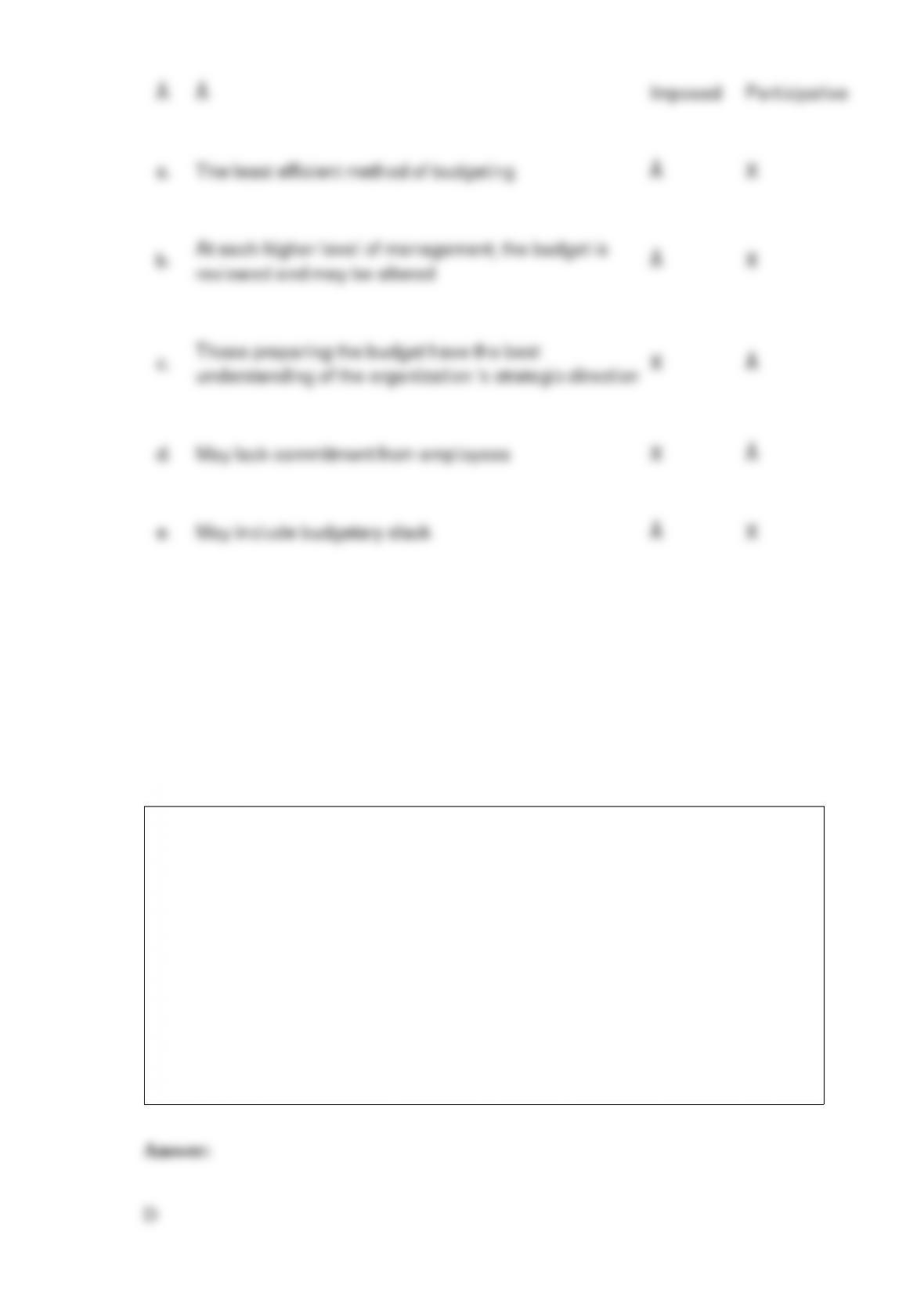
Indicate whether the following items are characteristics of imposed budgeting or
participative budgeting.
Imposed Participative
A&W Manufacturing uses an activity-based costing system for its cutting department.
The activity cost totals $148,000. The number of cuts is the cost driver. The cutting
department processed a total of 9,000 batches with an average cuts per batch of 6 and
total cuts of 46,250. What is the activity rate for the cutting department?
a. $1,500 per cut
b. $247 per cut
c. $16.45 per batch
d. $3.20 per cut
At a Dole pineapple processing plant, which of the following is not a value-added
activity?
a. Washing the pineapples
b. Coring the pineapples
c. Slicing the pineapples
d. Labeling the packages
Lagging indicators can be used to
a. Measure past performance.
b. Predict future results.
c. Provide evidence that a certain result has been obtained.
d. All of these answer choices are correct.
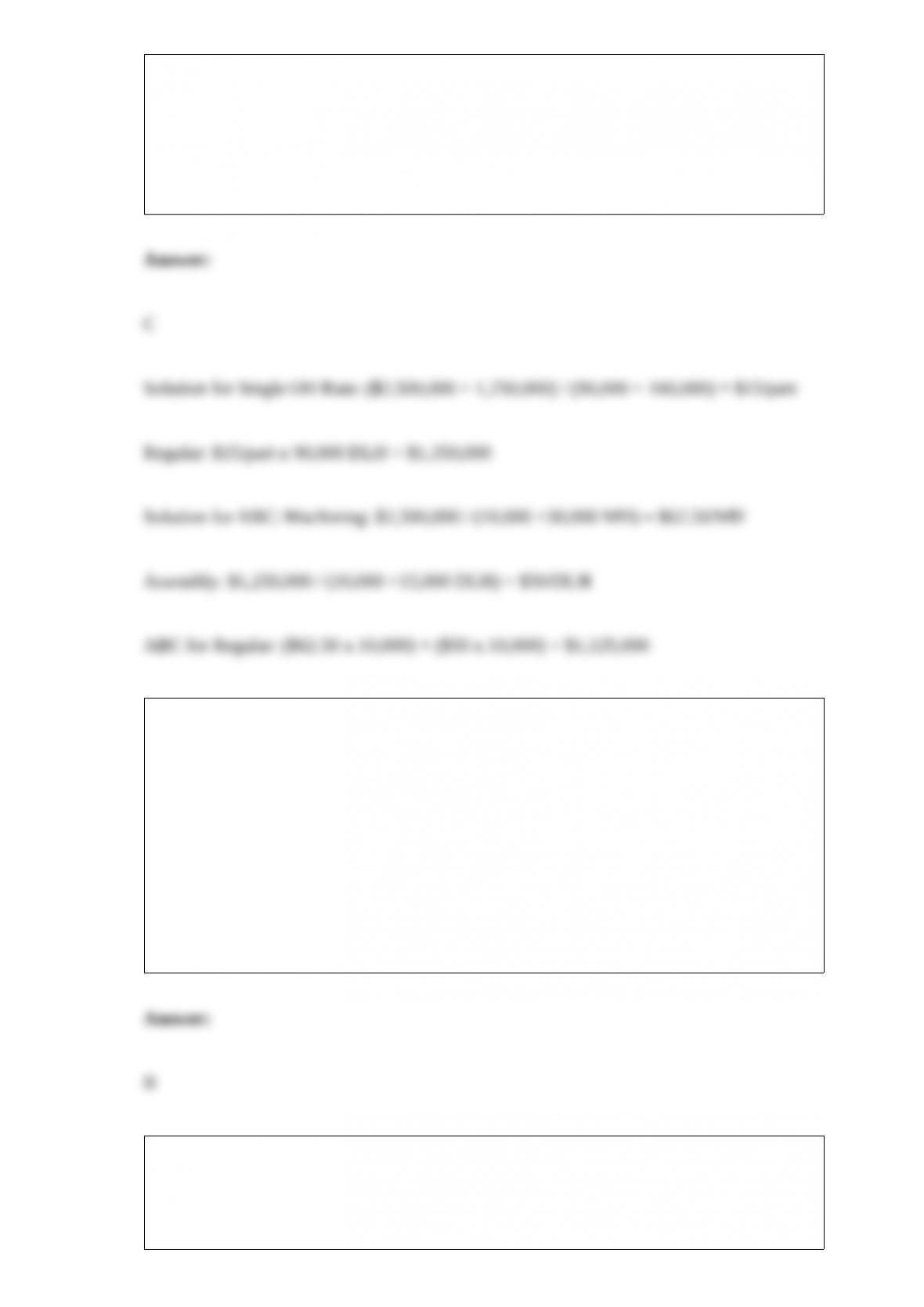
Dawson Company manufactures two products, Regular and Deluxe. Overhead costs
consist of machining, $2,500,000; and assembly, $1,250,000. Recent data are provided
below:
Overhead allocated to Regular using a single overhead rate (based on number of parts)
and using activity based costing, respectively, are:
a. $2,400,000 and $2,625,000
b. $937,500 and $2,812,500
c. $1,350,000 and $1,125,000
d. $1,075,000 and $2,675,000
ABC Corporation has three divisions, a service division with two locations, a retail
division with four locations, and a home office, each of which is evaluated individually.
This is an example of which type of organization?
a. Segmented decision making
b. Decentralized
c. Divisional instability
d. None of these answer choices are correct.
Vista Industries manufactures 75,000 digital cameras each year. Vista has been
producing the lenses internally. However, late last year the company received an offer
to produce the 150,000 lenses the company uses each year for a total contract price of
$380,000. When Vista manufactures the lenses internally, direct materials cost $1.05 per
lens, direct labor is $.65 per lens, and variable overhead is $.30 per lens. Vista ‘s total
overhead is $110,000. If the lens were purchased, $28,000 of fixed overhead could be
avoided. Should Vista purchase or produce the lenses, and what is the savings
associated with the decision?
a. Purchase the lenses and save $52,000
b. Produce the lenses and save $52,000
c. Purchase the lenses and save $2,000
d. Produce the lenses and save $2,000
Identify potential causes of the variable overhead spending and efficiency variances and
the fixed overhead spending variance.
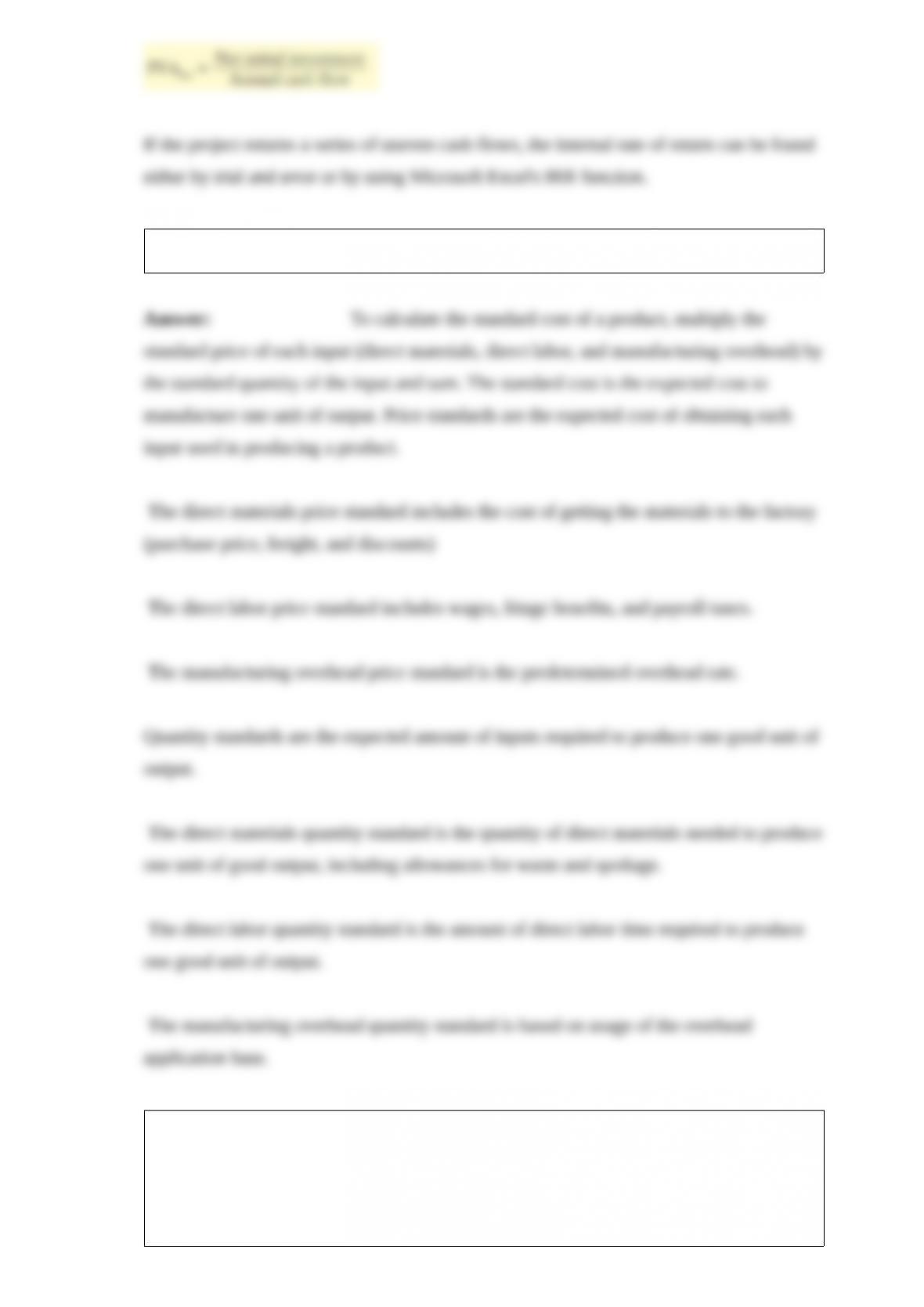
Use the internal rate of return to determine the acceptability of a project.
Calculate the standard cost of a product.
Your company has realized that some managers are making rash decisions which have
created negative consequences for the entire company. You have been assigned to a
team responsible for training managers on good decisions based on a relevant-cost
decision model. Your team has done some research and found that most management
decisions can be approached using a model that asked five questions. List and discuss
the five step approach in Chapter 8.
List three reasons why it is important for a company to have a written code of conduct.