1) In flexible budgets, costs that remain the same regardless of the output levels within
the relevant range are ________.
A) allocated costs
B) budgeted costs
C) fixed costs
D) variable costs
2) ________ is the continuing reduction in the demand for a company’s products that
occurs when competitor prices are not met.
A) Downward demand spiral
B) Competitor pricing pressure
C) Continuous step down demand
D) Super-variable costing
3) Management accounting information helps managers calculate a target cost for a
product ________.
A) by subtracting from the target price the operating income per unit of product that the
company wants to earn
B) by subtracting from the target price the net income per unit of product that the
company wants to earn
C) by subtracting profit margin per unit from the target price of product that the
company wants to earn
D) by adding the operating income per unit and the contribution margin per unit
4) Which of the following costs will be treated as period costs under absorption
costing?
A) raw materials used in the production
B) sales commission paid on sale of product
C) depreciation on factory equipment
D) rent for factory building
5) Which of the following is a responsibility center to measure the revenues and costs
of subunits in centralized or decentralized companies?
A) investment center
B) environmental center
C) exchange policy center
D) taxation rebate center
6) The time it takes the marketing department to specify to the manufacturing
department the exact requirements of the customer’s order is referred as ________.
A) receipt time
B) waiting time
C) delivery time
D) manufacturing cycle time
7) Demizio Valley Orchards, Inc. (DVO), developed standard costs for direct material
and direct labor. In 2015, DVO estimated the following standard costs for one of their
most well loved products, the DVO classic Grandma’s large apple pie which had a
brown sugar coating on the top of the crust as well as including cranberry and mince
ingredients in addition to the apples.
During September, DVO produced and sold 1,100 pies using 2,300 pounds of direct
materials at an average cost per pound of $6.00 and 200 direct labor hours at an average
wage of $13.25 per hour.
The direct labor efficiency variance during September is ________.
A) $260.00 favorable
B) $250.00 unfavorable
C) $280.00 favorable
D) $210.00 unfavorable
8) Teecorp Company provides the following ABC costing information:
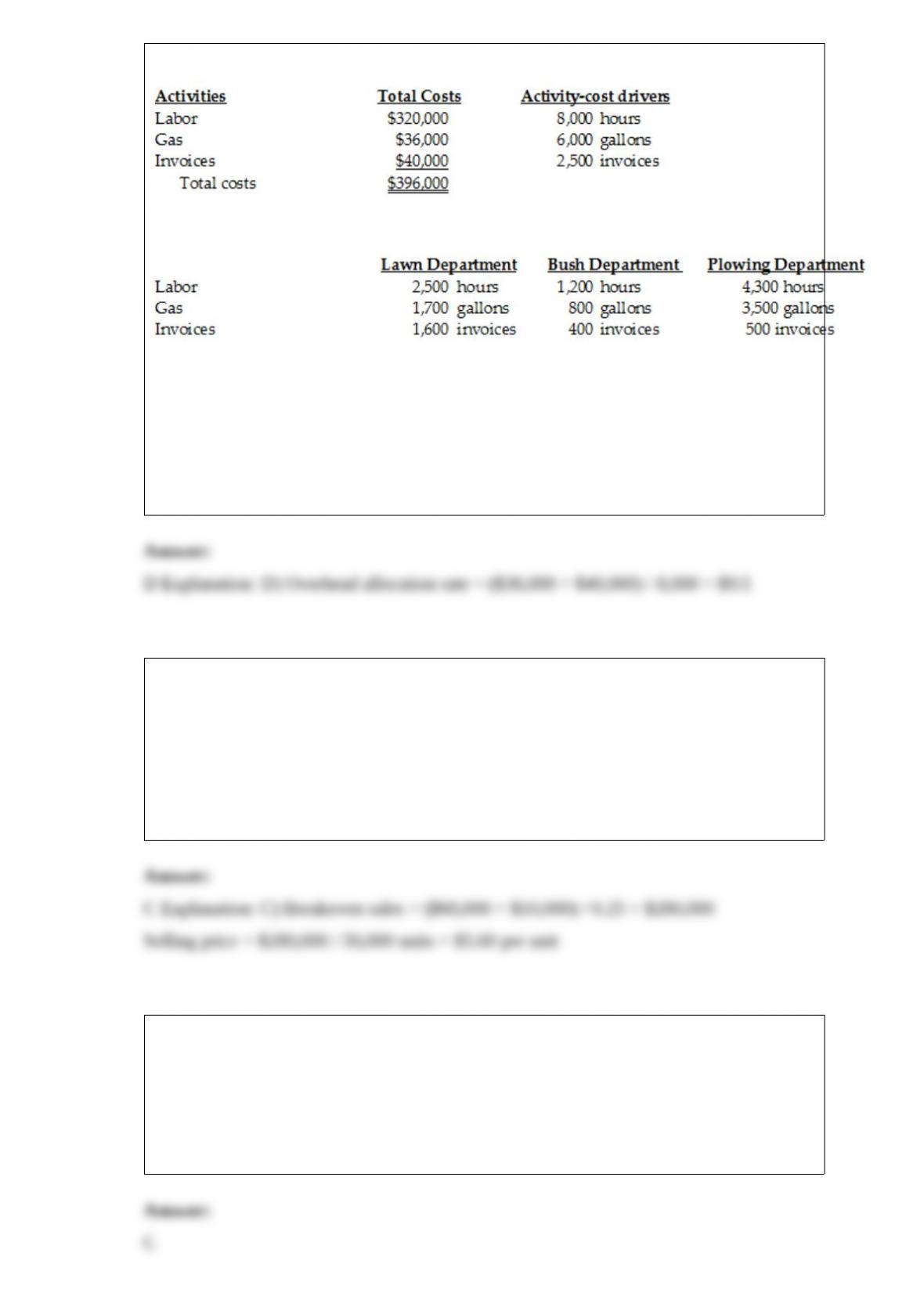
The above activities used by their three departments are:
If labor hours are used to allocate the non-labor, overhead costs, what is the overhead
allocation rate?
A) $49.50 per hour
B) $24 per hour
C) $4.60 per hour
D) $9.50 per hour
9) The Marietta Company has fixed costs of $60,000 and variable costs are 75% of the
selling price. To realize profits of $10,000 from sales of 50,000 units, the selling price
per unit ________.
A) must be $1.20
B) must be $6.00
C) must be $5.60
D) must be $4.23
10) Manufacturing-sector companies report ________.
A) only merchandise inventory
B) only finished goods inventory
C) direct materials inventory, work-in-process inventory, and finished goods inventory
accounts
D) direct materials inventory and finished goods inventory accounts only
11) A stretch budget is a budget that ________.
A) crosses more than one responsibility center
B) represents a challenging, but achievable level of performance
C) is impossible to implement in a cost center
D) is designed to include the effects of exchange rate fluctuations
12) For each report listed below, identify whether the major purpose of the report is for
(1) routine internal reporting, (2) nonroutine internal reporting, or for (3) external
reporting to investors and other outside parties.
Item:
a.study detailing sale information of the top-ten selling products
b.weekly report of total sales generated by each store in the metropolitan area
c.annual Report sent to shareholders
d.monthly report comparing budgeted sales by store to actual sales
13) Emerging Dock Company manufactures boat docks on an assembly line. Its
standard costing system uses two cost categories, direct materials and conversion costs.
Each product must pass through the Assembly Department and the Finishing
Department. Direct materials are added at the beginning of the production process.
Conversion costs are allocated evenly throughout production.
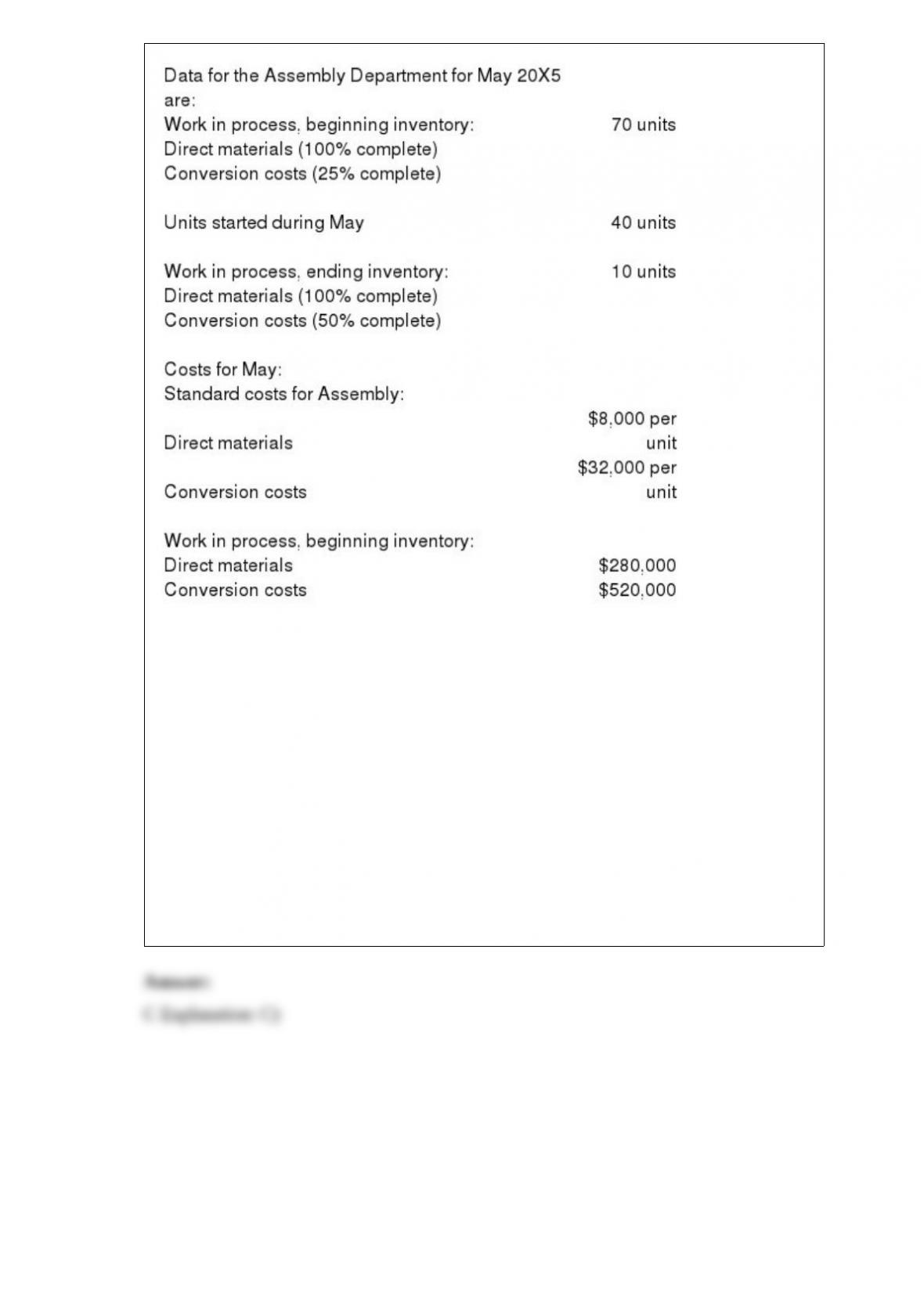
Which of the following journal entries records the total conversion costs variances of
the Assembly Department, assuming that conversion costs are 20% higher than
expected?
A) Work in Process Assembly 3,360,000
Conversion-Cost Variances 560,000
Assembly Department Conversion Cost Control 2,800,000
B) Assembly Department Conversion Costs Allocated 3,360,000
Direct Materials Variances 560,000
Finishing Department Conversion Cost Control 2,800,000
C) Assembly Department Conversion Costs Allocated 2,800,000
Conversion-Cost Variances 560,000
Assembly Department Conversion Cost Control 3,360,000
D) Work in Process Assembly 560,000
Assembly Department Conversion Cost Control 560,000
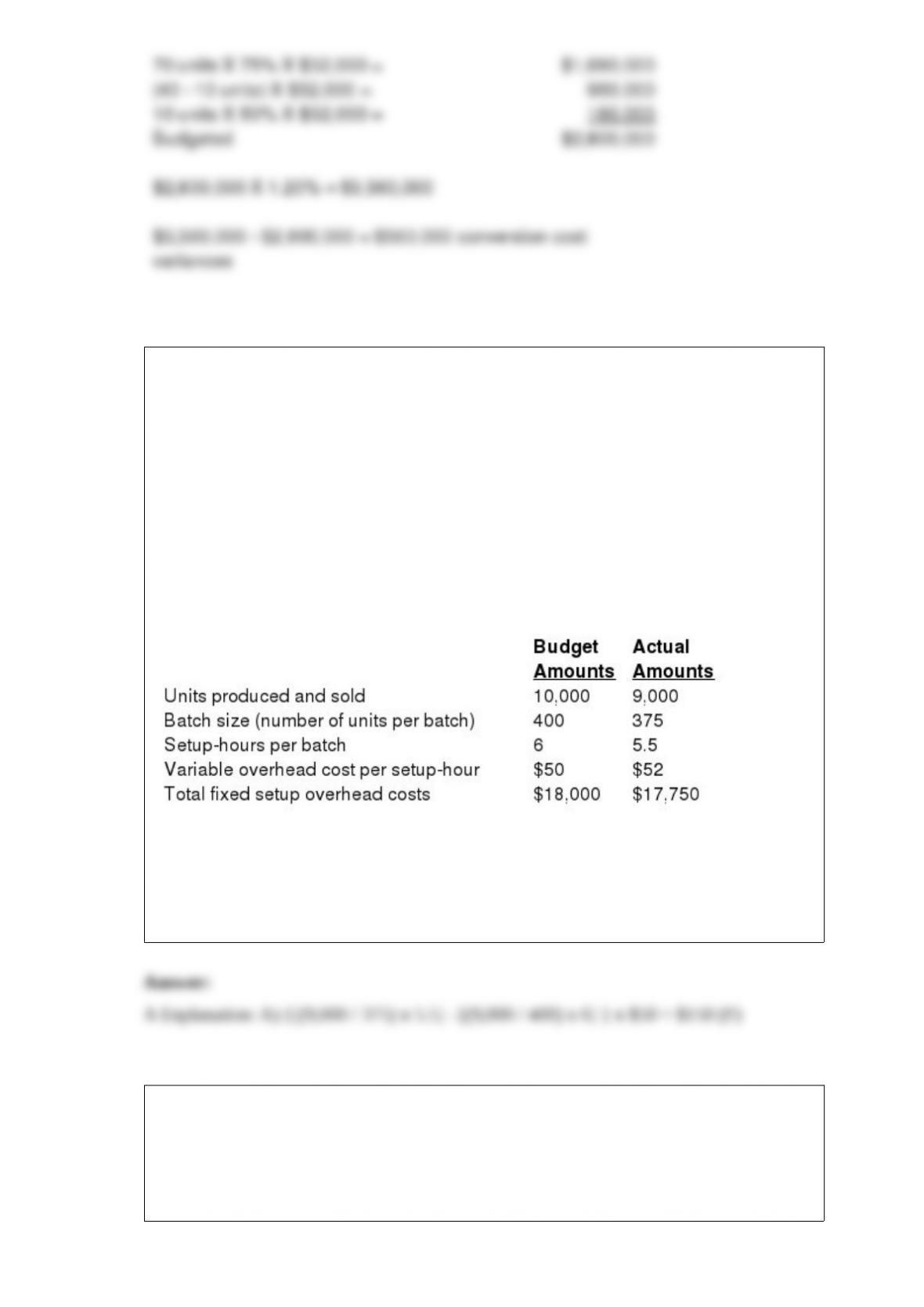
14) Lukehart Industries, Inc., produces air purifiers. Lukehart, Inc., produces the air
purifiers in batches. To manufacture a batch of the purifiers, Lukehart, Inc., must set up
the machines and assembly line tooling. Setup costs are batch-level costs because they
are associated with batches rather than individual units of products. A separate Setup
Department is responsible for setting up machines and tooling for different models of
the air purifiers.
Setup overhead costs consist of some costs that are variable and some costs that are
fixed with respect to the number of setup-hours. The following information pertains to
June 2015:
Calculate the efficiency variance for variable overhead setup costs.
A) $150 favorable
B) $114 favorable
C) $264 unfavorable
D) $264 favorable
15) ________ is the usual starting point for budgeting.
A) The revenues budget
B) The estimated net income
C) The production budget
D) The cash budget
16) Pearl Corp. applies manufacturing overhead costs to products at a budgeted
indirect-cost rate of $60 per direct manufacturing labor-hour. A retail outlet has
requested a bid on a special order of a necklace. Estimates for this order include: Direct
materials of $50,000; 400 direct manufacturing labor-hours at $20 per hour; and a 30%
markup rate on total manufacturing costs.
The bid price for this special order is ________.
A) $66,000
B) $106,600
C) $86,600
D) $116,600