The ledger consists of all of the accounts used by a business.
Answer:
A company does not need to record the receipt of a bill for utilities used during this year
if they will not pay for it until next year.
Answer:
A company that pays no dividends is always a poor investment.
Answer:
Factoring refers to an arrangement in which a company sells its receivables to another
company and receives cash immediately.
Answer:
Which of the following statements regarding inventory classifications is notTRUE?
A. Inventory may include materials used in producing goods for sale.
B. Companies that are manufacturers list their finished goods, work-in-process and raw
materials inventory separately.
C. Inventory is classified as a long-term asset on the balance sheet.
D. Merchandisers buy inventory in finished form ready for resale.
Answer:
Daily activities involved in running a business such as buying supplies and paying
wages are operating activities.
Answer:
When a company issues bonds that include no periodic interest payments, the bonds are
called zero-coupon bonds.
Answer:
The incentive element of the fraud triangle includes reasons why top management may
commit fraud such as enhancing job security and obtaining bigger paychecks.
Answer:
Which of the following statements regarding revenues and expenses isTRUE?
A. Both revenues and expenses typically have credit balances.
B. Revenues and expenses are considered assets and liabilities, respectively.
C. Revenue is the same as cash.
D. Expenses decrease the amount of stockholders’ equity.
Answer:
Today’s stock price is included in the annual report.
Answer:
FOB shipping point means that ownership of goods passes to the buyer when the goods
reach the buyer.
Answer:
Benchmarks are required to evaluate a company’s performance.
Answer:
Which of the following statements regarding inventory costing methods isTRUE?
A. The LIFO method assumes that the costs for the newest goods (the last ones in) are
used first and the older costs are left in ending inventory.
B. During a period of rising prices, LIFO results in a higher income tax expense than
does FIFO.
C. International Financial Reporting Standards (IFRS) allow the use of LIFO but not
FIFO.
D. In the U.S., if a company uses LIFO on the income tax return, it may use a different
method for financial reporting.
Answer:
Which of the following statements regarding treasury stock isTRUE?
A. When a company reissues treasury stock for more than it originally paid for the
stock, it does not report a gain.
B. When a company purchases treasury stock or pays a dividend, it increases total
stockholders’ equity.
C. Treasury stock is reported as an asset on the balance sheet.
D. Treasury stock is reported as issued and outstanding stock.
Answer:
Your store buys ice cream at a cost of $1.50 a half gallon and sells it for $4 a half
gallon. General and administrative expenses are $0.75 per half gallon. Which of the
following statements isTRUE?
A. Your gross profit per half gallon is $2.50.
B. Your gross profit per half gallon is $1.75.
C. The difference between the selling price and the cost is recorded in the gross profit
account.
D. The difference between the selling price and the cost is recorded in the net profit
account.
Answer:
Vertical analysis is the comparison of a company’s financial information over time.
Answer:
When a company routinely sells on credit, it is inevitable that some of its customers
will not pay the amount owed.
Answer:
Adjusting entries often involve cash.
Answer:
In general, P/E ratios are fairly consistent across industries, regardless of the goods or
services sold.
Answer:
Which one of the following statements regarding earnings per share (EPS) isTRUE?
A. The EPS ratio is important because it signals the ability of the company to pay future
dividends, which investors factor into the stock price.
B. Earnings per share is generally reported in the balance sheet under stockholders’
equity.
C. Earnings per share is the best way to compare the performance of different
companies.
D. EPS, in its basic form, is calculated by dividing net income by the average number
of all shares issued.
Answer:
Financial statements in the quarterly reports are usually audited to ensure that GAAP
were followed.
Answer:
The sales returns and allowances account balance should be reported as a deduction
from the sales account balance because it is an expense account.
Answer:
Which of the following statements regarding liquidity and solvency ratios isTRUE?
A. Unlike solvency ratios, liquidity ratios relate to the company’s long-run survival.
B. Both liquidity ratios and solvency ratios measure a company’s ability to meet its
financial obligations.
C. Liquidity ratios include the return on equity ratio and the times interest earned ratio.
D. Solvency ratios include the current ratio and the net profit margin ratio.
Answer:
A corporation’s charter establishes the number of shares of stock to be issued.
Answer:
Which of the following statements about a multiple-step income statement is
notTRUE?
A. Net income plus income tax expense is equal to income before income taxes.
B. Depreciation would be considered an operating expense.
C. Income before income taxes less non-operating expenses, plus non-operating
revenues is equal to income from operations.
D. Net income plus income tax expense plus non-operating expenses less non-operating
revenues equals income from operations.
Answer:
A corporation does not have a legal obligation to pay dividends.
Answer:
Your company receives advance payment in October for services that are provided
during November. Which of the following isTRUE?
A. A liability is recorded in October; in November the liability is reduced and revenue
is recorded.
B. Revenue is recorded in October and expenses are recorded in November.
C. An asset is recorded in October; in November, the asset is reduced and revenue is
recorded.
D. Revenue and expenses are recorded in October.
Answer:
When expenses exceed revenues in a period, stockholders’ equity will increase.
Answer:

If a company reports net income on the income statement, then the statement of cash
flows must show an increase in cash flows from operating activities for the period.
Answer:
Which one of the following statements regarding inventory is notTRUE?
A. An increase in inventory levels is always a sign of inefficiency in inventory
management.
B. The measurement of inventory affects both the balance sheet and the income
statement within an accounting period.
C. The ending inventory of one accounting period becomes the beginning inventory of
the next accounting period.
D. The cost of merchandise can vary over time and may be affected by weather,
politics, and technological innovation.
Answer:
A company signed an agreement to rent store space from another company. This is an
example of a recordable transaction.
Answer:
Which of the following isTRUE of an imprest system?
A. It is an internal control for cash receipts.
B. It is commonly used with voucher systems.
C. The payroll bank account equals zero after all employees have been paid.
D. Eliminates the need for a bank reconciliation.
Answer:
Which of the following statements regarding the effect of a net loss on the closing
process isTRUE?
A. If a company has a net loss during the current accounting period, then the ending
retained earnings will be smaller than the beginning retained earnings.
B. When closing entries are prepared, contributed capital is debited if a company has a
net loss.
C. If a company has a net loss, the closing entry will include debits to the revenue
accounts, credits to the expense accounts, and a credit to Retained earnings.
D. If a company has a net loss, the amount of revenues to be closed will be greater than
the amount of expenses to be closed in the closing process.
Answer:
The fixed asset turnover ratio is a measure of the efficiency of a company.
Answer:
A hurricane destroyed a company’s building that originally cost $1 million. Which of
the following could not beTRUE?
A. Assets remain the same, and liabilities and stockholders’ equity both decrease by $1
million.
B. Assets decrease by $1 million, liabilities decrease by $1 million, and stockholders’
equity is unchanged.
C. Assets, liabilities, and stockholders’ equity all remain the same.
D. Assets decrease by $500,000, and liabilities decrease by $500,000.
Answer:
Which of the following is notTRUE about liabilities?
A. Liabilities are amounts owed by a business.
B. Liability accounts have a normal credit balance.
C. Financing activities may affect the amount of liabilities.
D. Examples of liabilities include notes payable, contributed capital and income tax
payable.
Answer:
Under the allowance method for uncollectible accounts, writing off a specific account
will not affect the net accounts receivable.
Answer:
The direct write-off method for uncollectible accounts is not allowed by GAAP because
it ignores the conservatism concept and the matching principle.
Answer:
Which of the following entries would be found on a statement of stockholders’ equity?
A. Net loss is subtracted from contributed capital.
B. Shares of stock issued are added to retained earnings.
C. Dividends are subtracted from contributed capital.
D. Repurchased shares are subtracted from contributed capital.
Answer:
Which of the following would cause the greatest increase in a company’s inventory
turnover ratio?
A. Keeping the same amount of inventory on hand while unit sales are increasing.
B. Increasing the amount of inventory on hand while unit sales are increasing.
C. Keeping the same amount of inventory on hand while unit sales are decreasing.
D. Decreasing the amount of inventory on hand while unit sales are increasing.
Answer:
In January, the Caribbean Dream Resort books and accepts a cash payment for $32,000
for vacation services to be provided during spring break in March. The $32,000 would
be recorded during January as a:
A. debit to Cash and a credit to Unearned Revenue.
B. debit to Accounts Payable and a credit to Service Revenue.
C. debit to Accounts Receivable and a credit to Service Revenue.
D. debit to Prepaid Expenses and a credit to Service Revenue.
Answer:
Which of the following companies would be least concerned about a low inventory
turnover ratio?
A. A fish market selling fresh fish.
B. A hardware company selling drywall screws.
C. A dairy company selling butter and milk.
D. A semiconductor company selling microchips.
Answer:
The statement of cash flows cannot be used to determine
A. changes in working capital.
B. expenditures on long-term assets.
C. profitability as measured by specific revenues and expenses.
D. reliance on external financing.
Answer:
All of the following might be used to evaluate cash flow performance, except:
A. the absolute amount of cash flow.
B. whether cash flow is positive or negative.
C. the relationship between net income and cash flow.
D. the trend in sales and operating expenses.
Answer:
Your company sells $469,300 of goods during the year at a cost of goods sold of
$398,600. Inventory was $29,783 at the beginning of the year and $34,038 at the end of
the year.
Use the information above to answer the following question. How long on average does
it take to sell something from inventory after it is purchased?
A. 12.5 days
B. 24.8 days
C. 29.2 days
D. 165.9 days
Answer:

On January 1, 2014, a company has assets of $16 billion and stockholders’ equity of $8
billion. On January 1, 2015, the same company has assets of $20 billion and
stockholders’ equity of $9 billion. During 2014, the company had total sales revenue of
$9 billion and total expenses of $7 billion.
If the company doesn’t have other sources of revenue, its net profit margin during 2014
is closest to:
A. 0.01
B. 0.013
C. 0.22
D. 0.022
Answer:
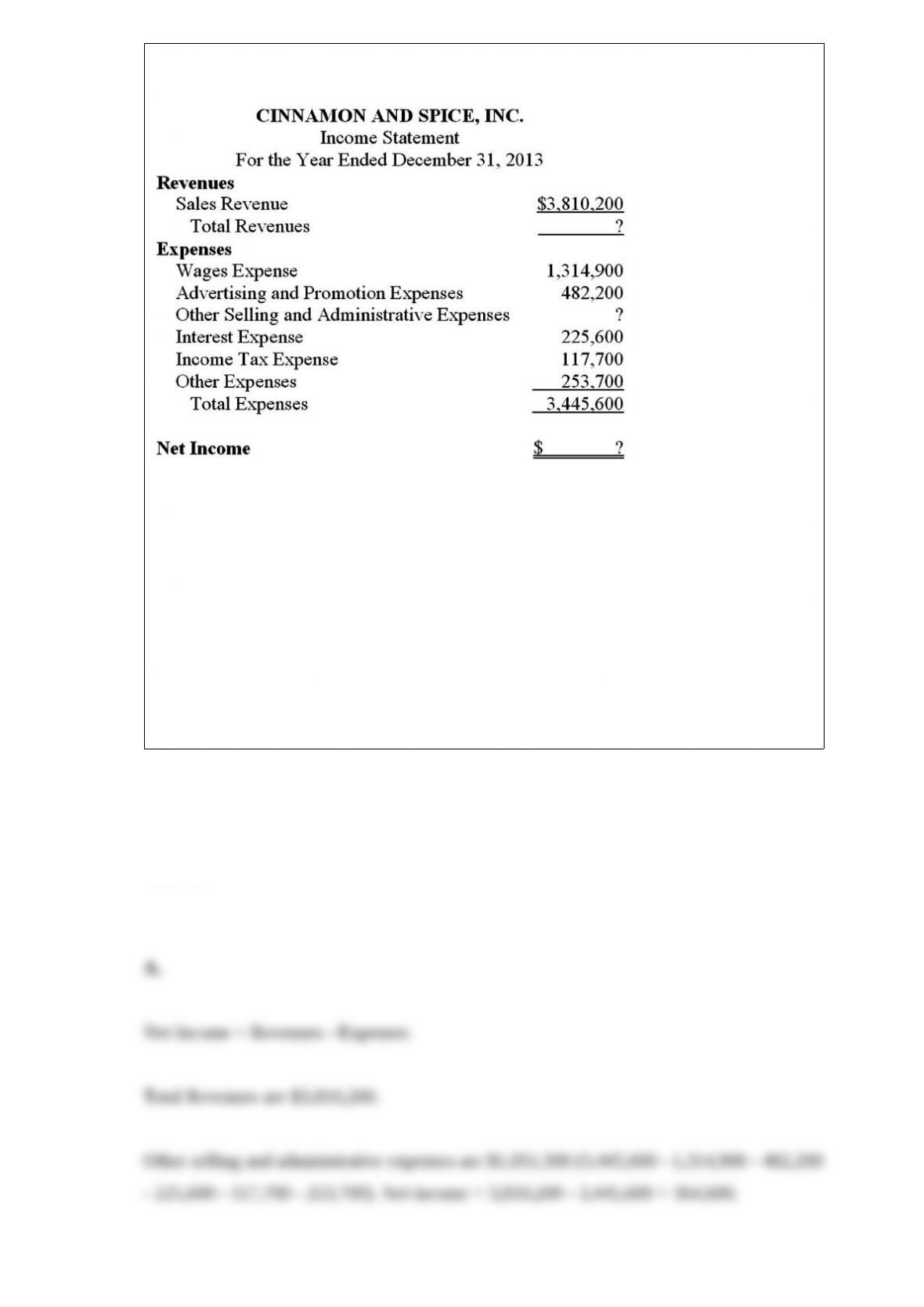
Find the missing data.
A. Total revenues are $3,810,200, other selling and administrative expenses are
$1,051,500, and net income is $364,600.
B. Total revenues are $2,495,300, other selling and administrative expenses are
$1,051,500, and net income is ($950,300).
C. Total revenues are $364,600, other selling and administrative expenses are
$3,081,000, and net income is $7,255,800.
D. Total revenues are $3,810,200, other selling and administrative expenses are
$364,600, and net income is $7,255,800.
Answer:
Use the information above to answer the following question. What was the amount of
cash paid for purchases of equipment during the year?
A. $40,000
B. $43,000
C. $50,000
D. $31,000
Answer:
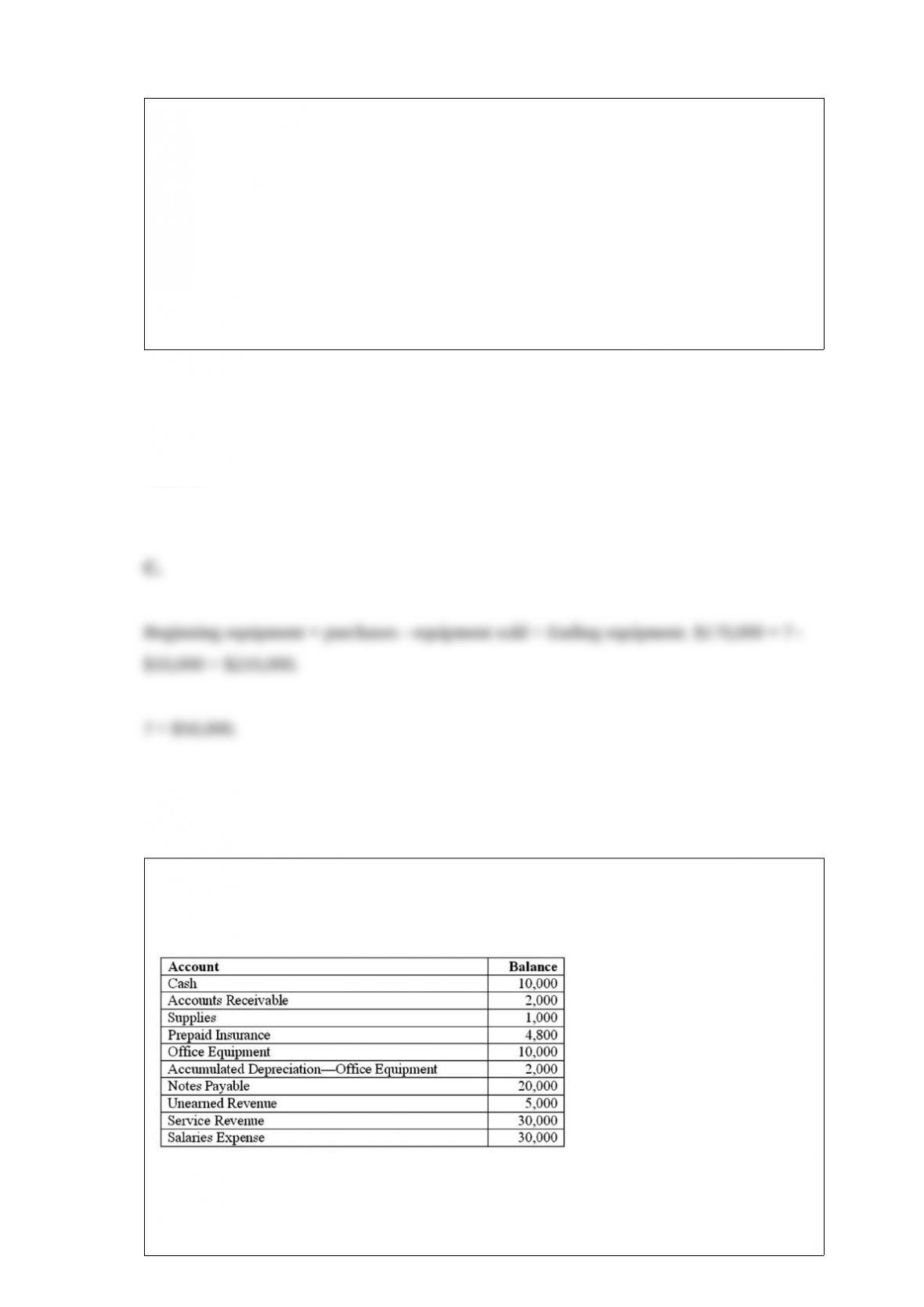
Presented below are selected accounts from the unadjusted trial balance of Sneetch Star
Makers Inc., a talent agency, at 12/31/13 (debit and credit labels have been omitted;
assume all balances are normal).
The insurance policy covers four years and was purchased by Sneetch on 1/1/13. The
adjusting entry on December 31, 2013 would include
A. a debit to prepaid insurance for $1,200.
B. a credit to prepaid insurance for $1,200.
C. a debit to insurance expense for $3,600.
D. a credit to prepaid insurance for $3,600.
Answer:
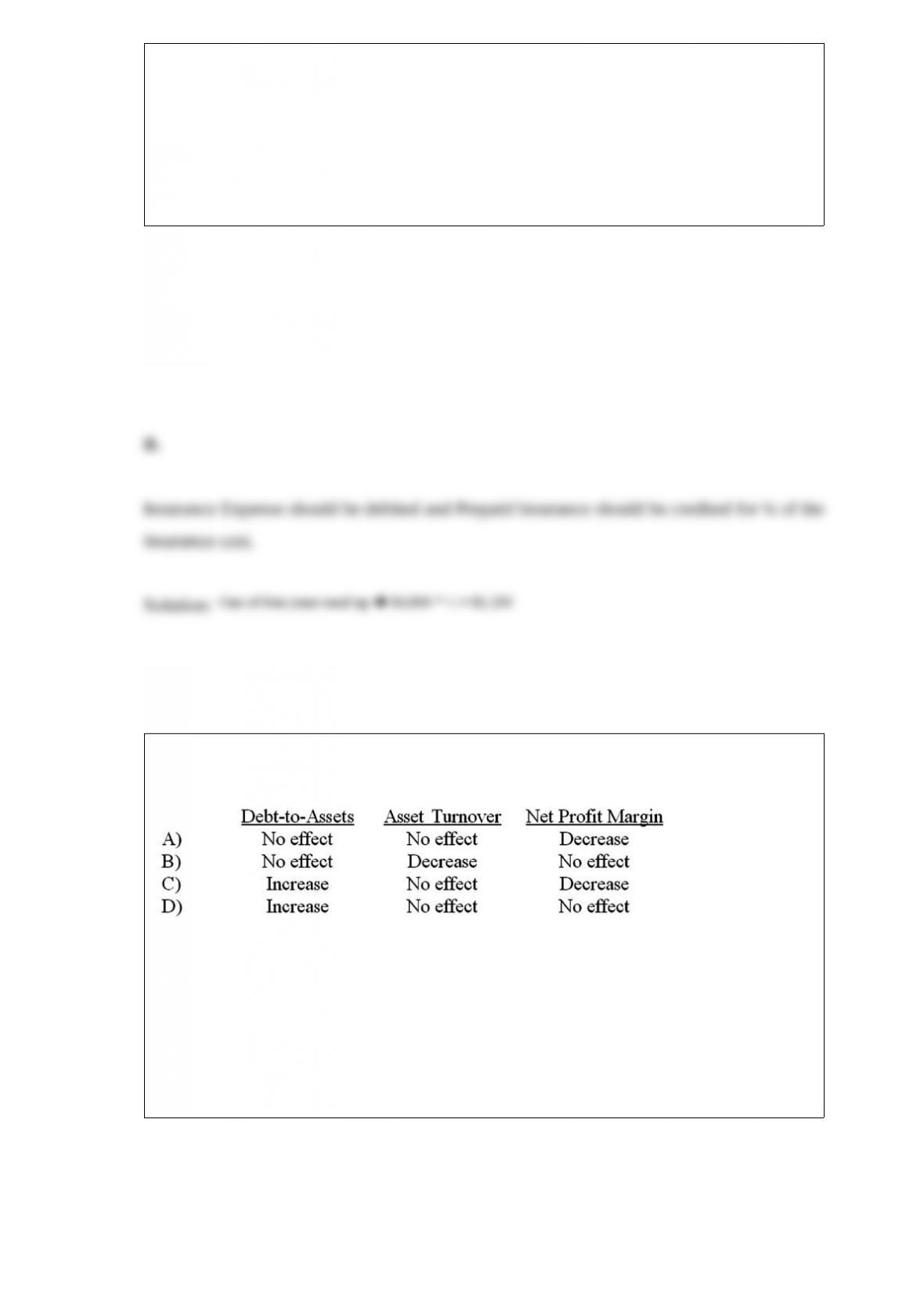
Which of the following accurately describes how declaring but not yet paying dividends
would affect the ratios indicated?
A. Option A
B. Option B
C. Option C
D. Option D
Answer:
A purpose of comparative income statements is to
A. reveal trends in sales.
B. see how the company compares to its competitors.
C. show whether retained earnings has increased or decreased over the years.
D. help prevent fraud.
Answer:
Flynn Company’s monthly bank statement showed the ending balance of cash of
$18,500. The bank reconciliation for the period showed an adjustment for a deposit in
transit of $1,500, outstanding checks of $2,000, a NSF check of $700, bank service
charges of $30 and the EFT from a customer in payment of the customer’s account of
$1,500.
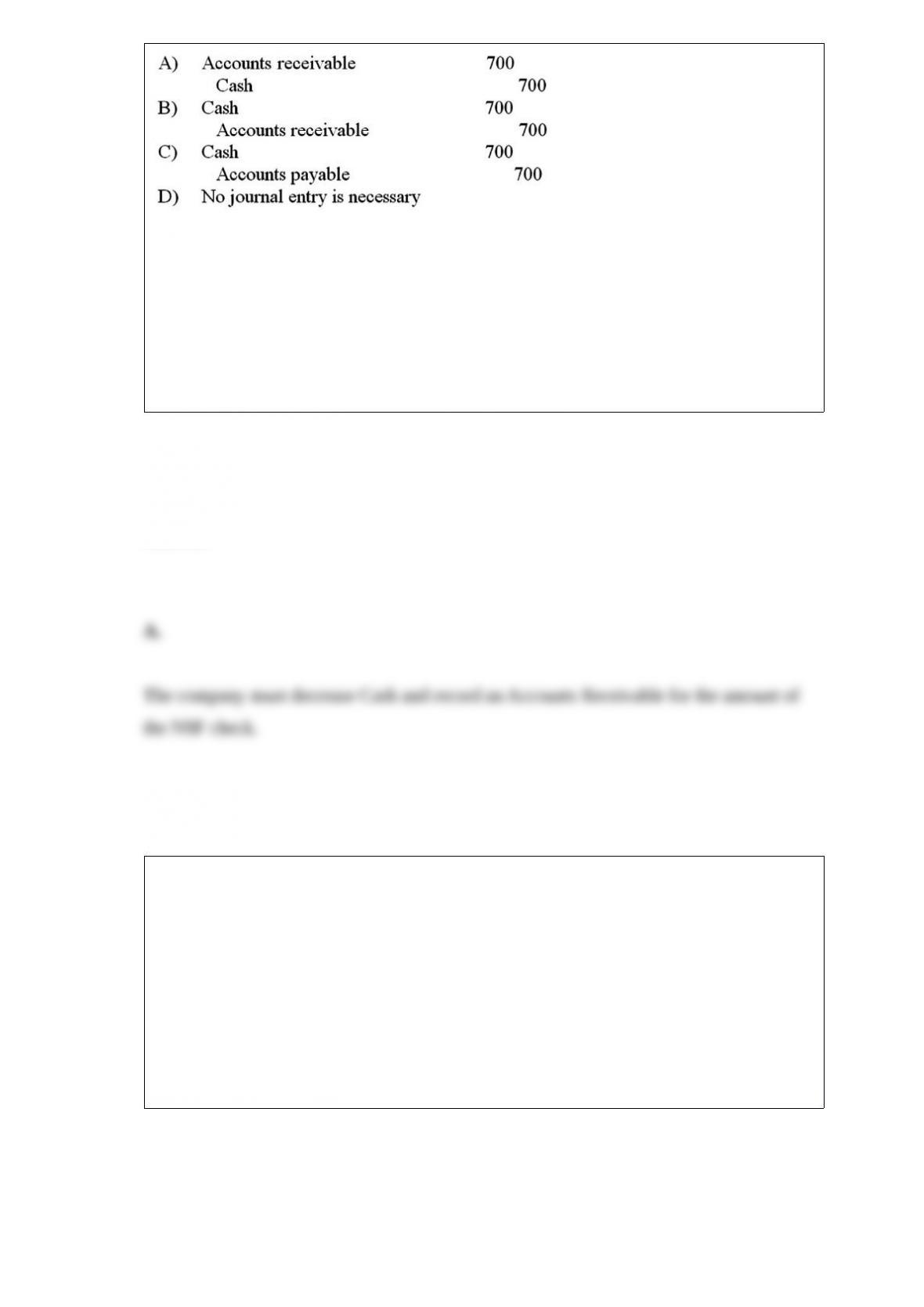
Use the information above to answer the following question. What journal entry should
be recorded by Flynn Company for the NSF check returned?
A. Option A
B. Option B
C. Option C
D. Option D
Answer:
Which of the following would not be considered cash and cash equivalents for purposes
of preparing a statement of cash flows?
A. Money market funds.
B. Checking accounts.
C. Treasury bills.
D. Notes receivable.
Answer:
A dance studio accepts $1,500 to provide a series of dance lessons to a youth group
during the month of July. The studio decides to record the revenue in July. The studio
also decides to record the July expenses of rent, utilities and salaries in August, when it
pays for them. One or both of these decisions:
A. violate the Expense Recognition (Matching) principle.
B. are an example of accrual accounting.
C. violate the revenue principle.
D. violate the accounting equation.
Answer:
Under the cost principle, a company capitalizes:
A. all ordinary repair expenditures incurred in the use of an asset.
B. any interest incurred in borrowing money to help pay for asset acquisitions.
C. all reasonable and necessary costs of acquiring an asset and preparing it for use.
D. the total market value of individual assets acquired in a ‘basket purchase’.
Answer:
Purrfect Pets has made all the year-end adjustments. Its expense accounts total
$130,000, and its revenue accounts total $190,000. The closing entry to close the
income statement accounts for the year will:
A. debit its various expense accounts for a total of $130,000, debit retained earnings for
$60,000, and credit its various revenue accounts for a total of $190,000.
B. debit its various revenue accounts for a total of $190,000, credit its various expense
accounts for a total of $130,000, and credit retained earnings for $60,000.
C. debit its various expense accounts for a total of $130,000, credit its various revenue
accounts for a total of $190,000, and credit retained earnings for $60,000.
D. debit its various revenue accounts for a total of $190,000, debit retained earnings for
$60,000, and credit its various expense accounts for a total of $130,000.
Answer:
A company owes rent at a rate of $6,000 per month. The company pays the rent owed
on the tenth of each month for the previous month. At the end of each month, what kind
of adjustment is required?
A. An accrual adjustment.
B. A closing adjustment.
C. A deferral adjustment.
D. No adjustment.
Answer:
Under the direct write-off method, the entry to write off a customer’s account would be:
A. Debit Bad Debt Expense, credit Allowance for Doubtful Accounts.
B. Debit Bad Debt Expense, credit Accounts Receivable.
C. Debit Write-off Expense, credit Accounts Receivable.
D. Debit Sales, credit Accounts Receivable.
Answer:
The ratio that measures how many times a company replenishes its inventory in a year
is the:
A. Days to sell.
B. Accounts receivable turnover ratio.
C. Inventory turnover ratio.
D. Days to collect ratio.
Answer:
On June, 30, 2013, a company purchased a two-year insurance policy for $18,000,
paying cash and debiting Prepaid Insurance for the entire two-year premium amount.
The adjusting entry on December 31, 2013 includes a
A. credit to Prepaid Insurance $4,500.
B. credit to Insurance Expense $4,500.
C. credit to Prepaid Insurance $9,000.
D. debit to Insurance expense $9,000.
Answer:
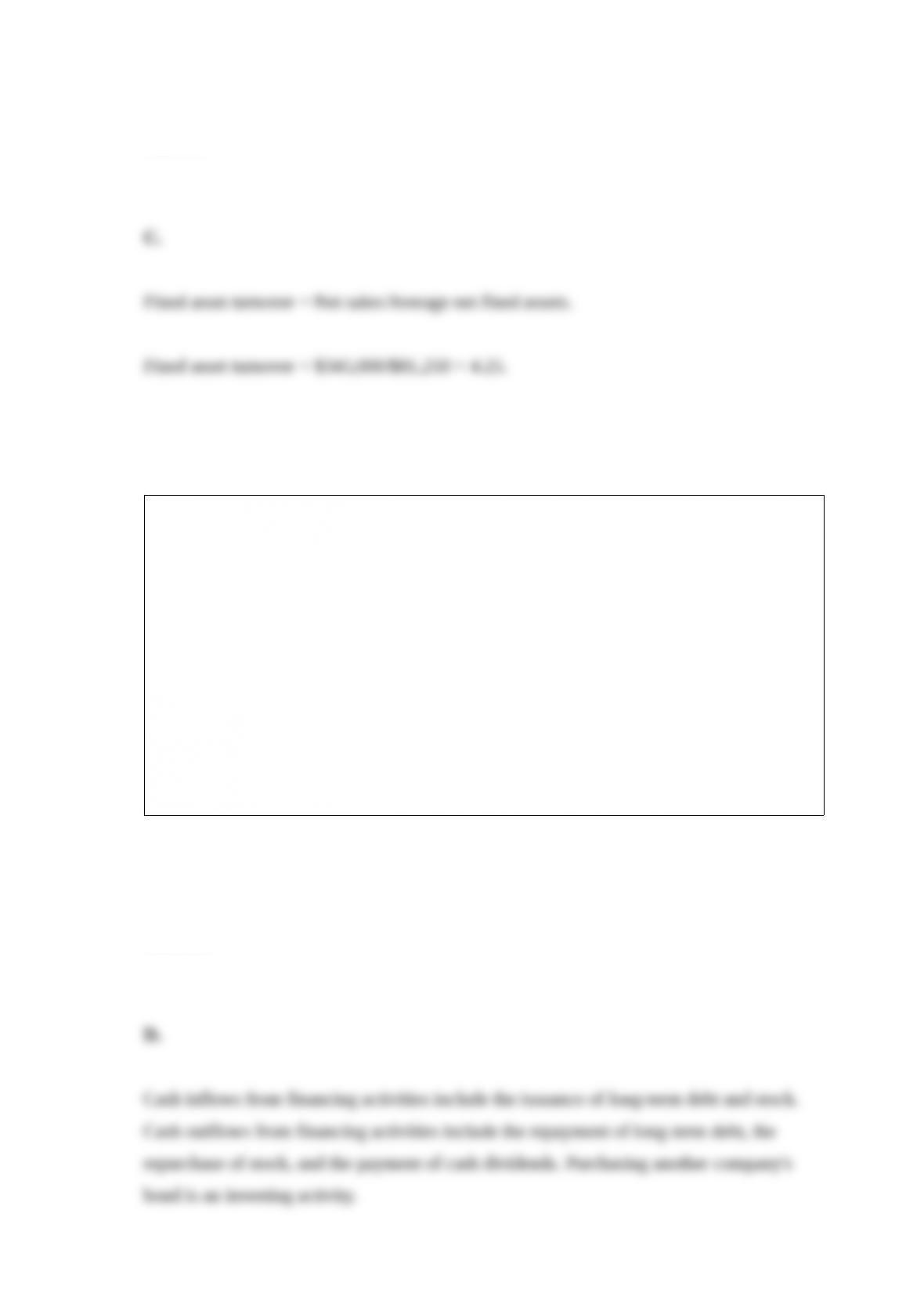
The following information is available for a company for the current year:
Use the information above to answer the following question. Which of the following is
closest to the fixed asset turnover ratio?
A. 2.65
B. 1.72
C. 4.25
D. 3.80
Answer:
A company issues $1 million of new stock and pays $200,000 in cash dividends during
the year. In addition, the company took advantage of falling interest rates to borrow
$1.5 million in a new bond issue and paid off existing bonds with a face value of $2
million. The company bought 500 of another company’s $1,000 bonds at a $100,000
premium. The net cash flow from financing activities is:
A. An inflow of $500,000.
B. An outflow of $200,000.
C. An outflow of $100,000.
D. An inflow of $300,000.
Answer:
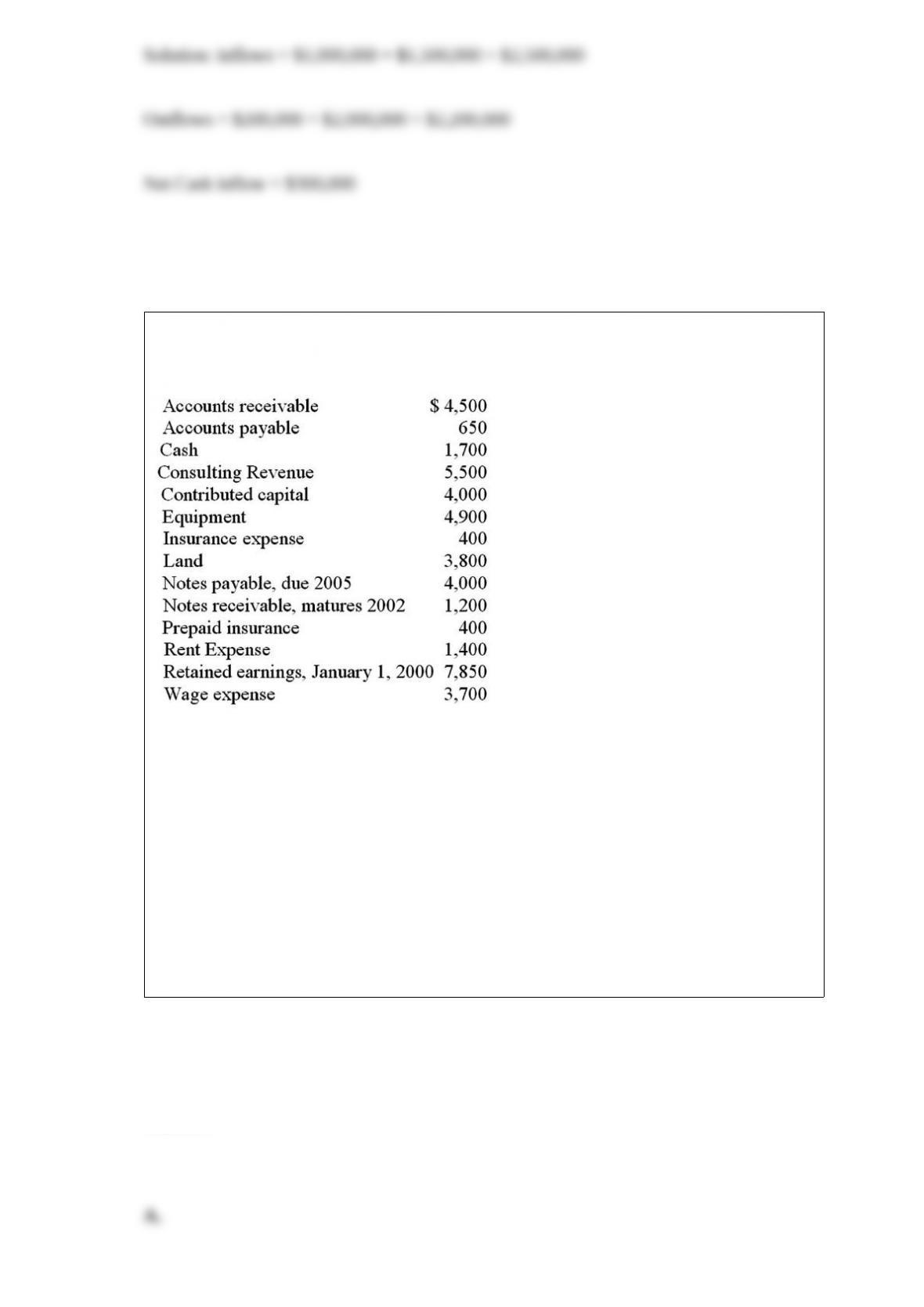
All accounts have normal balances.
What is the total of the debit side of the unadjusted trial balance?
A. $22,000
B. $17,350
C. $16,500
D. $13,500
Answer:
Which of the following statements regarding disposal of long-lived assets is not
correct?
A. The gain or loss resulting from the disposal of a long-lived asset always appears
below the “Income from Operations” line on the income statement.
B. A journal entry is usually needed to update depreciation expense on a long-lived
asset at the time of disposal.
C. A company may dispose of long-lived assets by selling them, trading them in on new
assets, or by scrapping them.
D. The amount of the gain or loss on disposal of a long-lived asset before the end of its
useful life will be influenced by the depreciation method that had been used.
Answer:
When the direct method is used to determine the cash flows from operating activities,
other operating expenses are converted into cash outflows by:
A. adding changes in prepaid expenses and accrued liabilities to other expenses.
B. subtracting increases in prepaid expenses and subtracting decreases in accrued
liabilities from other expenses.
C. adding increases in prepaid expenses and adding decreases in accrued liabilities to
other expenses.
D. subtracting changes in prepaid expenses and accrued liabilities from other expenses.
Answer:
Declared dividends:
A. are an expense of doing business.
B. are not a legal obligation that a company must pay.
C. are a way to distribute the company’s profits to its stockholders.
D. are reported on the balance sheet.
Answer:
In a period of falling prices, the inventory costing method that assigns a value to
inventory that approximates current cost is
A. LIFO.
B. FIFO.
C. Weighted average.
D. Specific identification.
Answer:
All of the following are a part of contributed capital except:
A. Common stock.
B. Additional paid-in capital.
C. Preferred stock.
D. Retained earnings.
Answer: