The costs of storing and delivering finished goods are allocated to the finished goods
account.
Material gains and losses from the disposal of plant and equipment are shown on the
income statement as part of income from operations.
Convertible bonds can be exchanged for common stock at the option of the company.
A commitment, such as a contract to pay a baseball player $5,000,000 a year for five
years, should be listed as a long-term liability.
Retained earnings are a fund of cash the business has earned from profitable operations.

Internal failure costs happen when an unsatisfactory good or service is delivered to a
customer.
If the note receivable bears interest, the amount debited to Notes Receivable is for the
maturity amount of the note.
The term “out-of-pocket cost” is often used to describe costs which have not yet been
incurred and which may vary among alternative courses of action.
A liability that is known to exist but the precise dollar amount is not known is called a
possible liability.

If the behavioral approach is employed to determine the levels at which budgeted
amounts are set, then reasonable and achievable levels should be used.
When a corporation presents both “basic” and “diluted” earnings per share, basic
earnings per share will be the smaller of the two figures.
EVA stands for “evaluating value added” performance.
In order for a company’s accounting records to be up-to-date and accurate after a bank
reconciliation has been completed, journal entries should be made for any service
charges by the bank and for deposits in transit.

The value chain starts with the supplier and ends with the consumer.
Limited personal liability is a characteristic of a sole proprietorship.
Public accounting is the segment of the profession where professionals offer audit, tax,
and consulting services to clients.
A company has a “hedged position” when it has similar amounts of accounts receivable
and accounts payable in the same foreign currency.
The Code of Ethics of the AICPA calls for a commitment to ethical behavior but not at
the sacrifice of personal advantage.

Job order costing involves averaging costs across products produced, and as such, the
first step in job order costing is to clearly understand the physical flows.
“Convergence” means abandoning a country’s financial reporting standards and
replacing them with the International Financial Reporting Standards.
A stock split will normally increase the market price of the stock and decrease the
number of shares on the market.
Any business that sells numerous units of identical products may determine its cost of
goods sold using a cost flow assumption, rather than the specific identification method.

A sunk cost is an expenditure that has proven to be nonproductive.
Conversion costs include direct labor and direct materials associated with converting
units, so that they can be transferred out of Work in Process.
The collection of an account receivable will cause total assets to decrease.
Future value is the amount that must be invested today at a specific interest rate to
receive a particular amount at some future date.
Under the “total quality management” philosophy, budgeted amounts should be set at
realistic and achievable levels rather than at levels representing absolute efficiency.

In a perpetual inventory system, the Inventory and Cost of Goods Sold accounts are
kept up-to-date throughout the accounting period.
The gross profit rate usually is lowest on fast moving merchandise and highest on
specialty and novelty products.
Once the estimated life is determined for a depreciable asset it can never be changed.
The present value of money is always:
A. Less than its future amount.
B. The same as its future amount.
C. More than its future amount.
D. More or less than its future amount depending upon the discount rate.
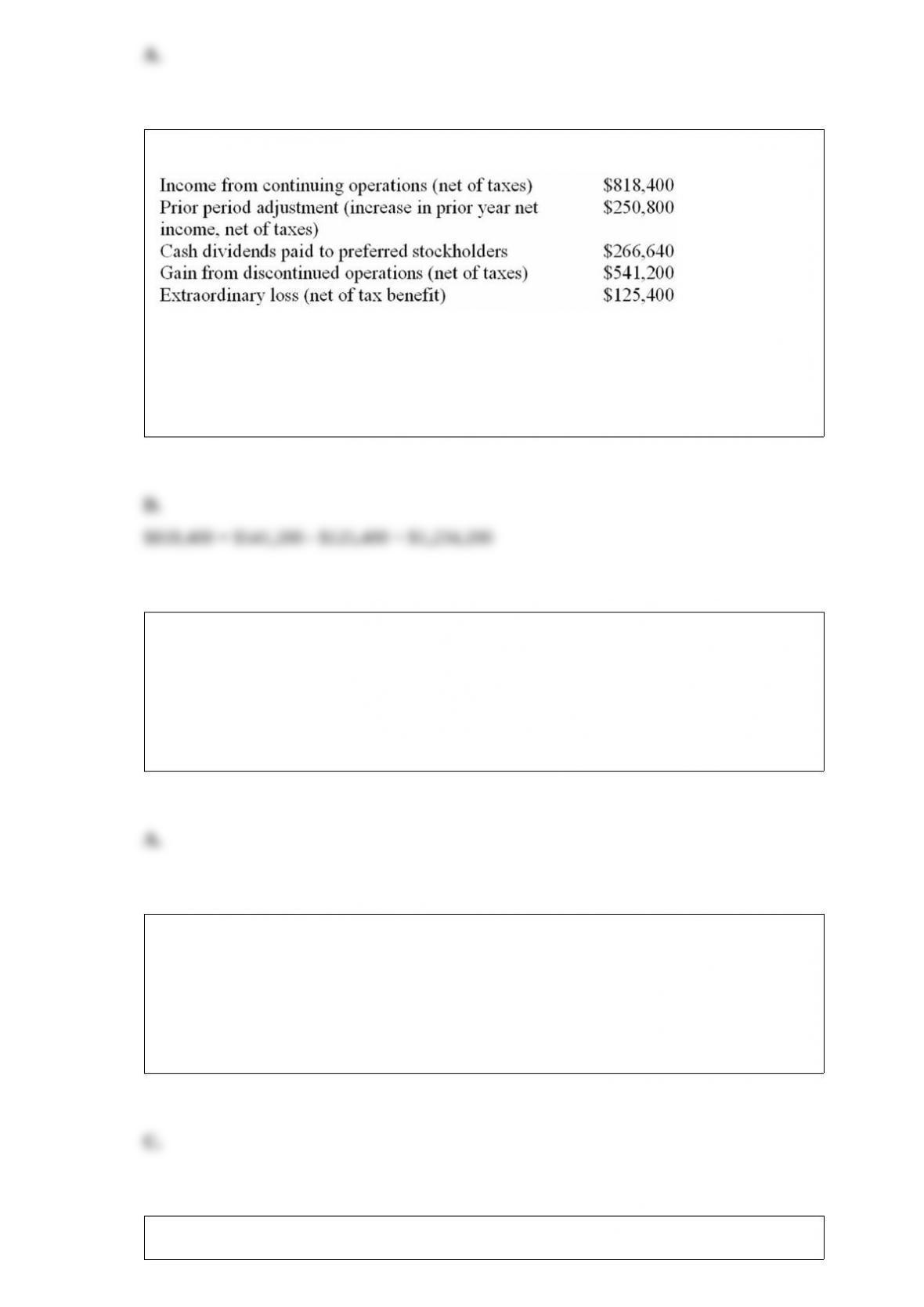
Corona Corporation’s financial statements for the current year include the following:
On the basis of this information, net income for the current year is:
A. $1,359,600.
B. $818,400.
C. $1,485,000.
D. $1,234,200.
On the statement of financial position, assets are normally presented in and liabilities
are usually presented in:
A. Their order of permanence; the order in which they become due.
B. The order in which they become due; their order of permanence.
C. Order of profitability; order of liquidity.
D. Order of liquidity; order of profitability.
Which of the following is a characteristic of manufacturing overhead in a job order cost
system?
A. It is directly traceable to specific jobs or units.
B. It includes the cost of all labor relating to manufacturing operations.
C. It is assigned to units produced by means of an overhead application rate.
D. It includes the cost of direct materials used and of indirect labor.
Which of the following methods of measuring the cost of goods sold most closely
parallels the actual physical flow of the merchandise?
A. LIFO.
B. FIFO.
C. Average cost.
D. Specific identification.
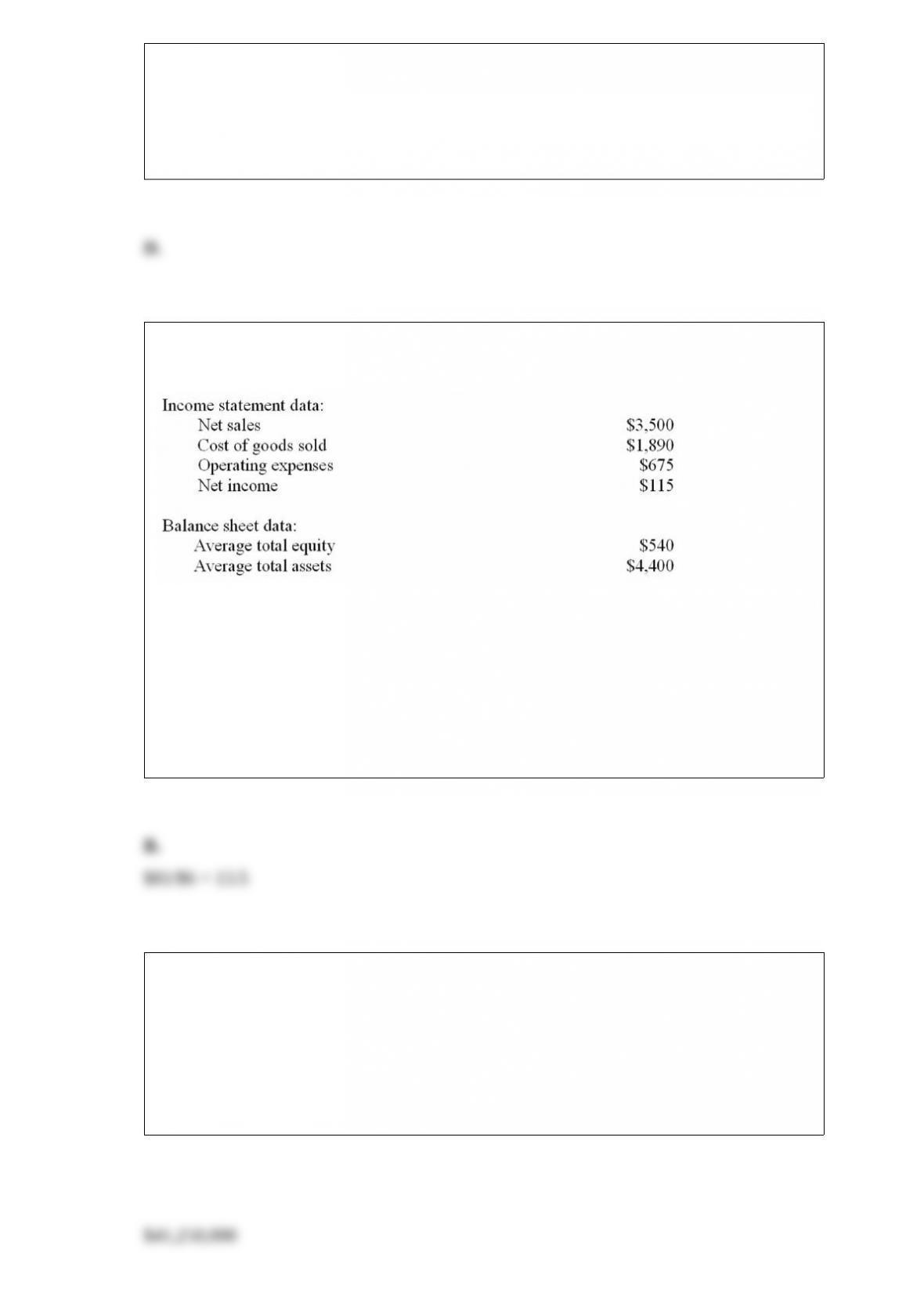
Shown below are selected data from the financial statements of Noble Computers.
(Dollar amounts are in millions, except for the per share data.)
Noble reported earnings per share for the year of $6 and paid cash dividends of $2.00
per share. At year-end, the Wall Street Journal listed Noble’s capital stock as trading at
$81 per share.
Refer to the information above. Noble’s price-earnings ratio at year end was:
A. .07.
B. 13.5.
C. 17.
D. 1.42.
Estimating costs and profit
International, Inc. expects total sales of $55 million, a margin of safety of $25 million,
and a contribution margin ratio of 25%. Compute the following:
(a) Variable costs: $_________________
(b) Break-even sales volume (in dollars): $_________________
(c) Fixed costs: $_________________
(d) Operating income: $_________________
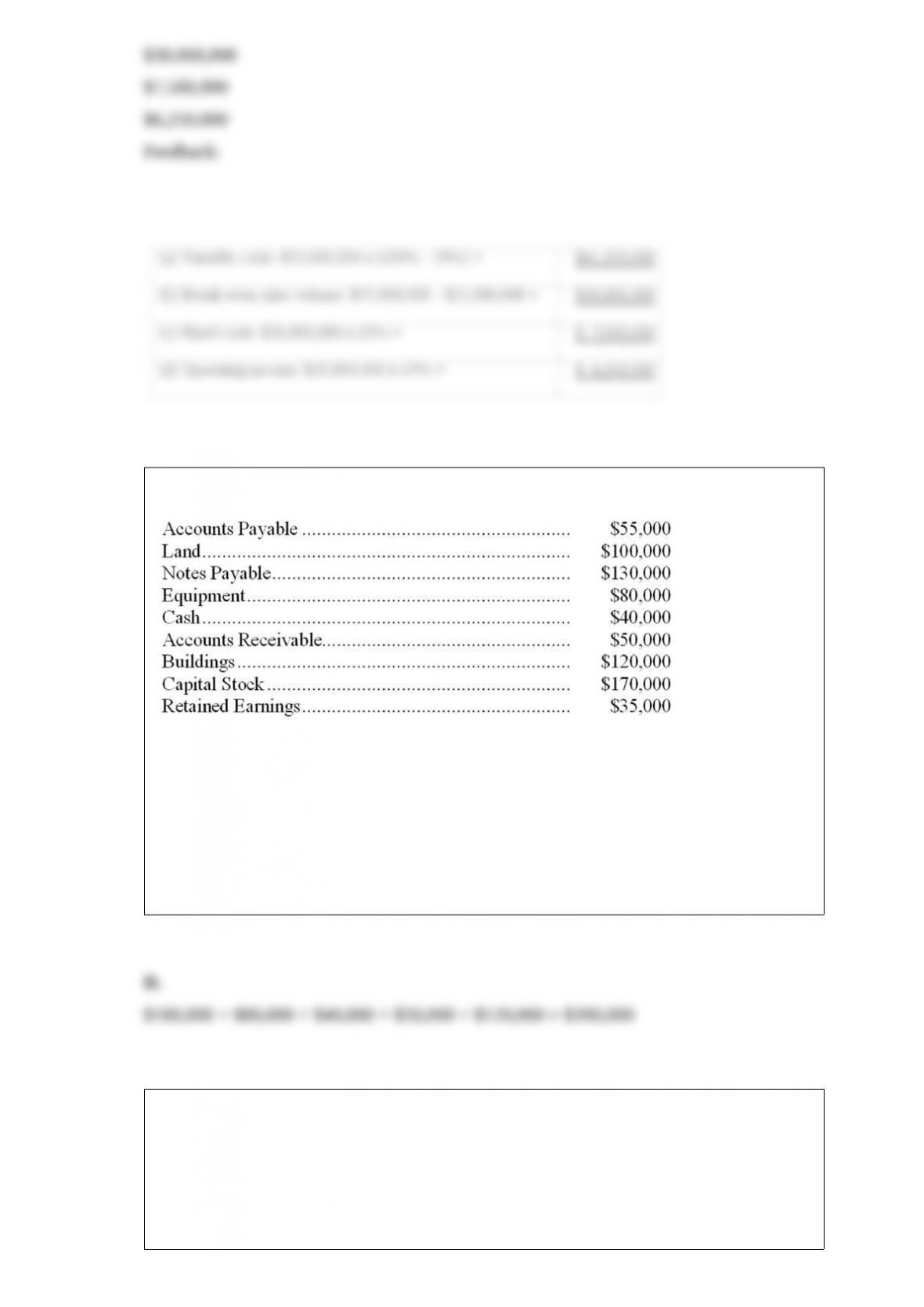
-Indirect Oil Co. reports these account balances at December 31, 2014
On January 2, 2015, Indirect Oil collected $25,000 of its accounts receivable and paid
$20,000 of its accounts payable.
Refer to the information above. In a trial balance prepared at December 31, 2014 the
total of the debit column is:
A. $805,000.
B. $780,000.
C. $415,000.
D. $390,000.
When standard costs are used in a cost accounting system:
A. A favorable cost variance results when standard amounts are less than actual costs.
B. Cost variances are shown in the year-end balance sheet as assets, if favorable, or as
liabilities, if unfavorable.
C. Costs charged to the Work in Process Inventory, Finished Goods Inventory, and Cost
of Goods Sold accounts are actual costs.
D. Costs charged to the Work in Process Inventory, Finished Goods Inventory, and Cost
of Goods Sold accounts are at standard costs.
Uncollectible accounts expense:
A. Should not occur if the credit department properly investigates prospective
customers who wish to purchase merchandise on credit.
B. Is the amount of cash a business must pay each time a credit customer fails to pay his
or her account.
C. Is the amount a business must pay to a collection agency to recover amounts on
overdue accounts receivable.
D. Represents the loss in value of accounts receivable that are estimated to be
uncollectible.
The best cost system to use for a company producing a continuous stream of similar
items would be a:
A. Job order system.
B. Process costing system.
C. Production costing system.
D. No cost system is required when jobs are similar.
An asset which costs $28,800 and has accumulated depreciation of $6,000 is sold for
$21,600. What amount of gain or loss will be recognized when the asset is sold?
A. A gain of $1,200.
B. A loss of $1,200.
C. A loss of $7,200.
D. A gain of $7,200.
Assuming a 365 day year, Bush Industries calculated an average of 47 days to collect its
accounts receivable in 2015. During 2015, Bush’s accounts receivable turnover rate:
A. Was approximately 7.77.
B. Was equal to 47 times its average accounts receivable.
C. Was approximately 0.13.
D. Can’t be determined from this information alone.
One of the unique services provided by San Francisco’s St. Francis Hotel is cleaning
and polishing coins (pocket change) for the guests. From the standpoint of hotel
management, this “money laundry” should be viewed as:
A. A contribution center.
B. A cost center.
C. An investment center.
D. A profit center (other than an investment center).
Refer to the information above. What are the equivalent units for direct labor and
overhead?
A. 140,000 units.
B. 80,000 units.
C. 160,000 units.
D. 130,000 units.
Total owners’ equity = $360,000 (capital stock issued)
-The following transactions occurred during May, the first month of operations for

Hunter Products, Inc.:
* Issued 50,000 shares of capital stock to the owners of the corporation in exchange for
$600,000 cash.
* Purchased a piece of land for $400,000, making a $150,000 cash down payment and
signing a note payable for the balance.
* Made a $60,000 cash payment on the note payable from the purchase of land.
* Purchased equipment on credit from BBW, Inc. for $63,000.
Refer to the information above. What is the balance in the Cash account at the end of
May?
A. $210,000.
B. $390,000.
C. $600,000.
D. $810,000.
The interest coverage ratio is computed by dividing:
A. Operating income by annual interest expense.
B. Net income by annual interest expense.
C. Carrying value of bonds by cash interest payments.
D. Earnings per share by the prime interest rate.
Which of the following does not appear in a corporate income statement?
A. Gains and losses from treasury stock transactions.
B. Income tax expense.
C. The income or loss from a segment of the business that has been discontinued during
the current year.
D. Gains and losses not expected to recur in the foreseeable future.
The balance in Income Summary:
A. Should equal retained earnings.
B. Will always be equal to the increase in retained earnings.
C. Will equal net income less dividends.
D. Will equal net income or net loss.
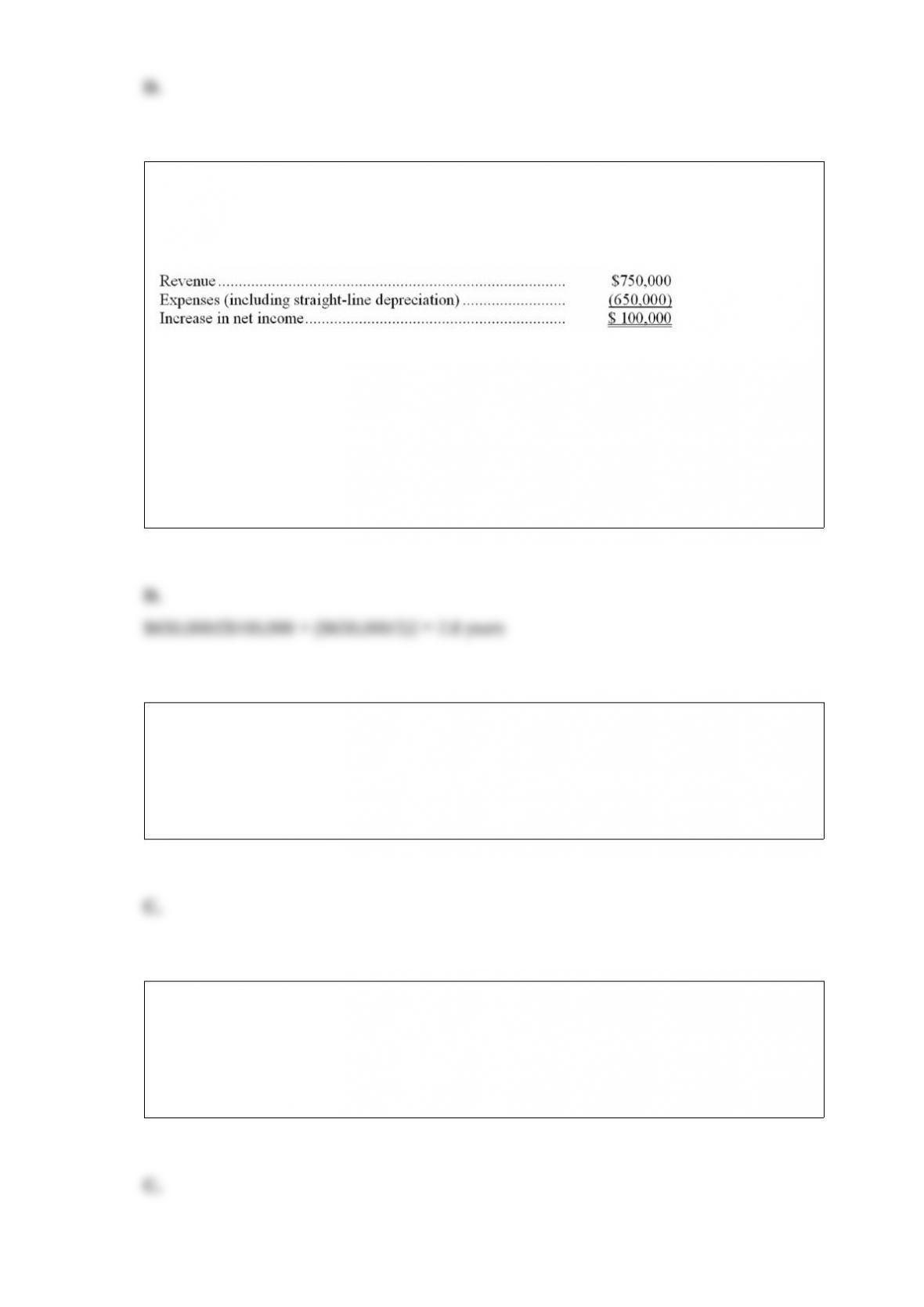
Newman Labs is considering buying equipment which would enable the company to
obtain a five-year research contract. The specialized equipment costs $650,000 and will
have no salvage value when the five-year contract period is over. The estimated annual
operating results of the project are as follows:
All revenue from the contract and all expenses (except depreciation) will be received or
paid in cash in the same period as recognized for accounting purposes.
Refer to the information above. The payback period for the investment in equipment is
closest to:
A. 5 years.
B. 1 year.
C. 2.5 years.
D. 2.8 years.
Publicly owned companies are:
A. Managed and owned by the government.
B. Must be not-for-profit companies.
C. Usually listed on a stock exchange.
D. Not permitted to be owned by individuals.
Which of the following is not an important financial consideration in capital budgeting?
A. The timing of the investment’s future cash flows.
B. The investment’s future profitability.
C. The sunk costs related to the investment.
D. The initial cost of the investment and its estimated salvage value.
Soriano Company had net sales of $300,000 for the month (after returns and allowances
of $1,500 and sales discounts of $3,250). Beginning inventory for the month was
$60,000; purchases for the month were $175,000; and gross profit was 43%.
Refer to the information above. What was the cost of goods sold for the month?
A. $129,000.
B. $171,000.
C. $235,000.
D. $304,750.
The interest coverage ratio:
A. Is computed by dividing total liabilities by annual interest expense.
B. Is computed by dividing liquid assets by annual required interest payment.
C. Indicates the percentage of total assets that are financed with borrowed money.
D. Measures the number of times the annual interest expense could be covered by
annual income from operations.
Edwards Auto Body uses a job order cost system. Overhead is applied to jobs on the
basis of direct labor hours. During the current period, Job No. 337 was charged $425 in
direct materials, $475 in direct labor, and $190 in overhead. If direct labor costs an
average of $16 per hour, the company’s overhead application rate is:
A. $7.27 per direct labor hour.
B. $6.40 per direct labor hour.
C. $17.50 per direct labor hour.
D. $40 per direct labor hour.
During periods of inflation, which method will yield the smallest ending inventory and
the largest cost of goods sold?
A. LIFO.
B. FIFO.
C. Average cost.
D. Specific identification.
Refer to the information above. The materials quantity variance for Maple Company for
June is:
A. $990 favorable.
B. $520 unfavorable.
C. $490 unfavorable.
D. $520 favorable.
Inventory:
A. Consists of all goods owned and held for sale to customers.
B. Is a non-financial asset.
C. Both consists of all goods owned and held for sale to customers and is a
non-financial asset.
D. Both consists of all goods owned and held for sale to customers and is a financial
asset.
One number expressed as a percentage of another is called:
A. Money changes.
B. Trend percentages.
C. Component percentages.
D. Ratios.
Harding Systems, Inc. uses a periodic inventory system. The purchases of a particular
product during the year are shown below:
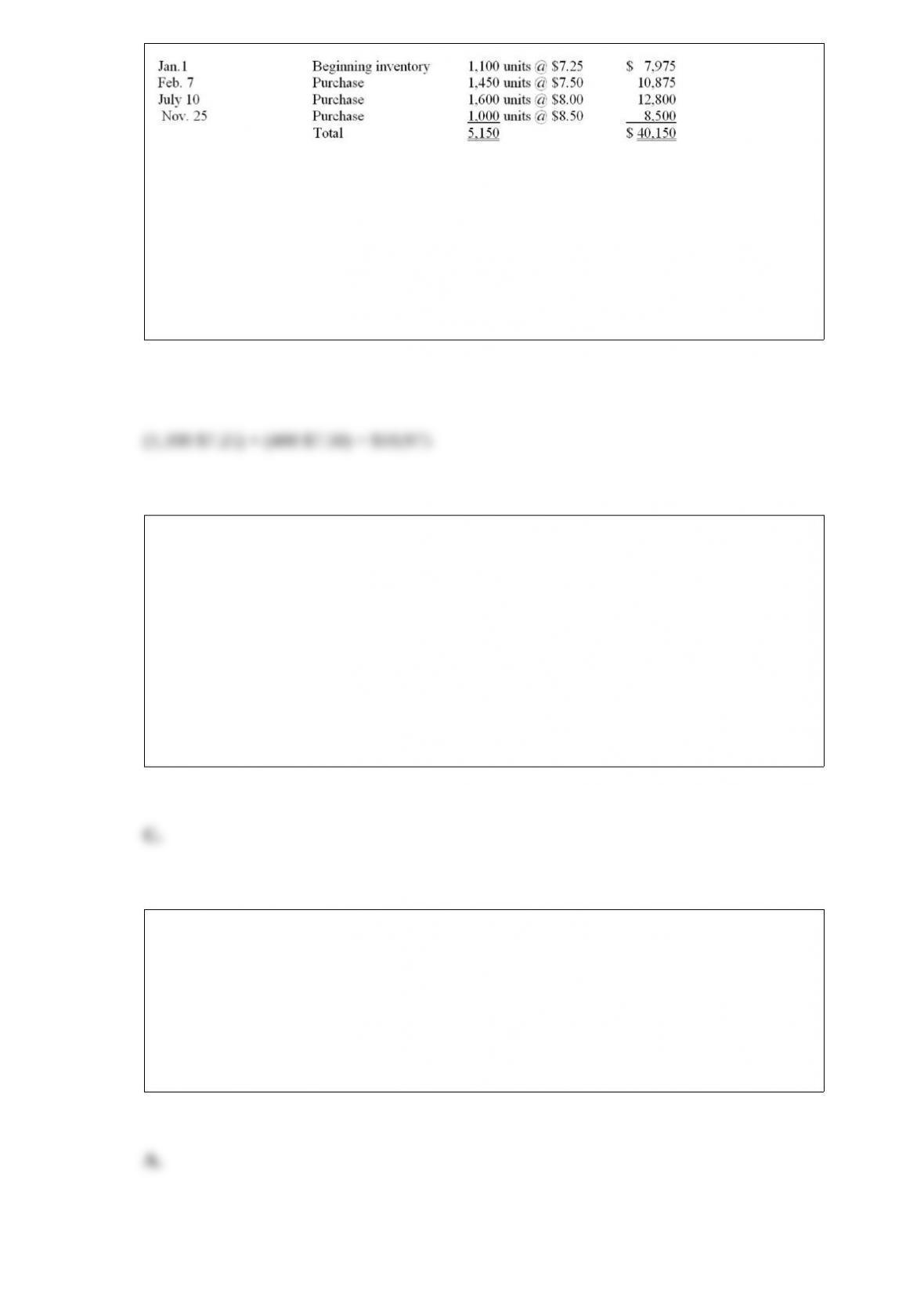
At December 31 the ending inventory consisted of 1,500 units.
Refer to the information above. Compute the cost of the ending inventory based on the
LIFO method of inventory valuation.
A. $12,500.
B. $27,650.
C. $10,975.
D. $29,175.
EJB Company used a “normal” production level of 10,000 units to determine the
standard per-unit cost of manufacturing overhead. Which of the following is not true?
A. There is no overhead volume variance for a given month if actual production that
month is 10,000 units.
B. When actual production exceeds 10,000 units, use of standard costs results in a
favorable overhead volume variance.
C. When actual production is less than 10,000 units, use of standard costs results in an
unfavorable total overhead variance.
D. Overhead variances arising as a result of producing more or less than 10,000 units do
not indicate either strong or poor performance by the Production Department.
J. Lennon borrows a sum of money from Y. Ono. A promissory note is used to
document the terms of the transaction. In this situation:
A. J. Lennon is considered the maker of the note.
B. J. Lennon is considered the payee of the note.
C. J. Lennon records the note as an asset in his accounting records.
D. The maker of the note could be either Y. Ono or J. Lennon depending on which party
actually draws up the document.
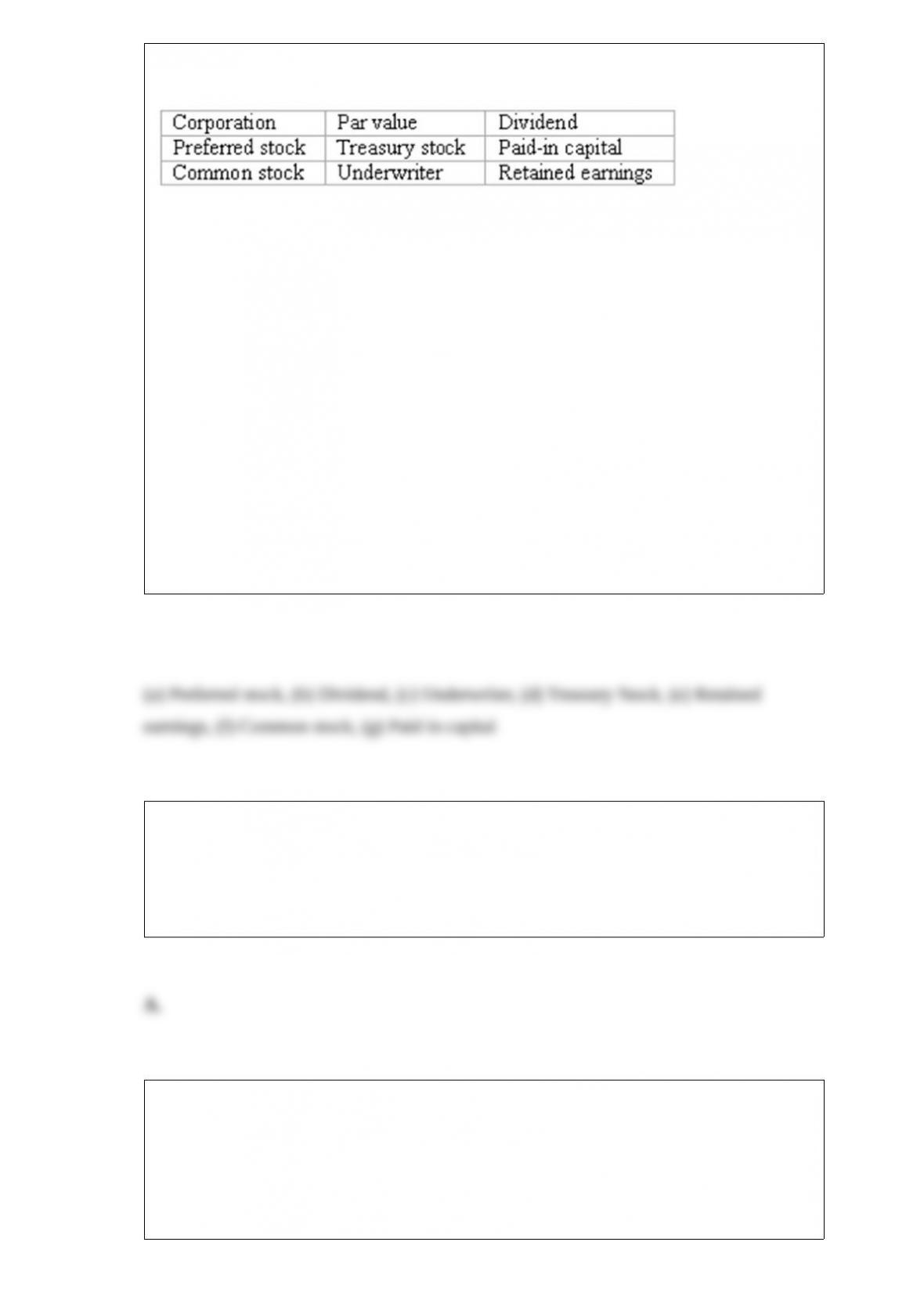
Accounting terminology
Listed below are nine technical accounting terms introduced in this chapter:
Each of the following statements may (or may not) describe one of these technical
terms. In the space provided beside each statement, indicate the accounting term
described, or answer “None” if the statement does not correctly describe any of the
terms.
_____ (a) The type of stock whose owners have little say in management of the
corporation and whose annual dividend is limited to a preset amount.
_____ (b) Distribution of cash or other company assets to the owners of a corporation.
_____ (c) An investment banking firm that guarantees an issuing corporation a specific
price for a stock issue and then makes a profit by selling the shares to the investing
public at a higher price.
_____ (d) Shares of a corporation’s stock that have been issued and then reacquired, but
not cancelled.
_____ (e) An element of stockholders’ equity arising from the profitable operations of a
business.
_____ (f) The type of stock most likely to increase dramatically in value if the issuing
corporation is extremely successful.
_____ (g) Amounts invested in a corporation by its stockholders.
A good system of internal control will include all of the following except:
A. Preparing a pro-forma financial statement on a monthly basis.
B. Separating the handling of cash from the maintenance of accounting records.
C. Making all major payments by check.
D. Reconciling bank statements with accounting records.
Accents Associates sells only one product, with a current selling price of $70 per unit.
Variable costs are 40% of this selling price, and fixed costs are $12,000 per month.
Management has decided to reduce the selling price to $65 per unit in an effort to
increase sales. Assume that the cost of the product and fixed operating expenses are not
changed by this reduction in selling price.
Refer to the information above. At the reduced selling price of $65 per unit, the
contribution margin ratio is (rounded, if necessary):
A. 43.1%.
B. 56.9%.
C. 52.8%.
D. Some other percentage.
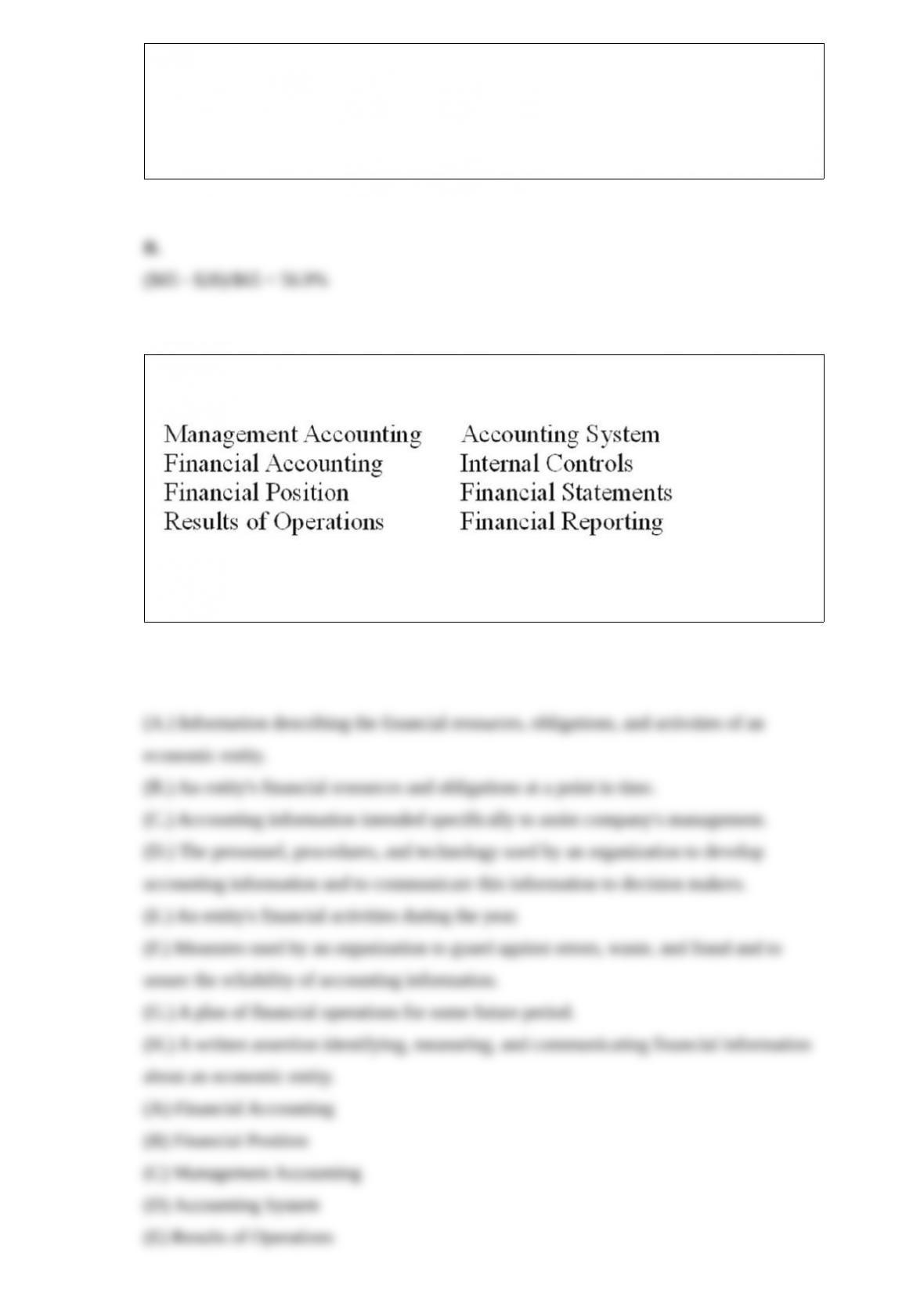
Accounting Terminology
Listed below are 8 accounting terms.
Each of the following statements may (or may not) describe one of these terms. In the
space provided, indicate the accounting term described or answer “None” if the
statement does not accurately describe any of the terms.
Differences between net income and operating cash flow.
Identify three factors that may cause net income to differ from the net cash flow from
operating activities.
Cost-volume-profit analysis and strategy
A manufacturing company experiencing severe financial difficulties has applied for a
large government guaranteed loan. As a condition for obtaining the guarantee, the
government mandates that the company significantly reduce its annual break-even
point. What steps might the company take to achieve the required reduction in its
break-even point?
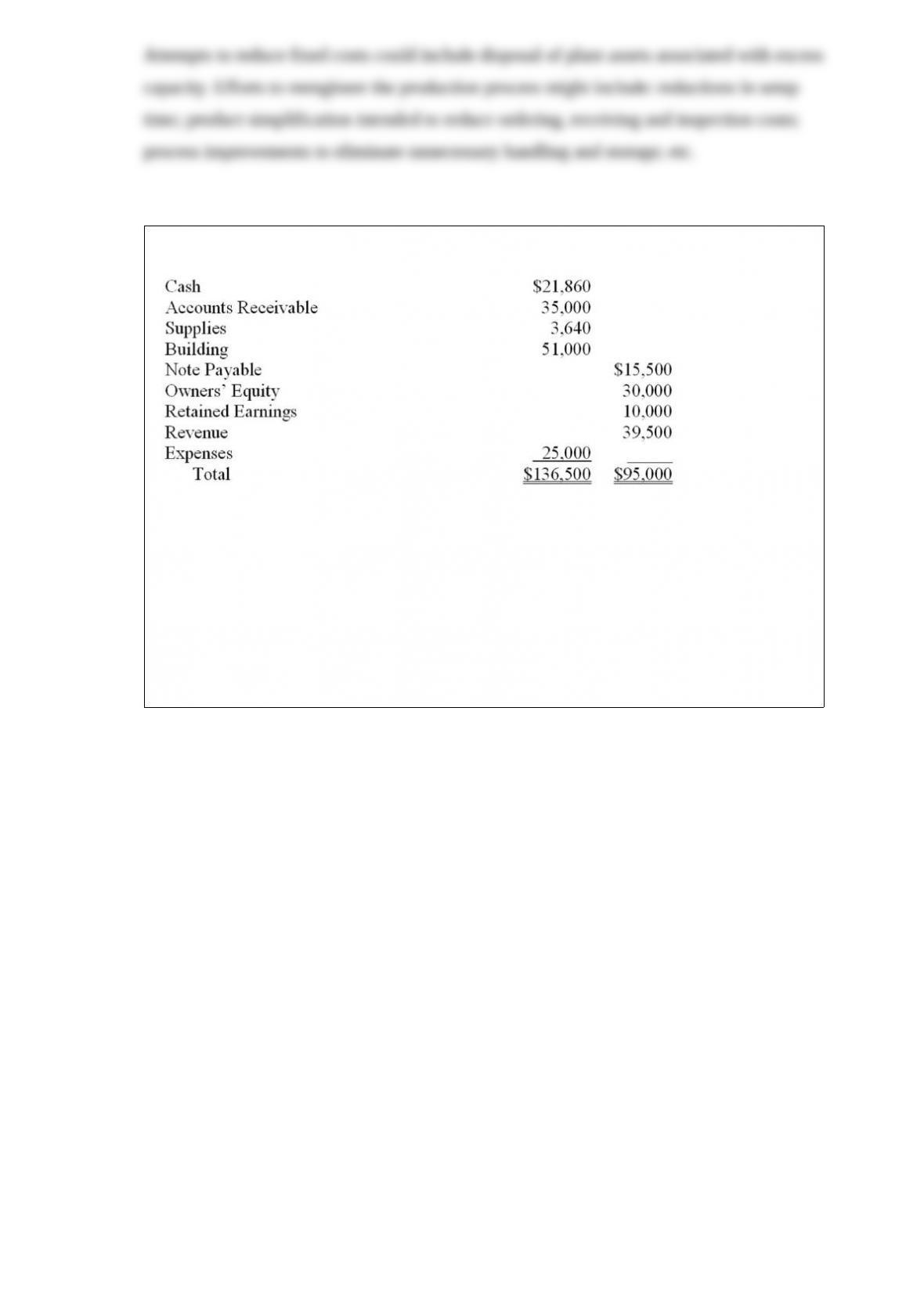
The following trial balance of Brian’s Pickle Co. for June 30, 2014 does not balance.
The following errors were discovered:
1. A purchase of supplies for cash was posted as $40 when it should have been $400.
2. The first two numbers of the amount for notes payable were transposed while being
copied from the account balance to the trial balance. The correct amount of Notes
Payable should be $51,500.
3. A collection of cash was debited to the cash account in the amount of $5,500 but was
not credited to the revenue account.
4. A purchase of supplies for $725 on account was not recorded.
Instructions: Prepare a corrected trial balance
Under- and over-applied overhead
What is meant by under-applied overhead? By over-applied overhead? Briefly explain
each term.
Explain what is meant by “profit rich, yet cash poor”.
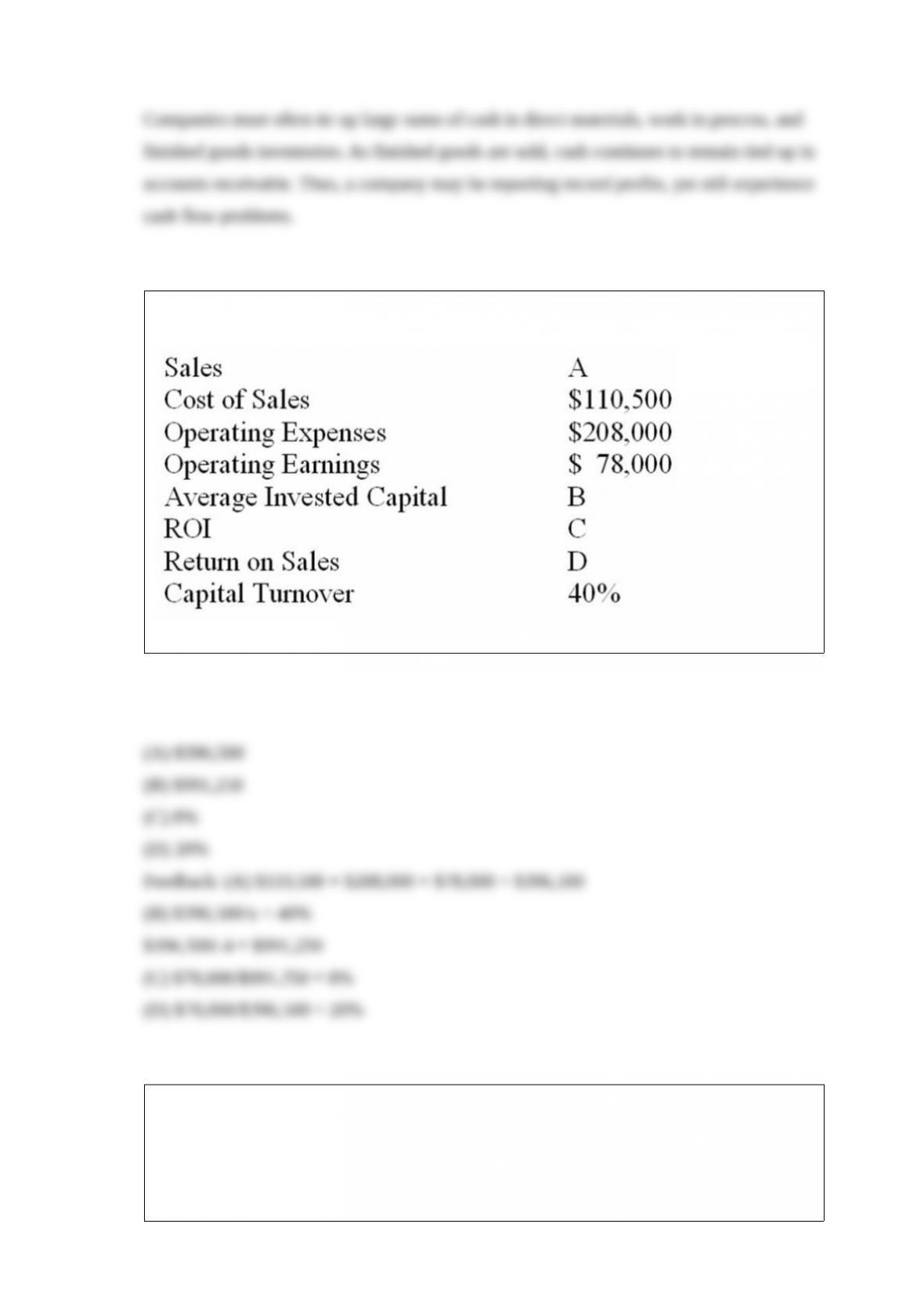
The following information regarding the Duncan Company is available:
Compute the answers for items A-D.
C, D, and E are partners. C has $25,000 in her capital account. D has $35,000 in hers,
and E has $45,000. Each gets a salary allowance of $15,000. C gets 10% interest on the
beginning balance in the capital account, D gets 12%, and E gets 14%. The remainder is
divided 20% to C, 35% to E, and 45% to E. What is the balance in the capital account at
the end of the year if net income was $80,000?
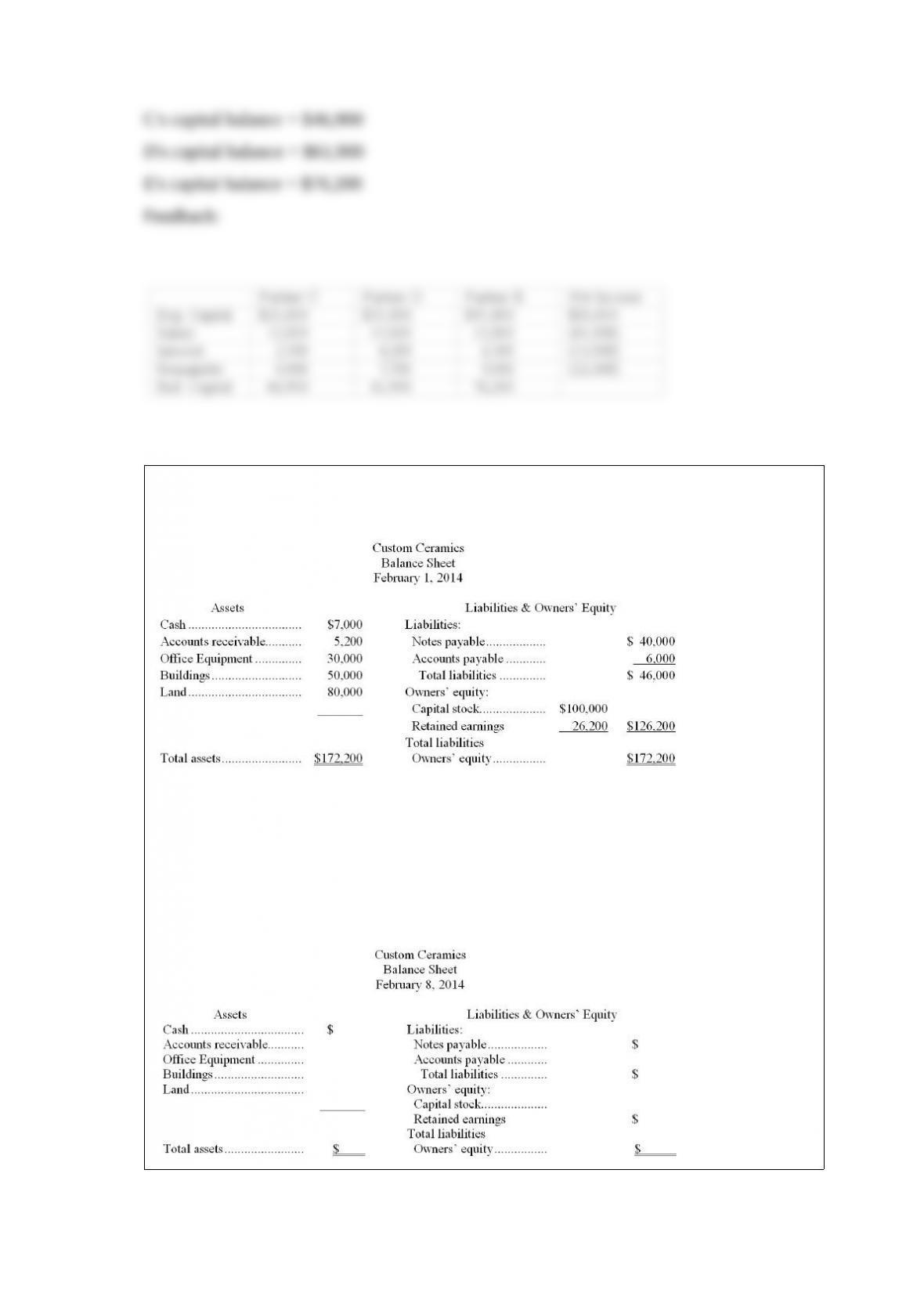
Preparation of balance sheet after a series of transactions
The balance sheet was as follows for Custom Ceramics on February 1, 2014:
During the first week of February, the following transactions occurred:
* The business used cash to pay off $5,000 of its accounts payable. (No payment was
made on the notes payable.)
* Additional capital stock was issued to Joan Custom for $15,000 cash.
* Equipment was purchased on credit for $1,800.
* The business collected $4,000 cash from accounts receivable.
Complete the balance sheet for Custom Ceramics as of February 8, 2014.
Subsidiary ledgers
Explain the nature of subsidiary ledgers, and give two specific examples. For each of
these examples, explain (1) the unit of organization within this ledger, and (2) the
usefulness of this ledger in business operations.
Differentiate between Adoption and Convergence as related to International Financial
Reporting Standards.
Cash flows and accounting records
In a business with an accrual-based accounting system, is a statement of cash flows
based upon account balances shown in the adjusted trial balance? Explain.