A check authorization is a document that permits the issuance of a check to pay an
invoice.
In a common-size income statement, each item is expressed as a percentage of net
income.
The faster goods are sold and collection is made, the shorter the financing period.
Depreciation is a process of allocation, not of valuation.
A corporation often uses an underwriter to guarantee the sale of stock in an initial
public offering (IPO).
Only the unused portion of a line of credit is recognized as a liability.
The cost of land should not include accrued property taxes paid by the purchaser.
A cost hierarchy and a bill of activities are tools for the implementation of
activity-based costing.
The Securities and Exchange Commission is an accounting information user with an
indirect financial interest.
If the asset accounts did not reflect their current values, the asset accounts would need
to be adjusted before admitting the new partner.
When all the bonds of an issue mature at the same time, they are called term bonds.
It is possible that an investor with less than a 50 percent ownership interest may qualify
for accounting recognition of control and appropriately prepare consolidated financial
statements.
Profitability is best determined from cash flow information.
Sole proprietorships in the United States generate more business (in terms of receipts)
than partnerships and corporations put together.
For a bank, a credit check of a loan applicant is an example of a batch-level activity.
The equity method usually is the most appropriate method for accounting for
investments of more than a 20 percent interest of another company’s stock.
Mineral deposits are subject to a process called depletion.
The entry to record the issuance of bonds at a discount on an interest payment date
should include a
A.debit to Cash for the face amount of the bonds.
B.debit to Cash for the face amount of the bonds plus the amount of discount.
C.debit to Cash for the face amount of the bonds minus the amount of discount.
D.credit to Cash for the face amount of the bonds.
Which of the following should be classified as an intangible asset?
A.Land held for future use
B.Long-term notes receivable
C.Special funds established to pay off a debt
D.Copyright
Which of the following would not be a valid reason for keeping currency on hand at a
place of business?
A.To pay small, unforeseen expenses
B.To make up for any imbalance in the books
C.To advance money to sales reps for travel expenses
D.To provide money for cash registers
A standard costing system
A.is used by management for cost planning, but not for cost control purposes.
B.is a system in which all costs affecting the three inventory accounts and the Cost of
Goods Sold account are stated in terms of actual costs incurred.
C.depends on actual costs rather than planned costs.
D.is employed with an existing job order costing or process costing system and is not a
full cost accounting system in itself.
The processing stage of accounting is accomplished by the recording of data.
Par value is the minimum cushion of capital established for the protection of
A.investors (stockholders).
B.management.
C.creditors.
D.customers.
How many total dollars of sales must Windblow Company sell to break even, if the
selling price per unit is $10, variable costs are $5.00 per unit, and fixed costs are
$10,000?
A.$20,000
B.$6,667
C.$10,000
D.$12,000
At year-end, a company’s trading portfolio appears as follows:
The adjusting entry will include
A)a debit to Allowance to Adjust Short-Term Investments to Market of $50.
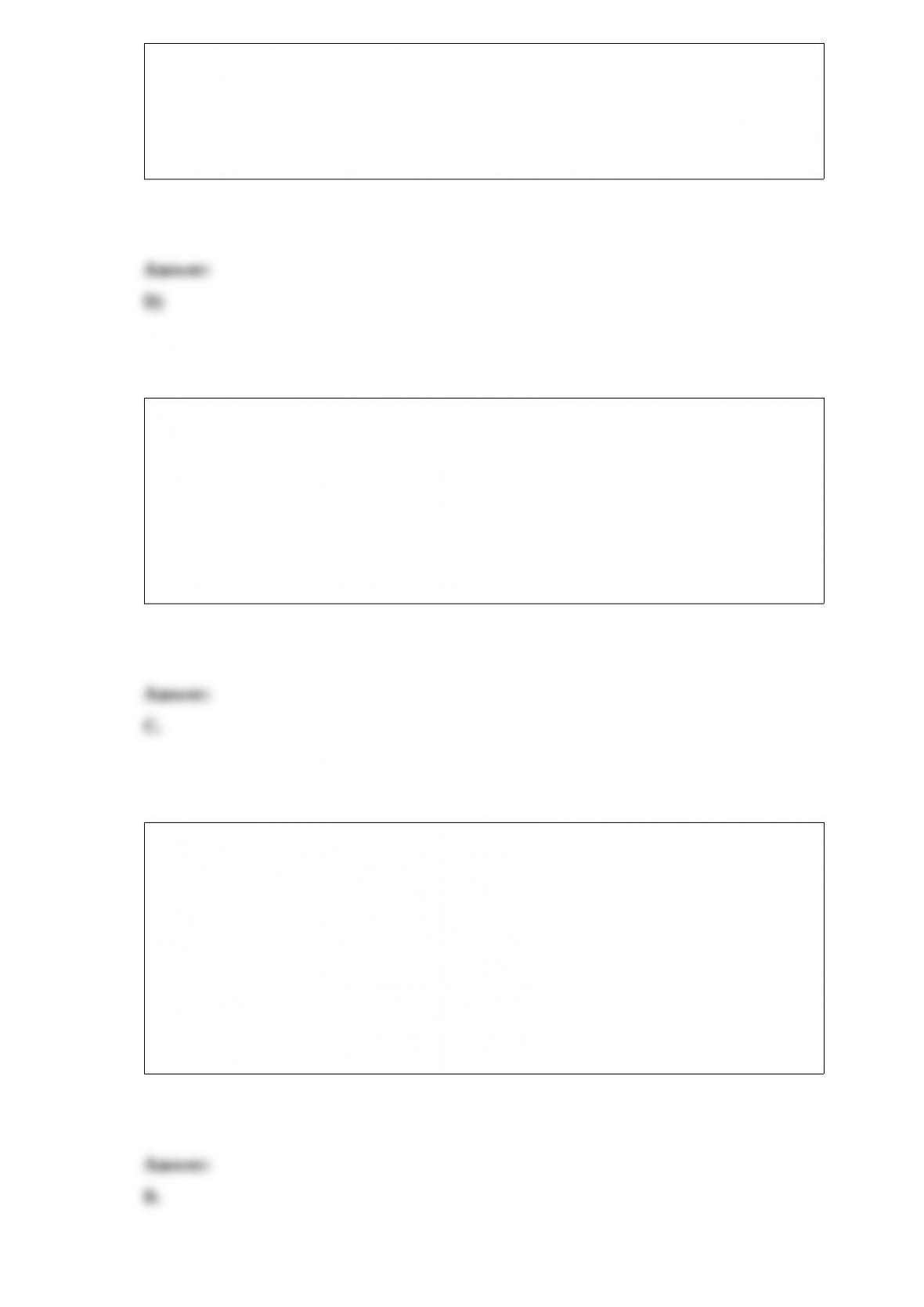
B)a credit to Allowance to Adjust Short-Term Investments to Market of $50.
C)a debit to Unrealized Loss on Short-Term Investments of $100.
D)none of these, since no adjusting entry is necessary.
Which of the following is not needed in calculating the value of a bond?
A.Face interest rate
B.Market interest rate
C.Future value of periodic interest payments
D.Present value of face (maturity) amount
The expensing of a long-lived asset such as a wastebasket is justified by which of the
following accounting rules or principles?
A.Matching
B.Materiality
C.Full disclosure
D.Consistency
Goods totaling $14,000 purchased February 2 on terms of 2/10, n/30 and on which
returns of $2,000 were made on February 10 would be subject to which of the following
discounts if paid for on February 12?
A.$240
B.$280
C.$320
D.$40
Which of the following would not be a basis for estimating the useful life of a piece of
equipment?
A.Potential production in units
B.Potential hours of service
C.Historical cost
D.Years of service
Great Lake Corporation wishes to prepare a cash budget for November 2014. Sales,
purchases, and expenses for October (actual) and November and December (estimated)
are as follows:

Sales: All sales are on credit, and the company’s experience shows that, on an average,
80 percent of sales are collected in the month of sale and the balance in the following
month. A 2 percent discount is allowed on all collections in the month of sale.
Purchases: The company pays 60 percent of purchases in the month of purchase and the
balance in the following month. The company is allowed an average discount of 1
percent on payments made in the month of purchase.
Expenses: The monthly expenses for November include charges for depreciation
amounting to $1,000 and $100 of prepaid expenses, which will expire. All other
expenses are paid as incurred.
Other: On September 1, 2014, a new machine was purchased for $5,000. A down
payment of $500 was made, and it was agreed that the balance would be paid in equal
installments in the following three months.
The cash receipts in November for October sales of Great Lake are expected to be
A.$8,000.
B.$9,600.
C.$9,408.
D.$7,840.
A new product, an easy to store guitar stand, is being planned, with the following cost
estimates: variable cost per unit, $9, and total fixed costs, $58,000. The projected sales
price is $13 each.
a. Using the contribution margin approach, compute the number of units that must be
sold to break even.
b. Using the same approach and assuming that fixed costs can be reduced by $8,000,
how many units must be sold to produce a profit of $65,000?
c. Given the original information and the projection that 50,000 units can be sold,
compute the selling price that the producer must use to obtain a profit of $150,000.
Memphis Co. is considering purchasing a machine for $83,200 that will increase cash
flows by $40,000 in the first year, $30,000 the second year, and $25,000 the third year.
The machine will have no residual value. The minimum rate of return is 10 percent. The
present value factors, at 10 percent, for the three years are 0.909, 0.826, and 0.751,
respectively.
Using the above information for Memphis, the machine’s actual rate of return is
A.negative.
B.greater than 10 percent.
C.less than 10 percent.
D.10 percent.
Using the indirect method, calculate the amount of net cash flows from operating
activities from the following data. Show your work
Which of the following is the most useful aid to the accountant in preparing closing

entries?
A.Journal
B.Financial statements
C.Ledger
D.Work sheet
On January 2, 20×5, Fresh Inc. issued 20-year bonds payable with a face value of
$1,000,000 and a face interest rate of 10 percent. The bonds were issued to yield a
market interest rate of 9 percent. Interest is payable semi-annually on January 1 and
July 1. In calculating the present value of the bond issue of January 2, 20×5, the
periodic interest payments to be used are
A.$100,000
B.$50,000
C.$90,000
D.$45,000
Executive officers’ compensation is typically comprised of all of the following except
A.incentive bonuses.
B.declared dividends.
C.stock option awards.
D.annual base salaries.
After all closing entries have been posted, which of the following accounts is most
likely to have a nonzero balance?
A.Interest Expense
B.Unearned Revenue
C.Service Revenue
D.Income Summary
The following facts pertain to Quail Corporation:
On the basis of these facts, compute the amount of net income (loss) for Quail
Corporation for 20×5.
Joan pays Eva $60,000 for her $40,000 interest in a partnership. The entry to record the
sale on the partnership books is:
When bonds are issued between interest dates, the issuer collects from the investor the
interest that would have accrued for the partial period preceding the issue date.
Describe two reasons why is this procedure is followed.
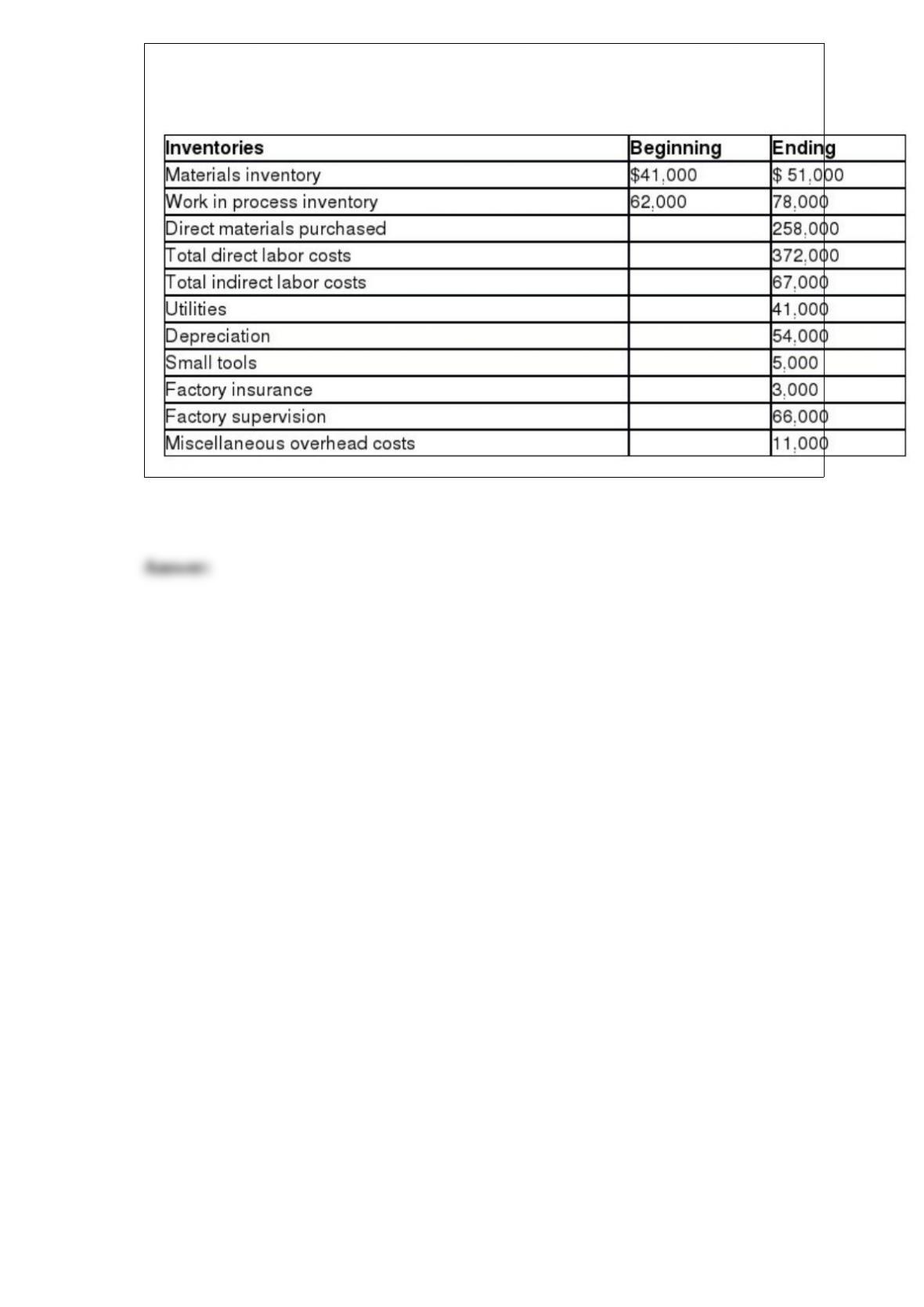
Use the information below for the year ended December 31, 2014, to prepare the
statement of cost of goods manufactured.
Identify and briefly discuss the three approaches for determining fair value identified by
the FASB.
Custom Realty Services sold a house for a client and will be paid a commission for its
services. Using the SEC’s four conditions or revenue recognition, explain why Custom
Realty Services either should or should not recognize the revenue now.
What are some items that can affect an investment center’s EVA calculation, and how
can EVA be improved?
Toojay Company manufactures and sells widgets. Each widget costs $60 and sells for
$100. Each widget carries a warranty that provides for free replacement if it fails for

any reason during the next 36 months. In the past, 4 percent of the widgets have had to
be replaced under the warranty. During April, Toojay sold 2,000 widgets and replaced
150 under warranty. Calculate the product warranty expense for the month. Show your
computation.