
A cash budget would not include:
A. sale of common stock.
B. payment of dividends.
C. payment of property taxes.
D. plant and building depreciation.
A(n) _____________ is the minimum cost that can be incurred, which when subtracted
from the selling price, allows for a desired profit to be earned.
A. relevant cost
B. opportunity cost
C. incremental cost
D. target cost
When the periodic inventory system is used:
A. operating profit from the sale of an item from inventory is known when the item is
sold.
B. gross profit from the sale of an item from inventory is known when the item is sold.
C. cost of goods sold can be calculated by subtracting the ending inventory amount
from the sum of beginning inventory and net purchases.
D. a physical inventory must be taken in order to estimate the cost of goods sold.
If it is to be most useful for control purposes, what variance should be reported to the
supervisor responsible for the number of pounds of corn syrup used in the manufacture
of a candy bar?
A. raw material price variance, expressed in cents per pound.
B. raw material usage variance, expressed as a total cost for the month.
C. raw material usage variance, expressed in total pounds for the month.
D. raw material usage variance, expressed in total pounds for the week.
A firm’s products have an average contribution margin ratio of 40%, which will be
maintained for the next month even though fixed expenses are expected to rise by
$20,000. In order to keep operating income for the month from being affected, revenues
will have to increase by:
A. $8,000.
B. $12,000.
C. $20,000.
D. $50,000.
At the beginning of the fiscal year, the balance sheet showed assets of $2,728 and
stockholders’ equity of $1,672. During the year, assets increased $148 and liabilities
decreased $76.
Stockholders’ equity at the end of the year totaled:
A. $1,672
B. $1,744
C. $1,896
D. $2,876
Martin & Associates borrowed $15,000 on April 1, 2016 at 8% interest with both
principal and interest due on March 31, 2017.
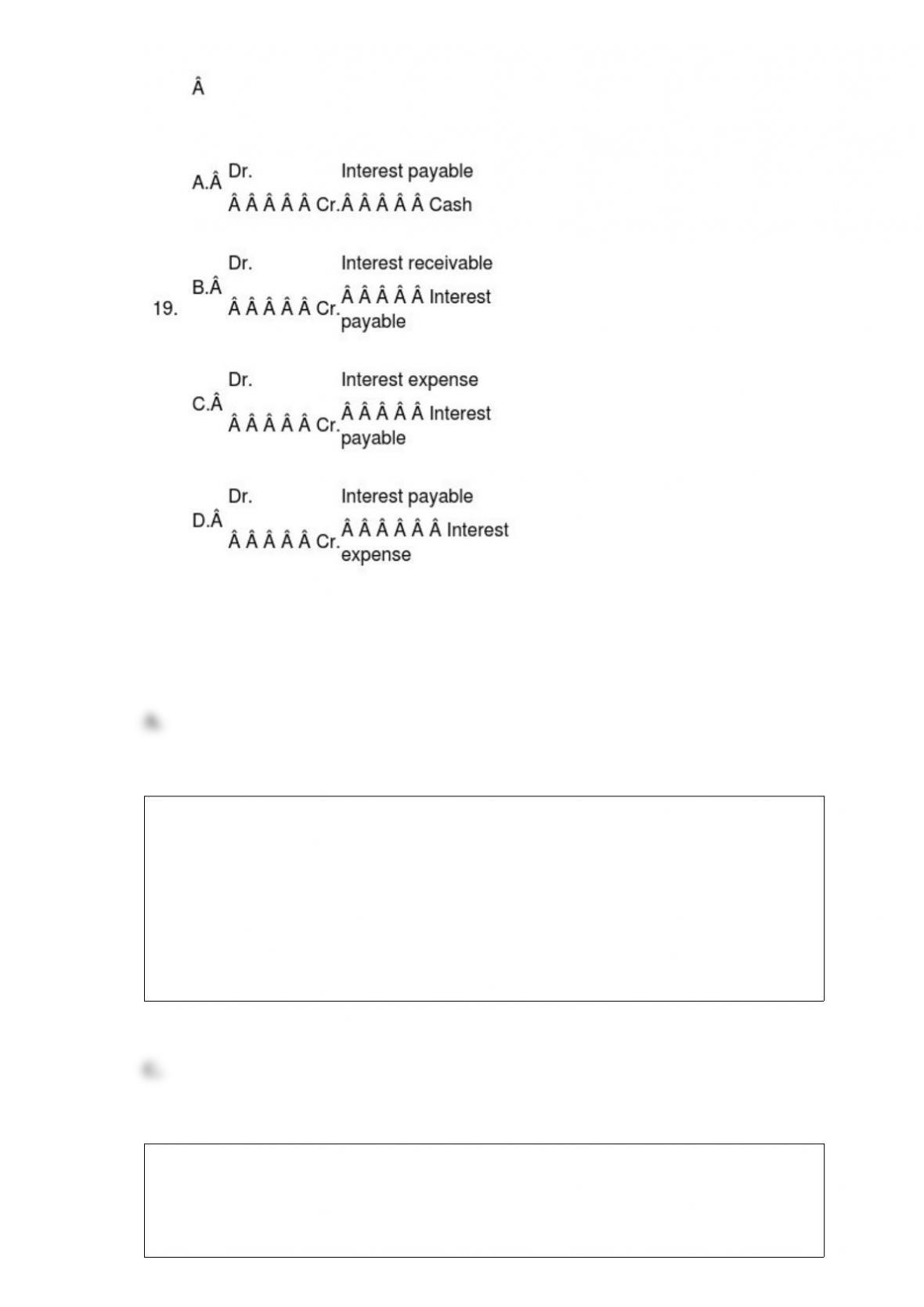
Which of the following journal entries should the firm use to record the payment of
interest on March 31, 2017?
Which of the following statements best describes the process of accounting for
depreciation?
A. A process that attempts to recognize loss in economic value over a period of time.
B. A process for setting aside cash so funds will be available to replace the asset.
C. A process for recognizing the cost of an asset that should be matched against revenue
earned as a result of using the asset.
D. A process for recognizing all of the cost associated with using an asset in a revenue
generating activity.
For capital budgeting decisions, the use of present value analysis significantly improves
management decision making, however:
A. other quantitative techniques may be even more insightful.
B. most decisions are significantly influenced by top management’s values and

experiences.
C. the accounting rate of return technique in usually more dependable.
D. a relevant cost analysis should always be used in close decisions.
The Interest Receivable account for February showed transactions totaling $17,000 and
an adjustment of $22,400.
A. The transactions probably resulted from accruing interest income earned.
B. The transactions were probably entered on the credit side of the account.
C. The adjustment was probably for cash receipts of interest receivable accrued in prior
months.
D. The balance in the interest receivable account decreased $5,400.
Cost accounting is a subset of:
A. financial accounting.
B. process cost accounting.
C. job order cost accounting.
D. managerial accounting.
When bonds are issued at a premium:
A. interest expense on the bonds will be less than the interest paid.
B. interest expense on the bonds will be more than the interest paid.
C. the bonds are sold for less than their face amount.
D. the coupon interest rate is less than the market interest rate.
Trading and Available-for-Sale securities are reported on the balance sheet at:
A. net realizable value.
B. historical cost.

C. weighted average cost.
D. market value.
Braizen, Inc. produces a product with a $30 per-unit variable cost and an $80 per-unit
sales price. Fixed manufacturing overhead costs are $100,000. The firm has a one-time
opportunity to sell an additional 1,000 units at $60 each that would not affect its current
sales. Assuming the company has sufficient capacity to produce the additional units,
how would the acceptance of the special order affect net income?
A. income would decrease by $30,000.
B. income would increase by $30,000.
C. income would increase by $140,000.
D. income would increase by $40,000. $60 – $30 = $30/per unit; $30 × 1000 = $30,000
Activity-based costing minimizes the risk of cost distortion when applying overhead by:
A. using a single cost driver rate.
B. using multiple cost driver rates.
C. using actual activity cost rates.
D. using absorption cost rates.
Product X sells for $80 per unit in the marketplace and ABC Company requires a 35%
minimum profit margin on all product lines. In order to compete in this market, the
target cost for Product X must be equal to or lower than:
A. $28.
B. $45.
C. $52.
D. $80. $80 – ($80 * .35) = $52

The principal weakness of the payback method for evaluating proposed investments is
that it does not:
A. provide a way of ranking projects in order of desirability.
B. consider cash flows that continue after the investment has been recovered.
C. result in an easily understood “answer”.
D. recognize the time value of money.
When a firm buys land on which there is a building, and the building is torn down so
that an appropriate new building can be constructed on the land:
A. any of the purchase cost allocated to the old building is reported as a loss.
B. the cost assigned to the land excludes the cost of the old building.
C. the total cost of the land and old building are capitalized as land cost.
D. any of the purchase cost allocated to the old building is capitalized as part of the cost
of the new building.
Which of the following items would be included in the operating expense budget?
A. sales commissions.
B. raw material purchases.
C. cash receipts.
D. cost of goods sold.