1) solvency ratios measure the short-term ability of the company to pay its maturing
obligations.
2) owners of business firms are the only people who need accounting information.
3) when no-par value stock does not have a stated value, the entire proceeds from the
issuance of the stock become legal capital.
4) cash dividends are not a liability of the corporation until they are declared by the
board of directors.
5) in horizontal analysis, the base year is the most current year being examined.
6) it is possible for an asset to be a current asset even though the expected conversion of
that asset into cash is to be longer than one year or the normal operating cycle.
7) retailers and wholesalers are both considered merchandising enterprises.
8) a bank reconciliation is generally prepared by the bank and sent to the depositor
along with canceled checks.
9) the separation of duties feature of internal control can be negated when several
employees are involved in a scheme.
10) in order to use the cost method of accounting for stock investments, how much
stock must the investor own?
a.less than 20%
b.more than 50%
c.between 20% and 50%
d.the cost method is always used for stock investments of any size
11) the net income reported on the income statement for the current year was $410,000.
depreciation recorded on plant assets was $76,000. accounts receivable and inventories
increased by $4,000 and $16,000, respectively. prepaid expenses and accounts payable
decreased by $2,000 and $22,000, respectively. how much cash was provided by
operating activities?
a.$370,000
b.$446,000
c.$410,000
d.$478,000
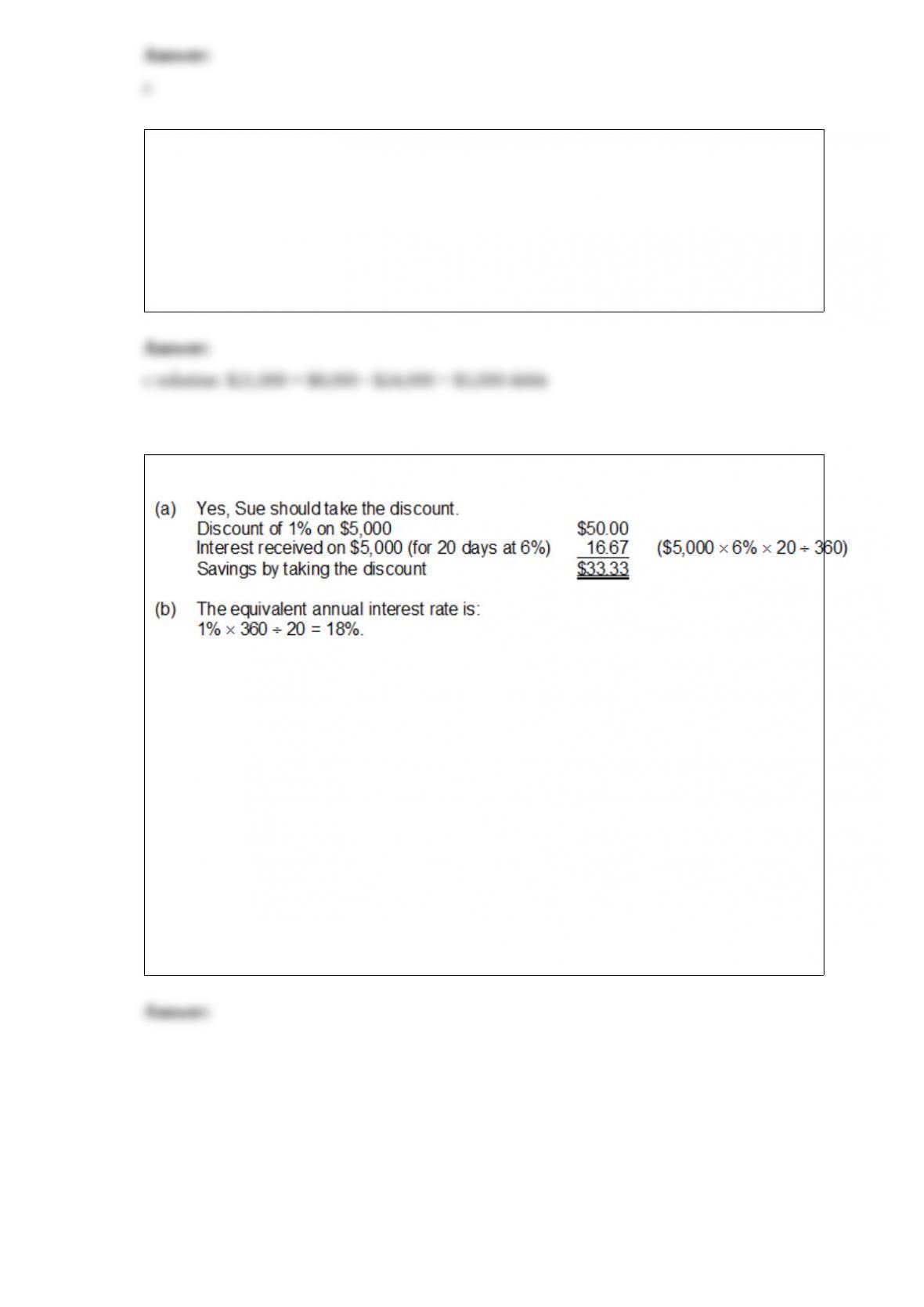
12) the credit terms offered to a customer by a business firm were 2/10, n/30, which
means
a.the customer must pay the bill within 10 days
b.the customer can deduct a 2% discount if the bill is paid between the 10th and 30th
day from the invoice date
c.the customer can deduct a 2% discount if the bill is paid within 10 days of the invoice
date
d.two sales returns can be made within 10 days of the invoice date and no returns
thereafter

13) in a classified balance sheet, assets are usually classified as:
a.current assets; long-term assets; property, plant, and equipment; and intangible assets
b.current assets; long-term investments; property, plant, and equipment; and common
stocks
c.current assets; long-term investments; tangible assets; and intangible assets
d.current assets; long-term investments; property, plant, and equipment; and intangible
assets
14) warner company issued $1,600,000 of 6%, 10-year bonds on one of its interest
dates for $1,381,920 to yield an effective annual rate of 8%. the effective-interest
method of amortization is to be used. the journal entry to be recorded at the end of the
second year for the payment of interest and the amortization of discount will include a
a.debit to bond interest expense for $96,000
b.credit to cash for $111,718
c.credit to discount on bonds payable for $14,554
d.credit to discount on bonds payable for $15,718
15) on january 1, swanson corporation had 60,000 ordinary shares with a 10 par value
outstanding. on march 17, the company declared a 15% share dividend to shareholders
of record on march 20. market value of the shares was 13 on march 1 the entry to record
the transaction of march 17 would include a
a.credit to cash dividends for 27,000
b.credit to cash for 117,000
c.credit to ordinary share dividends distributable for 90,000
d.debit to ordinary share dividends distributable for 90,000
16) on january 1, thompson corporation issued $4,000,000, 14%, 5-year bonds with
interest payable on december 31. the bonds sold for $4,288,384. the market rate of
interest for these bonds was 12%. on the first interest date, using the effective-interest
method, the debit entry to bond interest expense is for
a.$480,000
b.$502,324
c.$514,606
d.$560,000
17) on june 1, 2014, england inc. reported a cash balance of $21,000. during june,
england made deposits of $8,000 and made disbursements totaling $24,000. what is the
cash balance at the end of june?
a.$5,000 credit balance
b.$29,000 debit balance
c.$5,000 debit balance
d.$3,000 credit balance
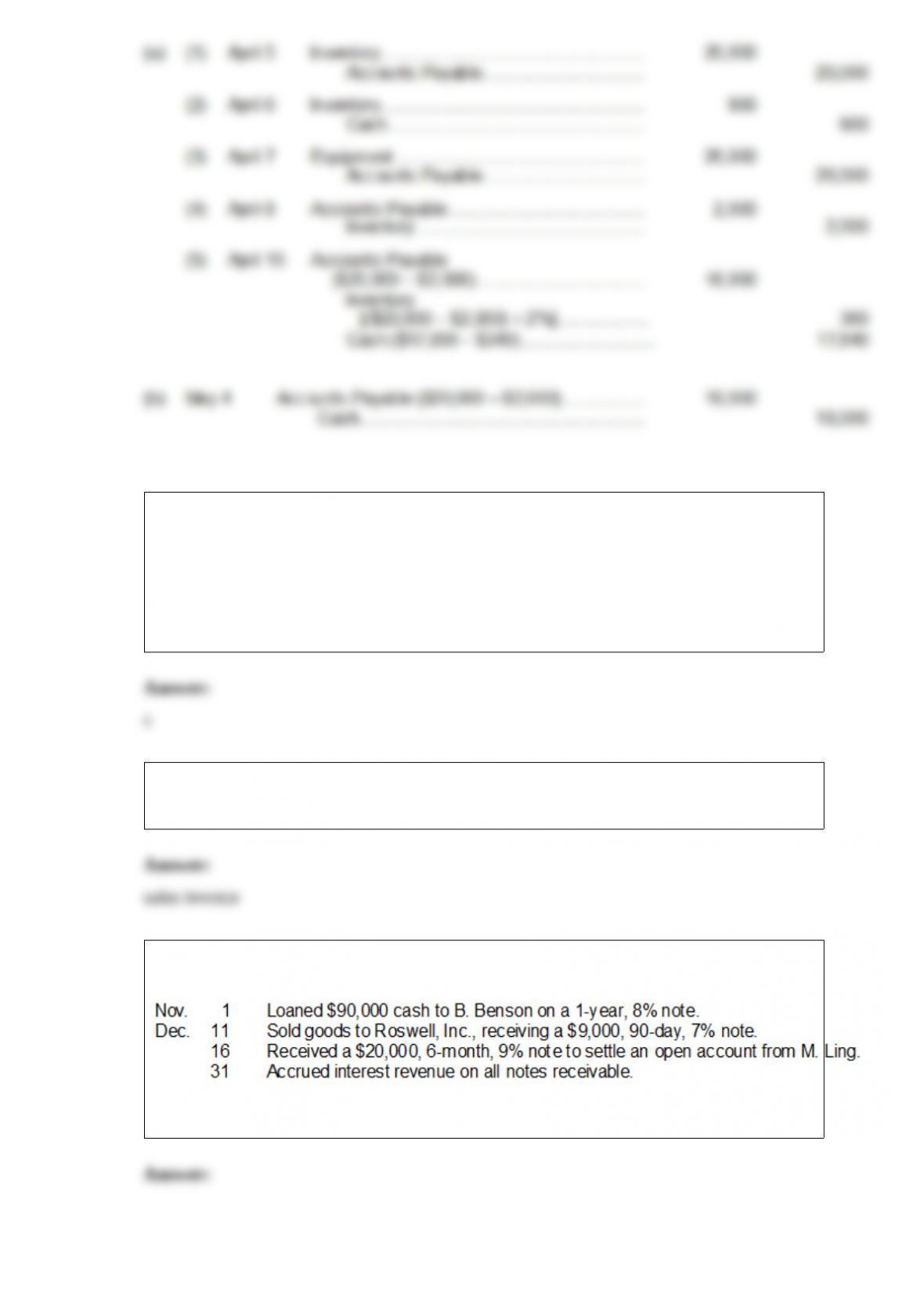
18)
this information relates to sherper co.
1>on april 5 purchased merchandise from newport company for $20,000, terms 2/10,
n/10.
2>on april 6 paid freight costs of $900 on merchandise purchased from newport.
3>on april 7 purchased equipment on account for $26,000.
4>on april 8 returned some of april 5 merchandise to newport company which cost
$2,000.
5>on april 15 paid the amount due to newport company in full.
instructions
(a)prepare the journal entries to record the transactions listed above on the books of
sherper co. sherper co. uses a perpetual inventory system.
(b)assume that sherper co. paid the balance due to newport company on may 4 instead
of april 15. prepare the journal entry to record this payment.
19) after a business transaction has been analyzed and entered in the book of original
entry, the next step in the recording process is to transfer the information to
a.the company’s bank.
b.stockholders equity.
c.ledger accounts.
d.financial statements.
20) every credit sales transaction should be supported by a _________________ that
provides written evidence of the sale.
21) great plains supply co. has the following transactions related to notes receivable
during the last 2 months of the year.
instructions
journalize the transactions for great plains supply co.
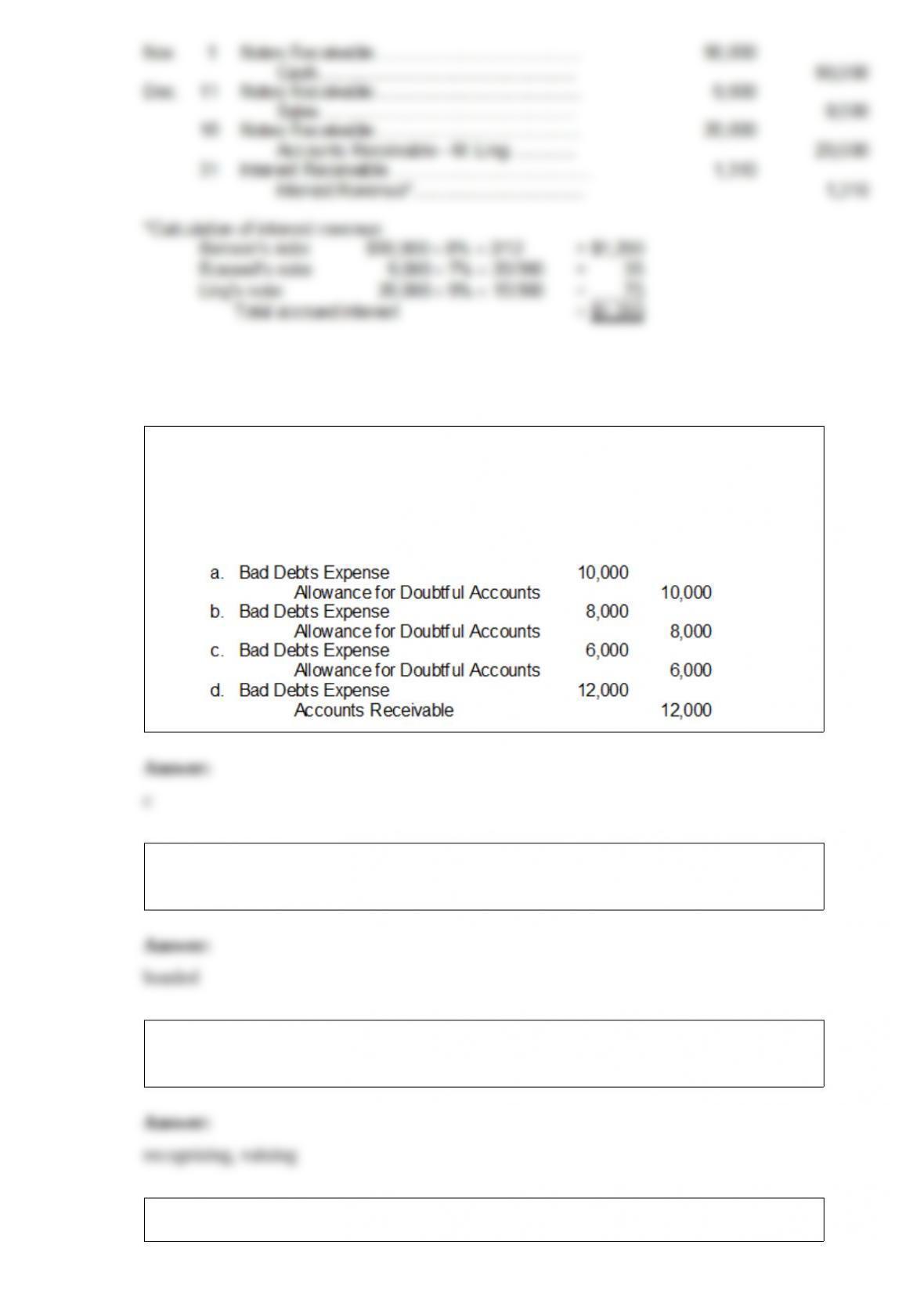
22) kinsler company uses the percentage of receivables method for recording bad debts
expense. the accounts receivable balance is $200,000 and credit sales are $1,000,000.
management estimates that 4% of accounts receivable will be uncollectible. what
adjusting entry will kinsler company make if the allowance for doubtful accounts has a
credit balance of $2,000 before adjustment?
23) employees who handle cash should be ______________ in order to protect against
misappropriation of assets by dishonest employees.
24) two accounting problems associated with accounts receivable are (1)
______________ and (2) ______________ accounts receivable.
25) income will always be greater under the cash basis of accounting than under the

accrual basis of accounting.