1) One of the major benefits of formal budgeting is the positive effect it can have on
employee attitudes if applied correctly.
2) A Company had net sales of $23,000 million, and its average account receivables
were $5,700 million. Its accounts receivable turnover is 0.24.
3) A company factored $30,000 of its accounts receivable and was charged a 2%
factoring fee. The journal entry to record this transaction would include a debit to Cash
of $30,000, a debit to Factoring Fee Expense of $600, and credit to Accounts
Receivable of $30,600.
4) Departmental income statements are prepared for service departments but not
operating departments.
5) When a voucher system is used, an invoice approval is not needed as long as the
purchase is evidenced by an invoice and purchase order.
6) Cash flows are essentially the same as net income because they are both measured
using accrual accounting principles.
7) Control, competency, compatibility, flexibility and cost-benefit are the five basic
principles of accounting information systems.
8) Job order costing is applicable to manufacturing firms only and not service firms.
9) Management’s intent determines whether an available-for-sale security is classified
as long-term or short-term.
10) Investment center managers are typically evaluated using performance measures
that combine income and assets.
11) No standard rule identifies the best basis of allocating expenses across departments,
so it is impossible to allocate costs in a manner that will be perceived as fair.
12) On January 1, Eastern College received $1,200,000 from its students for the spring
semester that it recorded in Unearned Tuition and Fees. The term spans four months
beginning on January 2 and the college spreads the revenue evenly over the months of
the term. What amount of tuition revenue should the college recognize on February 28?
A.$300,000.
B.$600,000.
C.$800,000.
D.$900,000.
E.$1,200,000.
13) The withdrawals account of each partner is:
A.Closed to that partner’s capital account with a credit.
B.Closed to that partner’s capital account with a debit.
C.A permanent account that is not closed.
D.Credited with that partner’s share of net income.
E.Debited with that partner’s share of net loss.
14) Perfection Company had cost of goods sold of $853,000, ending inventory of
$70,500, and average inventory of $71,600. Its inventory turnover equals:
A.11.9.
B.1.0.
C.6.0.
D.30.6.
E.12.0.
15) The accounting principle that requires important noncash financing and investing
activities be reported on the statement of cash flows or in a footnote is the:
A.Historical cost principle.
B.Materiality principle.
C.Full disclosure principle.
D.Going concern principle.
E.Business entity principle.
16) Identify the account below that is classified as a liability account:
A.Cash
B.Accounts Payable
C.Salaries Expense
D.J. Jackson, Capital
E.Equipment
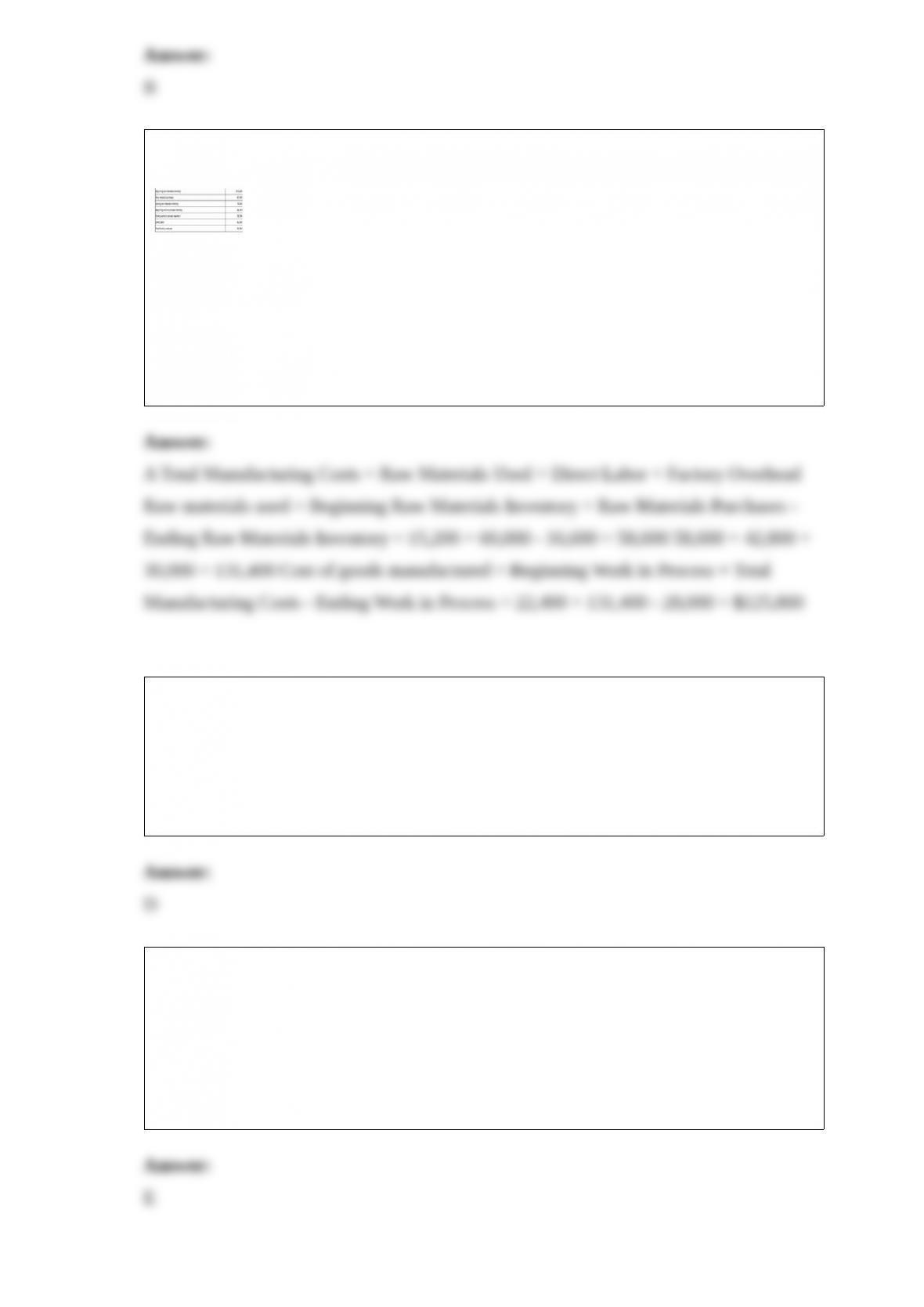
17) Current information for the Healey Company follows:
All raw materials used were traceable to specific units of product. Healey Company’s
Cost of Goods Manufactured for the year is:
A.$125,800.
B.$128,600.
C.$131,400.
D.$137,000.
E.$139,000.
18) Which of the following are classified as current assets?
A.Office equipment.
B.Patent.
C.Unearned revenue.
D.Office supplies.
E.Land.
19) Bonds that mature at more than one date with the result that the principal amount is
repaid over a number of periods are known as:
A.Registered bonds.
B.Bearer bonds.
C.Callable bonds.
D.Sinking fund bonds.
E.Serial bonds.
20) An internal control system consists of the policies and procedures managers use to
do all of the following except:
A.Urge adherence to company policies.
B.Promote efficient operations.
C.Ensure reliable accounting.
D.Determine pricing for products.
E.Protect assets.
21) Refer to the following selected financial information from Dodge Company.
Compute the company’s acid-test ratio.
A.2.75.
B.2.66.
C.0.92.
D.1.12.
E.1.63.
22) A company had average total assets of $1,660,000, total cash flows of $1,320,000,
cash flows from operations of $205,000, and cash flows from financing of $750,000.
The cash flow on total assets ratio equals:
A.45.2%.
B.22.0%.
C.11.65%.
D.12.3%.
E.79.5%.
23) All of the following statements related to current liabilities for U.S. GAAP and
IFRS are true except:
A.The definitions and characteristics of current liabilities are broadly similar for both
U.S. GAAP and IFRS.
B.The term provision is typically used under IRFS to refer to what is titled liability
under U.S. GAAP.
C.Because tax regulatory systems of countries are different, the approach to recording
taxes is totally different.
D.When there is little uncertainty surrounding current liabilities, both require
companies to record them in a similar manner.
E.When there is a known current obligation that involves an uncertain amount, but one
that can be reasonable estimated, both require similar treatment.
24) A unit of a business that generates revenues and incurs costs is called a:
A.Performance center.
B.Profit center.
C.Cost center.
D.Responsibility center.
E.Expense center.
25) Minstrel Manufacturing uses a job order costing system. During one month
Minstrel purchased $198,000 of raw materials on credit; issued materials to production
of $195,000 of which $30,000 were indirect. Minstrel incurred a factory payroll of
$150,000, paid in cash, of which $40,000 was indirect labor. Minstrel uses a
predetermined overhead rate of 150% of direct labor cost. The journal entry to record
the allocation of the factory payroll to production is:
A.Debit Work in Process Inventory $150,000; credit Factory Wages Payable $150,000.
B.Debit Work in Process Inventory $150,000; credit Cash $150,000.
C.Debit Factory Wages Payable $150,000; credit Cash $150,000.
D.Debit Work in Process Inventory $110,000; debit Factory Overhead $40,000; credit
Factory Wages Payable $150,000.
E.Debit Work in Process Inventory $110,000; debit Factory Overhead $40,000; credit
Cash $150,000.
26) Luker Corporation uses a process costing system. The company had $160,500 of
beginning Finished Goods Inventory on October 1. It transferred in $837,000 of goods
completed during the period. The ending Finished Goods Inventory balance on October
31 was $158,200. The entry to account for the cost of goods manufactured during
October is:
A.Debit Cost of Goods Sold $837,000; credit Finished Goods Inventory $837,000.
B.Debit Cost of Goods Sold $839,300; credit Work in Process Inventory $839,300.
C.Debit Finished Goods Inventory $837,000; credit Work in Process Inventory
$837,000.
D.Debit Finished Goods Inventory $158,200; credit Cost of Goods Sold $158,200.
E.Debit Cost of Goods Sold $839,300; credit Finished Goods Inventory $839,300.
27) Which of the following represents the correct formula for calculating cost of goods
manufactured?
A.Direct materials used + direct labor + factory overhead + beginning work in process
+ ending work in process.
B.Direct materials used + direct labor + factory overhead + beginning work in process –
ending work in process.
C.Direct materials used + direct labor + factory overhead – beginning work in process +
ending work in process.
D.Direct materials used + direct labor + factory overhead – beginning work in process –
ending work in process.
E.Direct materials used + direct labor – factory overhead + beginning work in process –
ending work in process.
28) When recording variances in a standard cost system:
A.Only unfavorable material variances are debited.
B.Only unfavorable material variances are credited.
C.Both unfavorable material and labor variances are credited.
D.All unfavorable variances are debited.
E.All unfavorable variances are credited.
29) One characteristic of plant assets is that they are:
A.Current assets.
B.Used in operations.
C.Natural resources.
D.Long-term investments.
E.Intangible.
30) Zheng invested $100,000 and Murray invested $200,000 in a partnership. They
agreed to share incomes and losses by allowing a $60,000 per year salary allowance to
Zheng and a $40,000 per year salary allowance to Murray, plus an interest allowance on
the partners’ beginning-year capital investments at 10%, with the balance to be shared
equally. Under this agreement, the shares of the partners when the partnership earns
$105,000 in income are:
A.$52,500 to Zheng; $52,500 to Murray.
B.$35,000 to Zheng; $70,000 to Murray.
C.$57,500 to Zheng; $47,500 to Murray.
D.$42,500 to Zheng; $62,500 to Murray.
E.$70,000 to Zheng; $60,000 to Murray.
31) Banks authorized to accept deposits of amounts payable to the federal government,
including amounts due for payroll taxes are _________________________________.
32) ______________________ ratios include the price-earnings ratio and dividend
yield.
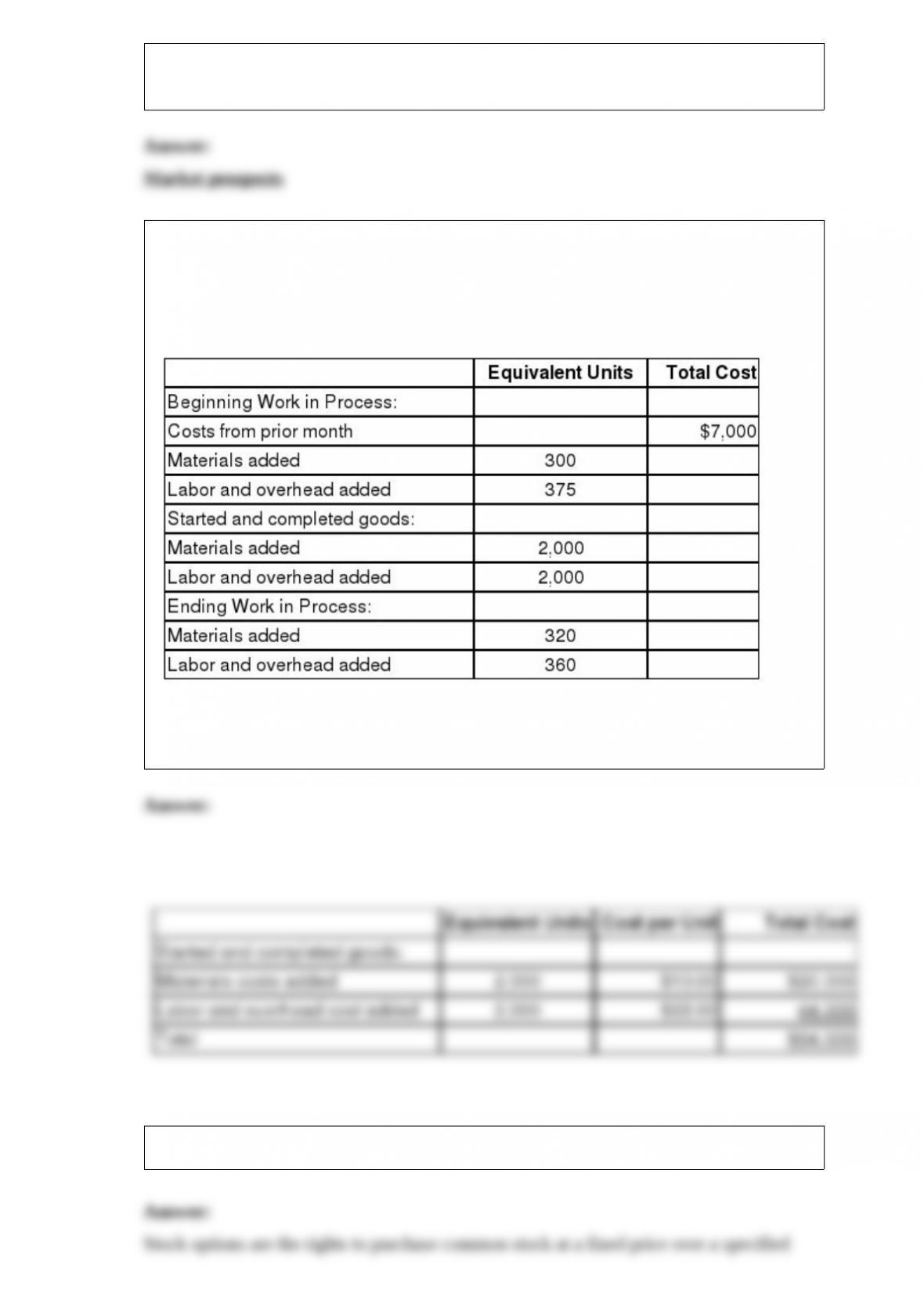
33) Refer to the following information about the Shaping Department of the Minnesota
Factory for the month of August. Minnesota Factory uses the weighted average method
of inventory costing.
The cost per equivalent unit of materials is $10.00, and the cost per equivalent unit of
labor and overhead is $22.00. Compute the cost that should be assigned to the units that
were started and completed during August.
34) Explain stock options and their effect on the company.
35) A stock _________________ keeps stockholder records and prepares official lists
of stockholders for stockholder meetings and dividend payments.
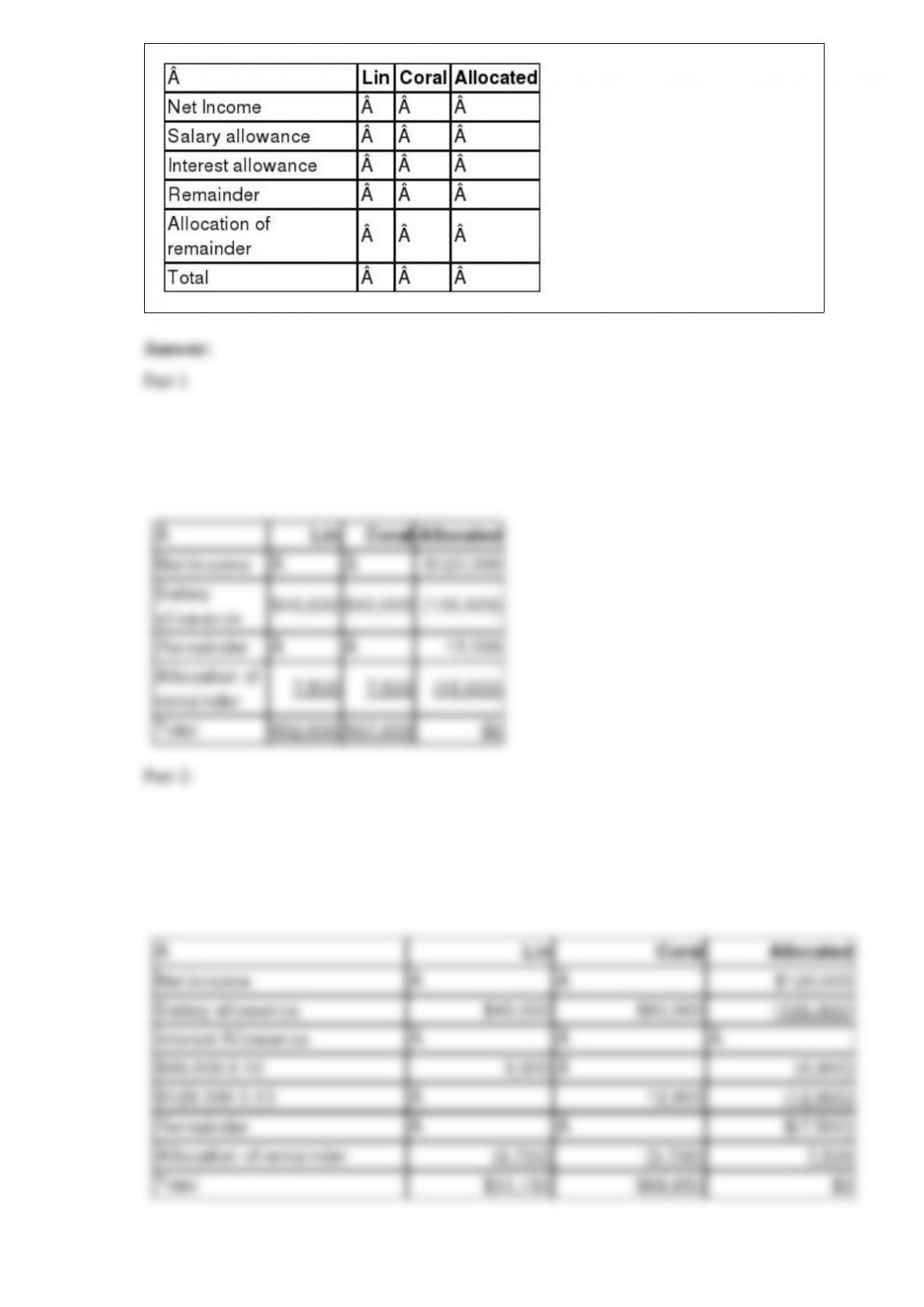
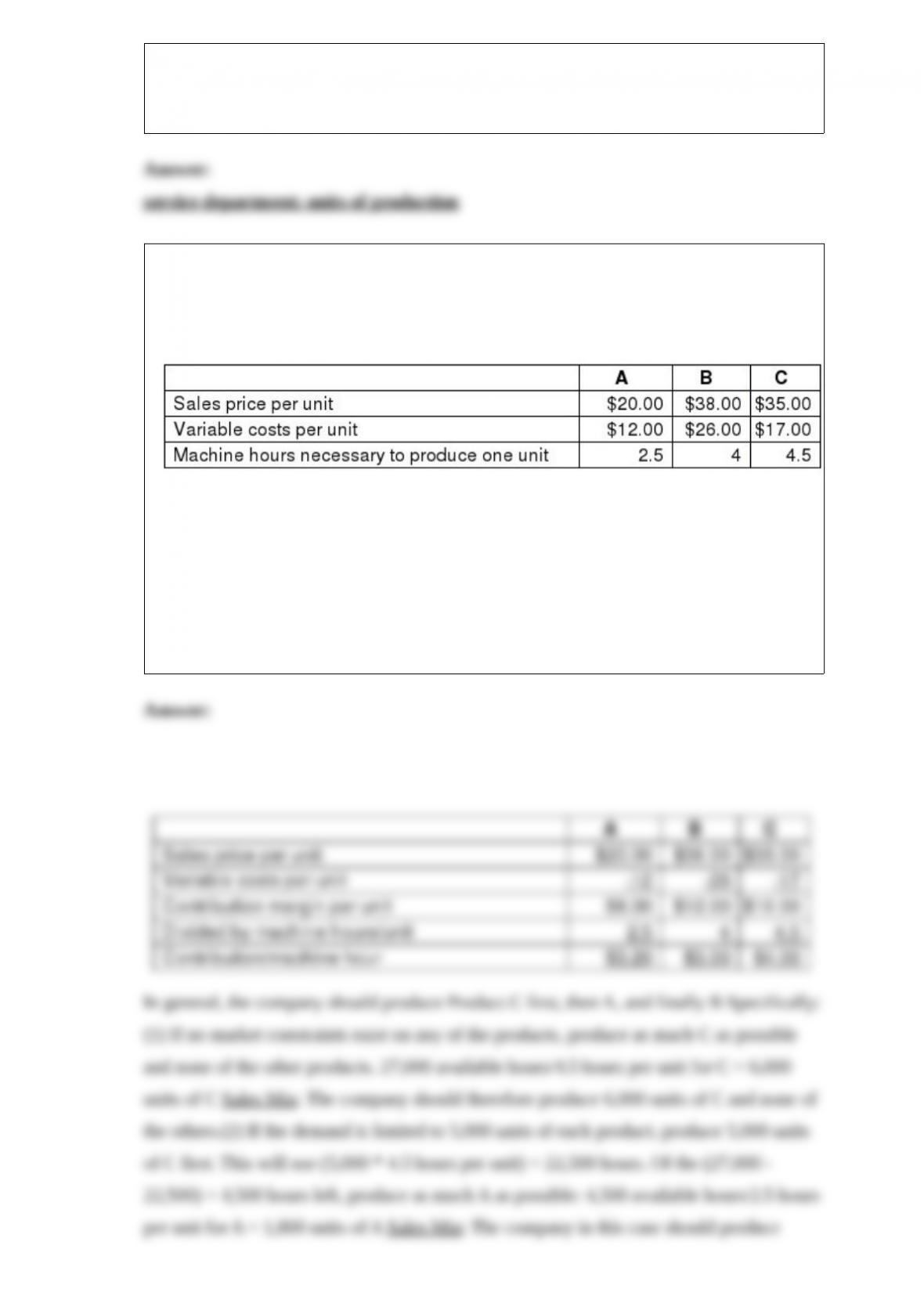
36) Lin and Coral invested $99,000 and $126,000, respectively, in a partnership they
began one year ago. Assuming the partnership earned $120,000 during the current year;
compute the share of the net income each partner should receive under each of these
independent assumptions.
1) The partnership contract specifies salary allowances of $45,000 to Lin and $60,000
to Coral, and any balance shared equally.
2) The partnership contract specifies salary allowances of $45,000 to Lin and $60,000
to Coral, interest allowance of 10% on the partners’ beginning capital balance for the
year.
37) In the two-stage cost allocation, ___________________ costs are allocated to
operating departments, and the operating department costs are allocated to
________________.
38) A company produces three different products that all require processing on the same
machines. There are only 27,000 machine hours available in each year. Production
information for each product is:
Required:
(1) Determine the preferred sales mix if there are no market constraints on any of the
products.
(2) Determine the preferred sales mix if the demand is limited to 5,000 units for each
product.
(3) Determine the preferred sales mix if the demand is limited to 3,000 units for each
product.