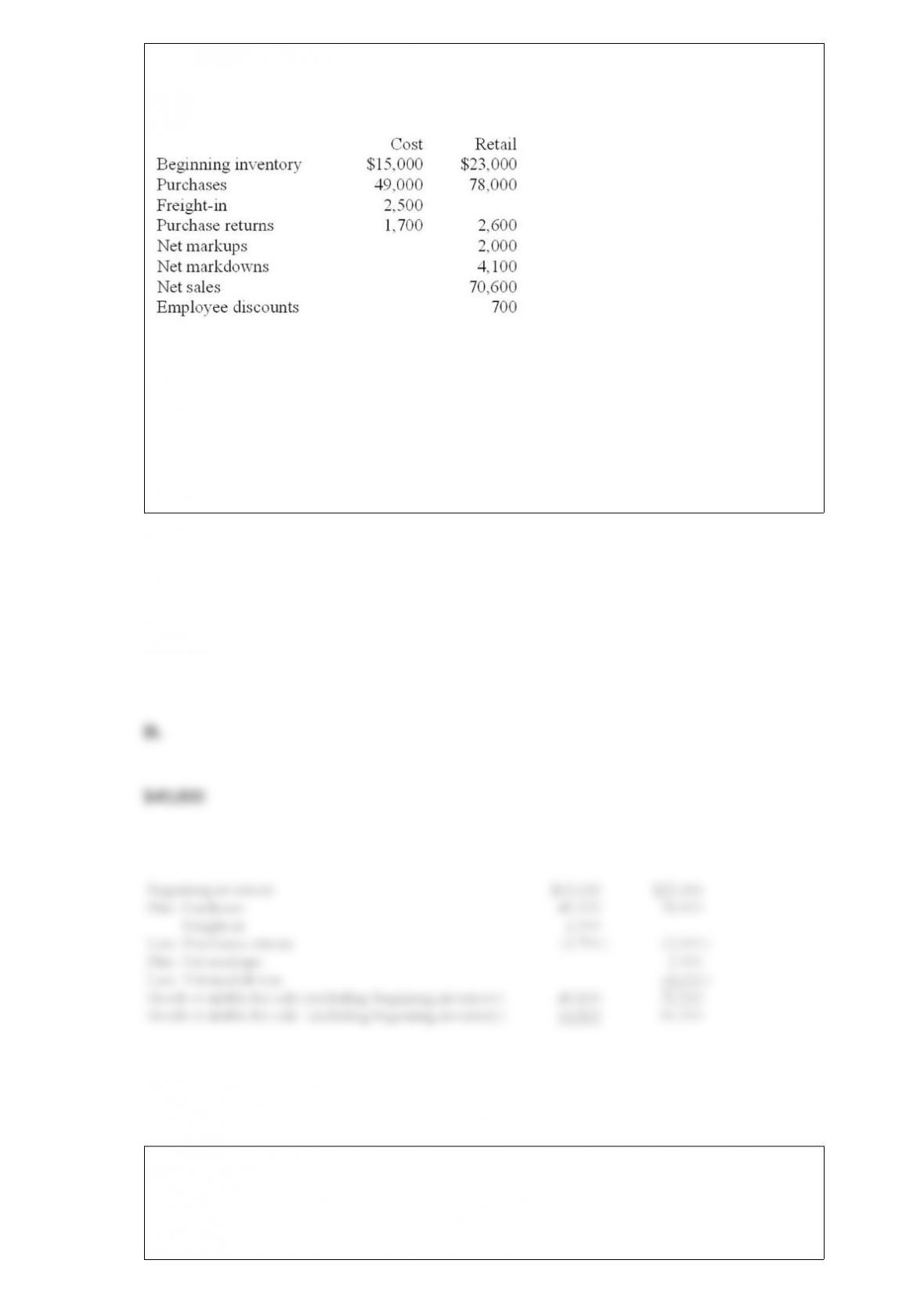
Harvey’s Junk Jewelry started business January 1, 2013, and uses the LIFO retail
method to estimate ending inventory. Listed below is data accumulated for the year
ended December 31, 2013:
The numerator for the current period’s cost-to-retail percentage is: A. $64,800.
B. $48,100.
C. $47,700.
D. $49,800.
Answer:
On December 31, 2013, Tiras Company reported net income of $50,000 and sales of
$200,000. The company also reported beginning and ending accounts receivable at
$20,000 and $25,000, respectively. Tiras will report cash collected from customers in its
2013 statement of cash flows (indirect method) in the amount of: A. $0.

B. $245,000.
C. $205,000.
D. $195,000.
Answer:
On January 1, 2013, Ozark Minerals issued $10 million of 9%, 10-year convertible
bonds at 101. The bonds pay interest on June 30 and December 31. Each $1,000 bond is
convertible into 40 shares of Ozark’s no par common stock. Bonds that are similar in all
respects, except that they are nonconvertible, currently are selling at 99. Upon issuance,
Ozark should: A. Debit discount on bonds payable $100,000.
B. Credit premium on bonds payable $100,000.
C. Credit equity $100,000.
D. Credit bonds payable $10,100,000.
Answer:

In 2013, due to a change in marketing forecasts, Barney Corporation reduced the
projected life of its patent for producing round dice. The cumulative patent amortization
prior to 2013 would have been $10 million higher had the new life been used. Barney’s
tax rate is 30%. Barney’s retained earnings as of December 31, 2013, would be: A.
Overstated by $7 million.
B. Overstated by $3 million.
C. Overstated by $10 million.
D. Unaffected.
Answer:
Brewer Inc. is owed $200,000 by Carol Co. under a 10% note with two years remaining
to maturity. Due to financial difficulties Carol Co. did not pay the prior year’s interest.
Brewer agrees to settle the receivable (and accrued interest) in exchange for a cash
payment of $150,000. The journal entry that Brewer would make to record this
transaction would include a loss on troubled debt restructuring of: A. $0.
B. $20,000.
C. $50,000.
D. $70,000.
Answer:

On September 1, 2013, Hiker Shoes issued a $100,000, 8-month, noninterest-bearing
note. The loan was made by Second Commercial Bank where the stated discount rate is
9%. Hiker’s effective interest rate on this loan (rounded) is: A. 9.0%.
B. 9.5%.
C. 9.6%.
D. 9.7%.
Answer:
On January 1, 2013, Legion Company sold $200,000 of 10% ten-year bonds. Interest is
payable semiannually on June 30 and December 31. The bonds were sold for $177,000,
priced to yield 12%. Legion records interest at the effective rate. Legion should report
bond interest expense for the six months ended June 30, 2013, in the amount of: A.
$8,850.
B. $10,000.
C. $10,620.
D. $12,000.

Answer:
At January 1, 2013, BB Industries, Inc., owed Second Bank $24 million, under a 10%
note due December 31, 2014. Interest was paid last on December 31, 2011. BB was
experiencing severe financial difficulties and asked Second Bank to modify the terms of
the debt agreement. After negotiation Second Bank agreed to:
– Forgive the interest accrued for the year just ended.
– Reduce the remaining two years’ interest payments to $2 million each and delay the
first payment until December 31, 2014, and
– Reduce the principal amount to $22 million.
Required:
Prepare the journal entries by BB Industries, Inc. necessitated by the restructuring of the
debt at (A) January 1, 2013, (B) December 31, 2014, and (C) December 31, 2015.
Answer:

Eligibility for postretirement health care benefits usually is based on the employee’s: A.
Job title.
B. Number of years in the profession.
C. Number of years in the current position.
D. Age and/or years of service.
Answer:
The reporting of earnings per share is required only for: A. Private companies.
B. Companies with complex capital structures.
C. Publicly traded corporations.
D. Medium-sized and large corporations.
Answer:

Black Enterprises reported the following ($ in 000s) as of December 31, 2013. All
accounts have normal balances.
During 2014 ($ in 000s), net income was $9,000; 25% of the treasury stock was resold
for $450; cash dividends declared were $600; cash dividends paid were $500
What ($ in 000s) was shareholders’ equity as of December 31, 2013? A. $29,600.
B. $35,600.
C. $30,400.
D. $28,600.
Answer:
Carpenter sells wholesale to McGuire Inc. under an arrangement in which McGuire
pays $2,000 plus a 5% royalty of McGuire sales of Carpenter products. Carpenter
anticipates that McGuire will sell a total of $2,500 of Carpenter product. Which of the
following is true? A. Carpenter would recognize $2,000 upon delivery and wait until
McGuire makes sales to recognize commissions.
B. Carpenter would recognize $2,125, equal to $2,000 + 5% x $2,500 upon delivery.

C. Carpenter would recognize $2,500 upon delivery.
D. None of the other answers is correct.
Answer:
GAAP that covers revenue recognition for multiple-part arrangements requires that a
seller recognize revenue for a particular part if: A. The part has value on a stand-alone
basis.
B. Customer acceptance of the part is not contingent on successful delivery of a later
part.
C. The part constitutes at least a “preponderance of the fair value” of the total
arrangement.
D. Both the part has value on stand-alone basis and customer acceptance of the part is
not contingent on successful delivery of a later part are required.
Answer:

Peterson Photoshop sold $1,000 in gift cards on a special promotion on October 15,
2013, and sold $1,500 in gift cards on another special promotion on November 15,
2013. Of the cards sold in October, $100 were redeemed in October, $250 in November,
and $300 in December. Of the cards sold in November, $150 were redeemed in
November and $350 were redeemed in December. Peterson views the probability of
redemption of a gift card as remote if the card has not been redeemed within two
months. At 12/31/2013, Peterson would show an unearned revenue account for the gift
cards with a balance of: A. $0.
B. $1,000.
C. $1,350.
D. $1,500.
Answer:
When treasury shares are resold at a price below cost:A. Paid-in capital and/or retained
earnings is reduced.
B. Paid-in capital and/or retained earnings is increased.
C. Retained earnings is always reduced.
D. A loss is taken on the income statement.
Answer:

Listed below are five terms followed by a list of phrases that describe or characterize
each of the terms. Match each phrase with the correct term. 1)Unearned revenues
2)Transaction analysis
3)Special journals
4)Revenues
5)Source documents
A. Used to identify external transactions.
B. Refers to inflows of assets from the sale of goods and services.
C. Determines the effects of an event in terms of the accounting equation.
D. Liabilities created by a customer’s prepayment.
E. Used to record repetitive types of transactions.
Answer:
Buckeye Corporation adopted dollar-value LIFO on January 1, 2013, when the
inventory value was $500,000 and the cost index was 1.0. On December 31, 2013, the
inventory value at year-end costs was $535,000 and the cost index was 1.06. Buckeye
would report a LIFO inventory of: A. $504,717.
B. $530,000.
C. $505,000.
D. $533,019.
Answer:
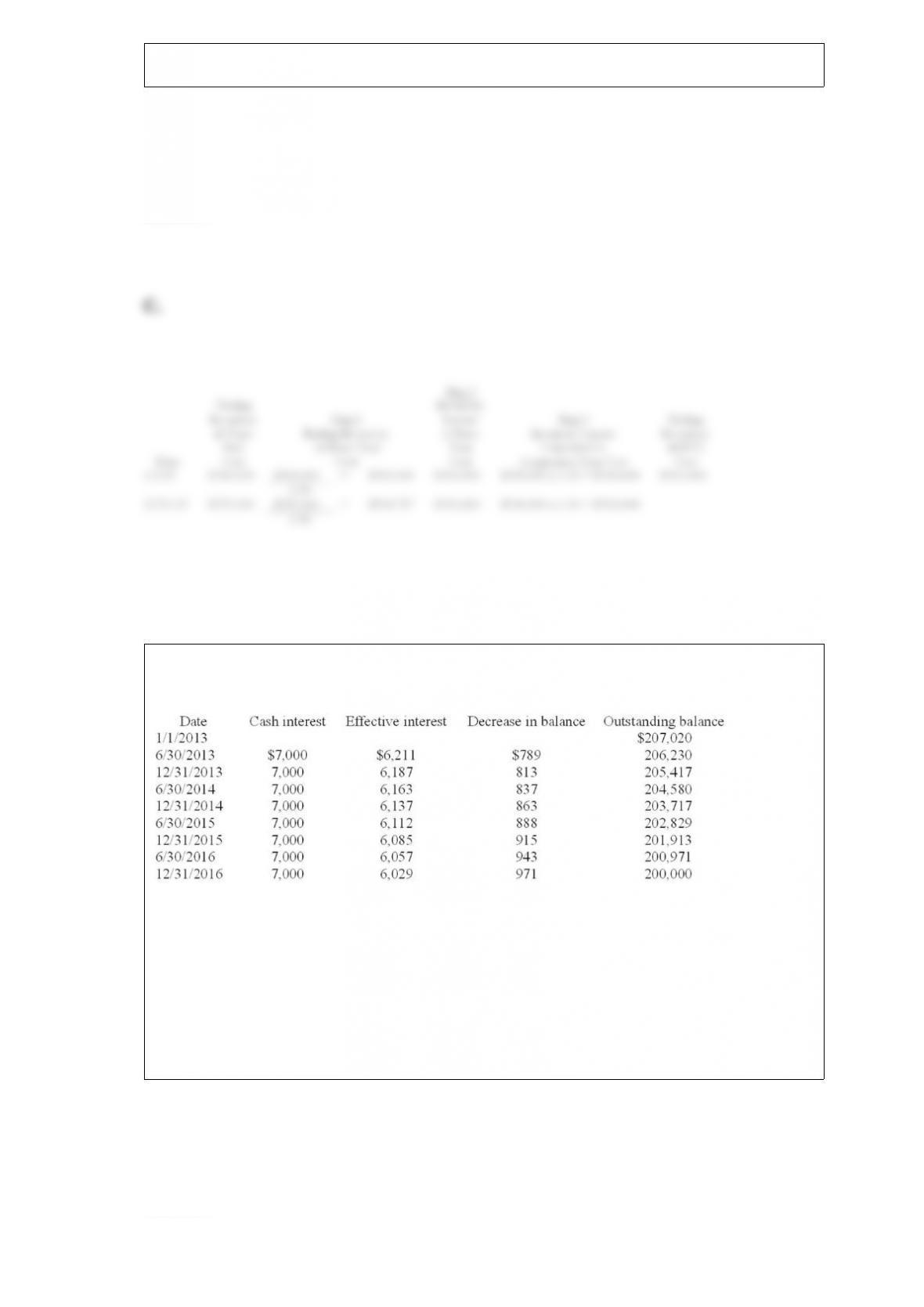
Lopez Plastics Co. (LPC) issued callable bonds on January 1, 2013. LPC’s accountant
has projected the following amortization schedule from issuance until maturity:
What is the annual effective interest rate on the bonds? A. 3%
B. 3.5%
C. 6%
D. 7%
Answer:

In 2013, Cupid Construction Co. (CCC) began work on a two-year fixed price contract
project. CCC uses the percentage-of-completion method to account for projects and
provides the following information (dollars in millions):
What is the amount of gross profit on the project recognized by CCC during 2013? A.
$160 million.
B. $72 million.
C. $48 million.
D. Cannot be determined from the given information.
Answer:
Interest is not capitalized for: A. Assets that are constructed as discrete projects for sale
or lease.
B. Assets constructed for a company’s own use.
C. Inventories routinely and repetitively produced in large quantities.

D. Interest is capitalized for all of these items.
Answer:
When an accounting change is reported under the retrospective approach, prior years’
financial statements are:A. Revised to reflect the use of the new principle.
B. Reported as previously prepared.
C. Left unchanged.
D. Adjusted using prior period adjustment procedures.
Answer:
The process of assigning the cost of postretirement benefits to the years during which
those benefits are assumed to be earned by employees is called: A. Restitution.
B. Retribution.
C. Attribution.
D. Assignation.

Answer:
Surefeet Corporation changed its inventory valuation method. Which characteristic is
jeopardized by this change? A.Comparability.
B.Representational faithfulness.
C.Consistency.
D.Feedback value.
Answer:
SFAC No.5 focuses on: A.Objectives of financial reporting.
B.Qualitative characteristics of accounting information.
C.Recognition and measurement concepts in accounting.
D.Elements of financial statements.
Answer:

Woody Corp. had taxable income of $8,000 in the current year. The amount of MACRS
depreciation was $3,000, while the amount of depreciation reported in the income
statement was $1,000. Assuming no other differences between tax and accounting
income, Woody’s pretax accounting income was: A. $5,000.
B. $6,000.
C. $10,000.
D. $11,000.
Answer:
Under the retail method, in determining the cost-to-retail percentage for the current
year: A. Net markups are included.
B. Net markdowns are excluded.
C. Net sales are included.
Answer:
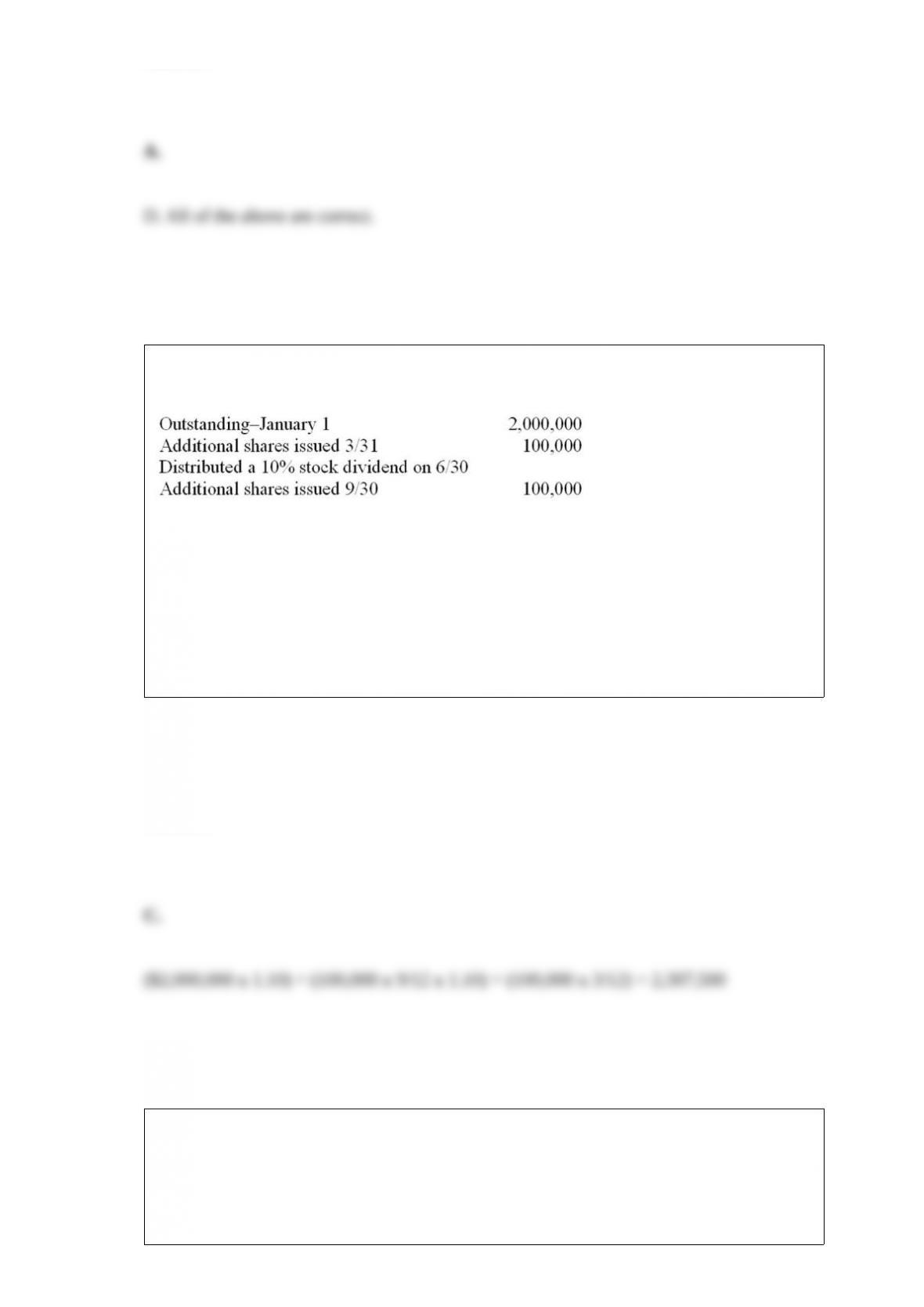
Morrison Corporation had the following common stock record during the current
calendar year:
What is the number of shares to be used in computing basic EPS? A. 2,000,000.
B. 2,205,000.
C. 2,307,500.
D. 2,335,000.
Answer:
Under IFRS, components of other comprehensive income: A. Can be reported as part of
a single statement of comprehensive income.
B. Are not permitted to be reported.

C. Must be reported in a separate statement of comprehensive income.
D. Can be reported as part of a statement of shareholders’ equity.
Answer:
Hong Kong Clothiers reported revenue of $5,000,000 for its year ended December 31,
2013. Accounts receivable at December 31, 2012 and 2013, were $320,000 and
$355,000, respectively. Using the direct method for reporting cash flows from operating
activities, Hong Kong Clothiers would report cash collected from customers of: A.
$4,965,000.
B. $5,000,000.
C. $5,035,000.
D. $5,045,000.
Answer:

One of the four criteria for a capital lease specifies that the present value of the
minimum lease payments be equal to or greater than: A. 90% of the cost of the asset.
B. 75% of the fair value of the asset.
C. 90% of the fair value of the asset.
D. 75% of the cost of the asset.
Answer:
The rate of interest that actually is incurred on a note payable is called the: A. Face rate.
B. Contract rate.
C. Effective rate.
D. Stated rate.
Answer:
Revenue and expense items and components of other comprehensive income can be
reported in a single statement of comprehensive income using: A. U.S. GAAP.
B. IFRS.

C. Both U.S. GAAP and IFRS.
D. Neither U.S. GAAP nor IFRS.
Answer:
Rudyard Corporation had 100,000 shares of common stock and 10,000 shares of 8%,
$100 par convertible preferred stock outstanding during the year. Net income for the
year was $400,000 and dividends were paid to both common and preferred
shareholders. Rudyard’s effective tax rate is 40%. Each share of preferred stock is
convertible into five shares of common.
What is Rudyard’s basic EPS? A. $2.13.
B. $4.80.
C. $4.00.
D. $3.20.
Answer:

Data related to the inventories of Alpine Ski Equipment and Supplies is presented
below:
In applying the LCM rule, the inventory of apparel would be valued at: A. $108,000.
B. $90,000.
C. $110,000.
D. $115,000.
Answer:
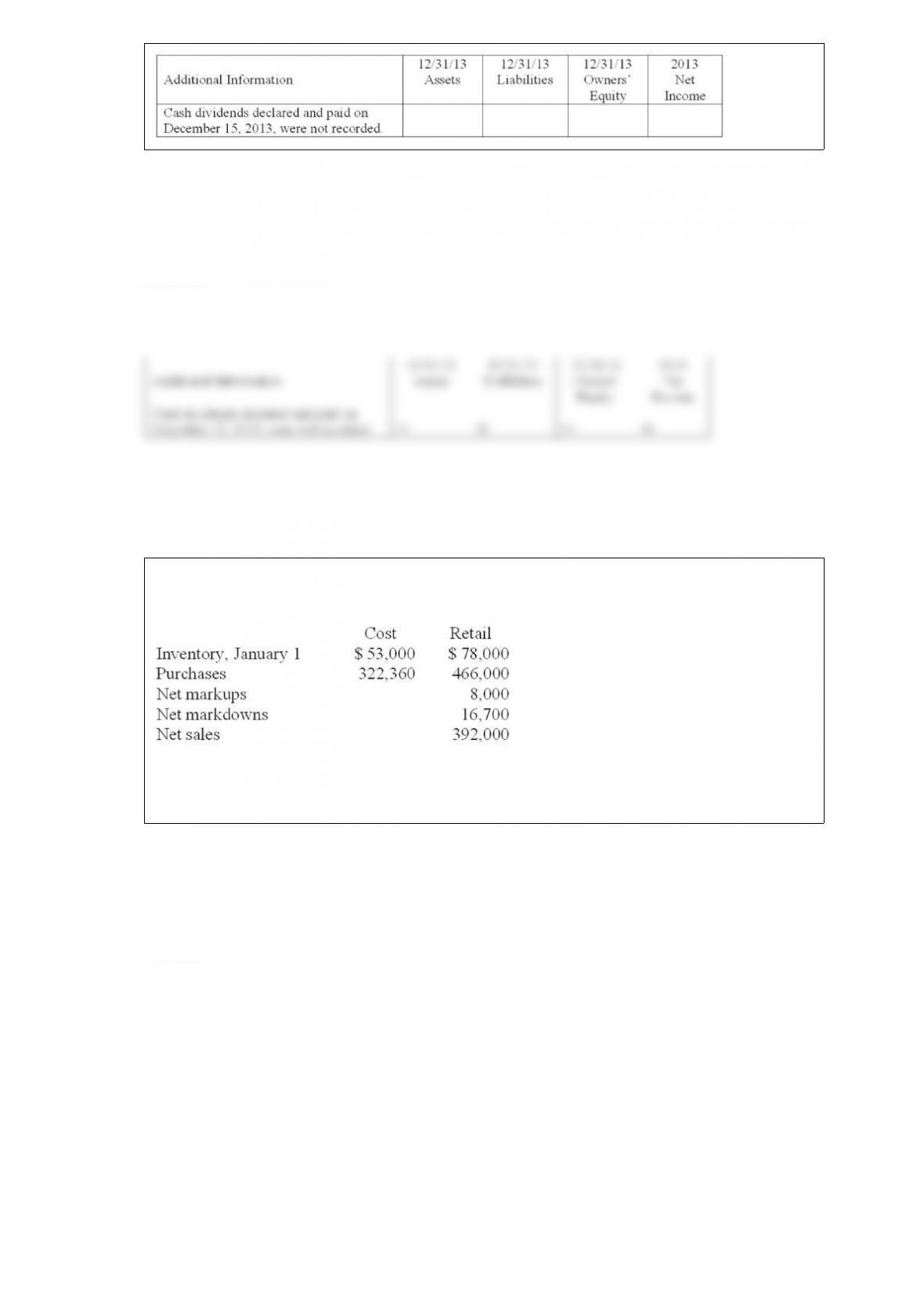
You are reviewing O’Brian Co.’s adjusted trial balance for the year ended 12/31/13. You
notice several omissions and incorrect items during your review, some of which are
noted below. For each one, you are to determine what effect, if any, these items would
have on the stated components of O’Brian Co.’s 2013 Income Statement and 12/31/13
Balance Sheet if they are not corrected or updated. Assume no income taxes.
Use the following code for your answers. You need not include any dollar amounts.
N = No Effect
O = Overstated
U = Understated
Answer:
Billingsly Products uses the conventional retail method to estimate its ending
inventories. The following data has been summarized for the year 2013:
Required:
Estimate the ending inventory as of December 31, 2013.
Answer:

The shareholders’ equity of Nick Co. includes the items shown below. The board of
directors of Nick declared cash dividends of $4 million, $8 million, and $50 million in
each of its first 3 years of operation: 2011, 2012, 2013, respectively.
Common stock, $1 par, 50,000,000 shares outstanding
Preferred stock, 6%, $100 par, 1,000,000 shares outstanding
Required:
Determine the amount of dividends per share on preferred and common stock for each
of the three years. The preferred stock is noncumulative and nonparticipating.
Answer:
The following is an incomplete pension spreadsheet for the current year for Sparky
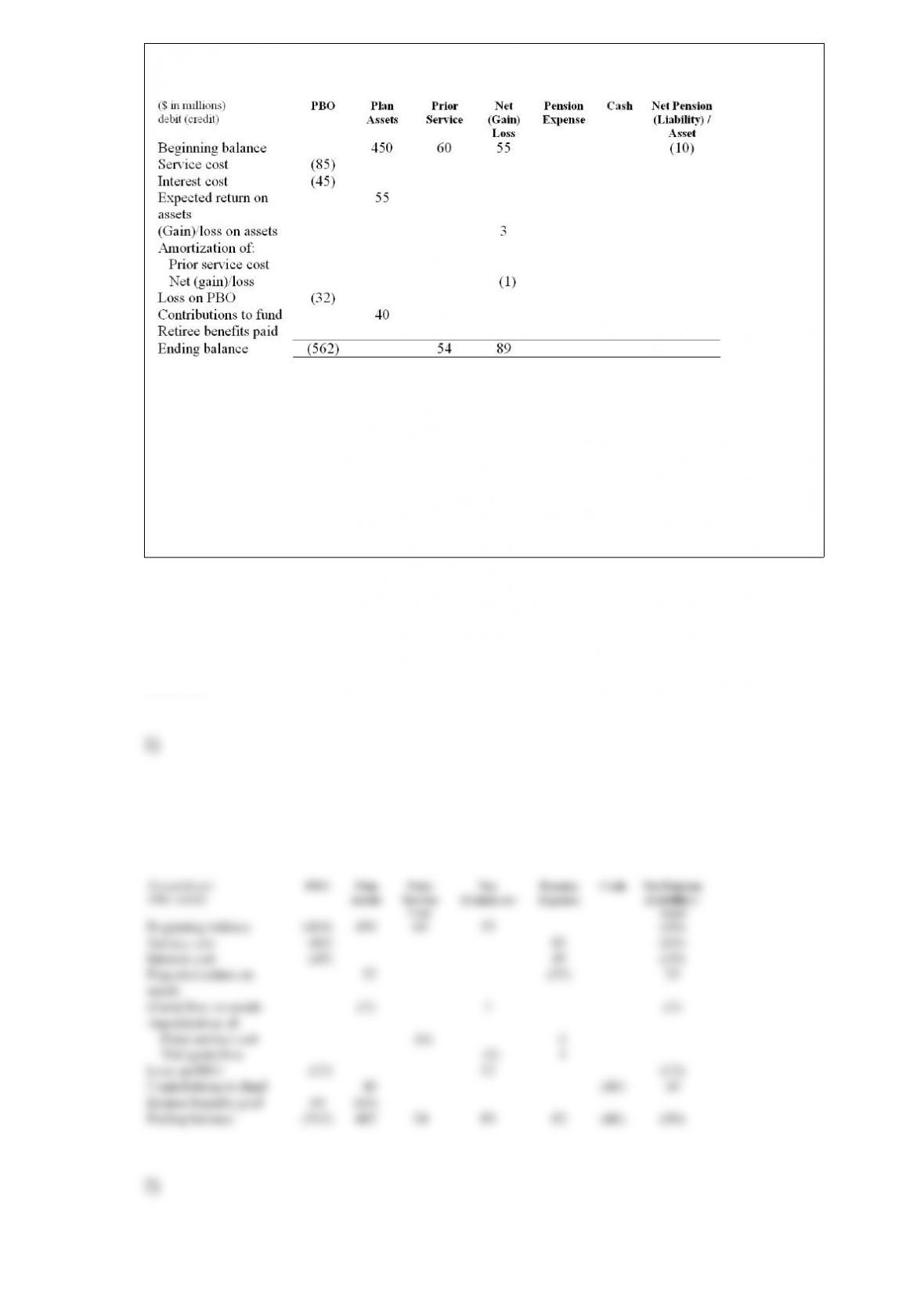
Corporation.
Required:
1) Complete the pension spreadsheet.
2) Prepare the journal entries to record pension expense and funding of plan assets for
the year.
3) Prepare the journal entry/ies to record any gains or losses for the year.
Answer:

Cracker Corporation began a special promotion in July 2013 in an attempt to increase
sales. A coupon was placed in each box of product. Customers could send in five
coupons for a free prize. Each prize cost Cracker Corporation $2.00. Cracker’s
management estimated that 70% of the coupons would be redeemed. For the six months
ended December 31, 2013, the following information is available:
Required:
Record all necessary journal entries for the premium offer for 2013.
Answer:

During its first year of operations, Criswell Inc. completed the following transactions
relating to shareholders’ equity.
January 5: Issued 300,000 of its common shares for $8 per share and 3,000 preferred
shares at $110.
February 12: Issued 50,000 shares of common stock in exchange for equipment with a
known cash price of $310,000.
The articles of incorporation authorize 5,000,000 shares with a par value of $1 per share
of common and 1,000,000 preferred shares with a par value of $100 per share.
Required:
Record the above transactions in general journal form.
Answer:
Beavis Construction Company was the low bidder on a construction project to build an
earthen dam for $1,800,000. The project was begun in 2012 and completed in 2013.
Cost and other data are presented below:
Assume that Beavis reports under IFRS and uses the cost recovery method for revenue
recognition.
Required: Compute the amount of gross profit recognized during 2012 and
Answer:

Identify or define the following terms: historical cost, realization.
Answer:
The following table presents a summary of ratio analysis for McDonald’s and averages
for their peer group:
Using the information provided above, use the DuPont framework to briefly summarize
the operating performance of McDonald’s relative to its benchmark competitors.
Answer:

Do the statement of cash flows and its related disclosure note report only transactions
that cause an increase or decrease in cash? Explain.
Answer:
The following information is for Hulk Gyms’ first year of operations. Amounts are in
millions of dollars. The enacted tax rate is 30%.
Required:Prepare a compound journal entry to record the income tax expense for the
year 2013. Show well-labeled computations.
Answer:

Briefly explain why the income statement is referred to as a change statement.
Answer:
For each of the following situations, state whether you agree or disagree with the
financial reporting practice employed, and briefly explain the reason for your answer.
1) Cantor Corporation’s accountant increased the book value of a patent from its
original cost of $1 million to its recently appraised value of $6 million.
2) Stanton Corporation paid for the personal travel of its chief financial officer and
charged travel expense.
3) At the end of its 2013 fiscal year, Dower, Inc., received an order from a customer for
$60,000. The merchandise will ship early in 2014. Because the sale was made to a

long-time customer and the invoice was paid in 2013, the controller recorded the sale in
2013.
4) In the middle of its 2013 fiscal year, Sanguinetti, Inc., paid $12,000 to its insurance
company for one-year comprehensive insurance coverage. Sanguinetti recorded the
entire expenditure as an expense in 2013.
5) The Churchill Pharmaceutical Company included a note in its financial statements
that described a pending lawsuit against the company.
6) The Daily Corporation, a company whose securities are publicly traded, prepares
monthly, quarterly, and annual financial statements for internal use but disseminates to
external users only the annual financial statements.
Answer:
On January 1, 2013, Fascom had the following account balances in its shareholders’
equity accounts.
During 2013, Fascom Inc. had several transactions relating to common stock.
Required:
Without preparing journal entries, prepare the shareholders’ equity section of Fascom’s
balance sheet as of December 31, 2013. Assume net income is $500,000 for 2013.
Answer:
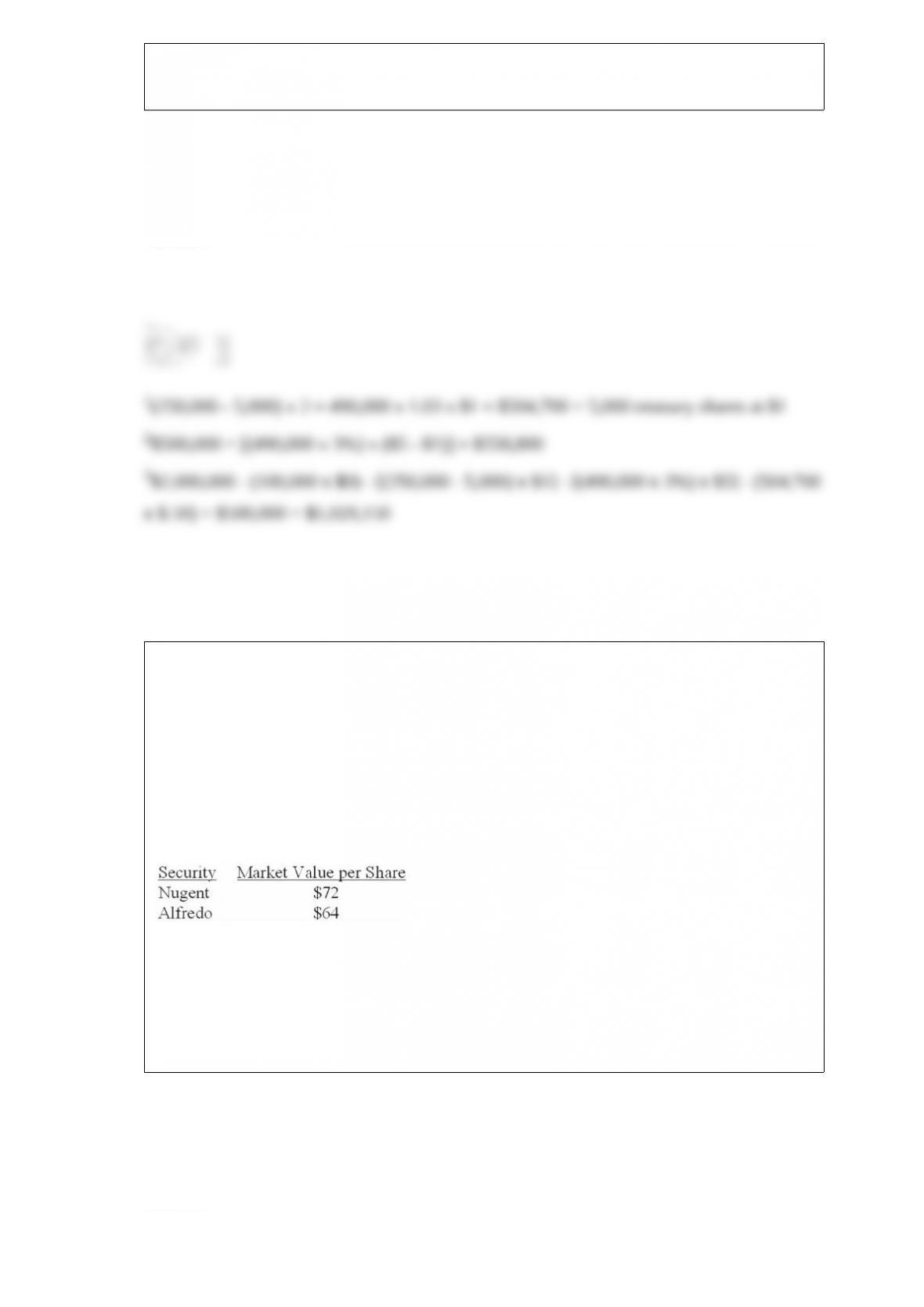
During 2013, Largent Enterprises purchased stock as follows:
May 17, Purchased 1,000 shares of Nugent common stock for $80 per share.
July 12, Purchased 400 shares of Alfredo common stock at $60 per share, plus a $600
brokerage commission.
Largent accounts for these investments as securities available for sale. At December 31,
2013, the market values of the securities were as follows:
Required:
(1) Prepare the journal entries to record the acquisition of the two investments.
(2) Prepare any necessary adjusting entries assuming the stocks are both classified as
available for sale securities.
Answer:

The following information comes from the 2013 Annual Report to stockholders of
Composition Inc. (in thousands):
From the Statement of Changes in Stockholders’ Equity:
From the Statement of Cash Flows: In Cash flows from financing activities:
What was the fair value of the treasury stock exchanged for asset
acquisitions for 2012?
Answer:
We record and report most changes in accounting principle retrospectively, but
sometimes report the changes prospectively. Explain when it is appropriate to report the
changes prospectively. Provide examples.
Answer: