1) Government and nonprofit organizations, as well as profit-seeking enterprises, are
feeling the pressures for improved performance.
2) For a particular decision, differential revenues and costs are always relevant.
3) The Federal Accounting Standards Advisory Board sets cost accounting standards for
all federal government activities.
4) Job order costing would be appropriate for the construction of a cruise liner.
5) When using a just-in-time manufacturing, a problem anywhere in the system can stop
all production.
6) If standards are lax, cost variances will tend to be unfavorable.
7) Costing system distortions relate to the handling of indirect costs.
8) The whale curve shows that the middle 60% of customers generate the majority of
total profits.
9) The term control in management accounting and control refers to the set of
procedures, tools, performance measures, systems, and incentives that organizations use
to guide and motivate all employees to achieve organizational objectives.
10) A well-designed management accounting and control system should incorporate the
organization’s ethical code of conduct.
11) ABC systems seek an activity cost allocation driver that has a cause-and-effect
relationship with costs in the cost pool.
12) A system is in control if it is on the path to achieving its strategic objectives.
13) A processing cycle efficiency (PCE) of 14% indicates better efficiency than a PCE
of 50%.
14) Reducing the number of production runs provides an economic benefit even though
resources remain at the same level.
15) The theory of constraints focuses on long-term initiatives to increase operating
income.
16) Assigning selling and distribution costs to product lines is becoming more
important because of customer requests for customized services.
17) In a normal job order costing system even though the cost driver rate is based on
estimates, overhead costs are applied to products based on actual levels of activity.
18) Low cost-to-serve customers order in smaller quantities.
19) Vander Belt Manufacturing, Inc., is considering reorganizing its plant into
manufacturing cells. The following estimates have been prepared to evaluate the
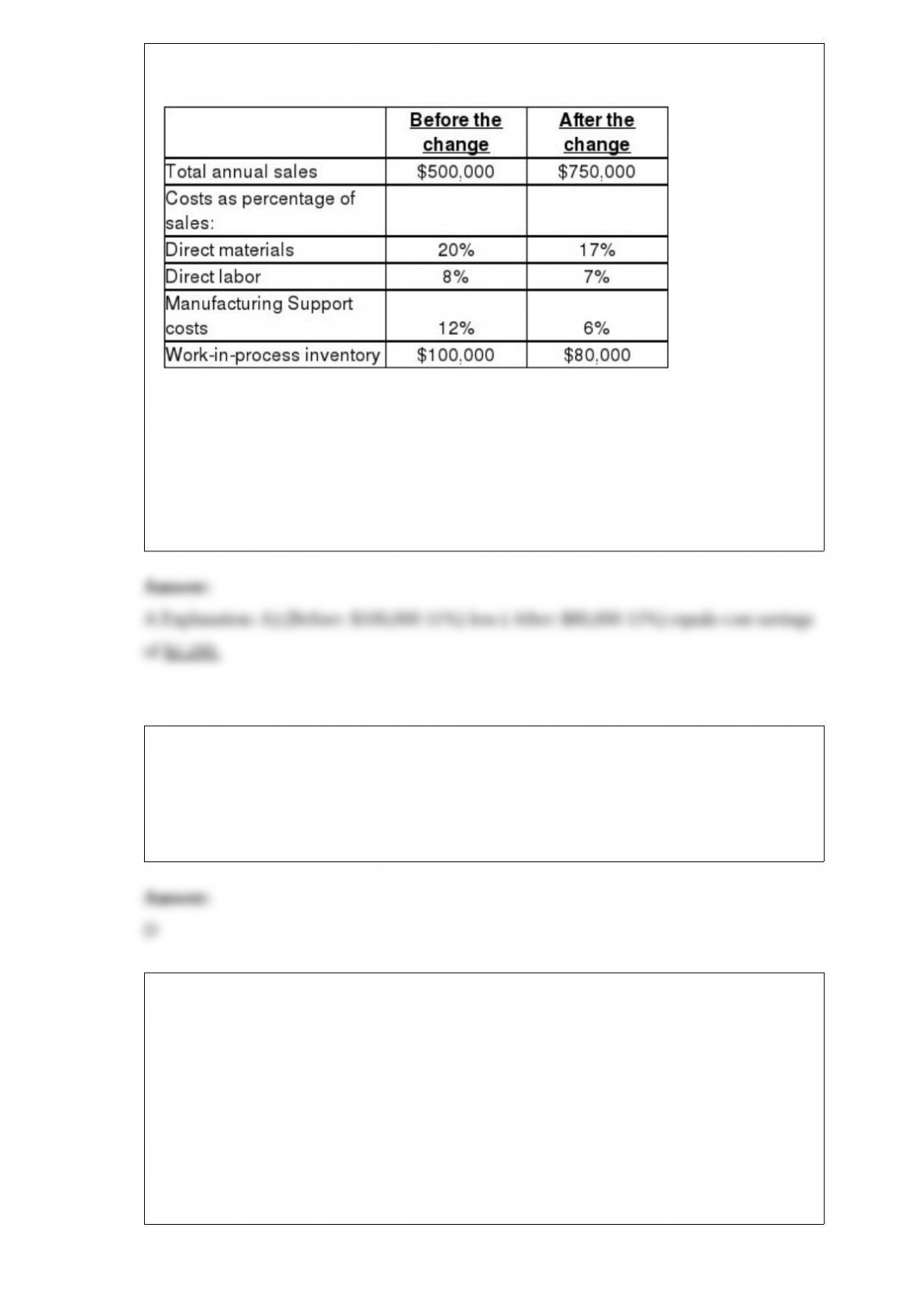
benefits from the reorganization:
Inventory carrying costs are estimated to be 11% per year.
As a result of the layout reorganization, reduced levels of work-in-process inventory are
projected to decrease inventory carrying costs annually by:
A) $ 2,200
B) $ 7,500
C) $ 8,800
D) $11,000
20) All of the following are true regarding benchmarking EXCEPT:
A) that buy-in by employees is critical
B) benchmarking can save time and money by avoiding the mistakes made by others
C) that the purpose is to gather information regarding the best practices of others
D) benchmarking initiatives generally result in quick changes to the work environment
21) L&M Manufacturing produces a single product that sells for $16. Variable (flexible)
costs per unit equal $11.20. The company expects the total fixed (capacity-related) costs
to be $7,200 for the next month at the projected sales level of 20,000 units. In an
attempt to improve performance, management is considering a number of alternative
actions. Each situation is to be evaluated separately.
What is the current break-even point in terms of number of units for the next month?
A) 1,500 units
B) 2,250 units
C) 3,333 units
D) None of the above is correct
22) Feedback systems that monitor organizational outcomes and correct any deviations
from predetermined performance standards are referred to as:
A) a diagnostic control system
B) the intensity factor
C) goal congruence
D) monitoring
23) Incentive compensation is MOST suited to:
A) all centralized organizations
B) centralized organizations where the employees are skilled and empowered
C) all decentralized organizations
D) decentralized organizations where the employees are skilled and empowered to react
to conditions and make decisions
24) ________ is when an employee alters his or her actions specifically in an attempt to
manipulate a performance indicator
A) Gaming the performance indicator
B) Data falsification
C) Smoothing
D) Change management
25) Intrinsic rewards for compensation:
A) are generally overused
B) are most effective when they are financial rewards
C) may have motivational effects greater than extrinsic rewards
D) require extensive use of management accounting information
26) All of the following are true regarding target costing EXCEPT that:
A) improvements are implemented in small, incremental amounts
B) customer input is collected continually throughout the target costing process
C) input is requested from suppliers and distributors
D) a key goal is to minimize ownership costs over the product’s useful life
27) Historically, management accounting innovations have been developed by:
A) the International Accounting Standards Board
B) the Cost Accounting Standards Board
C) Academic accountants
D) Managers
28) The type of control that focuses on measuring and comparing employee
performance against stated objectives is called:
A) task control
B) monitoring
C) results control
D) preventative control
29) Kaizen costing includes:
A) cost control system concept
B) standards set annually or semiannually
C) continuous improvement
D) comparing actual costs to standard costs
30) The act of simply measuring and reporting information on certain processes:
A) focuses the attention of employees on those processes that are being measured
B) diverts the employee’s attention to other activities that are not being measured
C) disproves the saying “What gets measured gets managed”
D) has no effect on employee behavior
31) Key performance indicator cards are scorecards that are developed:
A) with only a single measure for each of the Balanced Scorecard’s perspectives
B) without working from organizational strategy
C) to be more effective than the balanced scorecard
D) to define the compensation system for executives
32) Advantages of a time-driven ABC system include:
A) data used are more easily obtained
B) complex assumptions
C) theoretical
D) requires many parameters to be estimated
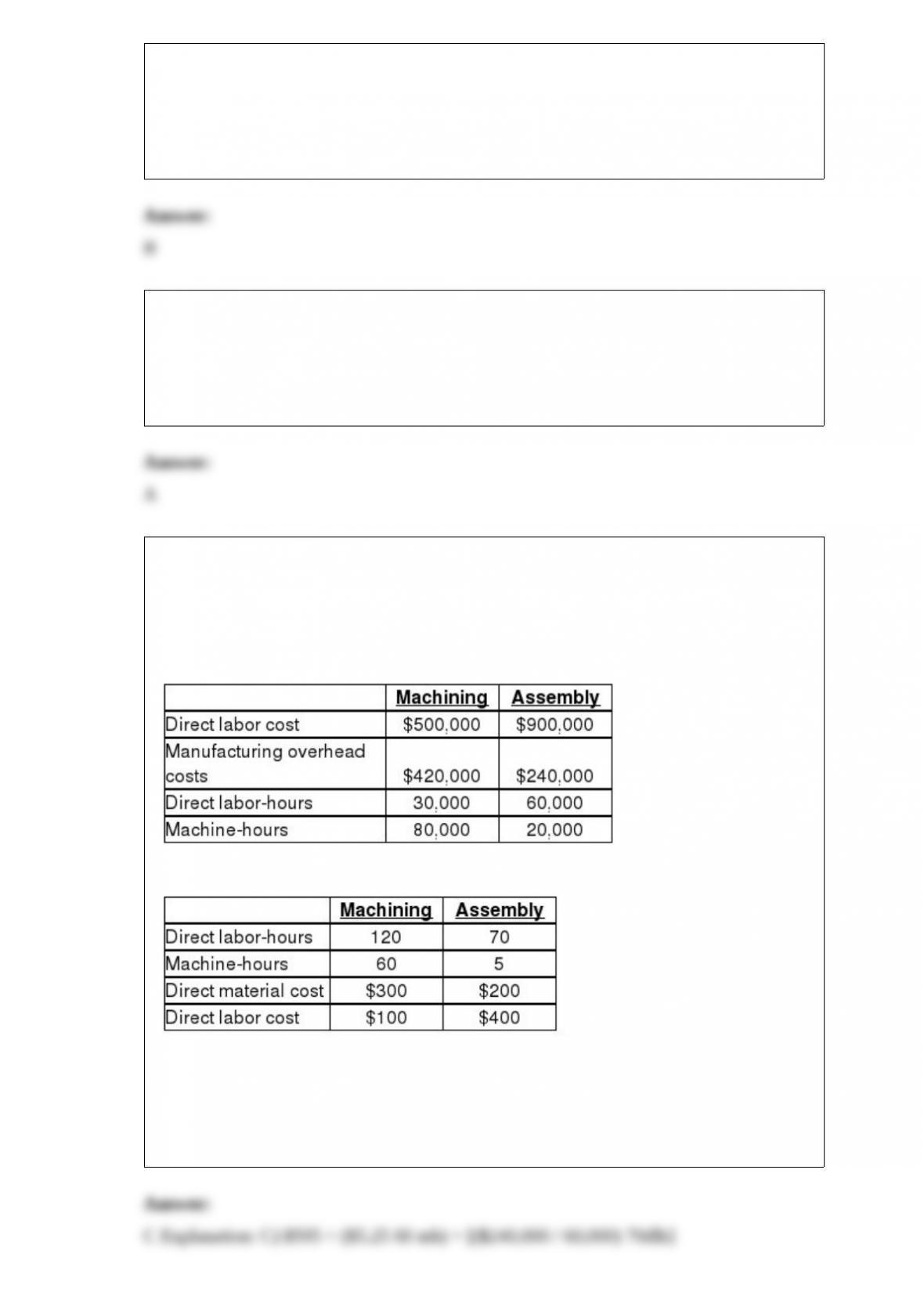
33) Sheppard Manufacturing uses departmental cost driver rates to allocate
manufacturing overhead costs to products. Manufacturing overhead costs are allocated
on the basis of machine hours in the Machining Department and on the basis of direct
labor hours in the Assembly Department. At the beginning of 2011, the following
estimates were provided for the coming year:
The accounting records of the company show the following data for Job #316:
What amount of manufacturing overhead costs will be allocated to Job #316?
A) $439
B) $502
C) $595
D) $532

34) The key group of users for an organization’s ethical code of conduct is:
A) the board of directors
B) shareholders
C) managers
D) All of the above are governed by the code
35) Defect rates for products and yield percentages in manufacturing are measures of
quality included in the ________ perspective of the Balanced Scorecard.
A) financial
B) production
C) process
D) internal
36) The sales plan identifies:
A) expected cash flows from the sales of each product
B) actual sales from last year for each product
C) the budgeted level of sales for each product
D) the variance of sales from actual for each product
37) An understanding of total-life-cycle costs can lead to:
A) additional costs during the manufacturing cycle
B) less need for the evaluation of opportunity costs
C) cost effective product designs that are easier to service
D) mutually beneficial relationships between buyers and sellers
38) In a centralized organization:
A) local-division managers do not need higher approval for most business decisions
B) company-wide standard operating procedures are common
C) local-division managers have an opportunity to gain decision-making experience
D) decisions are made by local division managers
39) Randall Company makes and distributes outdoor play equipment. Last year sales
were $4,800,000, operating income was $1,200,000, and the assets used were
$6,000,000.
Asset turnover, the productivity component of return on investment (ROI), is:
A) 20%
B) 80%
C) 25%
D) 125%
40) Quality engineering costs are an example of:
A) prevention costs
B) appraisal costs
C) internal failure costs
D) external failure costs
41) ________ occur(s) when managers ask subordinates to discuss their ideas about the
budget, but no joint decision-making occurs.
A) Traditional budgeting
B) Stretch targets
C) The beyond budgeting approach
D) Budget slack
42) Skate Magic manufactures three different product lines, Model TS, Model AY, and
Model GG. Considerable market demand exists for all models. The following per unit
data apply:
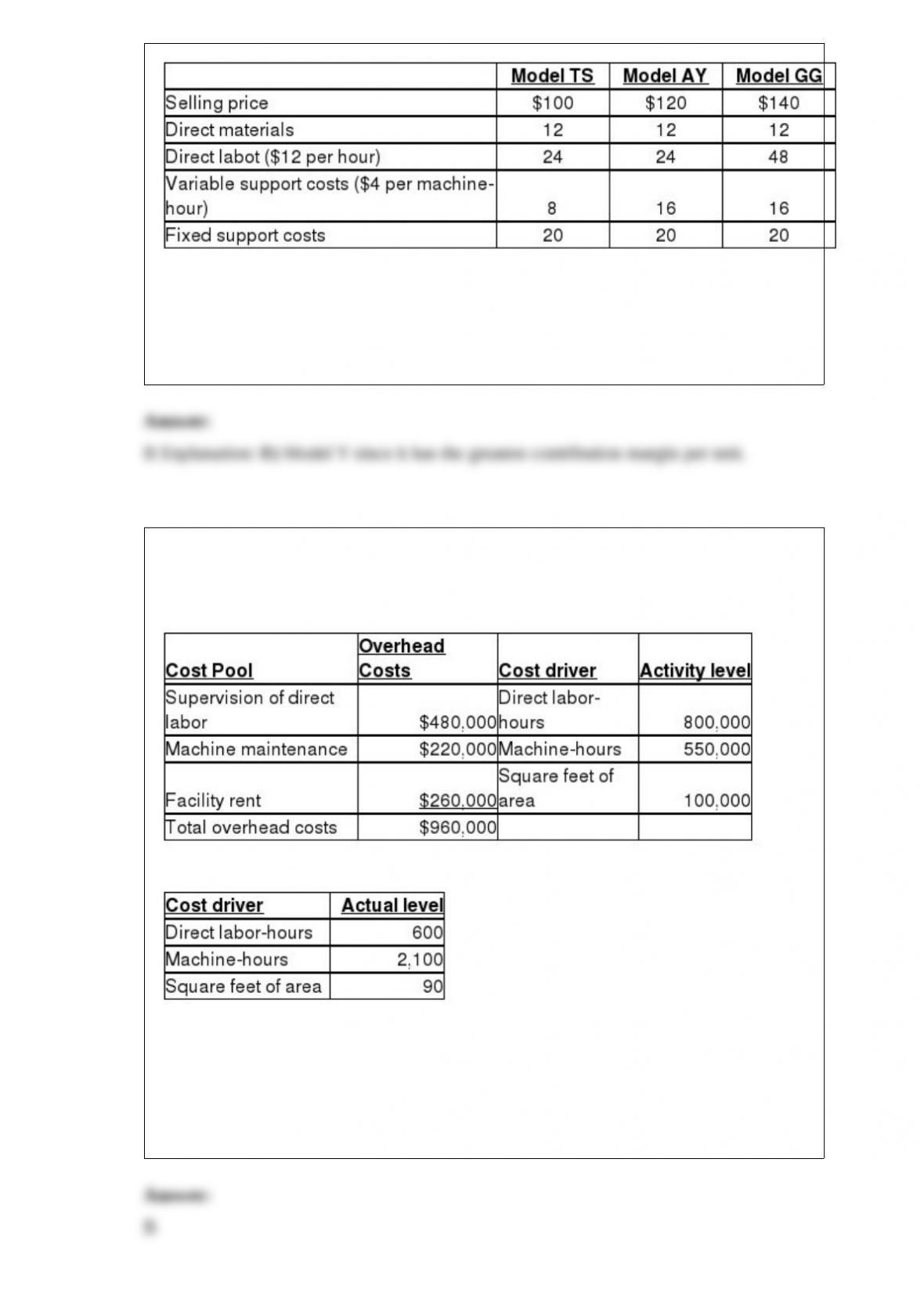
If there is excess capacity, which model is the most profitable to produce?
A) Model TS
B) Model AY
C) Model GG
D) both Models TS and AY
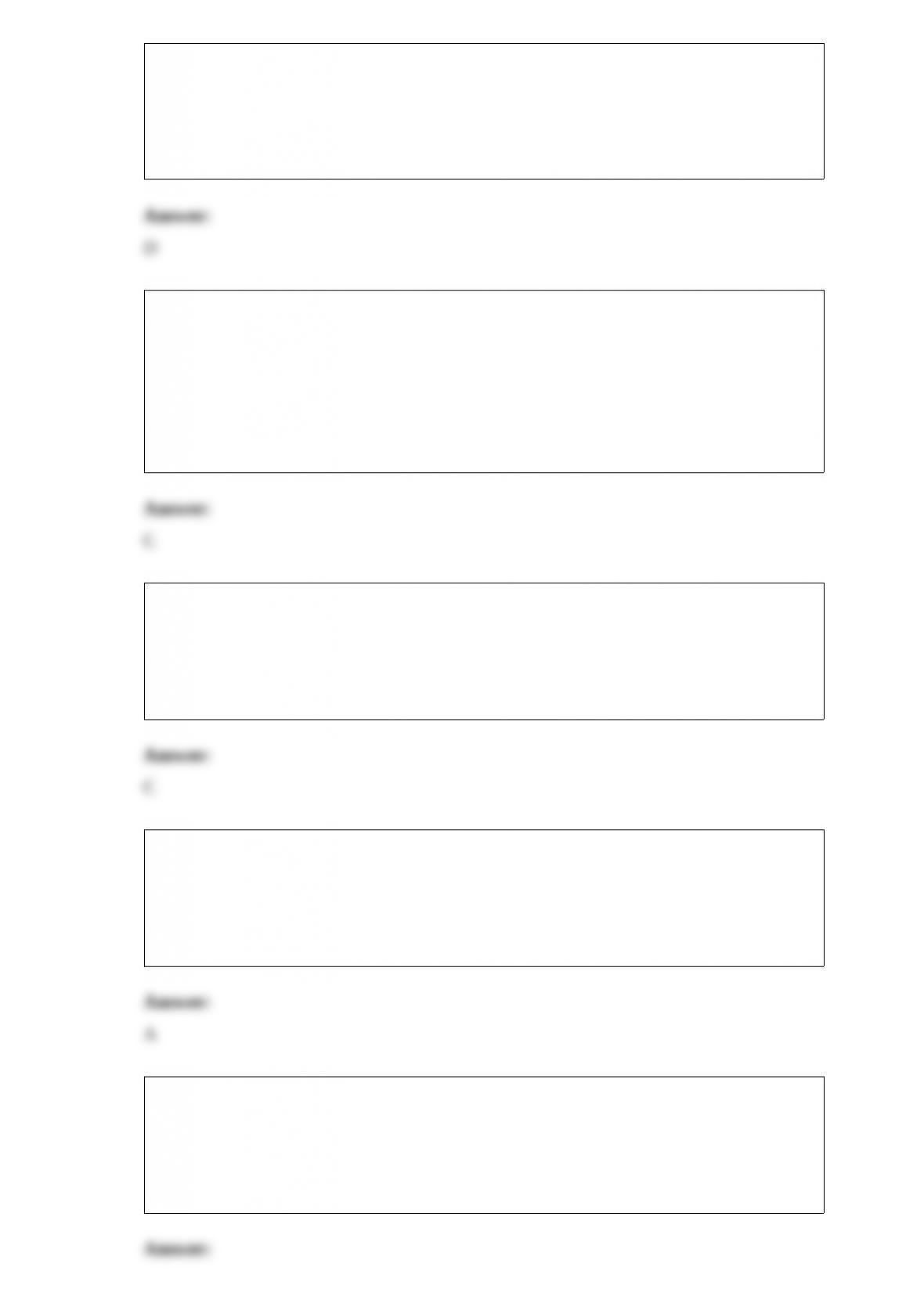
43) Blitzer Enterprises has identified three cost pools and three corresponding cost
drivers to allocate overhead costs. The following estimates are provided for the coming
year:
The accounting records show the Gergen Job consumed the following resources:
Using direct labor-hours as the only overhead cost driver, what is the amount of
overhead costs allocated to the Gergen Job?
A) $320
B) $720
C) $1,200
D) $1,360
44) Financial budgets include the:
A) capital spending plan
B) production plan
C) labor hiring and training plan
D) expected cash flow statement
45) Fostering a culture of high ethical standards includes all of the following EXCEPT:
A) following the good example set by senior management
B) communicating to employees a belief system that inspires and promotes
commitment to the organization’s core values
C) following the general examples set by front-line employees
D) communicating to all employees a boundary system that states what actions will not
be tolerated
46) Designing an activity-based cost system includes:
A) classifying as many costs as indirect costs as is feasible
B) creating as many cost pools as possible
C) identifying the activities performed by the plant’s resources
D) seeking a broader focus rather than detail
47) At the center of many boundary systems is(are):
A) a set of ethical principles
B) congruent goals
C) tasks to control
D) earnings management
48) The Balanced Scorecard is said to be “balanced” because it measures:
A) short-term and long-term objectives
B) financial and nonfinancial objectives
C) internal and external objectives
D) All of the above are correct
49) Poseidon Company produces customized sailboats. The company uses a job order
costing system. Its plant has three production departments: cutting, machining, and
assembly. The estimated manufacturing overhead cost and direct labor cost for each
department for 2011 follow:
CuttingMachiningAssembly
Manufacturing Overhead cost$600,000$800,000$100,000
Direct labor cost$300,000$200,000$500,000
In May 2011, the company received an invitation from Duluth Sailing Company to bid
on an order of five luxury sailboats that must be delivered by the end of September
2011. This Duluth Job would require direct manufacturing costs in the three
departments as follows:
CuttingMachiningAssembly
Direct material cost$12,000$ 800$ 4,600
Direct labor cost$ 7,000$2,000$15,000
Required:
a. Assume that a single, plantwide predetermined manufacturing cost driver rate based
on direct labor cost is used. Determine the manufacturing cost driver rate and
manufacturing overhead costs applied to the Duluth Job.
b. Assume that separate, departmental predetermined manufacturing cost driver rates
based on direct labor cost are used in each department. Determine the departmental
manufacturing cost driver rates and manufacturing overhead costs applied to the Duluth
job.
c. Assume that Poseidon has a policy to add a 60% markup to estimated job costs to
arrive at the bid price. Determine the bid price for the Duluth job using:
1> a plantwide manufacturing overhead cost driver rate; and
2> departmental manufacturing overhead cost driver rates.
d. Review the bid prices computed in (c). Why do the two bids differ?
e. What are the possible consequences of overbidding a job? Underbidding a job?
50) All of the following questions relate to the Balanced Scorecard’s learning and
growth perspective EXCEPT:
A) How do we achieve greater employee satisfaction?
B) How do we increase profits and return on capital?
C) How do we provide information systems with updated technology?
D) How will we sustain our ability to change and improve?
51) In target costing, what are at least two techniques used to achieve target costing
goals?
52) What is the primary role of the flexible budget?
53) Draw a strategy map that identifies the cause-and-effect linkages of the following
objectives:
Process quality
Customer loyalty
Skilled production workers
Return on investment
54) Discuss the importance of the sales forecast and items that influence its accuracy.
55) Distinguish between internal failure costs and external failure costs. Give examples
of each.
56) How does a Balanced Scorecard for nonprofit and government agencies differ from
a for-profit scorecard?

57) What considerations are important in estimating product costs in continuous
processing plants?