
1) A firm purchased $35,000 worth of investments classified as securities available for
sale. At the end of the year, the investments were worth $23,000. What is the correct
presentation of these events in the statement of cash flows prepared under the direct
method?
a. Investing cash outflow, $35,000
b. Add $23,000 in reconciliation of earnings and net operating cash flow
c. Investing cash outflow, $35,000; subtract $12,000 in reconciliation of earnings and
net operating cash flow
d. No disclosure is needed
2) The journal Accounting Horizons is published by which of the following
organizations?
a. American Institute of Certified Public Accountants (
b. American Accounting Association (AAA)
c. Securities and Exchange Commission (SEC)
d. Financial Accounting Standards Board (FASB)
3) When assets are exchanged at a loss in an exchange lacking commercial substance,
the basis of the new asset is usually
a. the list price of the new asset
b. the book value of the old asset plus any cash paid on the trade-in
c. the fair market value of the new asset
d. either the book value of the old asset plus any cash paid on the trade-in or the fair
market value of the new asset
4) Jenine Company sponsors a noncontributory, defined benefit pension plan. On
December 31, 2014, the end of the companys accounting period, the company received
the projected benefit obligation report from the independent actuary. The following data
were included:

Based on this information, the January 1, 2014, balance for the PBO and the service
cost for the year ended December 31, 2014, were
Beginning PBO 2014 Service Cost
a. $150,000 $81,000
b. $150,000 $67,500
c. $216,000 $67,500
d. $163,500 $54,000
5) The market price of a bond issued at a discount is the present value of its principal
amount at the market (effective) rate of interest
a. plus the present value of all future interest payments at the market (effective) rate of
interest
b. plus the present value of all future interest payments at the rate of interest stated on
the bond
c. minus the present value of all future interest payments at the market (effective) rate
of interest
d. minus the present value of all future interest payments at the rate of interest stated on
the bond
6) A company sold an investment in trading securities originally costing $30,000, for
$28,000. At the beginning of the year, the investment had a valuation allowance of
$3,000, debit. What is the correct disclosure for these events on the statement of cash
flows prepared under the direct method, assuming that this is the only investment in
trading securities?
a. $28,000 operating cash inflow; add $5,000 in the reconciliation of earnings and net
operating cash flow
b. $28,000 operating cash inflow
c. $28,000 operating cash inflow; add $33,000 in the reconciliation of earnings and net
operating cash flow
d. Add $5,000 in the reconciliation of earnings and net operating cash flow.
7) Where in the financial statements should basic and complex EPS figures for income
from continuing operations be reported?
a. In the accompanying notes
b. In management’s discussion and analysis
c. On the income statement
d. On the statement of cash flows
8) As independent (or external) auditors, CPAs are primarily responsible for
a. preparing financial statements in conformity with GAAP
b. certifying the accuracy of financial statements
c. expressing an opinion as to the fairness of financial statements
d. filing financial statements with the SEC
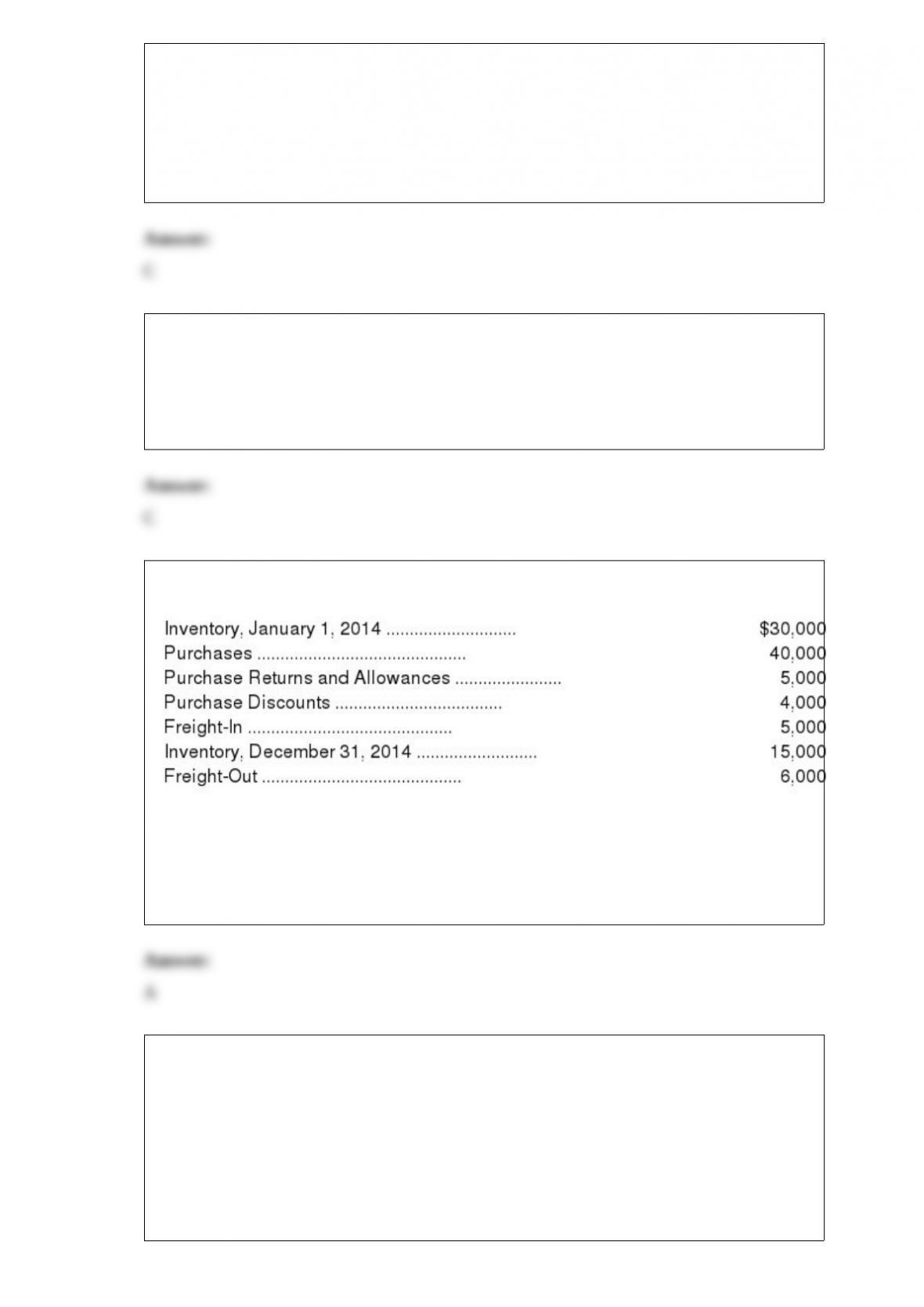
9) Following are the account balances from Canarsie Company’s income statement:
Given this information, the cost of goods sold during 2014 is
a. $51,000
b. $46,000
c. $56,000
d. $66,000
10) On August 1, 2014, B. Amherst Company reacquired 4,000 shares of its $15 par
value common stock for $18 per share. Amherst uses the cost method to account for
treasury stock. What journal entry should Amherst make to record the acquisition of
treasury stock?
a. Treasury Stock ………………….. 60,000 Additional Paid-In Capital ……….. 12,000
Cash …………………………. 72,000
b. Treasury Stock ………………….. 60,000 Retained Earnings ……………….. 12,000
Cash …………………………. 72,000

c. Retained Earnings ……………….. 72,000 Cash …………………………. 72,000
d. Treasury Stock ………………….. 72,000 Cash …………………………. 72,000
11) Initial direct costs incurred by a lessor in consummating a sales-type lease are
a. charged to unearned income in the first period of the lease term
b. charged to cost of sales in the first period of the lease term
c. deferred and allocated over the lease term in proportion to the recognition of rent
revenue
d. deferred and allocated over the lease term on a straight-line basis
12) Financial information exhibits the characteristic of consistency when
a. accounting procedures are adopted which smooth net income and make results
consistent between years
b. extraordinary gains and losses are shown separately on the income statement
c. accounting entities give similar events the same accounting treatment each period
d. expenditures are reported as expenses and netted against revenue in the period in
which they are paid
13) A company that changes from the declining-balance method of depreciation for
previously recorded assets to the straight-line method should report the change as a(n)
a. change in accounting principle
b. change in accounting estimate
c. prior period adjustment
d. extraordinary item
14) All of the following components are shown in the income statement net of
applicable income taxes EXCEPT
a. discontinued operations
b. cumulative effect of a change in accounting principle
c. gain or loss on sale of plant assets
d. extraordinary gain or loss
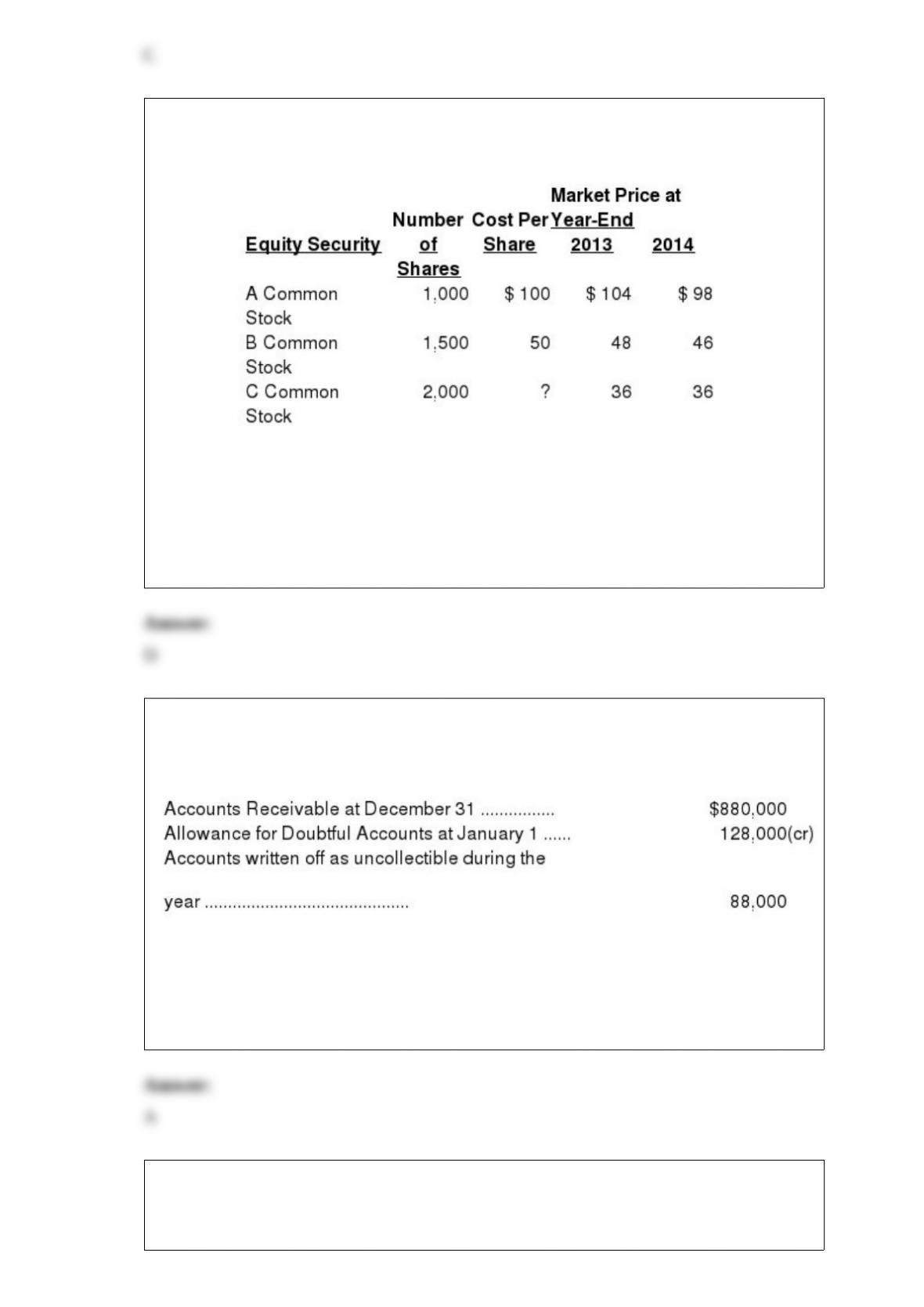
15) Neutron Corporation held the following short-term investments in equity securities
classified as trading securities:
The valuation account is a net credit of $8,000 at the end of 2014. What was the
original cost per share of the C common stock?
a. $22
b. $26
c. $30
d. $36
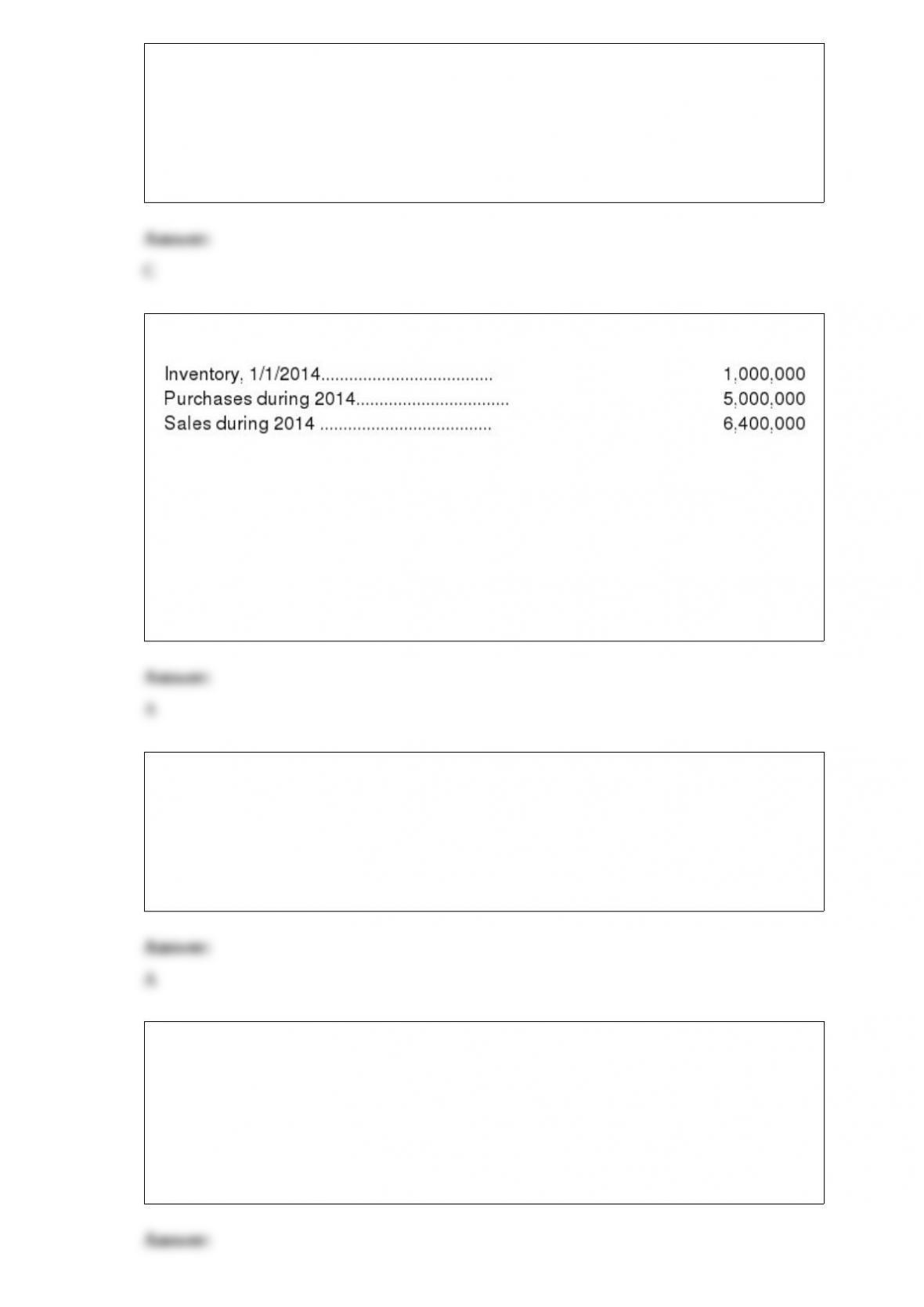
16) Based on the aging of its accounts receivable at December 31, Quanto Company
determined that the net realizable value of the receivables at that date is $760,000.
Additional information is as follows:
Quanto’s doubtful accounts expense for the year ended December 31 is
a. $80,000
b. $96,000
c. $120,000
d. $160,000
17) On October 1, Azuma, Inc. exchanged 8,000 shares of its $25 par value common
stock for a parcel of land to be held for a future plant site.Azuma’s common stock had a
fair market value of $80 per share on the exchange date. Azuma received $36,000 from
the sale of scrap when an existing building on the site was razed. The land should be
carried at
a. $200,000
b. $236,000
c. $604,000
d. $640,000
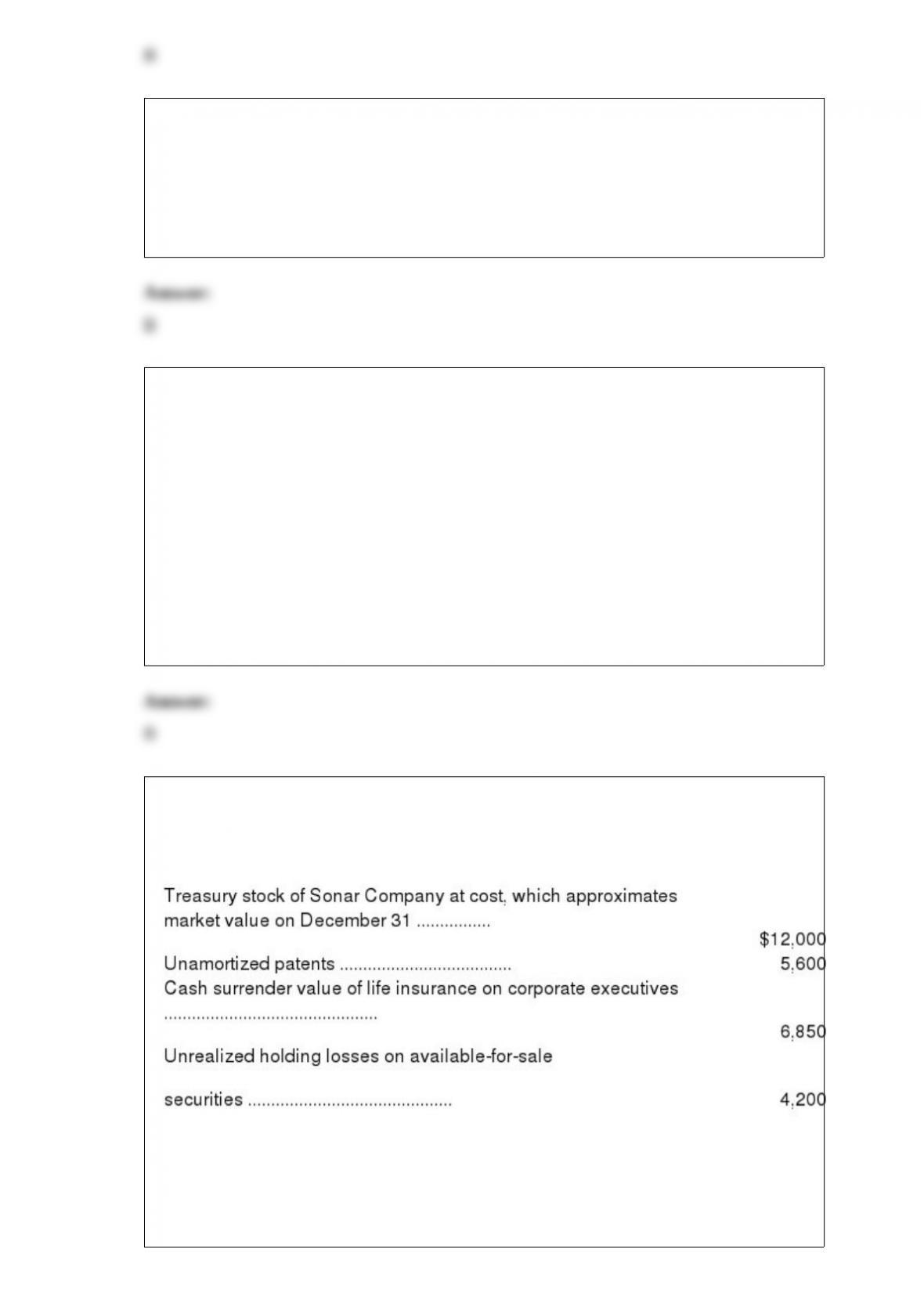
18) Tenure Company’s accounting records indicated the following information:
A physical inventory taken on December 31, 2014, revealed actual ending inventory at
cost was $1,150,000. Tenure’s gross profit on sales has regularly been about 25 percent
in recent years. The company believes some inventory may have been stolen during the
year. What is the estimated amount of missing inventory at December 31, 2014?
a. $50,000
b. $200,000
c. $350,000
d. $450,000
19) See information for Alana’s Clothing Store above. Using this information, the cost
of goods sold using the average cost method is
a. $378
b. $358
c. $265
d. $236
20) Which of the following categories of expenses is subject to immediate recognition
on the income statement?
a. Repairs and maintenance expense incurred on production equipment of a
manufacturer
b. The salary of the company president
c. The salary of the production foreman
d. Utilities expense for the production line of a manufacturer
21) Bad debts are recognized according to which of the following expense recognition
principles?
a. Immediate recognition
b. Direct matching
c. Systematic and rational allocation
d. Critical event recognition
22) The SEC currently requires foreign companies that list shares on U.S. exchanges to
provide
a. both complete U.S. GAAP financial statements and a reconciliation of their reported
income under non-U.S. GAAP to the reported income under U.S. GAAP
b. complete U.S. GAAP financial statements or a reconciliation of their reported income
under non-U.S. GAAP to reported income under U.S. GAAP
c. only complete U.S. GAAP financial statements; the SEC will not accept under any
circumstances only a reconciliation of an entitys reported income under non-U.S.
GAAP to reported income under U.S. GAAP
d. only a reconciliation of their reported income under non-U.S. GAAP to reported
income under U.S. GAAP; the SEC will not accept under any circumstances only a
complete set of U.S. GAAP financial statements
23) Sonar Company prepared a draft of its 2014 balance sheet. The draft statement
reported total assets of $437,500. Included in this total assets figure were the following
items:
At which amount should Sonar’ total assets be correctly reported in the December 31,
2014, balance sheet?
a. $420,850
b. $421,300
c. $425,050
d. $425,500
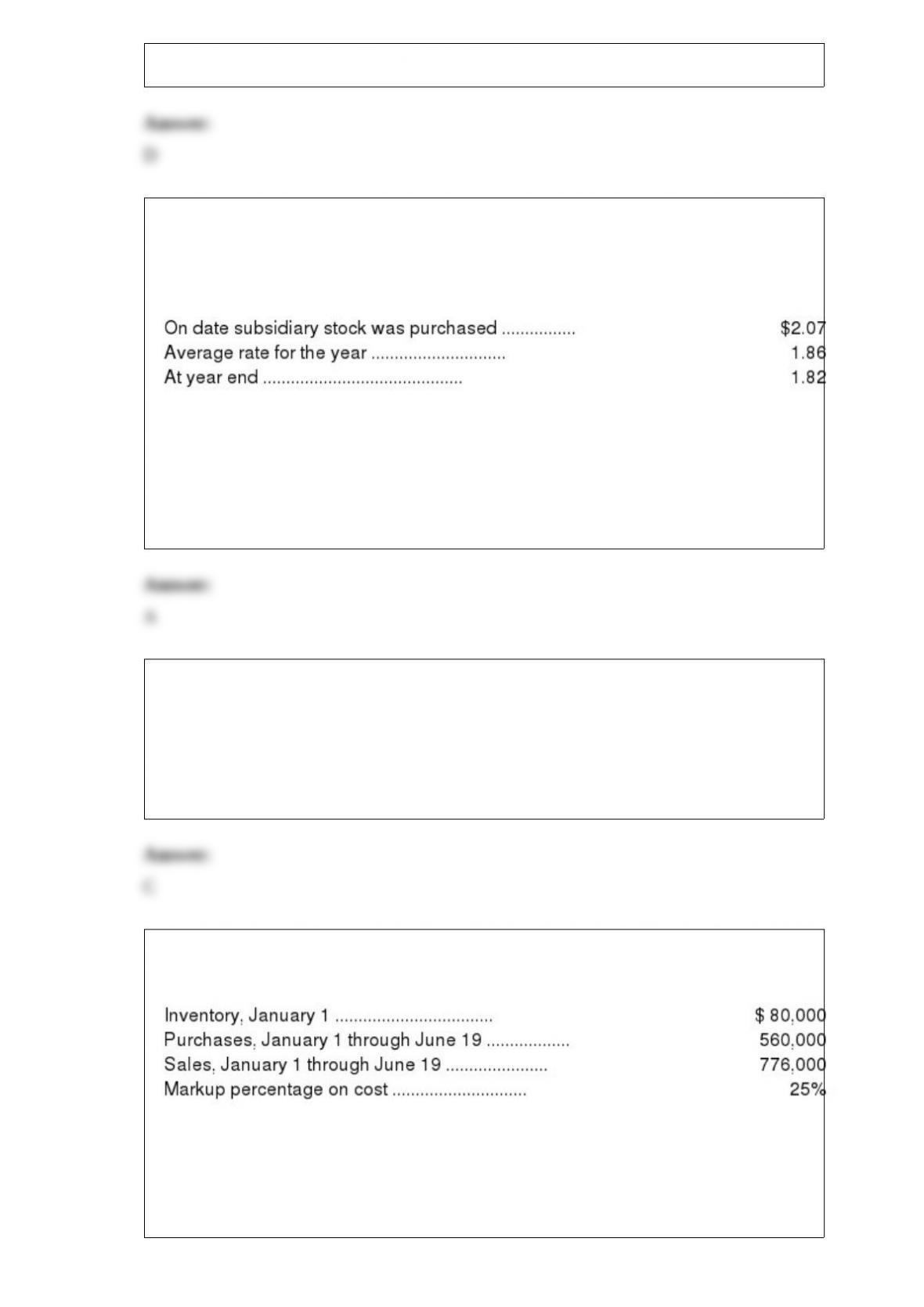
24) Monty Enterprises, a subsidiary of Kerry Company based in Delaware, reported the
following information at the end of its first year of operations (all in British pounds):
assets–483,000; expenses–360,000; liabilities–105,000; capital stock–90,000,
revenues–648,000. Relevant exchange rates are as follows:
As a result of the translation process, what amount is recorded on the financial
statements as the translation adjustment?
a. $34,020 debit adjustment
b. $34,020 credit adjustment
c. $11,520 debit adjustment
d. $11,520 credit adjustment
25) Which of the following statements is the assumption on which straight-line
depreciation is based?
a. The operating efficiency of the asset decreases in later years
b. Service value declines as a function of obsolescence rather than time
c. Service value declines as a function of time rather than use
d. Physical wear and tear are more important than economic obsolescence
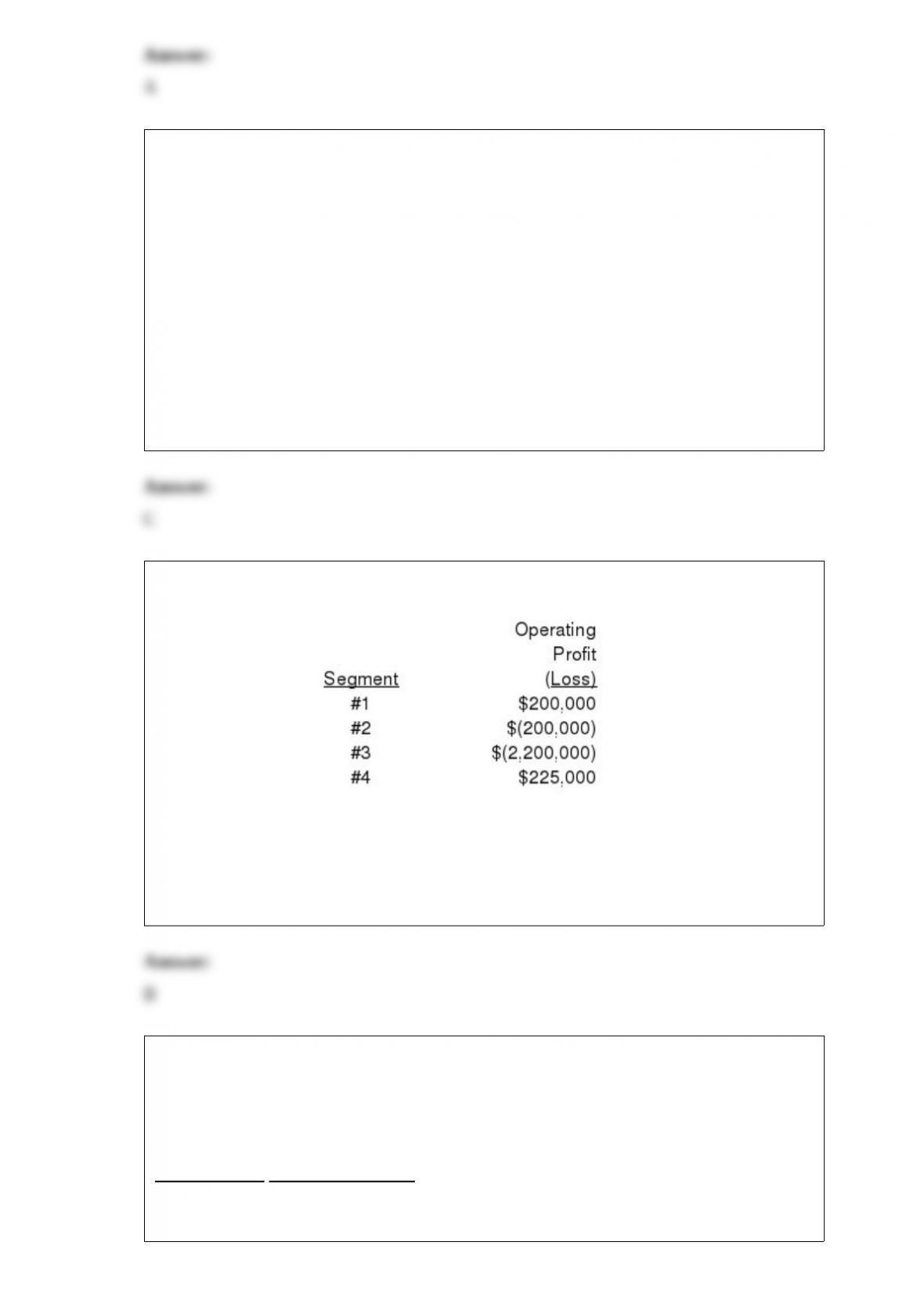
26) On June 19, 2014, a fire destroyed the entire uninsured merchandise inventory of
the Shelf Merchandising Company. The following data are available:
What is the approximate inventory loss as a result of the fire?
a. $19,200
b. $27,200
c. $34,000
d. $58,000
27) On June 1, 2014, Revere Corporation declared a stock dividend entitling its
stockholders to one additional share for each share held. At the time the dividend was
declared, the market value of the stock was $10 per share and the par value was $5 per
share. On this date Revere had 1,000,000 shares of common stock authorized of which
500,000 shares were outstanding. Assuming the par value of the stock was NOT
changed, what entry should Revere make to record this transaction?
a. Retained Earnings …………. 5,000,000 Common Stock Dividend Distributable
2,500,000 Capital in Excess of Par….. 2,500,000
b. Stock Dividend Payable …….. 5,000,000 Common Stock Dividend Distributable.
2,500,000 Capital in Excess of Par….. 2,500,000
c. Retained Earnings………….. 2,500,000 Common Stock Dividend Distributable
2,500,000
d. No entry
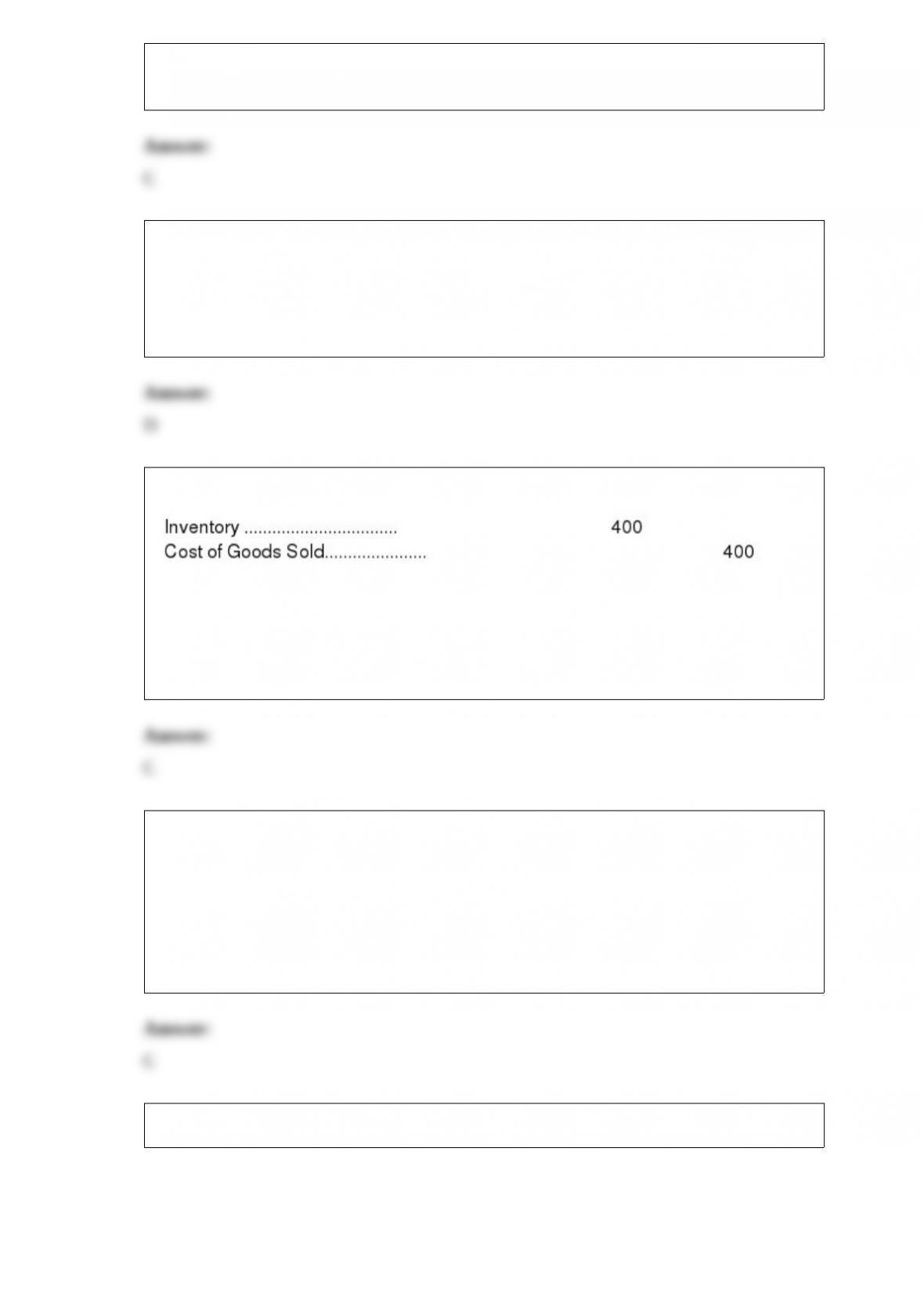
28) The following segments were identified for an enterprise:
Which of the four segments is a reportable segment?
a. 3 only
b. 3 and 4 only
c. 4 only
d. None are reportable segments
29) Highlight Manufacturing Company uses a perpetual inventory system for its raw
materials. The inventory records reflect a raw materials balance of $478,500 at
December 31. A physical inventory taken on that date revealed raw materials of $475,7
How will the $2,750 difference affect raw materials inventory and cost of goods sold,
assuming it is attributed to normal shrinkage?
Raw Materials Cost of Goods Sold
a. Increase Decrease
b. Decrease No effect
c. Decrease Increase
d. No effect Increase
30) Changes in accounting principles generally are reported as
a. adjustments to current and/or prior period statements
b. extraordinary items
c. adjustments to current period statements only
d. adjustments to prior period statements
31) The Narrows Company makes the following entry in its accounting records:
This entry would be made when
a. merchandise is sold and the periodic inventory method is used
b. merchandise is sold and the perpetual inventory method is used
c. merchandise is returned and the perpetual inventory method is used
d. merchandise is returned and the periodic inventory method is used
32) From the following, select the most appropriate basis for the valuation of a new
investment when properties or services are exchanged for stock.
a. The par or stated value of the stock received
b. The book value of the property or services exchanged
c. The fair market value of the stock received
d. Either the book value of the property or services exchange or the fair market value of
the stock received, whichever is more clearly determinable
33) The following information is available for Longview Company:

As a result of a review and aging of accounts receivable, it has been determined that the
Allowance for Doubtful Accounts should show a balance of $2,400 at December 31,
2014. What amount should Longview record as bad debt expense for the year ended
December 31, 2014?
a. $2,500
b. $1,300
c. $2,400
d. $3,700
34) If the replacement cost of a unit of inventory has declined below original cost, but
the replacement cost exceeds net realizable value, the amount to be used for purposes of
inventory valuation is
a. net realizable value
b. original cost
c. market value
d. net realizable value less a normal profit margin
35) A firm using the perpetual inventory method returned defective merchandise costing
$3,500 to one of its suppliers. The entry to record this transaction will include a debit to
a. Accounts Receivable
b. Inventory
c. Purchase Returns and Allowances
d. Accounts Payable
36) The following information relates to the defined benefit pension plan of the
Summersville Company for the year ending December 31, 2014:
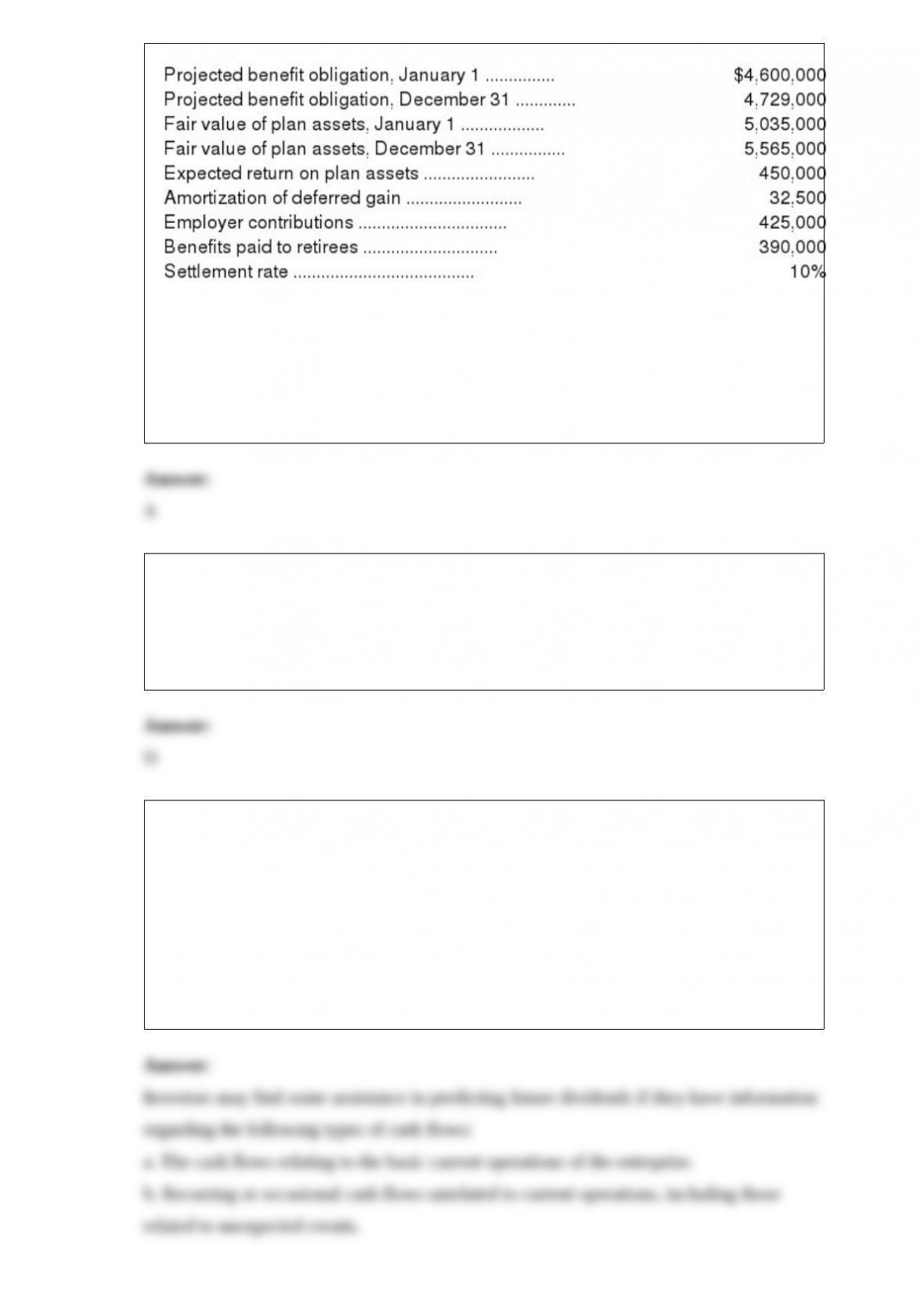
The net amount of the gain or loss component to be included in pension cost for 2014
would be
a. $8,500
b. $32,500
c. $47,500
d. $77,500
37) Which of the following would typically be considered a source document?
a. Chart of accounts
b. General ledger
c. General journal
d. Invoice received from seller
38) Users of financial statements are interested in the ability of a firm to generate
favorable cash flows. This is one reason why the FASB has required the inclusion of a
statement of cash flows in the primary financial statements of an enterprise. A cash flow
of major interest to investors is the dividends an enterprise has paid in the past and will
pay in the future. Investors are particularly interested in the prediction of future
dividends. The prediction of the cash flows associated with dividends requires,
however, that investors have information regarding other cash flows of the enterprise.
Identify cash flows of an enterprise the knowledge of which would be useful to users of
the financial statement in the prediction of future dividends.
39) A major conceptual issue associated with interperiod tax allocation is the issue of
discounting the deferred tax amount on the balance sheet to reflect its present value.
Current generally accepted accounting principles do not allow the discounting of
deferred taxes. Some in the profession have suggested, however, that the FASB should
reconsider its position on discounting in light of the Board’s current project on present
value-based measurements in accounting.
Provide arguments for and against the discounting of deferred income taxes.
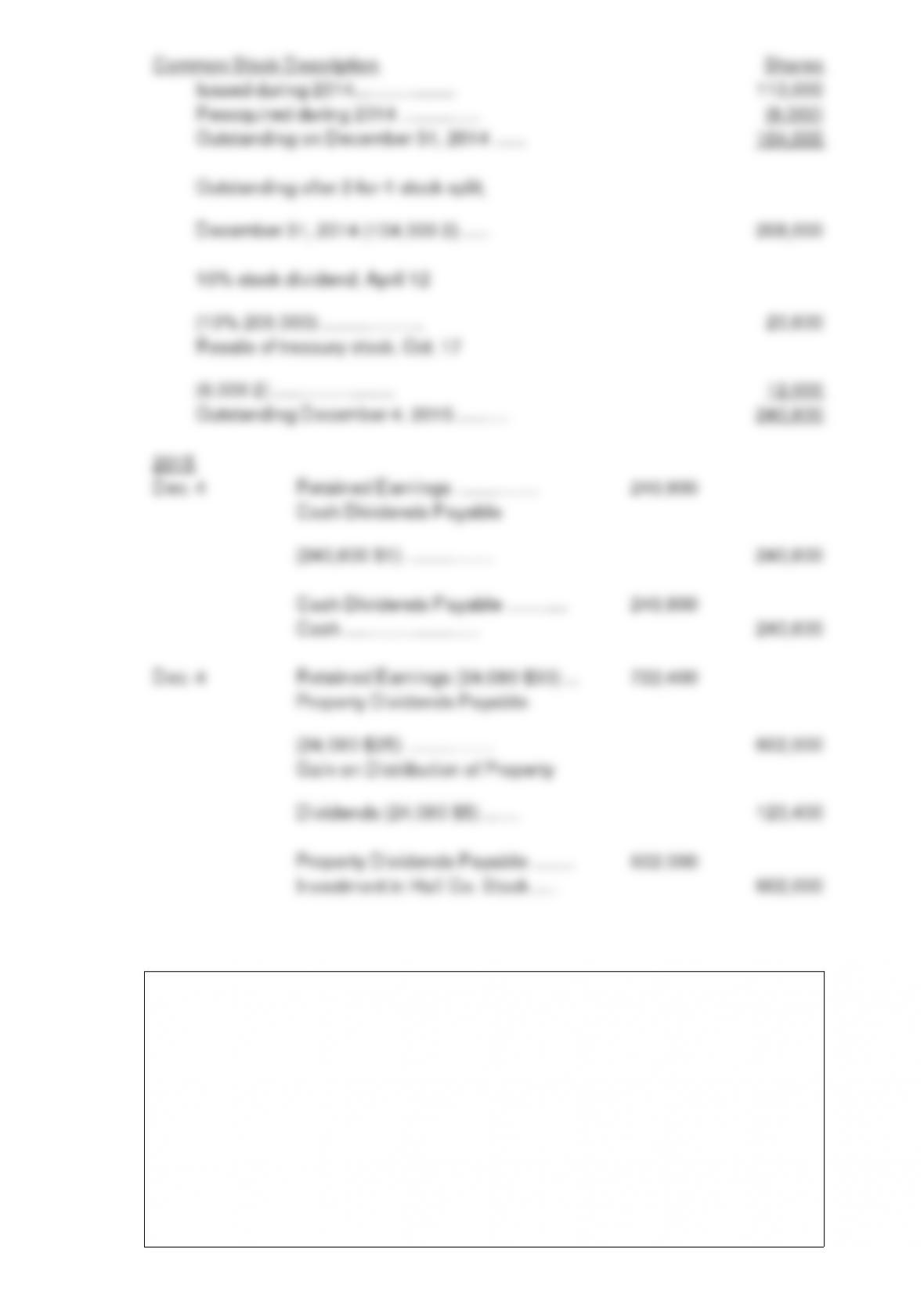
40) Upon organization on January 1, 2014, Cuke Inc. was authorized to issue 200,000
shares of $10 par common stock in multiples of 100 shares. During 2014, 110,000
shares were sold at $65 per share; 6,000 shares were later reacquired as treasury stock
at $72 per share. A stock split of 2-for-1 on all issued shares was approved on
December 31, 2014.
Provide the entries to record the declaration and payment of the dividends on December
4, 2015.
41) Sovereign Enterprises, Inc., has two operating divisions, one manufactures
machinery and the other is a trucking operation that has been used to ship finished
product for the manufacturing operation. Both divisions are considered separate
components as defined by SFAS No. 144. The management of Sovereign Enterprises
wants to focus on the manufacturing operation and accordingly adopted a formal plan to
sell the trucking division on November 15, 2014. The sale was completed on April 30,
20 At December 31, 2014, the trucking component was considered as held for sale.
On December 31, 2014, the companys fiscal year-end, the book value of the assets of
the trucking division was $250,000. On that date, the fair value of the assets, less costs
to sell, was $200,000. The before-tax operating loss of the division for the year was
$140,000. The companys tax rate is 40%. The after-tax income from continuing
operations for 2014 was $400,000.
Prepare a partial income statement for 2014 beginning with income from continuing
operations. Ignore EPS disclosures.
42) On December 31, 2014, Woodley Furniture (a retailer) sells a television and a
three-year warranty to a customer. Woodley would normally sell the television and
warranty separately for $2,000 and $400, respectively. The cost of the television to
Woodley is $1,400. As part of a year-end promotion, Woodley sells the television and
warranty together for a reduced price of $2,300. The customer pays in full at the point
of sale on the contract-signing.date.
Required:
1> Prepare the journal entry required at the contract-signing date.
2> Prepare the entry required when the television is delivered to the customer.
43) Wavelength, a cellular phone company, conducts a promotion in which new
customers who sign a two-year contract receive a free phone. The contract requires the
customer to pay a cancellation fee of $250 if the customer cancels the contract.
Wavelength charges a one-time activation fee of $60 and a monthly fee of $42 for
ongoing service. The monthly fee is the same regardless of whether a free phone is
provided. The phone costs Wavelength $105, and Wavelength sells the phone separately
for $125. Wavelength is not required to refund any portion of the fees paid for any
reason. The customer has no obligation to Wavelength if phone service is not provided.
Wavelength is a profitable business and has no reason to believe that the two-year
service requirement will not be met.
Required:
1> Are the phone and the phone service (airtime) separate deliverables under this
agreement?
2> What is the amount of revenue to be recognized upon signing of the agreement and
delivery of the phone to the customer?
44) Assume that a company receives $600 cash from a customer as the initial sign-up
fee for a service. In addition to the sign-up fee, the customer also is required to pay $25
per month for the service. The expected economic life of the service agreement is 50
months. The company providing the service could subcontract with a third party to
provide the service for 100 months for $200, which is also the cost to the company of
providing the service.
Current professional standards regarding revenue recognition would require that the
sign-up fee be recognized over the 50 months the service is provided. Nonetheless, you
have heard that the FASB is considering another approach to revenue recognition called
the asset-and-liability approach.
Required:
Explain how this transaction would be accounted for under the FASBs
asset-and-liability approach and evaluate this new approach.
45) We-Lease-All, Inc. leased a chroming machine to Fernandos Choppers.The lease
qualifies as a direct financing lease and requires lease payments of $74,502 per year,
payable in advance, over a ten-year period. There is no expected residual value. The fair
market value of the packing machine is $430,000–the same amount paid by Choppers
to purchase the asset. The lease term begins on January 1, 2014.
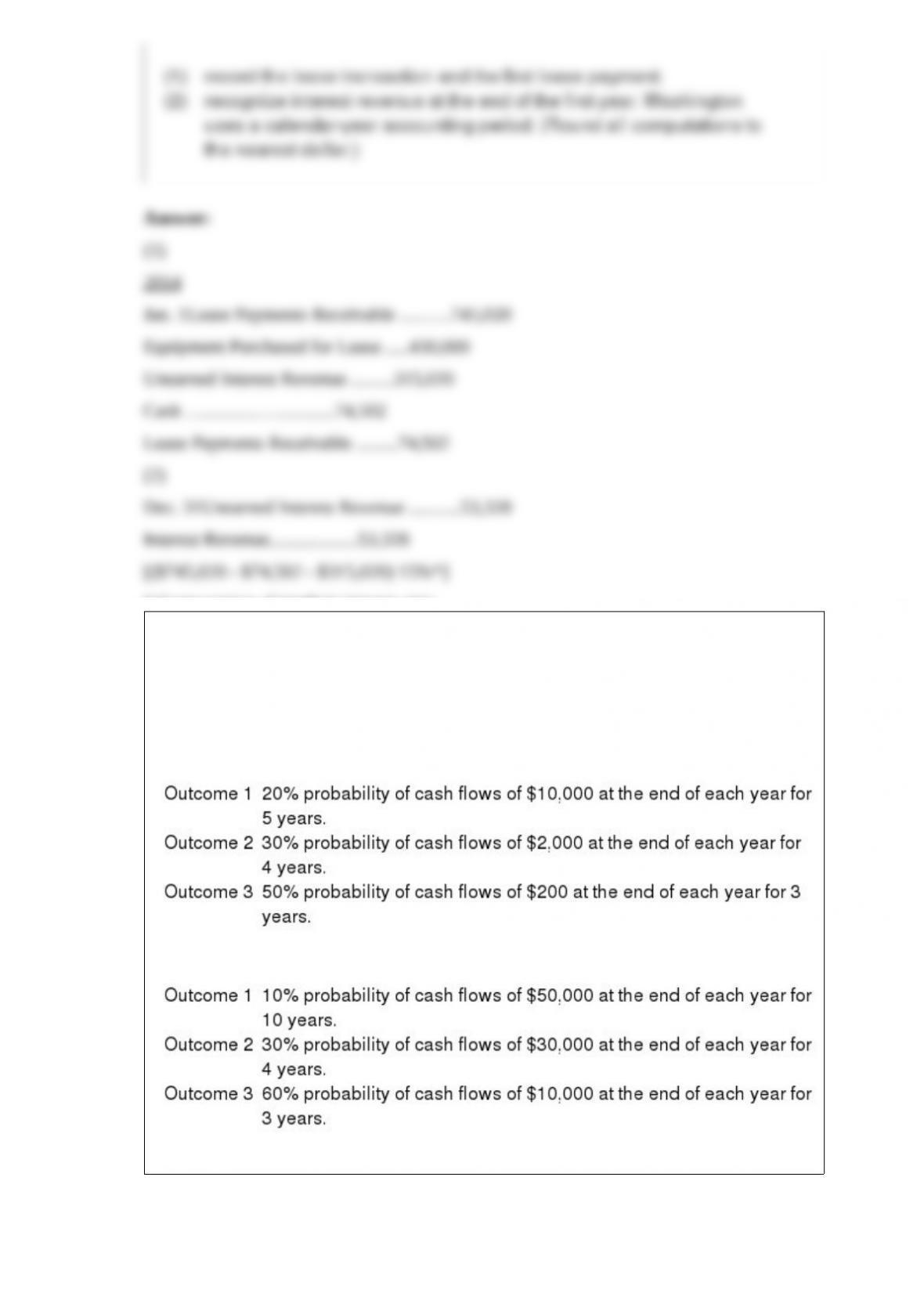
Provide the journal entries required on Choppers books to
46) Biotesting Company purchased a customer database and a formula for a new fuel
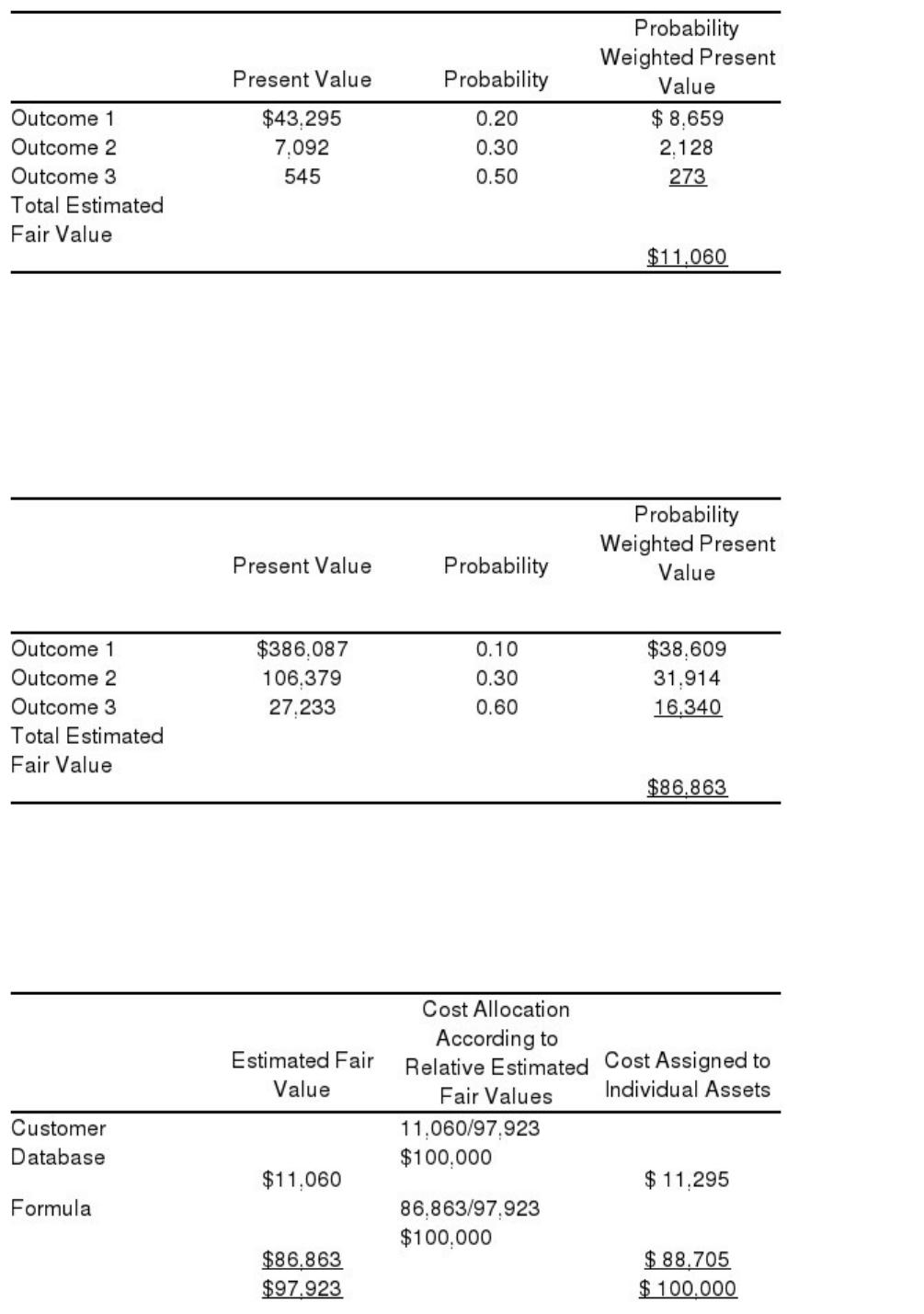
substitute for diesel fuel for a total of $100,000. Biotesting Company uses the expected
cash flow approach for estimating the fair value of these two intangibles. The
appropriate interest rate is 5%. The potential future cash flows from the two intangibles,
and their associated probabilities, are as follows:
Customer Database:
Formula:
Prepare the journal entry necessary to record the purchase of the two intangibles.
47) ProAudio manufactures and sells audio and video conferencing equipment. The
company sells its products through a nationwide network of distributors complemented
by a direct sales force. The distributors had a written agreement with ProAudio
requiring the distributors to pay ProAudio within 90 days of receiving ProAudio
products. The agreement also required distributors to take title to ProAudio products at
the time the products left ProAudios warehouse.
Through early 2014, ProAudio experienced robust growth and increased product sales
every quarter. In early 2014, it became apparent to ProAudios CEO, Linda Masters, that
the company would not meet its sales and revenue projections for the quarter ended
March 31, 2014. At the end of March 2014, Masters instructed Seth Nein, ProAudios
Director of Manufacturing, to assemble enough products to ship to distributors in order
to meet ProAudios sales projections. Masters entered into an agreement with one of
ProAudios distributors, Astro Marketing, to accept these products. The management of
Astro Marketing was assured that the transaction posed no risk to them. Masters also
informed Astro management that Astro would not be required to pay for the
merchandise until it was sold. Meanwhile, ProAudio recorded an account receivable
and revenue for this sale. These same procedures were followed at the end of each
quarter for which ProAudio anticipated falling short of its sales projections, including
the recognition of revenue by ProAudio.
During this same time period, ProAudio, whose stock was publicly traded, was
planning a private placement of additional shares of stock totaling $25.5 million.
Accordingly, the stock price needed to remain high in order for the private placement to
be attractive to investors.
Required:
Does the plan effected by Masters conform with Generally Accepted Accounting
Principles (GAAP)?