1) The following are transactions for the city of Greenville.
a.Issued $50,000 10-year bonds.
b.Used $30,000 of the cash to buy a truck.
c.Sold the truck that was replaced which had cost $28,000, for $2,000. The old truck
was fully depreciated. Residual value is zero.
d.Computed depreciation on the new truck for the year of $6,000.
Required:
Analyze the above transactions by using the accounting equation for a proprietary fund.
2) Interest payments on loans outstanding that do not relate to acquiring, constructing or
improving capital assets are classified as ________ on the cash flow statement for an
Enterprise Fund.
A) Cash Flows from Operating Activities
B) Cash Flows from Noncapital Financing Activities
C) Cash Flows from Capital and Related Financing Activities
D) Cash Flows from Investing Activities
3) In partnership liquidation, how are partner salary allocations treated?
A) Salary allocations take precedence over creditor payments
B) Salary allocations take precedence over amounts due to partners with respect to their
capital interests, but not profits
C) Salary allocations take precedence over amounts due to partners with respect to their
capital profits, but not capital interests
D) Salary allocations are disregarded
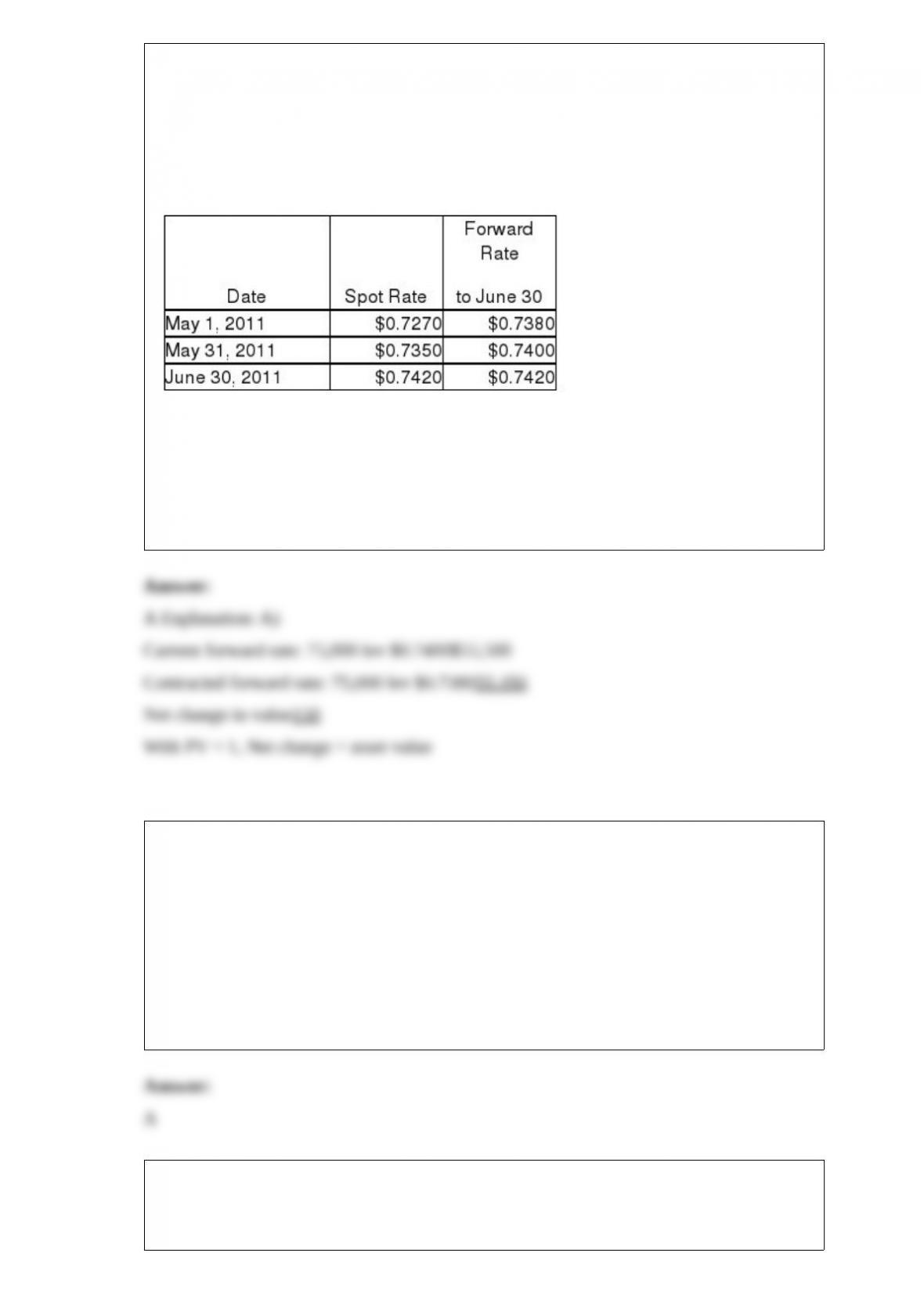
4) On May 1, 2011, Listing Corporation receives inventory items from their Bulgarian
supplier. At the same time, Listing signed a forward contract to purchase 75,000
Bulgarian lev in sixty days to hedge the inventory purchase at $0.738, the 60-day
forward rate. Payment for the inventory will be due in sixty days in Bulgarian lev.
Assume the forward contract will be settled net and this qualifies as a fair value hedge.
The related exchange rates are shown below:
Assuming a present value factor of 1 for simplicity, what is the fair value of this
forward contract on May 31?
A) $150 asset
B) $150 liability
C) $375 asset
D) $375 liability
5) Which statement below is incorrect with respect to the Government-wide financial
statements?
A) All governmental fund categories must convert to the modified accrual basis of
accounting
B) It is necessary to eliminate interfund balances within the governmental funds
C) Capital lease liabilities associated with governmental funds must be included on the
Government-wide financial statements
D) All fixed assets and long-term debt for governmental funds must be included on the
Government-wide financial statements
6) Palmer Corporation purchased 75% of Stone Industries’ common stock on January 2,
2010 . On January 1, 2011, Stone sold equipment to Palmer that had a net book value of
$16,000 and an original cost of $24,000 for $20,000. On January 1, 2011, Palmer sold a
building to Stone that had a net book value of $200,000 and an original cost of
$250,000 for $300,000. The equipment had a remaining useful life of 8 years, and the
building had a remaining useful life of 20 years. Neither asset had salvage value. Both
companies use straight-line depreciation.
Selected account balances are shown below for Palmer and Stone for the year ended
December 31, 2011:
PalmerStone
Sales$280,000$240,000
Cost of Goods Sold180,000100,000
Other Expenses60,00030,000
Gain on sale100,0004,000
Building – net560,000285,000
Equipment – net316,000187,000
Required:
1>Prepare the consolidating working paper entries relating to the equipment and
building for the year ended December 31, 2011 .
2>Calculate the following balances for the year ended December 31, 2011:
A. Consolidated “Other Expenses”
B. Consolidated Buildings
C. Consolidated Equipment
D. Noncontrolling interest in Stone’s net income
7) Pascalian Company owns a 90% interest in Sapp Company. On January 1, 2010,
Pascalian had $300,000, 6% bonds outstanding with an unamortized premium of
$9,000. The bonds mature on December 31, 2014 . Sapp acquired one-third of
Pascalian’s bonds in the open market for $97,000 on January 1, 2010 . Both companies
use straight-line amortization of bond discounts/premiums. Interest is paid on
December 31 . On December 31, 2010, the books of the two affiliates held the
following balances:
Pascalian’s books
6% bonds payable$300,000
Premium on bonds7,200
Interest expense16,200
Sapp’s books
Investment in Pascalian bonds$ 97,600
Interest income6,600
Consolidated Interest Expense and consolidated Interest Income, respectively, that
appeared on the consolidated income statement for the year ended December 31, 2010
was
A) $10,800 and $0
B) $10,800 and $6,600
C) $0 and $0
D) $16,200 and $6,600
8) An increase in the liquidity of corporate bonds, other things being equal, shifts the
demand curve for corporate bonds to the ________ and the demand curve for Treasury
bonds shifts to the ________
A) right; right
B) right; left
C) left; left
D) left; right
9) When mutually-held stock involves subsidiaries holding the stock of each other, the
________ method is not used.
A) equity
B) cost
C) conventional
D) treasury stock
10) The gift shop of a nonprofit, private hospital has cash revenue of $24,000. What
account will the hospital credit?
A) Unrestricted support
B) Unrestricted revenue
C) Temporarily restricted revenue
D) Other operating revenue – unrestricted
11) An increase in the riskiness of corporate bonds will ________ the price of corporate
bonds and ________ the price of Treasury bonds, everything else held constant
A) increase; increase
B) reduce; reduce
C) reduce; increase
D) increase; reduce
12) In a nonprofit, nongovernmental hospital, courtesy allowances are
A) charity care services
B) revenue deductions
C) expenses
D) revenues earned even if the standard charge is above or below the allowance
13) According to the liquidity premium theory of the term structure
A) because buyers of bonds may prefer bonds of one maturity over another, interest
rates on bonds of different maturities do not move together over time
B) the interest rate on long-term bonds will equal an average of short-term interest rates
that people expect to occur over the life of the long-term bonds plus a term premium
C) because of the positive term premium, the yield curve will not be observed to be
downward sloping
D) the interest rate for each maturity bond is determined by supply and demand for that
maturity bond
14) Which of the following hedging strategies would a business most likely use?
A) An importer will want to hedge his foreign denominated accounts receivable and
will purchase forward contracts to hedge an exposed net asset position
B) An importer will want to hedge his foreign denominated accounts payable and will
purchase forward contracts to hedge an exposed net liability position
C) An exporter will want to hedge his foreign denominated accounts receivable and will
purchase forward contracts to hedge an exposed net liability position
D) An exporter will want to hedge his foreign denominated accounts payable and will
purchase forward contracts to hedge an exposed net liability position
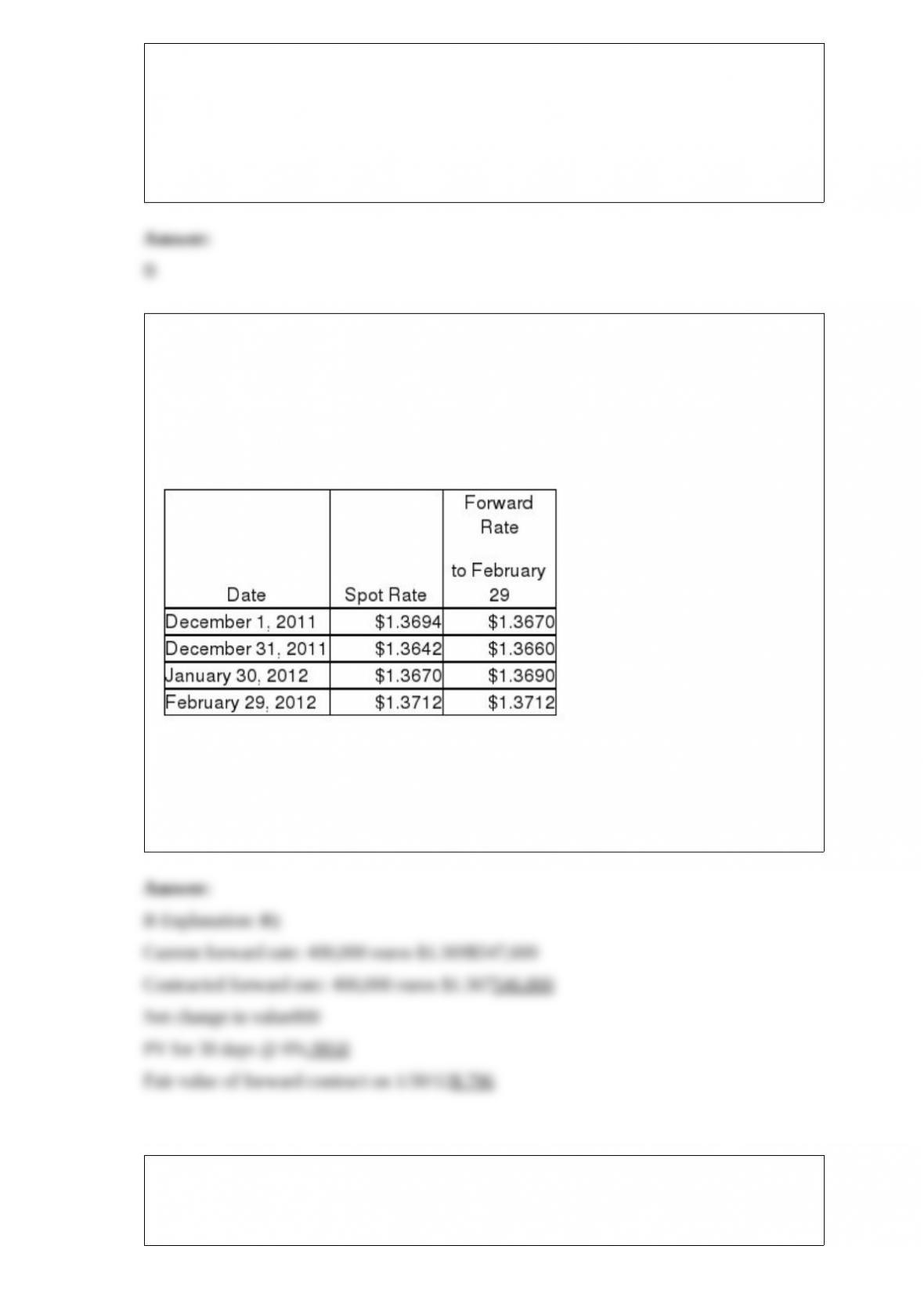
15) On December 1, 2011, Thomas Company, a U.S. corporation, purchases inventory
from a vendor in Italy for 400,000 euros. Payment is due in 90 days. To hedge the
transaction, Thomas signs a forward contract to buy 400,000 euros in 90 days at
$1.3670. Thomas uses a discount rate of 6% (present value factor for 30 days = .9950;
60 days = .9901; 90 days = .9851). Assume the forward contract will be settled net and
this is a cash flow hedge. Currency exchange rates are shown below:
What is the fair value of the forward contract at January 30?
A) $796 liability
B) $796 asset
C) $800 liability
D) $800 asset
16) Mary Contrary is the executor for the estate of Belle Silver. Belle owned a home
with a fair value of $200,000. The home has a remaining mortgage amount of $80,000.
Mary also has personal effects worth $8,000, an investment portfolio with a fair value
of $150,000 on the date of death, and approximately $7,500 in cash in various accounts.
The home was left to her daughter in the valid will that Belle had executed prior to her
death.
Belle did not have a surviving spouse, but her daughter is a minor, who is independently
wealthy after inventing a cutting-edge software program. The state in which Belle
resided, allows a $15,000 homestead allowance, and a $10,000 personal effects
entitlement.
After taking an inventory, and converting all of the assets, except for the home and the
personal effects, into cash, there is $159,000 for Mary to distribute to the appropriate
devises, beneficiaries, and creditors.
Mary has identified the following expenses and devises:
1>Belle’s unpaid final medical expenses were $24,000.
2>Belle left a devise of $100,000 to her church.
3>The costs and expenses of administering the estate were $21,000.
4>Real estate taxes of $3,600 are past due.
5>The unpaid funeral expenses were $8,700.
Required:
Prepare a schedule that will list the disbursements of assets. Assume that the state in
which Belle resided has adopted the Uniform Probate Code.
17) Pashley Corporation purchased 75% of Sargent Corporation on January 1, 2011, for
$115,000. Balance sheets for the two companies on this date, prepared just prior to the
purchase, are provided below.
PashleySargentSargent
Book ValuesBook ValuesFair Values
Cash$165,000$5,000$5,000
Inventory135,00035,00045,000
Buildings & equipment-net250,00060,00095,000
Total assets$550,000$100,000$145,000
Common stock$150,000$47,500
Retained earnings400,00052,500
Total equities$550,000$100,000
Required:
Prepare a consolidated balance sheet using the entity theory of consolidation.
18) The balance sheet of the partnership of Jim, Kim, and Larry is shown below as of
September 1, 2011 . The partners had decided to dissolve the partnership earlier in the
year, and all assets were converted into cash and all partnership liabilities were paid.
The remains of the partnership (with partner residual profit and loss sharing
percentages) was as follows:
Cash$150,000Jim, capital (20%)$(300,000)
Kim, capital (40%)(150,000)
Larry, capital (40%)600,000
Total assets$150,000Total liab./equity$150,000
The value of partners’ personal assets and liabilities on July 1, 2011 were as follows:
JimKimLarry
Personal assets$450,000$370,000$400,000
Personal liabilities200,000210,000195,000
Required:
Prepare the final statement of partnership liquidation.
19) On July 1, 2011, Joe, Kline, and Lama began a partnership in which Joe and Kline
each contributed cash of $200,000; and Lama contributed property with a fair value of
$100,000 and a tax basis $150,000. Joe receives a 10% bonus of partnership income.
Kline and Lama receive salaries of $40,000 each. The partnership agreement of Joe,
Kline, and Lama provides that all partners receive 5% interest on capital and that profits
and losses of the remaining income be distributed to Joe, Kline, and Lama by a 1:1:3
ratio.
Required:
Prepare a schedule to distribute $225,000 of partnership net income to the partners.
20) Middlefield County incurred the following transactions during 2011:
1>The county authorized a new general obligation bond issue of $5 million par to
construct an office building with a contract price of $4,975,000. The bonds were issued
for $4,980,000.
2>The county levied real property taxes of $10,000,000. Eighty-five percent of the net
taxes were collected immediately. Two percent of the total levy was estimated to be
uncollectible.
3>The office building was completed and the county paid the contract price to the
contractor.
4>The General Fund transferred $500,000 to the Debt Service Fund.
5>The county paid $200,000 for interest on the bonds from the Debt Service Fund.
Required:
Prepare journal entries for each of the above transactions. Identify the appropriate fund
or funds used by Middlefield County.
21) On November 4, 2011, the Oak Corporation, a U.S. corporation, purchased
components for an assembly machine from Maple Industries, a Canadian Company,
which were put into Parts Inventory. The purchase price was 80,000 Canadian dollars
and Oak agreed to pay in Canadian dollars in 90 days. Both corporations are on a
calendar year accounting period. Assume that the spot rates for the Canadian dollar on
November 4, 2011, December 31, 2011, and February 2, 2012, are $0.9985, $1.0191,
and $1.0064, respectively.
Required:
Record the November 4, December 31, and February 2 transactions in the General
Journals of Oak Corporation and Maple Industries. If no entry is required on a
particular date, indicate “No entry” in the General Journal.
22) The profit and loss sharing agreement for the Jill, Kelly, and Lila partnership
provides that each partner receives a bonus of 5% on the original amount of partnership
net income if net income is above $25,000. Jill and Kelly receive a salary allowance of
$7,500 and $10,500, respectively. Lila has an average capital balance of $260,000, and
receives a 10% interest allocation on the amount by which her average capital account
balance exceeds $200,000. Residual profits and losses are allocated to Jill, Kelly, and
Lila in their respective ratios of 7:5:8.
Required:
Prepare a schedule to allocate $88,000 of partnership net income to the partners.