1) The ratio of net sales to assets measures how effectively a business is using its assets
to generate sales.
2) Receiving a bill or otherwise being notified that an amount is owed is not recorded
until the amount is paid.
3) As product costs are incurred in the manufacturing process, they are accounted for as
assets and reported on the balance sheet as inventory.
4) The dividend yield rate is equal to the dividends per share divided by the par value
per share of common stock.
5) Both process and job order cost systems maintain perpetual inventory accounts with
subsidiary ledgers.
6) Operating expenses directly traceable to or incurred for the sole benefit of a specific
department and usually subject to the control of the department manager are termed
direct expenses.
7) The primary role of accounting is to determine the amount of taxes a business will be
required to pay to taxing entities.
8) Normal balances are the side that increase the account balance.
9) The accounting equation can be expressed as Assets – Liabilities = Owner’s Equity.
10) If the standard to produce a given amount of product is 1,000 units of direct
materials at $11 and the actual was 800 units at $12, the direct materials price variance
was $800 favorable.
11) An example of good internal controls over cash payments is the taking of all cash
discounts offered.
12) Journal entries can have more than two accounts as long as the debits equal the
credits.
13) After the account balances have been extended from the Adjusted Trial Balance
columns on the work sheet, the difference between the initial totals of the Balance Sheet
debit and credit columns is Net Income or Net Loss.
14) The distribution of cash, as the final process in winding up the affairs of a
partnership, is based on the income-sharing ratio.
15) When cities give land or buildings to a company to locate in the community, no
entry is made since there is no cost to the company.
16) Budgets are prepared in the Accounting Department and monitored by various
department managers.
17) E-commerce provides business opportunities at a higher cost.
18) The Accumulated Depreciation’s account balance is the sum of the depreciation
expense recorded in past periods.
19) For tax purposes, a Limited Liability Company may elect to be treated as a
partnership.
20) The format and number of specialized journals that a business uses depends upon
the legal organization of the business.
21) Partridge Co. can further process Product J to produce Product D. Product J is
currently selling for $21 per pound and costs $15.75 per pound to produce. Product D
would sell for $38 per pound and would require an additional cost of $9.25 per pound to
produce.
What is the differential cost of producing Product D?
A.$6.50 per pound
B.$9.25 per pound
C.$17 per pound
D.$5.25 per pound
22)
Which of the graphs in Figure 20-1 illustrates the nature of a mixed cost?
A.Graph 2
B.Graph 3
C.Graph 4
D.Graph 1
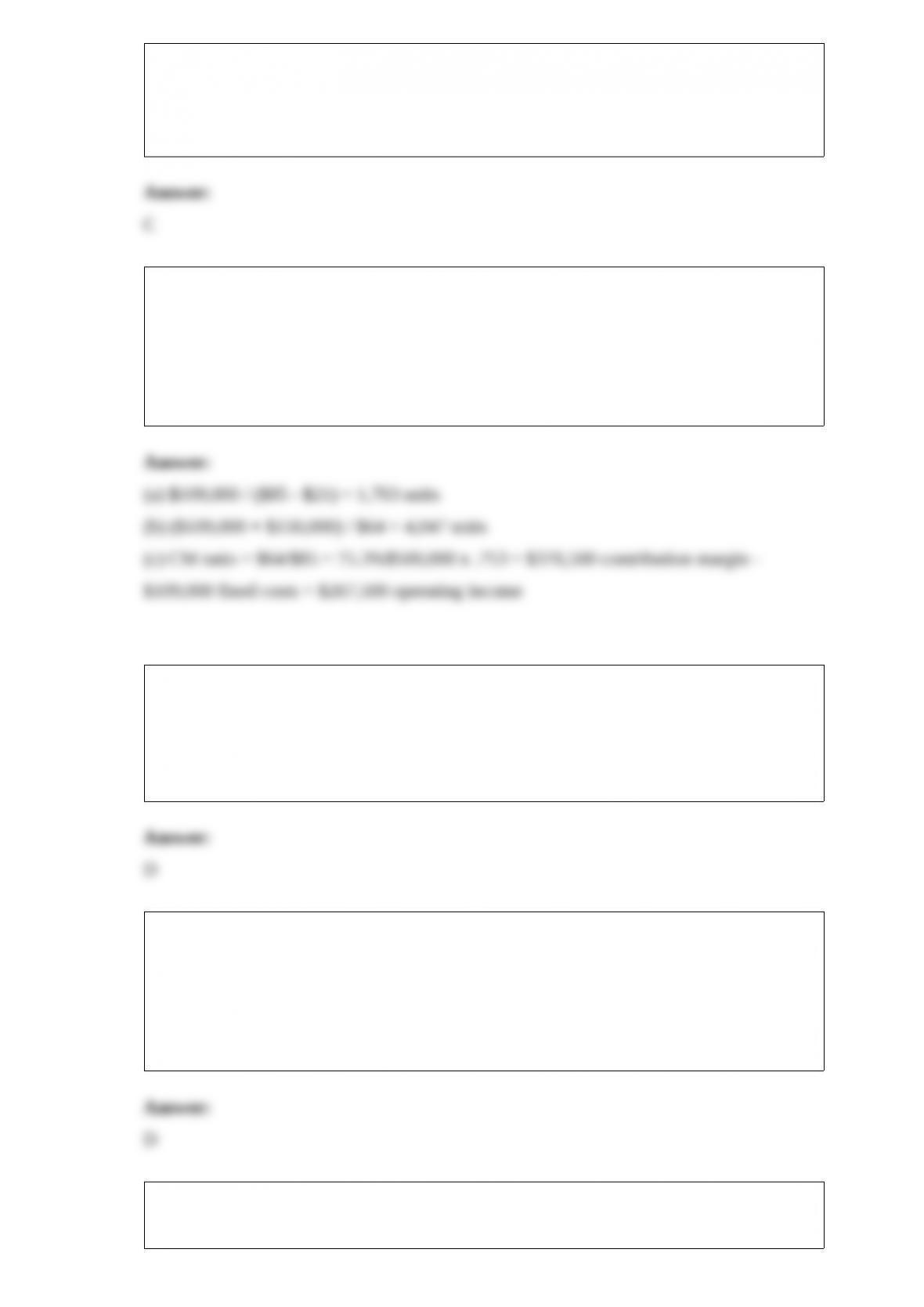
23) The chart of account for the Corning Company includes some of the following
accounts:
On the journal page 3, the following transaction was found:
What is the post reference that will be found on the cash account?
A.11
B.15
C.3
D.None
24) For the coming year, River Company estimates fixed costs at $109,000, the unit
variable cost at $21, and the unit selling price at $85. Determine (a) the break-even
point in units of sales, (b) the unit sales required to realize operating income of
$150,000 and (c) the probable operating income if sales total $500,000.
Round units to the nearest whole number and percentage to one decimal place.
25) Adjusting entries always include
A.only income statement accounts
B.only balance sheet accounts
C.the cash account
D.at least one income statement account and one balance sheet account
26) If $1,000,000 of 8% bonds are issued at 105, the amount of cash received from the
sale is
A.$1,080,000
B.$950,000
C.$1,000,000
D.$1,050,000
27) Motel Corporation is analyzing a capital expenditure that will involve a cash outlay
of $208,240. Estimated cash flows are expected to be $40,000 annually for seven years.
The present value factors for an annuity of $1 for 7 years at interest of 6%, 8%, 10%,
and 12% are 5.582, 5.206, 4.868, and 4.564, respectively. The internal rate of return for
this investment is:
A.10%
B.6%
C.12%
D.8%
28) The following adjusting journal entry does not include an explanation. Select the
best explanation for the entry.
A.Adjust supplies inventory to actual
B.Record purchase of supplies
C.Reduce supplies expense
D.Record sale of supplies
29) A bond indenture is
A.a contract between the corporation issuing the bonds and the underwriters selling the
bonds
B.the amount due at the maturity date of the bonds
C.a contract between the corporation issuing the bonds and the bond trustee, who is
acting on behalf of the bondholders
D.the amount for which the corporation can buy back the bonds prior to the maturity
date
30) A business received an offer from an exporter for 10,000 units of product at $17.50
per unit. The acceptance of the offer will not affect normal production or domestic sales
prices. The following data is available:
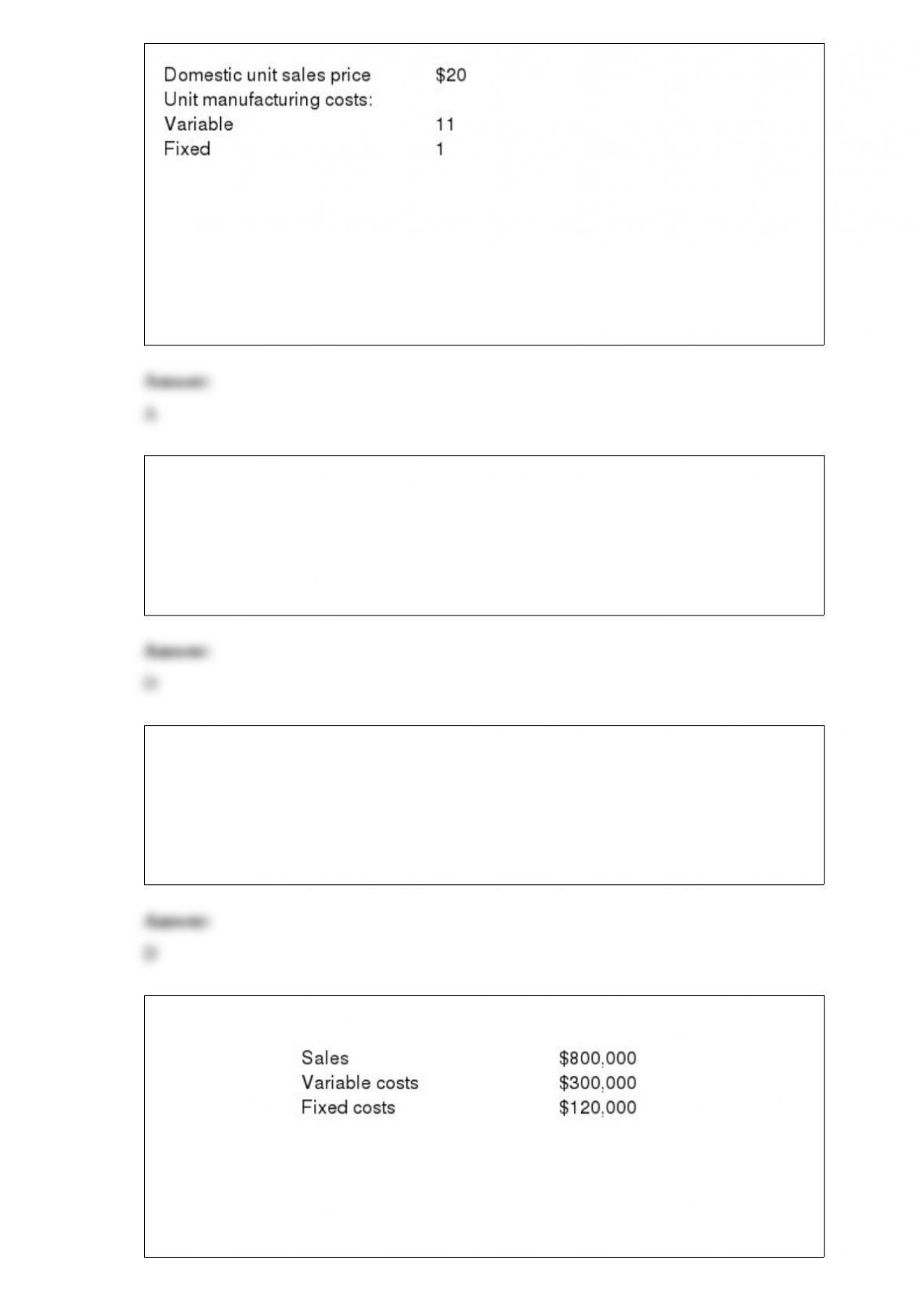
What is the amount of gain or loss from acceptance of the offer?
A.$65,000 gain
B.$50,000 loss
C.$30,000 loss
D.$20,000 loss
31) Accompanying the bank statement was a debit memo for an NSF check received
from a customer. What entry is required in the company’s accounts?
A.debit Other Income; credit Cash
B.debit Cash; credit Other Income
C.debit Cash; credit Accounts Receivable
D.debit Accounts Receivable; credit Cash
32) Which of the following is an example of direct materials cost for an automobile
manufacturer?
A.Cost of oil lubricants for factory machinery
B.Cost of wages of assembly worker
C.Salary of production supervisor
D.Cost of interior upholstery
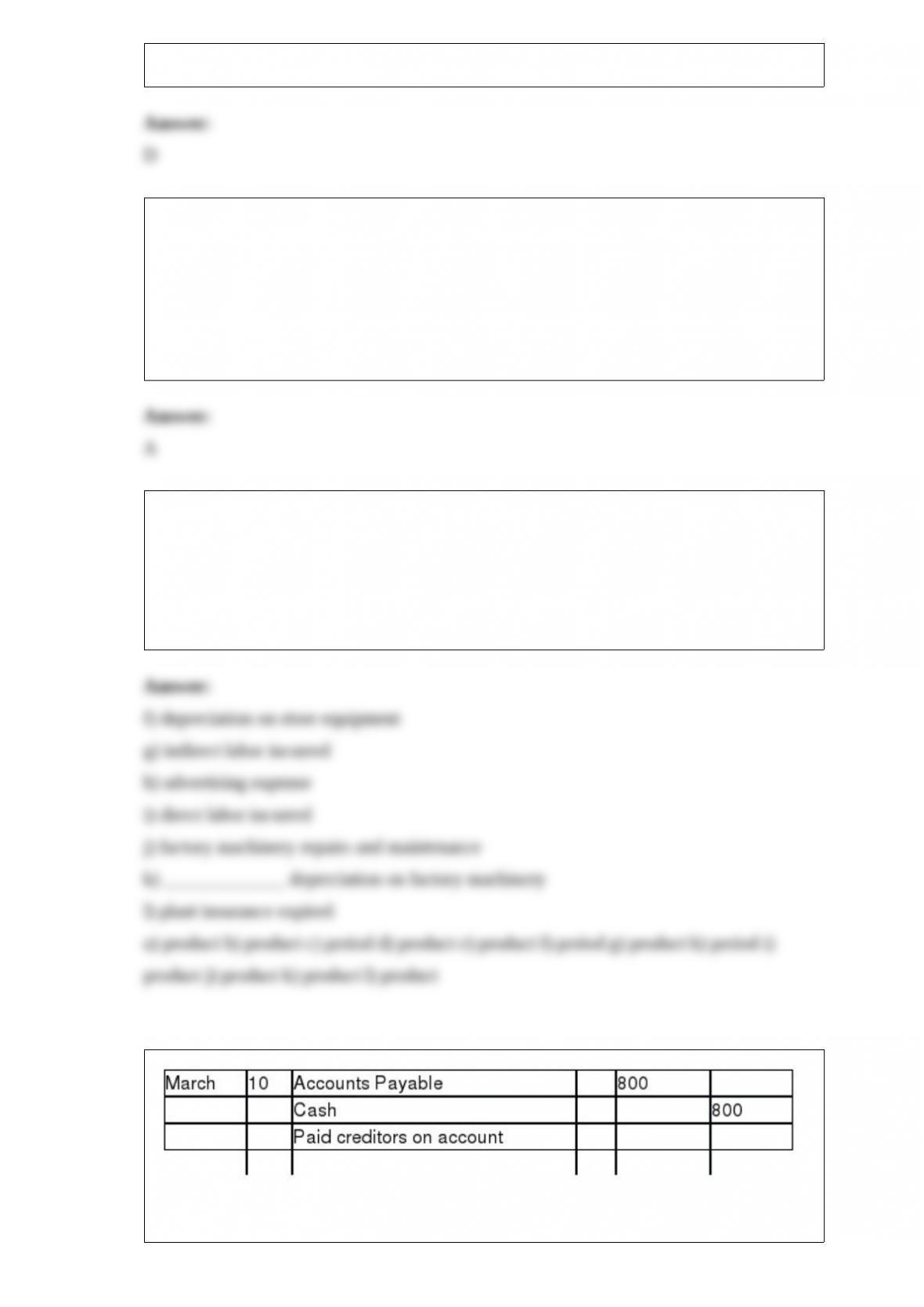
33) The Rocky Company reports the following data.
Rocky Companys operating leverage is:
A.6.7
B.2.7
C.1.0
D.1.3
34) In the manufacture of 10,000 units of a product, direct materials cost incurred was
$145,800, direct labor cost incurred was $82,000, and applied factory overhead was
$45,500. What is the total conversion cost?
A.$127,500
B.$145,800
C.$272,200
D.$273,300
35) Classify the following costs as either a product cost or a period cost:
a) direct materials used
b) factory utilities
c) salespersons commissions
d) salary of plant manager
e) indirect materials used
36)
What effect does this journal entry have on the accounts?
A.Decrease accounts payable, increase cash
B.Increase cash, decrease accounts payable
C.Increase accounts payable, increase cash
D.Decrease accounts payable, decrease cash
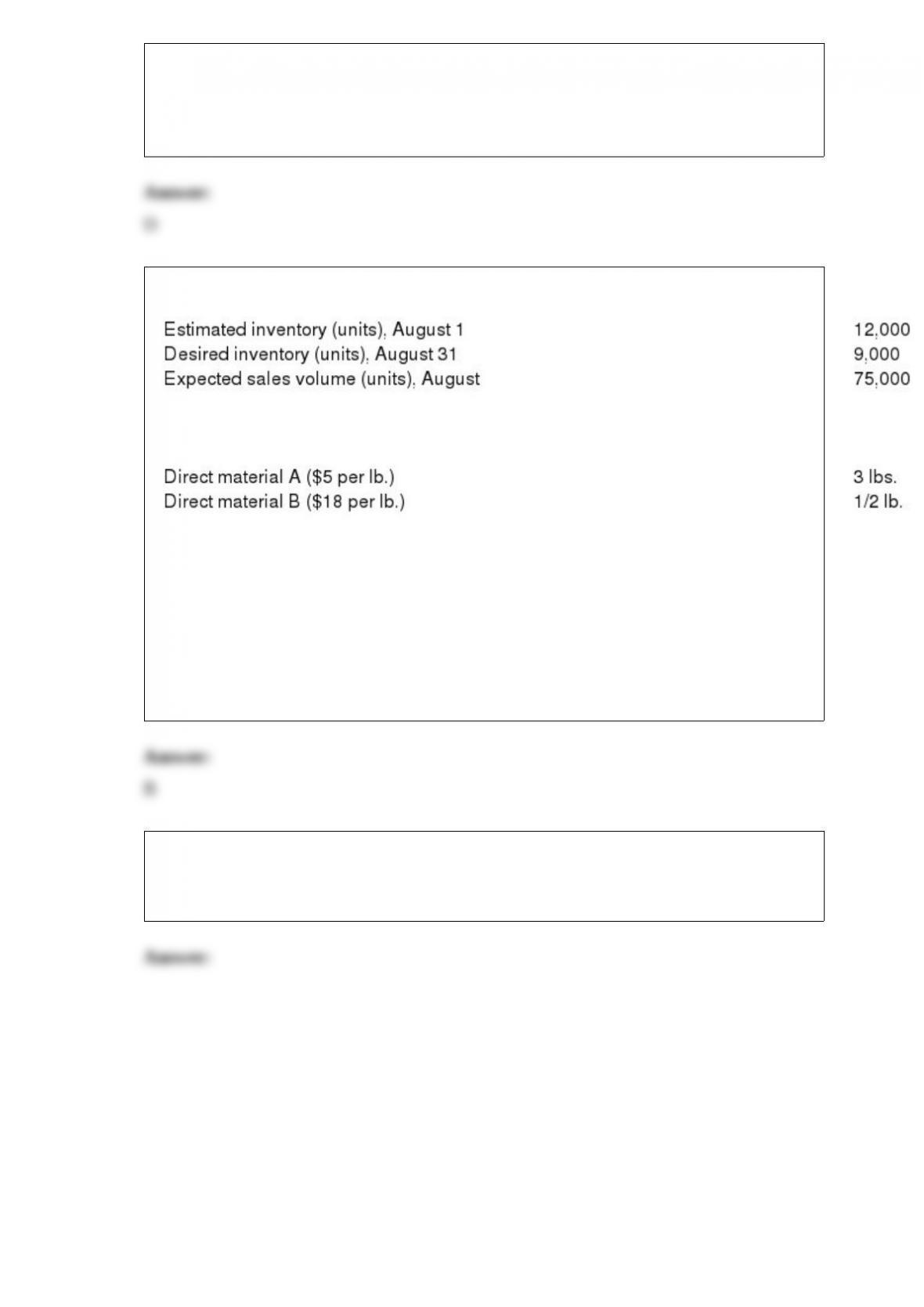
37) Production estimates for August are as follows:
For each unit produced, the direct materials requirements are as follows:
The total direct materials purchases (assuming no beginning or ending inventory of
material) of materials A and B required for August production is:
A.$1,080,000 for A; $1,296,000 for B
B.$1,080,000 for A; $648,000 for B
C.$1,125,000 for A; $675,000 for B
D.$1,170,000 for A; $702,000 for B
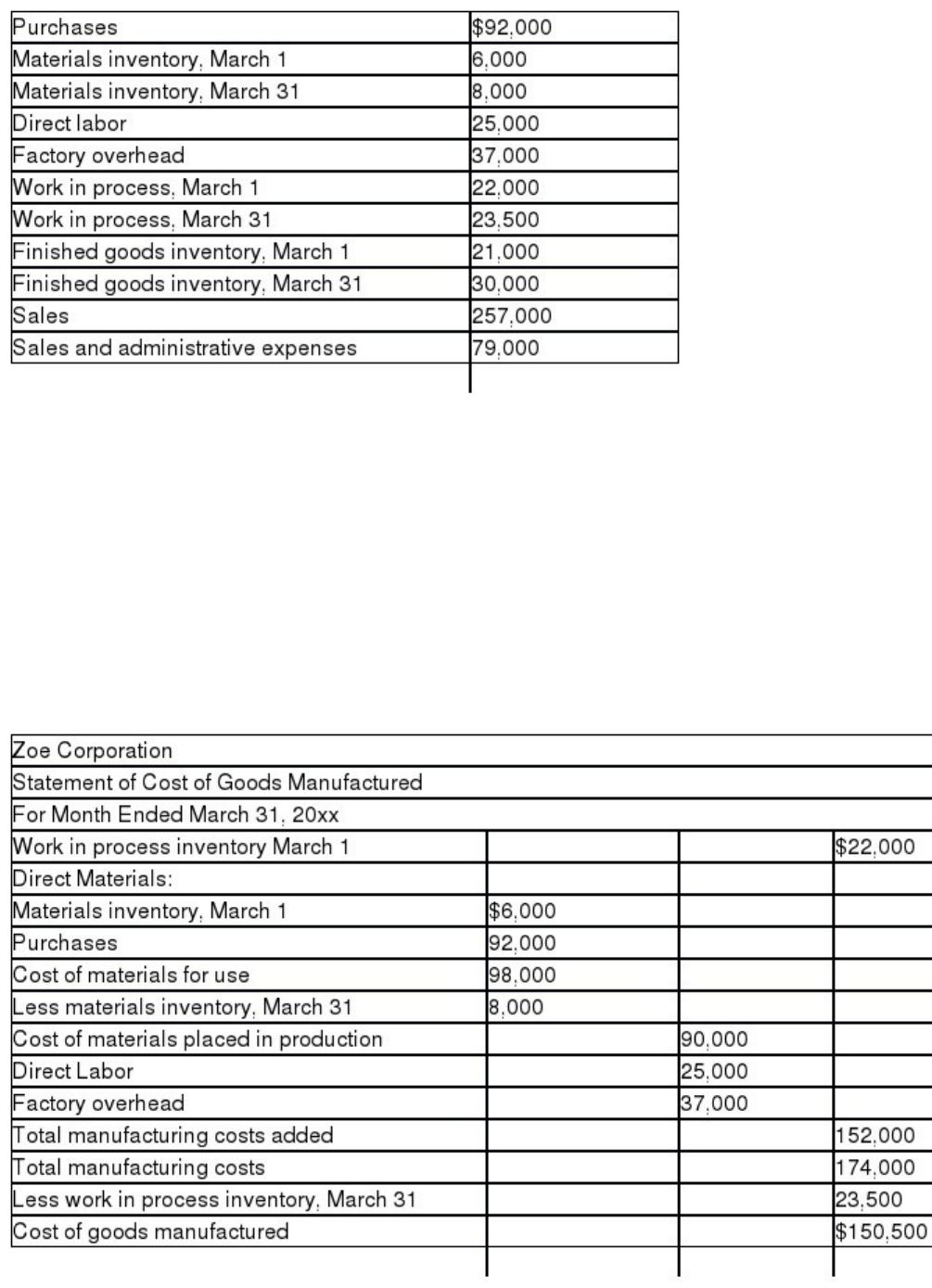
38) The Zoe Corporation has the following information for the month of March.
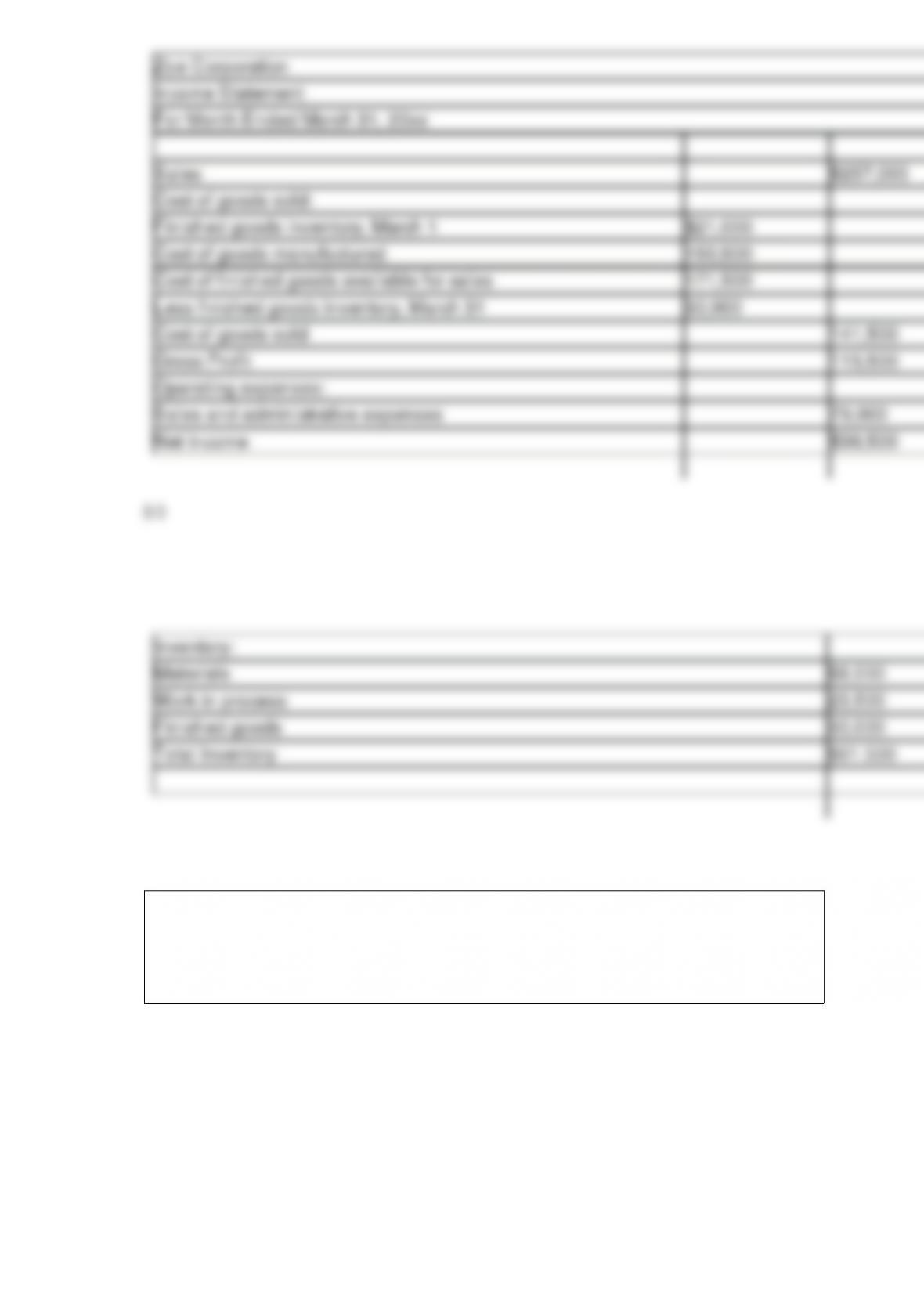
Prepare a (a) schedule of cost of goods manufactured, (b) an income statement for the
month ended March 31, and (c) prepare only the inventory section of the balance sheet.
39) The following information pertains to Newman Company. Assume that all balance
sheet amounts represent both average and ending balance figures. Assume that all sales
were on credit.
Assets
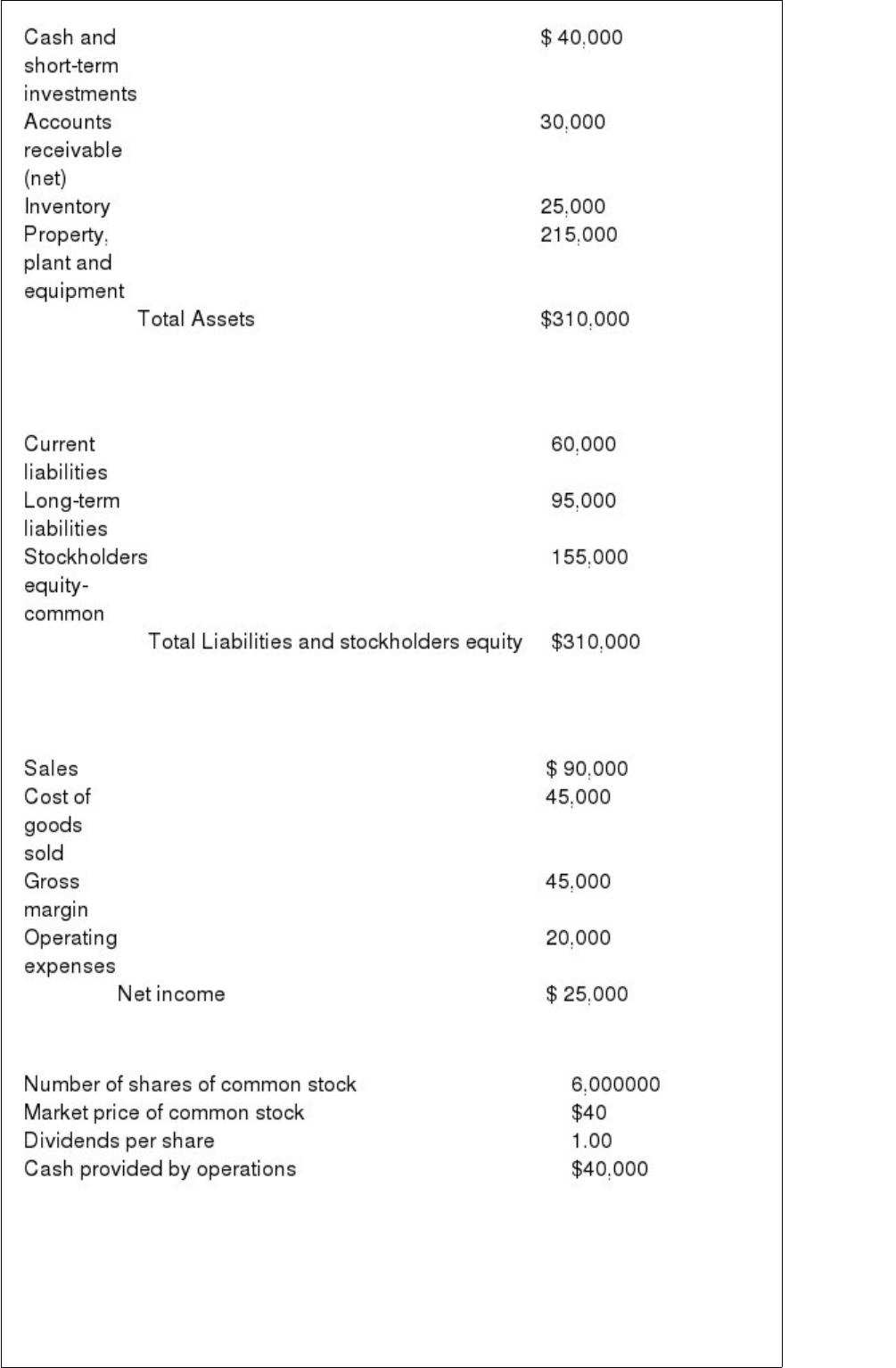
Liabilities and Stockholders Equity
Income Statement
What is the rate earned on total assets for this company?
A.8.1%
B.6.8%
C.10.5%
D.16.1%
40) Cost-volume-profit analysis cannot be used if which of the following occurs?
A.Costs cannot be properly classified into fixed and variable costs
B.The total fixed costs change
C.The per unit variable costs change
D.Per unit sales prices change
41) Which of the following are present value methods of analyzing capital investment
proposals?
A.Internal rate of return and average rate of return
B.Average rate of return and net present value
C.Net present value and internal rate of return
D.Net present value and payback
42) Knowing how costs behave is useful to management for all the following reasons
except for
A.predicting customer demand
B.predicting profits as sales and production volumes change
C.estimating costs
D.changing an existing product production
43) Held to maturity securities
A.are reported at fair market value
B.include stocks as well as bonds
C.may be reported as current or noncurrent assets
D.all of the above
44) The production department is proposing the purchase of an automatic insertion
machine. They have identified 3 machines and have asked the accountant to analyze
them to determine which of the proposals (if any) meet or exceed the companys policy
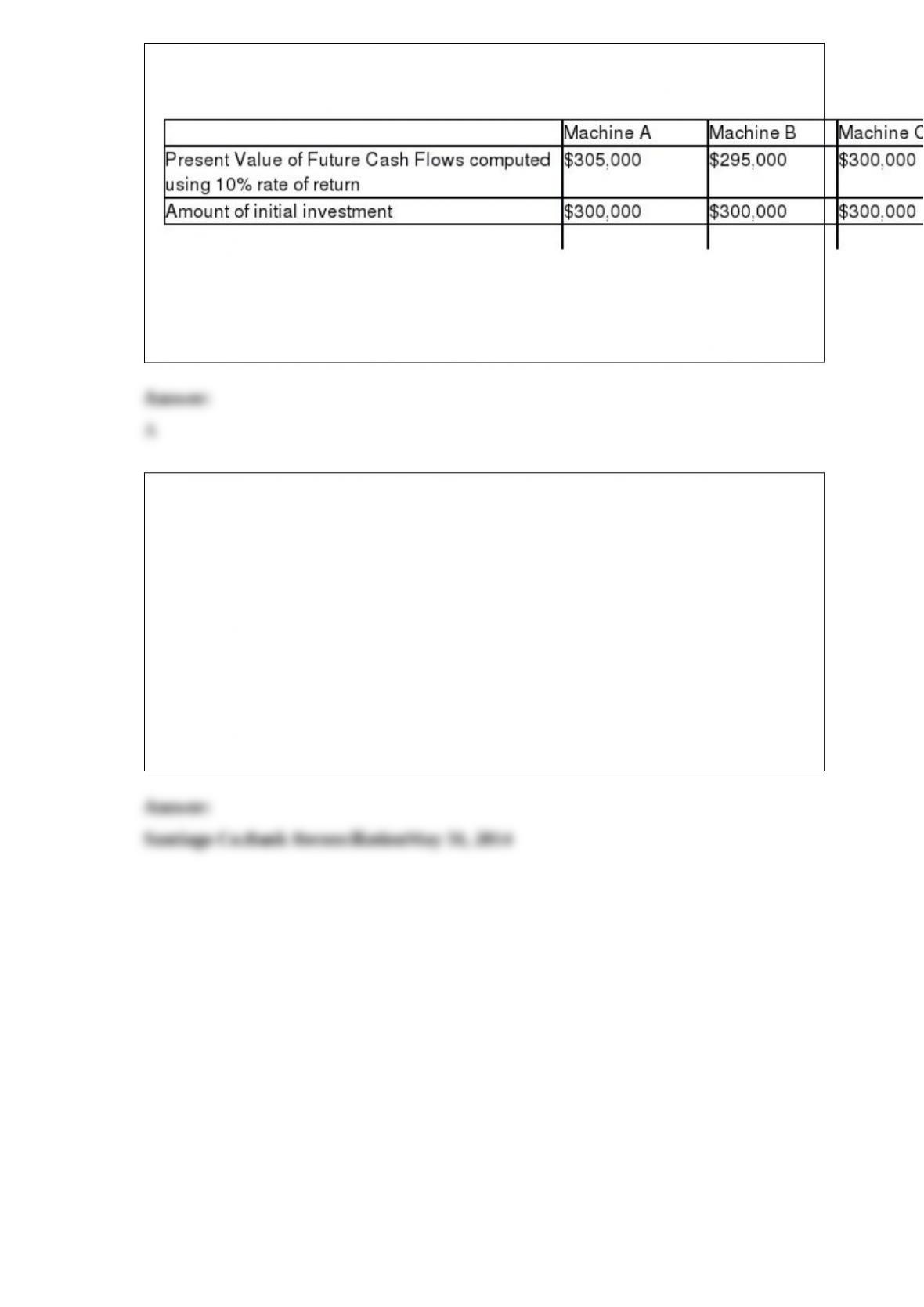
of a minimum desired rate of return of 10% using the net present value method. Each of
the assets has a estimated useful life of 10 years.
A.A & C
B.B & C
C.B
D.A only
45) The cash account for Santiago Co. on May 31, 2014 indicated a balance of $20,915.
The March bank statement indicated an ending balance of $25,645. Comparing the
bank statement, the canceled checks, and the accompanying memos with the records
revealed the following reconciling items:
a. Checks outstanding totaled $5,975
b. A deposit of $3,796 had been made too late to appear on the bank statement.
c. A check for $1,482 returned with the statement had been incorrectly recorded as
$482. The check was originally issued to pay on account.
d. The bank collected $4,515 on a note left for collection.
e. Bank service charges for May amounted to $70.
f. A check for $894 was returned by the bank because of insufficient funds.
Prepare a bank reconciliation as of May 31, 2014. Journalize the necessary entries.
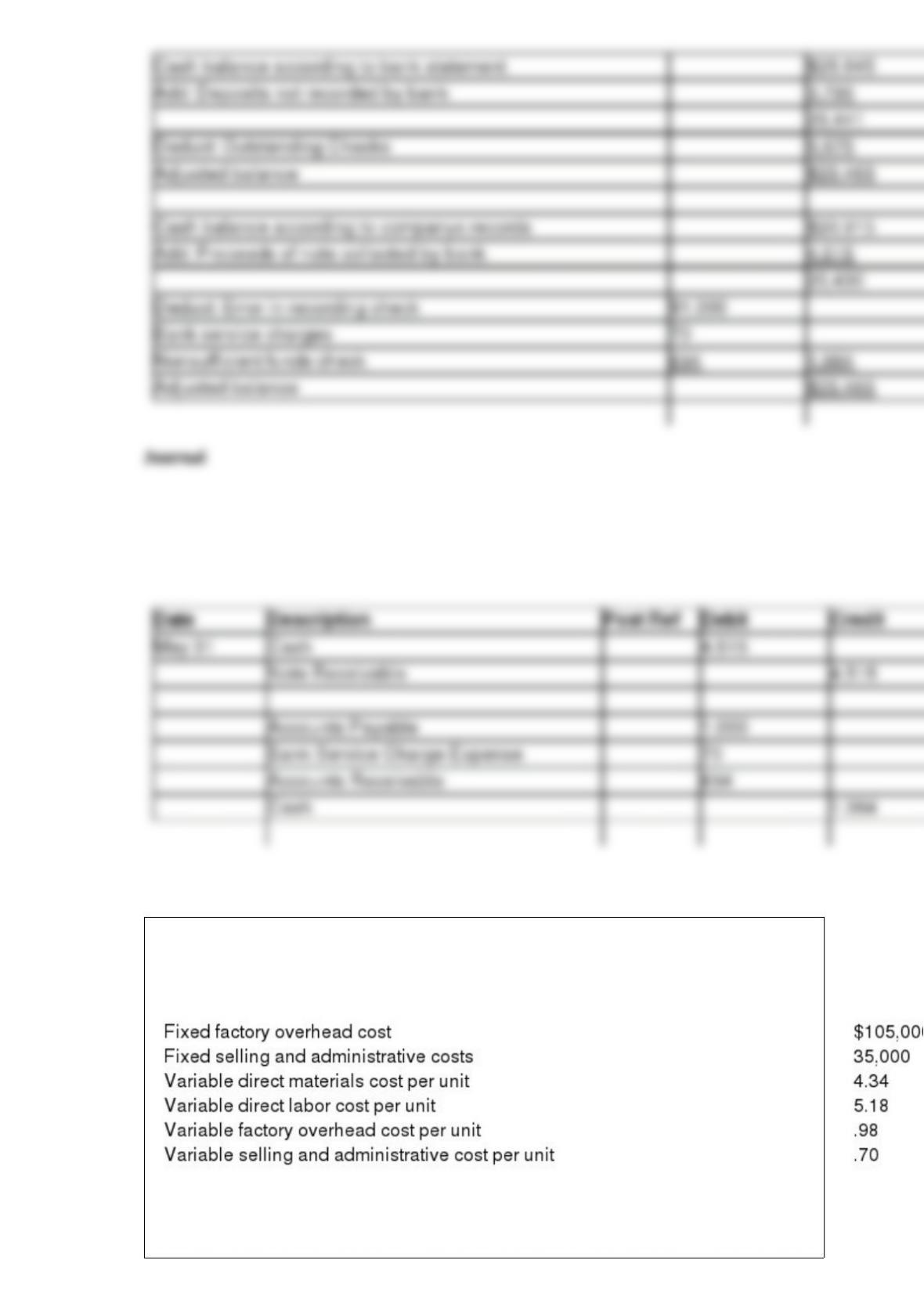
46) Dotterel Corporation uses the variable cost concept of product pricing. Below is
cost information for the production and sale of 35,000 units of its sole product. Dotterel
desires a profit equal to a 11.2% rate of return on invested assets of $350,000.
The variable cost per unit for the production and sale of the company’s product is:
A.$14.00
B.$12.60
C.$9.80
D.$11.20
47) Airflow Company sells a product in a competitive marketplace. Market analysis
indicates that their product would probably sell at $28.00 per unit. Airflow management
desires a profit equal to a 20% rate of return on invested assets of $1,400,000. They
anticipate selling 50,000 units. Their current full cost per unit for the product is $25 per
unit.
(1) What is the amount of profit per unit?
(2) What is the target cost per unit if they meet the market dictated price and
managements desired profit?
48) During the current year, merchandise is sold for $117,500 cash and $241,750 on
account. The cost of the merchandise sold is $157,400. What is the amount of the gross
profit?
49) Product J is one of the many products manufactured and sold by Oceanside
Company. An income statement by product line for the past year indicated a net loss for
Product J of $12,250. This net loss resulted from sales of $275,000, cost of goods sold
of $186,500, and operating expenses of $85,750. It is estimated that 30% of the cost of
goods sold represents fixed factory overhead costs and that 40% of the operating
expense is fixed. If Product J is retained, the revenue, costs, and expenses are not
expected to change significantly from those of the current year. Because of the large
number of products manufactured, the total fixed costs and expenses are not expected to
decline significantly if Product J is discontinued.
Prepare a differential analysis report, dated February 8 of the current year, on the
proposal to discontinue Product J.
50) On the first day of the fiscal year, a company issues a $500,000, 8%, 10 year bond
that pays semi-annual interest of $20,000 ($500,000 8% 1/2), receiving cash of
$437,740. Journalize the entry to record the issuance of the bonds.
51) An unfinished desk is produced for $36.00 and sold for $65.00. A finished desk can
be sold for $75.00. The additional processing cost to complete the finished desk is
$5.95. Provide a differential analysis for further processing.
52) Xang Companys costs were over budget by $46,000. The Xang Company is divided
in two regions. The first regions costs were over budget by $7,000.
Required:
Determine the amount that the second regions cost was over or under budget.
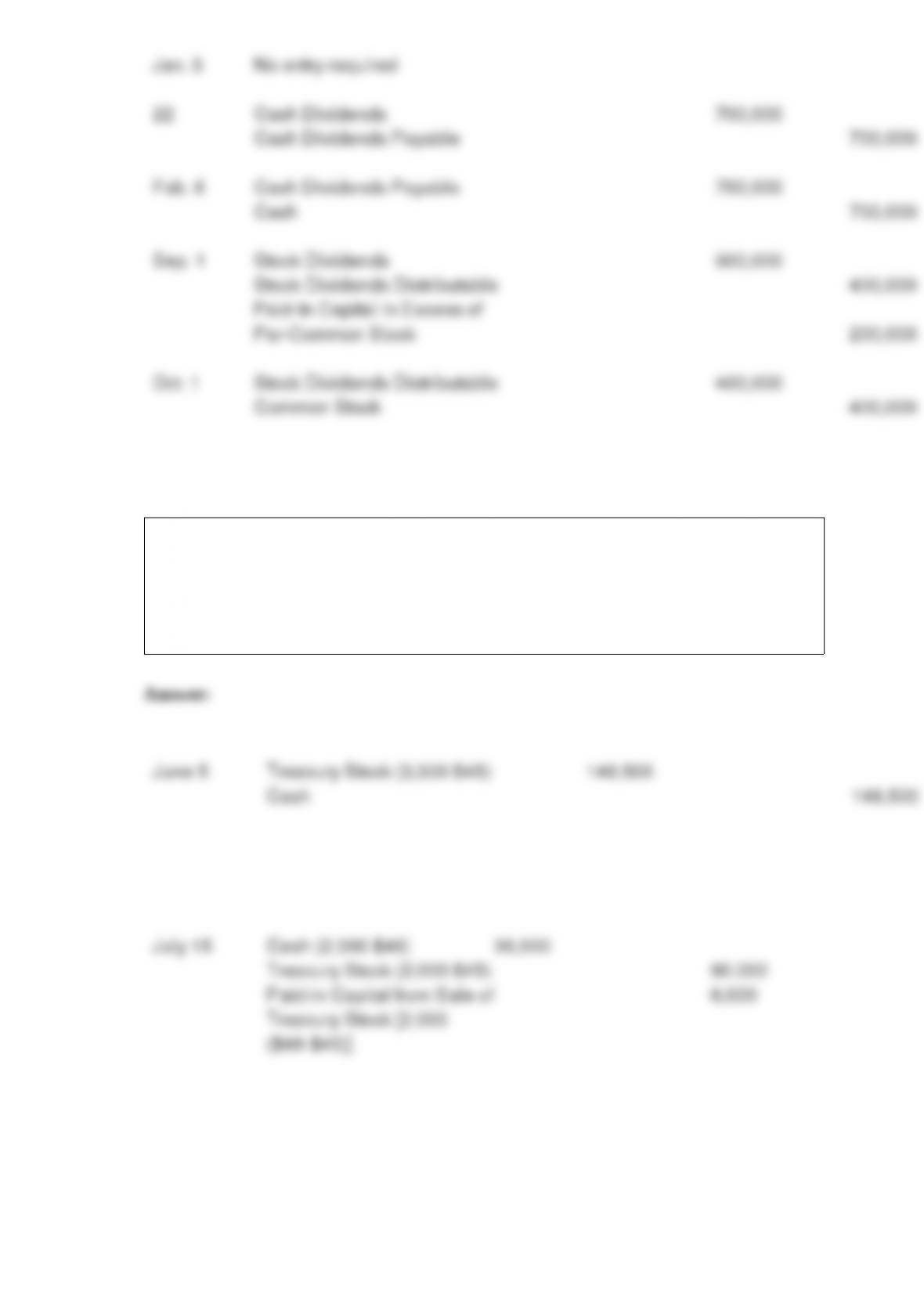
53) Journalize the following selected transactions completed during the current fiscal
year:
54) On June 5, Belen Corporation reacquired 3,300 shares of its common stock at $45
per share. On July 15, Belen sold 2,000 of the reacquired shares at $48 per share. On
August 30, Belen sold the remaining shares at $42 per share.
Journalize the transactions of June 5, July 15, and August 30.
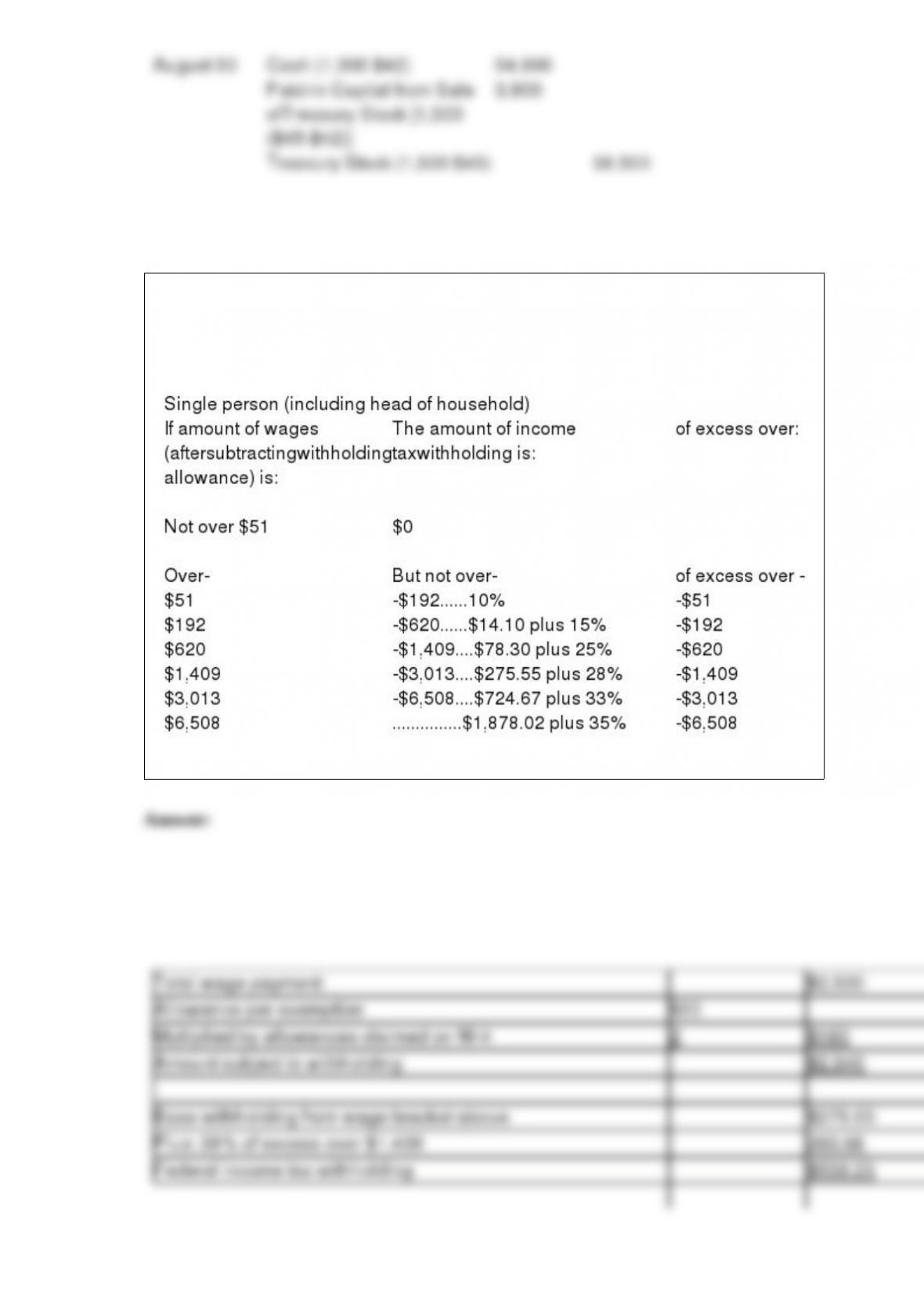
55) John Woods weekly gross earnings for the present week were $2,500. Woods has
two exemptions. Using $80 value for each exemption, what is Woods federal income
tax withholding?
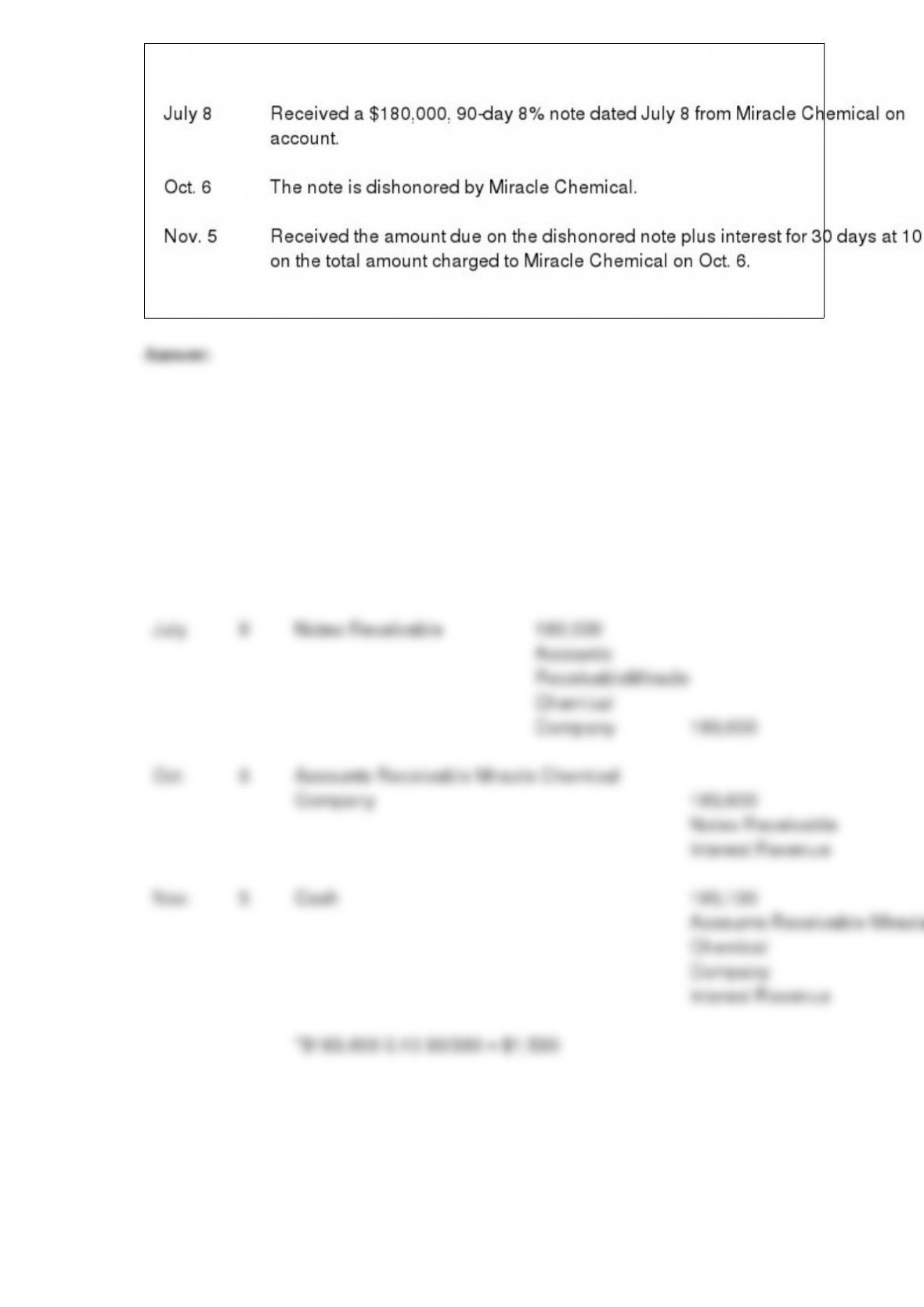
56) Journalize the following transactions of Upton Drugs: