1) Under traditional costing, supervisors and engineers are assumed to have superior
knowledge about how to improve processes because they actually work with the
manufacturing processes used to produce products.
2) Video surveillance is an example of results control.
3) Guiding the target costing process is a cross-functional team made up of individuals
from within and from outside the organization.
4) In a job order costing system, a cost driver rate is used to apply direct manufacturing
costs to a specific product.
5) The costs grouped in a cost pool should be driven by the same activity.
6) Companies generally use two approaches to customer satisfaction surveys: telephone
interviews and personal interviews.
7) At the highest level strategic planning involves choosing a strategy that provides the
best fit between the organization’s environment and its internal resources in order to
achieve the organization’s objectives.
8) If cost driver rates were based on actual short-term usage, periods of lower demand
would result in lower cost driver rates.
9) Residual income equals reported accounting income less the economic cost of the
investment used to generate that income.
10) One concern of target costing is that even though the target cost might be met,
increased development time may cause the product to come late to market.
11) Use of a single cost driver rate will always distort product costs.
12) Management accounting has no prescribed rules about its content, how the content
is to be developed, and how the content is to be presented.
13) The salary of the company president is a fixed manufacturing cost.
14) Job order costing is an approach to costing that estimates costs for specific
customer orders because the orders vary from customer to customer.
15) Practical capacity is generally smaller than theoretical capacity.
16) When implementing a new management accounting and control system, it is BEST:
A) to allow management to implement their ideas
B) for management to involve employees in the implementation
C) to involve consultants and implement their experienced ideas
D) to engage in benchmarking
17) Surveys regarding compensation plans in practice suggest that:
A) incentive compensation systems are generally extremely efficient
B) people believe that incentive compensation plans in the U.S. are increasingly unfair
C) increased top management incentives generally correlate with greater shareholder
wealth
D) senior executives are paid mediocre salaries for superior performance
18) To the extent that an ethical hierarchy exists, ________ have the highest authority.
A) societal norms
B) legal rules
C) organizational norms
D) personal norms
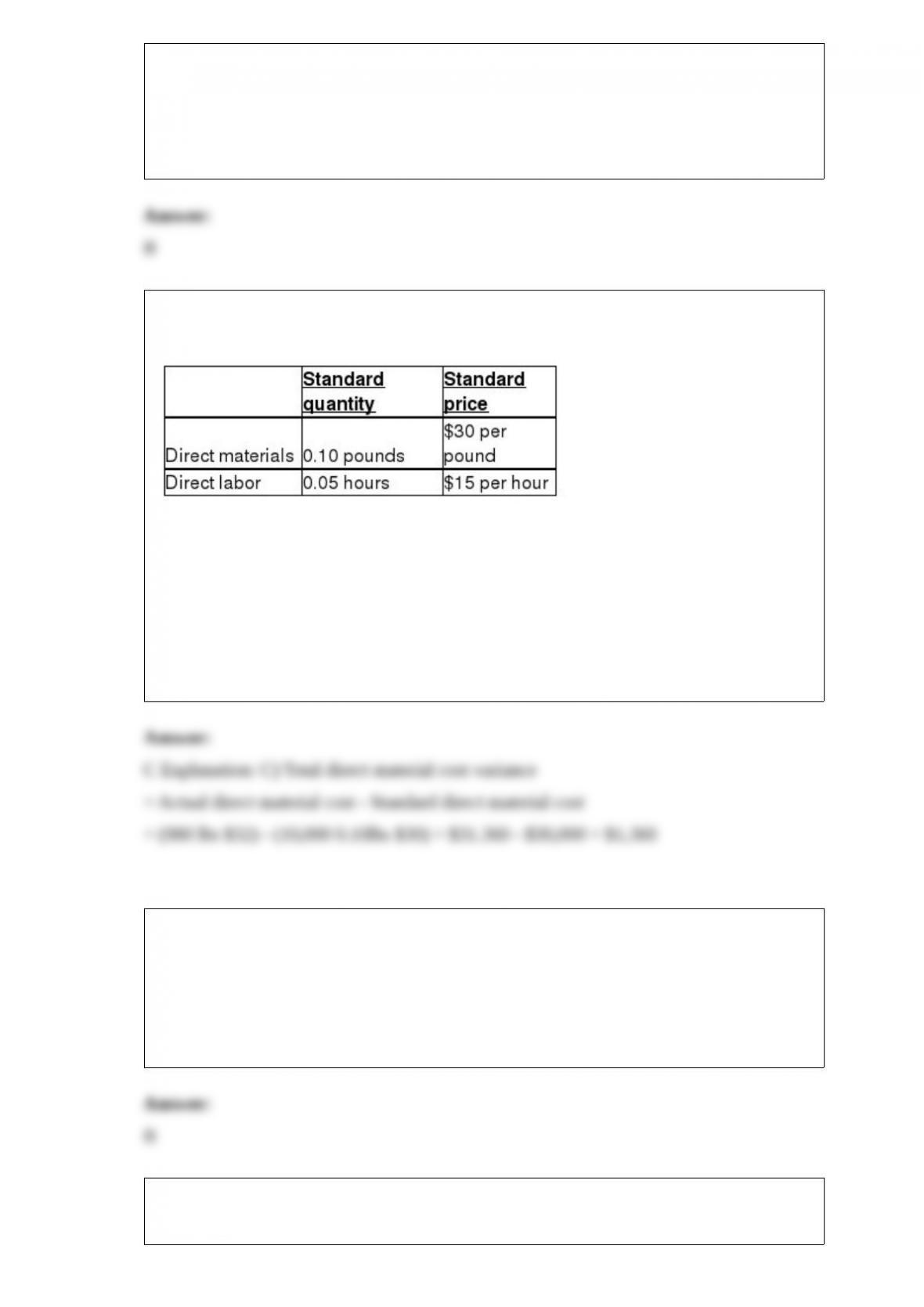
19) Talladega Industries, Inc., (TII) developed the following standard costs for direct
material and direct labor for one of their major products, the 10-gallon plastic container.
During August, TII produced and sold 10,000 containers using 980 pounds of direct
materials at an average cost per pound of $32 and 500 direct labor hours at an average
wage of $15.25 per hour.
August’s direct material cost variance was:
A) $1,960 unfavorable
B) $600 favorable
C) $1,360 unfavorable
D) None of the above is correct
20) It ONLY makes sense to implement an ABC system when:
A) ABC provides information to make better decisions
B) its benefits exceed implementation costs
C) ABC traces more costs as direct costs
D) there is a strong cause-and-effect relationship between costs in the cost pools and
their cost-allocation bases
21) Wood Manufacturing is a small textile manufacturer using machine-hours as the
single, plant-wide predetermined cost driver rate to allocate manufacturing overhead
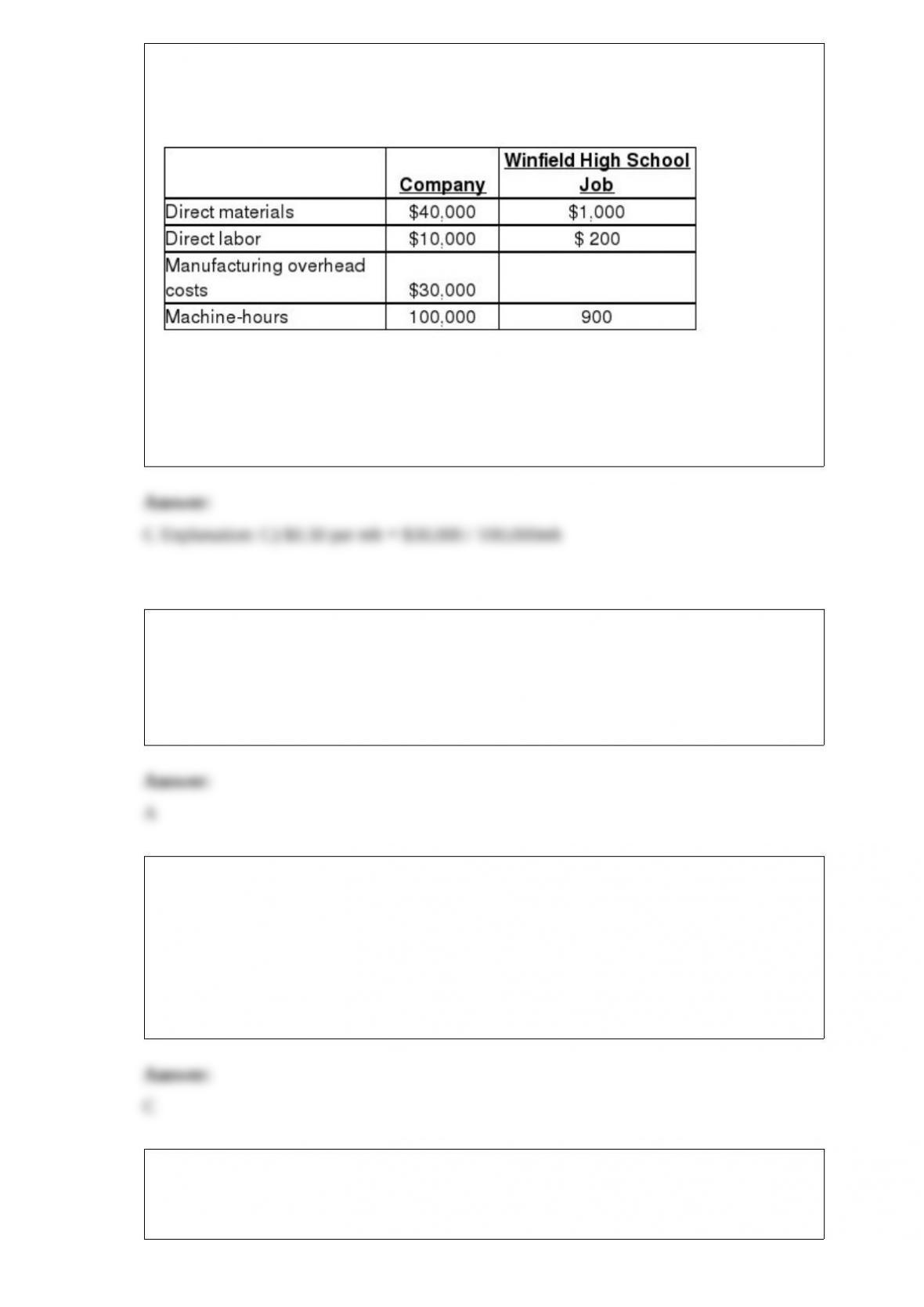
costs to the various jobs contracted during the year. The following estimates are
provided for the coming year for the company and for the Winfield High School band
jacket job:
For Wood Manufacturing, what is the annual manufacturing overhead cost driver rate?
A) $0.50 per machine hour
B) $0.80 per machine hour
C) $0.30 per machine hour
D) $33.33 per machine hour
22) Which of the following would be MOST helpful for a top manager of a company?
A) profitability report of the company
B) information to monitor hourly and daily operations
C) number of customer complaints
D) operating expense summary reported by department
23) ________ is the most common method of gathering information where companies
independently obtain information about one or several other companies that excel in the
area of interest.
A) Cooperative benchmarking
B) Database benchmarking
C) Unilateral (covert) benchmarking
D) Indirect/third party benchmarking
24) LCR Company manufactures paint and applies manufacturing overhead costs to
production at a predetermined rate of $20 per direct labor hour. The following data are
obtained from the accounting records for October 2011:
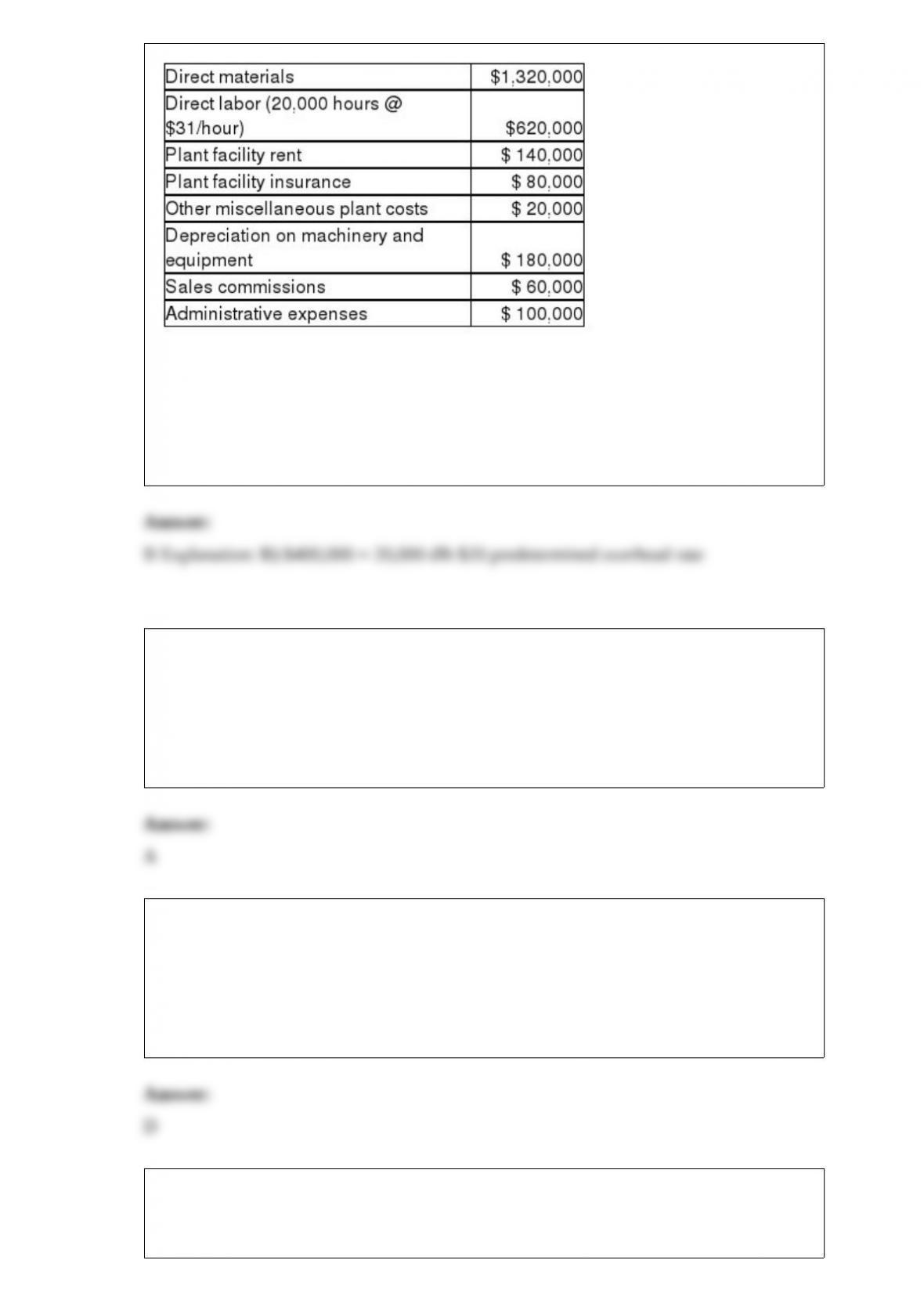
The amount of manufacturing overhead costs applied to all jobs during October 2011
total:
A) $ 102,000
B) $400,000
C) $620,000
D) $1,240,000
25) Measuring performance based on cost per unit will motivate performance that
includes keeping ________ under control.
A) only costs
B) costs and on-time delivery
C) costs and the amount of defects
D) only quality
26) Codes of ethics developed by professional organizations reflect broad moral
principles such as:
A) loyalty
B) discretion
C) competence
D) All of the above are correct
27) Dennis’ TV currently sells small televisions for $180. It has costs of $140. A
competitor is bringing a new small television to market that will sell for $150.
Management believes it must lower the price to $150 to compete in the market for small
televisions. Marketing believes that the new price will cause sales to increase by 10%,
even with a new competitor in the market. Dennis’ sales are currently 100,000
televisions per year.
What is the new target cost per unit if profit margin is 25% of sales?
A) $37.50
B) $45.00
C) $112.50
D) $135.00
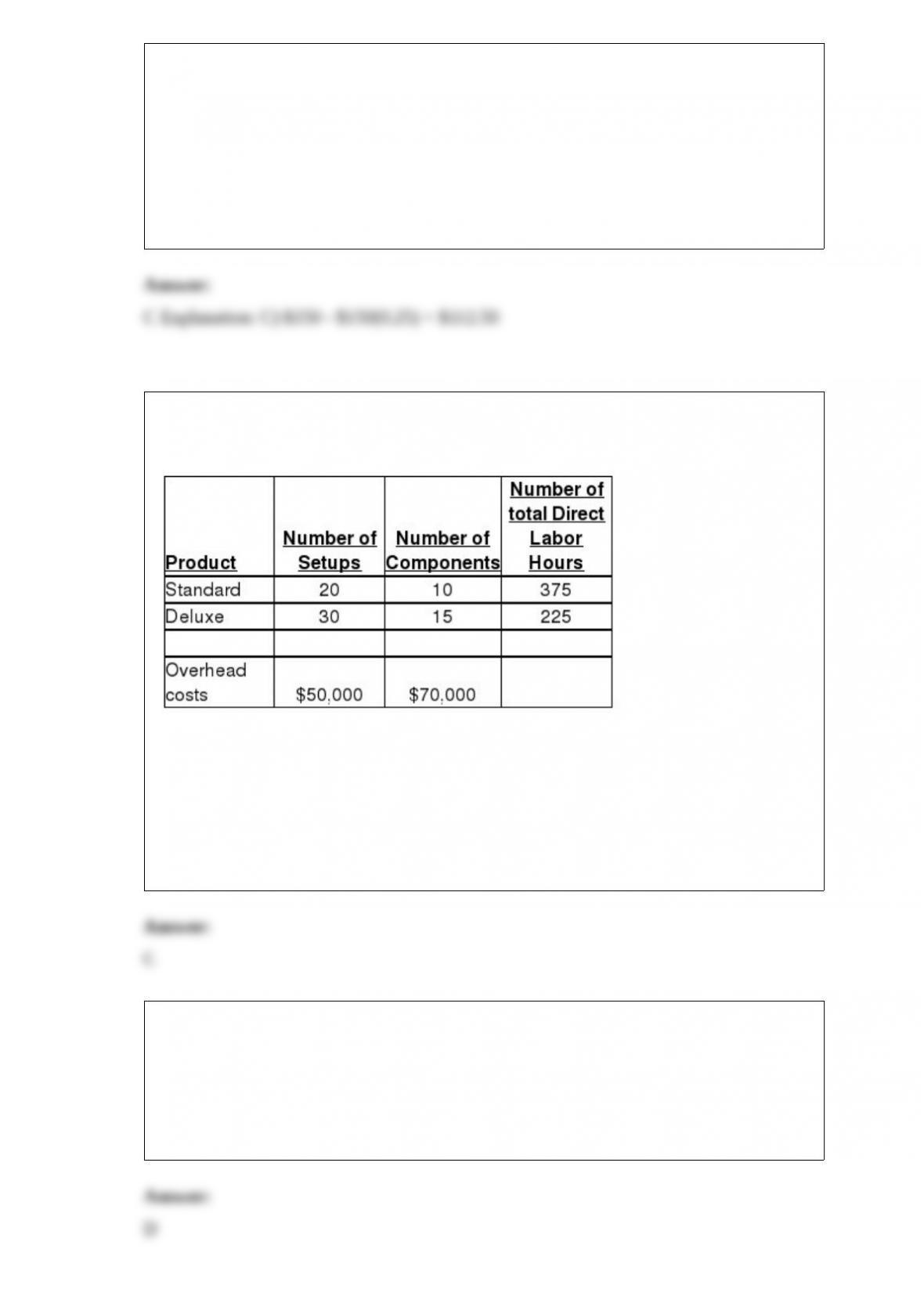
28) Tony’s Skate Corporation manufactures two models of skate boards: a standard and
a deluxe model. The following activity and cost information has been compiled.
Number of setups and number of components are identified as activity-cost drivers for
overhead costs. Assuming an activity-based costing system is used, what is the total
amount of overhead costs assigned to the standard model?
A) $20,000
B) $29,000
C) $48,000
D) $60,000
29) The research development and engineering cycle of the total life-cycle concept
which focuses on developing prototypes and production processes is the:
A) research, development, and engineering cycle
B) manufacturing cycle
C) product design stage
D) product development stage
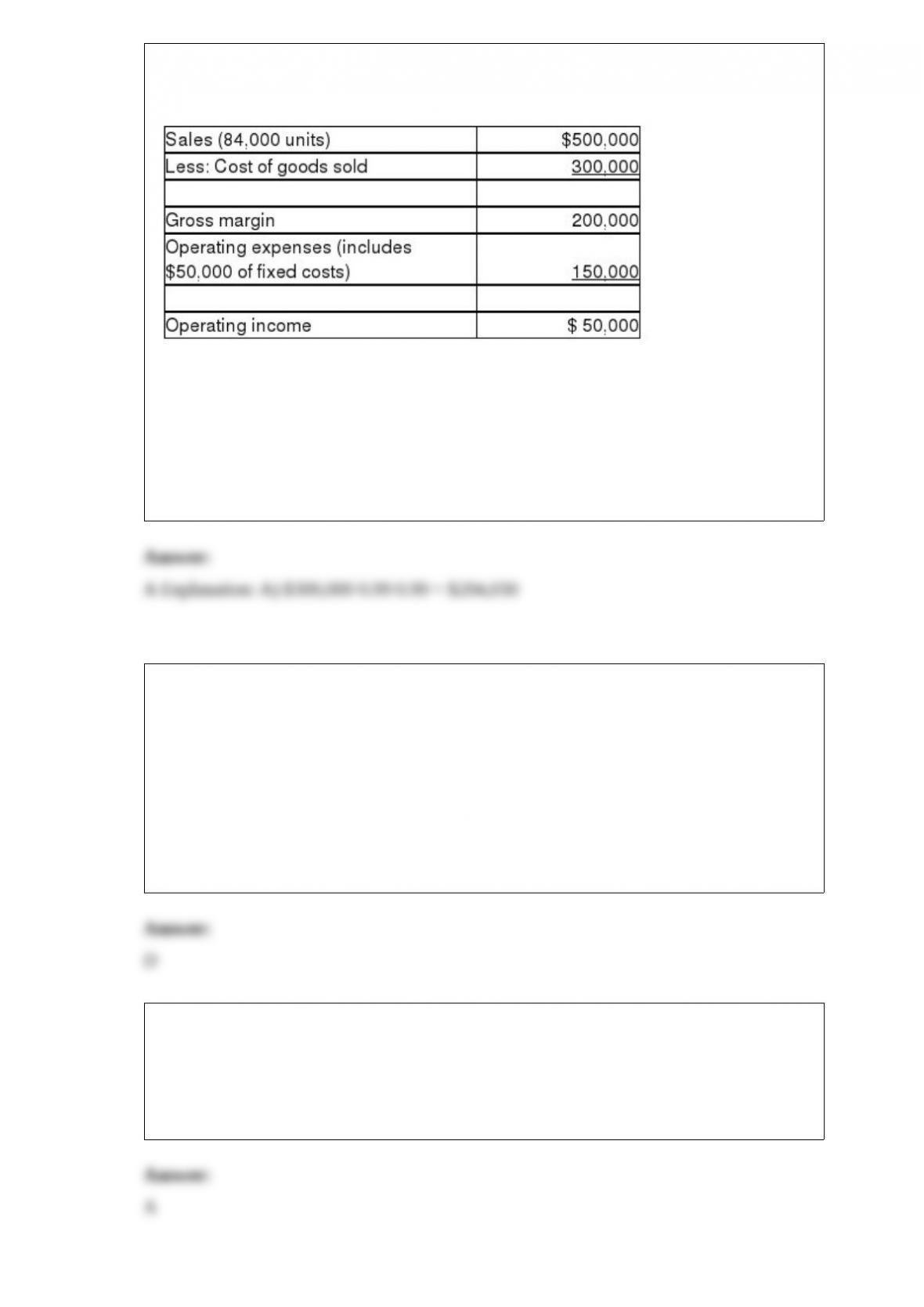
30) DJK Enterprises are using the Kaizen approach to budgeting for 2011 . The
budgeted income statement for January 2011 is as follows:
Under the Kaizen approach, cost of goods sold and variable operating expenses are
budgeted to decline by 1% per month.
What is the budgeted cost of goods sold for March 2011?
A) $294,030
B) $294,000
C) $300,000
D) $297,000
31) The text discusses how Quaker Oats used economic value added to evaluate the
practice of trade loading, which is a practice of loading up the supply line with product
to last several months. This application of economic value added would focus on:
A) comparing the profit changes caused by trade loading with changes in customer
satisfaction
B) the effect on partners in the distribution channel caused by abandoning trade loading
C) the difference in prices caused by trade loading
D) comparing the benefits and costs of trade loading with the required investment in
inventory
32) Cost-volume-profit analysis is used PRIMARILY by management:
A) as a planning tool
B) for control purposes
C) to establish a target net income for next year
D) to attain extremely accurate financial results
33) The following information pertains to the October operating budget for Flockhart
Corporation.
Budgeted sales for October $100,000 and November $200,000.
Collections for sales are 60% in the month of sale and 40% the next month.
Gross margin is 30% of sales.
Administrative costs are $10,000 each month.
Beginning accounts receivable (October 1) $20,000.
Beginning inventory (October 1) $14,000.
Beginning accounts payable (October 1) $60,000. (All from inventory purchases.)
Purchases are paid in full the following month.
Desired ending inventory is 20% of next month’s cost of goods sold (COGS).
No loans are outstanding on October 1
At the end of October, budgeted accounts receivable is:
A) $20,000
B) $40,000
C) $60,000
D) None of the above is correct
34) How the customer is treated at the time of the purchase is an example of the
__________ element of the value proposition
A) functionality and features
B) industry standards
C) quality
D) service
35) In a job order costing system, a manufacturing firm typically uses a cost driver rate
to estimate the ________ used for a job.
A) direct materials
B) direct labor
C) variable overhead
D) total costs
36) Talladega Industries, Inc., (TII) developed the following standard costs for direct
material and direct labor for one of their major products, the 10-gallon plastic container.
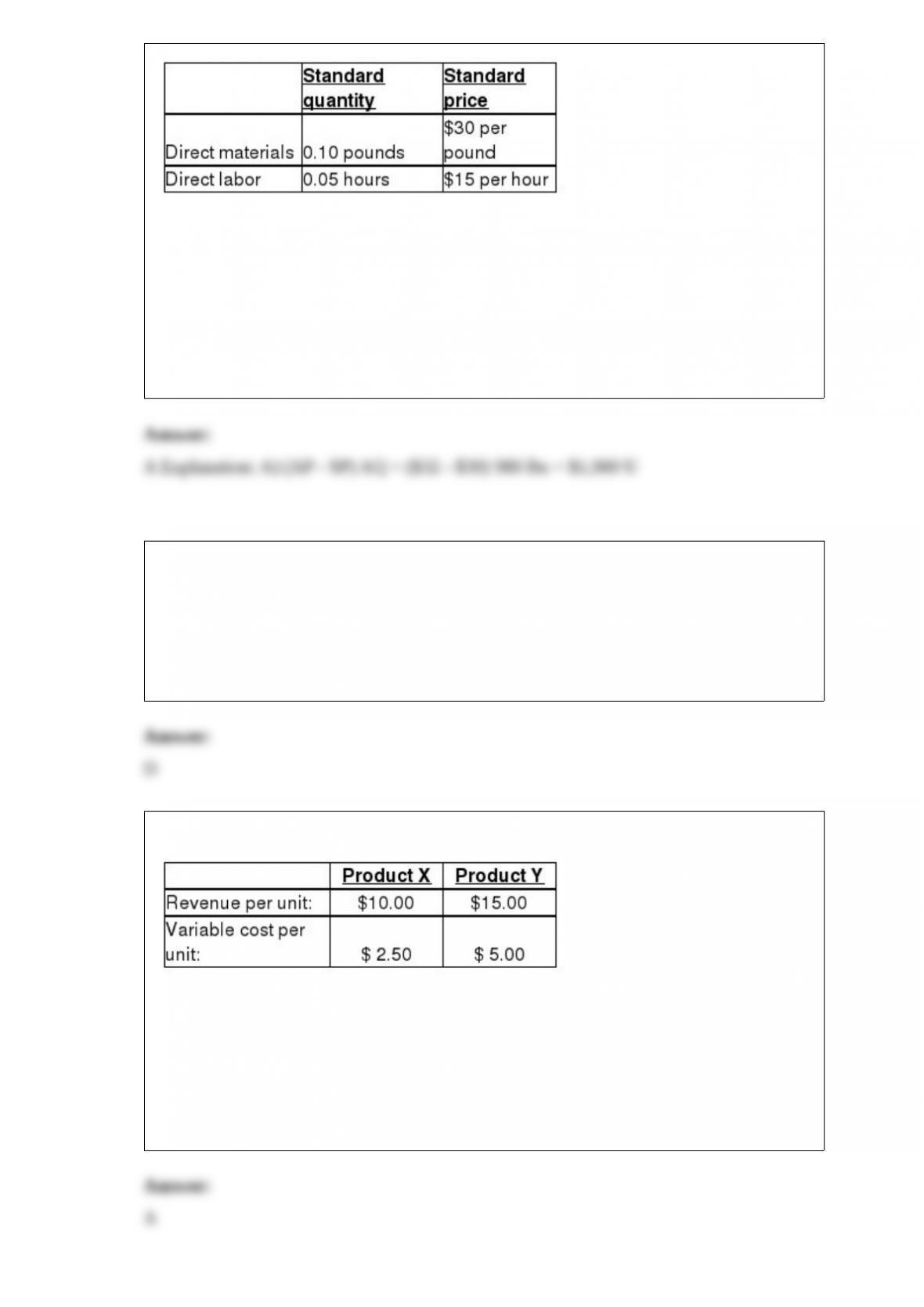
During August, TII produced and sold 10,000 containers using 980 pounds of direct
materials at an average cost per pound of $32 and 500 direct labor hours at an average
wage of $15.25 per hour.
August’s direct material price variance was:
A) $1,960 unfavorable
B) $600 favorable
C) $1,360 favorable
D) None of the above is correct
37) In multiproduct situations, when the sales mix shifts toward the product with the
highest contribution margin per unit, then:
A) total revenues will decrease
B) breakeven quantity will increase
C) total contribution margin will decrease
D) operating income will increase
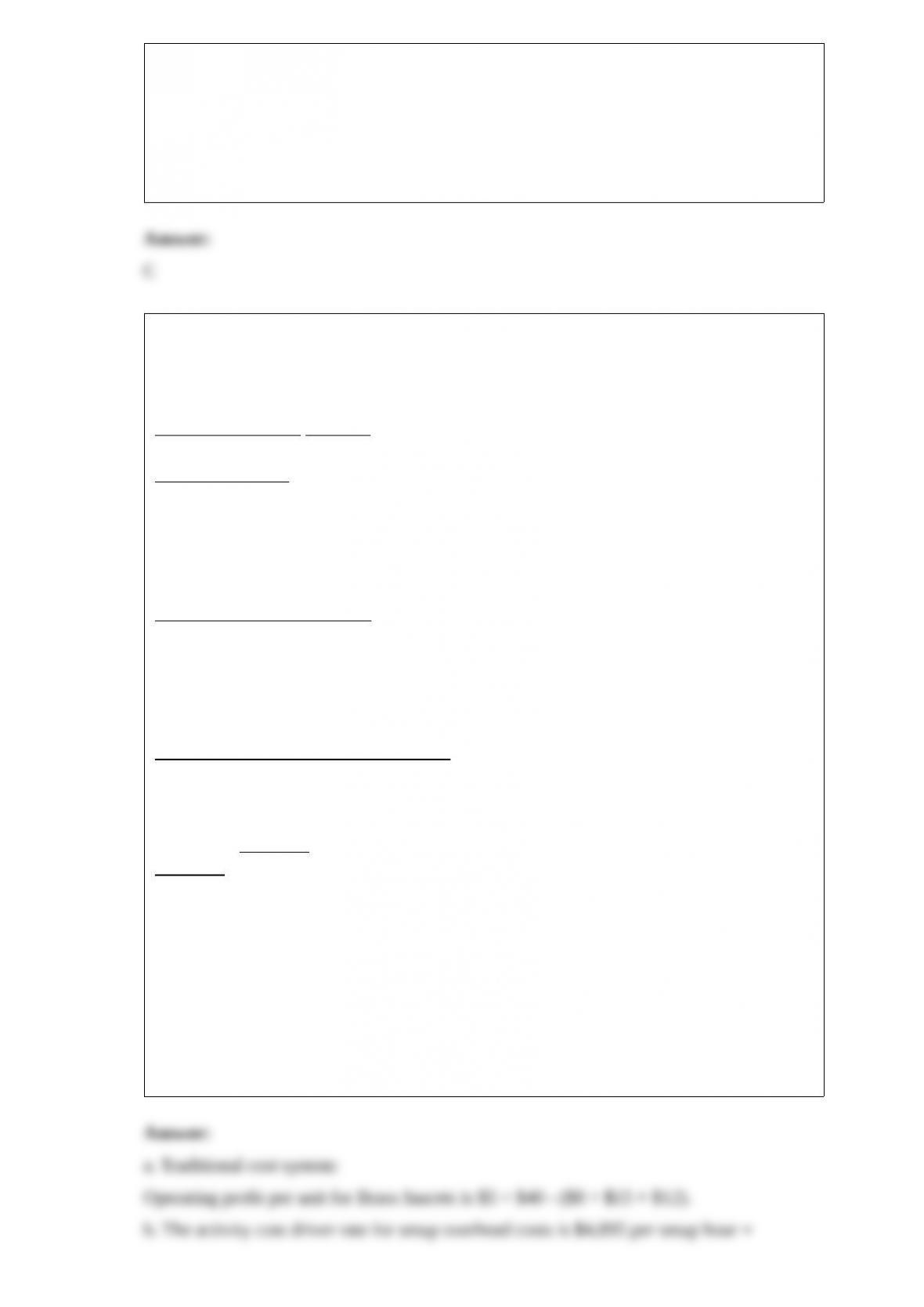
38) The following annual information is for Bressler Corporation:
Total fixed costs: $100,000
If the sales mix shifts to one unit of Product X and two units of Product Y, then the
contribution margin per unit of composite product will:
A) increase per unit
B) stay the same
C) decrease per unit
D) be undeterminable
39) Nonprofit and government organizations:
A) cannot use the Balanced Scorecard because they have no customers
B) cannot use the Balanced Scorecard because they have no financial objective
C) may use the Balanced Scorecard by adding a social impact perspective to the top of
the strategy map
D) may use the Balanced Scorecard by not linking it to mission and strategy
40) Brilliant Accents Company manufactures and sells three styles of kitchen faucets:
brass, chrome, and white. Production takes 25, 25, and 10 machine hours to
manufacture 1,000-unit batches of brass, chrome, and white faucets, respectively. The
following additional data apply:
BRASSCHROME WHITE
Projected sales in units30,00050,00040,000
PER UNIT data:
Selling price$40$20$30
Direct materials$ 8$ 4$ 8
Direct labor$15$ 3$ 9
Overhead cost based on direct labor hours
(traditional cost system) $12$ 3$ 9
Hours per 1000-unit batch:
Direct labor hours 40 10 30
Machine hours 25 25 10
Setup hours1.00.51.0
Inspection hours 30 20 20
Total overhead costs and activity levels for the year are estimated as follows:
ActivityOverhead costsActivity levels
Direct labor hours2,900 hours
Machine hours2,400 hours
Setups$465,00095 setup hours
Inspections$405,0002,700 inspection hours
$870,000
a.Using the traditional cost system, determine the operating profit per unit for the brass
style of faucet.
b.Determine the activity cost driver rate for setup overhead costs and inspection
overhead costs.
c.Using the ABC system, for the brass style of faucet:
1> compute the estimated overhead costs per unit; and
2> compute the estimated operating profit per unit.
d.Explain the difference between the profits obtained from the traditional cost system
and the ABC system. Which system provides a better estimate of profitability? Why?
41) Management accounting:
A) is both retrospective, providing feedback about past operations, and also
prospective, incorporating forecasts and estimates about future events
B) is primarily oriented to external stakeholders
C) must be consistent with rules formulated by the Financial Accounting Standards
Board (FASB)
D) provides information that is generally available only on a quarterly or annual basis
42) A key reason for using an ABC system rather than a conventional cost system is
because ABC assigns overhead costs:
A) because they are indirect costs
B) more simply than a traditional cost system
C) based only on transaction drivers
D) to reflect differences required by different activities as well as customers
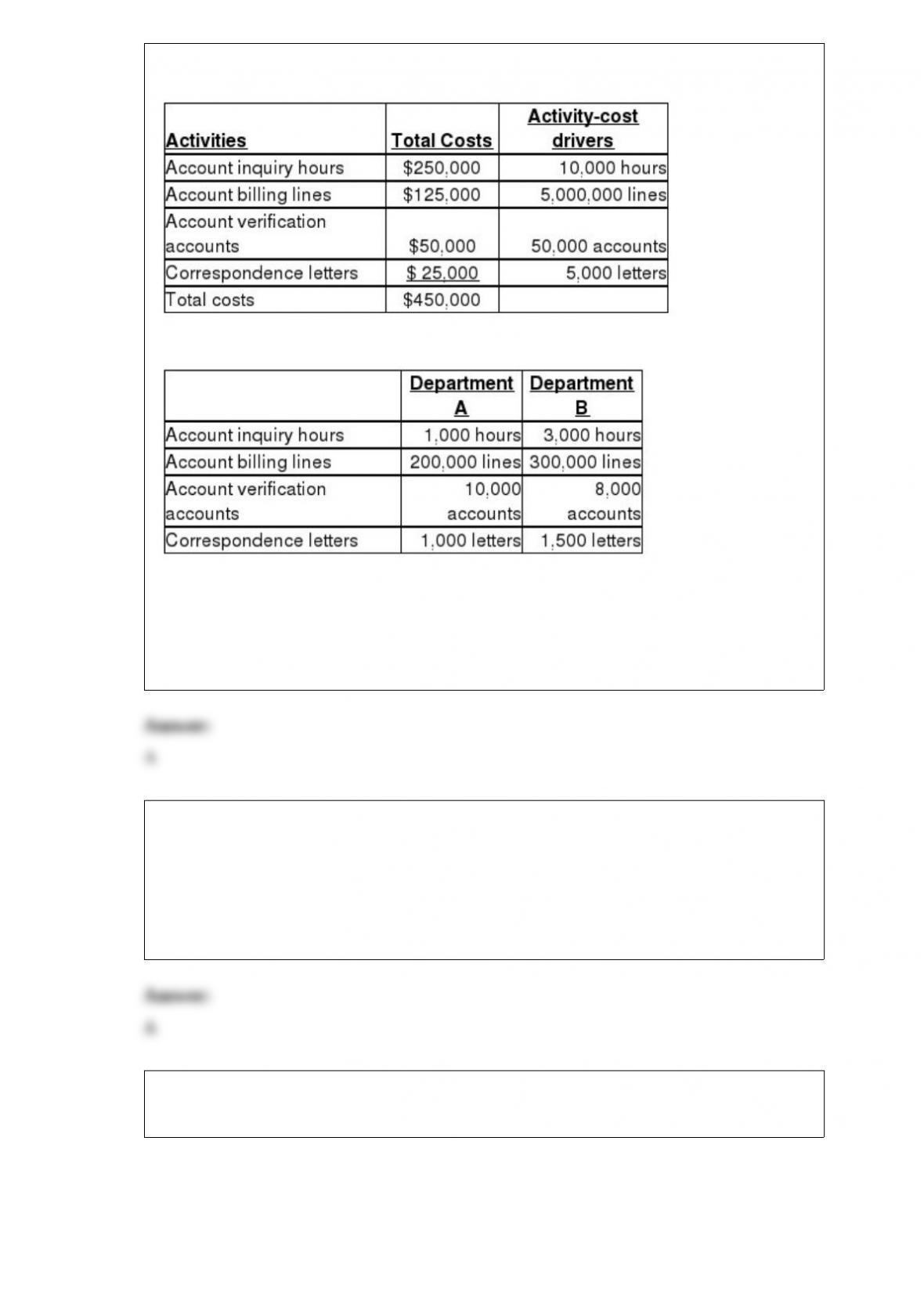
43) Webster Company provides the following ABC costing information:
The above activities are used by Departments A and B as follows:
How much of the account billing costs will be assigned to Department B?
A) $7,500
B) $12.500
C) $15,000
D) $25,000
44) ________ occur(s) when a superior simply tells subordinates what their budget will
be.
A) Authoritative budgeting
B) Stretch targets
C) Consultative budgeting
D) Budget slack
45) Talladega Industries, Inc., (TII) developed the following standard costs for direct
material and direct labor for one of their major products, the 10-gallon plastic container.
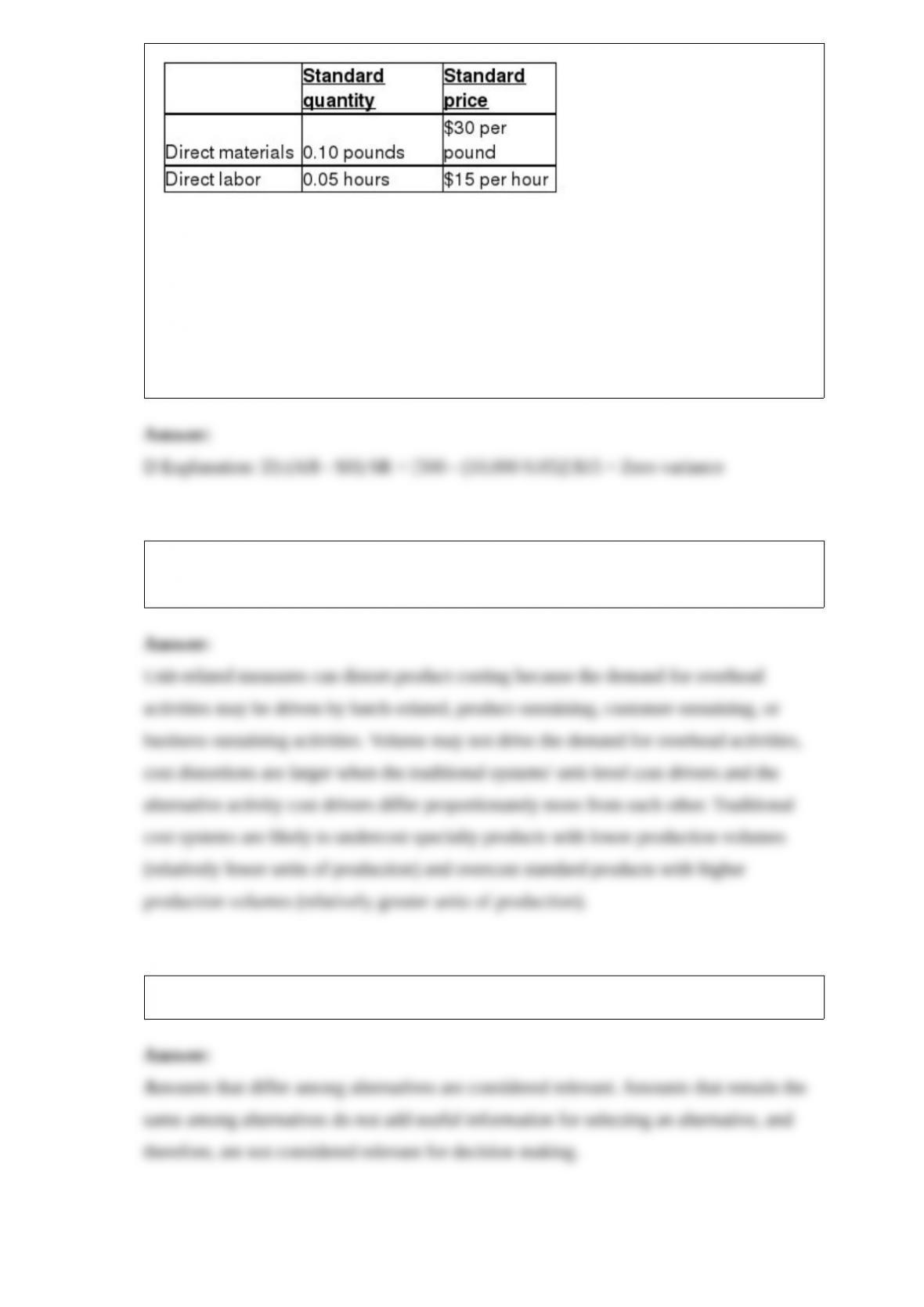
During August, TII produced and sold 10,000 containers using 980 pounds of direct
materials at an average cost per pound of $32 and 500 direct labor hours at an average
wage of $15.25 per hour.
August’s direct labor efficiency variance was:
A) $125 unfavorable
B) $125 favorable
C) $142,375 favorable
D) None of the above is correct
46) Explain how traditional cost systems, using only unit level cost drivers, distort
product costs.
47) Explain what revenues and costs are relevant when choosing among alternatives.
48) What is the purpose of management accounting?
49) What is budgeting? What is its role?
50) What is the primary reason a firm would adopt target costing?
51) Why is an accurate product cost important?
52) A motorcycle manufacturer is currently using a conventional processing system.
Recently work-in-process inventory has been piling up at two stations along the
assembly line. To eliminate this problem, management discussed the possibility of
implementing just-in-time manufacturing. Discuss the advantages and concerns of
implementing JIT.
53) The following information pertains to Maxi Corporation:
MonthSalesPurchases
July$40,000$20,000
August30,00015,000
September20,00010,000
October50,00025,000
November60,00030,000
December70,00035,000
Cash is collected from customers in the following manner:
Month of sale20%
Month following the sale50%
Two months following sale28%
Amount uncollectible2%
Thirty percent of purchases are paid for in cash in the month of purchase, and the
balance is paid the following month. A 2% discount is allowed on purchases paid for in
the month of purchase.
Labor costs equal 20% of sales; other operating costs of $5,000 per month (including
$2,000) of depreciation. Both are paid in the month incurred.
The cash balance on October 1 is $4,300. A minimum cash balance of $4,000 is
required at the end of the month. Money is borrowed in multiples of $1,000.
The company will issue $6,000 of common stock and pay $10,000 in dividends in
October.
There is no debt outstanding at October 1.
Required:
Prepare a projected cash flow statement in good form for the month ended October 31.
54) List at least three factors taken into consideration when determining the markup
rate.

55) Explain why buy-in by employees is critical to benchmarking.