
CAS 250 requires the auditor to communicate illegal acts to the audit committee
A) if the illegal acts are slightly material.
B) if the illegal acts are material.
C) if the illegal acts are other than trivial.
D) regardless of materiality.
If the auditor concludes that the physical controls over inventory are so inadequate that
inventory will be difficult to count, the auditor should
A) inquire of management the additional controls that can be put in place to enable a
better count to be carried out.
B) conduct additional control tests over the pricing and compilation of inventory to
obtain a higher degree of accuracy.
C) rely upon the perpetual inventory master files rather than the physical count.
D) expand the observation of physical inventory tests to ensure that an adequate count
is carried out.
How many public accounting firms are there in Canada that have more than 50
professional staff?

A) 25
B) 50
C) 75
D) 100
In a code of conduct, the advantage of general statements of ideal conduct, as opposed
to specific rules of behaviour, is
A) the emphasis on positive activities that encourage a high level of performance.
B) the ability to enforce the ideals.
C) the enforceability of minimum behaviour and performance standards.
D) the tendency to define the rules as maximum rather than minimum standards.
A code of professional conduct typically includes principles, rules of conduct, and
interpretations or examples. What is the purpose of the principles?
A) state what a practitioner must do for each audit engagement conducted
B) provide discussions of the rules of conduct and how they relate to practical situations

C) provide minimum standards of ethical conduct stated specifically
D) provide ideal standards of ethical conduct stated in philosophical terms
In the case of Enron, Andersen was ultimately convicted on the count of
A) obstruction of justice for altering a memo.
B) obstruction of justice for shredding documents relating to the audit of Enron.
C) failing to discover the fraud.
D) refusing to testify in court against their client.
“An engagement where, pursuant to an accountability relationship between two or more
parties, a practitioner is engaged to issue a written communication expressing a
conclusion concerning a subject matter for which the accountable party is responsible”
is the definition of a(n)
A) audit engagement.
B) assurance engagement.
C) review engagement.
D) compilation engagement.

Which of the following audit tests is usually the least costly to perform?
A) analytical procedures
B) tests of controls
C) tests of balances
D) confirmations
The form used to request the purchasing department to place orders for inventory items
is the
A) purchase order.
B) purchase requisition.
C) materials requisition.
D) bill of lading.

The client has presented all required financial statements with the exception of the
statement of cash flows. The auditor has completed the audit and is satisfied that
everything, with the exception of the missing statement, is presented fairly. As a result,
the auditor would likely issue
A) a qualified opinion.
B) an unqualified opinion.
C) a disclaimer of opinion.
D) either an unqualified or qualified opinion.
Bravo Design had IMB consulting design a custom software to record the job costs and
sales in progress. What acquisition process did Bravo design follow?
A) In-house development
B) Systems acquisition
C) Turnkey software development
D) Outsourcing
When an acquisition is on an FOB (freight on board) origin basis, the inventory and

related accounts payable must be recorded in the current period if the goods were
A) received prior to the balance sheet date.
B) shipped prior to the balance sheet date.
C) both shipped and received prior to the balance sheet date.
D) paid for.
Which of the following presentation and disclosure related audit objectives does not
have a parallel audit objective for both the transaction related audit objectives and
balance-related audit objectives?
A) allocation
B) classification
C) understandability
D) rights and obligations
A) An auditor is concerned that accounts receivable may be understated due to sales to
customers that have been omitted from the sales journal and from the accounts
receivable master file. Describe the procedure(s) the auditor should perform in these
circumstances.
B) Describe how the auditor tests the classification objective for accounts receivable.
In addition to the possibility of kiting, inaccurate handling of bank transfers could result
in
A) a misclassification between cash and accounts receivable.
B) an incorrect balance in the accounts receivable account.
C) a misclassification between cash and accounts payable.
D) an incorrect balance in the bank loan account.
When conducting an audit, the auditor should look at Canadian GAAS as

A) minimum standards of performance.
B) normal standards of performance.
C) ultimate standards of performance.
D) practical standards of performance.
Eleonar is inspecting a sample of “Code of Conduct acknowledgement forms” that must
be signed by all employees to indicate that they have read and understood the
company’s code of conduct. Eleonar is ensuring that they have been signed by the
employee. Eleonar is performing
A) a test of controls.
B) an analytical procedure.
C) a substantive procedure.
D) a procedure to obtain an understanding of internal controls.
PA is attempting to sell a service to his clients that will provide assurance on
information systems reliability. PA is attempting to sell a(n)
A) WebTrust service.
B) compilation service.

C) SysTrust service.
D) audit engagement.
Because of the importance of tests of controls for acquisitions and cash disbursements,
it is common in this audit area to use
A) attributes sampling.
B) variables sampling.
C) probability-proportional-to-size sampling.
D) block sampling.
The human resources and payroll cycle is the transaction cycle that begins with
A) processing the payment to the employees.
B) the creation of the employee profile in the payroll master file.
C) the employee performing work for the company.
D) hiring of personnel.

The major balance sheet account in the acquisition and payment cycle is
A) accounts payable.
B) purchases.
C) merchandise inventory.
D) common stock.
Choosing the appropriate analytical procedures requires the auditor to use
A) the standards developed by the auditor’s firm.
B) automated working paper software.
C) computer assisted audit techniques.
D) professional judgment.

Which of the following statements is a valid criticism of the use of non-statistical
sampling methods?
A) Many audit tests, such as footing of journals, must be performed outside a statistical
sampling context.
B) The cost of performing random selection or testing often exceeds the benefits.
C) Nonstatistical sampling does not differ substantially from statistical sampling
methods.
D) The difficulty of remaining unbiased in the selection of items.
It is important that the policies, procedures and key decisions of senior management,
board of directors and audit committee be considered when developing a client risk
profile because
A) they have a pervasive effect on the company.
B) they influence the most important decisions for the company.
C) it is required by accounting and auditing standards.
D) they have the effect of increasing client business risks.
Management assesses risks as a part of designing and operating internal controls to
minimize fraud and errors. Auditors assess risks to

A) decide the evidence needed in the audit.
B) fully implement the audit risk model.
C) enable them to assess the completeness of internal controls.
D) make sure that the company will continue to operate over the next year.
A public accountant would be facing an ethical dilemma when deciding whether or not
to
A) overlook a material overstatement of revenues to maintain a good client relationship.
B) overlook a non material error in the financial statements.
C) accept an invitation from the client to go golfing in order to maintain a good client
relationship.
D) participate in a charitable activity organized by the client.
Whenever a statistical method is used, a decision rule determines whether the
population is acceptable. The decision rule for dollar-unit sampling is “Accept the
conclusion that the book value is not misstated by a material amount if
A) the upper error bound falls between the understatement and overstatement tolerable
misstatement amounts.”

B) both the lower and upper error bound falls between the understatement and
overstatement tolerable misstatement amounts.”
C) both the understatement and overstatement tolerable misstatement amounts fall
between the upper and lower error bound.”
D) the overstatement tolerable misstatement amount falls between the lower and upper
error bound.”
PA is comparing the liabilities section of ABC Ltd. from last year to this year. Last year,
ABC Ltd. had large loans due to major shareholders and officers and to one bank. This
year, the debt has been reorganized, so there are now two different banks used for loans.
Instead of having debt to shareholders and officers, the company now owes notes to 25
different foreign investors, who are entitled to convert the debt to shares if interest is
not paid or if principal instalments are not paid on time. For this year’s audit, how will
the change in debt structure affect the audit risk model?
A) no effect on the audit risk model
B) higher control risk
C) lower audit risk
D) higher audit risk
In comparing management fraud with employee fraud, the auditor’s risk of failing to

discover the fraud is greater for
A) employee fraud because of the larger number of employees in the organization.
B) employee fraud because of the higher crime rate among blue collar workers.
C) management fraud because of management’s ability to override existing internal
controls.
D) management fraud because managers are inherently smarter than employees.
The defalcation process, which postpones entries for the collection of accounts
receivable to conceal an existing cash shortage, is referred to as
A) kiting.
B) lapping.
C) computer fraud.
D) financial statement fraud.
Most of the major lawsuits against public accounting firms have dealt with
A) audited or unaudited financial statements.
B) disputes over income tax preparation services.

C) disputes arising in the performance of management consulting services contracts.
D) unaudited financial statements.
Joan is the owner of a small manufacturing company. In prior years, your firm has
conducted a review engagement of the company. However, this year, Joan obtained a
loan from the federal business development bank, and is required to have an audit of
her financial statements. When you started asking about controls and procedures at the
company, Joan got pretty upset.
“All you need to be concerned about is the numbers! Why are you asking all of these
questions? It takes too much time away from my staff to answer these questions! Just
check the numbers and let us get on with our work!”
You calmed her down a bit, and reminded her about the general discussion that occurred
with the engagement letter. You invited her for coffee to briefly explain the following
items:
1. Why auditors are concerned about internal controls
2. Why auditors are required to be concerned about internal controls
3. What you need to do to understand internal controls
4. What you will do once you have documented your understanding of internal controls
Required:
Explain what you would say to Joan.
Explain why the auditor’s verification of owners’ equity is more complex for
publicly-held corporations than closely-held corporations.
Describe the audit procedures and related audit assertions for the audit of dividends.
The controller who had been with Bianca Limited for six years was fired last month,
allegedly for pocketing cash. Unfortunately, there was a fire in the accounting
department the week before he was fired, destroying the accounting records, including
the computer equipment and current backup disks.
The only records available for the current year is a copy of the computer system that is
a month old. There are also disks for the year ends going back three years. These were
at the president’s home, the place where the company kept archival records.
Required:
Explain how this situation might affect the audit process.
You are a senior at a PA firm and this is your junior’s first day. He would like you to
explain to him what are the different types of audit tests that should be performed over
the course of an audit to obtain sufficient and appropriate audit evidence. Further,
please indicate to which component of audit risk the type of test is linked.
State each of the seven specific balance-related audit objectives for manufacturing
equipment additions and, for each objective, describe one common test of details of
balances.
Define “assurance engagements.”
Describe the professional standards that must be followed when undertaking a
compilation engagement as specified by the CICA Handbook.
An auditor is conducting the audit of the financial statements of a retail department
store. The auditor is aware that he must obtain sufficient appropriate evidence with
respect to various audit assertions associated with management assertions and thus with
material financial statement amounts.
The following is a list of specific audit procedures the accountant plans to perform:

1. Send negative external confirmation requests to a large sample of the store’s
customers with balances due on account at year end.
2. Perform test counts of goods on hand during the company’s normal physical
inventory taking, one month prior to the year end.
3. Examine receiving reports dated prior to the year end which have not been matched
to vendor’s invoices.
4. Review paid invoices and supporting documents for amounts classified as repair and
maintenance expense for large or unusual items.
5. Examine audited financial statements of several foreign companies in which the
client owns shares, and which are being held as temporary investments.
Required:
For each of the five audit procedures listed, describe only the PRIMARY management
assertion being tested, the PRIMARY audit assertion being tested, and the quality of
evidence (high, medium, low) obtained, explaining WHY the evidence is the quality
level you specify.
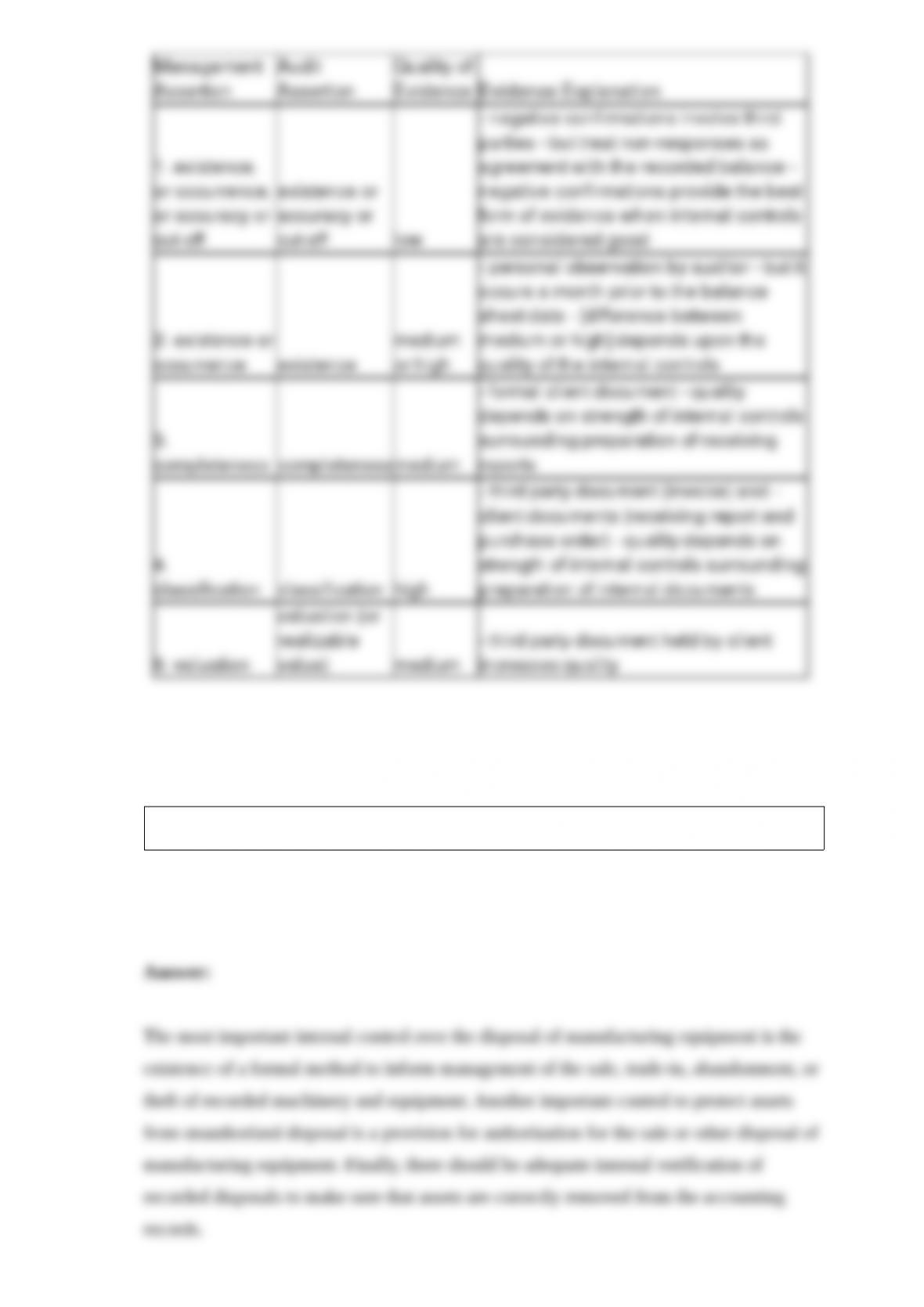
Discuss the key internal controls related to the disposal of manufacturing equipment.
Your PA firm has been auditing Ontario Pulp Company for three years. Two years ago,
a letter was received from the provincial government informing them that they needed
to reduce the level of contaminants that they were releasing into the air and into local
waterways. The deadline for this reduction is three months from today. The letter
indicates significant fines (several hundred thousand dollars) if the targets are not met.
Alternatively, the Company will need to shut down operations until the targets are met.
During your audit planning process management informed you that they have not taken
any action, but plan to start construction of the new pollution devices next month.
Required:
Explain the impact the above situation has upon your audit planning process.